Broody

As I was cramming my head with chicken information before the arrival of our first three chicks, one of the most fascinating facts I came across had to do with “broodiness.”

For those of you who aren’t versed in the ways of the chicken, “broodiness” is when hens get maternal. They stop laying, and their bodies undergo hormonal changes that turn them into egg-hatching machines: their breast feathers thin out in preparation for 21 days of sitting on a clutch of eggs, and somehow their bodies are able to maintain the precise heat and humidity that the eggs need to mature — conditions that have to be painstakingly replicated by an incubator if no broody hen is available.

Not all hens become broody, and nobody knows exactly why certain hens do. Among some serious chicken raisers, broodiness is not seen as an admirable trait, and it’s been bred out of many commercial chickens. A broody hen will stop laying eggs for almost a month. She’ll sit and sit and sit, with only occasional breaks for food, water, and elimination. Not only that: she’ll get grumpy, pecking at anyone who tries to disturb her or her clutch; this is why the word “broody” has come to mean “moody,” even in humans.

All of that is interesting enough, but what REALLY got me was this: When a hen goes broody, it has nothing to do with whether she herself has laid a fertilized egg. To put it another way, the eggs she feels compelled to hatch may not even be her own. Broody hens will sit on the eggs of other hens. They will sit on unfertilized eggs. They will sit on nothing if no eggs are available; I’ve read stories of broody hens spending 21 days attempting to hatch a dirt pile.

This behavior sounds a little silly. It’s also one of the most beautiful things I’ve ever heard. What could be more selfless than sacrificing your own comfort and convenience to raise babies that aren’t even yours? Why aren’t WE more like broody hens? I wondered.

And then I realized that WE ARE.

This past year, I’ve had the humbling pleasure of getting to know a number of women — and some men — who might best be described as “broody.” What I mean is that these are people who make it a regular habit to care for children who aren’t their own. In many cases — but certainly not all — these men and women have raised or are raising their own children. Here’s what else they do: take in foster children, host Fresh Air Fund children (kids from the inner city who come to Vermont during the summer to experience the rural outdoors), act as second parents to college students, and open their homes and lives to friends’ children on a regular basis. Some people do ALL FOUR of those things.

I don’t know why I feel like I’m surrounded by more “broody” people right now than at any previous point in my life. It could be that this behavior is more common — or more visible — in a small town. It could be that I know more people who have older children or no children at home, which makes it easier to care for other people’s children. Without a doubt, I am one of the least broody people I currently know, if for no other reason than that I have my hands pretty full with my own brood at the moment.

But, regardless of how I compare to others, I HAVE been feeling broodier this year. Lately I’ve been thinking that one of the most helpful things we can do is to take care of each others’ kids.

Speaking strictly for myself, the BEST gift that anyone can give me is to watch my kids. Most of life — errands, housework, quality time with your spouse, mental health — is much easier if you don’t have the kids around. If I’m trying to love my neighbors as myself, I need to ask myself: “Self, what would you most love?” The answer: for somebody to watch my kids.

So, my broody self has been trying to notice when people seem like they might need a little kid-less time, and then offering to watch their kids.

Some friends have been desperate enough to take me up on this, and dropped off their kids at our house when they needed to deal with other things. Another friend and I have being doing a “kid exchange” all summer: one day a week her two children come over to our house, and the next day she takes all of the Gong girls. It’s been fun for us, and for the kids.

Back when we were expecting our third child, a more experienced parent told us, “Once you have 3 kids, you might as well have 33.” I think that’s true; adding one or two more kids to our house doesn’t significantly increase the noise, chaos, or my stress level. In fact, it’s often helpful to have a couple of non-Gongs around; when our girls are playing with friends, they stay out of my hair for longer periods of time.

These drop-off playdates are also special chances for me to get to know other children. There’s not a lot of turnover in our small town, so these kids are going to be our girls’ friends (maybe even – ulp! – significant others) for years to come. I hope I’ll get to watch most of these children grow up — not just watch them, but be an active participant in showing them love and care.

Best of all, I get to support other parents by doing this. Parenting can chew way down to your soul; we need to help each other out.

I’ll be honest: sometimes it IS really hard being in charge of a houseful of kids, especially if any one child is having a bad day. Even on good days, our house gets torn apart, our snack supply is decimated, and I often feel like the whole operation is about to spiral out of control.

But then again, I feel that way on days when I’m just in charge of my own children. And, like most things worth doing, this is not about my own personal comfort; it’s about something I can do to love other children and parents.

I often wish I could do more, like teaching in Tanzania, or caring for orphans in Calcutta, or volunteering at the local senior center. And maybe someday, when I don’t have to schedule everything around naps, I will. But if you’re feeling the same way, I hope this might encourage you: sometimes you don’t even have to leave your home to change the world. Like broody hens, you don’t even need to be a parent yourself. Maybe you can change the world a little just by watching somebody’s kids for a couple of hours. Giving parents a break, and giving kids some love, can start endless good things in motion. It reminds me of my favorite Anne Lamott quote: “Lighthouses don’t go running all over an island looking for boats to save; they just stand there shining.”

Temporary

Little girls and fields: both temporary.

This summer, we took some visiting friends on a hike along the Robert Frost Interpretive Trail, a short drive up the mountain behind our house. The trail begins with a boardwalk spanning a beaver pond, crosses the Middlebury River, continues on through the woods, and then loops back through an old field. Although I’ve hiked the trail several times before, this time one of the wooden signs that stands at the border of the field caught my attention.

Here’s how it began: Fields are only temporary.

As I sit to write this, I’ve been turning those simple, beautiful words around in my head for over 24 hours. Fields are only temporary. I can’t quite get at what those words mean to me, why they’ve stirred my heart for the past day — but you can probably guess that I’m going to try.

What the sign meant was that fields, left to their own devices, never remain fields. At least, not in Vermont. Fields have to be created, cleared by either human or natural effort. If left untended, pioneer plants will take root: tall grasses and wildflowers and bushes. And before long, the trees will move in, quickly overshadow the lower plants, and a forest will be born. It’s a growth pattern that’s beautifully captured in Robert Frost’s poem “The Last Mowing” (the text of which is also on a sign along the trail).

A brief history of Vermont land use:

Throughout the latter half of the eighteenth century, settlers descended upon Vermont’s fertile Champlain and Connecticut River Valleys, seeking agricultural land that was in increasingly short supply throughout the rest of New England. In order to create fields for planting and pasture, they had to clear the land of trees and rocks; no small task, as the Vermont landscape had been dominated by six million acres of dense woodlands for roughly 12,000 years. But these were hardy, determined folk; between farming and the booming logging industry, settlers had removed more than half of Vermont’s forest by the late 1800s. It wasn’t until the effects of this deforestation became visible — nutrient-deprived soil, altered drainage patterns, and endangered and extinct wildlife — that conservation efforts began. Those efforts, along with the decline of Vermont’s agricultural industry, resulted in the reforestation of 77 percent of Vermont’s landscape. In other words, there are more trees in Vermont now than there were a century ago.

Fields are only temporary.

I live in the woods, and whenever I have anything to do with our “yard,” I’m awestruck by those early settlers. The trees grow thick together, and taking them down is backbreaking work — as my father’s four broken ribs and two fractured vertebrae will attest. We have a small area of grassy “yard” and several flowerbeds, and throughout most of the year I spend at least one day a week pulling up or chopping down the small saplings that are constantly trying to turn all of our yard to forest. Then there are the rocks: wonderful to play on, but try digging a hole anywhere around our house and you’ll quickly be frustrated. My husband and father-in-law broke a metal post driver while attempting to put some fence posts a few inches into the ground for our chicken coop.  We are no match for these woods.

Fields are only temporary might sound like bad news if you’re trying to create a farm — or even just a yard. It’s a poignant reminder of the futility of our labor; no matter how much we chop and dig and pull, the woods will always win in the end.

But looking at it another way, maybe this means we don’t have to try so hard to change things. Maybe, just maybe, we don’t need as much field or yard as we think we do. Maybe we can be okay with the pioneer plants and the trees growing up; we can stop fighting and let the woods be the woods.

Woods, you know, are very beautiful.

Fields are beautiful, too. And useful: the kids and dogs need places to run, or perhaps your livelihood is farming and you need fields in order to feed others — and your own family. It can be a very worthwhile thing to clear a field, while remembering that fields are only temporary.

I’m talking in metaphors now, of course. Not just about fields, but about relationships and possessions and vocations and life. Just like fields, our lives have growth stages. And I’m learning that the important thing is to see the particular beauty of the growth stage we’re in, be it field or grassland or forest. To know when to stop pulling up the seedlings and digging up the rocks. To realize that, after a while, if you insist on a field remaining a field, you don’t even have a very good field anymore, just parched, denuded dirt.

Or maybe I’m just looking for an excuse to stop weeding my flowerbeds….

Ch-ch-changes…

A few exciting new goings-on here in the green summer woods:

The new chicks are here!

We returned from a week at the beach to find that our rooster had started crowing. Or rather, our rooster had  been taught to crow by one of the men painting our house. This being a small town, the crowing coach is also the uncle of two of the girls’ best friends, and he lives on 25 acres of land with assorted free-range poultry. So I operated on the age-old rule: You teach my rooster to crow, it’s yours. Off went our rooster to the country — although the beautiful thing is that, in this case, that’s NOT a euphemism for putting an animal down: the country really IS the country, and it’s just  down the road.

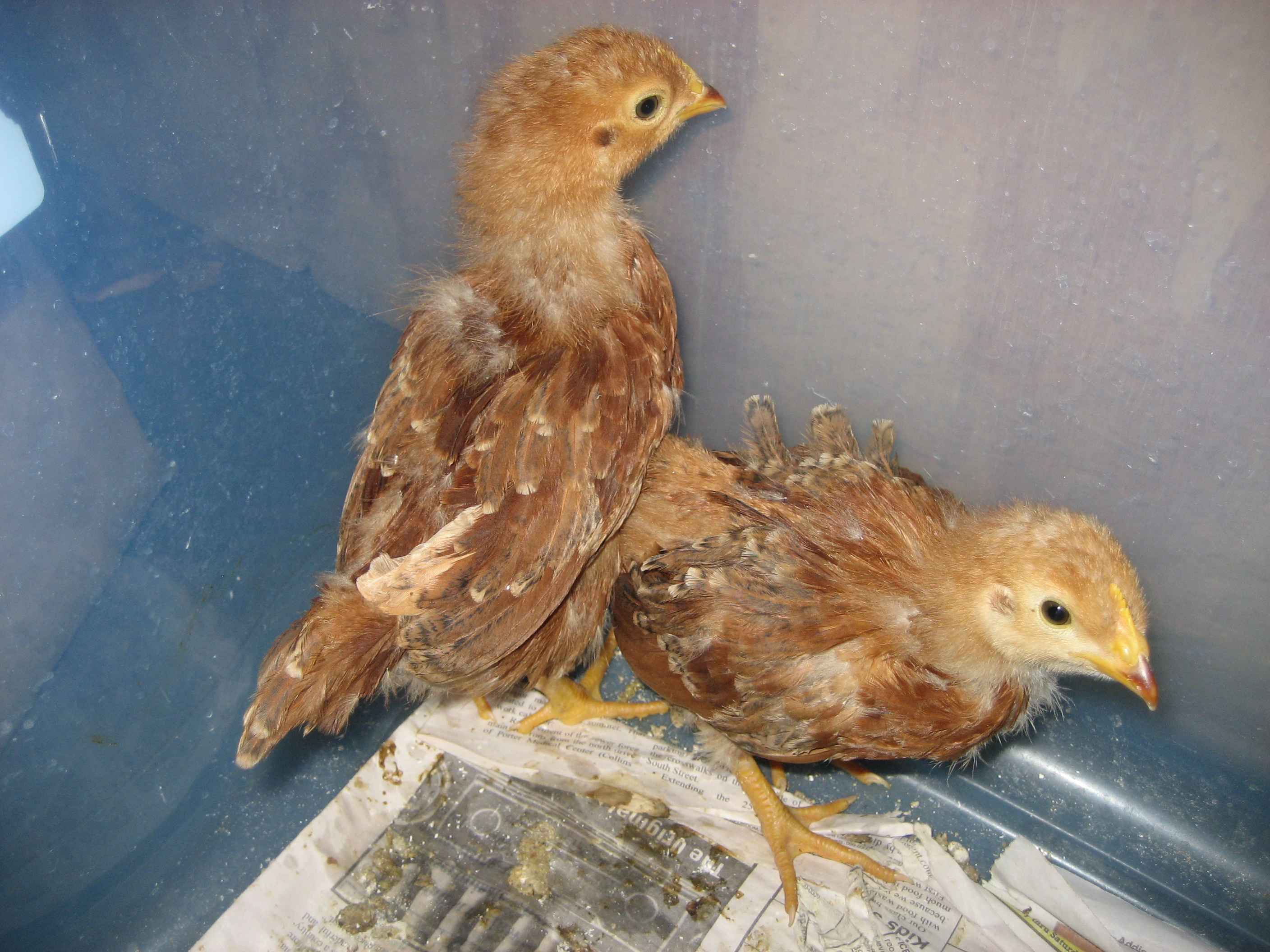
Finding a good home for our rooster neatly coincided with a friend offering us some extra chicks. So, on Campbell’s birthday, we picked up two Rhode Island Red chicks. The girls used this as an excuse to shuffle around the names of our chickens; we now have two white Leghorn hens named Daisy Flower and Sunny, and two brown chicks named Scaredy-cat Simba and Grace. We’re fairly sure that they’re all hens.

The new chicks are really, really cute, so they’ve been girl-handled quite a bit. I’m hoping that’ll make them a little more cuddly than the Leghorns, who are still pretty flighty.

We’ve got a new venue!

Starting tomorrow, I’m going to have a regular, bi-weekly column in the online edition of our local paper, The Addison Independent! I’ll be writing about life in central Vermont from the perspective of a mother of young children who’s a recent transplant to the area — in other words, I’ll be doing pretty much what I do here, it’ll just be a little more Vermont-y. (Just like how, when I write over at On the Willows , it’s pretty much what I do here, just a little more God-y).

I don’t expect that this new gig will significantly change anything here at The Pickle Patch. In fact, I’ll likely be re-using some of my more Vermont-focused material for the Independent column. As I do with On the Willows, I’ll post a link on this site whenever I have an article over at the Independent.

The new chicks and new column are both very happy things. But for whatever reason, life usually doesn’t hand you pure, undiluted joy — at least, not for very long. I’m not quite sure why it seems to work this way — that, when you’re given something, something else is taken away — but in my experience it’s usually been a good thing. Helps keep you from getting too full of yourself, if nothing else.

Which leads us to:

A tick made me sick (maybe)…

I’ve had to slow down quite a bit over the past couple of weeks, because I have not been entirely well. You may recall my mentioning the pain in my knee joints that started out of nowhere on our trip to Maine. You may even recall my joking that I assumed it was either Lyme disease or Lupus; if you expect the worst-case scenario, it can’t possibly be the worst-case scenario, right?

Turns out that’s not always true. The pain didn’t improve, I started feeling it down my arm and into my hand, and by the time we got home from Maine I was crushed by exhaustion. Not the normal, I-have-three-young-kids exhaustion, but an exhaustion so intense that by the end of the day I could barely lift my arms. All of which gave new meaning to the headaches and vague feeling of not-rightness I’d been having on an almost daily basis.

This is Georgia impersonating Jack Nicholson. (It’s a cuter picture than sick me laying on the couch).

So, I went to my doctor, who took four vials of blood out of me and began treating me for Lyme disease. (In our area, if doctors even suspect Lyme, they go ahead and begin treating it with antibiotics, because the cost of NOT treating it quickly can be the onset of chronic Lyme). The conclusion? My bloodwork came back completely clean: negative for Lyme and all other suspects. Unfortunately, that doesn’t mean that it wasn’t Lyme, because the test for Lyme is notorious for giving false negatives. Whatever the ultimate culprit — and my doctor thinks it could be another tick-borne bacteria that isn’t picked up by the Lyme test — the GREAT news is that I’m starting to feel better. A few days after beginning antibiotics, my energy returned to its normal level of exhaustion. The joint pain seems to be taking a little longer, but I’ve started to have some good days in that regard. (And honestly, I’ll take a little joint pain over the fog of exhaustion).

There are, of course, other changes brewing around here: summer is on its downslope into fall, Fiona and Campbell will start preschool in a few weeks, Erick will go back to teaching next month. And change, as we all know, can be difficult and disorienting. But this go-around, I’m trying to handle all these changes like a rooster.

Yes, like a rooster. The aforementioned rooster, who started crowing and had to be sent away, showed me how to deal gracefully with change.

The best way to transport a mature rooster is in a burlap sack. The rooster has to be enclosed, or else they’ll flap and fly all over your car. But a cage isn’t a good option, because they might bang around and damage their comb. So, when it came time to bid our rooster adios, we caught him, put him in a burlap sack, and tied the neck of the sack with twine.

I expected drama. I expected squawking and flapping and fighting and feathers flying. But instead, our rooster, who up to this point has spent his days posturing and crowing and bossing the hens around, got very still and quiet as soon as we placed him in that burlap sack. No noise, no movement; we could have been lugging around a bowling ball.

The rooster was nervous, of course — probably even terrified. But I think that this is how I’d like to handle change when it comes in my life: not by squawking or fighting, but by getting still and quiet. Change is like being shoved in a burlap sack and driven to an unknown destination; you’re never quite sure if you’ll be dropped off at the Purdue slaughtering plant or 25 acres of bucolic free-range countryside. But fighting this change is pointless, and it just makes the ride unpleasant. I’d rather be still and quiet, like a rooster.

Sense

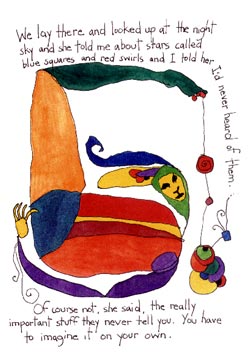
When our first child, Fiona, was born, our friends Trisha and Abel gave her this beautiful print, set in a frame they’d made themselves:

Print by Brian Andreas

This print was our introduction to the charming work of California artist and storyteller Brian Andreas. In case you can’t read the text around the image, here’s what it says:

We lay there and looked up at the night sky and she told me about stars called blue squares and red swirls and I told her I’d never heard of them. Of course not, she said, the really important stuff they never tell you. You have to imagine it on your own.

Click here to continue reading this post over at On the Willows.


Boring?

From what we’ve already seen of Middlebury and our new house, we hope and expect that we’ll spend a good long time there.  And that may well be the biggest adjustment. With relatively few breaks, Erick and I have spent most of our adult lives moving, following jobs or graduate degrees. In the past 15 years of my life, I’ve moved 7 times — that’s roughly every 2 years. And I’ve gotten to be pretty good at moving; saying goodbye and pulling up the stakes. So the thought of staying, of committing to a house and a town, is an unknown challenge. 

-Me, in the first entry on this blog, May 2011

Print by Dug Nap

I drove the girls to the library this morning. Usually, trips in our minivan are not times of great conversation. We keep a wide variety of CDs in the van, ranging from “The Disney Princess Collection” to “The Barbie Princess Collection.” As we pull out of the garage, the girls bark, “Turn it up!” and “Louder!” from the comfort of their carseats. Once the volume is up as high as I will allow (the point past which we’ll sound like cruising princess gang-bangers), they zone out. (As do I, but whether I should be allowed to operate a motor vehicle is a subject for another day).

Anyway, this morning, as we were driving through some cornfields, Campbell piped up: “This is the same way we drove to church yesterday.”

“Yeah,” added Fiona, “we always drive this way. We always see the same things. It’s so boring. Can’t we drive another way?”

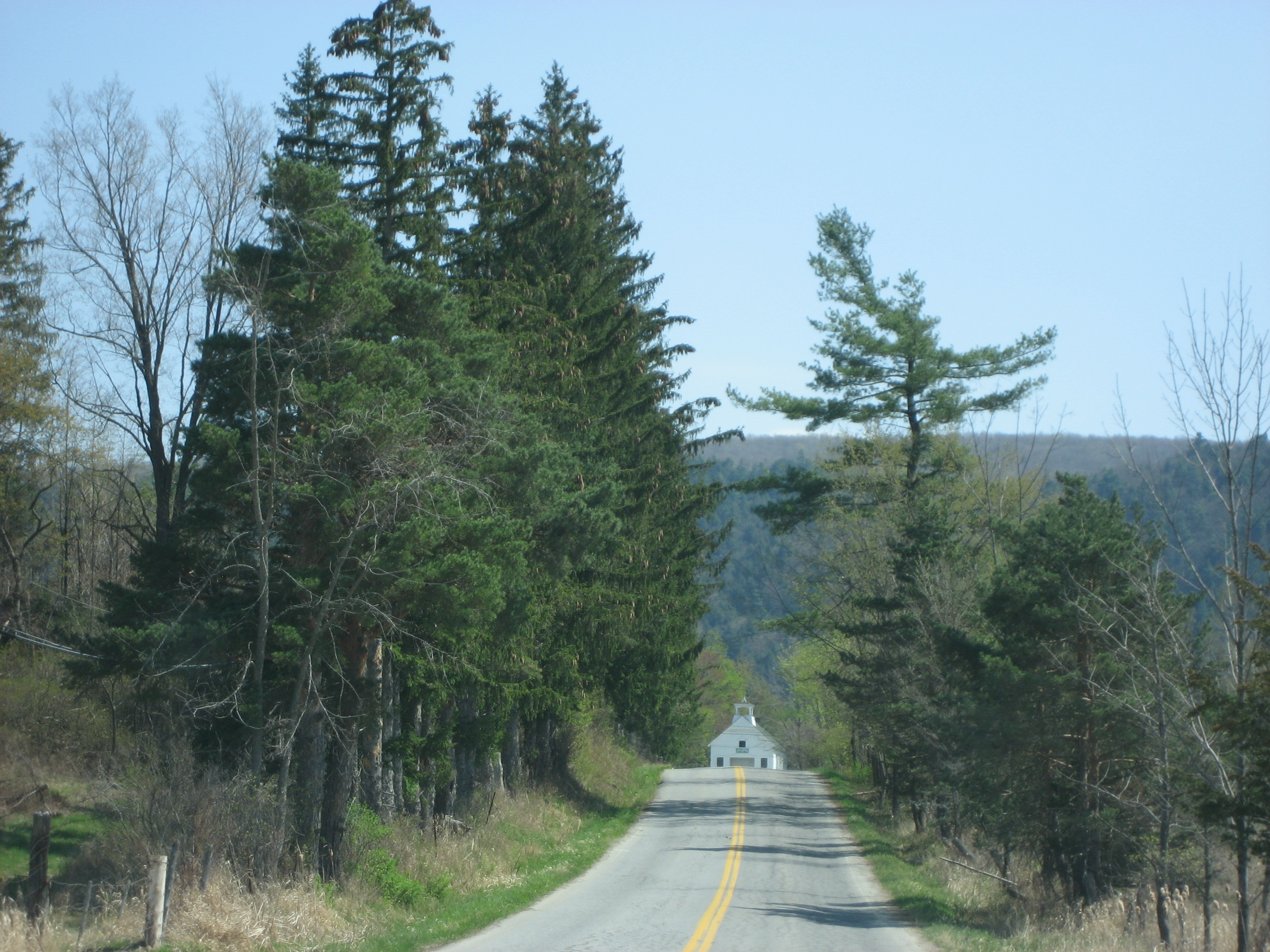
Have I mentioned that we live in a small town? Or rather, we live just outside a small town. In order to do most anything, we need to drive into town, and there are only two possible routes for doing so; one route spits us out at the south end of Main Street, the other drops us at the north end. So if our girls feel like we’re always driving the same way, it’s because we are.

The way we usually drive home.

I explained all of this to Fiona, and offered that, as a special treat, we could drive home the other way!

The other way home.

But then, sensing a teachable moment, I started in on one of my zen motherhood speeches: “Even though we always drive the same way, what you see isn’t always the same. It changes with the seasons and the time of day. When you see something over and over again, sometimes you just have to look a little deeper and you’ll notice things you haven’t seen before.” Then I pointed out little details in the scenery, like the rusty old tractor by the barn, the flags flapping in the breeze.

Fiona audibly rolled her eyes. “I know, Mommy. I’ve noticed that all before.”

Oh my, I thought, it’s going to be a long life.

If you’ve been following this blog from the beginning, you will recall that on the eve of our relocation to Middlebury I expressed some apprehension about the potential permanence of this move (the quote reprinted at the beginning of this post). Here’s the situation: whether we stay here depends largely on whether Erick gets tenure at the college, which is a 7-year process. So, we will be in Middlebury a minimum of 7 years. Seven years is the longest I’ve lived in any one place in my adult life.

If Erick does get tenure, we’re here for the long haul. I’m not really sure what “the long haul” is, but it means that there would be no forseeable endpoint. Erick and are I finally done with school, we will never need a bigger house, and as long as Erick is happy with his job, there will be no reason for us to leave Vermont. According to the 2007 U. S. Census, the average person in the United States can expect to move 11.7 times in their lifetime. This is the 11th time I’ve moved in my life, so if averages apply to me, my moving days are winding down.

What I’m saying is that — as children will do — Fiona was actually expressing some of my own concerns: that I’ll get bored with being in the same place, seeing the same things and people over and over again.

Maybe. But even though Fiona blew me off, I stand by what I told her: that living in the same place, seeing the same things, being settled, is actually a wonderful opportunity to look deeper.

I didn’t always feel this way. In fact, until recently I embraced travel, adventure, big cities, and frequent moves. Which is probably the way it should be when you’re young.

But unless you are fabulously wealthy, with an entire staff at your disposal, travel and moving become increasingly miserable the more children you have. One thing I used to like about moving was that it forced me to “travel lightly,” to weed out anything that wasn’t necessary. But it’s very hard to “travel lightly” with three young children. In fact, moving is now on the list of things I least want to do, just above cleaning up mousetraps. Yes, I know that travel is fun and horizon-expanding for children; up until we had our second child, I swore that children would never slow down our ability to travel. “They’ll just have to adjust to our plans,” I may have actually said (a number of times). And God rolled on the floor laughing. Because honestly, you should see the logistics involved in just driving down the street. Even living in a city with more things to do is no longer as attractive to me; I’m already exhausted by our limited options here.

Here and below: Three scenes from a “boring” rainy Sunday: Making Sun Bread.
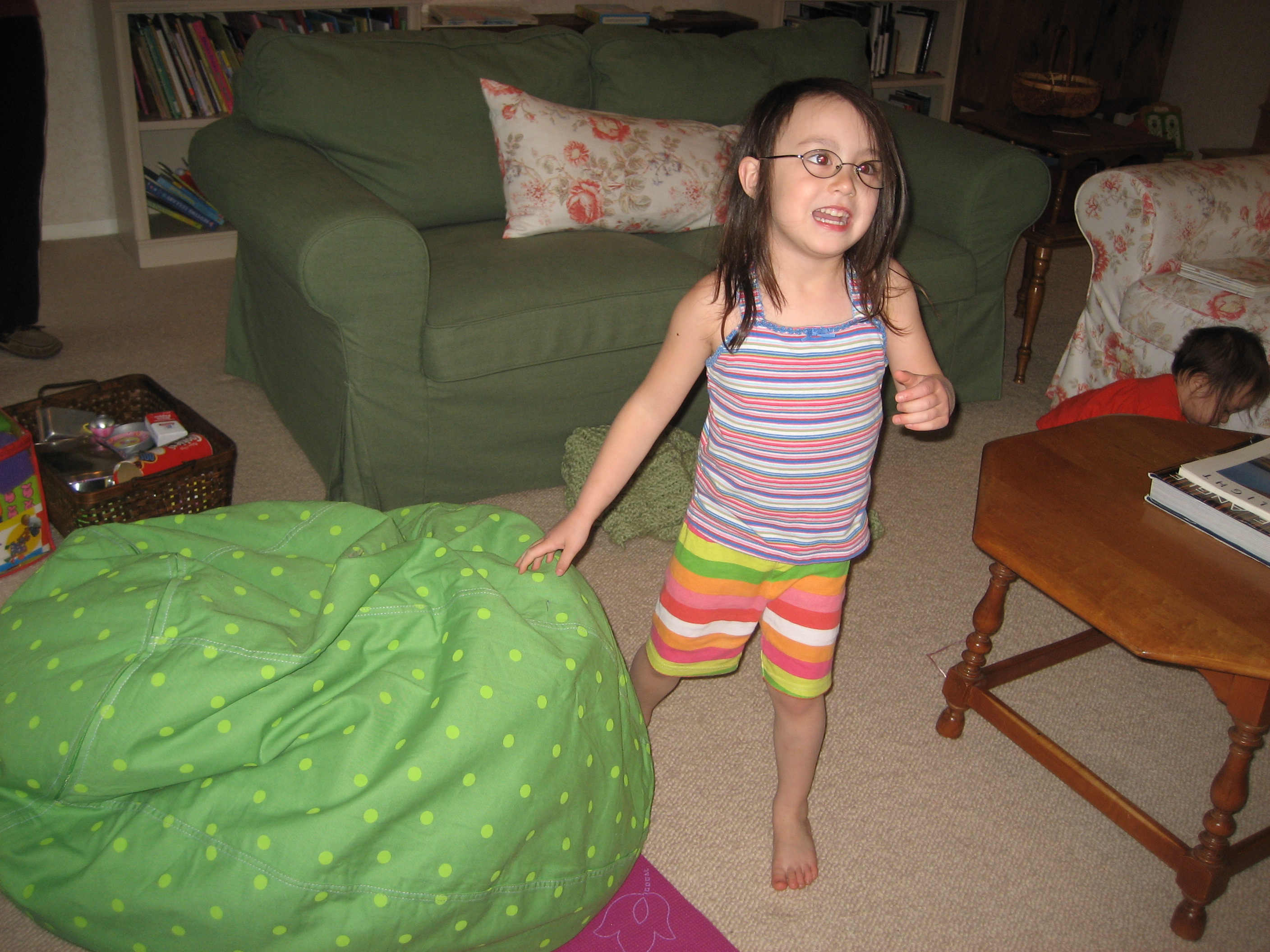
Fiona (wearing my glasses) attempts to lead us in “yoga.” (Yoga, apparently, involves kicking a beanbag chair while yelling “Hi-YA!”)

Looking back, I think that most of my previous travels and moves were, at root, an excuse to stay busy.  Fiona is very into the idea of opposites right now, so all day long she asks me things like, “Mommy, what’s the opposite of eating?” If she asked me, “What’s the opposite of looking deeply?” I would answer, “Staying busy.” Because when you’re staying busy, you don’t have to look around or — God forbid — look inside yourself. You don’t have to notice things. Your priority is to keep moving.

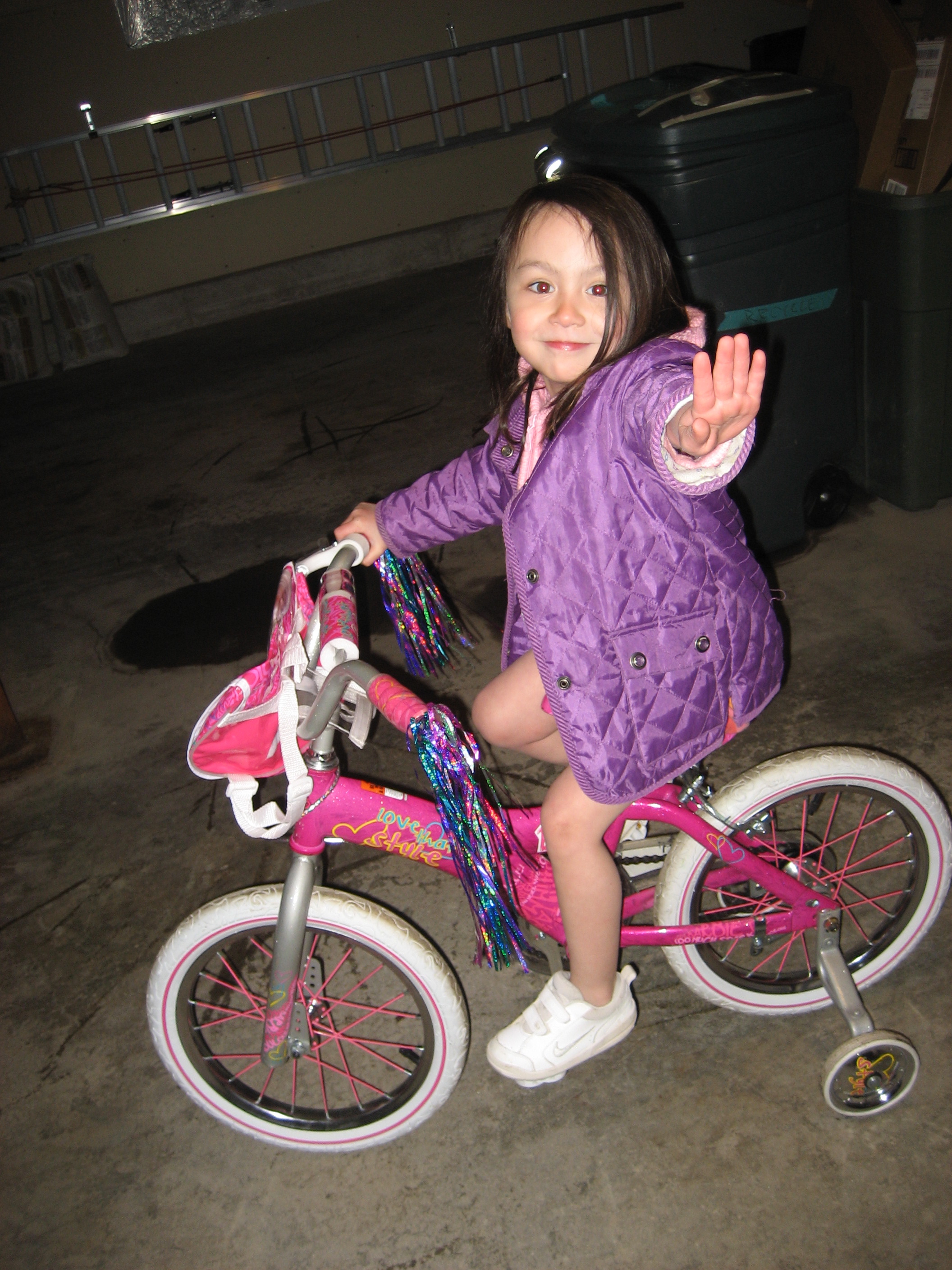
Riding bikes in the garage.

Here’s what living in Vermont for the past year has forced me to do: slow down, look deeply, and notice things. There are so few distractions here, it’s so much harder to stay “busy,” and we’re feeling so settled. Now I have time to notice things like the way the woods change with the seasons, I have time to look deeply into myself and think about who I am and what I believe, I have time to sit down and read and write. We’re also starting to form friendships, which need time to take root. I’m looking forward to forming friendships that we won’t have to uproot in a few years (always the hardest part of moving).

So no, I can’t see myself getting bored anytime soon. I’m not so sure about the girls, who already have plans to become singers in New York City when they grow up. But then again, on our recent vacation to Maine, Fiona sat on a rock by the ocean with her grandparents and drew this picture of mountains, a sunset, and our minivan on a road:

If you scroll up in this post, you’ll see that it looks uncannily like our usual, boring drive. When I asked Fiona what she was thinking of when she drew it, she said, “I was thinking of home.”

Uphill and Down

Looking down into Smuggler’s Notch from the Long Trail North.

Erick and I have always loved hiking, and we used to hike fairly often…pre-kids. The last substantial hike we took was when we left 6-month-old Fiona with her grandparents and took off on a day hike in California’s Pt. Reyes State Park. If you do the math, that was FOUR YEARS AGO.

Unless you’re a masochist, hiking any further than 1/2 mile with children under the age of 5 is just not very fun. Somebody — usually the oldest, heaviest child, NOT the baby who’s already strapped to your back — is always whining to be carried, somebody always has to pee and then misses and gets soaked, somebody always needs a drink or a snack. Our two older girls are reaching ages at which we can see the glimmer of pleasant future hikes together, but for now we still have to catch them both on a good day.

So, when Erick’s parents were visiting this June, we jumped at the chance to leave the girls with them for a night, and headed off for a hike in Smugglers’ Notch State Park in Stowe, VT. Smugglers’ Notch got its name back in 1807, when President Jefferson banned trade with Great Britain and Canada. This was rough on northern Vermonters, who relied on trade with Montreal. So, during the trade embargo and later during Prohibition, goods were smuggled to and from Canada through this narrow pass in the Green Mountains.

And let me tell you: those smugglers had a tough job — I seriously doubt that much of the liquor made it through the Notch untouched. Erick and I opted for the Long Trail North to Sterling Pond, a 6.6-mile round trip hike with an 1,800-foot elevation change. The trail was rated “difficult,” which was no overstatement: it was steep, and rocky, and muddy in many places. But it afforded some stunning panoramic views of Mt. Mansfield (Vermont’s highest peak) to the west and Spruce Peak to the east. We ate our picnic lunch of bread, cheese, and salami overlooking pristine Sterling Pond. Best of all, the hike gave us FIVE HOURS of peace and quiet; Erick and I aren’t big talkers on our hikes, and on this hike we were so winded most of the time that talking wouldn’t have been an attractive option in any event.

A portion of the trail: believe me, this looks much easier than it was.

During those five hours of quiet,  I thought about a question that my sister-in-law had asked me a week earlier, a question that had been weighing on my mind because I wasn’t satisfied with my initial answer. And on that hike, I arrived at a much better response.

The question was this: “So, it gets easier, huh?”

By “it,” she meant parenthood.

My sister-in-law, who is an amazing mother to the most adorable two-year-old nephew on the planet, was not the first person to ask me this. I’ve been asked versions of this question for most of my parenting career by mothers who are just a step behind me, and I’ve asked the same question of mothers who are a step ahead of me. With three children under the age of five, I’d hardly seem like an expert. But when my sister-in-law posed her question, I got it: I no longer have a newborn, and I’m right on the cusp of having multiple children in school. With kids in my house who can feed themselves, dress themselves, forgo diapers, and verbalize their needs without screaming (often), I’ve reached the next level: the level that comes after the brain-fogged survival of the newborn years.

So when my sister-in-law asked if parenthood gets easier, my first response was: “Yes,” because you should always give people hope.

But you should also be honest, so I added: “Well, it gets different.” That’s what mothers of older children are always telling me, and from my limited experience I know that it’s true. Then I floundered around that statement for awhile without accurately conveying what I think it means. Our hike helped show me what it means, so here goes:

I think the first couple years of parenting, especially the first couple years of parenting your first child, are like the initial ascent on a mountain hike. They’re HARD: the terrain is unfamiliar, you’re using muscles that you probably haven’t used in a while, you’re weighed down by a ton of gear in your pack (say, for instance, three bottles of water, a two-pound bag of trail mix, and a rain parka), you have to keep your eyes down on the ground because if you look ahead you’ll get discouraged, and sometimes the only thing to do is just to crawl on all fours.

I’ve done a fair number of these mountain hikes, and each time I make the same mistake, even though I know better; while I’m scaling that trail, I think to myself, “This’ll be MUCH easier on the way back down.”

Of course, it’s NOT AT ALL easier on the way back down, it’s just…different. Your pack is probably a little lighter, because hopefully you’ve drunk some of your water and eaten some trail mix. And the going may be a bit faster, but descending that slope is hard on the knees and toes, the tree roots that supported your feet on the way up now want to trip you, and sometimes the only thing to do is to scootch down on your bottom.

It’s kind of like the parenting that follows those first years: you’re done with diapers and middle-of-the-night feedings, sure. But instead you get to see your children’s hearts broken by friends, you start to see all of the neuroses and flaws that you know will plague them for life, you have to deal with their various anxieties in areas that you never expected. You’re up in the middle of the night again, but this time you’re wondering whether your child will ever have friends, and whether those friends will be good friends or will introduce your kid to crack cocaine and reality TV, and whether your child is just going through normal development or whether you need to call in a child psychiatrist stat.

It gets different, not easier.

But the things that keep me going during a hike are pretty much the same things that keep me going in parenthood. Sometimes the trees open up on a vista — mountains, sky, valley — that truly takes your breath away, a view you wouldn’t have experienced without that climb. Sometimes there are simple, quiet, delicious lunches by the pond. And sometimes you meet people like the couple we passed on the trail: not a day under 70, coming back down as we were going up, and chipper as could be. After we saw them, there was no way we were complaining for the rest of the hike.

A view of Mt. Mansfield from the trail.

And on the way back down, I found it easier to drop my worries about whether it was going to rain or how much longer it would be to our destination, and instead I just felt thankful. Thankful for the smallest things: the breeze, that cloud that provided a minute of shade, my hardworking legs — especially my knees, my awesome moisture-wicking hiking socks, the evergreen branches that some kind hiker had laid across the muddiest patches.

After all, you don’t want to get back to the parking lot and realize that you spent the entire hike wondering when it was going to get easier.

Sterling Pond.

One Decade Down…

Self-portrait from the early days.

On July 20, 2002, Erick and I were married in a ceremony at Christ Church in New York City. Like any wedding, the day was filled with snafus and family drama, but it was — and remains — the happiest day of my life, hands-down, no contest.

I don’t write much about Erick. That’s partly because he’s the only other member of our family who can read, and partly because he’s the most normal and well-adjusted member of our family — which makes him less interesting than, say, a two-year-old.

So, even though today is our 10th wedding anniversary, I’m not going to write much about Erick. Because I can’t imagine anything he’d like less than me gushing about him on the internet. And because I’m even more reluctant to discuss my marriage than I am to discuss my parenting; it’s still kind of a mystery to me.

But this winter I read Traveling Mercies by Anne Lamott (which I’d highly recommend to anybody). In it, Lamott recounts a joke that, when I read it, immediately made me think of Erick:

I was remembering an old story the other day about a man getting drunk at a bar in Alaska. He’s telling the bartender how he recently lost whatever faith he’d had after his twin-engine plane crashed in the tundra.

“Yeah,” he says bitterly. “I lay there in the wreckage, hour after hour, nearly frozen to death, crying out for God to save me, praying for help with every ounce of my being, but he didn’t raise a finger to help. So I’m done with that whole charade.”

“But,” said the bartender, squinting an eye at him, “you’re here. You were saved.”

“Yeah, that’s right,” says the man. “Because finally some goddamn Eskimo came along…”

What does that have to do with our marriage?

Well, I’m grateful every day that I married my Eskimo. Happy decade, Erick.

You’ve Got Hope

Photo credit.

I’m writing this from a family “vacation” at the beach in Maine. “Vacation” is in quotes, of course, because with three young children the idea of vacation falls into the same category as The Myth of Weekends. Back when we had fewer children, I remember asking our former pastor — himself the father of three girls — how his family vacation had been. He looked at me sideways for a minute, and then said, “We have three kids, Faith. It wasn’t a ‘vacation’; it was a trip.” I couldn’t have put it better myself.

So here we are in Maine, not really having a “vacation,” but having a wonderful trip. A week-long trip that took a week to pack for. Late nights and early mornings with girls hopped up on ice cream and the excitement of seeing their grandparents and cousins. The unbelievable logistics involved on either end of a single hour spent at the beach.

Another reason this feels more like a “trip” than a “vacation” is that we live in Vermont. And an interesting thing about living in Vermont is that almost anywhere else you travel is bound to be more congested and bustling than Vermont. So, while most people take vacations to places where they can relax and enjoy a slower pace of life, we’ve noticed that it’s harder to find those places when you live in Vermont. This small beach town in southern Maine is hopping compared to our home base.

When we arrived last night, I was holding on to my sanity for dear life, and grasping to recover my sense of joy. The week I’d spent packing everybody up for this trip had been a hot one in Vermont, and we’d had to keep the windows closed (we have no air conditioning) because a crew of six men is painting the outside of our house. We’d hit traffic jams — something else we’re not used to in Vermont — two times after crossing over the New Hampshire border. The four hour trip to get here was the longest amount of time we’d spent in our car with the three girls, and now that they’ve become little outdoor-sy Vermont hooligans, they’re not very good at spending hours trapped in the car (not that ANY kid is good at this, but I guarantee ours are worse than most). With 2/3 of our girls now potty-trained (yaaay!), we had to stop at almost every rest station in New Hampshire to use the potty (boo!). And then we had to explain why, yes, you DO have to actually use the potty, because at rest stations it’s not appropriate to “pee in the grass.” (See aforementioned Vermont hooligan comment). Also during this drive I’d begun to have burning, aching pain in both of my knees for no apparent reason. In my typical calm, rational style, I determined that I had either Lyme disease or Lupus, and would probably be suffering chronic knee pain for years to come.

We didn’t think that the cottage we were renting had internet access, but it turned out that it does. So, after the girls were in bed (very late) that first night, I logged on to my email for the first time all day. And among all the Amazon Mom and library book due-date notices, I had these two emails:

1. A friend from our Berkeley days, mother of a son the same age as Fiona, who tragically lost a baby girl late into her second pregnancy — this friend’s husband sent an email announcing the healthy birth of their second son.

2. A friend from Vermont, mother of one of Fiona’s preschool classmates with whom I’d just been discussing chickens and the sad fact that we’re going to have to give up our rooster and be left with two lonely hens — this friend had gone to pick up her own litter of baby chicks and, thinking of us, had asked whether the farm supply store had any extras. When she heard from the store that there were, in fact, extra chicks to be had, she drove back and picked up more chicks, which were ours for the taking. Chicks of the EXACT breeds that I’d been wanting to try out next. (Rhode Island Reds and Barred Rocks, if you’re interested).

These two emails were — on the surface — small, small things. But to me they were so huge that I let go of the sanity I’d been holding on to for dear life, and instead, for the past 24 hours, I’ve been holding on to these emails. Because they’re not just email updates; they’re little seeds of hope. Hope that pain can be redeemed and sorrow can turn to joy; hope that people are kind and sometimes things all come together at just the right time and in just the right ways.

My knees still hurt, and I don’t know why, or if or when they’ll feel better. And we still have another four hours in the car ahead of us when we travel back to Vermont. But somehow those two little seeds of online hope are all I need to get me through this moment.

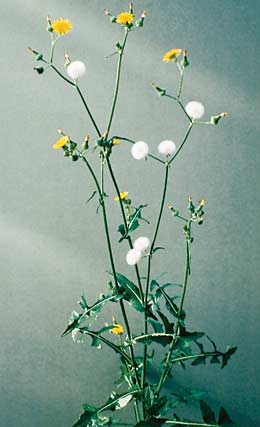
There’s a plant that grows along the Maine coast called a sow-thistle. It’s a weed that looks like a dandelion, except it grows to be 1-4 feet tall. The sow-thistle isn’t a native plant — it was introduced to the United States from Europe — but it’s become an invasive species, found in almost every state. So, when Fiona took a handful of its tiny, feathered seeds and tossed them into the wind on our walk back from the beach yesterday, she was helping to birth plants that can grow taller than her, that can take root in the rocky Maine coast, in the cracks of New York City sidewalks, and in cultivated agricultural fields in California.

That’s how hope is. The tiniest thing — a new baby coming into a space of loss, or extra chicks at the perfect time — can take root in the parched, rocky soil of our lives and give us all the hope and joy we need to keep going.

So, I wish you many tiny little seeds of hope in your inbox, today and always.

Patched Jeans

This summer has included some wonderful visits with family. Nana and Boom came twice in May to help out when Erick was traveling. In early June, we had two straight weeks of California family staying with us: Erick’s parents, his brother, sister-in-law, and our 2-year-old nephew. And now we’re preparing for a week in Maine with Nana, Boom, and my aunt and cousins on Nana’s side of the family. It’s been a summer filled with laughter, chaos, and hugs.

This is how we rolled for two weeks in June. (With Erick’s family at Shelburne Farms).

All of this time with family got me to thinking that the hard thing about families is also the best thing about families: family teaches you to make peace with different styles of being. Or rather, family hopefully teaches you to make peace, because if you don’t make peace with the different styles within your own family, you’ll either go nuts or have some mighty strained relationships  — or both.

Let me be up front: I love my family, on both sides, very very much. And really, we’re a remarkably functional bunch. But like any family, our family is composed of different family members, and each of those members is a unique person with their own way of doing things. Just because you’re family doesn’t mean that you like the same music, or use the same kind of sponge to wash your dishes, or want the same things from life.

With Nana and Boom at Iver’s Pond (photo by Fiona).

It used to make me ANGRY when people did things differently than I did. Really: if somebody made a decision that I wouldn’t have made, I would actually feel outraged. Inside, of course; nice girls don’t get outraged in public. But inside I’d be seething. That was the WRONG thing to do, my mind would fume, and SOON they’ll realize it and be SORRY!

Back then, I probably would have told you that I had such a visceral reaction because I loved these people and wanted to save them from their poor life choices. But now, I see that wasn’t it at all; my anger came from a place of deep internal insecurity, not from a place of love and concern. I was angry when people lived life differently than I did, because when people made different choices, it called my own choices into question and made me doubt myself. I would feel afraid that maybe, just maybe, I was wrong. Anger was my defensive response to fear, not love. Because really, what I was secretly hoping was that these people would come to regret their behavior; that they’d gnash their teeth and rend their clothes over their poor choices, and I’d be validated in the end.

These behaviors that infuriated me ran the gamut from how other people spent their money, to how they raised their children, to what restaurant they wanted to eat in. And this didn’t apply only to my family, but to anybody within my orbit. I look back and realize that I spent a lot of time being angry because of other people’s choices.

The thing about family, though, is that you have to — or at least, you SHOULD — love them and live with them regardless of whether you agree with them in all things. (This only applies, of course, to behavior that doesn’t directly harm you or them or others). So, the longer I’ve lived with myself and learned to feel confident with my own choices, and the longer I’ve lived with my family and learned that their choices don’t have any bearing on our ability to love one another, the more I’m able to cut people a lot of slack. Family has taught me to let people be who they are; to let them show me love in whatever way works best for them, and to love them back regardless of whether I think it was a good idea for them to buy that house or listen to that music or eat dinner in that restaurant.

Because, in reality, most of life is NOT  like a simple game of “Chutes & Ladders,” with good choices taking you up and bad choices bringing you down. Most of life is like a climbing rope that you have to grasp onto with your hands and feet, and it’s really wiggly, and you can inch yourself either up it OR down it, but whichever way you’re going, it helps to have somebody holding the bottom steady for you.

The girls with Nana, their cousins, and Great-Aunt Carolyn last summer (a part of the family we’ll be seeing in Maine).

This is where the patched jeans come in.

Back when Erick and I were newly married, it used to bug me that so many of his clothes had holes in them. Those of you who know Erick, or have just SEEN Erick, have probably noticed that he wears torn and stained clothes with pride. This is a guy who hates to give up on his clothes. He’ll bring me sweaters with gaping holes in the armpits, jeans with torn pockets or worn-through knees, and ask me to mend them…again and again and AGAIN. It’s only when I can convince him that something is un-mendable that he’ll reluctantly pitch it. (Most of the time).

This used to make me kind of angry; it was different from how I did things. “Why don’t you just buy a new one?” I’d ask, “Don’t you CARE how you look?”

Now, my stage of motherhood is hard on the knees. You’re always crawling around on the floor with little people, and before you know it, you’ve worn through the knees of your pants. So it was that I tossed out TWO torn pairs of jeans — both of which I’d had for over five years — right before we moved to Vermont.

Once we arrived in the Green Mountain State, I drove an hour to Burlington in order to buy a new pair of jeans at the Gap. Buying jeans is traumatic for everyone, and I’m no exception. My problem is that I’m short, and it’s almost impossible to find a pair of jeans that I don’t need to hem. Gap used to make ankle-length jeans that did the trick, but somehow even those don’t work for me anymore. I’d driven AN HOUR, though: I was leaving this store with a pair of jeans. I selected the best option, took them home, and hemmed them.

Less than a year later, one of the knees wore through.

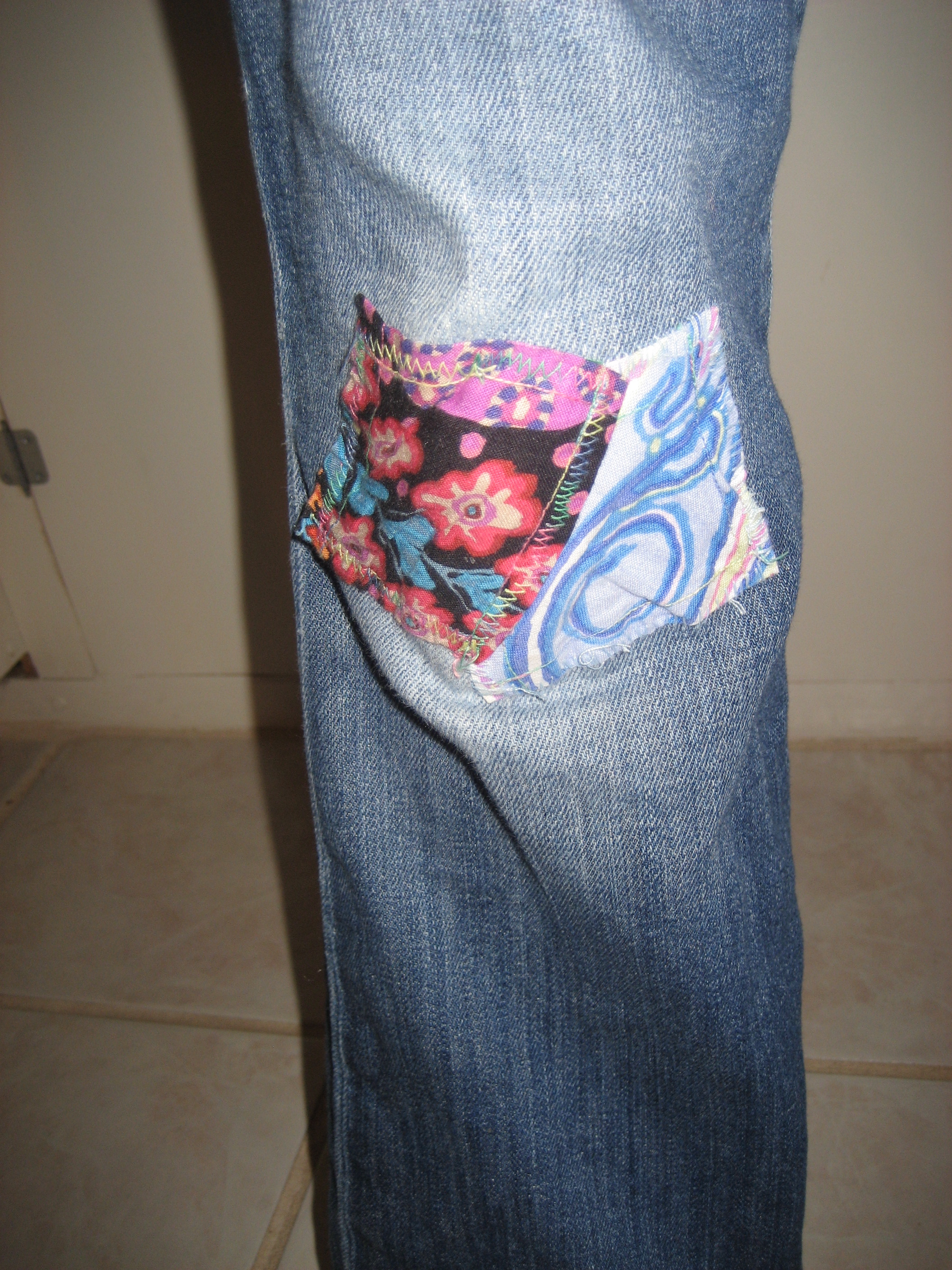
Faced with the problem of whether I had to drive another hour for a new pair of jeans — or, even worse, attempt to order jeans online without first trying them on — I decided to put a patch over the hole. I found a cute fabric scrap in my sewing bag and smacked it on the offending knee. Problem solved.

Until the hole somehow grew out from under the patch.

Faced, yet again, with the problem of what to do, I dug into my sewing bag for another cute fabric scrap, created another patch, and sewed that patch on to overlap the first patch and cover the growing hole.

Problem solved, again. (Although I’m trying not to notice that the other knee is now starting to wear alarmingly thin).

It’s a small but significant example: this is very different from how I used to do things. Once upon a time, my own behavior would have made me angry. Why not just get a new pair of jeans?

It hit me as I was sewing on that second patch: I was not giving up on these jeans, holes and all.

Erick taught me how to do this, just as the rest of my family is teaching me not to give up on people, to be liberal with the patches, and that, instead of watching critically while others play “Chutes & Ladders,” I’d rather be helping to hold the climbing rope steady.

Family!

UNLESS

First, some sad news from the woods:

R.I.P. Pink Sweetie, 2007-2012

You may remember that, just a few months ago, I wrote about the Sweeties — White and Pink —  on this blog. I’m deeply saddened to tell you that Pink Sweetie, described by Campbell as “the one I love most of all,” is no longer with us.

It happened this past Saturday, a hot and humid day, when we decided to take the ferry across Lake Champlain to get ice cream in the quaint town of Essex, New York. The ferry ride was refreshingly breezy. Very, very breezy. Pink Sweetie was along for the ride. And then, right in the middle of Lake Champlain, Campbell held on to Pink Sweetie a little too loosely, and Pink was ripped from her hands and blown overboard.

The last photo of Pink Sweetie.

All things considered, Campbell has made us proud with her stoicism. After initial cries of “I want to STOP THIS BOAT!” and “How will I sleep without Pink?”, she moved on, embracing her one remaining Sweetie (although the plan apparently is to dye White Sweetie pink as soon as possible), and consoling herself with the idea that Champ, the lake monster who trolls the bottom of Lake Champlain, has now acquired a new blankie.

You were a good Sweetie, Pink, and a very important member of this family. As Campbell once put it, you “smelled like love.” And a water burial seems appropriate; Erick can rest easy that you will never be dirty again. You will be missed.

AND NOW:

Something a little different from me over at On the Willows, in which I respectfully disagree with my resident development economist over whether NGOs, short-term missions trips, humanitarian tourism, and Bono really can make a difference. Click here to read it.