Mystery

Because it was highly recommended to me by several respected friends, I’ve finally gotten around to reading Wendell Berry’s novel Jayber Crow. I tend to be suspicious of things that come highly recommended, but this turned out to be a phenomenal book: a beautiful portrait of a man, a community, agriculture, religion, and life in general.

I’m glad I didn’t read it until I moved to Vermont. Berry set Jayber Crow in Port William, a small town in Kentucky during the mid-20th-century, but in many ways he could be describing my own small town in Vermont today. For instance, there’s this sentence about halfway through the book that I probably wouldn’t have noticed until this past year:

“Like, I think, most of the people in Port William, Roy lived too hard up against mystery to be without religion.”

Roy is a very minor character, and this sentence is tossed off in a tangential plotline, but it nearly smacked me with its truth.

The story leaves vague exactly what Wendell Berry meant when he wrote that “Roy lived too hard up against mystery.” He might be talking about agriculture; the character of Roy in Jayber Crow is a farmer. It’s hard to escape mystery when you live in a town where agriculture and nature are still closely intertwined with daily life. I’m not sure how you can watch a chick hatch, or a field of corn push up through the earth, and not feel it in your heart. To be a farmer, it seems, you’ve got to have faith in something — if only that the eggs will hatch and the seeds sown will push up. And to be a farmer, you have to come to some understanding with death; it’s a fact that everything you sow and grow will die eventually, either by your own hand or someone else’s. I’m not a farmer, but I do raise chickens and plants, I live in close proximity to farms and have friends who are farmers — and I’ve been changed by a year of watching these mysterious cycles of life and death unfold.

But I think agriculture is only part of it: every person has these same mysterious cycles of life and death, joy and grief, weaving in and out of their lives. This is true no matter where you live, but living in a small town makes it easier to see. When there are fewer people to know, you get to know them better. You learn their stories.

Last month, NPR aired an interview with the band The Avett Brothers, during which Seth Avett said, “The older you get…in some ways you’re just biding your time between tragedies.” The mystery that comes with small town life is that you KNOW about the tragedies, and you also get to SEE, close up, people biding their time between the tragedies — and not just biding their time, but LIVING, carrying on. How most people are able to continue with life is a great mystery. Some days, I feel like I’m surrounded by unsung heroes.

Here’s an example:

At our church, we sometimes sing a song called “Glory be to God.” (You can listen to a version of it here). It was a new song for me when we moved to Vermont, and it’s just pure praise. The other Sunday, we sang “Glory be to God” again. Standing where I was, I could see in my peripheral vision people who had recently suffered unimaginable loss, people who were struggling with mental illness, people who had escaped dangerous situations, single parents trying to raise their children through heartache, people who had no idea what their next step in life would be. And ALL THESE PEOPLE stood there, singing “Glory be to God…Forever and ever!”

Talk about mystery; it was almost too much for me — my heart felt like it was in a tug of war between joy and sorrow. What I saw that Sunday was my vision of heaven: not perfect cherubim flitting around playing their harps, but broken, hurting, totally IMperfect people standing up together and singing “Glory be to God.”

Now, here’s the thing: this doesn’t just happen in small towns. It happens everywhere. It was happening in my previous churches, but I didn’t notice it as much because those churches were large, so I didn’t really know people’s stories. Also, the people who went to these churches were mostly young, which meant that they looked like they had it all together, or they hadn’t yet lived enough to accumulate an impressive series of tragedies.

This doesn’t just happen in places of worship, either; you don’t have to go to church (or mosque, or synagogue) to experience this kind of mystery. The  people around us are singing with their lives every day. Maybe, in larger towns, it’s easier to hide your tragedies, keep your story private, and give the appearance of everything being okay. But everything is never okay. Like I said, it’s just that small towns make this easier to see.

I wish that everybody could experience what I did in church that day, that little vision of heaven.  It took living in a small town for me to see the mysterious pain, love, grace, strength, and redemption everywhere, in nature and in people. But we all live “hard up against mystery,” it just might require more attention — eyes and ears and hearts a little more open — to notice it in the suburbs.

According to Wendell Berry, once you’ve lived “hard up against mystery,” it’s hard to avoid religion. Do with that word what you will; I mean it as “faith in something outside yourself.” Whatever it is that keeps chicks hatching, corn sprouting, and people surviving, it’s certainly not me. It’s a mystery — and most of us, I think, are detectives, spending our lives gathering clues, trying to get closer to figuring out whodunnit.

The Second Day

Fiona and Campbell started preschool at the end of August. For Fiona, this was a return to the same preschool, same classroom, and same teacher as last year. Her fellow students, however, were almost entirely new to her. (Because of Fiona’s November birthday, she was placed in the four-year-old class last year; because the cut-off date for kindergarten is September 1, Fiona and a few other classmates will spend another year in the four-year-old class, while most of their peers from last year move on to kindergarten).  For Campbell, starting out in the three-year-old class next door to Fiona, the whole experience was new.

Both of them were hugely excited for the first day of school — but not as excited as I was!

There’s a lot of build-up before the first day of school each year: anticipation, nervousness, new clothes and shoes and supplies. Even I felt a little nervous, although my main priority was just getting the kids out of the house. I hoped and prayed that Fiona would make friends and be happy with her new peer group. I hoped and prayed that Campbell would respect her teachers and be kind to the other students and avoid inappropriately using the word “poo-poo” — at least for the first day.

But, having done the first-day-of-school thing last year, I also knew this: It’s not the first day of school that’s the issue; it’s the SECOND day.

See, the first day, everything is fresh and exciting. There may be jitters, there may be wrenching goodbyes — but in my experience, adrenaline mostly carries everyone through. I’ve been the mom patting myself on the back after the first day of school, proudly relieved that my child had NO PROBLEM saying goodbye.

And then the second day hit.

By the second day, the kids have wised up. It’s not fresh and exciting anymore; instead, they can see past the new clothes and school supplies to the rules, expectations, and social minefield that they’re going to have to navigate EVERY SINGLE DAY. You mean I have to KEEP GOING?!? their eyes seem to say.

I was thinking about this as school began, and I realized that much of what makes life hard has to do with The Second Day. It’s not always literally the second 24-hour day, but it’s the state of mind we face when the newness has worn off. Think about it: You get married, and at first you’re swept along through the wedding and honeymoon, but pretty soon comes that Second Day, when you stare at your partner across the table and think, You mean I have to KEEP GOING?!?

Or, say, you have a baby, and you’re all jazzed up because you survived labor and now you have this cute little munchkin and you’re getting all sorts of attention and your house is stuffed with nifty new baby supplies…but then you come home from the hospital and have to face the Second Day, when nobody cares anymore that you have a new baby (except your parents — they’ll always care), and all your clothes are covered with bodily fluids and that munchkin is STILL waking up every two hours and you think, You mean I have to KEEP GOING?!?

OR maybe you do something really great in your profession/vocation/calling/art: you win an award, or obtain a degree, or invent something new, or create a painting/performance/book/film/play/blog post that people really like. Congratulations! You feel like your existence is finally validated…for about 24 hours. Because then comes that Second Day, when you have to sit at your desk or computer or easel again, and you think, You mean I have to KEEP GOING?!?

OR EVEN, let’s say you move to a small town in Vermont, and everything is new and wonderful. You love your new house, your new friends, the new landscape — your entire new lifestyle. But then the second year rolls around, and suddenly nothing’s quite so new anymore. You’ve seen all these seasons before, done just about everything there is to do at least once. And one dark and freezing winter morning, when you’re heading outside to feed those damn chickens AGAIN, you think, You mean I have to KEEP GOING?!?

Hey, it could definitely happen.

That Second Day is no joke. Based on the examples above, I’d venture that it’s the root cause of many cases of divorce, postpartum depression, and personal and professional burnout. I myself have experienced it plenty. In fact, I abandoned my first profession — teaching — because after four years I just couldn’t face a lifetime of Second Days in the classroom.

I have no tips for avoiding the Second Day phenomenon. It’s an inescapable part of life. Nothing stays new forever; if every day were a FIRST day, life would eventually become hyperactive and exhausting. All I have is this insight: the Second Day is difficult and depressing, but if you persevere through it, that’s when things start to take root and get really interesting. Marriage and parenting will always be HARD WORK — filled with multiple Second Days — but when I think back to my husband on our wedding day, or my kids when they were first born, I realize that I love them now with much more richness and complexity. I wouldn’t go back to that first day for anything.

I suppose the best way to handle Second Days is to anticipate them. I know now that I need to be just as prepared — if not more — to help my kids navigate that second day of school. I need to linger with a few extra hugs and kisses at the door, maybe even slip a little love note or special chocolate treat into their lunch bags. I need to offer encouragement that the most worthwhile thing in life — deep and genuine LOVE: for others, for what you do, for where you live — requires pushing past that Second Day. Perhaps we should all treat ourselves accordingly when we face life’s Second Days. Especially the extra chocolate treat.

So, now I’ve thought this through, and I feel more equipped to tackle those Second Days. But you know what?

I still have to get up tomorrow morning and feed those damn chickens.

Chancy Cows

Badlands Cow in the Road #1, by Jim McKinniss

I never considered that, when I became a parent, a major part of my job description would include fighting death. But it’s true: at its most basic, parenting is about trying to keep your kids alive into adulthood. No easy task, that. Every day I fight to keep my children and myself alive. I know it’s crazy to think that I have any control over death, that it’s something I can “fight.” I know that death is inevitable. But, inasmuch as I can control anything, I want to see my daughters flourish during the time that we all have.

And it’s not just my children and myself; these days I’m also responsible for the lives of three houseplants, numerous garden plants, four chickens, and one monarch caterpillar.

I’m starting to feel like my resume for 2011-12 should read: Anti-Death Warrior. [Anti-Death Warrior is a deceptively glamorous term for a job that, most days, involves managing food on one end and poop on the other. But still.]

I’ve had varying degrees of success in my attempt to keep the living things within my orbit alive and prospering. Thus far, I’ve been most successful with the girls. The garden plants are doing well, although truth be told they receive the least of my efforts. I may have managed to kill one of our houseplants, a gift from my parents with the promise that “It’s IMPOSSIBLE to kill.” It’s not dead yet, but it’s pretty brown around the edges.

And a few weeks ago, it looked like things were really falling apart for the chickens and me.

One of our new chicks started limping for no obvious reason, a development that filled me with the alternating emotions of fear (Could it be a disease that would wipe out the whole flock?), guilt (Was it something I did, or failed to see?), and indecision (Do I take her to a vet? Or just wait and see?).

And then there was me.

You may recall that, about a month ago, I was treated for Lyme disease. It now seems that I didn’t have Lyme disease, after all, but during the last few weeks of August I wished I did. Compared with what I was going through, Lyme disease looked simple, clear-cut, and treatable.

I’ll spare you all the medical details, except to say that a second round of blood tests for my Lyme-like symptoms — joint pain, headaches, fatigue — revealed elevated muscle enzymes, suggesting that my muscles were inflamed, possibly to the point of breakdown. In an instant, I found myself in medical hell: during the course of ONE WEEK, I went back and forth from the hospital for FOUR separate rounds of bloodwork and a brain MRI. I received daily voicemail updates from my doctor, including reassuring statements like, “By the way, I’m very concerned.” I alternately hugged my girls too tightly and snapped at them. I teared up at the smallest things, like Fiona saying, “Mommy, this winter I’m planning to make a HUGE snowman!” And I learned that sometimes, the more medical attention you receive, the sicker you feel.

My medical drama happened during the SAME week that our chick started limping. Everything was crashing.

I’d like to tell you that I handled all of this like a rooster in a sack: by getting still and quiet, meditative and contemplative. But I handled it more like a stressed hen: flapping and fighting and squawking. I cried so hard in that space-age, clanging MRI tube when the Coldplay song “Fix You” was piped in over the speakers from my iPod, that the technician came over the intercom to ask if I’d fallen asleep: “We’re getting some motion in the pictures.” I was furious at God for what was, in my humble opinion, his terrible timing: I have young kids, Erick’s semester was about to start, and this put a stop — either temporary or permanent — to various plans we’d been making. I was terrified that the tests results would turn up something truly awful, but I was also terrified that they’d turn up nothing; that all this drama and trauma would leave us just as stupefied as we were now, that I’d be achy and exhausted forever with no clear reason. I wanted a reason, I wanted a treatment, and I wanted a NAME.

I also spent inordinate amounts of time out by the chicken coop, watching our limping chick and wondering what I should do. “Why is Mommy always with the chickens?” Fiona complained to Erick when she came downstairs one morning to find that I was out at the coop again.

Then, that same week — the week of the limping chicken and my elevated enzymes — I just happened to read an article in the June 25 issue of The New Yorker by Jill Lepore, about Barack Obama’s family history. It turns out that when Obama’s grandfather, Stanley Dunham, was a young man, he was supposed to go with some friends to the movies. His grandmother kept him at home, and his friends’ car swerved to avoid a cow on the road and crashed into a tanker truck, killing all passengers. Lepore concludes: “Every family has a chancy cow or two roaming the meadows of its past.”

It’s a beautiful thought, but that week it struck me as a massive understatement. No, I thought to myself, it’s more like every PERSON has a HERD of chancy cows roaming the meadows of their life. By “chancy cows,” I mean things that could have happened but didn’t — or things that DID happen but might not have — due to something that seemed insignificant at the time. Like a cow in the road, or a grandmother’s decision.

Even right smack in the middle of that crappiest of crappy weeks, I could see chancy cows all over the place.

For instance, the reason I was being sent to the hospital for repeated lab tests, instead of sitting at home wondering why my knees were still hurting after I’d finished the antibiotics for Lyme, is that we just happen to live next door to a doctor — an experienced diagnostician whose practice is closed to new patients. And we just happen to be seeing a lot of this doctor lately, because he happens to have a Golden Retriever puppy named Brinkley whom our girls have adopted, so the doctor often has to trek through the woods to our yard, to retrieve his Retriever. The other week, when this doctor came to take Brinkley home, Erick just happened to mention that I was being treated for Lyme. “Well,” said the doctor, “you need additional tests. Call my office and I’ll fit you in.”

See? Chancy cows everywhere. And if it sounds like I’m saying that a Golden Retriever puppy might just be an agent of God, it’s because I am. Chancy cows are like God’s fingerprints; they reassure me, even when everything seems to be crashing at the worst possible time, that I’m part of a larger story that’s still unfolding. There’s a reason why we all love those movies in which seemingly random, disparate plotlines turn out to be connected at the end; I think it’s because we know, deep inside, that these movies are a lot like life.

Where life and movies diverge, of course, is that movies usually have neatly tied-up endings. Life, not so much.

Later that week, Fiona called to me one morning: “Mommy? I think that chick’s walking just fine now.” And she was right; I can’t explain what made our chick limp to begin with, or how it got better, but out of nowhere it made a full recovery.

On the other hand, our monarch caterpillar spun a gorgeous sparkly green chrysalis, and then never hatched. This happens — the monarch dies in utero — and it’s been happening a lot more lately now that farmers are spraying their crops with NPV, which is a deadly virus for caterpillars.

And me? After a clean MRI but continuing funky bloodwork, my doctor referred me to a neurologist up in Burlington. Last week I drove an hour in order to have little needles stuck into my muscles, and to be told that it’s still unclear what’s going on. I have no answers, just orders for MORE bloodwork and another MRI.

Driving back from Burlington, through the cow fields (seriously!), I decided I didn’t care anymore about finding a name for what ails me. I’m tired of doctors and tests, and I’m satisfied that whatever’s going on, it’s nothing life-threatening. I’ll do this next round of tests to humor my doctor, and then I’m going to stop and accept that my “new normal” may include some aches and fatigue.

I’m okay with all of that. I may not have answers, but I know I’m not in a free fall — there are two many chancy cows wandering around for that. Who knows? Looking back, this whole episode may turn out to have been just another chancy cow.

Broody

As I was cramming my head with chicken information before the arrival of our first three chicks, one of the most fascinating facts I came across had to do with “broodiness.”

For those of you who aren’t versed in the ways of the chicken, “broodiness” is when hens get maternal. They stop laying, and their bodies undergo hormonal changes that turn them into egg-hatching machines: their breast feathers thin out in preparation for 21 days of sitting on a clutch of eggs, and somehow their bodies are able to maintain the precise heat and humidity that the eggs need to mature — conditions that have to be painstakingly replicated by an incubator if no broody hen is available.

Not all hens become broody, and nobody knows exactly why certain hens do. Among some serious chicken raisers, broodiness is not seen as an admirable trait, and it’s been bred out of many commercial chickens. A broody hen will stop laying eggs for almost a month. She’ll sit and sit and sit, with only occasional breaks for food, water, and elimination. Not only that: she’ll get grumpy, pecking at anyone who tries to disturb her or her clutch; this is why the word “broody” has come to mean “moody,” even in humans.

All of that is interesting enough, but what REALLY got me was this: When a hen goes broody, it has nothing to do with whether she herself has laid a fertilized egg. To put it another way, the eggs she feels compelled to hatch may not even be her own. Broody hens will sit on the eggs of other hens. They will sit on unfertilized eggs. They will sit on nothing if no eggs are available; I’ve read stories of broody hens spending 21 days attempting to hatch a dirt pile.

This behavior sounds a little silly. It’s also one of the most beautiful things I’ve ever heard. What could be more selfless than sacrificing your own comfort and convenience to raise babies that aren’t even yours? Why aren’t WE more like broody hens? I wondered.

And then I realized that WE ARE.

This past year, I’ve had the humbling pleasure of getting to know a number of women — and some men — who might best be described as “broody.” What I mean is that these are people who make it a regular habit to care for children who aren’t their own. In many cases — but certainly not all — these men and women have raised or are raising their own children. Here’s what else they do: take in foster children, host Fresh Air Fund children (kids from the inner city who come to Vermont during the summer to experience the rural outdoors), act as second parents to college students, and open their homes and lives to friends’ children on a regular basis. Some people do ALL FOUR of those things.

I don’t know why I feel like I’m surrounded by more “broody” people right now than at any previous point in my life. It could be that this behavior is more common — or more visible — in a small town. It could be that I know more people who have older children or no children at home, which makes it easier to care for other people’s children. Without a doubt, I am one of the least broody people I currently know, if for no other reason than that I have my hands pretty full with my own brood at the moment.

But, regardless of how I compare to others, I HAVE been feeling broodier this year. Lately I’ve been thinking that one of the most helpful things we can do is to take care of each others’ kids.

Speaking strictly for myself, the BEST gift that anyone can give me is to watch my kids. Most of life — errands, housework, quality time with your spouse, mental health — is much easier if you don’t have the kids around. If I’m trying to love my neighbors as myself, I need to ask myself: “Self, what would you most love?” The answer: for somebody to watch my kids.

So, my broody self has been trying to notice when people seem like they might need a little kid-less time, and then offering to watch their kids.

Some friends have been desperate enough to take me up on this, and dropped off their kids at our house when they needed to deal with other things. Another friend and I have being doing a “kid exchange” all summer: one day a week her two children come over to our house, and the next day she takes all of the Gong girls. It’s been fun for us, and for the kids.

Back when we were expecting our third child, a more experienced parent told us, “Once you have 3 kids, you might as well have 33.” I think that’s true; adding one or two more kids to our house doesn’t significantly increase the noise, chaos, or my stress level. In fact, it’s often helpful to have a couple of non-Gongs around; when our girls are playing with friends, they stay out of my hair for longer periods of time.

These drop-off playdates are also special chances for me to get to know other children. There’s not a lot of turnover in our small town, so these kids are going to be our girls’ friends (maybe even – ulp! – significant others) for years to come. I hope I’ll get to watch most of these children grow up — not just watch them, but be an active participant in showing them love and care.

Best of all, I get to support other parents by doing this. Parenting can chew way down to your soul; we need to help each other out.

I’ll be honest: sometimes it IS really hard being in charge of a houseful of kids, especially if any one child is having a bad day. Even on good days, our house gets torn apart, our snack supply is decimated, and I often feel like the whole operation is about to spiral out of control.

But then again, I feel that way on days when I’m just in charge of my own children. And, like most things worth doing, this is not about my own personal comfort; it’s about something I can do to love other children and parents.

I often wish I could do more, like teaching in Tanzania, or caring for orphans in Calcutta, or volunteering at the local senior center. And maybe someday, when I don’t have to schedule everything around naps, I will. But if you’re feeling the same way, I hope this might encourage you: sometimes you don’t even have to leave your home to change the world. Like broody hens, you don’t even need to be a parent yourself. Maybe you can change the world a little just by watching somebody’s kids for a couple of hours. Giving parents a break, and giving kids some love, can start endless good things in motion. It reminds me of my favorite Anne Lamott quote: “Lighthouses don’t go running all over an island looking for boats to save; they just stand there shining.”

Ch-ch-changes…

A few exciting new goings-on here in the green summer woods:

The new chicks are here!

We returned from a week at the beach to find that our rooster had started crowing. Or rather, our rooster had  been taught to crow by one of the men painting our house. This being a small town, the crowing coach is also the uncle of two of the girls’ best friends, and he lives on 25 acres of land with assorted free-range poultry. So I operated on the age-old rule: You teach my rooster to crow, it’s yours. Off went our rooster to the country — although the beautiful thing is that, in this case, that’s NOT a euphemism for putting an animal down: the country really IS the country, and it’s just  down the road.

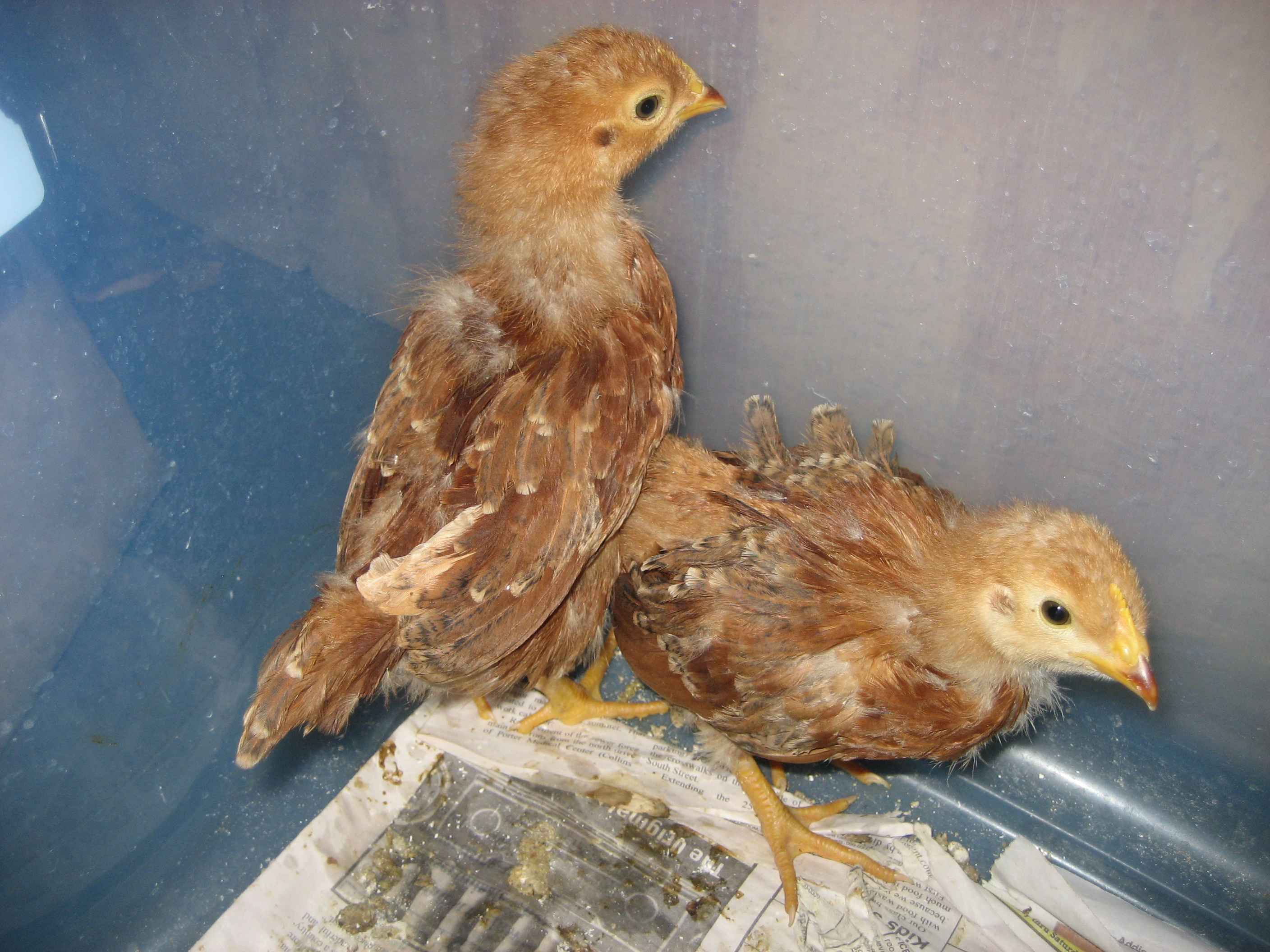
Finding a good home for our rooster neatly coincided with a friend offering us some extra chicks. So, on Campbell’s birthday, we picked up two Rhode Island Red chicks. The girls used this as an excuse to shuffle around the names of our chickens; we now have two white Leghorn hens named Daisy Flower and Sunny, and two brown chicks named Scaredy-cat Simba and Grace. We’re fairly sure that they’re all hens.

The new chicks are really, really cute, so they’ve been girl-handled quite a bit. I’m hoping that’ll make them a little more cuddly than the Leghorns, who are still pretty flighty.

We’ve got a new venue!

Starting tomorrow, I’m going to have a regular, bi-weekly column in the online edition of our local paper, The Addison Independent! I’ll be writing about life in central Vermont from the perspective of a mother of young children who’s a recent transplant to the area — in other words, I’ll be doing pretty much what I do here, it’ll just be a little more Vermont-y. (Just like how, when I write over at On the Willows , it’s pretty much what I do here, just a little more God-y).

I don’t expect that this new gig will significantly change anything here at The Pickle Patch. In fact, I’ll likely be re-using some of my more Vermont-focused material for the Independent column. As I do with On the Willows, I’ll post a link on this site whenever I have an article over at the Independent.

The new chicks and new column are both very happy things. But for whatever reason, life usually doesn’t hand you pure, undiluted joy — at least, not for very long. I’m not quite sure why it seems to work this way — that, when you’re given something, something else is taken away — but in my experience it’s usually been a good thing. Helps keep you from getting too full of yourself, if nothing else.

Which leads us to:

A tick made me sick (maybe)…

I’ve had to slow down quite a bit over the past couple of weeks, because I have not been entirely well. You may recall my mentioning the pain in my knee joints that started out of nowhere on our trip to Maine. You may even recall my joking that I assumed it was either Lyme disease or Lupus; if you expect the worst-case scenario, it can’t possibly be the worst-case scenario, right?

Turns out that’s not always true. The pain didn’t improve, I started feeling it down my arm and into my hand, and by the time we got home from Maine I was crushed by exhaustion. Not the normal, I-have-three-young-kids exhaustion, but an exhaustion so intense that by the end of the day I could barely lift my arms. All of which gave new meaning to the headaches and vague feeling of not-rightness I’d been having on an almost daily basis.

This is Georgia impersonating Jack Nicholson. (It’s a cuter picture than sick me laying on the couch).

So, I went to my doctor, who took four vials of blood out of me and began treating me for Lyme disease. (In our area, if doctors even suspect Lyme, they go ahead and begin treating it with antibiotics, because the cost of NOT treating it quickly can be the onset of chronic Lyme). The conclusion? My bloodwork came back completely clean: negative for Lyme and all other suspects. Unfortunately, that doesn’t mean that it wasn’t Lyme, because the test for Lyme is notorious for giving false negatives. Whatever the ultimate culprit — and my doctor thinks it could be another tick-borne bacteria that isn’t picked up by the Lyme test — the GREAT news is that I’m starting to feel better. A few days after beginning antibiotics, my energy returned to its normal level of exhaustion. The joint pain seems to be taking a little longer, but I’ve started to have some good days in that regard. (And honestly, I’ll take a little joint pain over the fog of exhaustion).

There are, of course, other changes brewing around here: summer is on its downslope into fall, Fiona and Campbell will start preschool in a few weeks, Erick will go back to teaching next month. And change, as we all know, can be difficult and disorienting. But this go-around, I’m trying to handle all these changes like a rooster.

Yes, like a rooster. The aforementioned rooster, who started crowing and had to be sent away, showed me how to deal gracefully with change.

The best way to transport a mature rooster is in a burlap sack. The rooster has to be enclosed, or else they’ll flap and fly all over your car. But a cage isn’t a good option, because they might bang around and damage their comb. So, when it came time to bid our rooster adios, we caught him, put him in a burlap sack, and tied the neck of the sack with twine.

I expected drama. I expected squawking and flapping and fighting and feathers flying. But instead, our rooster, who up to this point has spent his days posturing and crowing and bossing the hens around, got very still and quiet as soon as we placed him in that burlap sack. No noise, no movement; we could have been lugging around a bowling ball.

The rooster was nervous, of course — probably even terrified. But I think that this is how I’d like to handle change when it comes in my life: not by squawking or fighting, but by getting still and quiet. Change is like being shoved in a burlap sack and driven to an unknown destination; you’re never quite sure if you’ll be dropped off at the Purdue slaughtering plant or 25 acres of bucolic free-range countryside. But fighting this change is pointless, and it just makes the ride unpleasant. I’d rather be still and quiet, like a rooster.

Sense

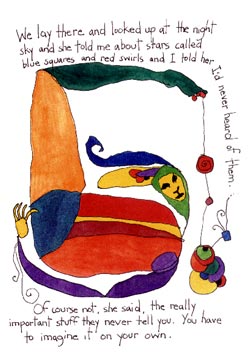
When our first child, Fiona, was born, our friends Trisha and Abel gave her this beautiful print, set in a frame they’d made themselves:

Print by Brian Andreas

This print was our introduction to the charming work of California artist and storyteller Brian Andreas. In case you can’t read the text around the image, here’s what it says:

We lay there and looked up at the night sky and she told me about stars called blue squares and red swirls and I told her I’d never heard of them. Of course not, she said, the really important stuff they never tell you. You have to imagine it on your own.

Click here to continue reading this post over at On the Willows.


One Decade Down…

Self-portrait from the early days.

On July 20, 2002, Erick and I were married in a ceremony at Christ Church in New York City. Like any wedding, the day was filled with snafus and family drama, but it was — and remains — the happiest day of my life, hands-down, no contest.

I don’t write much about Erick. That’s partly because he’s the only other member of our family who can read, and partly because he’s the most normal and well-adjusted member of our family — which makes him less interesting than, say, a two-year-old.

So, even though today is our 10th wedding anniversary, I’m not going to write much about Erick. Because I can’t imagine anything he’d like less than me gushing about him on the internet. And because I’m even more reluctant to discuss my marriage than I am to discuss my parenting; it’s still kind of a mystery to me.

But this winter I read Traveling Mercies by Anne Lamott (which I’d highly recommend to anybody). In it, Lamott recounts a joke that, when I read it, immediately made me think of Erick:

I was remembering an old story the other day about a man getting drunk at a bar in Alaska. He’s telling the bartender how he recently lost whatever faith he’d had after his twin-engine plane crashed in the tundra.

“Yeah,” he says bitterly. “I lay there in the wreckage, hour after hour, nearly frozen to death, crying out for God to save me, praying for help with every ounce of my being, but he didn’t raise a finger to help. So I’m done with that whole charade.”

“But,” said the bartender, squinting an eye at him, “you’re here. You were saved.”

“Yeah, that’s right,” says the man. “Because finally some goddamn Eskimo came along…”

What does that have to do with our marriage?

Well, I’m grateful every day that I married my Eskimo. Happy decade, Erick.

You’ve Got Hope

Photo credit.

I’m writing this from a family “vacation” at the beach in Maine. “Vacation” is in quotes, of course, because with three young children the idea of vacation falls into the same category as The Myth of Weekends. Back when we had fewer children, I remember asking our former pastor — himself the father of three girls — how his family vacation had been. He looked at me sideways for a minute, and then said, “We have three kids, Faith. It wasn’t a ‘vacation’; it was a trip.” I couldn’t have put it better myself.

So here we are in Maine, not really having a “vacation,” but having a wonderful trip. A week-long trip that took a week to pack for. Late nights and early mornings with girls hopped up on ice cream and the excitement of seeing their grandparents and cousins. The unbelievable logistics involved on either end of a single hour spent at the beach.

Another reason this feels more like a “trip” than a “vacation” is that we live in Vermont. And an interesting thing about living in Vermont is that almost anywhere else you travel is bound to be more congested and bustling than Vermont. So, while most people take vacations to places where they can relax and enjoy a slower pace of life, we’ve noticed that it’s harder to find those places when you live in Vermont. This small beach town in southern Maine is hopping compared to our home base.

When we arrived last night, I was holding on to my sanity for dear life, and grasping to recover my sense of joy. The week I’d spent packing everybody up for this trip had been a hot one in Vermont, and we’d had to keep the windows closed (we have no air conditioning) because a crew of six men is painting the outside of our house. We’d hit traffic jams — something else we’re not used to in Vermont — two times after crossing over the New Hampshire border. The four hour trip to get here was the longest amount of time we’d spent in our car with the three girls, and now that they’ve become little outdoor-sy Vermont hooligans, they’re not very good at spending hours trapped in the car (not that ANY kid is good at this, but I guarantee ours are worse than most). With 2/3 of our girls now potty-trained (yaaay!), we had to stop at almost every rest station in New Hampshire to use the potty (boo!). And then we had to explain why, yes, you DO have to actually use the potty, because at rest stations it’s not appropriate to “pee in the grass.” (See aforementioned Vermont hooligan comment). Also during this drive I’d begun to have burning, aching pain in both of my knees for no apparent reason. In my typical calm, rational style, I determined that I had either Lyme disease or Lupus, and would probably be suffering chronic knee pain for years to come.

We didn’t think that the cottage we were renting had internet access, but it turned out that it does. So, after the girls were in bed (very late) that first night, I logged on to my email for the first time all day. And among all the Amazon Mom and library book due-date notices, I had these two emails:

1. A friend from our Berkeley days, mother of a son the same age as Fiona, who tragically lost a baby girl late into her second pregnancy — this friend’s husband sent an email announcing the healthy birth of their second son.

2. A friend from Vermont, mother of one of Fiona’s preschool classmates with whom I’d just been discussing chickens and the sad fact that we’re going to have to give up our rooster and be left with two lonely hens — this friend had gone to pick up her own litter of baby chicks and, thinking of us, had asked whether the farm supply store had any extras. When she heard from the store that there were, in fact, extra chicks to be had, she drove back and picked up more chicks, which were ours for the taking. Chicks of the EXACT breeds that I’d been wanting to try out next. (Rhode Island Reds and Barred Rocks, if you’re interested).

These two emails were — on the surface — small, small things. But to me they were so huge that I let go of the sanity I’d been holding on to for dear life, and instead, for the past 24 hours, I’ve been holding on to these emails. Because they’re not just email updates; they’re little seeds of hope. Hope that pain can be redeemed and sorrow can turn to joy; hope that people are kind and sometimes things all come together at just the right time and in just the right ways.

My knees still hurt, and I don’t know why, or if or when they’ll feel better. And we still have another four hours in the car ahead of us when we travel back to Vermont. But somehow those two little seeds of online hope are all I need to get me through this moment.

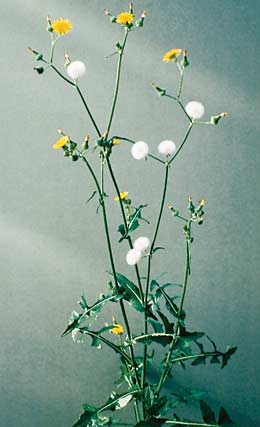
There’s a plant that grows along the Maine coast called a sow-thistle. It’s a weed that looks like a dandelion, except it grows to be 1-4 feet tall. The sow-thistle isn’t a native plant — it was introduced to the United States from Europe — but it’s become an invasive species, found in almost every state. So, when Fiona took a handful of its tiny, feathered seeds and tossed them into the wind on our walk back from the beach yesterday, she was helping to birth plants that can grow taller than her, that can take root in the rocky Maine coast, in the cracks of New York City sidewalks, and in cultivated agricultural fields in California.

That’s how hope is. The tiniest thing — a new baby coming into a space of loss, or extra chicks at the perfect time — can take root in the parched, rocky soil of our lives and give us all the hope and joy we need to keep going.

So, I wish you many tiny little seeds of hope in your inbox, today and always.

Patched Jeans

This summer has included some wonderful visits with family. Nana and Boom came twice in May to help out when Erick was traveling. In early June, we had two straight weeks of California family staying with us: Erick’s parents, his brother, sister-in-law, and our 2-year-old nephew. And now we’re preparing for a week in Maine with Nana, Boom, and my aunt and cousins on Nana’s side of the family. It’s been a summer filled with laughter, chaos, and hugs.

This is how we rolled for two weeks in June. (With Erick’s family at Shelburne Farms).

All of this time with family got me to thinking that the hard thing about families is also the best thing about families: family teaches you to make peace with different styles of being. Or rather, family hopefully teaches you to make peace, because if you don’t make peace with the different styles within your own family, you’ll either go nuts or have some mighty strained relationships  — or both.

Let me be up front: I love my family, on both sides, very very much. And really, we’re a remarkably functional bunch. But like any family, our family is composed of different family members, and each of those members is a unique person with their own way of doing things. Just because you’re family doesn’t mean that you like the same music, or use the same kind of sponge to wash your dishes, or want the same things from life.

With Nana and Boom at Iver’s Pond (photo by Fiona).

It used to make me ANGRY when people did things differently than I did. Really: if somebody made a decision that I wouldn’t have made, I would actually feel outraged. Inside, of course; nice girls don’t get outraged in public. But inside I’d be seething. That was the WRONG thing to do, my mind would fume, and SOON they’ll realize it and be SORRY!

Back then, I probably would have told you that I had such a visceral reaction because I loved these people and wanted to save them from their poor life choices. But now, I see that wasn’t it at all; my anger came from a place of deep internal insecurity, not from a place of love and concern. I was angry when people lived life differently than I did, because when people made different choices, it called my own choices into question and made me doubt myself. I would feel afraid that maybe, just maybe, I was wrong. Anger was my defensive response to fear, not love. Because really, what I was secretly hoping was that these people would come to regret their behavior; that they’d gnash their teeth and rend their clothes over their poor choices, and I’d be validated in the end.

These behaviors that infuriated me ran the gamut from how other people spent their money, to how they raised their children, to what restaurant they wanted to eat in. And this didn’t apply only to my family, but to anybody within my orbit. I look back and realize that I spent a lot of time being angry because of other people’s choices.

The thing about family, though, is that you have to — or at least, you SHOULD — love them and live with them regardless of whether you agree with them in all things. (This only applies, of course, to behavior that doesn’t directly harm you or them or others). So, the longer I’ve lived with myself and learned to feel confident with my own choices, and the longer I’ve lived with my family and learned that their choices don’t have any bearing on our ability to love one another, the more I’m able to cut people a lot of slack. Family has taught me to let people be who they are; to let them show me love in whatever way works best for them, and to love them back regardless of whether I think it was a good idea for them to buy that house or listen to that music or eat dinner in that restaurant.

Because, in reality, most of life is NOT  like a simple game of “Chutes & Ladders,” with good choices taking you up and bad choices bringing you down. Most of life is like a climbing rope that you have to grasp onto with your hands and feet, and it’s really wiggly, and you can inch yourself either up it OR down it, but whichever way you’re going, it helps to have somebody holding the bottom steady for you.

The girls with Nana, their cousins, and Great-Aunt Carolyn last summer (a part of the family we’ll be seeing in Maine).

This is where the patched jeans come in.

Back when Erick and I were newly married, it used to bug me that so many of his clothes had holes in them. Those of you who know Erick, or have just SEEN Erick, have probably noticed that he wears torn and stained clothes with pride. This is a guy who hates to give up on his clothes. He’ll bring me sweaters with gaping holes in the armpits, jeans with torn pockets or worn-through knees, and ask me to mend them…again and again and AGAIN. It’s only when I can convince him that something is un-mendable that he’ll reluctantly pitch it. (Most of the time).

This used to make me kind of angry; it was different from how I did things. “Why don’t you just buy a new one?” I’d ask, “Don’t you CARE how you look?”

Now, my stage of motherhood is hard on the knees. You’re always crawling around on the floor with little people, and before you know it, you’ve worn through the knees of your pants. So it was that I tossed out TWO torn pairs of jeans — both of which I’d had for over five years — right before we moved to Vermont.

Once we arrived in the Green Mountain State, I drove an hour to Burlington in order to buy a new pair of jeans at the Gap. Buying jeans is traumatic for everyone, and I’m no exception. My problem is that I’m short, and it’s almost impossible to find a pair of jeans that I don’t need to hem. Gap used to make ankle-length jeans that did the trick, but somehow even those don’t work for me anymore. I’d driven AN HOUR, though: I was leaving this store with a pair of jeans. I selected the best option, took them home, and hemmed them.

Less than a year later, one of the knees wore through.

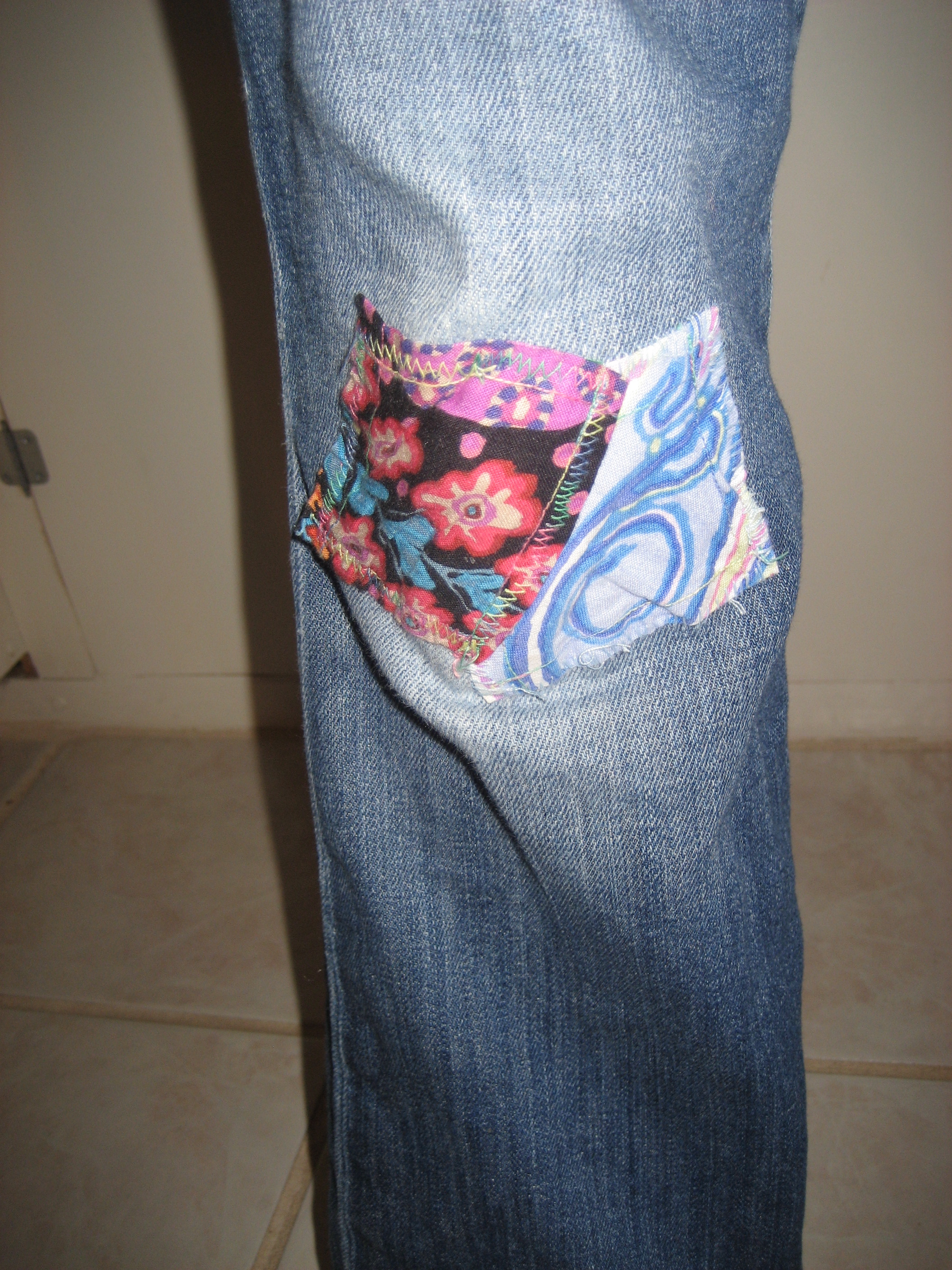
Faced with the problem of whether I had to drive another hour for a new pair of jeans — or, even worse, attempt to order jeans online without first trying them on — I decided to put a patch over the hole. I found a cute fabric scrap in my sewing bag and smacked it on the offending knee. Problem solved.

Until the hole somehow grew out from under the patch.

Faced, yet again, with the problem of what to do, I dug into my sewing bag for another cute fabric scrap, created another patch, and sewed that patch on to overlap the first patch and cover the growing hole.

Problem solved, again. (Although I’m trying not to notice that the other knee is now starting to wear alarmingly thin).

It’s a small but significant example: this is very different from how I used to do things. Once upon a time, my own behavior would have made me angry. Why not just get a new pair of jeans?

It hit me as I was sewing on that second patch: I was not giving up on these jeans, holes and all.

Erick taught me how to do this, just as the rest of my family is teaching me not to give up on people, to be liberal with the patches, and that, instead of watching critically while others play “Chutes & Ladders,” I’d rather be helping to hold the climbing rope steady.

Family!

Put Down the Duckie!

Photo credit.

Sometimes I’m concerned about how many of my recent life lessons come from children’s literature and music. But then I figure that truth is truth; when it comes to the basics, what’s true at 4 is true at 40. My latest case in point: “Put Down the Duckie.”

“Put Down the Duckie” is a song from Sesame Street. You can watch it here. To summarize: Ernie’s having trouble playing his saxophone, so he solicits the advice of Hoots the Owl. Hoots tells Ernie that his problem is simple: he has to put down the rubber duckie he’s clutching in his hand if he wants to play the saxophone.

I don’t remember this song from my own Sesame Street days, but it’s included on a “Sesame Street’s Greatest Hits” CD that we keep in our minivan, which means I get to listen to it a lot while I’m cruising the back roads of Vermont with my peeps.

To be honest, it’s not my favorite song on the CD. But one morning — maybe it was that extra cup of coffee — I suddenly had a revelation. The saxophone is LIFE, I thought to myself, and the duckie stands for the things we won’t let go of, that prevent us from doing life as well as we could.

Whoa.

Of course, my next thought was: What’s MY duckie? What’s the thing that I refuse to put down, that’s getting in my way?

In truth, I probably have about twelve duckies. But the most glaring one, the one I’ve been trying hard to put down, is my pride in being self-reliant. To put it another way: I have a very, very hard time accepting help.

Here’s what my life looked like last year in California: Erick cooked us breakfast and dinner almost every day, and was always home mornings, evenings, and weekends to help with the kids. Erick’s parents would drive over two days a week to watch the girls from 10-5, while I worked. And on those days, Erick’s mom cooked us all dinner. I was so spoiled. It was wonderful. And the whole time, I was consumed with guilt.

Guilt because, when I looked around at my other mom friends (always a bad idea), they didn’t seem to have anywhere near the level of support that I did. It must look like I can’t handle my life on my own, I would think to myself. And in my darkest moments: Everybody is offering me this help because THEY THINK THAT I’M INCOMPETENT.

I can take care of multiple kids and keep the house clean and cook all the meals, just like everybody else! I would wail inwardly, But nobody’s giving me the chance to TRY!!

If my inner monologue sounds ridiculous, that’s because it was. And sometimes it became an outer monologue. After one of my self-bashing sessions, Erick looked at me and said calmly, “Why do you have to feel guilty about having help? Why can’t you just feel grateful?”

Huh.

So, for my final months in California, I tried to replace guilt with gratitude. And I really WAS grateful, because during those months I was buying a house, finishing out a job, packing up our lives for a cross-country move, and caring for three children ranging from newborn to three years old. If ever it was understandable to need some help, that was the time.

When we moved to Vermont, things were different: Erick started an intense full-time job, and we had no family anywhere nearby. I got my wish to be just like everybody else, loading three kids in and out of the minivan all day, taking care of all the grocery shopping, cooking, and cleaning. It’s been wonderful in most ways, and I’ve mentioned before that this was the year that I finally felt like a grown-up.

But you know what? I’m still holding on to that duckie.

Because even though my family members are now limited by busy-ness and distance, they still just want to help. Erick usually takes all three girls on Saturday mornings so that I can get things done around the house. And sometimes, instead of gratitude, I catch myself thinking, I don’t see many other dads doing as much. Despite the distance, Erick’s parents have spent 6 weeks in Vermont this year; my parents have visited every month except one. (To put it in perspective, Erick’s done a lot of traveling in the past months, but thanks to the grandparents I’ve only had to spend three nights on my own). And sometimes, instead of gratitude, I catch myself thinking, Wow, our parents seem to spend more time here than other grandparents, and people are noticing.

I know exactly where this comes from. During a recent  four-day visit by my parents, I noticed that even though my dad had, among other things, re-caulked a sink, repaired a shelf, built a gravel box, built and hung a birdhouse, planted a garden, hung a hammock, made a pancake breakfast, and played with three granddaughters, all with two broken vertebrae, he felt like he wasn’t doing enough. He seemed guilty that he was more limited, less self-reliant, than he used to be. It was kind of like the old Cat Stevens song “Cat’s Cradle,” but in reverse: My dad was just like me, yeah.

So I’m once again trying very hard to put down this duckie. Because I won’t be able to play my saxophone very well if I’m always feeling guilty that I’m not doing enough on my own. What good are flying fingers if they’re wrapped around a duck? And the truth is that life isn’t a solo, at least not most of the time; if we want to make powerful music, we need to let other instruments jam with us.

One more truth: there’s nothing fundamentally wrong with self-reliance. If I were overly dependent on help from everyone around me, that would be another sort of duckie. But it’s like Hoots the Owl tells Ernie: “You don’t have to lose your duck; you can pick it up when you’re finished!” At this point in my life, I can stand to accept a little extra help with grace and gratitude; there’s plenty of time for self-reliance in the future. And having people around me now who are offering help is a blessing. Just because I can handle life on my own doesn’t mean that I have to. In the words of Hoots, I don’t wanna be a “stubborn cluck,” I wanna lay aside the duck. And the first step is this:

Thank you, Erick. Thank you, Nana and Boom. Thank you, Grandmommy and Granddaddy. I am so grateful for each of you, and I love you.

Happy Independence Day, everyone! Perhaps we can all celebrate freedom by putting down our duckies, whatever they are.