Life. Motherhood. Vermont. (Not necessarily in that order.)
Primary Menu
Author: Faith
There are nine of us now in the Pickle Patch: Erick, Faith, Fiona, Campbell, Georgia, Abigail, Levi, Hermes the cat, and Gracie the labradoodle. In June 2011, after spending most of our lives in major urban centers, we moved across the country to a small town in the middle of Vermont. This blog is about Vermont, and motherhood, and life -- three things that are often fun, frequently hilarious, and sometimes difficult.
On July 20, 2002, Erick and I were married in a ceremony at Christ Church in New York City. Like any wedding, the day was filled with snafus and family drama, but it was — and remains — the happiest day of my life, hands-down, no contest.
I don’t write much about Erick. That’s partly because he’s the only other member of our family who can read, and partly because he’s the most normal and well-adjusted member of our family — which makes him less interesting than, say, a two-year-old.
So, even though today is our 10th wedding anniversary, I’m not going to write much about Erick. Because I can’t imagine anything he’d like less than me gushing about him on the internet. And because I’m even more reluctant to discuss my marriage than I am to discuss my parenting; it’s still kind of a mystery to me.
But this winter I read Traveling Mercies by Anne Lamott (which I’d highly recommend to anybody). In it, Lamott recounts a joke that, when I read it, immediately made me think of Erick:
I was remembering an old story the other day about a man getting drunk at a bar in Alaska. He’s telling the bartender how he recently lost whatever faith he’d had after his twin-engine plane crashed in the tundra.
“Yeah,” he says bitterly. “I lay there in the wreckage, hour after hour, nearly frozen to death, crying out for God to save me, praying for help with every ounce of my being, but he didn’t raise a finger to help. So I’m done with that whole charade.”
“But,” said the bartender, squinting an eye at him, “you’re here. You were saved.”
“Yeah, that’s right,” says the man. “Because finally some goddamn Eskimo came along…”
What does that have to do with our marriage?
Well, I’m grateful every day that I married my Eskimo. Happy decade, Erick.
I’m writing this from a family “vacation” at the beach in Maine. “Vacation” is in quotes, of course, because with three young children the idea of vacation falls into the same category as The Myth of Weekends. Back when we had fewer children, I remember asking our former pastor — himself the father of three girls — how his family vacation had been. He looked at me sideways for a minute, and then said, “We have three kids, Faith. It wasn’t a ‘vacation’; it was a trip.” I couldn’t have put it better myself.
So here we are in Maine, not really having a “vacation,” but having a wonderful trip. A week-long trip that took a week to pack for. Late nights and early mornings with girls hopped up on ice cream and the excitement of seeing their grandparents and cousins. The unbelievable logistics involved on either end of a single hour spent at the beach.
Another reason this feels more like a “trip” than a “vacation” is that we live in Vermont. And an interesting thing about living in Vermont is that almost anywhere else you travel is bound to be more congested and bustling than Vermont. So, while most people take vacations to places where they can relax and enjoy a slower pace of life, we’ve noticed that it’s harder to find those places when you live in Vermont. This small beach town in southern Maine is hopping compared to our home base.
When we arrived last night, I was holding on to my sanity for dear life, and grasping to recover my sense of joy. The week I’d spent packing everybody up for this trip had been a hot one in Vermont, and we’d had to keep the windows closed (we have no air conditioning) because a crew of six men is painting the outside of our house. We’d hit traffic jams — something else we’re not used to in Vermont — two times after crossing over the New Hampshire border. The four hour trip to get here was the longest amount of time we’d spent in our car with the three girls, and now that they’ve become little outdoor-sy Vermont hooligans, they’re not very good at spending hours trapped in the car (not that ANY kid is good at this, but I guarantee ours are worse than most). With 2/3 of our girls now potty-trained (yaaay!), we had to stop at almost every rest station in New Hampshire to use the potty (boo!). And then we had to explain why, yes, you DO have to actually use the potty, because at rest stations it’s not appropriate to “pee in the grass.” (See aforementioned Vermont hooligan comment). Also during this drive I’d begun to have burning, aching pain in both of my knees for no apparent reason. In my typical calm, rational style, I determined that I had either Lyme disease or Lupus, and would probably be suffering chronic knee pain for years to come.
We didn’t think that the cottage we were renting had internet access, but it turned out that it does. So, after the girls were in bed (very late) that first night, I logged on to my email for the first time all day. And among all the Amazon Mom and library book due-date notices, I had these two emails:
1. A friend from our Berkeley days, mother of a son the same age as Fiona, who tragically lost a baby girl late into her second pregnancy — this friend’s husband sent an email announcing the healthy birth of their second son.
2. A friend from Vermont, mother of one of Fiona’s preschool classmates with whom I’d just been discussing chickens and the sad fact that we’re going to have to give up our rooster and be left with two lonely hens — this friend had gone to pick up her own litter of baby chicks and, thinking of us, had asked whether the farm supply store had any extras. When she heard from the store that there were, in fact, extra chicks to be had, she drove back and picked up more chicks, which were ours for the taking. Chicks of the EXACT breeds that I’d been wanting to try out next. (Rhode Island Reds and Barred Rocks, if you’re interested).
These two emails were — on the surface — small, small things. But to me they were so huge that I let go of the sanity I’d been holding on to for dear life, and instead, for the past 24 hours, I’ve been holding on to these emails. Because they’re not just email updates; they’re little seeds of hope. Hope that pain can be redeemed and sorrow can turn to joy; hope that people are kind and sometimes things all come together at just the right time and in just the right ways.
My knees still hurt, and I don’t know why, or if or when they’ll feel better. And we still have another four hours in the car ahead of us when we travel back to Vermont. But somehow those two little seeds of online hope are all I need to get me through this moment.
There’s a plant that grows along the Maine coast called a sow-thistle. It’s a weed that looks like a dandelion, except it grows to be 1-4 feet tall. The sow-thistle isn’t a native plant — it was introduced to the United States from Europe — but it’s become an invasive species, found in almost every state. So, when Fiona took a handful of its tiny, feathered seeds and tossed them into the wind on our walk back from the beach yesterday, she was helping to birth plants that can grow taller than her, that can take root in the rocky Maine coast, in the cracks of New York City sidewalks, and in cultivated agricultural fields in California.
That’s how hope is. The tiniest thing — a new baby coming into a space of loss, or extra chicks at the perfect time — can take root in the parched, rocky soil of our lives and give us all the hope and joy we need to keep going.
So, I wish you many tiny little seeds of hope in your inbox, today and always.
This summer has included some wonderful visits with family. Nana and Boom came twice in May to help out when Erick was traveling. In early June, we had two straight weeks of California family staying with us: Erick’s parents, his brother, sister-in-law, and our 2-year-old nephew. And now we’re preparing for a week in Maine with Nana, Boom, and my aunt and cousins on Nana’s side of the family. It’s been a summer filled with laughter, chaos, and hugs.
This is how we rolled for two weeks in June. (With Erick’s family at Shelburne Farms).
All of this time with family got me to thinking that the hard thing about families is also the best thing about families: family teaches you to make peace with different styles of being. Or rather, family hopefully teaches you to make peace, because if you don’t make peace with the different styles within your own family, you’ll either go nuts or have some mighty strained relationships — or both.
Let me be up front: I love my family, on both sides, very very much. And really, we’re a remarkably functional bunch. But like any family, our family is composed of different family members, and each of those members is a unique person with their own way of doing things. Just because you’re family doesn’t mean that you like the same music, or use the same kind of sponge to wash your dishes, or want the same things from life.
With Nana and Boom at Iver’s Pond (photo by Fiona).
It used to make me ANGRY when people did things differently than I did. Really: if somebody made a decision that I wouldn’t have made, I would actually feel outraged. Inside, of course; nice girls don’t get outraged in public. But inside I’d be seething. That was the WRONG thing to do, my mind would fume, and SOON they’ll realize it and be SORRY!
Back then, I probably would have told you that I had such a visceral reaction because I loved these people and wanted to save them from their poor life choices. But now, I see that wasn’t it at all; my anger came from a place of deep internal insecurity, not from a place of love and concern. I was angry when people lived life differently than I did, because when people made different choices, it called my own choices into questionand made me doubt myself. I would feel afraid that maybe, just maybe, I was wrong. Anger was my defensive response to fear, not love. Because really, what I was secretly hoping was that these people would come to regret their behavior; that they’d gnash their teeth and rend their clothes over their poor choices, and I’d be validated in the end.
These behaviors that infuriated me ran the gamut from how other people spent their money, to how they raised their children, to what restaurant they wanted to eat in. And this didn’t apply only to my family, but to anybody within my orbit. I look back and realize that I spent a lot of time being angry because of other people’s choices.
The thing about family, though, is that you have to — or at least, you SHOULD — love them and live with them regardless of whether you agree with them in all things. (This only applies, of course, to behavior that doesn’t directly harm you or them or others). So, the longer I’ve lived with myself and learned to feel confident with my own choices, and the longer I’ve lived with my family and learned that their choices don’t have any bearing on our ability to love one another, the more I’m able to cut people a lot of slack. Family has taught me to let people be who they are; to let them show me love in whatever way works best for them, and to love them back regardless of whether I think it was a good idea for them to buy that house or listen to that music or eat dinner in that restaurant.
Because, in reality, most of life is NOT like a simple game of “Chutes & Ladders,” with good choices taking you up and bad choices bringing you down. Most of life is like a climbing rope that you have to grasp onto with your hands and feet, and it’s really wiggly, and you can inch yourself either up it OR down it, but whichever way you’re going, it helps to have somebody holding the bottom steady for you.
The girls with Nana, their cousins, and Great-Aunt Carolyn last summer (a part of the family we’ll be seeing in Maine).
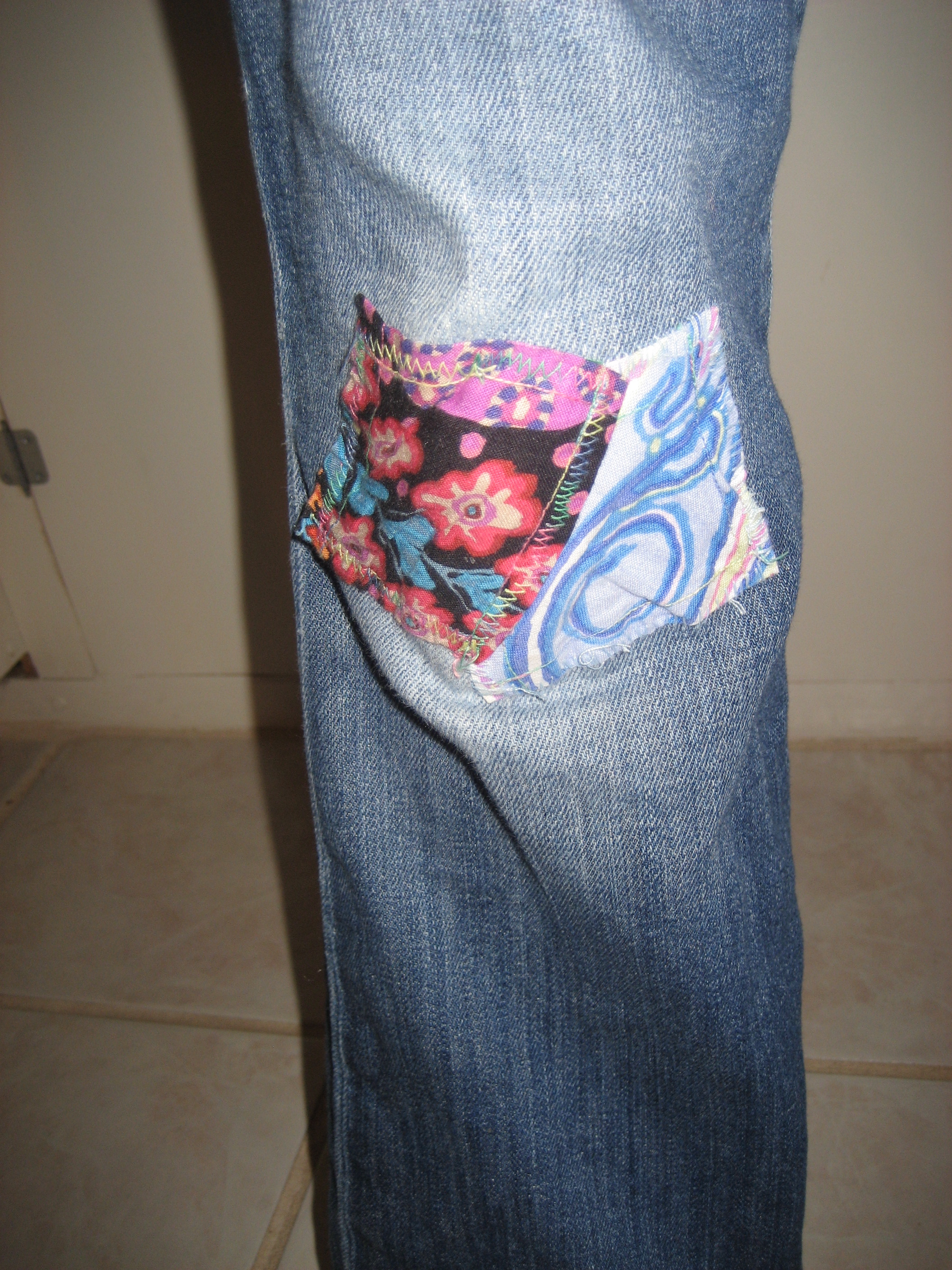
This is where the patched jeans come in.
Back when Erick and I were newly married, it used to bug me that so many of his clothes had holes in them. Those of you who know Erick, or have just SEEN Erick, have probably noticed that he wears torn and stained clothes with pride. This is a guy who hates to give up on his clothes. He’ll bring me sweaters with gaping holes in the armpits, jeans with torn pockets or worn-through knees, and ask me to mend them…again and again and AGAIN. It’s only when I can convince him that something is un-mendable that he’ll reluctantly pitch it. (Most of the time).
This used to make me kind of angry; it was different from how I did things. “Why don’t you just buy a new one?” I’d ask, “Don’t you CARE how you look?”
Now, my stage of motherhood is hard on the knees. You’re always crawling around on the floor with little people, and before you know it, you’ve worn through the knees of your pants. So it was that I tossed out TWO torn pairs of jeans — both of which I’d had for over five years — right before we moved to Vermont.
Once we arrived in the Green Mountain State, I drove an hour to Burlington in order to buy a new pair of jeans at the Gap. Buying jeans is traumatic for everyone, and I’m no exception. My problem is that I’m short, and it’s almost impossible to find a pair of jeans that I don’t need to hem. Gap used to make ankle-length jeans that did the trick, but somehow even those don’t work for me anymore. I’d driven AN HOUR, though: I was leaving this store with a pair of jeans. I selected the best option, took them home, and hemmed them.
Less than a year later, one of the knees wore through.
Faced with the problem of whether I had to drive another hour for a new pair of jeans — or, even worse, attempt to order jeans online without first trying them on — I decided to put a patch over the hole. I found a cute fabric scrap in my sewing bag and smacked it on the offending knee. Problem solved.
Until the hole somehow grew out from under the patch.
Faced, yet again, with the problem of what to do, I dug into my sewing bag for another cute fabric scrap, created another patch, and sewed that patch on to overlap the first patch and cover the growing hole.
Problem solved, again. (Although I’m trying not to notice that the other knee is now starting to wear alarmingly thin).
It’s a small but significant example: this is very different from how I used to do things. Once upon a time, my own behavior would have made me angry. Why not just get a new pair of jeans?
It hit me as I was sewing on that second patch: I was not giving up on these jeans, holes and all.
Erick taught me how to do this, just as the rest of my family is teaching me not to give up on people, to be liberal with the patches, and that, instead of watching critically while others play “Chutes & Ladders,” I’d rather be helping to hold the climbing rope steady.
I’m sure you’ve all been asking yourselves, How are Grace, Simba, and Hermione doing? You’ve been desperately hoping each time you click on a Pickle Patch post that I’ll include some news about our chickens. And each time, I’ve let you down.
Until today, my friends.
Grace, Simba, and Hermione are thriving. Every day they look less like cute, fuzzy little chicks, and more like full-grown chickens. I can’t imagine that any other animal illustrates the concept of adolescence better than chickens: for several weeks, they had yellow, downy fuzz on their necks and heads, but feathers down below: half chick, half chicken. Throw in some pimples and a squeaky “cluck,” and you’ve got the universal 13-year-old.
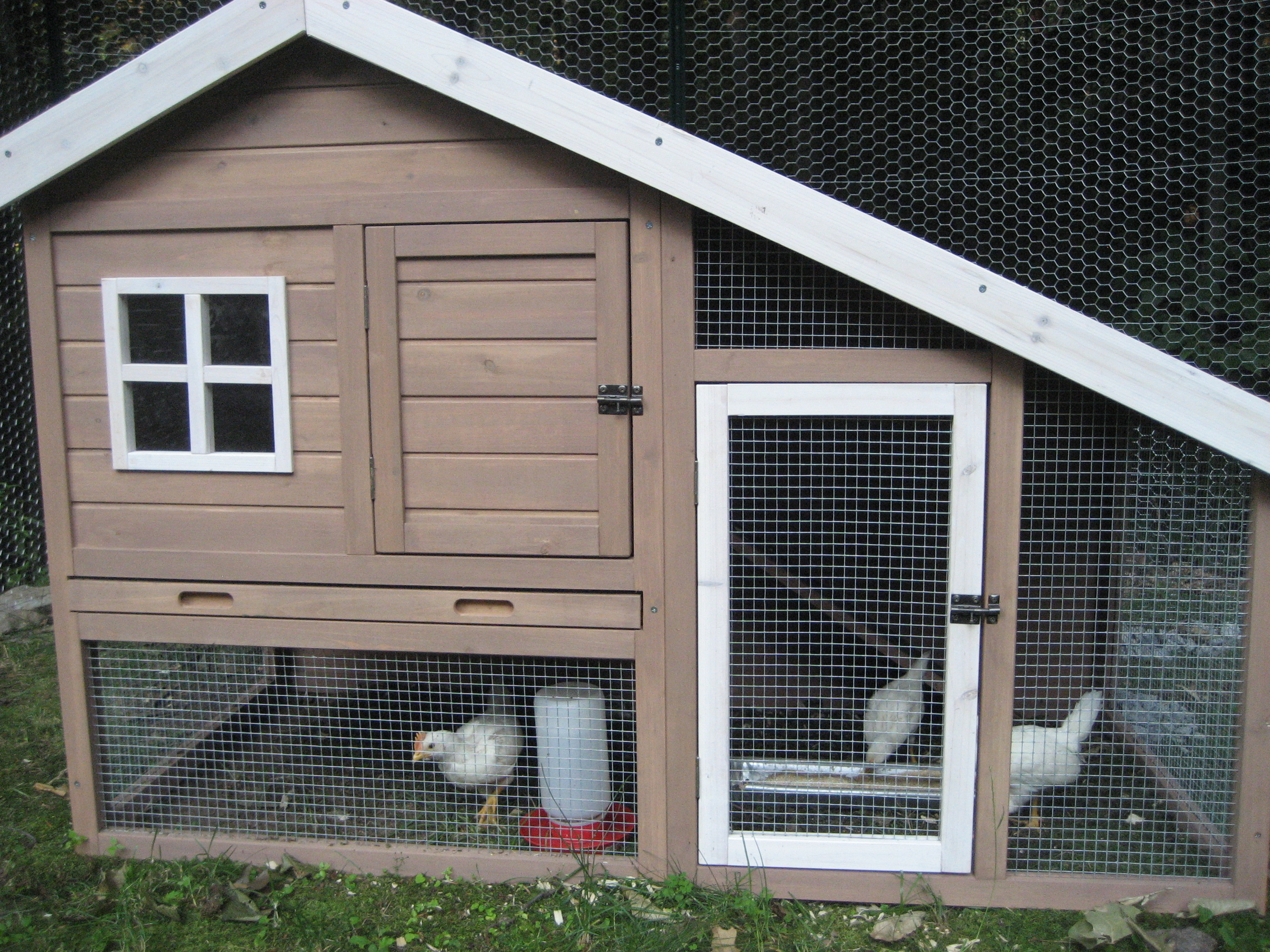
After about 4 weeks in a large plastic bin under a heat lamp in our garage (the very impressive, chicken-raising term for this setup: “The Brooder”), they were large enough to move out to the chicken coop in our yard. And, I’m proud to say, they have survived! I honestly feel a greater sense of accomplishment about keeping these chickens alive outside than I did about keeping our newborn children alive. As clueless as first-time parents are, at least we’re the same species as our children; when it came to chickens Erick and I had ABSOLUTELY NO IDEA what we were doing. We ended up ordering the chicken coop from Wal-Mart (yes, Wal-Mart sells chicken coops; who knew?), and Erick and his father constructed a rudimentary fence from metal posts and chicken wire. This probably won’t be our final set-up; it’s too flimsy to withstand predators and Vermont winters for long. But until Erick gets around to his winter project of building a chicken coop by hand in our basement (which he claims he’s “getting excited about;” who knew?), it’ll do.
The new digs.
Of course, it hasn’t all been smooth sailing. First we had to resolve the tiny little issue of whether we were allowed to keep chickens in our neighborhood at all. Our kind neighbors, neither of whom minded us keeping chickens, both mentioned in passing that we should know that there was some sort of “Neighborhood Covenant” forbidding the keeping of farm animals. Huh?!? In Vermont?!? But we wanted to be good neighbors; I didn’t relish the idea of trying to keep chickens secret. We hadn’t been told of any “Neighborhood Covenant” when we bought the house, but there was a reference to it in our Deed. Good girl that I am, I went over to the Town Clerk’s office and pulled up the Covenant. It does exist, it does forbid the keeping of “anything other than domestic animals,” (and sets strict limits on what color you can stain your house), AND…it expired the year we moved in! So our chickens are legal. (And now we’re now planning to paint our house purple and start grazing cows on the lawn).
The first day the chickens were out in the coop was pretty harrowing. I was like a new mother, checking her baby obsessively in the bassinet; I kept peeking in the coop, to make sure that they were eating and drinking and alive. Our coop has a fenced-in “grazing” area on the bottom, and a ramp leading “upstairs” to the roost and nesting box. By nightfall, I noticed that our chickens were still hanging out in the downstairs grazing area, which made me a little nervous; safer for them to be up in the roost, protected from predators. Something wasn’t right. By about 10 PM, I couldn’t stand it any longer. I threw boots and a coat on over my pajamas, strapped on a headlamp (since it was pitch dark outside), and tromped out to the coop with Erick wearily following along behind. It was like a scene from every zany “clueless people raising animals” comedy ever made.
There were the chickens, cuddled up and sleeping in the grazing area. We picked them up (thankfully sleepy chickens are much easier to get a handle on than wide-awake chickens) and moved them up to the nesting area. That was all it took; “OH, there’s an UPSTAIRS?” you could see their little chicken brains clicking.
The chickens venture “downstairs.”
Moral of the story? Chickens: not so smart.
In their chicken bedroom.
And now for the bad news: It looks like we have one rooster. This isn’t exactly bad news, since in my darkest moments I imagined that somehow we’d end up with three roosters, and that all our efforts on behalf of these chickens would be for naught; we’d be left with an empty chicken coop and no eggs. And I’m still not entirely sure, since supposedly you can’t really tell which chickens are hens and which are roosters until about the fourth or fifth month, when the roosters will start to crow. But all I can say is that one of our chickens has a huge, bright red comb on top of its head, and the other two don’t. I’m calling it: Rooster.
Thankfully, our girls have enough experience with other roosters to agree that we don’t want to keep a rooster. “That one’s a rooster,” they’re already telling their friends. “We’re going to give it away…or EAT it.” And no, we have no idea which girl’s chicken turned out to be the rooster, because really, these chickens are impossible to tell apart. But Fiona keeps insisting that she’s sure the rooster is Campbell’s (Simba).
You may remember that, just a few months ago, I wrote about the Sweeties — White and Pink — on this blog. I’m deeply saddened to tell you that Pink Sweetie, described by Campbell as “the one I love most of all,” is no longer with us.
It happened this past Saturday, a hot and humid day, when we decided to take the ferry across Lake Champlain to get ice cream in the quaint town of Essex, New York. The ferry ride was refreshingly breezy. Very, very breezy. Pink Sweetie was along for the ride. And then, right in the middle of Lake Champlain, Campbell held on to Pink Sweetie a little too loosely, and Pink was ripped from her hands and blown overboard.
The last photo of Pink Sweetie.
All things considered, Campbell has made us proud with her stoicism. After initial cries of “I want to STOP THIS BOAT!” and “How will I sleep without Pink?”, she moved on, embracing her one remaining Sweetie (although the plan apparently is to dye White Sweetie pink as soon as possible), and consoling herself with the idea that Champ, the lake monster who trolls the bottom of Lake Champlain, has now acquired a new blankie.
You were a good Sweetie, Pink, and a very important member of this family. As Campbell once put it, you “smelled like love.” And a water burial seems appropriate; Erick can rest easy that you will never be dirty again. You will be missed.
AND NOW:
Something a little different from me over at On the Willows, in which I respectfully disagree with my resident development economist over whether NGOs, short-term missions trips, humanitarian tourism, and Bono really can make a difference. Click here to read it.
Sometimes I’m concerned about how many of my recent life lessons come from children’s literature and music. But then I figure that truth is truth; when it comes to the basics, what’s true at 4 is true at 40. My latest case in point: “Put Down the Duckie.”
“Put Down the Duckie” is a song from Sesame Street. You can watch it here. To summarize: Ernie’s having trouble playing his saxophone, so he solicits the advice of Hoots the Owl. Hoots tells Ernie that his problem is simple: he has to put down the rubber duckie he’s clutching in his hand if he wants to play the saxophone.
I don’t remember this song from my own Sesame Street days, but it’s included on a “Sesame Street’s Greatest Hits” CD that we keep in our minivan, which means I get to listen to it a lot while I’m cruising the back roads of Vermont with my peeps.
To be honest, it’s not my favorite song on the CD. But one morning — maybe it was that extra cup of coffee — I suddenly had a revelation. The saxophone is LIFE, I thought to myself, and the duckie stands for the things we won’t let go of, that prevent us from doing life as well as we could.
Whoa.
Of course, my next thought was: What’s MY duckie? What’s the thing that I refuse to put down, that’s getting in my way?
In truth, I probably have about twelve duckies. But the most glaring one, the one I’ve been trying hard to put down, is my pride in being self-reliant. To put it another way: I have a very, very hard time accepting help.
Here’s what my life looked like last year in California: Erick cooked us breakfast and dinner almost every day, and was always home mornings, evenings, and weekends to help with the kids. Erick’s parents would drive over two days a week to watch the girls from 10-5, while I worked. And on those days, Erick’s mom cooked us all dinner. I was so spoiled. It was wonderful. And the whole time, I was consumed with guilt.
Guilt because, when I looked around at my other mom friends (always a bad idea), they didn’t seem to have anywhere near the level of support that I did. It must look like I can’t handle my life on my own, I would think to myself. And in my darkest moments: Everybody is offering me this help because THEY THINK THAT I’M INCOMPETENT.
I can take care of multiple kids and keep the house clean and cook all the meals, just like everybody else! I would wail inwardly, But nobody’s giving me the chance to TRY!!
If my inner monologue sounds ridiculous, that’s because it was. And sometimes it became an outer monologue. After one of my self-bashing sessions, Erick looked at me and said calmly, “Why do you have to feel guilty about having help? Why can’t you just feel grateful?”
Huh.
So, for my final months in California, I tried to replace guilt with gratitude. And I really WAS grateful, because during those months I was buying a house, finishing out a job, packing up our lives for a cross-country move, and caring for three children ranging from newborn to three years old. If ever it was understandable to need some help, that was the time.
When we moved to Vermont, things were different: Erick started an intense full-time job, and we had no family anywhere nearby. I got my wish to be just like everybody else, loading three kids in and out of the minivan all day, taking care of all the grocery shopping, cooking, and cleaning. It’s been wonderful in most ways, and I’ve mentioned before that this was the year that I finally felt like a grown-up.
But you know what? I’m still holding on to that duckie.
Because even though my family members are now limited by busy-ness and distance, they still just want to help. Erick usually takes all three girls on Saturday mornings so that I can get things done around the house. And sometimes, instead of gratitude, I catch myself thinking, I don’t see many other dads doing as much. Despite the distance, Erick’s parents have spent 6 weeks in Vermont this year; my parents have visited every month except one. (To put it in perspective, Erick’s done a lot of traveling in the past months, but thanks to the grandparents I’ve only had to spend three nights on my own). And sometimes, instead of gratitude, I catch myself thinking, Wow, our parents seem to spend more time here than other grandparents, and people are noticing.
I know exactly where this comes from. During a recent four-day visit by my parents, I noticed that even though my dad had, among other things, re-caulked a sink, repaired a shelf, built a gravel box, built and hung a birdhouse, planted a garden, hung a hammock, made a pancake breakfast, and played with three granddaughters, all with two broken vertebrae, he felt like he wasn’t doing enough. He seemed guilty that he was more limited, less self-reliant, than he used to be. It was kind of like the old Cat Stevens song “Cat’s Cradle,” but in reverse: My dad was just like me, yeah.
So I’m once again trying very hard to put down this duckie. Because I won’t be able to play my saxophone very well if I’m always feeling guilty that I’m not doing enough on my own. What good are flying fingers if they’re wrapped around a duck? And the truth is that life isn’t a solo, at least not most of the time; if we want to make powerful music, we need to let other instruments jam with us.
One more truth: there’s nothing fundamentally wrong with self-reliance. If I were overly dependent on help from everyone around me, that would be another sort of duckie. But it’s like Hoots the Owl tells Ernie: “You don’t have to lose your duck; you can pick it up when you’re finished!” At this point in my life, I can stand to accept a little extra help with grace and gratitude; there’s plenty of time for self-reliance in the future. And having people around me now who are offering help is a blessing. Just because I can handle life on my own doesn’t mean that I have to. In the words of Hoots, I don’t wanna be a “stubborn cluck,” I wanna lay aside the duck. And the first step is this:
Thank you, Erick. Thank you, Nana and Boom. Thank you, Grandmommy and Granddaddy. I am so grateful for each of you, and I love you.
Happy Independence Day, everyone! Perhaps we can all celebrate freedom by putting down our duckies, whatever they are.
One of the many delightful facts of Vermont life is that it tends to be uncrowded. Traffic-free. Line-free. As of the 2010 U.S. Census, Vermont’s population was 625,741, which made it the 49th most populous state…out of 50 states. That’s right: only Wyoming has fewer people.
Of course, Vermont is also a small state, in terms of land area. Even so, it’s the 30th state on the list for population density, with 67.7 inhabitants per square mile. Compare that to our two previous states of residence: New York has 412.3 inhabitants/sq. mile, and California has 241.7. Addison County, where we live, has a population density of 48 people/sq. mile, putting it below the state average.
So, you’d expect that there wouldn’t be much competition for resources around here. And there isn’t. Usually you can stroll into any restaurant and find a table, go to the grocery store and breeze through the checkout line, drive into town and barely have to stop. BUT I’ve learned that there are a few special circumstances in our small town when you’d better line up in advance. I pass these along as a public service to anybody who might one day decide to increase our population density:
1. Preschool Registration. First, let me be clear that compared to New York City or the Bay Area, where you need to get your child on a preschool waiting list immediately after birth, the preschool situation in Vermont is a walk in the woods. And by “walk in the woods,” I mean that you need to leave early and bring plenty of water and snacks.
By my count, there are approximately five preschools (or childcare centers that serve preschool-aged children) serving our town — and all other towns within a 20-mile radius. I don’t have exact figures on how many three- and four-year-old children live in this area, but there are a lot of families with young children. Last year, when we found out we’d be moving to Vermont and I started calling preschools in February for the following academic year, I thought that I might be overreacting, falling back on my “big city ways.” But now I know that my timing was about right: you get your child onto preschool waiting lists in late winter/early spring. Granted, if you do this, you’ll likely get a spot somewhere. And granted, the cost of preschool here is about 1/3 what it was in Berkeley. But I was still a little surprised that I couldn’t just stroll into a preschool on the first day and drop off my child.
2. Finding a Doctor. This was more surprising to me than the need for early preschool registration: every primary care practice in this county is currently closed to new patients. Thankfully, our family was able to duck through the door as it was closing — I think we were the last patients to be accepted at our family practice.
As with preschool, this is a problem of supply and demand: although the hospital in our town is a major employer for the area (second only to the college), it’s also the only hospital in our county. According to a recent article in the Addison County Independent, this means that there are 40 primary care doctors in 10 practices sprinkled throughout the county, and in 2011 they had to accommodate over 87,000 patient visits.
Thankfully, things are about to improve; according to the same article in the Independent, seven new doctors are set to arrive in town and cure the doctor shortage. If you’re a doctor looking to move to small-town Vermont, come on over!
3. Sitting on Santa’s Lap. Each December, Santa Claus rides a fire engine into town and disembarks at the Middlebury Community House, across from the town green. There he reigns for a couple of hours, submitting to lap-sitters and camera flashes. The line in front of the Community House rivals that at Macy’s Herald Square. We didn’t even attempt to visit Santa this year, because a) our girls had no interest, and b) we were happy that they had no interest. Hopefully things will stay that way.
Lining up early is actually a good idea for all of the seasonal activities that occur on or around the town green. In addition to Santa, these include the Spooktacular in October (when all the kids in town parade down Main Street in their costumes and the stores give out treats) and the Festival on the Green in July (an outdoor summer performance series with fun Brown Bag Lunch programs for kids).
4. Gymnastics Registration. I still experience some post-trumatic stress when writing about gymnastics registration. Our town’s Parks and Recreation Department offers gymnastics classes to children ages 3 and older in the fall, spring, and summer. For some reason, registration for these classes is held at the town gym on a single evening prior to each new session, between the hours of 5:30-7:30 PM.
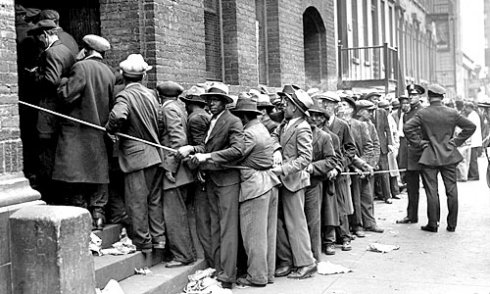
Fiona had been begging to take gymnastics when we moved to Vermont, so last fall I went to the evening registration session. Not suspecting that gymnastics classes would arouse a town-wide mania, I arrived at exactly 5:30 PM. I strolled calmly into the town gym…and froze. The line stretched the width of the basketball court and out the door. I followed the line down the hallway, through another set of doors, and out onto the sidewalk. As I stood there for 30 minutes, only to put Fiona on the lengthy waiting list, all I could think was: “I have failed my child.”
The good news is that Fiona made it off the waiting list and had a wonderful time in fall gymnastics. But I’m still shocked that gymnastics classes in our town need to be handled with the same amount of pre-planning required to nab Justin Beiber tickets. If you want your child to take gymnastics in Middlebury, DO NOT LET THIS HAPPEN TO YOU. When spring gymnastics registration rolled around, I bundled the girls into the stroller with books and snacks, and we queued up 30 minutes early.
5. The Middlebury Volunteer Fire Department Annual Ham Supper. Like most towns in our area, Middlebury depends upon a force of volunteer firefighters. This means that, whenever there’s an emergency, the first thing you see are assorted pick-up trucks, SUVs, and cars rigged up with flashing lights speeding towards the fire station; a few minutes later, the actual fire engines will head off to the rescue. I suppose some time is lost in the process, but there’s a quaint neighborliness to the whole production.
Each spring, the Middlebury Volunteer Fire Department holds their annual fundraiser: a ham supper at the Waybury Inn. Purchasing a ticket will get you all the baked ham, scalloped potatoes, mac & cheese, dinner rolls, cake – oh, and salad — that you can eat. We purchased tickets to this year’s ham supper because it’s a great cause (and maybe also because the tickets were being sold by Erick’s department chair, who moonlights as a firefighter). The supper was from 5-8 PM. We arrived shortly after 5, and, while not quite at the level of gymnastics registration, both dining rooms were already filled and the line was out the door. And here’s the strange thing: we live in a small town, right? For the 30 minutes or so that we were at the ham supper, we saw absolutely NOBODY we know. The last time this happened was on the day that we moved here. So, I can only conclude that there must be an inter-town community of ham supper-goers, who travel around to all of the area’s ham suppers (of which there are quite a few). Kind of like Deadheads.
My advice? You can get a take-out bag. Opt for the take-out bag.
So, there you have it: all of my insider tips for keeping life in Middlebury as stress-free as possible. You’re welcome.
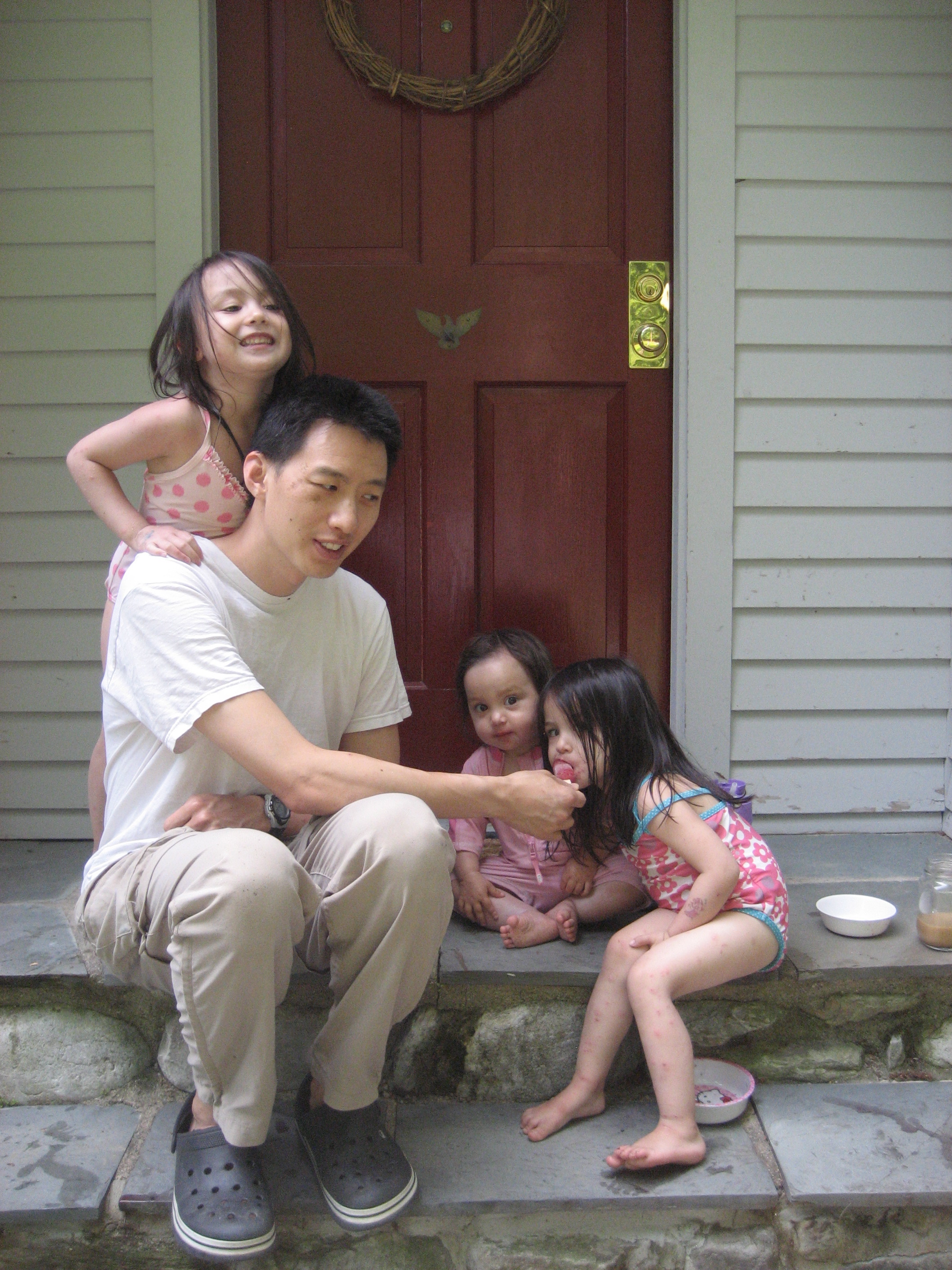
Just for fun: “Having it all” – popsicles after the wading pool – this past weekend.
Last week, several friends forwarded me Anne-Marie Slaughter’s article in The Atlantic, titled “Why Women Still Can’t Have it All.” Usually I keep my mouth shut after I read articles on this topic, which I file under “The Mommy Wars”: the emotionally charged battle over work-family balance for American women today. But this time I didn’t keep my mouth shut. For better or worse, my response is published today over at On the Willows. Click here to read it.
I’m not a fan of making doomsday predictions to women who are expecting their first child. You know: “Ooooh boy, prepare to have your life turned upside down!” “Sleep now, because you’ll never sleep for the next decade!” “Say goodbye to your white couches!” and so on. Regardless of the truth of these statements, they’re not helpful. When I was pregnant for the first time, well meaning friends — many of them mothers — told me to get lots of sleep. In retrospect, these were clearly people who had either no idea or no memory of what it’s like to be pregnant: by the latter half of most pregnancies, no position is comfortable, breathing is difficult, the bathroom calls every 5 minutes, and when you finally do drift off, you have vivid nightmares about misplacing your newborn. Sleep is not really happening in any normal sense. So I spent the final trimester of my first pregnancy exhausted AND stressed that I wasn’t following everyone’s sleeping advice.
That said, there is one thing that I advise friends who are expecting for the first time, because I think it is helpful: Eat brunch as often as possible.
I vaguely remember brunch: sleeping in on a Saturday morning, then ambling down to whatever restaurant we chose for some delicious pancake-y or egg-y food, drinking multiple cups of coffee while leisurely perusing The New York Times and deciding whether to nap before or after we went jogging, which museum we should visit, what movie to see that night.
Nowadays, all of that would be impossible. Let’s start with the sleeping in: our kids have no concept that weekend sleep patterns should differ from the rest of the week, so they stubbornly refuse to sleep in on the weekends. To them, Saturday is just a day like any other, and they come barreling out of their room at 7 AM — if we’re lucky.
Then, there’s the timing of brunch; as a general rule, I believe the ideal time for brunch is about 10 AM. That’s a completely unrealistic time to be eating the first meal of the day if you have kids — including a baby — who are used to eating at 7 AM. By 10 AM, we’ve all eaten, dressed, washed up, and Georgia is waking up from her morning nap. In order to do brunch, we’d have to eat breakfast first, which kind of defeats the purpose.
And I won’t even bother explaining why we can’t possibly read The New York Times during meals these days.
I’d say our brunch days are on hold for at least another 5 years. And that’s why I tell expectant moms to eat brunch while the brunching’s good.
Now, I know all kids are different. I know that some preschoolers sleep until 9 AM, will patiently wait an hour before eating, and sit quietly at the table during meals. (I make myself feel better by assuming that these preschoolers aren’t as interesting as our kids). But brunch is only part of what I refer to as “The Myth of Weekends.”
One of the many refining features of parenthood — and life — is that it forces us to abandon our expectations. By the time we had kids, I’d built up a couple decades worth of expectations about weekends: that weekends were times of rest, restoration, and recreation…usually involving brunch. Every weekend post-kids, I brought those expectations with me: Maybe THIS will be the weekend when we all sleep late, when we all live in perfect harmony, when I will feel completely recharged by Sunday night. And every weekend my expectations exploded and I felt more exhausted by Sunday night than I did on Friday night.
I’ve already explained why sleeping late and brunch no longer happen on our weekends. Then there’s recreation: our family has a lot of fun on weekends, but it’s hardly restorative fun; it’s exhausting fun. All recreational activities involve wrangling three kids. So, for instance, if we decide to take a hike: someone has to lug around 19 pounds of baby, then Campbell wants to be carried, Fiona wants to charge ahead, Campbell wants to walk, Fiona needs to pee, Campbell is thirsty, Fiona wants to be carried, Fiona is hungry, Campbell wants to be carried again. (And that’s just at the trail head).
But the MAIN source of my mistaken weekend expectations stems from the simple fact that, in our family, there is one extra person who is around more on weekends: Erick. During the week, Erick vanishes from our house during the hours between breakfast and dinner, but for the most part he’s home all weekend long. Which is wonderful, and you’d think it would make at least the child-wrangling part of weekends easier.
But it doesn’t.
Again, PLEASE don’t get me wrong: Erick is a superstar husband and father. We all adore him, and are thrilled to have him home on the weekends. In fact, he usually takes all three girls on Saturday mornings so that I can spend a few hours wrestling the house back into submission. But I’ve had to accept that his presence doesn’t automatically transform weekends into restful and restorative times of family togetherness.
Here’s why: During the week, the girls and I have a flow, a rhythm that gets us through the days. We stick to a relaxed but predictable schedule, everybody knows her role and — for the most part — follows it, and the girls (usually) respect the fact that I’m the only parent available and cut me some slack. Then the weekend hits. Suddenly, there’s another exhausted person around who doesn’t necessarily know the routine, and who’s been moving to his own rhythm the rest of the week. The girls are all jazzed up because Daddy’s home, and I’m inclined to loosen the reins a little because there’s another adult to pick up the slack. In other words, we’re all out of whack with each other.
The bottom line is: if two adults are each expecting the weekend to be a time of rest, but they’re outnumbered by three kids, the math just doesn’t work out.
Anybody else have this experience?
After a few years’ worth of deflated weekend expectations, I solved the problem of “The Myth of Weekends” in the only grown-up way I could: I left my expectations at brunch, back about four-and-a-half years ago. Maybe I’ll pick them up again someday, maybe not. In the meantime, I’ve decided to redefine the conventional idea of “Weekend = Saturday + Sunday.” Instead, I try to take little weekends where I can find them throughout the week: early in the morning before the kids are awake, naptime, after the kids are in bed at night, solo trips to the grocery store or the dentist, date nights with Erick when grandparents are in town.
And, I tell you, these little weekends have brought me joy and gratefulness in a way that conventional weekends never did. These days, nothing beats being able to read an entire copy of People in the doctor’s waiting room.
But last month, as the time rolled around again for Fiona’s “Mommy Date,” she had a plan:
“I want to go to the ceremony,” she declared one day.
“The what?” I asked. “What ceremony?”
“You know,” she said, starting to get agitated, “the CEREMONY. The one next to campus, with all the stones in it.”
“Ohhhhhhhh. You mean thecemetery.”
And so I took Fiona on a Mommy Date to St. Mary’s Cemetery.
St. Mary’s Cemetery is one of about seven cemeteries in Middlebury. Compared to the more urban places we’ve lived, where cemeteries tend to be sprawling operations that still somehow stay tucked away out of sight, the Middlebury cemeteries are older, smaller, and much more visible — right next to the main roads, in many cases. St. Mary’s Cemetery is directly adjacent to the Middlebury College campus, so Fiona had seen it numerous times during our walks and drives around campus. And, because she’d never seen a cemetery before, she was interested.
Photo by Fiona.
“What will we do on our Mommy Date to the cemetery?” I asked her that morning.
“Walk around, and sit, and I’m going to bring some markers and paper to draw,” she answered, matter-of-fact. “And then we can meet Daddy, Campbell, and Georgia for ice cream.”
I couldn’t argue with that kind of conviction, so that’s exactly what we did. And it turned out to be the nicest afternoon I’ve spent in a long, long time.
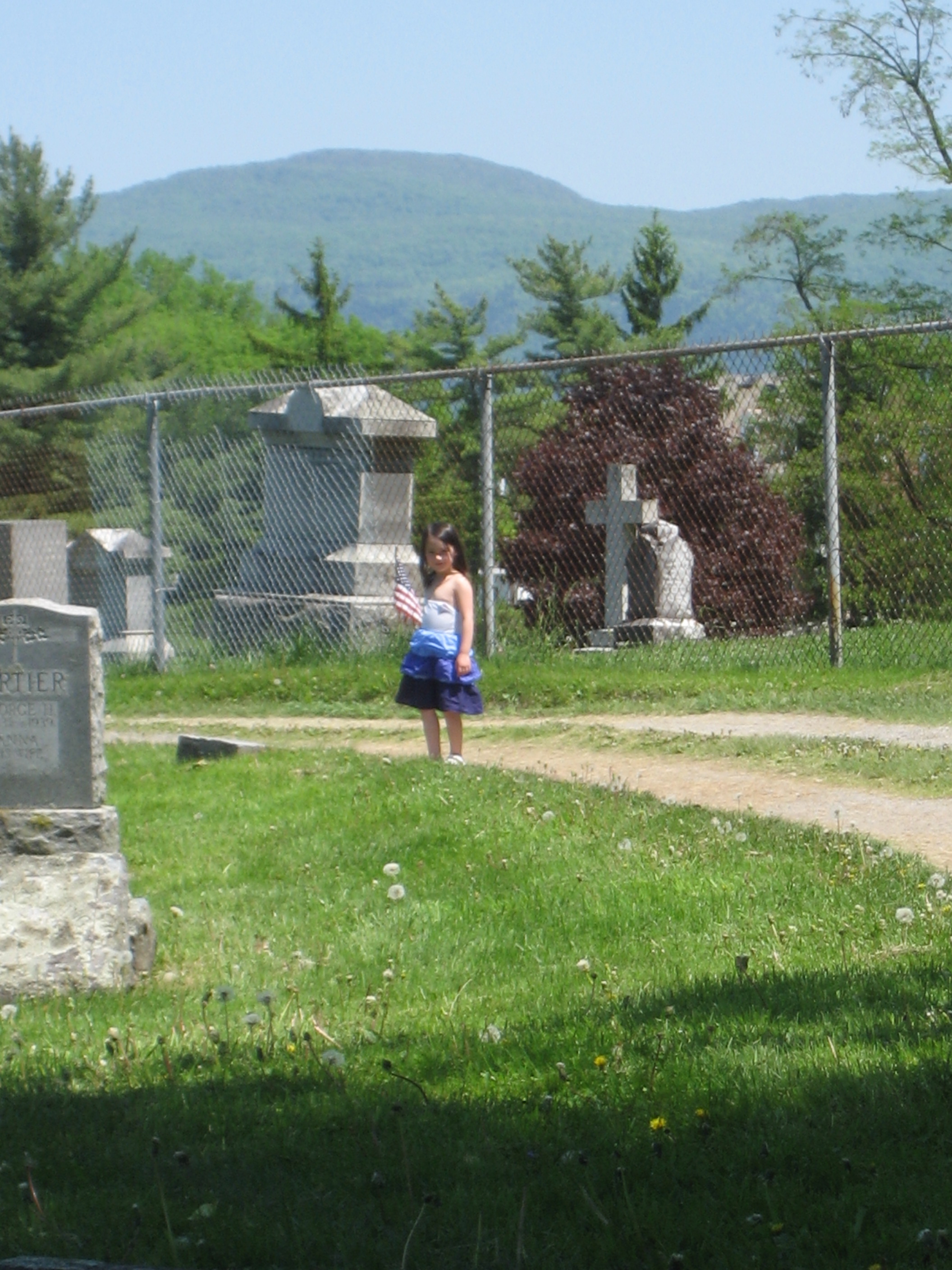
It was a gorgeous Sunday, with temperatures in the mid-80s. We parked on campus and walked through the cemetery’s front gate. During the almost two hours that we spent there, we were almost entirely alone. A few people stopped in to tend various gravesites, a woman walked her dog, and a handful of undergraduates jogged by.
Unflattering photo of me on the steps of the Munroe family crypt, by Fiona.
Fiona and I spent some time wandering among the headstones, and she asked me to tell her the stories of the ones she liked (mostly the ones with sparkly hearts carved into them). I’d forgotten how interesting graveyards can be. In St. Mary’s, there are plenty of brand new headstones, some still lacking an end date. But there are also some very old ones, dating back to the 1800s. It was fascinating to piece together the stories of these people, their family history, their relationships. Because this is a small town, we recognized many of the family names as belonging to people we currently know.
Of course, cemeteries can be poignant — even tragic. One particular family appeared to have lost three children, aged 20, 16, and 6, during a six-month period in 1824. There’s even a section of the cemetery dedicated to miscarried babies.
Photo by Fiona.
But mostly, I found that the cemetery fulfilled its purpose as a resting place. It was incredibly quiet and peaceful. Even Fiona, at four years old, stretched her arms and declared, “This is so relaxing.”
Because it was hot in the sun, after our initial wandering we sought out the shady places: first a low stone wall, where Fiona asked a lot of questions about cemeteries and burial and death while we watched a fat bumblebee in action; next, the steps of the Munroe family crypt, where we drew pictures with the markers and paper; and finally, a bench by the babies’ gravesite, where Fiona directed me in telling her a long, meandering, made-up fairytale. And since Fiona has recently discovered the joys of photography, I brought along our little camera so that she could snap pictures throughout the visit.
Photo by Fiona.Photo by Fiona.
That was it. Nothing profound; I didn’t come away with any new insights on life or death. I just learned that we don’t need to hide cemeteries, or be afraid of them; a cemetery was the perfect, peaceful place to spend an afternoon with my girl.





















 The Pickle Patch