My Way

IMG_2943

Last month, I went to the dentist for my semi-annual cleaning and check-up. I always feel a little smug about going to the dentist, because I have great teeth. I’m not bragging, that’s just the truth. Much to my disappointment back in middle school when everybody else was getting braces, I never needed any orthodontia. I also take good care of my teeth. Not as good as Erick, who is a total tooth nerd (he brings his toothbrush to work with him, and the first thing he does when he gets home at night is rush upstairs and use his water pick), but I brush at least twice a day, floss every night, and visit the dentist twice a year. In my entire life, I’ve only had two cavities, both of which were of the minor, “we’ll just fill it before it becomes a problem” variety. So visiting the dentist is usually an ego boost for me, because everybody makes a big deal about what great teeth I have.

This time, I had six cavities.

You read that right: SIX CAVITIES.

I don’t even know how it’s possible to get six cavities in the six months since I last saw the dentist. I didn’t slack off during those six months: I used a Sonicare electric toothbrush daily and continued to floss every night before bed. Yet somehow I ended up with SIX cavities. I’m now a cautionary tale for dental health in our house. “Brush your teeth,” Erick tells the girls, “You don’t want to end up like your mother with SIX CAVITIES!”

Six is so many cavities, I couldn’t even have them filled all at once. Instead, I had to make two separate appointments, each of which was longer than an entire episode of “Today with Kathie Lee and Hoda.” But as much as I’d usually consider laying in a dentist’s chair watching “Kathie Lee and Hoda” a mini-vacation, I couldn’t hear Kathie Lee OR Hoda because I had a drill vibrating in my head. That, and my dentist tends to hum the entire time he’s working. When I finally made out what he was humming, it turned out to be “My Way.” Which seems like it must have some significance.

When this ordeal was over, I asked my dentist (out of the side of my mouth that still had sensation) how I could have possibly ended up with six cavities. He dismissed all of my theories (pregnancy, non-fluoridated water, UFOs), and said it probably boiled down to this: I’ve been pregnant so much that they haven’t been able to take dental X-rays for over a year, which is how they ultimately found the cavities. Also: AGE.

Yes, age. Despite all of my efforts, my dental health is crumbling because I am getting old.

That’s not a bid for flattery, it’s a statement of fact: I am actually getting old. Last month, I turned 38.

[exhale]

I am 38. That’s very hard for me to admit. I never expected to be embarrassed about my age, but somewhere after 30 I started hiding how old I was. I don’t include my birth year on anything unless required, never volunteer which birthday I’m celebrating. I’m sharing the truth now because I believe in honesty, and because I need to get over this. I try to be confident in who I am as an example for my daughters, and that includes throwing off my vanity about age.

Now, 38 may not exactly qualify as OLD; not unless you’re ready to start calling Angelina Jolie old (Yup, me and Ang, hanging out at the shuffleboard court). But it is objectively middle aged. It’s very, very close to 40, which is a big number.

I’ve hidden my age because I don’t feel 38. I’m not quite sure what it means to “feel 38,” but I suppose I expected to be a little further along by now; to be “together,” to have a better grasp on who I am and where I’m going. And I’m afraid that if I share my age with others, they’ll be disappointed when they find out how confused and insecure I still am.

I remember sitting in my childhood bedroom as a 17-year-old, listening to Stevie Nicks sing “Landslide” on the radio, and feeling time start to speed up. Before too long, I thought, I’ll be where the person in this song is, and I’ll really KNOW what she’s singing about. That was half a lifetime ago; I just heard “Landslide” again, and I feel exactly NO different from that 17-year-old.

Time makes you bolder, children get older, I’m getting older, too.

I think this new year of my life is about accepting my real age, and accepting my real age involves embracing this truth: You can be good and take all the precautions in the world, but everything’s going to break down anyway.

That applies to my teeth, obviously. Also to my body as a whole; barring a major act of God, Abigail will be our last child. That’s not only because four children is a lot (although it is!), but also because this pregnancy was rough on me; my body has let me know that I’m done. And this year, suddenly friends my age are getting sick, really sick. They’re too young, and I’m praying that they all make it through. But it’s a fact that illness and infirmity are going to strike more of our friends — and us, too — in the years ahead.

This might seem depressing. I won’t deny that there are things that make me sad about being 38: knowing that I won’t have another baby, knowing that I’ll start losing family and friends, knowing that I’ll probably log more hours in the dentist’s chair. Then again, there are things that stink about any age; I wouldn’t want to return to the self-centered anxiety of my 20s, for instance.

So I’m choosing to embrace middle age as a new normal: to accept the limitations of aging, and to continue to grab the joys that are always present at every stage of life. That’s what I’ll be trying to do this year, and in the years to come.

I may even be humming “My Way” as I go.

Remembering to Breathe

IMG_2918

I wish you could sit with me on the couch in our sunroom, looking out at the woods. That way I wouldn’t have to use words to describe what I see: the tapestry of leaves, most still the dark green of late summer, but with patches of early fall color bursting out —  new colors appearing each morning. The golden afternoon sunlight that filters down between the trees, making the ground look like the ocean floor every time the wind blows. The shadows moving over the rocks.

I live with this view every day, but of course it’s only occasionally that I see it. Today was one of those moments, with two girls napping upstairs and two girls running errands in town with their father. I sat on the couch for twenty minutes of uninterrupted quiet. It was so quiet, and so still; the only action was what was happening between the leaves and the wind. Do you know how rare that is, in this house?

I sat there thinking about how, almost exactly one year ago, I learned that I was pregnant with our fourth child. And how I spent that year wishing to be where I was right now: When I’m through the first trimester….When the baby is born….When Erick gets back from Africa….When the oldest girls start school again….  It was a crazy, crazy year, a year I felt had to be endured, gotten through, in order to reach a place of — what? Peace, I suppose. A place where I could sit on the couch in quiet, and breathe deeply, and think to myself, Well, we got through that, and it’s all okay now. No more babies, no more puppies, half of the kids in school. From here on out, it’s just smooth sailing.

I probably don’t have to tell you that “smooth sailing” is not what I was feeling on the couch.

I’m gradually coming to accept what I already know to be true:  that there IS no final peace in this life, no point at which you’ve gotten through everything there is to be gotten through, no smooth seas from here to the horizon. I don’t exactly understand why that is. Why are we allowed so few moments of unadulterated joy? It seems like even the happiest moments are marred by troubles, like a gorgeous cake with a fly stuck in the buttercream frosting. Maybe there’s a law of spiritual gravity: there always has to be some bitter mixed with the sweet, or we’d just float away with the joy of it all.

So, for all the challenges of the past year, and for all the joys that have been given to our family, I’m still firmly tethered to the ground. Down here there are postpartum hormones to contend with, and daily screaming sister fights under our roof, and friends and family in pain, and permission forms to sign, and contractors to call.

I sat there on the couch mourning the peace and joy that I’d assumed the universe owed me.

Then I remembered to breathe.

About a decade ago, I started taking yoga. And what really made an impact on me after my very first yoga class was the feeling that I’d never actually breathed before. I mean, of course I’d breathed, because I’d been alive. But yoga made me pay attention to the action of breathing: taking in as much air as I could and then releasing it fully, and continuing this mindful breathing while moving through various poses. The contrast between yogic breathing and my everyday, utilitarian breathing was dramatic. I realized that I’d lived most of my life holding my breath, stomach clenched with stress, taking in only the minimum amount of air needed to sustain life.

It’s impossible to feel stressed or rushed if you breathe the way they teach you in yoga class. If I could REALLY BREATHE like this for the rest of my life, everything would be okay, I thought.

Of course, I don’t breathe like that for most of my life, but every once in a while I remember. Sitting on the couch was one of those times.

So I sat, and I breathed, and I looked at the leaves and the sunlight, and for that one moment, in the middle of life’s drudgery and heartbreak, I felt grateful just to be alive: to be breathing, to be witnessing the dappled beauty of those woods. It wasn’t the ultimate peace I’d expected a year ago: In another few minutes the girls would wake from their naps and start bashing each other over the heads with My Little Ponies, the dog would bark hysterically at a passing car, and I still had to have six cavities filled the next week (SIX cavities! More on that later….).

I suppose we never get to stop enduring; life rarely awards us the long stretches of unadulterated joy that we think we deserve. But there are these moments when we remember to breathe — like spaces in the forest where the sun breaks through.

Teenage Wasteland

"Happy Sweet 16! Here are your wheels!"
“Happy Sweet 16! Here are your wheels!”

Our fourth daughter was born this summer. We now have four girls, aged 5, 4, 2, and 3 months.

Which means that in 13 years, we will have four teenaged girls.

I didn’t consider that scenario when we were planning our family, for the very simple reason that we didn’t plan our family. It all just happened, fast and furious, and when the dust settled this past July we suddenly had four daughters staring at us.

But I’m reminded of our teenaged future almost daily now, because whenever I venture into public with my daughters, someone will inevitably look at us and say, “Four daughters?!? Wow, that’s going to be interesting when they’re all teenagers!” And instead of “interesting,” they sometimes use words like “challenging,” “crazy,” or “horrible.”

Click here to continue reading at On the Willows.

Finding My Drink

IMG_2881

Almost immediately after I turned 21, I started on a quest to find “my drink.” It seemed like an important part of being a legally-allowed-to-imbibe adult. I wanted to have my own signature drink, a reliable cocktail that I could order whenever I went to a bar.

College, where I turned 21, was all about beer — mostly the beer-flavored drink known as Rolling Rock. But I’ve never been much of a beer drinker, never loved the taste.

During January of my senior year of college, I took a wine tasting class that a local restaurant offered to over-21 students. It was fun, informative, and gave me a good idea of what it looks like to know about wine. But wine is about as lost on me as beer; I’ll drink it with dinner if everyone else is, or to appear sophisticated, but to this day I can’t appreciate the various bouquets and flavors and finishes. White wine tends to give me headaches, red wine tends to give me stomachaches, that’s all I know.

That final year of college, my roommate promised to sell me on the virtues of the “Fuzzy Navel,” a drink she claimed to have perfected. For those who aren’t in the know, a “Fuzzy Navel” is made by mixing peach schnapps with orange juice. It’s delicious in a light, fruity way. One of those dangerous, “You can’t even taste the alcohol” kind of drinks.

But, I’m sorry, you can’t possibly continue to order “Fuzzy Navels” when you move to New York City for your grown-up, post-college career life.

During my early days in New York, I tried what other people were having to see if anything stuck. This was the heyday of “Sex and the City,” so I ordered my share of Cosmopolitans (vodka, triple sec, cranberry & lime juices). Not bad, but the thing about Cosmos is that they’re just a slightly more grown-up version of the “Fuzzy Navel:” light and fruity and frilly. Also, in New York City, Cosmos typically cost a lot of money for very little actual drink. And the biggest problem: everyone else was ordering them, so they weren’t really “MY drink.”

Then I started dating Erick, and for a while I had what he had: orange Stoli and tonic. Meh.

Towards the end of our time in New York, Erick and I (now married) had some friends over for a party. One of these friends — a big, boisterous Australian — handed me a drink and said, “You should try this.” It was a Scotch on the rocks.

I don’t remember what kind of Scotch it was, but it was a revelation. Something in me went BAM! THIS is my drink! It might have been generations of alcoholic Anglo-Saxon ancestors talking, but I listened.

Scotch continues to be my drink of choice. I consider it the perfect drink; a woodsy flavor that’s just the right amount of strong, a drink that can stand alone or go well with dinner. I’m far from a connoisseur, mostly because you really shouldn’t drink Scotch while pregnant, and I’ve been pregnant for the past six years. But I’m not anymore!

And that big, boisterous Australian who poured me my first Scotch? True story: He’s now the pastor of a church outside of Boston. One of the many reasons I love God.

NOTE: Please don’t read this as condoning alcohol abuse. Drink responsibly, everyone! Just saying that it’s nice to have a drink to call your own. Mine is Scotch, and I enjoy a glass of it every once in a while after the girls are all tucked in.

Downwardly Mobile

IMG_2295
Not exactly where I thought I’d be….

Last month, Erick and I celebrated our 11-year anniversary. That’s the Steel Anniversary, if you’re the type who follows these things. I’m not, but Erick is; last year, he went to a great deal of trouble to track down aluminum jewelry as a gift for our 10th (Aluminum) anniversary. Yes, it turns out, there is such a thing as aluminum jewelry. The bracelet and earrings that Erick gave me are beautiful, and just about as durable as you’d expect (think aluminum foil….).

I much prefer the symbolism of steel over aluminum when it comes to marriage. Steel is an alloy of iron and carbon (and other elements), and it’s made by blasting iron with extreme heat so that its impurities burn off and carbon is distributed evenly. The result is greatly improved strength. Sounds a lot like marriage to me.

Anyway, Erick and I didn’t exchange steel gifts for our 11th anniversary, because we weren’t actually together on our anniversary: Erick was thousands of miles away in Kenya, setting up a research project. Since I was celebrating my marriage at a distance from my husband, I spent some time reflecting. I thought back to where we were in July 2002, in contrast with where we are now. And I realized that, if our marriage has a unifying theme, it’s that we’ve spent these past 11 years being downwardly mobile: scaling back our lifestyle and ambitions in a way that might look crazy to an outside observer.

Actually, it looks crazy to us, too. We didn’t plan any of this. So little of where you end up in life is intentional.

Here are the specifics:

When we first met, Erick and I held degrees from prestigious, private (expensive) Williams College, and prestigious, public (less expensive) UC Berkeley. I also had a Master’s Degree in education, and was living in Manhattan and teaching at the prestigious, private (VERY expensive) Nightingale-Bamford School. Erick was living in the upscale, exclusive suburb of Greenwich, Connecticut, where he worked at a hedge fund making more money for the already-super-rich.

Dating a hedge fund manager brings certain perks. For the two years leading up to our marriage, Erick and I led a pretty fancy life: we went to fancy parties with fancy people, ate in fancy restaurants, and got free tickets to concerts and sporting events. Our wedding was pretty fancy, too: in a church right on Park Avenue, with a reception just up the block at the Colony Club. After honeymooning in Bora Bora (yes, really), we moved into the apartment we’d bought on the Upper East Side. It was on the 28th floor, with views of the East River. Our first major purchase, after the apartment, was a king-sized four-poster bed.

Things started going downhill almost immediately. Just before our wedding, Erick’s boss decided to get out while he was ahead and close down the hedge fund. Erick stayed on for a couple of years to manage the shut-down, which gave him enough time to return to school for a Master’s Degree in economics. Inspired by a trip we took to Africa, he chose to focus on development economics — NOT the money-making kind of economics.  At the same time, I quit my teaching job and went back to school to study photography — definitely NOT a money-making move.

When Erick’s job at the hedge fund finally ended for good and he received his M.A., he decided to keep going for a PhD. in economics. Thus began his five years as a professional student. We moved to Berkeley, California. We rented a tiny, dark apartment that I always thought of as our “Hobbit hole.”. The king-sized four-poster bed was the first thing to go: it wouldn’t have fit in any of the three places we rented in Berkeley. Inspired by that same trip to Africa, I worked for two nonprofit organizations that offered minimal pay and no benefits.

Then, we started having children.

That history might come as a surprise to people who know us now. NOW we live off of a single assistant professor’s salary. I stay at home with our four daughters because a) I’d have to love any job I took, since all of my income would go towards childcare at this point, and b) there aren’t many jobs I’d love available in Middlebury, Vermont. Our house is the largest we’ve ever inhabited, but that’s due to a combination of our family’s size and the low cost of  Vermont real estate. We sleep in a full-sized bed with a dust ruffle that’s ripped from our daughters climbing up to snuggle. And just the other day, Erick and I had a budgeting discussion in which we concluded that it’s neither affordable nor logical just now for us to buy a slipcover for the armchair with stuffing-spilling holes in both arms.

I’m not making a value judgement on our life then or our life now; I’m just stating facts. But this trajectory that our lives have taken isn’t what you’d have predicted if you’d met us 11 years ago. What should have happened is this: Erick should’ve continued to work in investment banking, making ridiculous amounts of money. I should’ve continued to teach at fancy prep schools, or maybe gone into administration. We should’ve moved to a fancy New York suburb (with that king-sized four-poster bed) and had two children. We should’ve continued to go to Broadway shows and sit courtside at Knicks games and take exotic vacations.

I can’t take pride in being a pioneer who went against the tide, because it turns out that the downwardly mobile course my life has taken is something of a trend. There’s even a book about it: Homeward Bound by Emily Matcher which, according to a blurb in The New Yorker, “follows college-educated, middle-class American women who have rejected cities, consumerism, and corporate culture in favor of very old-fashioned house- and family-keeping.”

Actually, I can’t even claim to be one of Emily Matcher’s women, either, because the blurb goes on to say, “They grow their own vegetables, knit their own clothes, and homeschool their children. Some run their own farms.” Good Lord, I do none of those things.

Which leaves me stuck in downwardly mobile limbo. I’m sitting here with the phantom of my earlier promise hanging over my head (high school valedictorian, $100,000 liberal arts education, two graduate degrees), and I’m not even canning my own beets or doing flashcards with my kids. I bailed on the workplace in favor of home, but am I failing on the home front, as well?

Sometimes I feel guilty about these things, about my place in society’s big picture. But mostly I’m just grateful for my life right now, and happy. I think that’s the story of our marriage, and of this blog, too: There’s a sort of sweet bafflement about where life has taken us. Never did I expect to be a stay-at-home mother of four in small-town Vermont. But never did I expect that downward mobility would bring so much joy upward.

What I’m Reading in the Middle of the Night

IMG_2538
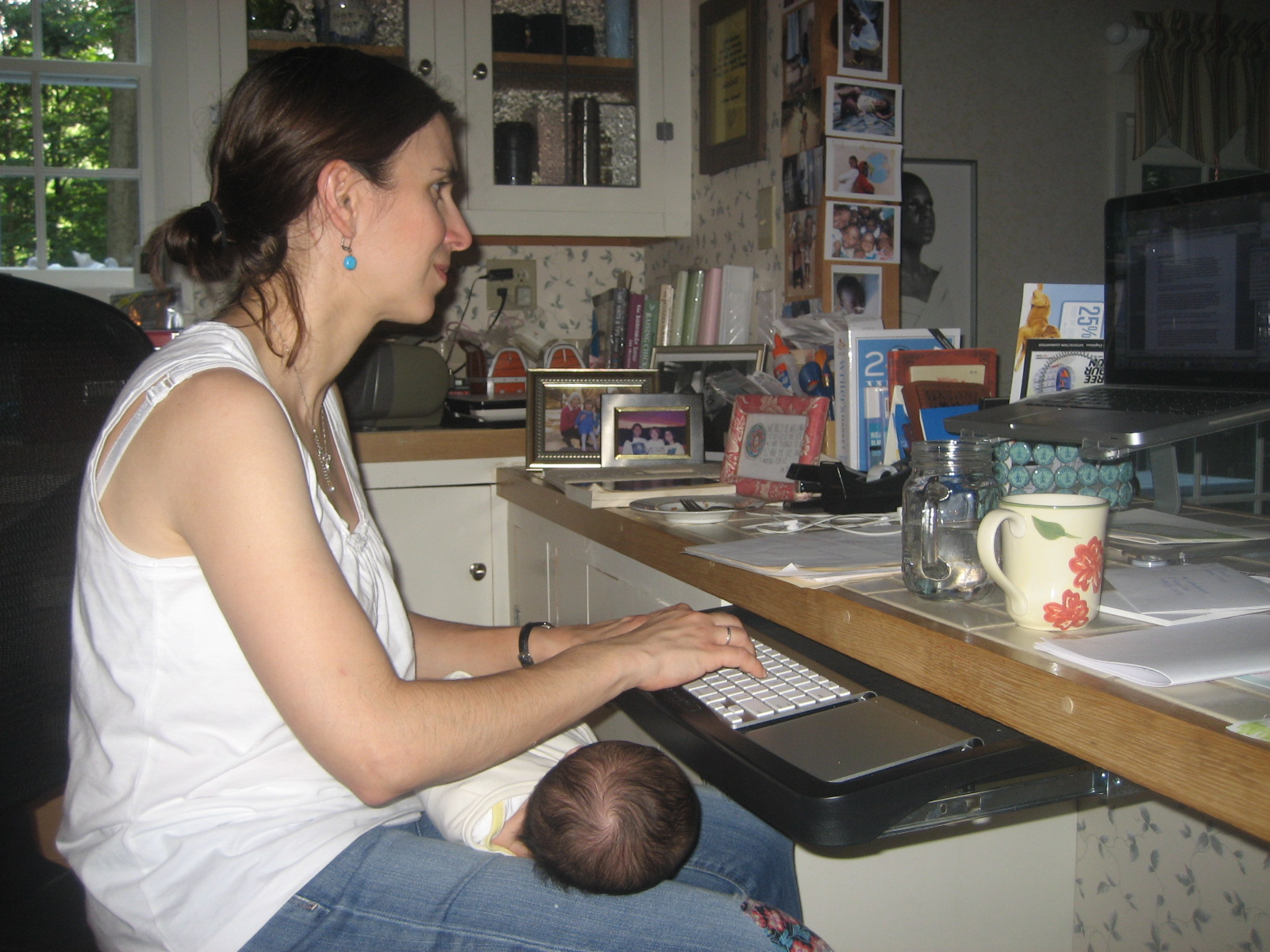
Photo by Fiona: Not exactly how I read at night, but it’ll give you an idea of how I’m writing this blog these days. Can you spot the baby in this picture?

My very favorite thing about nursing a newborn is that it gives me the chance to catch up on my reading.

That may seem counter-intuitive; you’d expect babies would put an end to maternal reading. But in my experience, the reading moratorium only happens once my children start sleeping through the night; when they’re up every two hours all night long, I tear through books faster than a bag of popcorn.

That’s right: I read in the middle of the night while I’m feeding the baby. While this might not be necessary for all mothers, it’s necessary for me. In fact, it’s necessary for me to get out of bed, sit up in a chair, and read while feeding the baby. Why? Because two babies ago, I fell asleep while nursing (and reading) in bed, and dropped the baby. Sitting in a chair with a text is my insurance policy against that ever happening again.

So, in preparation for Abigail’s birth, I went to the Vermont Book Shop and loaded up on books. Unfortunately, Abigail was 10 days late, so I read through most of those books during the agonizing wait before her birth. No matter: This time around, my nighttime reading has been revolutionized by a Kindle, a gift from my high-tech mother-in-law after she upgraded her own model. The Kindle is brilliant for reading-while-nursing because you don’t even need to hold it in order to read.

Books that will keep your attention at roughly 12:30, 2:30, 4:30, and 6:30 AM are worth sharing, so here’s a list of my favorites from the past couple of months:

The Language of Flowers by Vanessa Diffenbaugh

This book reads like silk — it’s so beautifully written and compelling that I found myself looking forward to frequent feeding times! The subject matter is a little rough, about a girl who’s come out on the wrong side of the foster care system and has difficulty forming relationships. But it’s ultimately a redemptive story about families — mothers and daughters, in particular — that taught me something new: the Victorian concept that every flower expresses a certain emotion or idea, which is the method the heroine uses to communicate.

Cloud Atlas by David Mitchell

NOT necessarily an easy read, but more of an, “Oh my gosh, how did he WRITE this?!?” kind of book. Mitchell weaves together stories spanning from the past into the future, and each story is written using a completely different style and dialect. Thematically, there’s so much going on that I’d need to take a 24-hour meditation retreat in order to get my brain around it all. But the over-arching themes of good vs. evil, interconnectedness, and reincarnation are breathtaking enough.

Lots of Candles, Plenty of Cake by Anna Quindlen

I picked this up because I’d never read a book by Anna Quindlen before and wanted to check her out. It’s a series of essays about womanhood, written from Quindlen’s point of view as a 60-something wife, mother, daughter, and writer. (Right up my alley, in other words). I thoroughly enjoyed her humor, optimism, and balanced perspective as someone who fought to have a career as a female journalist during the 1970s, but also wanted to have a quality family life.

The Dinner by Herman Koch

This was my book club’s July selection, and it was almost impossible to put down. I believe it’s also the first book I’ve read by a Dutch author, which was interesting; I’m suddenly much more aware of The Netherlands. Most of the “action” takes place in the form of one character’s interior monologue during a dinner with his brother. It starts off innocuous enough, then evolves into a psychological thriller. A great summer read if you’re prepared to suspend some disbelief.

Crazy Salad by Nora Ephron

I’d read somewhere that this collection of Ephron’s women’s columns for Esquire from the 1970s was a “must-read” for all women. So I read it. It’s sort of like a prequel to Anna Quindlen’s book: the book Quindlen might have written back when she was fighting for a career as a female journalist in the 1970s. It’s a little angry (verging on nasty, at times) for my taste, but it made me appreciate how ferociously the early feminists fought for things that we take for granted today.

The Burgess Boys by Elizabeth Strout

Elizabeth Strout is one of my very favorite authors. I’ve read all of her previous novels — Abide With Me, Amy and Isabelle, and Olive Kitteridge (which won the Pulitzer Prize). Each of these books is set in small-town Maine, and Strout has a gift for capturing life in a small-town community, the intricacies of family relationships, and moments of small but soul-stirring grace. The Burgess Boys is her latest novel, and it’s my least favorite. It centers on the shockwaves that shake the lives of three grown siblings when one of their sons commits a hate crime against the new community of Somali immigrants in a small Maine town. Strout’s trying to do a little too much in this book — it feels Tom Wolfe-ish in its collection of numerous, thinly-drawn character types. But it’s still a compelling read, with some important things to say about the changes happening in contemporary New England.

There you have it: books that will keep you awake no matter what the time! As summer winds down, I hope that you’re all enjoying the last days of summer reading. Feel free to share some of your favorites; I still have a few months to go before I’m sleeping through the night!

“You Look Great!” and Other Post-Partum Lies….

IMG_2362

It’s a funny thing, having a fourth child. The idea that I should be an old pro by now has been disproved at every stage of Abigail’s pre- and post-natal life: Pregnancy always seems to have fresh discomforts up its sleeve, babies don’t arrive when and how you expect, and nursing a newborn every two hours is still exhausting. Whether you’ve just had your first child or your fourth, it turns out that the baby-birthing process is new each time, with its own particular blend of joys and struggles.

But there’s one thing, I’ve found, that stays relatively the same after each birth, and that’s what other people say to you. Having heard these pithy exclamations and encouragements four times, I have now realized two things:

1. People are so, so kind in those first post-partum weeks. Strangers will fall all over you and your baby whenever you leave the house until you feel like a celebrity.

2. They are lying to you.

Yes, they are. These are kind, well-intentioned lies, of course; the sort of lies we all tell each other in order to get through the days. But they are lies nonetheless. I didn’t realize this when I had my first, second, or even third child. But now I’m no longer under the illusion that I’m a celebrity for having recently given birth. No; by the fourth time around, I’m just another person contributing to global overpopulation, and I know enough to call out the following statements as lies:

1. “You look great!”

This is one of the first things that people exclaim when they see you post-partum. The implication is — sometimes this isn’t merely implied but stated — that you “look like you haven’t even given birth.” In other words, you do not look exhausted, unwashed, and awkwardly in-between hugely pregnant and not pregnant. This is intended as a compliment, and reflects our culture’s sad obsession with the body, in which celebrity magazines mock women for pregnancy weight gain and praise them for modeling lingerie two weeks after giving birth.

And it’s most likely a lie — at least when said to me. Maybe you look great. but I certainly look exhausted, unwashed, and puffy. I can no longer stand to wear maternity clothes, but I still can’t fit into most of my pre-pregnancy clothes, which leaves me with three baggy outfits stained with lanolin, spit-up, and sweat. I’m sleeping in one-hour increments. I’m permanently hunched from carrying the baby all day. When I do bathe, it’s a harried process of handing Abigail off to my husband and racing through a shower while trying to ignore her screams. I may look many ways, but “great” is not one of them.

NOTE: This comment, however inaccurate, is MUCH better than the question — which I have actually been asked — “So, have you lost the pregnancy weight yet?” I can’t fathom what would possess somebody to ask this of a new mom, but if you’ve ever considered it — DON’T.

2. “She’s so beautiful!” Now listen: I love my babies. I think they’re beautiful, but that’s because I’m their mom and I’ve just struggled to produce them at great expense to my body and my health insurance. But are they truly, objectively beautiful? Of course not. All of my newborns have looked like plucked chickens — and not the plump butterball chickens, but the scrawny ones headed straight for the chicken nuggets pile. They are coated with fuzzy hair and peeling skin. After a few weeks, the peeling stops and the baby acne starts.

In time, they will become truly, objectively beautiful, but they’re not there yet.

3. “Nursing shouldn’t hurt at all.” Okay, this may be an uncomfortable topic for some non-moms, but I promise no graphic details. I feel that this lie is important to unmask as a public service. While it may not be a universal experience, I’ve had numerous new moms question me — with shame and discouragement in their voices — about the pain they’re experiencing with nursing. So let me be honest:

I think nursing is a great thing (though certainly not the only thing). I have nursed all four of our children. And every single time it hurt like the dickens for the first month or so. At times I was concerned that I was scarring my children for life because their earliest memories would be of their mother yelping in pain whenever they ate.

That’s bad enough, but what made it worse was that every single time, some well-meaning labor and delivery nurse or lactation expert would tell me, “It shouldn’t hurt to nurse. If it hurts, you’re doing it wrong.” Now, I certainly advise new moms to consult a nurse or lactation expert about nursing, because they’re very helpful. But as far as I can tell, this bit about nursing being pain-free is a lie. (And I have professionals to back me up on this: For the first time, I have a female ob/gyn who nursed two children of her own, and according to her the notion of pain-free nursing is “a load of bull.”)

So I say: nurse away, give your body a month to toughen up, and don’t let them make you feel worse by selling you a lie.

4. “It gets easier.” I can’t yet claim with total authority that this is a lie, because I’m still on the front lines of parenting very young children. But every time a kind veteran parent encourages us by saying, “It gets easier,” I’m starting to suspect that they just might be lying in order to buck us up. And that’s okay: It’s okay if it doesn’t get easier. I didn’t sign up for parenting with the mistaken impression that it would be relaxing.

I think it’s true that the newborn days are a special kind of hard: There’s nothing quite like having to hold and feed a baby round the clock. But, as I’ve written before, my sense is that parenting doesn’t really get easier the longer you do it, it just gets different. For instance, next year our two oldest daughters will attend two separate schools, each with different start and end times. These two daughters are also cultivating their own groups of friends and starting to get involved in extracurricular activities. All of this presents a series of logistical challenges that were unknown back in the pre-school days when we had a newborn and a toddler or two at home. And something tells me it ain’t getting any simpler.

What to make of these post-partum lies? I’m really not trying to paint a depressing picture of people, or of post-partum life. As I’ve said, these lies reveal people at their kindest, most encouraging. For all I know, most of the people who say these things sincerely believe that they’re speaking the truth.

Maybe the best thing about fourth-time parenthood is having the assurance that, even if these statements aren’t true when they’re first spoken, that’s only temporary. Soon enough, you will look great — or at least, less like a misshapen blob of exhaustion. Soon enough, your baby will be beautiful — or at least, less of a scrawny, naked chicken. Soon enough, nursing will be painless — and before you know it, they’ll be demanding juice in their sippy cup. And whether or not parenting gets easier, soon enough you’ll be converting your children’s rooms to accommodate visiting grandchildren.

Then, when you see a new mother, you’ll smile and tell her that she looks great and her baby is beautiful.

What NOT to Expect When You’re Expecting….

IMG_2330
I feel like this photo says a lot about our family dynamics….

Back when I was teaching third grade, I worked with a dedicated co-teacher who was about 25 years older than me. Every once in a while, this teacher would sigh and say, “It’s hard being a grown-up.” Since I was 23 years old at the time, I’d smile and nod knowingly, but I didn’t really have any idea what she was talking about.

Now I do: It’s HARD being a grown-up, because it feels like you never actually reach the elusive state of being finally, completely GROWN UP. I keep thinking that the day will come when I’ll feel like a fully-actualized grown-up; when everything I’ve learned and resolved and written about will crystallize, and I can just coast along in my grown-up-ness for the rest of my life.

I’m starting to think that’s never going to happen.

Take my experience in late May/early June, for example. There I was, 9 months pregnant. Each day brought me closer to my due date: June 6. I was cruising along, trying to be peaceful and nonchalant about the whole thing; after all, this was my fourth pregnancy, so I should be a pro, right? I even wrote a piece on this very blog about how I’d learned NOT to plan too much because every past childbirth experience had thwarted all of my “plans.”

Guess what? I lied.

While I wrote that piece with my conscious brain, my subconscious brain was busily building a fortress of expectations. It went something like this:

“Because this is your fourth child, and also your LARGEST baby, and also your most uncomfortable pregnancy, this baby is surely going to come early. Let’s just hope you make it to 37 weeks! Best to be totally prepared a month in advance: buy newborn diapers, return the books that you’ve borrowed, finish sewing the doll dress that you haven’t touched in six months, watch the Season 3 finale of ‘Downton Abbey.’ Stop putting new events on the calendar, and if you do add something, make sure to specify that it’s ‘pending baby’s arrival.'” Every night for a month, I went to bed with all of our family’s ducks in a row, just in case I gave birth overnight. It was exhausting.

The weeks passed: 37…38. I attended events that I’d been certain I’d miss. My parents wanted to be present for the baby’s arrival, and by 39 weeks life was getting hard enough that we called them to come up early. At that point, I joked, “You know, if you come up early, I’m sure this baby’s going to be a week late.” Ha. Ha.

I started having regular, strong contractions five days before my due date, but I knew not to take them seriously until I’d given them time. Sure enough, the contractions stopped. That’s how it went for the next week: contractions, nothing, contractions, nothing. My emotions followed a similar cycle: frustration, excitement, depression, acceptance, and back to frustration.

Suddenly, I was looking at my due date in the rearview mirror. I couldn’t believe it. How had this happened to me? Every morning, I’d wake up and realize with a sinking feeling that I hadn’t had the baby. I started calling the fetus “Godot,” as in: “Waiting for….” That might seem good-natured, but remember that Godot never actually shows up? I was certain that I was the exception to the rule that nobody STAYS pregnant: I would be 9 months pregnant forever. I dreaded going out in public, because I’d have to discuss my lack of a baby with everyone I ran into — AGAIN. A neighbor whom I hadn’t seen in a few months did a double-take: “ANOTHER one?!? This is number FIVE, right?” No, still pregnant with the SAME FOURTH CHILD.

I felt stupid for allowing myself to develop expectations. I felt guilty, because I started resenting the baby: The LEAST you could do is be born when we expected! What gives?!?

Somehow, AGAIN, I’d stumbled into the delusion that I had control. I’d let myself think that I knew, better than my body or my baby, when this birth would happen. It was deja vu all over again: NO, you DON’T have control, dummy!

As a side note, here are a couple of things that are NOT helpful to tell a woman who’s waiting to give birth. (Both said to me by loving and well-intentioned family members):

1. “You just have to wait on God’s perfect timing.” This is very true. But the thing about God’s perfect timing is that it’s best appreciated in retrospect. I’ve often looked back and thought, “OOOOH, I didn’t understand it at the time, but God knew what he was doing.” However, telling me when I’m in the middle of waiting that I need to depend on “God’s perfect timing” only leads me to one response: I know he’s GOD and all, but in this case, God’s timing is clearly WRONG WRONG WRONG!

2. “You just need to relax and not think about it.” This advice almost always comes from a male. Telling a 9-months-pregnant woman to relax and not think about giving birth is the equivalent of saying, “Hey, you have a 150-pound anaconda on your head! Just relax and don’t think about it.”

Waiting to give birth is HARD. There’s the physical discomfort: huge belly and swollen feet and sleepless nights. But there’s also a mental component. No matter how many times you’ve done it, pregnancy is harrowing: nine months of trusting your body, hoping the baby you can’t see will be okay, giving up control every second of every day. By the end, I always have lack-of-control fatigue; I just want to SEE this baby, to get it on the outside so that I can care for him/her with my own hands. To have the illusion of control.

*****

Everything above was written on June 10;  Abigail Esther was born early on June 16, 10 days after her expected due date. In retrospect, of course, the timing was perfect: I was able to participate in every major June event on our family’s calendar, my parents were still around to help (they’d planned to give up and leave the very next day), and — as a lovely gesture to Erick, as if to compensate for the 1:5 male:female ratio she created — Abigail decided to arrive on Father’s Day. She arrived on her own timing, four days before my doctor would have induced labor.

She was worth waiting for. And her tardiness was consistent with her character thus far; Abigail has been the easiest of all our babies and seems — in contrast to her sisters (and her mother) — almost relaxed.

So, if I had to do it all over again (which I can virtually promise you I WILL NOT), I’d remind myself every day that prior experience and due dates mean very little. Part of being a grown-up is accepting how little we can control or predict anything in our lives — and realizing that that’s usually a good thing.

Lesson learned. Again.

Help!

I’m baaaack! This is my first official Pickle Patch post since taking “maternity leave” in late May. And I’m excited, because this is a post that I feel passionate about. It came about based on MANY conversations I’ve had with other women. I’m hoping that, for those who need to hear it, it’ll provide your daily dose of liberation. Surviving as a woman is all about daily liberation, isn’t it? I feel like every morning I have to liberate myself from my own expectations — or from what I imagine others expect from me: those expectations that I’m going to be a perfectly calm and loving wife and mother who completes numerous educational crafts with my children, maintains a perfectly neat house, prepares delicious meals (always with home-baked bread), plants gardens, and stays fit and fashionable. Sound familiar?

The-Lone-Ranger

As you may know, an important part of this blog for me is that it’s an exercise in honesty. I’ve confessed that I hate housework, that I’m not a gourmet cook, and that I’m a very imperfect person. You’d think there wasn’t much else to confess, wouldn’t you? (I mean, apart from things that would bring the Vermont State Troopers knocking on my door.) How much lower can you get than being an imperfect, messy person who can’t cook?

Well, there is something else; one of the hardest things I’ve ever confessed: I HAVE HELP.

That’s right; my life might be more of a rusty clunker than a well-oiled machine, but I don’t do it alone. We have two amazing sets of grandparents, and between them there are grandparents visiting us almost monthly. The minute they walk in the door, I throw the kids and a household “To-Do” list at them, and spend the next week in the coffee shop. During the school year, my two oldest girls were in preschool three FULL DAYS a week (I consider this “help” more than “education”). All summer long, we’ve had a wonderful high school girl who bikes to our house two mornings a week and plays with my older girls so that I can focus on the baby and various chores. AND we have a lovely woman who cleans the house twice a month.

I owe thanks to many of you for our house cleaner. Last fall I wrote a post renouncing my passive-aggressive attitude towards housework, having gained the perspective that MY HOUSE IS NOT ALIVE. And multiple readers responded along the lines of: “That’s a nice insight, but you should consider having someone come help out with the housework once in a while. I do.”

I was shocked. It had never occurred to me that so many other women — some of them working, some of them stay-at-home, none of them fabulously wealthy — might actually hire cleaners. So, a short time later, when a local friend confessed that her “little secret” was a wonderful cleaning woman, I took it as a sign from the universe and asked for the cleaning woman’s contact information.

This led me to question: Why, for so many women, is this kind of help considered a “little secret?!?” Why do we have so much trouble admitting to each other that we need or receive help? Why are we still burdened by the expectation that we need to do everything, and that outside help is a sign of weakness or incompetence?!?

I’m announcing our cleaning woman on the internet, but this isn’t information that I’d normally disclose to anyone with whom I wasn’t extremely comfortable. I feel a little embarrassed about it. Why? Well, I tend to think of cleaning women as belonging to the world of the rich and famous: luxuries employed by mothers whom I’ve heard dismissed by the phrase: “Of course, she has TONS of help.” (That phrase is never, ever meant as a compliment).

And another thing: I’m a stay-at-home mom. My JOB is to care for my family and home. What on earth is wrong with me that, with all the hours in the day, I can’t manage to keep my own house clean without outside assistance?

In short: What justifies the luxury of a cleaning woman in a household with a stay-at-home mom and the income from one assistant professor’s salary?

The best answer I have is: My Sanity. COULD I do all of the Superwoman things I feel that I should be doing — care for four kids and a puppy, love my husband, make delicious home-cooked meals every night, maintain flawless gardens, sew all of our clothes, decorate the house with my own hand-made crafts, carve out some daily time for reading and writing and exercise, and take charge of all the cleaning? I probably could, but I’d be a mess. Sooner or later I’d burn out, and the whole house of cards would come down on all of us.

Instead, we have a cleaning woman twice a month, and she’s been a lifesaver. We initially hired her because the physical act of housecleaning became difficult for me during late pregnancy, but we’re keeping her on post-baby. Having her come twice a month is nice, too, because I still feel like I’m responsible for maintaining the house on those weeks when she doesn’t come (although often I’m lazy and let things slide). Her help has taken just enough off of my plate so that I feel a little more sane, a little more able to focus on enjoying my family and making time for the things that recharge my batteries.

Don’t get me wrong: a cleaning lady IS a luxury. I know that hiring help doesn’t fit in everyone’s budget. We’re certainly not super-wealthy; we’ve prioritized this by sacrificing some other things.

But really, I’m talking about something larger than cleaning ladies, or budgets. I’m talking about GETTING RID OF THE IDEA THAT WE SHOULDN’T NEED HELP. Because obviously help isn’t just something that you pay for: It comes free, too, when we take up friends and family members on their offers to watch our kids for a while, to bring over a meal, to run an errand.

I’m trying to avoid the over-used quote that “It takes a village to raise a child.” But that’s essentially what I’m saying. The longer I do parenthood, the more convinced I am that WE WERE NEVER MEANT TO DO THIS ALONE. For centuries, before post-secondary education and changes in industry and infrastructure made it possible for people to leave their hometowns, most people stayed close to family. You might even raise your own family in the house where you were born, surrounded by parents and siblings and extended family who could help with the chores, or at least hold the baby for five minutes.

That might sound like a mixed blessing, and I’m sure it was. But now most of us have to build our own support structures when it comes to caring for a home and a family, asking for or hiring help that used to be a given. So, where did we get the idea that to be a parent (especially a mom), one needs to be a Lone Ranger? Why are we guilty about getting help? Why are we afraid to admit to others that we NEED help?

I’m going on record: I need help. I get help. And I’m getting better at accepting help without worrying that I’m unworthy or lazy or incompetent.

After all, even the Lone Ranger had Tonto.

College Town

Originally published in October 2012. This was one of the most difficult posts for me to write, and it felt like a pretty major revelation — that I’d spent my college years with no sense of self, screwed up royally, and suffered from depression and anorexia. Interestingly, it got very little response the first time around, which might indicate that perhaps my own experiences weren’t as rare or as shocking as I’d thought. I guess they never are, are they?

****

‘Does it hurt?’ asked the Rabbit.

‘Sometimes,’ said the Skin Horse, for he was always truthful. ‘When you are Real you don’t mind being hurt.’

-from The Velveteen Rabbit

What happens when you end up living in a college town that’s almost a carbon copy of the town where you spent your own undergraduate years?

I went to Williams College, a small liberal arts school of about 2,000 students in Massachusetts’ Berkshire Mountains. I now live near where my husband teaches: Middlebury College, a small liberals arts school of about 2,000 students in Vermont’s Green Mountains. When he was interviewing for his job, Erick knew that I had some concerns about the deja vu aspect of this move, so he specifically asked his future colleagues how Middlebury differed from Williams. “Oh,” they scoffed, “Williams is out in the middle of nowhere. It’s tiny. Middlebury is much more of a town.”

I found — and still find — this comparison hilarious. It’s like arguing the relative difference between a flea and a gnat. In fact, as of the 2000 census Middlebury’s population was 8,183; Williamstown’s was 8,424. (And please note that those numbers include the  2,000 undergrads who descend on each town for nine months of the year). Both towns are centered around a single main street. It may be true that Middlebury’s main street is slightly longer, with slightly more offerings that Williamstown’s. But I’m living in essentially the same town where I went to college.

So far, it’s been interesting how little I’m aware of living in a college town. Sure, my husband goes off to work at the college every morning. Sure, I’ll occasionally notice students walking around downtown. Roads and restaurants are busier during special weekends when the students’ families come to town. Many of our friends work for the college in some capacity — but by no means all of them. There’s an unofficial “college pew” at our church where all the students sit together. Our daughters take swim lessons taught by members of the college swim team at the college pool. We’ve even had students from Erick’s senior seminar over to our house.

That sounds like a lot of interaction with the college, but it’s such a vastly different experience from when I actually attended college that I seldom feel any deja vu. As a mother of three, more than a decade out of college myself, I’m in a different world. We’re a 15-minute drive away from campus, and — what with the three young kids — we don’t attend many campus events. Shockingly, the undergraduate population tends not to breakfast at 7 AM, hang out in the children’s room of the public library, frequent the local playgrounds, or eat dinner at 5:30 PM. So we don’t see much of them.

When I do see groups of undergrads going about their college lives, they seem very young, and very loud. Their confidence and energy make me a little nervous. They appear to float on their own potential; most of them haven’t yet felt life’s hard blows that cultivate humility and empathy.

I look and them and think, NOT FOR ANYTHING WOULD I WANT TO BE BACK WHERE YOU ARE.

College was not a particularly happy time for me. As I understand it, many people look back on college as the best years of their lives: years when they forged lasting friendships, joyfully experimented in both the academic and personal arenas, and emerged after four years having found themselves.

For me, college was when I lost myself.

This may come as a shock to some people who knew me during college — perhaps even to most people who knew me then. I put up a very good front, as I’ve done for most of my life, because that’s what good girls do.

When I arrived at Williams, many of my peers seemed to already know who they were and where they were headed. They’d survived the proving ground of high school, and now they were ready to soar off on their talent. Sure, some edges needed to be smoothed, but at a basic level they were who they would be. Maybe it only seemed that way, but over a decade later these college friends and acquaintances still appear to be fundamentally who they were back then.

I was not that undergrad. I came to college looking like I had it all together, having spent the first 18 years of my life being perfect: working hard, getting good grades, going to church, and trying to make everybody happy. High school wasn’t much of a proving ground for me; I more or less breezed through it with a group of like-minded peers.

Problem is, trying to be perfect and make everybody happy for 18 years doesn’t leave much room for becoming a real person. I was 18 years old and I didn’t have a single opinion of my own. Going to church didn’t help me with identity formation, frankly, because if you’re perfect then you completely miss the point of grace. How can you receive forgiveness and love despite your failings if you’ve never actually failed?

No, when I arrived at college, I was more like the description of a crab cake I once saw on a menu: “Just enough binding to hold it together.”

If this were a novel or a movie, what would happen to a protagonist like that? Clearly, they’d have to fail. Something would have to rip apart the binding of their fragile self so that the pieces could be put back together more securely. It’s an old story. It’s The Velveteen Rabbit: the toy bunny needs to be discarded on the trash heap with a broken heart in order to become Real.

And, thankfully, that did happen to me: I made mistakes. The specifics aren’t important. These weren’t major crimes against humanity; they were the kind of mistakes that happen when you wander through four years of college without knowing who you are. But they were major to me, because I wasn’t supposed to make mistakes. And it wasn’t pretty; the ripping apart of my binding that began in college resulted in a three-year post-college morass of depression and anorexia, during which time I distanced myself from friends and family. It wasn’t until I found grace and Erick — almost simultaneously — that my pieces started to come together again.

I missed my college reunion this year (because our California family was visiting) and I’m very sorry that I did. None of this was college’s fault; I still have fun memories, and I made some friends whom I hope to know forever (and whom I wish I saw more often!). I wanted to be at that reunion, because I think that most people who knew me in college didn’t really know me. I’d like to have a chance to get re-introduced.

So, these are the thoughts that enter my mind when I come into contact with undergrads these days. I’m glad for those moments, for living in a town that allows me periodic flashbacks to the lost-est time of my life. I wonder how many of these students — underneath their pulled-together, confident exteriors — are just as much of a mess as I was back then. (For that matter, I wonder how many of my own college peers were just as much of a mess as I was back then? Probably a fair amount).

NOT FOR ANYTHING WOULD I WANT TO BE BACK WHERE YOU ARE, I’d like to tell these undergrads, BUT NOT FOR ANYTHING WOULD I HAVE SKIPPED IT.

Here’s what I would have skipped: My panic and shame at having my perfect front deconstructed. It was that panic and shame that I took out on my body, my family, my friends. And for that, I’ll always be deeply sorry.

So if I were to give advice to any undergrad who, like me, arrives at college as a hollow shell of “perfection,” it would be this: DO NOT PANIC when you discover that you’re not perfect after all. Welcome it as the thing that will make you who you are, as radiation therapy for your soul. But don’t wallow. Show yourself some grace. Gently pick up your pieces and start looking for the tools to put yourself back together again.

In a recent segment on the NPR program This American Life called “The Ghost of Bobby Dunbar,” a woman from a family that had suffered tragedy, deceit, and mistaken identity concluded, “If you hate that it happened, then you hate that you are.”

If you hate that it happened, then you hate that YOU ARE.

You should never, EVER, hate that you are.