Children Get Older

IMG_5096

That title seems obvious. But is it, really? Like most obvious life facts — you should floss daily, we’re all going to die, squirrels are evil — the always-advancing age of our children is something we’d rather not think about. So, mostly, we don’t.

In this area, I think parents of young children tend to suffer from lack of imagination as opposed to denial. It’s just impossible to imagine (even if you had the time) your helpless baby or your adorable toddler as a scrawny grade-schooler who reads to him- or herself, is capable of running a vacuum cleaner, and who also occasionally rolls his or her eyes, snaps “I don’t care!” and slams the bedroom door.

I myself can imagine only as far as that grade-schooler, because I have one now. Middle and high school are still shadowy places on the distant horizon — although they’re becoming ominously clearer the more I experience grade school behavior.

“Just wait,” every parent of young children has heard from certain well-meaning (probably) and honest (undoubtedly) parents of grown children, “it only gets harder.”

As a parent of four, with one foot in early toddlerhood and one in early grade school, I’m not convinced that “harder” is the right word. There’s not much that’s “harder” than waking up every two hours throughout the night to nurse an infant after enduring toddler tantrums, managing sibling squabbles, and serving as activities coordinator/chauffeur/errand runner all day. Granted, I speak with limited authority — I have yet to see a child through to adulthood — but I think those experienced parents are trying to say that the struggle moves from the physical realm (How do I stay alert and lug the grocery bags and my children?) to the mental/emotional realm.

By mental/emotional realm, I mean a little something like this:

You are standing outside a door that your 7-year-old has just slammed, after rolling her eyes and shouting “I don’t care!” The precipitating event changes (you weren’t properly attentive to her artwork, you let a sibling share first at dinner, you used the wrong tone of voice when making a request), but the underlying issue is always the same: she doubts your love. She’s angry with you for falling short, and she’s also angry with herself for still needing you. It spiraled out of control, and now you stand in the hall, thinking: She needs discipline; I can’t allow her to talk to me like that. I need to set boundaries of respectful behavior, to be tough. But also, she needs to know I love her, no matter how she behaves. She needs affection and reassurance. 

And you think that there’s probably some perfect combination — if you could just balance the right amount of toughness with love, or find the exact words — and the lock will spring and her eyes will light up again and you’ll hug and she’ll mend her ways and become a kind, well-behaved, well-adjusted adult. Otherwise, you imagine, she’s in for a lifetime of conflict, broken relationships, hundreds of dollars spent on therapy and pharmaceuticals.

You feel all this, because you’ve been there, on the other side of that door — it seems like just minutes ago. But you can’t quite remember what would have made the lock spring back then; you only remember the hurts that you’re still getting over.

That’s the mental/emotional realm.

[Side note: “I don’t care,” with its dishonest bluster that hides anger behind indifference and shuts down further discussion, has become my least favorite phrase. I understand now why Maurice Sendak devoted an entire children’s book — the classic Pierre — to its dark potential. I’m convinced that most of the world’s ills can be blamed on “I don’t care.”]

What the “It only gets harder” parents never told me is that adolescence — by which I mean the basic Webster’s Dictionary definition of “the state or process of growing up” — seems to begin around 1st grade. According to the American Academy of Pediatrics:

Now prepubertal, bigger, more interactive, and involved with friends, the emotionally developed 7- and 8-year-old child now uses his increasing cognitive strengths and communication skills to plot a developmental trajectory toward mature independence and autonomy. His newly formed superego, or conscience, allows the understanding of rules, relationships, and social mores. Moral development progresses. Early experiences with separation foster individuation.

Or, to quote my college developmental psychology textbook: “Parents report that children at this stage are often sulky, depressed, or passively noncooperative, or that they avoid them after an angry conflict.”

I thought I’d have more time to prepare before the eye rolls, the slammed doors, the “I don’t care”s.

When we were first-time parents, an older friend of my husband’s told him, “All you really have to worry about between birth and 2 years is  keeping them alive.” This is good advice. The following two years are spent enduring tantrums. Then, after roughly one year of peace, you find yourself trying to mold them into decent human beings — but it’s too late! They’re already pushing away.

In a jaw-droppingly beautiful essay in the September 29, 2014 issue of The New Yorker, the writer Meghan Daum hashes through her lack of desire to have children and her experiences as a court-appointed advocate in the foster-care system. One of her conclusions is that “maybe creating a diversion from aging is in fact much of the point of parenting.”

I love her writing, but I completely disagree: Since becoming a parent, I have become more acutely aware of aging. It’s not only that parenting has aged me prematurely, with its stress, sleep deprivation, and the physical toll of carrying 20 pounds of child plus 50 pounds of diaper bag. It’s impossible to deny time’s progression when every day my children unfold upwards and outwards a little bit more; I search their baby photos for clues, traces of who they are now, and I can barely recognize today’s child inside the infant they were.

Nothing in my life has forced me to grow up more than parenting.

Working out how to relate to a grade-schooler is only the latest way in which parenting is grinding me into a grown-up. To say that it’s humbling seems far too trite. I’m learning for the thousandth time that life is not all about me; when I’m on one side of that slammed door, if I insist completely on me — on my idea of justice, on what want and need, on how feel — then I blow it.

Instead, I’m learning that sometimes it’s best to let perfect justice take a backseat to mercy, because that’s a developing person on the other side of the door. I’m learning to choose my words with care and bite my tongue often, because my words carry extra weight when the recipient is still acquiring a vocabulary. And I’m learning the awful truth that it’s entirely possible to dislike your offspring on occasion, and that the grittiest work of love is not pulling away in moments of dislike, because that’s not an option: This is your child.

Above all, I’m learning that I will blow it, which is okay since it’s not all about me. I remind myself of the power of apology, the resilience of children, and the grace of the other voices in my child’s life.

Sometimes I think that parenting is kind of like what they say about doing volunteer work in Africa: I’m probably getting more out of it than they are.




For Shame

IMG_5112

shame, n 1  a: a painful emotion caused by consciousness of guilt, shortcoming, or impropriety [Webster’s Ninth New Collegiate Dictionary, 1986]

***

I am not a member at the Middlebury Natural Foods Co-op.

There! It’s out!

I have absolutely nothing against the Co-op. It’s a lovely place filled with lovely food — much of it locally produced — and staffed by lovely people. I do, on occasion, shop at the Co-op; just last week I needed two cans of garbanzo beans and I had only one child with me and the Co-op was on my way.

When I took my two cans to the register, the clerk asked, “Are you a Co-op member?” I hung my head in shame and mumbled, “No.” She looked disappointed in me.

Most people are shocked to discover that I’m not a member at the Co-op. It’s a topic that’s come up a lot lately in conversations with friends and acquaintances from all walks of life: new neighbors, my husband’s colleagues at Middlebury College, and life-long Vermonters. We’ll be discussing some food product or recipe, and they’ll say, “Oh, you can get that at the Co-op. You’re members at the Co-op, right?”

When I confess my outsider status, jaws drop. Conversation screeches to a halt. At last, broken by their silent judgement, I start babbling an explanation.

Click here to learn why I don’t belong to the Co-op — and other shameful secrets — in my latest “Faith in Vermont” column for The Addison Independent!


Well, The Kids Had Fun….

IMG_5091

Every year I fight to downsize Christmas.

Christmastime is when my soul craves meaning, peace, spiritual focus. Yet I always end up feeling like I’m beating back a crushing tide of too much: too much to do, too many gifts, too many social obligations. By December 26, even if it’s been a “good” Christmas — and it usually is — I’m exhausted and faintly disappointed that I got sucked under by too much. Again.

Who’s with me?

Anyway, this year, taking inspiration from some other families, I suggested to my husband that we drastically curtail our gift giving and use the money we’d save to take our family on a mini vacation.

He looked at me for a long minute before saying, “Yeah, because it’s always so relaxing to travel with our kids.”

He had a point, but I was undeterred. Time spent together sharing experiences as a family seemed much more meaningful than gift-wrapped boxes.  I pictured us all laughing together, cuddling together, making lasting memories. Despite knowing better, I succumbed to the rosy glow of my imagination and booked our family for a two-night stay at the Highland Lodge in Greensboro, Vermont during a long weekend in January.

We’d stayed at the Highland Lodge twice before, but always in summer. In summer we inhabit a small cabin on the Lodge property and spend our days swimming and boating in nearby Caspian Lake.

The cabins are closed during the winter months, and Caspian Lake becomes a frozen expanse dotted with ice fishing shanties, so this winter visit promised to be a very different experience.

***

On Saturday morning we crammed our minivan chock full with the ridiculous amount of gear required to spend two nights away with four young children. Thanks to our portable DVD player, the 2.5-hour drive to Greensboro was mostly peaceful. It seemed like the perfect time to get away: my husband had been particularly stressed lately, which concerned me because usually I’m the stressed one.

We arrived to find that we were sharing the Highland Lodge’s main building with one elderly couple. All weekend long my husband made references to The Shining, but it wasn’t spooky at all: It was nice not to worry about the girls bothering anybody. Willie and David, the innkeepers, kindly gave us two rooms right next to each other, clear across the Lodge from the other guests.

The girls settled in to their room, with all the bossing and bickering that entails. Then we spent a fun afternoon on the Lodge’s excellent sledding hill. I even slipped away for a short run on some of the Lodge’s gorgeous nordic ski trails. The rosy image from my imagination was becoming reality.

The call from our dog sitter came just before dinner.

***

We’ve attempted a variety of care arrangements for Gracie, our two-year-old, overly-anxious Labradoodle. Our next-door neighbors — owners of her canine friend Brinkley — used to watch her for us, which was ideal. Then they moved. We tried boarding her: The first night at the boarding kennel she jumped an 8-foot fence and ran away. (Luckily we were still in town, so I drove out and lured her back, but she’s forever restricted to a crate and leashed walks at that kennel.)

Her second time at the kennel, Gracie came down with an intestinal virus and “kennel cough,” so her first day back at home I followed her around cleaning up phlegm.

“We’re never boarding her again,” I swore.

The next time we went away, we hired a wonderful dog sitter: the son of a friend, an experienced dog watcher, who would stay at our house and care for Gracie. She’d met him only once before, so when he entered our house, she did her usual thing: barked like crazy. When he finally got her out in the yard, Gracie broke through the electric fence and ran away. She spent an entire night outside in snow and sub-freezing temperatures, before returning the next morning.

Nevertheless, the dog sitter was undeterred, and so were we. NO problem! I thought, This time we just won’t let her roam the yard. 

When I answered my cell phone at the Highland Lodge, the dog sitter said: “It’s worse than last time.”

This time, when he’d arrived, Gracie had been so nervous that she’d run around the first floor, peeing. Then she’d bolted up the stairs, jumped the child safety gate, and run down the upstairs hallway, pooping. She’d poop, step in the poop, then try to climb the walls.

When our dog sitter managed — miraculously — to get Gracie outside on the tie-out, she yanked her head through her collar and ran away.

That’s what we had to deal with, hours into our vacation.

We made arrangements: We called in the grandparents. Gracie returned later that night, my parents arrived to let her in the house, and they spent hours scrubbing her bodily fluids off our floors and walls.  How do people manage when there aren’t grandparents nearby?

***

Our daughters were up before dawn the next morning, ready for hot chocolate. If that sounds cozy, consider: one daughter doesn’t like hot chocolate, one won’t drink it with marshmallows, one will only drink it with marshmallows, and the baby wants to sit on my lap and pour her hot chocolate all over me.

We survived breakfast, and the rest of the day included more sledding, cross country skiing, and a walk on the frozen lake.

That evening, daughters successfully tucked into bed, my husband and I settled in the downstairs library to read and munch popcorn. All was peaceful, until I heard what sounded like pounding from upstairs. I mentioned it to my husband, who went to investigate.

“Uh, there’s sort of a situation,” he said when he returned. “Georgia’s in our bedroom, and she’s locked the door.”

Remember: We had two bedrooms right next to each other, and we were virtually the only people staying at this lodge in a tiny town in northeastern Vermont. So, did we lock our doors? No! My husband stashed the keys up on our closet shelf. That’s where they were when Georgia, our three-year-old, entered our room and locked the door behind her.

Georgia is prone to drama; when I arrived upstairs she was yelling and pounding on the door.

I put on my best “Calm Mommy” act. “It’s okay, Georgia,” I said soothingly. “All you have to do is turn the knob. Can you turn the knob?”

“NO!” she sobbed. “I can’t!”

“It’s just like in the Alfie book,” I reasoned [the classic Alfie Gets in First by Shirley Hughes, in which Alfie locks himself in his house and the whole neighborhood talks him through unlocking the door.] I had her pull a box of diapers over to the door and stand on it, the better to turn the knob.

“I can’t!” she kept crying from atop the diaper box.

Finally, my husband took the easy route: he called the innkeepers to find where they kept the extra keys. Georgia was released, and to this day maintains that she never locked the door.

“It was my unicorn’s fault,” she insists.

***

Vacation was almost over; in a few short hours, we’d drag our exhausted selves back to whatever horrific scene awaited us at home.

“I’m so sorry!” I moaned to my husband. “This trip was my idea, and I feel like I’m causing you more stress than if we’d stayed home! And the dog was my idea, too! And I had all these kids! All I do is stress you out!”

“Don’t be silly,” he reassured me. “The kids are having a great time.”

It’s true: Our daughters didn’t want to leave. And we returned to a house that — thanks to my parents’ ministrations — was cleaner than we’d left it. (The dog was very happy to see us.)

LESSONS LEARNED:

-Always maintain control of the hotel room keys.

-Contact the vet about anti-anxiety medication for Gracie.

-Keep grandparents close by.

-When “vacationing” with young children, the expectation should be no higher than that the kids have fun. That’s good enough.


Radon: It’s a Gas!

IMG_5056

Like most parents of young children, my husband and I block out the days between Christmas and New Year’s Day — dates that correspond roughly with the school winter vacation. During this two week period, we set aside our to-do lists, check email less frequently, and abandon our typical schedule in order to devote ourselves to more sacred pursuits, like celebrating the birth of Jesus, decorating candy canes to look like reindeer, and breaking up sibling quarrels that erupt every five minutes over nothing at all.

I never return to my to-do list so enthusiastically as I do when school resumes after the holidays. Buoyed along by the fresh energy of the new year, I’m ready to accomplish things that have nothing to do with whether the Calico Critters are distributed justly. Rarely am I so content to stay indoors and catch up on correspondence, tackle home improvement projects, and cook gallons of soup.

This new year, my husband wanted to tackle something that’s been on his to-do list since 2011: He wanted to fight radon.

Click here to continue reading my latest “Faith in Vermont” column for The Addison Independent!

Mary & Me

Our pastor (trustingly and graciously) asked me to write and deliver a brief reflection on a Bible passage during our church’s Lessons & Carols service yesterday. She gave me a choice of two passages: one was the well-known, bare facts version of Jesus’s birth; the second was a little flashier, about the angels appearing to the shepherds. 

I chose the less exciting Bible passage, because I felt like I would benefit from spending time digging into a story I’ve heard so often that I barely hear it anymore. What follows is that passage, and my reflection upon it. 


Luke 2:1-7

In those days Caesar Augustus issued a decree that a census should be taken of the entire Roman world. (This was the first census that took place while Quirinius was governor of Syria.) And everyone went to their own town to register.

So Joseph also went up from the town of Nazareth in Galilee to Judea, to Bethlehem the town of David, because he belonged to the house and line of David. He went there to register with Mary, who was pledged to be married to him and was expecting a child. While they were there, the time came for the baby to be born, and she gave birth to her firstborn, a son. She wrapped him in cloths and placed him in a manger, because there was no guest room available for them.

***

I have a really difficult time relating to Mary.

Joseph confuses me, too, but I feel like Mary should be a kind of soul sister: she was a woman, I’m a woman; she was a mother, I’m a mother.

Still, I just don’t get her. Almost every other Biblical character turns out to have been a lot like us – or, better yet, worse than us. The big names in the Bible were liars, murderers, cheats, prostitutes. But not Mary; read the Christmas story for the hundredth time, and Mary looks exactly like she did back when I was in Sunday School: humble, obedient, and perfect. Too perfect.

This is a young woman who, when an angel visits her early in Luke and tells her that she’s going to be fodder for the Nazareth tabloids by being an unwed mother to God’s son, essentially says, “Huh? Okay!” Then she starts singing poetry.

That would not exactly be my response if I were in her sandals.

Then there’s this census trip to Bethlehem with Joseph. Mary and Joseph probably traveled about 90 miles from Nazareth to Bethlehem. And, although most pictures seat Mary on a donkey, the Bible never mentions any donkey, so she may have been walking. The trip would have taken them about a week, give or take. And Mary was in her last trimester of pregnancy.

During my last trimester of pregnancy, I was either buying baby supplies or on the couch watching Downton Abbey. I was emotional, uncomfortable, and impatient. If I’d had to walk or – only slightly better – ride a donkey 90 miles, somebody would have heard about it, loudly and often.

As for the actual birth of Jesus, it seems that our Western image of Mary and Joseph arriving in Bethlehem, finding no vacancy at the Motel 6, and spending the night in a barn is about as accurate as Mary riding on a donkey.

Many Biblical scholars believe that the word “inn” is a bad translation of the original Greek word “katalymati,” which is more accurately interpreted as “guest chamber” or “upper room.” Mary and Joseph were probably traveling with members of Joseph’s extended family, and because Bethlehem was Joseph’s ancestral home, they may well have been staying with his family. A truer description of what happened on Christmas Eve is probably: Because the home where they were staying was so jam-packed, Mary had no privacy and nowhere to put her baby. So she retreated to what was either – depending on the house’s setup – a cave in the backyard where animals were kept, or a lower room where the animals and servants stayed.

You want to see my husband’s eyes widen with fear? Just try presenting him with this scenario: Hey, Erick, how about if, when Faith was 9 months pregnant, she had to walk for a week to a house full of in-laws? And then, because the in-laws wouldn’t leave her alone and hadn’t gotten the crib on her baby registry, she had to give birth among animals and lay the baby in a feeding trough?

But in the Bible, Mary never makes a peep. Western Christmas culture has interpreted this to mean that she plodded along without complaint or resentment. Also: She was blonde, pink-cheeked, and beaming peacefully the whole time.

I can’t relate to any of that.

Then I re-read this passage in Luke, which most of us have heard so often that it barely registers, and I realized that we have no idea how Mary acted or felt. There’s simply not enough information. We get a brief outline of events – just the facts, ma’am — from the journey to Bethlehem through Jesus’s birth, but nothing about Mary’s reactions. For all we know, she could have nagged at Joseph the entire 90 miles to Bethlehem. She could’ve resented the heck out of her in-laws for not having a spare crib. She could’ve been terrified about delivery, and bitter that it wasn’t the birth she’d expected. (“I gave birth to the Savior, and all I got was this lousy manger.”)

Or maybe not.

But here’s what else I realized: It doesn’t matter.

I don’t have to understand Mary in order to be rocked to the core by the Christmas story, because Mary is not the point.

The one and only point is: That’s GOD lying there in the manger.

And my guess is, God was going to do his work through Mary whether she grumbled or humbly accepted it. When the angel told her God’s plan, he didn’t present it as an option. So maybe the most remarkable thing about Mary isn’t that she was perfect, but that she recognized God’s power better than I do.

This year, God has been teaching me in many ways, most of them uncomfortable, that I am not the point: that the world, the arc of history, and even God’s plans for my own life do not hinge on my personal comfort or convenience.

That kind of thinking’s not popular in our culture today. We think in terms of self- esteem and self-actualization. We say that God has a plan for our lives, and we assume that means a fairytale ending.

The Christmas story shows that God’s plan will be worked out through us regardless of whether we agree, complain, or are comfortable. We are not the point.

But not being the point doesn’t mean that we don’t matter. We know we matter, because that’s God in that manger. For us.

We can plan all we want for a comfortable birth, but God?  God’s plan is to save us.

***

I’m now beginning two full weeks at home with all four children, all day long. So, aside from my regular obligations at The Addison Independent you probably won’t hear from me for a while. I wish you and yours a wonderful Christmas, and a joyful 2015.

Keeping the Cards

IMG_4969

When On the Willows invited contributors to write about a favorite holiday tradition, I signed up immediately.

Then I stared at the wall for several weeks.

Our family is still a little new to this holiday tradition thing.

Neither my husband nor I brought a stockpile of holiday traditions to our marriage. I’m an only child who grew up many hours away from my extended family; my parents produced festive holidays, but it seems to me that at least one sibling is necessary to create a family culture in which holiday traditions are remembered and carried on. And my husband is the son of first-generation Chinese immigrants; they combined Western Christmas traditions with Chinese cooking, which would be wonderful if either of us could cook like my mother-in-law.

It was only four years ago, when our third child was born and we moved to Vermont, that we declared ourselves officially “Home For The Holidays.” Henceforth, we would celebrate Christmas in our home rather than alternating between grandparents; extended family was welcome to come to us.

Four years isn’t a long time to develop traditions, especially with three young children and a fourth baby in the mix; we’re mostly just trying to stay afloat through the holidays.

Click here to continue reading about our holiday tradition (we do have one!) over at On the Willows.

The Slumber Party

A 1924 slumber party.


When my oldest daughter turned seven last month, she requested a slumber party.

I’m not sure where the idea originated; she’d never attended a slumber party before. Sure, she’d spent nights at her grandparents’ houses. She and her sister once slept over at a friend’s house. We’ve had company come to stay, which often involves a few extra children sleeping on her bedroom floor. And because my daughter shares a bedroom with three younger sisters, one could argue that every night of her life is a slumber party.

But she wanted a birthday slumber party, with three friends from school. This is a girl who has a vision of her birthday party each year, down to the color scheme; she’s a force when it comes to celebrations.

As it happens, I have a fraught history with slumber parties. After a few innocuous sleepovers, when I was around my daughter’s age I attended what has become known as — in my mind — The Slumber Party From Hell. Not because it was a bad party, but because I behaved badly. I was not prone to bad behavior, but as an only child from a quiet, orderly household, I found slumber parties overly stimulating: More girls than parents! Whoo-hoo! At this particular party, I hoisted a large ceramic ball (a sculptural item belonging to my hostess’s parents) over my head in an attempt to impress my friends, which I inevitably dropped and broke. Then I laughed so hard that I wet my pants.

Click here to continue reading my latest “Faith in Vermont” column for The Addison Independent. (I promise this link will open; sorry for the “Subscription Only” limitation on yesterday’s feature. If it’s in the print version, apparently, it’s protected.)

Something New

A little something new today:

In November, I sat down for coffee with my editor at The Addison Independent — the local paper that runs my “Faith in Vermont” column in their online edition. The point of the meeting was to discuss how I could branch out a little, do a bit more at the paper.

Today, I’m happy to share the result: I’ll now be reporting regularly on some select stories for the Independent. These stories will run in both the print and online editions, and today the first of them, a profile of Bert LaBerge, hits the stands.

Aside from some tricky childcare juggling, this new reporting gig has been even more fun than I could have imagined. I’m an introverted person, so the idea of cold-calling people for interviews might seem terrifying. But as long as I can hide behind the “I’m a reporter for the Independent,” line, I’m fine. Then I get to ask questions, be nosy, put a story together. And the best thing: It’s not at all about me! Don’t get me wrong: I love writing this blog and my little column, but they’re essentially personal essays. They deal with what I did, saw, or thought. Reporting cuts me out of the story, which is a nice break for everybody!

So here’s my first piece of reportage: Bert LaBerge, a 74-year-old man with Parkinson’s disease who’s been slowly chopping up two big trees over at the Methodist Church. I probably won’t share all of my stories on this site (my next one, for instance, is about a new treatment at the local spa — probably limited regional interest in that one!), so you’ll have to look for them on the Indpenedent‘s site, but I’ll share my favorites — like this one. I feel like I lucked out getting this for my first assignment: everyone I talked to was just lovely, I thoroughly enjoyed chatting with Bert as he worked and while driving him to #1 Auto Parts so he could get a new spark plug for his Ranger, and it’s just an all-around good story. Enjoy!

(And local friends: You may now feel free to pitch me stories!)

Fall Cleaning, or: I Love Getting Rid of Stuff

IMG_4876
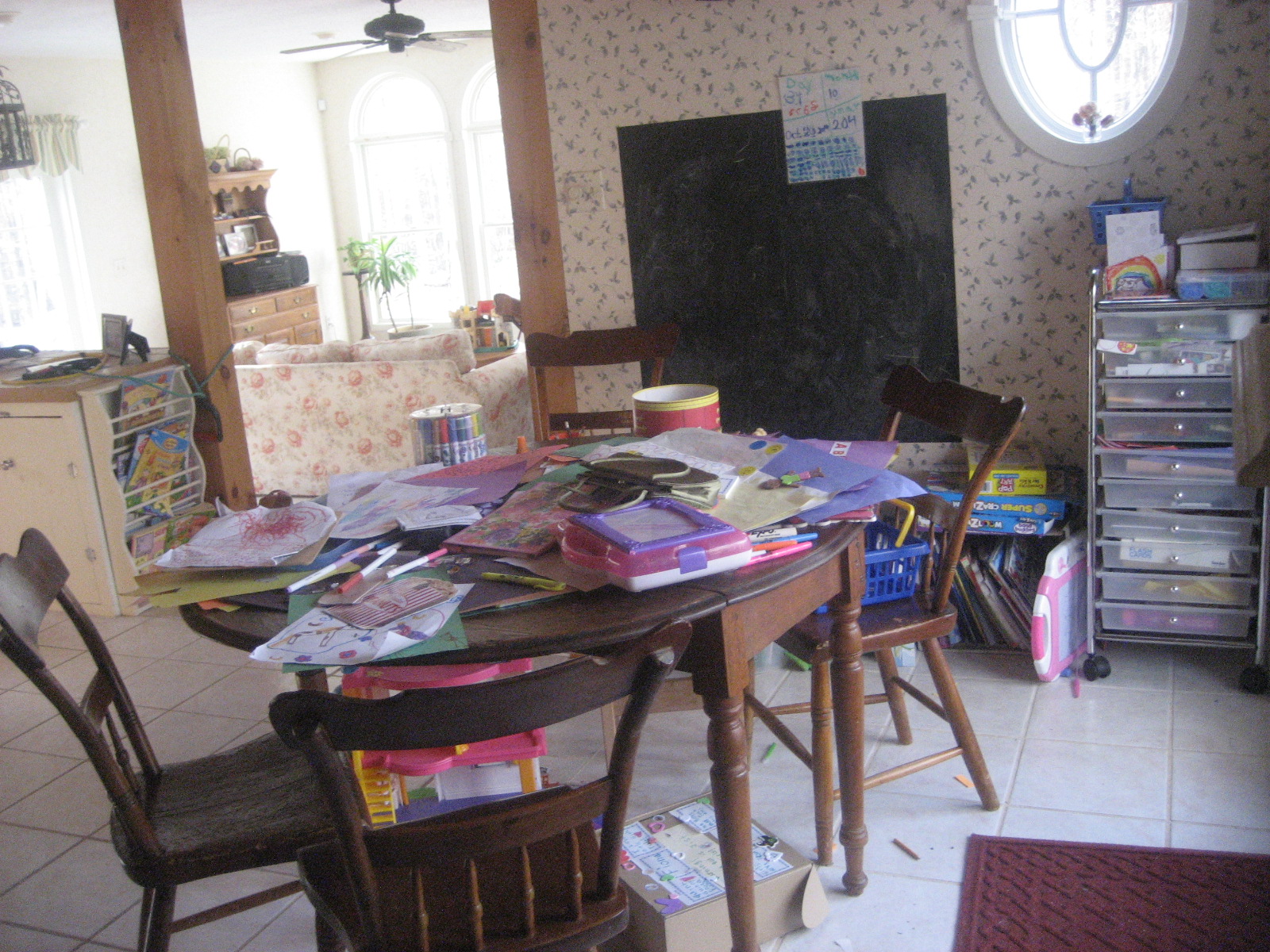
Our school/craft area: A major site of pile-up!

I’ve never really felt the compulsion to do “spring cleaning,” unless spring happened to coincide with an upcoming move or the arrival of a new baby. I understand the point of it: You’ve been cooped up in the house all winter, and once warmer weather arrives you direct a burst of energy at the house in which you’ve been imprisoned. Time to open the windows, shake the rugs, clear the cobwebs!

Because I live in a climate that’s subject to dramatic temperature swings, from sub-zero winters to 90-degree summers, there are certain seasonal tasks to be done; spring is when I put up the screen doors, remove the plastic insulation from my daughters’ bedroom windows, set up outdoor furniture and planters, and do a final sweep around the now-cold wood stove. But these are chores, and I do them without enthusiasm while steeling myself for the approaching summer “vacation,” knowing I’ll spend the next three months refereeing sibling squabbles, shuttling four girls to various activities, and applying sunscreen to squirmy little limbs.

So I’m not inspired by spring cleaning. But this year, I had a burst of home-focused energy that began in September, a couple weeks after the start of school, and is still going strong. I think of it as “fall cleaning.”

I should probably clarify, right here and now, that my version of fall cleaning has very little to do with what the average person defines as “cleaning.” I’m not talking about the type of cleaning one does with sponges and rags and chemicals. I’m talking about making one’s living space more beautiful and comfortable.

Fall cleaning makes a lot more sense to me than spring cleaning. In spring cleaning, you’re essentially beautifying a space in which you won’t spend much time for the next several months. Sure, detritus has built up over the winter and everything needs a good airing-out, but chances are that you’ll be out in the yard or at the pool, lake, or beach more than you’ll be indoors, so who really cares?

Fall cleaning is preparing the space in which you will be shut up for the next several months. Who wouldn’t want to make their cell a little more comfortable?

So I’ve been giving our house a critical eye, and applying my energy to making it a place where I’ll enjoy spending most of my time over the winter months, often in the company of four small children.

Here’s what my fall cleaning does not involve:

1. Lots of money.

2. Major projects.

The primary reason I’ve ruled out both of the above is the reality of life with four small children. Why spend large amounts of money and time making significant improvements to our house, when our daughters will undo them in seconds with the swipe of a marker, a sudden spill, or a misdirected ball?

Instead, here is what my fall cleaning has involved:

1. Small touches to make the house more bright and fun. Winter is dark. Our house is in the woods, and gets very little light. Most of the interior walls, ceilings, and floors are exposed wood in the “post-and-beam” style. It’s suddenly occurred to me that there are very small things I can do to brighten our house. This winter, I’m painting two large pieces of wooden furniture, which will lighten them and the rooms in which they reside. I’m going to work with my daughters to create brighter, more colorful artwork to hang on the walls. I replaced the dingy old white duvet cover on our bed with one in a bright pattern. And I finally got some new light slipcovers for an ancient couch and chair that have been spilling their upholstered intestines for over a year. (Slipcovers, I figure, can be light, because I can always wash them.)

2. GETTING RID OF STUFF! More than all the small decorating touches combined, the major reason why our house feels dark and cluttered is because it’s got too much STUFF in it. Again, the kids are a major factor here: all of their toys, their artwork from school, their books, their “craft projects,” and the little pieces of junk they pick up at birthday parties and doctors’ offices and arcades…it piles up. Back when I had only one child, I heard parenting advice that went like this: Your house is not the kids’ house — it is YOUR house. Your children are guests in YOUR HOUSE. Their stuff must stay within a small, designated area rather than taking over YOUR HOUSE. It seemed so reasonable at the time; now, I say, “Yeah, right!” Houses are set up to serve their inhabitants; there are now twice as many children as adults in our house, so whose house is it, really?

Without giving up my parental authority (i.e., I still nag them about cleaning), I’ve given up on trying to make our house look like only grown-ups live here. There are signs of our daughters everywhere, as there should be at this stage. But I have not given up on waging war against stuff; this fall, I’ve been merciless. If anything is broken, it’s out. If it hasn’t been played with in over a year, it’s donated. If it’s small, plastic, and not a Lego, its days are numbered. And, finally, now that we’ve had our last child (I hope), I’m donating clothing the second our youngest outgrows it.

I love, love, love getting rid of stuff!

This burst of domestic energy is not like me. (Did I mention I’m also sewing dresses for my three oldest daughters???) I’m assuming it won’t last; I’ll spend some months brightening and painting and throwing things away, and then revert to my lazy habit of writing a blog instead of paying attention to my house. I can’t account for this change, other than to say that it’s fall cleaning, or maybe the fermenting leaves in our well water.

****


Nesting place

I rarely promote things on this blog, but The Nesting Place by Myquillyn Smith has been a major inspiration to me as I’ve been fall cleaning. It’s an easy read with lots of pictures, and it’s basically a decorating book for domestic imperfectionists. Highly recommend.


Riding for Home: Thoughts on Election Day

IMG_4837

Because this column will run on Election Day, I feel compelled to write about local politics.

I typed that sentence, and then spent five minutes staring at my computer screen. The truth is, I’m terrified to write about politics.

Click here to continue reading my latest “Faith in Vermont” column for The Addison Independent.