Almost immediately after I turned 21, I started on a quest to find “my drink.” It seemed like an important part of being a legally-allowed-to-imbibe adult. I wanted to have my own signature drink, a reliable cocktail that I could order whenever I went to a bar.
College, where I turned 21, was all about beer — mostly the beer-flavored drink known as Rolling Rock. But I’ve never been much of a beer drinker, never loved the taste.
During January of my senior year of college, I took a wine tasting class that a local restaurant offered to over-21 students. It was fun, informative, and gave me a good idea of what it looks like to know about wine. But wine is about as lost on me as beer; I’ll drink it with dinner if everyone else is, or to appear sophisticated, but to this day I can’t appreciate the various bouquets and flavors and finishes. White wine tends to give me headaches, red wine tends to give me stomachaches, that’s all I know.
That final year of college, my roommate promised to sell me on the virtues of the “Fuzzy Navel,” a drink she claimed to have perfected. For those who aren’t in the know, a “Fuzzy Navel” is made by mixing peach schnapps with orange juice. It’s delicious in a light, fruity way. One of those dangerous, “You can’t even taste the alcohol” kind of drinks.
But, I’m sorry, you can’t possibly continue to order “Fuzzy Navels” when you move to New York City for your grown-up, post-college career life.
During my early days in New York, I tried what other people were having to see if anything stuck. This was the heyday of “Sex and the City,” so I ordered my share of Cosmopolitans (vodka, triple sec, cranberry & lime juices). Not bad, but the thing about Cosmos is that they’re just a slightly more grown-up version of the “Fuzzy Navel:” light and fruity and frilly. Also, in New York City, Cosmos typically cost a lot of money for very little actual drink. And the biggest problem: everyone else was ordering them, so they weren’t really “MY drink.”
Then I started dating Erick, and for a while I had what he had: orange Stoli and tonic. Meh.
Towards the end of our time in New York, Erick and I (now married) had some friends over for a party. One of these friends — a big, boisterous Australian — handed me a drink and said, “You should try this.” It was a Scotch on the rocks.
I don’t remember what kind of Scotch it was, but it was a revelation. Something in me went BAM! THIS is my drink! It might have been generations of alcoholic Anglo-Saxon ancestors talking, but I listened.
Scotch continues to be my drink of choice. I consider it the perfect drink; a woodsy flavor that’s just the right amount of strong, a drink that can stand alone or go well with dinner. I’m far from a connoisseur, mostly because you really shouldn’t drink Scotch while pregnant, and I’ve been pregnant for the past six years. But I’m not anymore!
And that big, boisterous Australian who poured me my first Scotch? True story: He’s now the pastor of a church outside of Boston. One of the many reasons I love God.
NOTE: Please don’t read this as condoning alcohol abuse. Drink responsibly, everyone! Just saying that it’s nice to have a drink to call your own. Mine is Scotch, and I enjoy a glass of it every once in a while after the girls are all tucked in.
Since the birth of our fourth daughter, several people have made the comparison between the four Gong Girls and the four March sisters — protagonists of Louisa May Alcott’s classic novel, Little Women. It happens that our daughters are familiar with Little Women (in the form of an abridged version by Usborne Books), and the comparison is not lost on them. “Which one is Georgia?” they’ll ask whenever I read it to them, “Which one am I?”
Louisa May Alcott divided the March sisters into easily identifiable types; the types you might expect based on the conventional wisdom of birth order. Meg, the oldest, is responsible and steady, with a weakness for fashion. Second-born Jo is the tomboy, a temperamental writer. Beth is sweet, sickly, self-sacrificing, and prefers quietly playing her piano. The youngest, Amy, is a spoiled, petulant, artistic type.
In families with multiple children, each sibling tends to carve out a distinct role. But when we read Little Women and they ask, “Which one am I?” the most honest response would be: “Not the one you think!”
Our girls don’t conform to the sisterly types created by Louisa May Alcott. Sure, the Gong girls are still in the process of becoming, and Abigail’s still an unknown quantity, but I’m fairly confident that our family has no sweet, quiet, sickly Beth. Most days it feels like we have four Jo-Amy hybrids: independent, temperamental, outspoken bundles of energy.
The thing is: None of my girls is turning out to be whom I thought she’d be.
Like most parents, I brought certain expectations to the table based on my own upbringing, the birth order archetypes I’d learned in college psychology classes, and sibling characters like those in Little Women. But I’m finding that one of the most fun and rewarding parts of parenting is setting those expectations aside and watching as my children are gradually revealed to me. I know that some parents never let go of their expectations and force their children into molds of their own making. To me, parenting feels more like archaeology: My children came to me already themselves, like fossils embedded in rock, and it’s my delight to gently chip and brush away the extraneous dirt to uncover who they really are. (And hopefully instill some manners along the way).
Take my first- and second-borns, for instance. Fiona: a sweet people-pleaser with a strong dramatic streak and a love of all things pink and princess-y; I’d pegged her for the shy, girly girl who’d gravitate towards dance and theater. And Campbell, who’s always been a little bit of a rebel, who loves yellow and lions and seemed tougher than her older sister; I assumed she’d be the outgoing, sporty one.
It looks like, in both of these cases, my first assumptions were totally wrong. Fiona is definitely the classic firstborn responsible people-pleaser, but she’s not particularly shy. And she’s not interested in dance or theater; her love is sports, something I never saw coming. She’s already a solid swimmer, she’s proud of her fast running and will race anything that moves, and she’s looking forward to playing soccer next year (although apparently, despite never having picked up a racket, she’s “mostly interested in tennis.”)
Campbell has little interest in sports. She’s certainly independent and “tough,” in the sense that she doesn’t care what others think of her. But she’s also the most introverted of all my daughters. She loves animals and nature: She’s happiest playing ponies by herself, or picking a bouquet of flowers. and her career plans at the moment vary between veterinarian, florist, artist, and mountaineer.
And then there’s Georgia. It’s hilarious that Georgia is the one in the “sweet third daughter” position, because she bears absolutely zero resemblance to Louisa May Alcott’s Beth. Georgia is a fireball: She’s outgoing, never stops talking, fiercely independent, afraid of nothing, and she loves to eat. She’s only two, so it’s still hard to separate the essential Georgia from the terrible two-ness, but she seems inclined to grab life by the neck and throttle it. (Or maybe the frequency with which she bites her sisters is really an indication that she wants to take a big bite out of life).
The poet Sylvia Plath wrote in “Morning Song:” “I’m no more your mother than the cloud that distils a mirror to reflect its own slow effacement at the wind’s hand.” I used to think Plath had a detached view of motherhood because she was depressed, but now I understand that line differently. I don’t know where these kids came from. Sure, there are certain aspects of their personalities that I recognize as coming from me or Erick, but there are other, HUGE parts of who they are that I can’t even relate to. One of Fiona’s favorite parts of kindergarten is P.E., which was exactly what I dreaded for my entire school career. Where did THAT come from???
Of course, my girls are still very young, and all of the things I’ve just written about them are subject to change in the coming years. The essential point remains, and here’s an illustration: Now that Campbell and Fiona are attending separate schools, Campbell is emerging from her big sister’s shadow and into her own. This mostly means horrible fights, but the other day when Fiona was getting a little too bossy, Campbell looked at her and said: “I am NOT you! I am A DIFFERENT PERSON!”
And that’s just the thing about parenting: Our children are, and always have been, different people. That’s either scary or exciting. At the moment, I’m choosing to focus on the exciting.
Shortly after this picture was taken, I imposed a “bottoms must be worn at all times” rule in our house. (Because really, you never know when the Queen might drop by).
When I feel guilty as a mother, it usually stems from the vast distance between the parent I thought I’d be, the parent I’d LIKE to be, the parent I present myself as in public and on Facebook — and the reality. I know I’m not alone here, but because I try to keep certain parts of my parenting under wraps, it sometimes feels like I’m alone. In an effort to correct this, here are some of my guilty parenting secrets:
-We have a drawer full of Barbies in our living room. We also have Barbie books, and the girls check out Barbie movies from the library on a weekly basis. I don’t love this, but I’ve allowed it.
-Speaking of the library: I live in fear that someday our local library will be able to trace all of the books that are repaired with packing tape back to our family, and we’ll have our library cards revoked for life.
-While I make feeble attempts to provide a variety of healthy food options, my daughters essentially live on a diet of Cheez-Its and what I optimistically refer to as “fruit chews.” Every non-Gong child I know calls “fruit chews” “gummies,” which is a more accurate term, since these processed snacks contain absolutely no natural fruit products.
-My daughters drink a lot of water, and each one has a personal water bottle — a stainless steel bottle with a plastic flip-top and rubber straw. I tote these bottles around in our diaper bag, and if you were to take one apart you would probably be appalled at the musty odor and visible mold on the rubber straw. I blame Thermos for creating a water bottle that’s a pain in the neck to clean, but I also credit Thermos with my daughters’ hardy immune systems.
-I have an iPod, but it’s no longer really mine; it now contains more Tinkerbell, Sesame Street, and My Little Pony games than my own apps. That’s because the only way I’ve been able to get my oldest daughter to stay out of my hair while her younger sisters nap is to hand her the iPod. She probably spends way too much time on it, and I’ve had to limit her to downloading one new game per week. But without that iPod, this blog wouldn’t exist.
-We don’t own a T.V., but the portable DVD player we received last Christmas has saved my sanity many times — and not just during long road trips. In an attempt to be a good mother, I limit the girls to 30 minutes of daily “screen time,” watching DVDs they choose at the library. This means that, especially during the summer months, they almost always watch 30 minutes of videos per day. How did anyone cook dinner before videos existed?
-I usually forget to give Abigail her daily vitamin D drops. She rarely gets daily “tummy time.” Abigail spends most of her time in her carseat or in the Moby wrap.
-On the first day of school, when every other parent is putting up Facebook posts about how they cried while dropping off their kids, I am gripped by the fear that I don’t love my kids enough. I have never once, not EVER, even become mildly choked up when dropping my kids off on the first day of school. Instead, I fly out the door with arms spread wide yelling, “FREEEEDOM!!!!” (Then I buckle the remaining 2 kids into their carseats and go grocery shopping).
-While we’re on the subject of school attendance: On those rare days (thank you, Thermos!) when a daughter is sick and can’t attend school, I don’t feel sympathy so much as I feel wrathful and vengeance-seeking.
Well, it felt good to get THAT off my chest. Who’s with me?
I once heard that Facebook, the social media site originally founded as a way for college students to connect, has found its target audience in a new demographic: 30-something stay-at-home moms. That certainly rings true to me; on those days when we don’t leave the house and my only adult conversation happens after my husband returns from work, it can feel like a refreshing little escape to log on to Facebook and see that there’s a whole other world out there: a world of friends, my age, who are eating ribs RIGHT NOW!
I’ve been logging on to Facebook more often than usual this summer. The major reason for this is that we have a new baby, which increases the number of days when we don’t leave the house. I’m spending about 12 hours a day feeding the baby. Half of the time I’ll feed the baby with one hand while with the other I cook dinner. change another child’s diaper, or repair the transmission on our minivan. But that still leaves almost 6 hours when I’m feeding the baby in peace; the perfect time to check Facebook.
I’ve particularly needed the escape of Facebook during August. Why? Well, as of the moment this post publishes, there is one day until school starts. Want to know how many hours? 19! Anybody else counting down to the first day of school? Can I get an “Amen!”?
Yes, in August we entered the “Countdown to School” portion of our summer: that time when summer starts to lose its glow, when we’ve all spent too much time together, when the girls are bickering constantly with each other and driving me nuts.
The first week of August was the worst, because my two oldest girls spent every morning at an outdoor nature camp. They loved this camp, and then they’d come home filthy and exhausted and be terrible people until bedtime. One daughter chose this same week to become obsessive-compulsive about her clothes; she’d change outfits 20 times a day until we finally responded by moving all of her clothes to the basement. There was eye-rolling and door slamming and angst; nobody warned me that adolescence starts at kindergarten.
I was grouchy and annoyed with my kids. I sought solace in Facebook.
The thing is, that wasn’t a very happy time on Facebook, either. For a couple of weeks, I couldn’t log on to Facebook without encountering some tragedy, and all of these incidents involved parents or their children. I won’t go into detail here, because these are not my tragedies to share — they involved my friends’ friends or family: toddlers dying, newborns dying, parents dying in childbirth or just prior to the birth of their children. The kind of things we like to tune out, to pretend don’t happen anymore in this time and place. The kind of things that remind us of how we’re all walking around with pianos dangling over our heads, and it’s just a matter of time until the rope snaps. That could have been MY child. That could have been ME.
One afternoon, I logged on to Facebook during naptime as an alternative to clawing my eyebrows out after a particularly frustrating encounter with a daughter. I found myself choking back tears while reading the account of a baby who’d died days after birth. Then it hit me:
It is a LUXURY — a BLESSING — to be annoyed by my kids.
Annoyance means that they’re here, and I’m here, and we’ve had the gift of enough time together to really get under each others’ skin.
I’m still counting down the days, hours, and seconds until school starts. I don’t expect that I’ll stop feeling annoyed with my kids anytime soon. But when I do, I will remind myself that annoyance is a by-product of time, and time is a gift that not everybody gets.
Our dog suffers from anxiety issues and low self-esteem.
Before owning a dog, it never occurred to me that dogs could suffer from anxiety and low self-esteem. There are a LOT of things that never occur to non-dog-owners; then you get a dog, and the next thing you know you’re consulting a dog whisperer and shelling out $16 at the natural food co-op for “Rescue Remedy,” a plant-based stress-reliever with which to lace the doggie bowl water.
My oldest daughter begins kindergarten at our town’s public elementary school next week, so last spring I attended the school’s “Parent Information Night.” More than anything else in the past five years, attending a kindergarten information night made me feel like a grown up, like a MOM, …old. It’s one thing to have children and be responsible for their upbringing; it’s another thing to sit on plastic chairs in a stuffy music room and realize that you’re about to become part of an entirely new community: a school community, with its teachers and administrators and volunteer commitments and dates-to-remember.
Last month, Erick and I celebrated our 11-year anniversary. That’s the Steel Anniversary, if you’re the type who follows these things. I’m not, but Erick is; last year, he went to a great deal of trouble to track down aluminum jewelry as a gift for our 10th (Aluminum) anniversary. Yes, it turns out, there is such a thing as aluminum jewelry. The bracelet and earrings that Erick gave me are beautiful, and just about as durable as you’d expect (think aluminum foil….).
I much prefer the symbolism of steel over aluminum when it comes to marriage. Steel is an alloy of iron and carbon (and other elements), and it’s made by blasting iron with extreme heat so that its impurities burn off and carbon is distributed evenly. The result is greatly improved strength. Sounds a lot like marriage to me.
Anyway, Erick and I didn’t exchange steel gifts for our 11th anniversary, because we weren’t actually together on our anniversary: Erick was thousands of miles away in Kenya, setting up a research project. Since I was celebrating my marriage at a distance from my husband, I spent some time reflecting. I thought back to where we were in July 2002, in contrast with where we are now. And I realized that, if our marriage has a unifying theme, it’s that we’ve spent these past 11 years being downwardly mobile:scaling back our lifestyle and ambitions in a way that might look crazy to an outside observer.
Actually, it looks crazy to us, too. We didn’t plan any of this. So little of where you end up in life is intentional.
Here are the specifics:
When we first met, Erick and I held degrees from prestigious, private (expensive) Williams College, and prestigious, public (less expensive) UC Berkeley. I also had a Master’s Degree in education, and was living in Manhattan and teaching at the prestigious, private (VERY expensive) Nightingale-Bamford School. Erick was living in the upscale, exclusive suburb of Greenwich, Connecticut, where he worked at a hedge fund making more money for the already-super-rich.
Dating a hedge fund manager brings certain perks. For the two years leading up to our marriage, Erick and I led a pretty fancy life: we went to fancy parties with fancy people, ate in fancy restaurants, and got free tickets to concerts and sporting events. Our wedding was pretty fancy, too: in a church right on Park Avenue, with a reception just up the block at the Colony Club. After honeymooning in Bora Bora (yes, really), we moved into the apartment we’d bought on the Upper East Side. It was on the 28th floor, with views of the East River. Our first major purchase, after the apartment, was a king-sized four-poster bed.
Things started going downhill almost immediately. Just before our wedding, Erick’s boss decided to get out while he was ahead and close down the hedge fund. Erick stayed on for a couple of years to manage the shut-down, which gave him enough time to return to school for a Master’s Degree in economics. Inspired by a trip we took to Africa, he chose to focus on development economics — NOT the money-making kind of economics. At the same time, I quit my teaching job and went back to school to study photography — definitely NOT a money-making move.
When Erick’s job at the hedge fund finally ended for good and he received his M.A., he decided to keep going for a PhD. in economics. Thus began his five years as a professional student. We moved to Berkeley, California. We rented a tiny, dark apartment that I always thought of as our “Hobbit hole.”. The king-sized four-poster bed was the first thing to go: it wouldn’t have fit in any of the three places we rented in Berkeley. Inspired by that same trip to Africa, I worked for two nonprofit organizations that offered minimal pay and no benefits.
Then, we started having children.
That history might come as a surprise to people who know us now. NOW we live off of a single assistant professor’s salary. I stay at home with our four daughters because a) I’d have to love any job I took, since all of my income would go towards childcare at this point, and b) there aren’t many jobs I’d love available in Middlebury, Vermont. Our house is the largest we’ve ever inhabited, but that’s due to a combination of our family’s size and the low cost of Vermont real estate. We sleep in a full-sized bed with a dust ruffle that’s ripped from our daughters climbing up to snuggle. And just the other day, Erick and I had a budgeting discussion in which we concluded that it’s neither affordable nor logical just now for us to buy a slipcover for the armchair with stuffing-spilling holes in both arms.
I’m not making a value judgement on our life then or our life now; I’m just stating facts. But this trajectory that our lives have taken isn’t what you’d have predicted if you’d met us 11 years ago. What should have happened is this: Erick should’ve continued to work in investment banking, making ridiculous amounts of money. I should’ve continued to teach at fancy prep schools, or maybe gone into administration. We should’ve moved to a fancy New York suburb (with that king-sized four-poster bed) and had two children. We should’ve continued to go to Broadway shows and sit courtside at Knicks games and take exotic vacations.
I can’t take pride in being a pioneer who went against the tide, because it turns out that the downwardly mobile course my life has taken is something of a trend. There’s even a book about it: Homeward Bound by Emily Matcher which, according to a blurb in The New Yorker, “follows college-educated, middle-class American women who have rejected cities, consumerism, and corporate culture in favor of very old-fashioned house- and family-keeping.”
Actually, I can’t even claim to be one of Emily Matcher’s women, either, because the blurb goes on to say, “They grow their own vegetables, knit their own clothes, and homeschool their children. Some run their own farms.” Good Lord, I do none of those things.
Which leaves me stuck in downwardly mobile limbo. I’m sitting here with the phantom of my earlier promise hanging over my head (high school valedictorian, $100,000 liberal arts education, two graduate degrees), and I’m not even canning my own beets or doing flashcards with my kids. I bailed on the workplace in favor of home, but am I failing on the home front, as well?
Sometimes I feel guilty about these things, about my place in society’s big picture. But mostly I’m just grateful for my life right now, and happy. I think that’s the story of our marriage, and of this blog, too: There’s a sort of sweet bafflement about where life has taken us. Never did I expect to be a stay-at-home mother of four in small-town Vermont. But never did I expect that downward mobility would bring so much joy upward.
I’m baaaack! This is my first official Pickle Patch post since taking “maternity leave” in late May. And I’m excited, because this is a post that I feel passionate about. It came about based on MANY conversations I’ve had with other women. I’m hoping that, for those who need to hear it, it’ll provide your daily dose of liberation. Surviving as a woman is all about daily liberation, isn’t it? I feel like every morning I have to liberate myself from my own expectations — or from what I imagine others expect from me: those expectations that I’m going to be a perfectly calm and loving wife and mother who completes numerous educational crafts with my children, maintains a perfectly neat house, prepares delicious meals (always with home-baked bread), plants gardens, and stays fit and fashionable. Sound familiar?
As you may know, an important part of this blog for me is that it’s an exercise in honesty. I’ve confessed that I hate housework, that I’m not a gourmet cook, and that I’m a very imperfect person. You’d think there wasn’t much else to confess, wouldn’t you? (I mean, apart from things that would bring the Vermont State Troopers knocking on my door.) How much lower can you get than being an imperfect, messy person who can’t cook?
Well, there is something else; one of the hardest things I’ve ever confessed: I HAVE HELP.
That’s right; my life might be more of a rusty clunker than a well-oiled machine, but I don’t do it alone. We have two amazing sets of grandparents, and between them there are grandparents visiting us almost monthly. The minute they walk in the door, I throw the kids and a household “To-Do” list at them, and spend the next week in the coffee shop. During the school year, my two oldest girls were in preschool three FULL DAYS a week (I consider this “help” more than “education”). All summer long, we’ve had a wonderful high school girl who bikes to our house two mornings a week and plays with my older girls so that I can focus on the baby and various chores. AND we have a lovely woman who cleans the house twice a month.
I owe thanks to many of you for our house cleaner. Last fall I wrote a post renouncing my passive-aggressive attitude towards housework, having gained the perspective that MY HOUSE IS NOT ALIVE. And multiple readers responded along the lines of: “That’s a nice insight, but you should consider having someone come help out with the housework once in a while. I do.”
I was shocked. It had never occurred to me that so many other women — some of them working, some of them stay-at-home, none of them fabulously wealthy — might actually hire cleaners. So, a short time later, when a local friend confessed that her “little secret” was a wonderful cleaning woman, I took it as a sign from the universe and asked for the cleaning woman’s contact information.
This led me to question: Why, for so many women, is this kind of help considered a “little secret?!?” Why do we have so much trouble admitting to each other that we need or receive help? Why are we still burdened by the expectation that we need to do everything, and that outside help is a sign of weakness or incompetence?!?
I’m announcing our cleaning woman on the internet, but this isn’t information that I’d normally disclose to anyone with whom I wasn’t extremely comfortable. I feel a little embarrassed about it. Why? Well, I tend to think of cleaning women as belonging to the world of the rich and famous: luxuries employed by mothers whom I’ve heard dismissed by the phrase: “Of course, she has TONS of help.” (That phrase is never, ever meant as a compliment).
And another thing: I’m a stay-at-home mom. My JOB is to care for my family and home. What on earth is wrong with me that, with all the hours in the day, I can’t manage to keep my own house clean without outside assistance?
In short: What justifies the luxury of a cleaning woman in a household with a stay-at-home mom and the income from one assistant professor’s salary?
The best answer I have is: My Sanity. COULD I do all of the Superwoman things I feel that I should be doing — care for four kids and a puppy, love my husband, make delicious home-cooked meals every night, maintain flawless gardens, sew all of our clothes, decorate the house with my own hand-made crafts, carve out some daily time for reading and writing and exercise, and take charge of all the cleaning? I probably could, but I’d be a mess. Sooner or later I’d burn out, and the whole house of cards would come down on all of us.
Instead, we have a cleaning woman twice a month, and she’s been a lifesaver. We initially hired her because the physical act of housecleaning became difficult for me during late pregnancy, but we’re keeping her on post-baby. Having her come twice a month is nice, too, because I still feel like I’m responsible for maintaining the house on those weeks when she doesn’t come (although often I’m lazy and let things slide). Her help has taken just enough off of my plate so that I feel a little more sane, a little more able to focus on enjoying my family and making time for the things that recharge my batteries.
Don’t get me wrong: a cleaning lady IS a luxury. I know that hiring help doesn’t fit in everyone’s budget. We’re certainly not super-wealthy; we’ve prioritized this by sacrificing some other things.
But really, I’m talking about something larger than cleaning ladies, or budgets. I’m talking about GETTING RID OF THE IDEA THAT WE SHOULDN’T NEED HELP. Because obviously help isn’t just something that you pay for: It comes free, too, when we take up friends and family members on their offers to watch our kids for a while, to bring over a meal, to run an errand.
I’m trying to avoid the over-used quote that “It takes a village to raise a child.” But that’s essentially what I’m saying. The longer I do parenthood, the more convinced I am that WE WERE NEVER MEANT TO DO THIS ALONE. For centuries, before post-secondary education and changes in industry and infrastructure made it possible for people to leave their hometowns, most people stayed close to family. You might even raise your own family in the house where you were born, surrounded by parents and siblings and extended family who could help with the chores, or at least hold the baby for five minutes.
That might sound like a mixed blessing, and I’m sure it was. But now most of us have to build our own support structures when it comes to caring for a home and a family, asking for or hiring help that used to be a given. So, where did we get the idea that to be a parent (especially a mom), one needs to be a Lone Ranger? Why are we guilty about getting help? Why are we afraid to admit to others that we NEED help?
I’m going on record: I need help. I get help. And I’m getting better at accepting help without worrying that I’m unworthy or lazy or incompetent.
My husband and I didn’t discuss much about child-rearing before we had kids; in the early years of our marriage, kids themselves — let alone how to raise them — were far from our thoughts. But there was one topic that we did wrestle with, long before any kids entered the equation: Santa Claus.
Originally published in May 2012 — one of my all-time favorites. After reading through almost two years of Pickle Patch archives, I also think this post sums up a major theme of this blog: motherhood is a humbling, imperfect, messy, and grace-filled thing, and we should tell each other the truth about that.
I am happy to report that, during the first month of her life, I did not drop Abigail. But there’s still lots of time….
****
Tomorrow is Mother’s Day, so I’m thinking about motherhood.
I remember reading (sometime, somewhere) about the different mothering trends of the past few decades. There was the ultra-competitive power mothering of the 90s and early 2000s (Get your child the right stroller! Get them into the perfect school!). This was followed by a backlash that the author termed the “bad mother” trend (embodied by Ayelet Waldman’s memoir Bad Mother — which is, by the way, an honest and funny and touching read). “Bad mothers” proudly confessed to their failures, forgetfulness, selfishness, and use of vodka shots to get through the day. I’m not sure what you’d call the current mothering trend, but between last year’s hot mothering book, Battle Hymn of the Tiger Mother, and THIS year’s hot mothering book, Bringing Up Bebe: One American Mother Discovers the Wisdom of French Parenting, I’d call it “comparative multicultural mothering” (“Here’s how Asians do it!” “Oh yeah? Well here’s how the FRENCH do it!”).
I don’t really fit in to any of the above categories. I think I’m a mom who shows up every day and tries my imperfect best (with the help of God and coffee). A pretty good mom.
But I’m a pretty good mom who dropped my newborn.
I still remember vividly the first time Fiona got hurt. She was around 6 months old, and we were sitting on the floor of her room looking at books. As she was pulling out books from her bookshelf, a book from a higher shelf fell out and hit her right next to her eyebrow. It left a nasty red mark, and Fiona screamed for a few minutes, then recovered and forgot all about it.
I, however, did not forget. I cried harder than Fiona over her pain and my helplessness. How could I let such a thing happen to my child and not prevent it?!? That book COULD have landed in her eye! She’ll never forgive me for sitting there and letting her get hurt! I am clearly an unfit mother.
If you’re expecting me to tell you that things got better with time and additional children, you’re wrong.
Because when Campbell was about 4 days old, I was nursing her in bed late one night. I always read during late-night feedings in an attempt to stay awake, and I was reading that night. But despite my best efforts, worn out from the challenge of caring for a 20-month-old and a newborn, I nodded off with Campbell still in my arms. And woke up to a loud THUD and my baby wailing.
Campbell had fallen off the bed; more accurately, since I’d been holding her when I nodded off, I had dropped my newborn. I was completely beside myself. How COULD I, a second time mother, be so stupid?!? How would Campbell ever recover a sense of safety or trust after being dropped by her own mother at 4 days old?! Thankfully, our bed was only about 18 inches off of the floor, or it might have been a lot worse. We took her to the doctor the next day (where I was sure they’d call Child Protective Services on me), and she checked out fine. As far as I know, Campbell has no memory of the event and doesn’t hold it against me, although lately she has taken to saying, “Mommy, I wish I was back in your tummy.” I don’t know what that’s all about, but I’ve wondered whether she’s thinking, You know, things were a lot better back before she could get her hands on me.
And THEN, when Georgia was about 5 months old, I was trimming her fingernails one morning and nicked a little chunk of skin out of her tiny finger. She cried, and bled, and bled, and bled. She bled for the better part of an hour, through two washcloths and countless tissues. The only reason we didn’t take her to the doctor was because Erick was home, so he did his research (when there’s a family crisis, I handle the emotions and Erick handles the research) and determined Georgia was probably fine. Which she was.
Once again, I was the one who wasn’t fine. How many hundreds of fingernails had I trimmedwith our previous two children, and I slice open our third daughter?!? How could I be so careless?!? Would Georgia ever trust me to cut her fingernails again?!? Happily, Georgia continues to submit to manicures, so I assume she’s let bygones be bygones. (I can’t say the same for her older sisters, who witnessed the event and remind me of it every time I go to trim their nails).
It goes without saying that this will NEVER be a parenting-advice blog. In fact,I no longer read parenting advice books or websites. (I know there are many excellent parenting resources out there that have helped countless people, but I started to notice that reading this advice made me anxious and confused). Not that I don’t need any input or advice, but these days I get it by talking to friends — friends who are in the trenches with me, or friends who are further along the parenting path and have great kids to show for it. Sharing stories, I’ve found, is the most helpful.
So that’s why I shared these stories with you: because I hope they might be helpful to other moms, especially moms who are struggling. (Is there any other kind?) I shared these stories precisely because they were stories I thought I’d never tell. They were too embarrassing, too traumatic. Back when they happened, I never would have predicted that I’d write them up and post them on the internet, let alone be able to chuckle over them a little.
Still happy, despite the blood loss. (Photo by Zoe Reyes).
Here is my Mother’s Day thought: I don’t think that time, experience, or more children necessarily make you a better, more competent mother. They just make you an older mother. Personally, I’m just as capable of dropping my third child as my first (maybe even more so, because I’m more tired and distracted). BUT, I DO think that time and experience can give mothers the gifts of perspective and humor. Things that seem so crucial — even shameful — at the time, later turn out to be things we tell virtual strangers with a chuckle. I’m only four years into this game, but if this is how I now see some of my darkest mommy moments, I’m guessing that in another four years we’ll all be chuckling about naps and potty training and kindergarten — the things that seem so important right now.
Bottom line: I think that it’s possible to be a pretty good mother and still drop your baby (metaphorically or actually). We are human, and imperfect, and all the love that we have within us will never be enough to make our children feel completely whole. All we can do is show up every day and try our imperfect best. Love — and laughter — and especially grace — really do cover a multitude of sins. And usually our children bounce back from our mistakes more quickly than we do.
So, Happy Mother’s Day. I wish my fellow mamas the gifts of perspective and humor. Remember that you’re still a pretty good mother, even if you drop the baby once in a while. And when it comes to motherhood, pretty good is good enough. Maybe it’s even great.
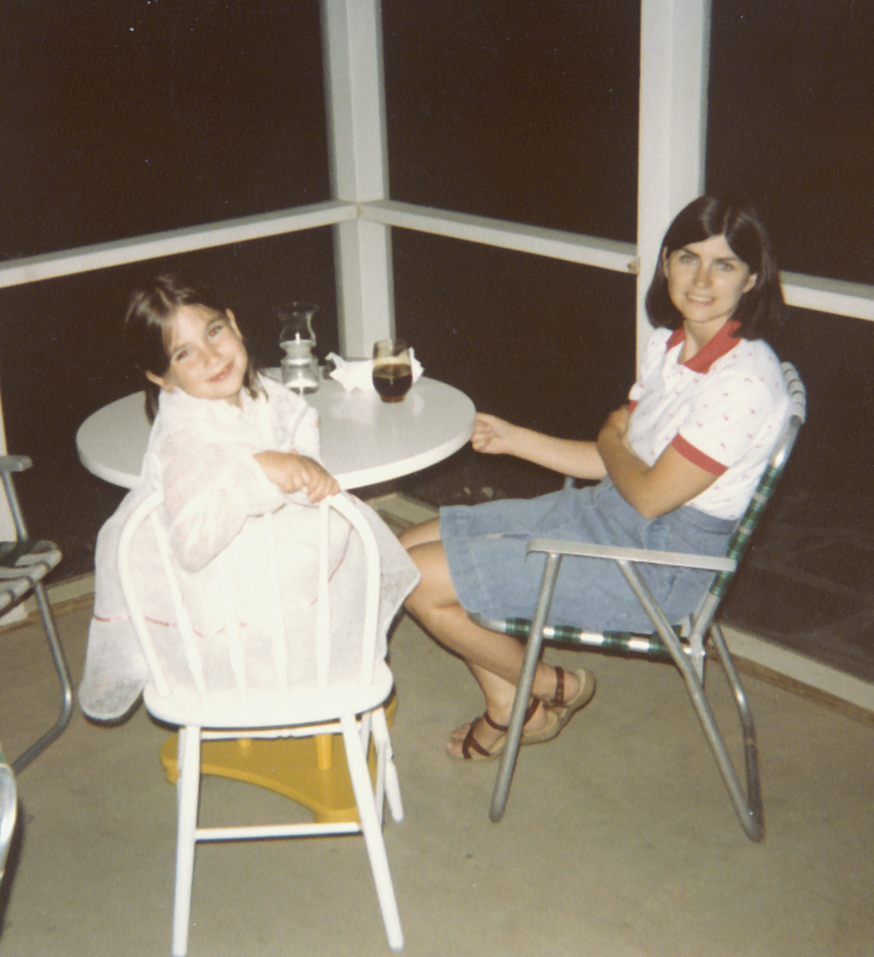
Check out my beautiful Mom (she’s the one on the right, of course). She’s one of the greats, and I’m pretty sure she never dropped me. Happy Mother’s Day, Mom! I love you!
ADDENDUM: My mom just read this, and has informed me that I fell off the changing table when I was a baby. So there you go!










 The Pickle Patch