In the juggling act of life, most of us try to keep multiple balls in the air in order to maintain our mental and physical health. The balls in play typically involve some combination of work, relationships, exercise, relaxation, and spiritual life.
Adding children is akin to lobbing a cannon ball into the mix.
At least, it was for me. After having children, work and relationships were bumped aside, exercise and relaxation fell to the ground and rolled away, and spiritual life…how do you maintain a fulfilling spiritual life with young children? Is it possible to have daily “quiet time” when no time is quiet?
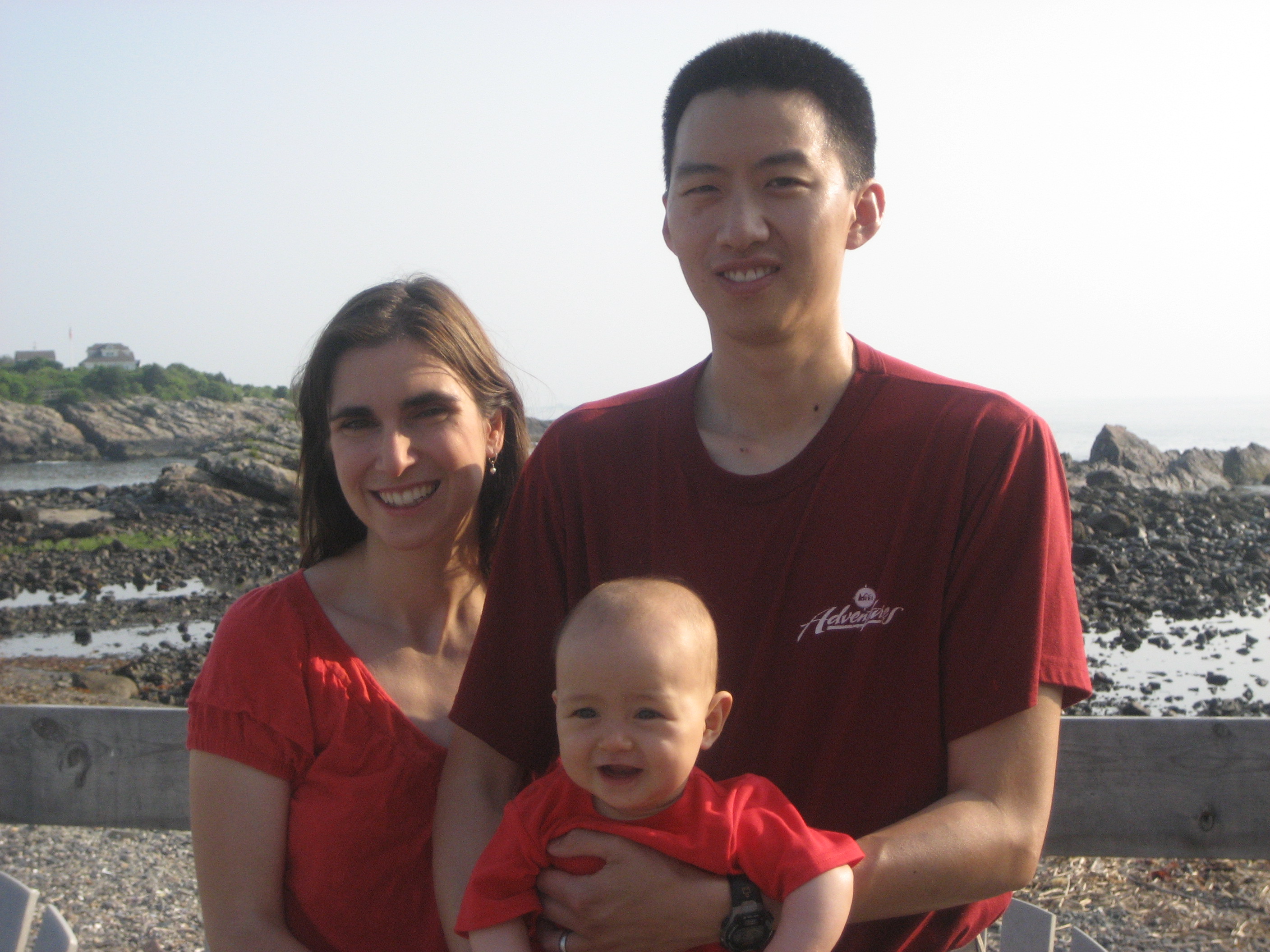
Photo from our second trip to Maine, with only one child. (We have no photos from our current trip!)
Our family spent this week in a rented house on the Maine coast, as we have for four of the past six summers (the two absences were due to the summer births of babies #2 and #4). By “our family,” I mean my husband and me, our four children, and my parents. Also with us — just down the road — are my mother’s sister, her two daughters (my cousins), their husbands, and their four combined children. Assorted family members visit us throughout the week. It’s a reunion of sorts, a vacation (of sorts), and a very fun time. Our daughters look forward to Maine all year. This trip is becoming a tradition, one that’s full of memories. The first time we came here, we were living in California and I was pregnant with our first child. A lot has changed in six years.
Now that we live in Vermont, Maine is a nice place to visit for two reasons. First, it has a seacoast, which landlocked Vermont does not. (This means that my husband spends a lot of time worried about waves and rip tides, which our daughters — experienced lake and pool swimmers — only encounter here.) Also, Maine is convenient; we can get here in about 5 hours, which includes an hour break for lunch. (In other words, we arrive before the battery dies on our portable DVD player.)
But now that we live in Vermont, I’ve also noticed that our Maine vacation seems a little backwards. You see, for most people a beach vacation entails “getting away from it all,” going somewhere with “a slower pace of life.” This was certainly true the two summers when we traveled to Maine from the San Francisco Bay Area. But now…now we live “away from it all.” Finding a location with “a slower pace of life” than our small town in Vermont would entail visiting a smaller town in Vermont.
These days, the Maine beach town that we’ve always visited seems bustling, over-developed, congested. It’s filled with tourists from fancy places like Boston and New Jersey. They drive fancy, fast cars, and they don’t stop when they see you waiting to cross the street. Enormous new beach “cottages” are being constructed on every square foot of land. The only bookstore in town closed down and became the 57th tacky souvenir shop. And 30 minutes of our 5-hour drive to Maine are spent inching along in traffic on the three-mile stretch between the interstate and our rental house.
If it sounds like I’m cranky and complaining, I’m really not. Maine may no longer be the idyllic retreat that it once seemed, but it’s always fun to be somewhere other than home for a time. The beaches are beautiful. We get to visit with family whom we rarely see the rest of the year. Maine offers us new experiences and sights, like lighthouses and lobster boats and saltwater taffy (which, in one hilarious episode this summer, my oldest daughter tried, disliked, and then was unable to spit out. “It’h sthicky!” she cried, bent over the trashcan and clawing at her mouth.)
This particular summer, I’ve noticed something else backwards about our trip to Maine: For some strange reason, being at the beach brings out the best behavior in my daughters. For instance, our first morning here my two oldest girls woke up at the crack of dawn, as is their custom. But instead of bursting into our bedroom and demanding water or the toilet, I heard them walk quietly downstairs. Then I heard clanking noises, which immediately alarmed me. Surveying the situation from the top of the staircase, I saw that they’d gone downstairs, fetched one of the rental house’s games, set it up in the living room, and were now happily engaged in a round of “Connect 4.”
I tiptoed back to bed.
That might have been just a blip, a temporary foray into maturity. But after breakfast that same morning, my three oldest daughters slipped upstairs. Ten minutes later they emerged. They were dressed. Their hair was done. Their teeth were brushed. And, as they proudly showed us, they’d cleaned their rooms and made their beds. These are the very things that I spend an hour hounding them to do every morning back home.
“Girls,” I exclaimed, “I’m so proud of you! This is wonderful! But just tell me something: Why don’t you act this way when we’re at home?”
“Mommy, we’re on vacation!” one of my daughters replied, as if that explained it all.
Later this month, my husband Erick and I will celebrate a dozen years of marriage; we’ve spent almost 15 years of our lives as a couple.
Erick and I aren’t a particularly glamorous, romantic, or even interesting couple, but we did “meet cute;” we’d stand up pretty well alongside those couples in When Harry Met Sally… who tell the true stories of how they met.
Summer 1999. I was working at a now-defunct restaurant in Greenwich, Connecticut called “Organic Planet.” It was about as much of a hole-in-the-wall as you can get in Greenwich: a tiny space with about 8 tables, next to a vacuum cleaner repair shop on a nondescript street off of Greenwich’s main drag. But it dished up smoothies and tempeh salads to clientele like Tommy Hilfiger. The Tommy Hilfiger. (He was a very generous tipper.)
I had no previous waitressing experience, and was biding my time until I moved to New York City to begin a teaching job that fall. I figured everybody should waitress at least once in their lives, and that I’d probably learn a thing or two. As it turned out, I learned how to pronounce “quinoa,” and I met my future husband.
Erick was working (and often sleeping) at the Greenwich office of a hedge fund startup. The office’s air conditioning was turned off on the weekends, but Erick worked on the weekends and it was summer. So occasionally he’d bring his work to the air-conditioned, tofu scented paradise that was Organic Planet.
My first impression: “There’s a young, skinny Asian guy who seems nice and probably won’t try to hit on me. But why is he lugging around that huge stack of papers?”
Whenever Erick and I tell this story to others, he highlights his subtle strategy for wooing me. Throughout most of the summer, his plan of attack involved timing his arrival for 7:50 PM — Organic Planet closed at 8 — so that he could be the last customer in the place and therefore have more time to talk with me. He’d always order a banana smoothie.
It was only later, after we’d been dating a while, that he told me how precisely he’d orchestrated this. And I, in turn, told him how his plan had driven me nuts.
Because by 7:45, I’d figured that nobody else was going to come in and order a smoothie: Who drinks smoothies at 8 PM? I was anxious to close up shop and get home. So I’d clean the blender.
Cleaning the blender was one of the worst parts of waitressing. Most of the other dishes we’d just slide back to the dishwashing staff, but the blender station was up front, so cleaning it was the waitstaff’s responsibility. Blenders, as you may know, have multiple parts, including blades. Cleaning them involves disassembling the parts, scrubbing under and between the little blades, and then reassembling the whole thing.
As soon as I set the neatly scrubbed blender atop its base, in would walk Erick, asking for a smoothie.
As Erick and I told this story to some new friends last month, I realized that for years I’ve thought of this blender incident as just an amusing anecdote, a cute little detail, when actually it was an amazingly accurate preview of marriage. Because that feeling I had when Erick would ask me to make a smoothie using my just-cleaned blender — that feeling is one of the emotions I’ve felt most often throughout twelve years of marriage. Frustration. Vague annoyance. Martyrdom. Just when I get everything nice and tidy, you come in and make me mess it up again with your needs!
I’ve felt this way more than I’ve felt the soaring highs of early love, more than I’ve felt passion. And that’s not because I don’t love Erick, or because he’s an irritating person; on the contrary, I love him immensely, and he’s one of the least demanding people I’ve ever met.
I think that the “please make me a smoothie in your clean blender” feeling is all tangled up with what it means to have relationships with others. You don’t even have to be married to feel it: I feel it all the time towards my children. If I’m honest, I feel it every time the phone rings.
Because sometimes, at the end of a long day, you just want to sit on the couch eating popcorn and reading a good book, but your spouse wants to talk about their feelings or your day or the budget.
Sometimes, just when you think all the kids are napping (finally!) and you’re sitting down to write your next blog post, the bedroom door slams open and they come pounding down the hall screaming, “Mommy! Mommy!”
Sometimes, when you’re trying to cook dinner or get everyone out the door or call the dog in, the phone rings and it’s a friend who needs help or wants to chat.
Having your neat and tidy life messed up is a side effect of connection. And love is when you grit your teeth and usher in the mess.
When you lay down your book and talk to your spouse.
When you get up from your computer and tuck the kids back into bed.
When you pick up the phone.
When you toss bananas, yogurt, and ice into the blender that you just scrubbed.
If I seem to suggest that love usually entails frustration and teeth-gritting acts of service — well, I think that’s true. It’s what a dozen years of marriage, half of those years with children, have taught me.
But I wouldn’t give back a single one of those years. In fact, I’m probably more romantic than when I put on that white dress twelve years ago. I believe wholeheartedly in love. I believe that nothing has more power to change other people and ourselves for the better than dirtying our clean blenders because somebody else wants a smoothie.
Keeping the blender unsullied, keeping our lives neat and tidy, may sound like a good thing. It may even feel like a good thing, for a time. But after a while, you’re just a waitress sitting alone with a clean blender at closing time. And that sounds pretty sad to me.
On the Willows has been on hiatus for a few months, but now it’s back! And I have a new post up over there, about the strategy of “hanging in there” when you find yourself in one of life’s pits. Click here to read.
Our dog, Gracie, recently turned two years old. Age is not mellowing her. I often think of her as our fifth daughter, because, like the other Gong girls, she’s full of energy and a little tightly wound. Parenting Gracie is a lot like parenting our other daughters, as well; it’s trial and error, making appropriate adjustments for whatever irritating habit she’s developed in a given week.
Also, we love her a lot.
One of the ways that we allow Gracie to be herself and burn off her energy, while also maintaining boundaries to keep her safe, is by using an electric dog fence around our property. Because we live in the woods, this isn’t a fancy-schmancy suburban dog fence underneath our manicured lawn. We have no manicured lawn, so the dog fence is a wire that sits aboveground and runs around the perimeter of our yard (and our neighbor’s yard, since Gracie is best friends with their golden retriever).
When we let Gracie outside, we put a special collar on her. If she gets too close to the fence boundary, the collar beeps a warning. She’s learned that, if she goes through the fence, the collar will give her a brief but strong electric shock. (It’s uncomfortable but not cruel; I can tell you as someone who’s accidentally shocked myself with her collar).
Here’s the thing: Sometimes Gracie breaks through the fence. This is when she’s feeling particularly strong-willed about something, for instance; her dog friend next door breaks through the fence, or our family goes out for a walk without her, or she sees a squirrel, or just wants an adventure. So, she screws up her courage, gets a running start, yelps when she gets the shock, and then she’s free and clear!
Or so she thinks.
Because when Gracie jumps the fence, she may be free, but she’s not safe. There are cars and trucks out there that drive too quickly. There are (really and truly) bears and coyotes around these woods. There are hunters with guns. She has no experience taking care of herself, finding her own food. It’s not good for her to be outside the fence; that’s why we installed the fence to begin with.
But, here’s the funny thing: Often, when I’m actually trying to take Gracie out of our yard — on a walk, or to meet our daughter’s school bus — she refuses to come. She’s afraid she’ll get shocked. Even though she’s not wearing her collar, even though I’m leading her on a leash. She’ll dig in her heels, and I have to tug on the leash while attempting to reason with her: “It’s okay, Gracie. See, your collar isn’t on? No shock, okay?” Sometimes I have to pick her up — all 54 pounds of her — and carry her down the driveway.
We went through this just the other day, and it occurred to me: Oh my gosh, Gracie is JUST LIKE ME!
I, like Gracie, have a screwed-up idea of what freedom is. I think we all do; my daughters certainly do. We assume that if something’s safe, then it isn’t really free. So we’ll gather up our courage, get a running start, and risk pain and punishment — an electric shock, a time out, a broken relationship — for the “freedom” to go play in traffic.
For the “freedom” to mingle with bears and coyotes and hunters.
For the “freedom” to be the boss of me!
On the other hand, whenever I’m being prompted to do something that I really should do, something that would be fun or soul-expanding — I tend to dig in my heels and fight against it. I’m afraid. Afraid of imagined harm that could befall me, the shock that might zap me.
I have the freedom to do these things, but I don’t trust that freedom. I don’t think I’ll be safe.
Examples of this kind of misguided inertia include: Picking up the phone to invite my child’s friend over to play (I know, I know — it’s completely irrational to be afraid that another parent will refuse to allow their child to play with mine…but it’s true). Writing a book, or even just submitting my writing to new outlets. Leaving my children in order to do something “selfish” like spend an afternoon alone or a night with friends.
The trick is knowing the difference between the safe and the stupid kinds of freedom. For Gracie, it seems simple: When somebody is leading you on a leash, do it; if nobody’s walking you down the driveway, stay in the yard. But when you’re the one wearing the collar, it’s a lot harder to discern whether you’re leading yourself or being led.
I don’t think there’s an easy solution to this conundrum. But I do suspect — and I might catch some flack for this — that we are smarter than dogs. Most of us, if we take a minute to reflect, can distinguish between playing in traffic and going for a stroll. And most of us, if we’re still and patient, can hear the warning beeps as we approach the safety fence — or feel a gentle tug at the end of the leash.
When we feel that tug, we should go. Because, unlike Gracie, it’s unlikely that someone else will pick us up and carry us over that fence.
My parents recently moved 15 minutes away from us (cue angelic chorus). Part of this process involved packing up the house in Virginia where they’d lived for 27 years.
In no way are my parents hoarders — they’re far too neat for that — but they’re not quick to throw things out. When something breaks in my house, for instance (and things break here every day), we usually toss it and think, Yay! Less stuff! My parents would fix it. This is because they’re frugal, but also because they have an emotional attachment to certain things. They remember who gave them the gravy boat, and exactly where and when they bought the bookcase. They save papers for historical and nostalgic purposes. They keep careful records of their granddaughters’ vital statistics at every check-up.
But their new house in Vermont is smaller than their former house in Virginia.
So, when it came time for my parents to load the truck, they offloaded several large boxes on me. The contents of these boxes included school papers, report cards and test scores, artwork, compositions, awards, and photos — stretching back as far as preschool.
I’m an only child, so you can just imagine.
And that’s how I found myself sitting on the kitchen floor several naptimes in a row, sorting through records of my past.
Most of this was dull (programs of all the science fairs in which I’d participated, academic award certificates), or embarrassingly awful. My seventh grade English teacher was either a saint or a masochist, because she had her students keep a running poetry journal throughout the year. Nobody should have to go back and read the poems they wrote in middle school. I bet even Shakespeare turned out maudlin, self-centered treacle when he was twelve. My own efforts were just as dreadful as you’d expect — but even worse were my personal journals, especially those I kept while I was reading the collected works of L.M. Montgomery (you can tell because I refer to my parents as “Mother” and “Father”).
But some of what I found in those boxes was fascinating — and surprising. And I think it applies to more than just myself.
1. My strengths have always been mystrengths. It’s difficult for me to discuss what I’m good at, because — along with topics like money and icky feelings — I grew up believing that talking about one’s successes was rude. BUT, in those boxes was clear evidence that I’ve always loved writing. Not only that, but (middle school poetry aside), I’ve always been pretty good at writing. My teachers said so, year after year. I won awards (like First Place for Humor in the Scholastic Art and Writing Awards). Re-reading my creative writing projects, many of them painstakingly illustrated (I wasn’t bad at art, either), I almost wept at the amount of time I’d invested when I could have been playing Donkey Kong. A career test, taken in my teens, revealed that my two top career fields would be the “Communication or Caring Professions.” I was a college writing tutor, and developed and taught a nonfiction writing course with a friend our senior year.
2. My weaknesses have always been my weaknesses. “Anxiety” is a word that comes up repeatedly: in personality assessments throughout school, in notes from my parents’ discussions with counselors, and even in my autobiographical writing. A psychologist whom I saw a couple of times in fourth grade even gave me a diagnosis: “Overanxious Disorder of Childhood with minor depressive features.” Holy Cow!Doesn’t that just about sum us all up?!? Also, I cared a little too much about what other people thought. I concluded a six-page autobiography from sixth grade with: “If you got bored during the last part of this, I don’t blame you.” My mother, in notes from a discussion with a counselor, wrote, “To help define what Faith would like to be. She has no image of that girl. Just what Mom & Dad want her to be.” Holy Cow!
3. I had absolutely no clue about either my strengths or my weaknesses. I’ve always considered myself to be relatively self-aware, yet all evidence points to the contrary. I had all the information, I just didn’t apply it.
Despite everything that should have encouraged me to focus on writing and the arts, I consistently said, year after year, that I wanted to be a lawyer. My father is a lawyer, and I suppose it’s common to begin with the desire to follow a parent’s career path. My career aspirations did change in high school, when I started doing well at science fairs; then I decided that I’d be a biologist, which is what I told prospective colleges. Not surprisingly, I dropped that idea after one year of college biology.
More seriously: that anxiety. Despite having been diagnosed as overanxious, despite writing my college admissions essay on how I’d overcome crippling anxiety in the past, I continued to struggle with crippling anxiety, perfectionism, people-pleasing, and overall lack of identity for the next decade. (And those things still rear their ugly heads when I get off-kilter to this day).
All of which leads me to this: I think we always are who we are. Certainly our experiences shape us in crucial ways, but we’re all born predisposed to a set of strengths and weaknesses that stick with us for life. This doesn’t mean that we can’t change; obviously the point is to dial up the strengths and dial back the weaknesses. But change requires self-awareness.
Which leads to one more thing: I think, somewhere between toddlerhood and adulthood, most of us tend to forget who we are. We suffer setbacks and traumas, we try to conform to who we think our parents, friends, or the culture want us to be, we read too much L.M. Montgomery and start adopting her voice. We ignore all the signs, and take a wide detour around our true selves.
It’s nice to believe, decades after those papers were filed away, that maybe I’m finally starting to zero in on who I am — which is who I was all along. It’s confirmation that, as a parent, a big part of my job is to help my daughters accurately identify their own strengths and weaknesses; to help them know who they are and be the Best Them they can be. So that they don’t find themselves sitting among the file boxes decades hence, wondering, Why didn’t I pay attention?
A couple of weeks ago, our phone rang right after dinner. On the other end was a voice belonging to a 7-year-old boy we know.
“I was wondering if you could come to my baseball game this Friday?” he asked.
He’d recently started practicing with our town’s Little League baseball team, the Middlebury Meteors. That Friday they’d be playing their first game, against the Cornwall Cougars.
When a 7-year-old asks you to attend his first baseball game, you go to the game.
My husband and I have an ongoing joke this year; whenever we have one of those conversations that focuses on a problem — something sad, or stressful, or disturbing — Erick will end it with, “And also, we’re going to die!”
That’s what I get for confiding in my husband that this year I’ve become acutely aware of how fragile our bodies are, how at a certain point everything in the physical realm starts sliding downhill, how death seems to be breathing down our necks more than ever before.
He tells me I’m having what’s commonly known as a “mid-life crisis.” I can’t believe that I’m old enough to be having a mid-life crisis, but when I note my age relative to the average life expectancy, I admit that he’s probably right. (The average life expectancy for American females of all races in 2010 was 81.1. I’m 38 years old — almost halfway there).
If you’ve been following this blog over the past year, you had some warning that this was coming when I turned 38. The realization that I was entering middle age, the fact that I’d just given birth to what we expect will be our final child, and the humbling analysis from my (20-something) dental hygienist that the onset of my first cavities was probably due to “age,” threw me into a bit of a tailspin. Although I ended that 38th birthday post on a positive note, my tail has continued spinning.
So, lucky you! You get a front-row seat to my mid-life crisis. Unfortunately, it seems that my mid-life crisis will not involve fun things like buying a sports car, getting a tattoo, taking up with the gardener (if only we had one!), or running away to Acapulco. No; for my own mid-life crisis, I will apparently sit right here in my Vermont kitchen and think the following thoughts:
–My body will never be any healthier than it is right at this very moment.
–We’re all dying. What have I done with my life so far? And what will I do with the time I have left?
That last question is a big philosophical issue. It’s important, but, to be honest, I have less trouble with the philosophical struggles of middle age than with the physical. My religious faith helps immensely in this. Also, even if I never get a book deal or win an award in the future, I figure four kids is a pretty decent legacy.
In other words: I don’t fear death as much as I fear decades of chronic back pain.
Fortunately for me, I do not (yet) suffer from chronic back pain; unfortunately for him, my husband does. He’s always been prone to throwing out his back — usually on the eve of our next baby’s birth. But this year, due to a combination of age and a job that requires long hours at a computer, his back pain has become chronic. He takes ibuprofen, he sees a chiropractor, he’s tried acupuncture, he does back exercises and stretches every single night, we bought a Sleep Number Bed, and he sleeps cocooned in a complex arrangement of pillows. Sometimes the pain is better, sometimes it’s worse, but we’re coming around to accepting that it’s probably going to be around for the long haul.
My own aches and pains are more varied. It turns out that when you hit your late 30s after having given birth to four children in six years, that body you’ve taken for granted — ignored — for so long, suddenly makes its presence known. Hello! it says. Remember me? I’ve been working hard for you, and now I’m gonna make you FEEL it!
Too many people live with far more discomfort than I, for a much greater part of their lives. But for almost four decades, I’ve been blissfully unaware of my good health. Sure, there have been uncomfortable moments, but I’ve always assumed that if something hurts now, it probably won’t hurt later. After a certain age, one can no longer make that assumption. If something hurts now, it may well hurt for the next four decades.
Assuming I have four decades left. Not a safe assumption when our parents’ friends are starting to die, and people our own age are diagnosed with serious illnesses at an increasing rate.
It’s all enough to make a person feel a little…down.
I found some solace, oddly enough, at a memorial service.
The man who had died was a member of our church. I didn’t know him well, but our church is small and he was someone who’d quietly touched everybody within arm’s reach during his 88 years. (He read my articles in the Addison Independent, and he often sent me thoughtful email responses). He made a quiet but deep impact upon his world despite struggling with severe depression through the years. It might be more accurate to say: He made his impact upon the world because he struggled with severe depression through the years. He was very open about his struggles, even with me in the brief time I knew him.
He’d chosen the “Hallelujah Chorus” from Handel’s Messiah as the closing music for his memorial service. Before it was played, the pastor told the story of how Handel came to write Messiah. When Handel found the libretto which inspired his famous oratorio, he was at one of the lowest points in his life. He’d recently had a stroke, which had paralyzed his right arm and made it impossible for him to perform or conduct music. He complained of blurred vision. He was out of favor with the royal court, and in debt due to a failed venture into the opera business. Despite these struggles — it might be more accurate to say because of these struggles — he went on to write a world-shaking piece of music.
I sat there thinking about my friend changing lives while fighting depression, and about Handel composing Messiah with a bum arm and blurred vision. And then I thought about the veritable galaxy of people who’ve made huge impacts while struggling with physical and mental pain: John F. Kennedy had severe back pain, Franklin D. Roosevelt was paralyzed by polio, Georgia O’Keeffe and Isaac Newton suffered nervous breakdowns, Beethoven was bipolar. The notable people who’ve struggled with depression are too numerous to list. More recent celebrities with chronic back pain include George Clooney, Bono, Bo Derek, and Elizabeth Taylor. And that’s only the tip of the iceberg.
Is it necessary to suffer in order to make an impact? Probably not. But one could make a compelling argument that struggling with chronic physical or mental pain sharpens empathy, tenacity, and focus. My husband says that his chronic back pain has made him more acutely aware of — and grateful for — those times when he isn’t hurting.
In any case, reflecting upon the numerous people who’ve had full and meaningful lives that included acute discomfort made me realize that life is not over just because one’s physical condition has begun the downward slide. As I move into middle age and experience increasing physical discomfort, I can choose to fixate on and complain about my aging body — eventually becoming, in the words of C. S. Lewis, “a grumble.” Or I can take inspiration from those who’ve persevered despite — or because of — pain. I’ve been spoiled by three decades of comfort, but it well may be that the decades to come are richer — spiritually, mentally, emotionally, creatively — despite (or because of?) the presence of some physical pain.
You gonna tell this girl there’s no such thing as fairies???
When I have no idea what I’m doing, I tend to behave according to what I think of as “The Script.” The Script is made up of all of the external advice and expectations that I’ve compiled throughout my life, things that I’ve filed away under headings like “How to be a Good Girl,” “How to Not Make Mistakes,” and “How to Blend In and Not Look Stupid.” It’s pretty safe to conform to The Script, but not very exciting. In fact, I’ve never made a good decision when I followed The Script; the best things I’ve done in life have all happened only when I took a deep breath and decided to improvise.
The Script has been there for my entire life, but it’s felt especially near during my life as a parent. As a parent, I have no idea what I’m doing almostall of the time. So I tend to grab onto a special parenting script for topics like, “What Would a Good Parent Do?” and “What’s Best for the Kids?”
I have no idea who wrote The Parenting Script, but I suspect it’s been drafted throughout history by all of the grandparents.
Please understand: I’m not knocking the grandparents. But in my experience, grandparents tend to be a little bit tighter on the safety (and looser on the purchasing) than parents. It’s completely understandable, really: they want their grandchildren to be happy and healthy. Most grandparents will question things like whether it’s safe to take your toddler backpacking in the Congo — or why you haven’t seen the doctor about baby’s runny nose.
So when I say that I suspect my parenting script has been drafted by grandparents, that’s because it’s so safe. The Parenting Script is all about protecting children, isolating them from any sort of harm (physical, yes, but mostly mental and emotional and spiritual), raising children who will never, ever end up in therapy.
According to The Parenting Script, I should have answers for my children. And the answers should be final and reassuring. Because otherwise, my children might feel insecure.
EXAMPLE: Child: I’m scared.
Parent: What are you scared of?
Child: Ghosts.
Parent: There’s no such thing as ghosts.
How many of us have had that exact conversation? Numerous times? (Perhaps with something else in place of “ghosts?”)
And, on the surface, there’s absolutely nothing wrong with it. Nothing wrong with reassuring your child. Nothing wrong with telling them that the world is a safe place, that evil doesn’t exist — at least, not under our roof, not in our closets.
The problem is: It’s not true.
I don’t want my children to grow up paralyzed by fear. I don’t want to expose them to all the world’s evil before their minds can handle it (Can any of our minds really handle it?). No question: my children should wait a few years before learning about the Holocaust.
But if I answer with a definite, conversation-stopping “no,” when the truth is, “I don’t know” — am I draining my children’s world of possibility and complexity, of wonder and creativity? One thing’s for sure: I’m lying to them.
Are there such things as ghosts? I honestly don’t know. I’ve never encountered a ghost that I’m aware of, but “There are more things in heaven and earth, Horatio….” and all that.
If I follow The Parenting Script and act like I have all the answers, I’m trying to protect my daughters from uncertainty and confusion. Do I want to protect my daughters from uncertainty and confusion? Life is about uncertainty and confusion. There’s no failure in never having all the answers. Far more important is to ask lots of good questions and be comfortable with lots of “I don’t know’s”.
So, I’m okay with not being the final authority on all questions. I’m okay with not totally shielding my daughters from the reality that life contains evil and scary things. We’re quick to deny the presence of ghosts and monsters and things that go bump in the night, because we love our children and The Parenting Script tells us to keep them from worrying. But they already do. My own children — like most children — have already experienced the deaths of animals and people. Furthermore, they were born with a sense of fear, an aversion to the shadows. Ghosts and monsters are just where they put that fear until they can find better words for it. To shut down their fear with a simple “No” may not be reassuring at all.
So I say “I don’t know” a LOT these days: to questions about fairies and 9/11 and when we’ll die and a whole lot of questions about God and Jesus and the Bible. These are the BIG QUESTIONS, and I really don‘t know — none of us does.
It feels a little scary, a little squishy, to go off script. But it’s where I prefer to do my parenting, because a life that’s totally secure and question-free seems pretty boring. It’s like I tell my girls: If you removed all the problems from fairy tales, they’d be duller than dull. “Rapunzel woke up, ate breakfast, brushed her hair, went to work, ate dinner, and went to bed. The End.” Without questions, you never have to think, to ponder, to be creative. Without evil, you never have to love, or pray, or experience redemption. Without problems, there’s no chance for a happy ending.
That post was a combination of two previous posts from The Pickle Patch, both about the various ways I’d done stupid, clumsy things that endangered or hurt my children. And yes, it was long, but let me tell you: I spent the better part of a month editing it down, trimming off extraneous words. Out of necessity (or, out of respect for the number of times readers are willing to scroll down in a post), I omitted some things. But I think they’re things worth saying, so here goes:
The “takeaway message” of “And Down Will Come Baby” is that we can’t keep our kids from getting hurt — sometimes, despite our best efforts, by ourselves. But accidentally hurting my children (whether physically or emotionally) has taught me about grace (I need forgiveness from my children and myself), and about my daughters’ resilience.
True, true, true.
What I left out are the lessons I’ve learned from other people’s reactions to my parenting fails. Namely: my husband and my mother.
1. The Husband: Is that a log in your eye?
My husband has never, ever (to my knowledge) done anything to endanger our girls; never put their carseats too close to the stairs, dropped them from the bed, cut their fingers, or flipped them out of their strollers. Unfortunately, he’s had to remind me of this fact several times when I’ve criticized his own parenting skills.
For instance, a short time (a very short time, like, maybe, minutes) after I put Fiona’s carseat too close to our stairs and watched her slide backwards, I was nitpicking Erick about something. I can’t even remember what it was; probably that he didn’t cut up her food small enough, or put her diaper on tight enough — something small and ridiculous. And Erick looked at me in exasperation and said, “Hey, I’m not the one who just dropped our daughter down the stairs!”
If you don’t know Erick, that sounds harsh. If you DO know Erick, then you can only imagine how annoying I must have been to make him snap like that. But the point is: He was exactly right.
I find that the times I judge Erick’s parenting — or anybody else’s parenting, really — are exactly those times when I’m feeling the most insecure. After Fiona’s carseat took the plunge, I felt like a complete failure as a mother. So I reacted by trying to find something, anything in Erick that would make me feel superior. I may have let her slide downstairs, but at least I cut her food into small enough pieces!
Of course, this doesn’t just apply to parenting. Whenever I find myself becoming critical of someone else (especially poor Erick), I usually need to step back and consider exactly what I’m feeling guilty or insecure about.
2. The Mother: Everyone has something.
It’s extremely difficult for me to imagine my mother ever making a mistake. She’s a perfectionist, she’s incredibly careful and thorough in everything she does — and she only had one child. (Me).
I published the original “And Down Will Come Baby” post on Mother’s Day, and ended it with well wishes for my mother — who, I said, had certainly never dropped me.
My mother happened to be visiting us when that post came out. She read it, and then walked over to me and gave me a big hug. “Oh, sweetie,” she said, “you fell off of the changing table.”
This rocked my world. First, I have absolutely no memory of ever falling off the changing table. Second, for all I’ve done wrong, none of my daughters has ever fallen off of the changing table. (There I go, judging again!)
What my mother’s confession revealed to me is that everyone has a story. I never thought, back when my own baby-dropping incidents occurred, that I’d ever share them. I was mortified, certain that if anybody knew how I’d blown it as a mother they’d…I don’t know, not like me anymore?!? But through simply sharing my stories, I learned that my mother still loved me, and she’d done the same thing!
And not just my mother, either; after “And Down Will Come Baby” appeared through “Messy, Beautiful Warriors,” I was barraged by baby-dropping stories, both from people I know and people I don’t. Apparently, babies are flying through the air at an alarming rate. But we don’t know it, because nobody talks about it. And my guess is that nobody talks about it because we’re embarrassed that we’ll seem like bad parents, because…nobody else ever mentioned dropping their baby, right?!? It’s a cycle of repression that keeps us under guilt’s thumb.
I think it would be great if parent education classes included this little bit of information: “At some point, you will probably drop your baby. Or nick them while cutting their fingernails. Or fail to properly supervise them and they’ll hurt themselves. You will feel terrible, but it happens. And your baby will, more likely than not, be okay.”
Until that happens, I’m convinced of the power of sharing our failings, embarrassments, and insecurities with others — especially with new, terrified parents. Because “Me, too!” is one of the best phrases out there — “Me, too!” encapsulates the best part of being human. And you can’t get a “Me, too!” without first submitting a “Me.”








 The Pickle Patch