From the Annals of Bad Motherhood….

It's not easy being the fourth. (Photo of Abigail by Campbell, because nobody else bothers to take pictures of the baby).
It’s not easy being the fourth. (Photo of Abigail by Campbell, because nobody else bothers to take pictures of the baby).

I’ve written before about my propensity for dropping my babies. You’d think that by the fourth time around, things would be different. You might expect that I’d have learned something from my first three babies, or at least exhausted all possible disastrous scenarios.

Poor Abigail. Parental experience aside, I really think that the fourth child has it the worst in terms of personal safety: the house is now designed to accommodate big kids, and nobody has time to look out for the baby. In her seven months of life, Abigail’s sister has pulled her off the sofa — by her feet. She’s been improperly snapped into her high chair (I thought it was good enough to get one leg buckled in, but I didn’t count on her wriggling that leg free and sliding under the tray onto the kitchen floor). I’ve even repeated the manicure massacre that I first tried on Georgia, in which I sliced off the tip of her finger while trimming her nails.

But today, my friends, I’ve really outdone myself. Today, I brought innocent bystanders down with me.

In retrospect, it was a poor choice to push Abigail in the stroller while running errands in town with my three youngest girls. The stroller in question is one of those “Snap & Go” types: a frame with wheels into which you insert the infant carseat. This stroller has been through three babies already; it’s rusty, the fabric basket is torn, and I fully expect a wheel to pop off any day now. But it only has to last a few more months.

This rickety stroller was my choice for Abigail’s transportation the day after a decent snowstorm. Although our town has been shoveled and plowed, mounds of snow are heaped along the sidewalks, and deep puddles of slush precede every crosswalk. So every few feet the stroller would get stuck and  I’d have to puuuuuuush it through the slushy snow.

But I decided to soldier on with the stroller; with two bags and two additional children in tow, it was my best option. Of course I didn’t fasten the belt that’s supposed to secure the carseat to the stroller frame; I haven’t done that in four years — who has time? Also, Abigail wasn’t buckled into her carseat, because she’d been fussy in Ben Franklin’s and I’d had to take her out and carry her. But since we weren’t driving and she can’t exactly get up and walk out of her carseat, I figured it was fine to just lay her back in.

The girls and I crossed Main Street, which took about ten minutes. Then, at the curb by Two Brothers Tavern, I hit a slush trap. The stroller was stuck, and it wouldn’t budge. I was going to have to lift it over the curb and onto the sidewalk.

At that moment, my good Samaritans appeared. This happens a lot when you have young kids in our nice little town, especially when you look as frazzled as I do — someone’s always offering to help me out. In this case it was a young couple — a childless young couple, as I later deduced.

“Do you need some help?” asked the husband.

“Oh, thanks, I think I’m okay,” I grunted, as I wrestled with the stroller and my two older daughters ran on ahead.

He wasn’t buying my independent act, so he circled to the back of the stroller. “Well, okay, maybe if you can lift that side,” I said gratefully.

At which point, he lifted not the stroller, but the carseat that was sitting atop the stroller. And remember how I didn’t have that carseat belted on? So, he lifted the back end of the carseat out of the stroller frame, which flipped the carseat right over.

And remember how Abigail wasn’t buckled into that carseat? So, when the carseat flipped over, Abigail flipped out and landed on her stomach in a puddle of slush.

The husband stared at me and said, “Holy s*#%t! There was a baby in that stroller?!?” Apparently, when he saw my other daughters run ahead (good thing they did, so that I didn’t have to define “s*#%t” for them later) he assumed that I was a normal person with two children, using my empty stroller to carry things.

The great thing is that, when I picked up Abigail (unhurt, just a little soggy), she was totally unfazed. She even smiled at the man who’d just flipped her out of her carseat. Her entire demeanor said: Yup, I’m a fourth child and I have no concept that my life is supposed to be safe and easy. That’s my girl.

The couple didn’t notice how fine she was; they just started apologizing profusely. They even offered to give me their names — I suppose in case I wanted to sue for damages. In retrospect, I probably should have jumped on the opportunity and asked for a scholarship fund. But I took the high road.

“It’s okay, it’s really okay,” I reassured them. “She’s a fourth child. This sort of thing happens to her every day. If anything, it’s my fault; I knew there was a baby in the stroller. Excuse me, I probably should catch up to my other children now.” (At this point, Campbell and Georgia were small dots in the distance; Abigail’s near-death experiences don’t phase them, either).

As I trudged away, I’m sure that the nice young couple stared after me with horror. Perhaps they still felt guilty, or perhaps they were starting to wonder whether they should call social services. In any case, I figure that’s one couple that’s going to wait a while before having kids.

The Worm and Me

Happy February! I’m back.

In a manner of speaking.

I’m back, but a little broken.

“Humbled,” might be a more accurate word.

“Still exhausted,” would also be true.

If you regularly read this blog, then you know that in early January I announced that I would extend the “Pickle-cation” I began over the holidays in order to do some restorative reflecting and writing. I had high hopes that this month-long break would provide me with tons of new material, a fresh outlook, inspiration by the truckload.

This is not a triumphal re-entry.

I can’t remember a more difficult month — personally or for our whole family — than this January. Like anybody, I have bad days; days when I feel like I’m clawing my way up the walls of a deep, dark pit, trying desperately to find some joy. The entire month of January was like that for me.

There weren’t any big tragedies, just a steady stream of days that became progressively more difficult. There was the freezing Arctic air — colder than usual, even for Vermont — which kept us housebound and cancelled school and skiing and, one particularly busy morning, froze both garage doors shut. Then Erick went to Africa for two weeks. Four days after he left, the girls started getting sick. By the time he returned, every girl had been sick at least once with either a stomach bug, a fever bug, or a confirmed case of the flu. The Gong supervirus also took down three grandparents (who’d come in shifts to help while Erick was away), and me. Three days after his homecoming, Erick was also sick.

Did I mention that, during this time, our bathroom was being renovated? Also, Georgia was getting potty-trained for good, which meant a lot of bodily fluids always needed wiping up at exactly the worst possible moment.

So, on January 31 — the last day of my “break” — I sat at my computer, exhausted and with nothing to show for my month of bloglessness except a hacking cough, and I felt very, very sorry for myself.

Self-pity brings out my worst self. It’s probably one of the most dangerous emotions, because it promotes selfishness and gives birth to resentment and anger. Poor me, I thought, this was supposed to be my month of rest, but I’m more exhausted than when it started. It was supposed to be my month to concentrate on writing, and I had less time than ever to write. I spent all my time taking care of other people, and NOBODY took care of ME!

See? Dangerous. Before too long, that kind of thinking would have me angry at my husband, resentful of my kids, and ungrateful for all the help I do receive.

Self-pity is like living by the banks of a poisoned river, but choosing to use the water for drinking and cooking and washing because, hey, it’s right there. Then, one day, someone passes by and says, “You know, there’s a lake filled with beautiful, clean, clear water right over that mountain!”  But instead of making the effort to get to that clean water, you say, “Naw, I’m good. I’ll just keep poisoning myself with this water right here.” The worst emotions are always the easiest. They’re also the ones that slowly poison our souls. But getting out of them, finding our way back to joy, to gratitude, to selfless love — that’s HARD WORK. It’s like scaling a mountain — or clawing out of a dark pit.

How could I claw my way out of this self-pity?

It just so happened that when half of our girls were sick and sacked-out on the couch, their grandfather had shown them the VeggieTales version of Jonah on his iPad. Which reminded me that the story of Jonah gives an honest (and hilarious) portrayal of self-pity.

Even if you didn’t do time in Sunday School, you probably know the first half of Jonah: God tells Jonah to take a message to the evil city of Nineveh, Jonah says, “No way!” and sails in the opposite direction, terrible storm rocks the boat, Jonah realizes it’s his fault and demands to be tossed overboard, fish swallows Jonah (thus saving his life), Jonah feels grateful, fish spits out Jonah.

But that’s only the first half. In the 3rd and 4th chapters of Jonah, Jonah finally does go to Nineveh to deliver God’s message. The message is: “God’s going to destroy this city in 40 days.” But instead of getting mad at Jonah and killing him (which is presumably what Jonah feared at the outset), the Ninevites repent. Once they’ve repented, God changes his mind and doesn’t destroy the city.

And Jonah is LIVID. “Awwww, God, I knew you’d do this!” he yells. “That’s why I didn’t want to come here; you sent me to condemn this horrible city, but I knew you’d take pity on them in the end! I’m so mad I could DIE!” Jonah sits down on the ground and pouts. Like some kids I know. Like myself.

A plant growing over Jonah gives him shade, and he feels a little better. But then a worm eats the plant so that it withers and dies. “I’m so angry I wish I were dead!” Jonah whines again.

I understand exactly how Jonah is feeling here: Not only has he just had a harrowing near-death nautical adventure, NOW God’s used Jonah against his will as a tool to save the wickedest city of his time, and on top of that he can’t even pout in peace because a worm just killed his nice shade plant. Sheesh.

It’s classic self-pity.

And here’s what God says to Jonah: “You have been concerned about this plant, though you did not tend it or make it grow. It sprang up overnight and died overnight. And should I not have concern for the great city of Nineveh, in which there are more than a hundred and twenty thousand people who cannot tell their right hand from their left — and also many animals?”

Boom. That’s it; that’s the end of the book of Jonah. God’s great like that: “–and also many animals.” Full stop. No further advice or explanation.

But God’s saying: Get over yourself, Jonah. You’re so worried about your little shade plant, but I’m worried about an entire city of lost people (and also many animals). And that may just be the best advice for overcoming self-pity: Get over yourself. Raise your head and look around at all the people who need your help.

I thought this would be my month to get into myself; to spend time hanging out in my head, putting my thoughts into words and putting the words into print. But God had other plans. Instead, this was my month to get over myself. There were people who needed my help. (And also one animal). My people are more important than my words. That’s a blessing, not a pity.

It’s good to be back.

Post-Holiday Lessons from Christmas Cards and Fudge.

IMG_3921
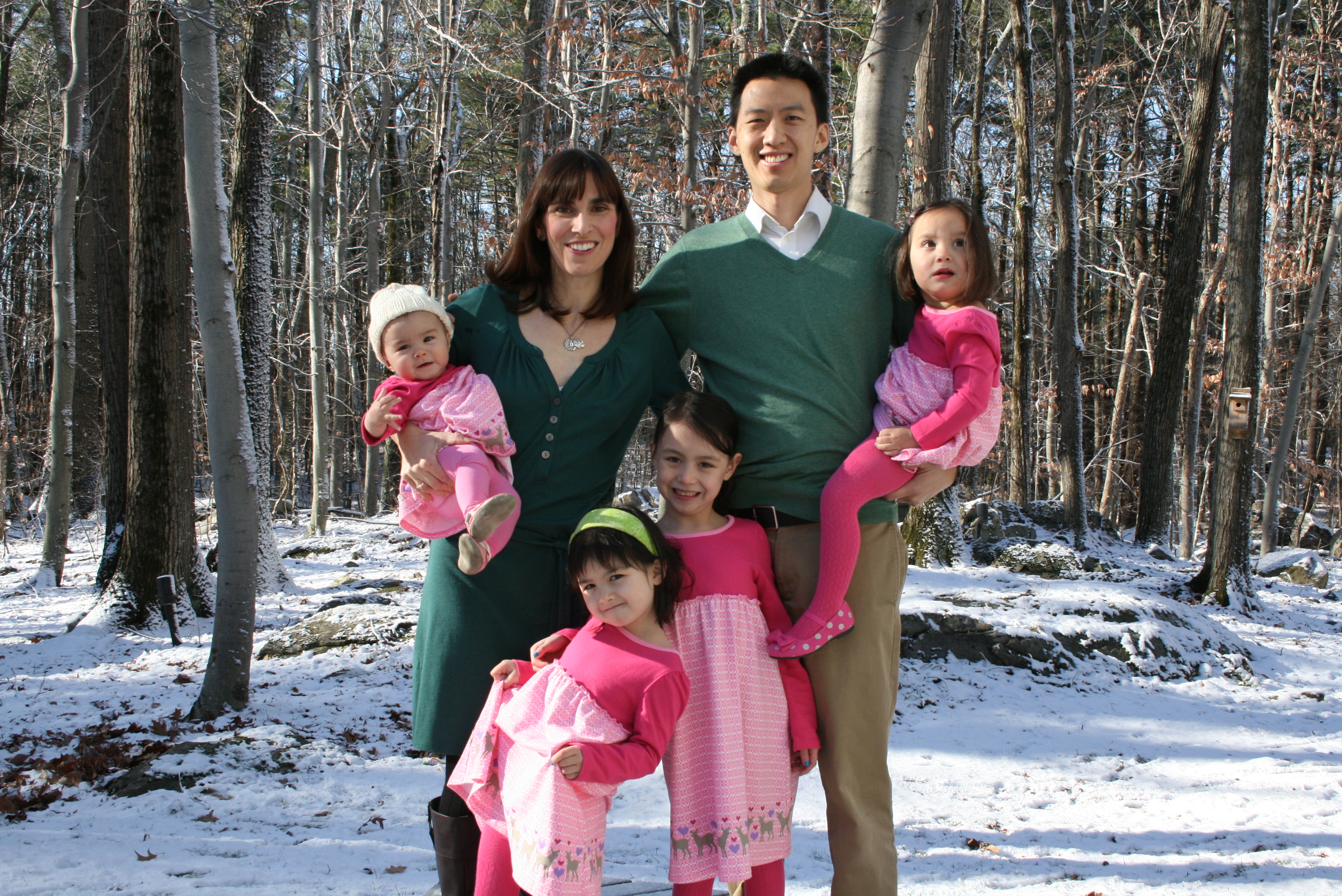
This year’s Christmas card photo

Every year, I feel conflicted about Christmas cards. They’re impersonal; many on our Christmas card list hear from us once a year, and at best we send them a form letter. Christmas cards can seem braggy; we showcase our best photo and write a rosy update — no mention of the potty accidents or the fights or the dusty corners. Christmas cards have absolutely nothing to do with the real Christmas, and they’re a lot of work and expense at a time of year that’s already stressful and expensive.

Click here to continue reading — and for a recipe for my Nana’s famous fudge — over at On the Willows.


How to Enjoy Freezing Temperatures…With Kids

IMG_3466

[Abridged version: Stay indoors. Drink Scotch.]

Last week’s sub-zero temperatures across much of the continental United States were Big News. We all heard the reports and saw the pictures of children blowing bubbles that froze solid, polar bears sheltering inside their zoo houses, planes grounded due to freezing fuel, lighthouses covered in buttercream-thick ice, schools closed because of cold.

As most Vermonters are aware, however, last week was a fairly unremarkable week in our own state, as winter temperatures go; the temperature hovered between the single digits and teens, with one bizarre rainy thaw into the 30s.

Vermont’s own sub-zero temperatures came the week before the rest of the country: the first week of the New Year. The National Weather Service recorded negative temperatures in Middlebury every day between January 2 and 5; on January 3, the high was -3. I witnessed a -17 reading on our outdoor thermometer; one afternoon as I prepared to meet the school bus, I found myself thinking, “Oh, good, it’s warmed up to -5; otherwise, it’d be really cold out there!”

Click here to continue reading my latest “Faith in Vermont” column for The Addison Independent.

A Break From My Break

IMG_3580

In early December, I announced that I would take a “Pickle-cation” from writing for this blog. The break was to extend through the holidays, and I envisioned it as a time to “write…reflect…and to enjoy the holidays with my family” without the pressure of writing weekly posts for The Pickle Patch.

Well, folks, this is me checking in from my self-imposed exile to give you the update: there has been NO writing, and NO reflecting, but an overabundance of “enjoying the holidays with my family.” In other words: Holidays: 1, Faith: 0.

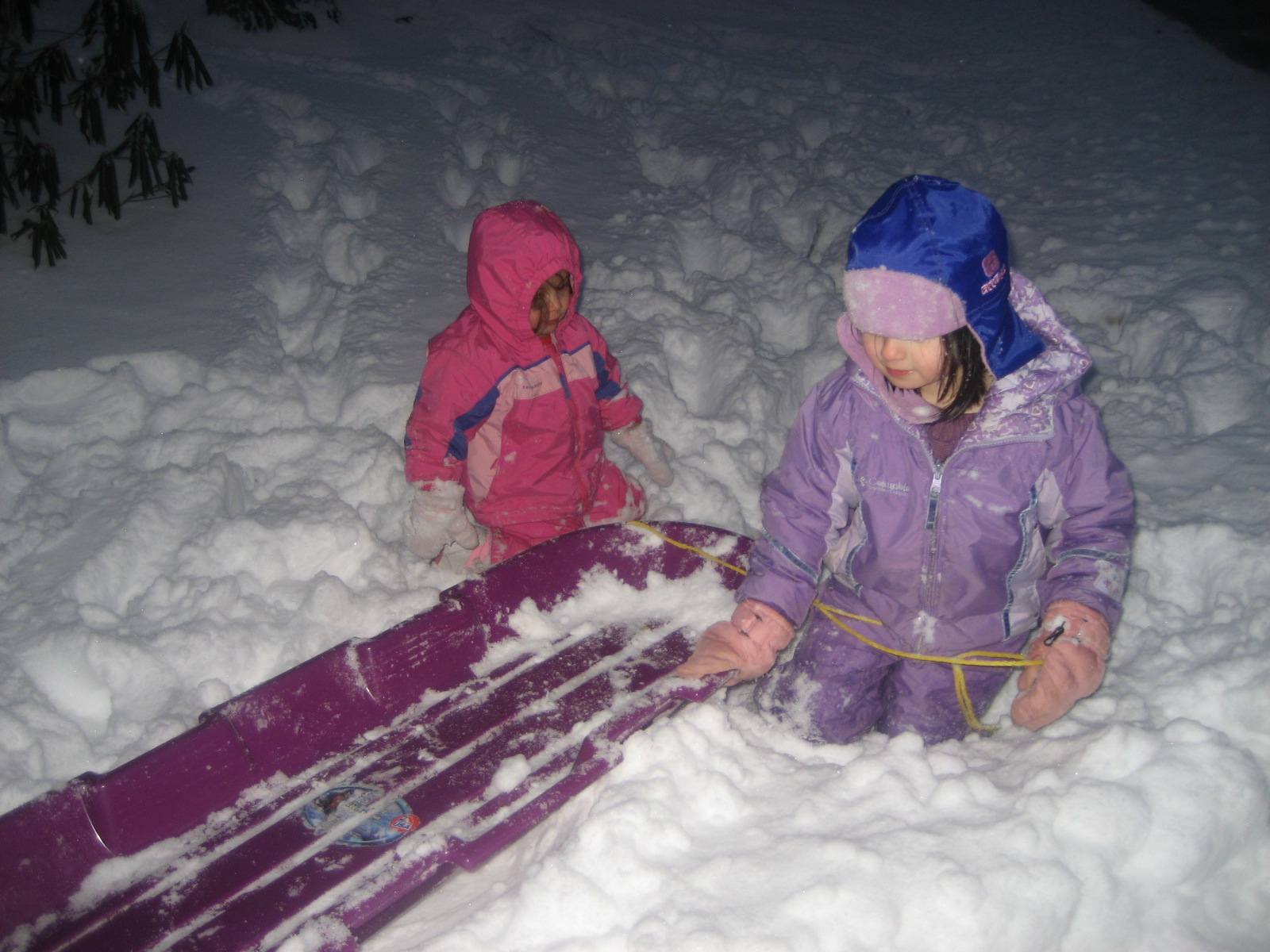
Please don’t misunderstand: I love the holidays, and I love my family. The Gongs had a wonderful Christmas season. There was skiing and sledding and skating and hikes in the woods. There were grandparents. There were holiday parties and sleepovers with friends. There were “Mommy dates” with my oldest, who’s usually at school all day. There was baking and crafting. There were many candles lit and books read. There was the joyful hysteria of Christmas morning. There was the Christmas pageant in which Campbell performed a moving interpretation of an attention-seeking cow with poor impulse control.

It was lovely.

But every holiday or vacation time, there are moms who post something like this on Facebook: “So glad for the school break! It’s wonderful to have all the kids at home.”

And every holiday or vacation time, I’m reminded that I am not yet that mom. Maybe I never will be; maybe that kind of selfless desire for togetherness requires a special kind of temperament — or medication. I prefer to think that it requires time; that, when the girls are older and school holidays don’t just mean that I have double the number of voices calling, “Mommy! Mooooommmmmy!” every two minutes, perhaps I really will welcome extended times of togetherness.

For now, though, holidays mostly feel draining and confusing. I know that holidays can feel that way for everyone; there are errands to run, events to attend, and the expectation that every single second should somehow be “special” and “memorable.” In my case, I also forgot one crucial thing: at this point in my life, “writing and reflecting” and “enjoying the holidays with my family” are not compatible.

You see, during our regularly-scheduled life, I’m able to write and reflect due to the presence of certain structures that are built into the day to keep the kids away from me: school, naptime, and bedtime. I also wake up an hour earlier than any of our kids so that I can get dressed, wash my face, and start the day in peace. But during vacations and holidays, all of that goes out the window.

It starts first thing each day with this dilemma: Do I keep to my regular, pre-dawn wake-up time, or do I sleep in? Every morning, I decide to sleep in. It’s vacation, after all, there’s no need to rush the kids off to their schools, and I need the rest. And every morning, when the girls come racing down the hall (much earlier than is warranted by their way-too-late holiday bedtimes) screaming, “I have to go potty!” or “She hit me!” and I’m stuck wiping bottoms and resolving disputes without having had the chance to get dressed and centered, I think, This is horrible. I NEED to get up earlier tomorrow. The next day, it’s the same scene all over again.

Each day of holiday vacation is a nonstop marathon of togetherness, without the separation imposed by school and universal naptimes. About midway through the vacation, Erick can see that I’m starting to fray, so he’ll say something like, “How about I take the girls to see the train display, so that you can have a break?” And almost without fail, I’ll respond, “You’re going to see the train display? But I want to come, too!” The next day, I’ll feel overwhelmed and put-upon, with thoughts like, “Why is Joan of Arc considered a martyr? I could teach her a thing or two about martyrdom — she didn’t even have kids!!!” But then, when Erick says, “Hey, how about I take the girls out for breakfast tomorrow?” I’ll say, “Can I come, too?”

I think I read somewhere that the definition of insanity is repeatedly doing the same things, but expecting different results. You can draw your own conclusions, but when I examine my own behavior during the holidays, I do not look sane.

I’m coming to see that the problem isn’t with what I’m doing; the problem is my expectations. It’s okay — healthy, even — to sleep later and adopt a more relaxed schedule during the holidays. It’s more than okay to sacrifice alone time — even if that’s time normally spent doing things that feed your soul, like reflecting and writing — in favor of time spent with family. In general, I think it’s important to be selfish about things that feed your soul, but it just may be that Christmas week isn’t one of those times.

This reminds me of this year’s Apple holiday commercial, which went viral because it touched so many people. You know: the one with the awkward teenage kid who won’t put down his iPhone throughout the family holidays, and then on Christmas morning he plays the holiday video he’s been recording all along, and everyone weeps as if to say, “It’s okay that you’ve spent the entire holiday tethered to your smartphone, since you were using it to create this digital memory!”

I HATE that commercial.

I get that it’s supposed to be about understanding, and how the person on the sidelines might not be as tuned out as they seem. But the first time Erick and I saw it, we looked at each other and burst out laughing, because it was such a naked attempt to justify our culture’s electronics addiction.

Here’s the thing: all the time, but especially during vacations and holidays, YOUR FAMILY WANTS YOU. Who cares if you’ve spent a week making a digital video, if it sidelined you from participating fully in your life? Let’s face it: in a decade, that footage will probably be unwatchable, anyway, because Apple will have developed some new video technology. Likewise, my daughters could care less if I’m carving out daily writing time during the holidays, even if I’m writing beautiful and thought-provoking pieces about the holidays; they do care that I’m available to play and bake and read and participate fully in our family’s holiday.

So, I’ve learned something: next year I will again take a Pickle-cation, but I will NOT expect to get any writing done until after the New Year. Which is to say: I now need a break from my break, and so I will be extending my Pickle-cation through January to do the writing and reflecting that didn’t happen in December. See you in February!

What Shall I Give Her?: Thoughts on GoldieBlox, William’s Doll, and the Confusing World of “Girly” Toys (Part 2 of 2)

IMG_3457
Who’re you calling “girly?”

INTRODUCTION: In the first part of this piece, which appeared yesterday, I related how I’d been bombarded by the viral video commercial for GoldieBlox — construction kits that are being marketed specifically to girls in order “to get girls building” — while considering Christmas gifts for my own four daughters. After an initial rush of enthusiasm from consumers, GoldieBlox experienced some backlash for peddling pastel toys while simultaneously claiming that they wanted to “disrupt the pink aisle.” All of which raised interesting questions that get at the heart of our culture’s confusion about what it means to be a female: Are traditionally “girly” toys and games (dolls, tea sets, princess play) inferior to traditionally masculine toys and games? In order to encourage girls to engage in more “masculine” play, do we need to make separate-but-equal toys (i.e. traditional boy toys in pastel hues)? And if we answer “yes” to the two previous questions, aren’t we being demeaning to girls? So where does that leave us?

I’ll attempt to tackle some of these issues based on my own experience.

Click here to read Part 2 of this post over at On the Willows.

What Shall I Give Her? Thoughts On GoldieBlox, William’s Doll, and the Confusing World of “Girly” Toys (Part 1 of 2)

IMG_3417

In our house, we try to fight against Christmas becoming all about gifts. Our children get presents, but since we buy sparingly I spend a lot of time considering what to purchase, because I want it to be meaningful. We have four girls, so while considering toys this year I couldn’t avoid the GoldieBlox phenomenon.

For those who missed it, GoldieBlox is a toy company whose stated mission is “to get girls building.” Concerned that men vastly outnumber women in science, technology, engineering, and math (STEM) jobs, GoldieBlox designs storybook and construction sets for girls. Their “Princess Machine” commercial, in which three girls design a Rube Goldberg machine throughout their house, went viral this fall — and, no doubt, sold lots of GoldieBlox sets.

My own finger hovered over the “Add to Cart” button on the GoldieBlox website. Then I stopped, because something I couldn’t quite name was bothering me.

Click here to continue reading over at On the Willows. Because this is a long-ish article, it’s divided into two parts, with the second part publishing tomorrow.

Advent-ures: My 24 Days of Christmas

IMG_3461

Life with four young children being what it is, I don’t spend much time looking ahead at the calendar. Most days I can tell you the number of minutes until bedtime, but I’d be hard pressed if you asked me the specifics of next week’s schedule – let alone what’s happening next month. This past November was a particularly busy month for our family, so all of my energy was focused on just getting through Thanksgiving.

Right after Thanksgiving, I ran into a friend at a Middlebury College family dinner. She asked about our holiday, and I said, “It was wonderful, and I’m feeling much more relaxed now that we’ve survived November.”

“That’s great!” she said, “November must’ve been pretty crazy if you’re feeling relaxed with only three weeks until Christmas.”

That’s how I learned that, this year, there were only three weeks – THREE WEEKS!! — between Thanksgiving and Christmas.

Click here to continue reading about my 24 days of Christmas in my latest “Faith in Vermont” column for The Addison Independent.


Bring in the Noise

IMG_3095

Last spring, I was doing what I used to do before our town entered the 21st century and instituted online registration for recreation programs: standing in a serpentine line outside the town gym, waiting 30 minutes for the doors to open upon gymnastics registration. In retrospect, I look back fondly on the hours I spent in those lines; they were great chances to catch up with friends and to make new acquaintances. In this case, I was chatting with a friend, who then introduced me to a new acquaintance: a woman with four sons.

“Wow,” I said, “four SONS! I don’t know anything about sons, but I hear they’re harder to raise than daughters.”

“Well, sons are very energetic, very physical,” she said, “but I personally would find daughters much harder –“

At just this moment, all three of my girls (Abigail still being in utero) came shrieking down the hall, doing their  best impersonation of an air raid siren.

“– for that very reason,” my new acquaintance continued. “The noise would drive me crazy.”

Now, I don’t put much stock in gender stereotypes. What I said to that woman is true: I don’t know ANYTHING about sons. My information about young boys comes mostly from observing my daughters at play with their male friends — and from what I can tell, my girls run circles around these boys. So I can’t say with any authority that boys are harder, or more energetic, or quieter than girls.

Here’s what I can say with authority: MY GIRLS ARE LOUD.

They scream. They scream with joy while playing, they scream at each other (and us)  in anger, they scream for no apparent reason — just for fun. And when they’re not screaming, they’re talking. They talk all the time, about everything. Also, because there are four of them, they’ve learned that they need to talk loudly.

Mealtimes at our house are probably just as you’d imagine: Four girls verbally elbowing each other to get a work in edgewise (even though Abigail isn’t using words yet, she still adds noise), ratcheting up the volume to make themselves heard above their sisters — and above their parents’ increasingly loud pleas to stop interrupting and take turns.

The problem is, even when they’re not jockeying to be heard, they’re still loud. It’s as if, due to the constant noise in our house, they’ve lost all sense of what a normal “indoor voice” is. So whether in a restaurant, a store, the library, or on the phone to their grandparents, my girls continue to shout. More than once I’ve said, “Please, you don’t need to shout,” only to have the daughter in question look at me with confusion and shout, “I’m not shouting!” During our conference with Campbell’s preschool teachers last year, her teachers reported — with disbelief bordering on concern — that Campbell had told the class that her house was “really quiet.” Campbell knows what “quiet” means, she’s just deluded about what it actually is.

I’m sure that most people in our town can hear us coming long before they can see us.

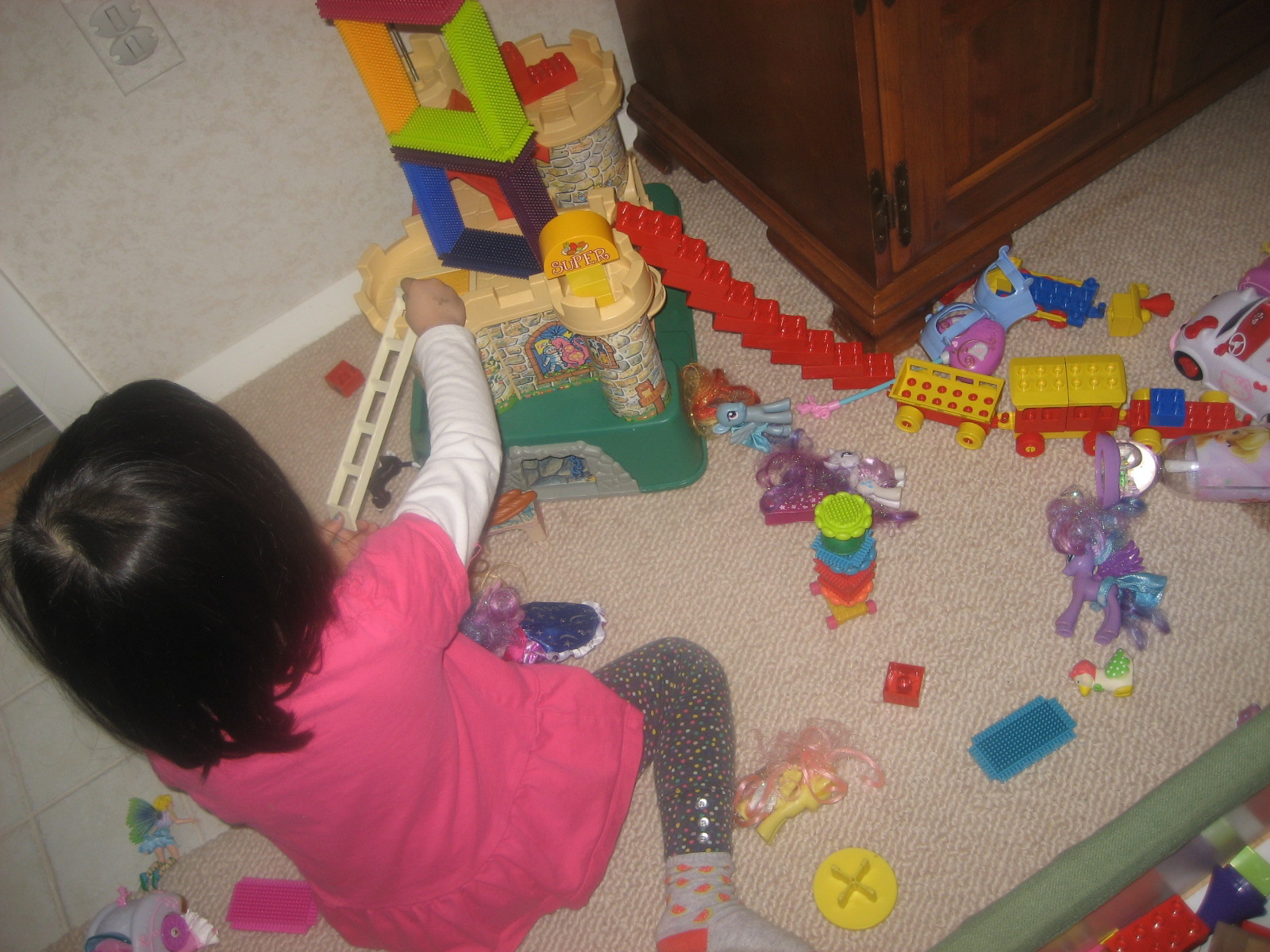
And that’s just when they’re being well-behaved. Then there are the fights. It may be that boys fight by beating each other to a pulp; my girls beat each other to a pulp while screaming at the top of their lungs. Kicking, biting, scratching, hitting, all accompanied by, “MOMMY! She’s not SHARING!” (The item not being shared is usually an equine-shaped piece of plastic from My Little Pony: Friendship is Magic. I’ll say it’s magic; ah, the irony!)

Even when they’re supposed to be quiet, the noise doesn’t stop. Since they all share a room, bedtime sounds like a college party in full swing until all goes abruptly quiet when they pass out from exhaustion (we’ve decided not to intervene as long as they stay behind closed doors).

Even when they’re alone, the noise doesn’t stop. There are moments during the week, when the older two girls are in school and Abigail is napping, that Georgia is all alone. Does she sit and play quietly? No. Instead, Georgia has taken to narrating her life. For instance, Georgia will say, “She takes out a book and sits on the couch. She looks at the book,” as she does just that. Yes, she refers to herself in the third person, like she’s providing the voiceover for an Animal Kingdom segment on herself. I’m not sure whether to be concerned, or to steer her towards a future career in reality T.V.

Even when they’re quiet, the noise doesn’t stop. Usually they’ll stop talking after a while in the car (especially on these cold, grey winter days when the heat is turned up), but they always want to listen to music. These days, their music of choice is the soundtrack to the Broadway production of Annie. At first, I welcomed this as a relief from the Disney Princess CD that we’d played on repeat for years, but I’d never realized how much of Annie consists of prepubescent girls shrieking songs at the top of their lungs. At least, those are the only songs we listen to — we’ve never listened to the entire show all the way through, because my daughters insist on “‘Tomorrow,'” and…”‘Tomorrow,’ again!” until I’m about to lose my mind. It’s only a day A-WAY! PLEASE, make it STOP!!!!

For all these reasons, we’re not big on toys that make noise. But sometimes they’re impossible to avoid, like when they’re given as gifts. Last Sunday, one of my daughters unearthed a little fuzzy duckling that says, “QUACK QUACK QUACK QUACK!” when you squeeze its belly — a gift to one of the girls when she was a newborn. Somehow, this duckling made it out of the house, into the car, and into church, where the girls sit with us for the first part of the service. Of course, right in the middle of the offertory prayer, the duckling got squeezed. QUACK QUACK QUACK QUACK!

But I’m told that we’ll miss the noise when the girls are grown and gone. I’m told by no less a parenting authority than Brad Pitt, who said in a May 21 interview to People magazine:

“There’s constant chatter in our house, whether it’s giggling or screaming or crying or banging. I love it. I love it. I love it. I hate it when they’re gone. I hate it. Maybe it’s nice to be in a hotel room for a day – ‘Oh, nice, I can finally read a paper.’ But then, by the next day, I miss that cacophony, all that life.”

As I write this, with all my girls at school or napping and my ears still ringing from the noise of an hour ago, I think: Spoken like a person who gets to spend lots of days reading the paper in hotel rooms, Mr. Pitt.

But I’m sure he’s right, and so when the ringing in my ears subsides just in time for the girls to wake up again, I’ll try to enjoy the noise while it lasts.

What’s In A Name?

Are you talkin' to ME?
Are you talkin’ to ME?

The second you become a parent, whether or not you’re ready, you are forced to become a turbo-charged problem solver. My days are like a never-ending loop of MacGyver episodes (MomGyver?), in which I figure out how to change a diaper in a changing-table-less public restroom; how to simultaneously bathe, feed, and clothe four unattentive children; how to rig up a harness to attach My Little Pony figures to a Fisher Price carriage; how to answer questions like whether ghosts are real.

No problem. But here’s one that, after nearly six years of parenting, I still haven’t figured out: The problem of how my children should address non-family adults.

My husband and I grew up on opposite sides of the country, in families with different cultural backgrounds. Yet we agree that, as children, there was never a question as to how one addressed a grown-up. They were all “Mr./Mrs. [LAST NAME],” with the exception of extremely close family friends, who might ask you to call them “Uncle/Auntie [FIRST NAME]” (and even then, I usually felt uncomfortable doing so).

I’m not saying that was the best system, but it was simple. It was clear. There was no awkward bumbling around with names when introductions were made.

Now, it’s all an awkward, bumbling mash-up. The etiquette for how children should address adults seems to vary by geographical location, age group, and even between different social circles.

In Northern California, where we started having children, things were a bit simpler. At that point, most of our friends with children were roughly our age and attended our church. For some reason, the people who’d had children first tended to be Southern transplants, so they set the culture for naming adults: Children addressed grown-ups as “Mr./Miss [FIRST NAME],” as in “Miss Daisy.” Since that’s what most of our friends did, that’s what we did. At times I felt like a character in The Help, but at least it was simple. It was clear. And it seemed to strike a nice balance: informal without being too casual.

Then we moved to Vermont, and everything got confusing. Here, our friends are all over the place: We have friends from the college, friends from town, friends from church, friends who are our age up through friends who are in their 80s. So, when the Gong Girls blazed into town with their “Mr./Miss [FIRST NAME],” it wasn’t always quite right. Clearly that’s too informal for most New Englanders  over age 70. But it also seems a little too formal for some of the friends in our own age group, most of whom introduce adults to their children by their first names. (I don’t necessarily have anything against children calling close family friends by their first names — I personally feel ancient and confused when somebody calls me “Mrs. Gong” — but Erick tends to bristle when a two-year-old saunters up to him and says, “Hey Erick!” “I have 20-year-old students who address me more formally than most toddlers,” he’ll grumble). Then there’s a whole group of people in the 40-60 age range, which I consider a panic-inducing grey area.

Add to this another problem: Despite living in a small town, we know a lot of people who share the same names. For instance, there are about ten Deborahs in our life. So we call some by their last names, and some by their first names with qualifying details — “Miss Deb with the horses,” for instance.

I know you’re probably thinking: Relax, Faith! This doesn’t have to be a problem. Why don’t you just ASK people what they’d LIKE your children to call them? Ah, but I do. I have no qualms about asking someone, minutes after we’ve met, “What would you like my children to call you?” The problem is, most people are just so NICE! They’ll smile and say, “Oh, whatever! It doesn’t matter to me. Anything’s fine.” And then I’m left fishing around for an appropriate form of address, carefully watching my new acquaintance’s face to see if they’re offended: “Fiona, this is Sue. Miss Sue. Mrs. Bridge.”

That’s why I end up having exchanges like the following with my children:

ME: So, Fiona, did Mrs. Jones teach Sunday School today?

FIONA: Who?!?

ME: You know, Mrs. Jones. Miss Deborah.

FIONA: Who?!?

ME: Janie’s mom.

FIONA: Oh. Yeah.

Anyone else having this problem? If so, I say we band together and start a movement to standardize how children should address their elders. I don’t care if it’s first name, last name, or social security number, just as long as it’ll save me this awkward stumbling around for an appropriate title. At the risk of being overly political, maybe we need something like ObamaName (but with a better computer program). Who’s with me?