This is NOT a Mother’s Day Post….

I’m a little nervous about this one, folks; it’s more opinionated than I’m usually comfortable with. In reading it, please just remember that — to quote my middle child — “I love EVERYBODY! Because that’s what God says to do!”

6
Image link

This week was blank on my blog calendar for some time. Finally, I posted a note for myself that said, “Something for Mother’s Day?” and left it at that. Then I fretted and stewed, because I’m just not inspired to write about Mother’s Day; I don’t get excited by this holiday. Some say, “Every day is Mother’s Day!” Well, maybe it is and maybe it isn’t, but what’s definitely true is that I’m a mother every day; all that seems different about Mother’s Day is that my husband and kids get stressed out trying to thank me properly for my sacrifice. I’d much rather have moments of genuine thanks scattered throughout the rest of the year than delivered under pressure from Hallmark.

Also, I’m not interested in writing about motherhood as an institution. Motherhood has been around for a long time. Billions and billions of women have done it. Women have children, and then they raise them as best they can. Really, what is there to say other than, “It’s crushingly hard most of the time, but love balances it out?” I’d rather write about my own life experiences, my own thoughts and feelings, and hope that they make other moms smile or feel a little more okay.

Inspiration came, as it often does, in an unexpected form; in this case, it was this article that popped up on my NPR news feed one afternoon. The article’s focus is an argument against gay marriage put forth by Ryan T. Anderson of the Heritage Foundation; according to Anderson, government legislates marriage because when a man and a woman get together, children may result. The government has an interest in making sure that children are permanently cared for by both a mother and a father, so that the government won’t have to provide child support later on. To quote Anderson, “Marriage is the way the state non-coercively incentivizes me to be in the institution that does best for children.” He believes that allowing gay marriage would weaken marriage as a “coercive” force for heterosexual couples.

Now, before anybody’s heart rate gets going (too late?!?), let me assure you of something: I’m NOT trying to use this blog to advance my own political or spiritual views, which are too personal and uninformed to be of much use in any dialogue. Ryan T. Anderson is a smart man who’s spent far more time pondering these issues than I have; Slate apparently called his book What is Marriage? Man and Woman: A Defense, “the best argument against gay marriage.”

To the extent that my political or spiritual views DO seep into my writing, it’s because they’re intertwined with my experience. So I AM going to write from the logic of my own experience. The NPR article got me thinking about families — the families I know. I don’t know the families that Ryan T. Anderson knows, but it seems that his reality doesn’t look much like mine.

Here’s my reality: I know families composed of a mother + father + kids. I know families who’ve lost moms and dads to death, divorce, or abandonment. I know kids who honestly might have been better off without certain mothers or fathers in the picture. I know unmarried people, and childless married couples. And let me tell you this: Some of the most delightful, polite, intelligent, and well-adjusted kids I know right now — kids who make my own kids look like hooligans — are being raised by two married mothers.

My experience is that the religion I practice doesn’t give me a whole lot of specifics on how to vote or how government should legislate. But it DOES give me a WHOLE LOT of specifics on love, and grace, and humility. Specifically, it tells me to embody these things.

So, I’d like to re-christen this Mother’s Day as “Family Day.” I think that we need to celebrate the brave, important, and incredibly difficult work of raising children — shepherding the next generation — that’s being done every day in any number of family configurations. I want to salute the mothers and fathers and non-biological “family members” who are in the trenches — either alone or together — doing their darndest to nourish little people.

I also want to celebrate the people who choose to remain single, and married people who decide not to have children. These are brave decisions in a culture that sets the “norm” at marriage and children. To make these choices requires a confidence and a self-awareness that I admire. It also frees these people to function as productive members of society — and in the lives of children — in ways that may be impossible to married or child-laden people. They’re still family.

I’m not sure on what evidence Anderson reached the conclusion that heterosexual marriage is “the institution that does best for children.” Marriage as father + mother + children is Anderson’s ideal, and it’s not a bad ideal: It’s the way my own life looks right now. But like most ideals, it’s something that many people don’t have. (I’m not convinced that it’s something that the majority of people throughout history ever did have). Advancing this ideal as something that’s so “best for children” that it must be the only legal option — that excludes a lot of people I know, and diminishes the wonderful love happening in all sorts of families.

So, what really “does best for children?” (After all, until fairly recently my own marriage — which is interracial — would not have been included among relationships that “do best for children.”)

Here’s what I think: I think we all need each other. My own children have a father and mother, but we certainly don’t do it alone — we can’t do it alone. It wasn’t until I had kids that I realized my children need so much more than just Erick and me; they need their grandparents, they need their teachers, they need every one of the loving adult friends and family members who surround them. No one family situation is truly ideal — sometimes your mother dies, sometimes your father leaves, sometimes you get two drunk and abusive parents — but I think if kids are surrounded by enough love from whatever source, then they’re usually able to take the best of that and make it through life in one piece.

So here’s to all the families and parents and just plain folks out there who are trying to “do best” for our kids. When it comes to kids, all we can do is our best, and our best will always be better if we do it together. Whatever comes at the start of the equation, More Love = More Love. Happy Family Day.

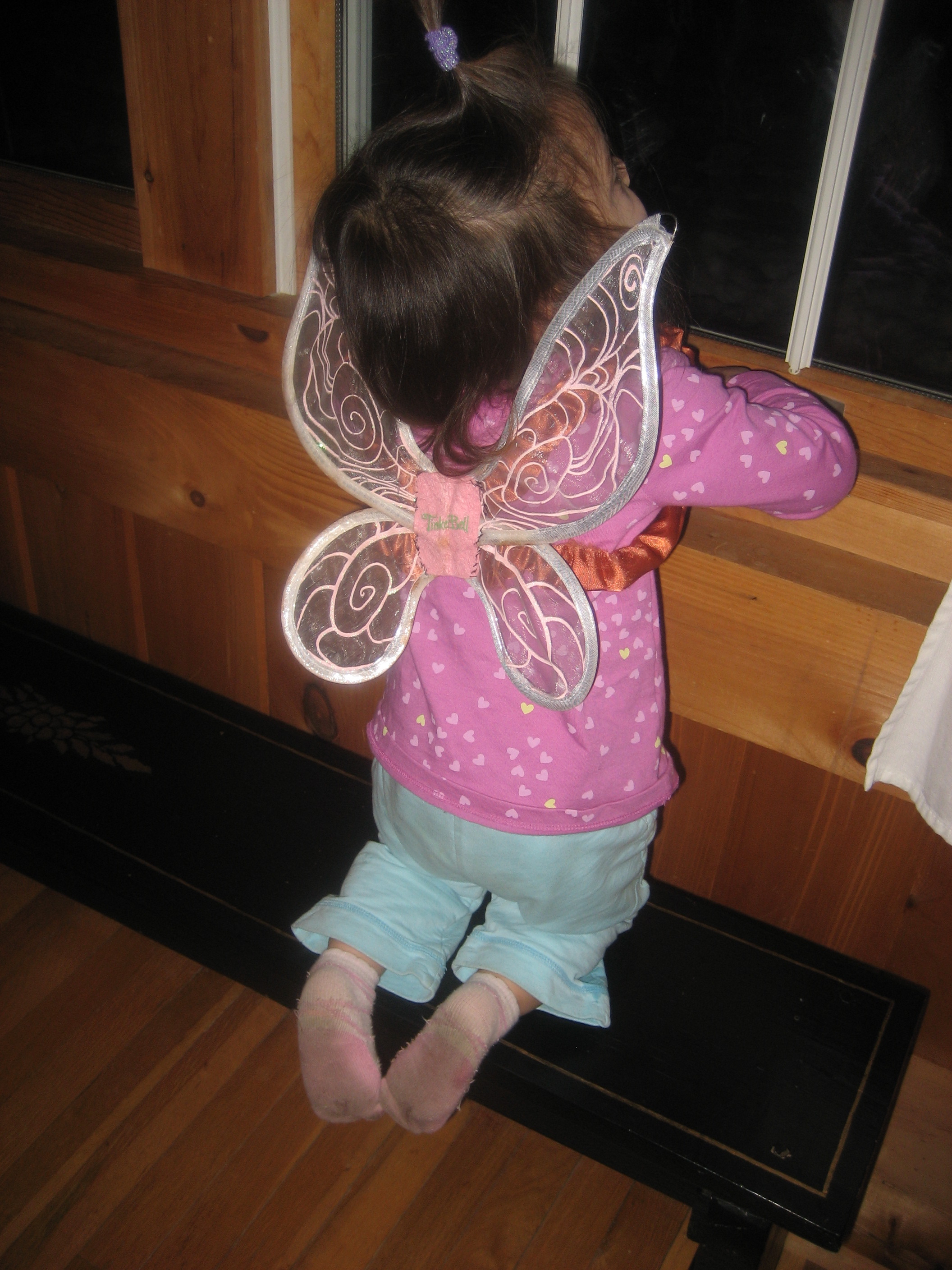
Little Girls

IMG_0837

Today is International Women’s Day. This is not a day I’ve noted before, because until recently I didn’t think much about being a woman.

Growing up, in the time and place that I did, I had the strange “luxury” of feeling ambivalent about my female-ness. It was something that I took for granted; Hair: Brown, Race: Caucasian, Sex: F. I never disliked being a woman, but neither did I take any particular pride in it. I emerged from adolescence with some vaguely negative stereotypes about what it meant to be a woman: women were overly emotional, too sensitive, too talkative, bad drivers, and subject to the ultimate Sophie’s Choice of career vs. motherhood: no matter how you chose, your life was doomed to be less than satisfying. Back then, I would’ve been afraid to say I was proud to be a woman; such a statement might align me with the angry voices of second-wave feminism. Granted, those angry voices were necessary in order to get the culture’s attention, but anger doesn’t usually speak to me. I was brought up to be polite; I still don’t do angry very well.

It’s gradually dawned on me that I am a woman. Not only that: I am the mother of three little girls who will one day be women. As such, I am my daughters’ first example of what it is to be female.

That’s a charge I shouldn’t take lightly.

My role as a mother, I repeatedly tell my girls, is to help each one of them become “the best YOU that you can be.” How do I help my girls become their best selves, and instill pride that their SELF includes being a WOMAN?

I think pride in being a woman begins with recognizing that there’s something unique about womanhood. Men and boys are special, of course, but women are special because they’re not men — we bring something different to the table. My daughters, despite being raised in the relative cultural isolation of small-town Vermont — few chain stores, no billboards, no T.V., and the only magazine we get is The New Yorker — STILL gravitate towards fairies and princesses and ponies and pastels. They choose to dress and play differently than the boys we know. I can either fight this apparently inborn female-ness, or I can encourage them to find the strengths in who they already seem to know they are.

Those female stereotypes I grew up with, many of them are in some way true. But they also encompass some of the qualities I love best in my girls, qualities that I think make them uniquely female. In trying to get at what’s special about women, I’ll take each stereotype I grew up with and highlight its strengths:

Women are too emotional: Emotion results from feeling things deeply. Being able to feel deeply is a gift; like any gift, it has a dark underbelly, but its bright side is an ability to be passionate about ideas, causes, people. Passion is what gets things done. If nobody was emotional, we’d end up with a world of economists, and TRUST ME, that would be tragic.

-Women are too sensitive: Like emotion, sensitivity can be problematic if overindulged, but it’s a necessary ingredient for successful relationships. Being sensitive may mean that you’re easily hurt, but it also makes you more aware of the feelings of others.

-Women are too talkative: Sorry, but as a writer I don’t have a problem with this. Aren’t words the essence of life? Isn’t the moral of the story of the Tower of Babel that, without the ability to communicate, our cities end in ruins?

Women are bad drivers: I don’t really know where this one came from, but I DO know that when I’m a bad driver, it’s usually because there are three little people screaming at me from the backseat. Which gets at something that I think is a female strength: the ability to multitask. Just about every woman I know thinks nothing of talking on the phone while preparing dinner with one hand and bouncing a baby on her hip. Or writing her PhD dissertation with one side of her brain while simultaneously solving her best friend’s relationship troubles with the other side. So pardon us if we’re distracted! (In contrast, when my husband watches the girls, he’ll get dinner cooked…while the girls run around naked setting small fires in every corner).

-Work vs. motherhood: This is a whole can of worms, but the WONDERFUL thing about being a woman is that you GET a choice. You can become a MOTHER, for crying out loud! That’s an amazing thing that only women can do. But, thankfully, in this day and age, you can also choose a CAREER! The world needs women represented in all fields — and with fewer and fewer restrictions, you can do what you love. Nowadays, there are creative ways to cobble motherhood and career into something that works. But it’s NOT easy: it’ll never be easy to be a mother, it’ll never be easy to carve out a career, it’ll NEVER be easy to balance both. But women do it, and have done it forever — since back when “career” meant “keeping a farm running.” And that’s why the toughest people I know are all women.

Those are a few strengths that I’d claim for women. But what makes me PROUDEST about being a woman is the company in which it puts me. Powerful women have surrounded me my entire life, it’s just taken me a while to notice. There are the women in my own family. There are the six years’ worth of students I taught at two girls’ schools (two of them recently re-introduced herself to me here; they’re students at Middlebury — talk about feeling old!). There’s the Pakistani woman I tutored for six years in Manhattan, who’s currently pursuing her bachelor’s degree. And there are my friends across the world: women who have amazing careers, women who are mamas, women who have careers and are mamas, single women, partnered women. Women who stay in hard marriages; women who leave impossible marriages. Women who show up with a meal at the perfect time (because it’s always the perfect time!). Women who create things of beauty. Women who tell the truths you need to hear. Women who raise the children — and not just their own. Women who care for the sick and comfort the grieving and fight for justice.

These women are beautiful. They make the world more beautiful. They keep life going. I’m so grateful that my own little girls can grow into women, surrounded by women like these. As my oldest daughter said the other day, “Every girl’s a princess, even if she doesn’t live in a castle.” Amen, and Happy International Women’s Day!

Georgia, Bustin’ Out All Over

IMG_2006

I am six months pregnant: I feel large, Kiddo 4 is making it increasingly difficult to breathe, and I get winded from walking up one flight of stairs. Not much gets me running these days.

Except for these words: “Mommy, come look what Georgia’s doing!!!”

When I hear that, I know that I can expect to see Georgia balancing on top of a piece of furniture. Or removing all of our  CDs from their cases. Or sitting on the floor holding an empty bottle, surrounded by Erick’s allergy pills. Or programming my computer. Or pummeling one of her sisters.

This kid is a firecracker. She makes Campbell, the child we thought was our “wild one,” look like the Dalai Lama. Our children seem to be getting progressively wilder, which makes us worry about the outlook for Kiddo 4.

It just goes to show that you never really know your child until they turn two. Georgia turns two today.

And no, I am NOT having a Friend Party for her, because sometimes you just have to break from tradition and say, “Enough!” (Or, to put it more mildly, we ARE having a two-year-old Friend Party for Georgia, and the two friends she gets to invite are Fiona and Campbell, with a bonus visit from three of her cousins).

But I am going to stick with tradition and tell you a few fun facts about Georgia as she is right now, just as I’ve done in the past for Fiona and Campbell. Because, unlike last year, this year we’re starting to really know Georgia.

1) Georgia is a lunar girl. I don’t know where this comes from, but Georgia loves the moon. If there’s a moon in any book, she’s the first to point it out (which may explain why her favorite books are Goodnight Moon and Owl Moon). She’s also the first to spot the moon in the sky, even if it’s just the hint of a moon during the day. For some reason, on a family nighttime stroll this fall, we thought it would be fun to howl at the moon. So now, whenever Georgia sees the moon, she yells, “Moon! HOOOOOOOWWWWLLLLL!”

IMG_1889

2) Georgia is the most independent of the Gong Girls. I say “independent;” her sisters say “rascally.” This is partly because she wants to be just like her two big sisters, partly because she’s received less supervision than her sisters (so sue me, I’m exhausted!), and partly because she’s lived almost her entire life in Vermont — which breeds a certain kind of independence. Georgia, at barely two, wants to do everything herself: dress herself, cut her food, wash the dishes, and drive the car. She throws herself wholeheartedly into life: art projects, singing and dancing, and temper tantrums. The girl has no fear, which is nice when she’s not afraid to help Erick stack wood outside on freezing pitch-black nights, and not so nice when she disappears upstairs with a mischievous agenda. [Note: Last year, I proclaimed Campbell the “most independent” of our daughters. I proclaimed wrong.]

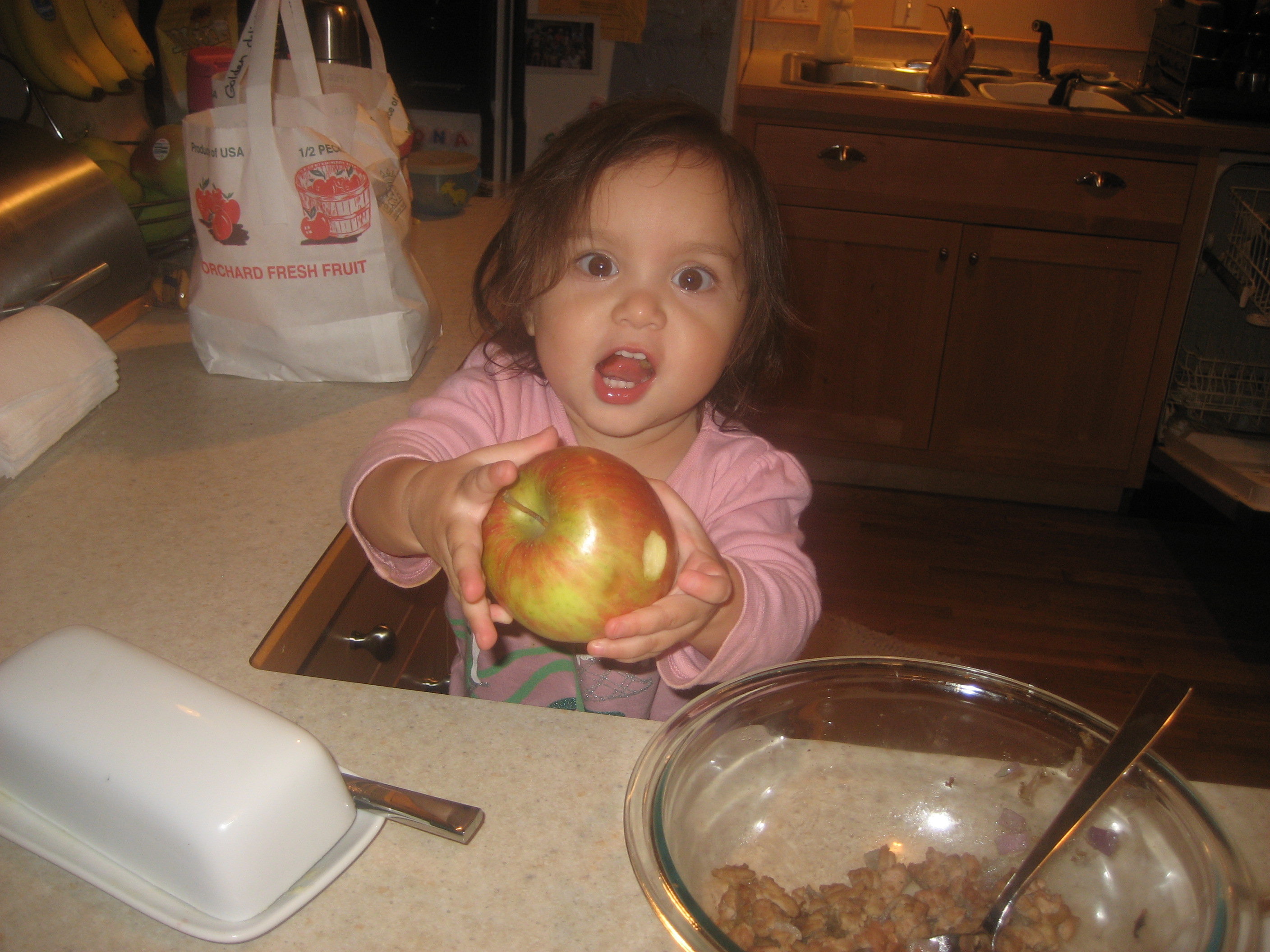
Georgia, helping herself to an apple.

3) Georgia never met a dog she didn’t LOVE. All of our girls love dogs, but Georgia takes it to extremes. She responds to dogs the same way she responds to the moon: “DOOOOG!!!” If the dog is within reach, she immediately wants to cuddle. “Cuddling,” for Georgia, includes putting each hand on the dog’s cheeks and kissing it square on the mouth. If Gracie, our own amazingly tolerant dog, is sleeping, Georgia will throw her entire body across Gracie’s. I think the only reason Gracie puts up with this is because Georgia’s other favorite activity is to “Give treats!”

Can't a dog get a minute's peace around here?
Can’t a dog get a minute’s peace around here?

So, there you have it: two fun Georgia facts, and one to grow on. We love this third daughter of ours like crazy. But we’re still holding out hope that Kiddo 4 will be “the laid-back one.”

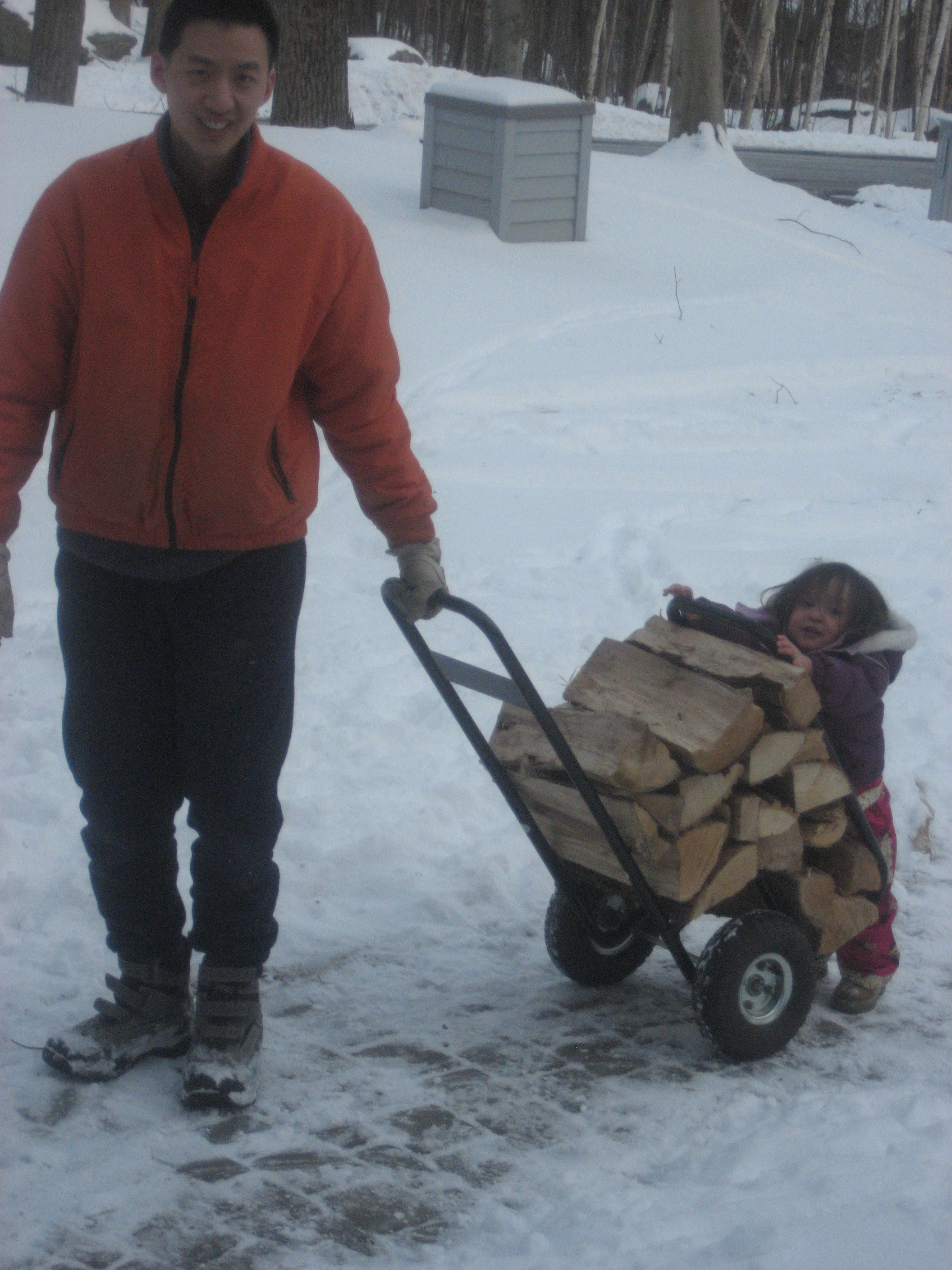
Daddy's little helper.
Daddy’s little helper.

How I Met Your Mother (Bonus Valentine’s Day Post!)

A NOTE FROM FAITH:

Okay, folks, something new today: for the first time ever, we have a guest blogger! Let me introduce my husband, Erick: development economist, lone male among 5 women in our house, and most recently the first place Asian finisher in the Southern Vermont Primitive Biathlon (read: the ONLY Asian finisher…). Today being Valentine’s Day, Erick announced that in lieu of flowers he had written me a blog post. (His exact words, I believe, were, “The demand curve for long-stemmed roses on Valentine’s Day is very inelastic.” I have no idea what that means; life with an economist).

Anyway, Erick steers clear of the econ-speak here. He’s been thinking a lot about love lately, which will make a nice change of pace on this blog. (I have NOT been thinking much about love lately; I’ve mostly been thinking about sleep). Here he is! Enjoy, and Happy Valentine’s Day!

A recent attempt at a date night. (Photo taken by our babysitter).

Part I: How I Met Your Mother…

When I think of Valentine’s Day, I think first of all, “Phew! I remembered!”  This is followed by some thoughts about love.  I remember the opening scene of the film Love Actually, where couples run into each others’ arms; love is the first date, the honeymoon period, it’s wonderful bliss.  Of course, love doesn’t stay this way forever.  But since it’s Valentine’s Day, let’s linger a bit on the bliss.

I first met Faith at a small dive restaurant.  She was waitressing, and I usually came in near closing time. She would serve me and then sit behind the counter and read. The first time I saw her, I thought to myself, Wow, she’s pretty AND she reads books. Hey, I read books too.  Well, sometimes, more like book reviews- in inflight magazines.  I wonder if we have a connection?

Thus, my first words to Faith were, “So, what are you reading?”

And from that moment, I was filled with the tingling nervousness of attraction. From the over-analysis of brief encounters (She smiled at me when she gave me the check! That must mean something.), to longer conversations, and finally to the big question of any initial relationship:

“I was wondering, uh, well, if you’d like to join me, at a baseball game, I mean, if you don’t already have plans, because if you don’t, it would be great if you could come, but I totally understand if you can’t make it?”

The first date became several dates, and long phone conversations, and intense longing desire set in.  And of course, the earnest compatibility checks:

“Wow, she likes to eat.  I like eating.  We’ll be perfect together!”

“She loves the Indigo Girls.  I just heard one of their songs on the radio.   We’re a match!”

“She runs. I know how to run.  We could run together. Forever! And then eat! And then listen to the Indigo Girls…. “

Love was easy.  Anything Faith did was magical.  I felt like the luckiest guy in the world just to be near her.  We got married (as you probably figured out).  And the honeymoon period kept going – for quite a while.  Of course, these intense feelings tempered as time went by.

And then we had kids.

Part II: …And Why I’m Still In Love With Her.

“ …researchers tracked 1761 people who got married and stayed married over 15 years.  The findings were clear: newlyweds enjoy a big happiness boost that lasts, on average, for just two years.  Then the special joy wears off and they are back where they started….[T]he good news…is that if couples get past that two-year slump and hang on – they may well recover the excitement of the honeymoon period 18 to 20 years later, when children are gone.”

New York Times, “New Love: A Short Shelf Life” Dec 1, 2012

As the New York Times article cited above points out, wedded bliss doesn’t last forever.  Our own lives became really busy: graduate school, careers, more graduate school, church involvement, and of course, kids.  Three kids.   If I spent all my time thinking about how amazing Faith is, I would neglect everything else: my research, my teaching, my friends and family, my kids, and personal hygiene.  And the Times mentions another reason for the limited shelf-life of wedded bliss: the charming term, “hedonic adaptation.”

What is this hedonic adaptation that stands between me and bliss?  In short, scientists say we are hard-wired to take positive experiences for granted.  I was elated when Faith agreed to marry me, and I’m still really happy.  But I wouldn’t describe each day as euphoric.  The same can be said for all positive experiences: new job, new clothes, new anything; eventually the excitement fades.

So, does this mean I’ll never “fall in love” again with Faith?  Well, marriage scientists have a simple solution to the problem of hedonic adaption:  Novelty.  Doing new and exciting things with your spouse – new restaurants, skiing, dancing — can reignite passionate feelings. The key is to share new experiences.

I see two big problems with this approach.  First, with three kids (and a fourth coming), it’s really hard to do novel and surprising things with your spouse.  For example:

ME: Surprise, dear! I booked us a weekend in New York. We can visit a few museums, see a play….

FAITH: Uh, what about the kids?

ME: You think they’ll be okay for a few days? They could watch Dora. How about we put a few pounds of mac & cheese in the timed kitty feeder?

Hence the Times’s qualification that Faith and I have to wait 18 to 20 years before we recapture our honeymoon period — that’s longer than the average prison sentence!

The second problem?  If reigniting passion for one’s spouse involves a continual series of novelties, where does it end? There’s constant pressure to find a new novelty.   It might begin with, “Let’s try out that new Italian-Japanese fusion place,” and end with “Let’s try skydiving…in the winter… nude.”

I think sharing new experiences is great.  But I think it misses the point.  I believe what renews our feelings for each other is another type of love.  A difficult love.  The love you give when you don’t feel like it.

I call this type of love “costly love,” because it takes effort.  When I first met Faith, it was easy to love her. But 10 years into marriage, love takes more effort. Work responsibilities get in the way; sometimes the time I spend with Faith is time I worry should be spent on research.

But it’s costly love that’s necessary to sustain our marriage.  It has different forms: taking the kids for a few hours so that Faith can have some quiet time, preparing a meal, tidying the house. Planning date nights is costly love; it’s not easy – or cheap – finding a babysitter for three kids.  For me, the most costly act of love is sitting down after a long day and listening to how Faith’s day went.  I’m not a great listener, but this is how I show Faith I love her.

And I’ve learned that costly love – loving someone even when you don’t feel totally into it – mysteriously reignites wedded bliss.   When I make the effort to spend time with Faith instead of working, I recapture those magical love feelings that I experienced when we first met.  These moments are brief, but they are much more valuable now.

Costly love forces me to stop what I’m doing and realize what’s really important: Faith.  I put down my work and think of her.  Simply thinking about Faith, realizing how lucky I am to be with her, and making the effort to share life together (date nights, late evening conversations, primitive biathlon, nude winter skydiving) reignites the passion that I experienced in our first years.  And being on the receiving end of costly love is amazing – Faith certainly has loved me even when I wasn’t particularly “lovable.”

For the record, I still have a LOT of work to do on this whole costly love thing; I’m very self-absorbed and too often get lost in my work.  Which reminds me, I better call the florist; those roses aren’t going to be cheap.

Ashes

Teach us to care and not to care

Teach us to sit still.

-“Ash Wednesday,” by T. S. Eliot

Since moving to Vermont, I’ve thought about ashes more than ever before. Now that we heat our home by wood stove, ashes are part of daily life.

Today is Ash Wednesday, which is the start of the season of Lent (40 days of preparation for Easter) in the Christian church. For Protestants, Lenten practices are sort of all over the place; we’ve been part of churches that barely noticed Lent, and churches that took Lent very seriously. Our family observes Lent in various ways, although we’ve never done the ashes-on-the-forehead thing on Ash Wednesday. (Also, as Ash Wednesday services tend to be quiet, solemn affairs, and we have three very loud, rambunctious children, we don’t do the church thing either).

Wearing ashes on Ash Wednesday is a sign of repentance — regret for past mistakes — to kick off the spiritual journey towards Easter. Throughout the Bible, when people are deeply sorry or sad, they cover themselves with ashes (frequently combined with tearing their clothes). This is the origin of the term “sackcloth and ashes” — an outward manifestation of grief and repentance.

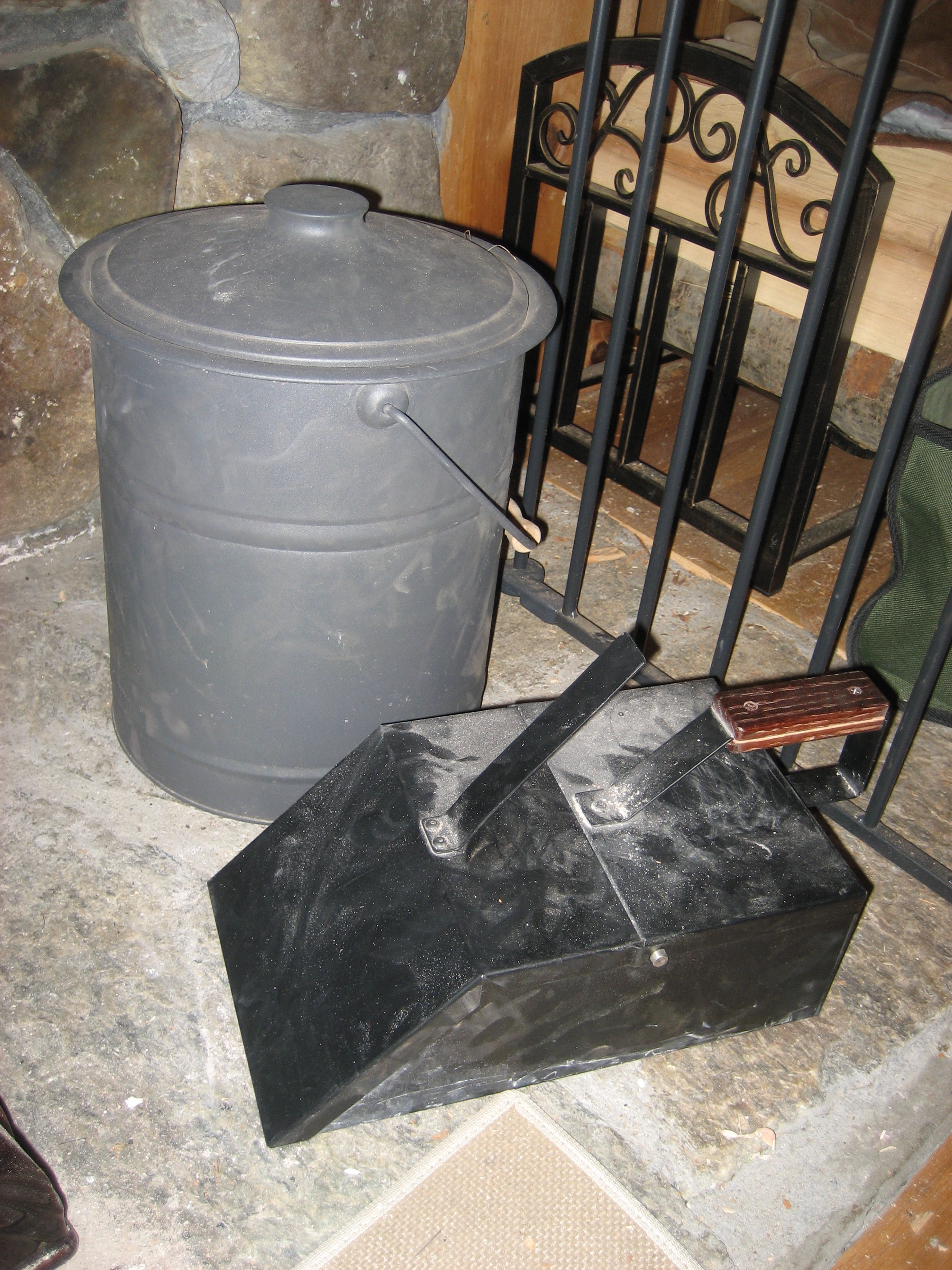
I have a more literal understanding of ashes now that I have to handle them every day. I feel like I’m covered in ashes half the time. Proper ash disposal has become an obsession of Erick’s. Many of his latest “man toys” have something to do with the safe removal of ashes from our fireplace; we even have the “Ash Dragon.”

The ash can and Ash Dragon!

Because the thing is, ashes are really REALLY messy, and they’re also dangerous.

They’re messy because, no matter how careful we are, whenever we open our wood stove little puffs of ash come floating out. Ashes are light, so it only takes the slightest breath of air to make them swirl in all directions. Our entire house now has a fine coating of ash over everything. I could honestly spend every day dusting and sweeping up ashes, and still feel like I’d made no progress. (Which is either depressing, or a nice excuse to just give up dusting).

Some of our dust.

Ashes are dangerous because they’re deceptive: they hide the glowing embers underneath. When we go down to the wood stove in the morning, it looks like the fire has burned itself out and the bottom of the stove is filled with harmless ash. But one stir of the ashes will uncover enough orange-pulsing embers to start up the fire for the day. That’s why proper ash disposal involves transferring the ashes to an airtight ash bin, where we let them sit for at least a day before dumping them on the ash heap in our yard (yes, we have an ash heap!). And even then, Erick is paranoid enough to pour water on top of them.

Our ash heap.

But ashes are necessary. They’re the by-product of what we do to survive the winter.

Ashes: messy, dangerous, necessary.  It occurs to me that those same three qualities also apply to repentance. The word “repentance” probably makes a lot of people shut down right away — it sounds too harsh, too judgmental, too “churchy.” But I’m referring here to all types of repentance: spiritual and/or interpersonal. (Although I’m not sure that there’s a big difference). When we realize we’ve been wrong and ask forgiveness — whether from god or another person — it’s a messy business: nobody likes to admit that we’re to blame when things go wrong. It’s also dangerous: we could get hurt in the process, by losing our pride or failing to win forgiveness.

In the end, though, repentance is as necessary to our lives as the heat sources that help us to survive. Without acknowledging the ways we fail ourselves and others, and without seeking to right those wrongs, we go cold.

Backstage at the Pageant

My little lambs at last year's pageant (I have NO photos from this year!)
My little lambs at last year’s pageant (I have NO photos from this year!)

This Christmas, I directed our church’s annual Christmas pageant.

Notice that I don’t say, “I volunteered to direct our church’s annual Christmas pageant,” because I didn’t. How I came to head up this massive production is still unclear to me. Say you’re standing on a dock, looking up at an enormous cruise ship, and you turn to a nearby crew member to inquire where the ship is going. The crew member whisks you inside, dresses you in the captain’s uniform, sits you behind the controls, and says, “Anchors away!”

THAT’S how I became the director of the Christmas pageant.

Click here to continue reading over at On the Willows.

On the Willows: Great Expectations

Because Christmas is really more about the outtakes....
Because Christmas is really more about the outtakes….

Chestnuts roasting on an open fire? Dashing through the snow? All is calm? Peace on Earth, goodwill to men?

Is that how your Christmas is looking this year?

Mine, either.

I have a little piece over at On the Willows today about our expectations for Christmas, and how they’re never quite realized. A version of something I published here last year, but I like the new one better. Click here to read.

LOVE > Fear + Hate

Yesterday afternoon, during nap time at our house, I decided to log in to my computer and check on the world before heading upstairs to wrap Christmas presents. Like so many of you, that’s when I was first confronted by news of the unimaginable tragedy at Sandy Hook Elementary School in Newtown, CT. For the next two hours, I sat glued to my computer screen, refreshing my Google news feed every few minutes. As if more FACTS could somehow help me make sense of this thing.

On the one hand, it feels like there’s nothing to say, especially when others are saying so much, so eloquently. On the other hand, it feels wrong to NOT say anything. So I’m going to re-post something I wrote back in April, in response to other unimaginable tragedies. I think it still stands; you can add Sandy Hook to the list of bad news, Adam Lanza to the list of bullies, and replace Easter with Christmas.

I find it hard to apply my own logic here to the Sandy Hook situation, but love IS hard. I post this to remind myself that, although it’s important to discuss things like gun laws and the mental health system, the root cause of senseless violence is US: broken people. And also to remind myself that love always, ALWAYS wins out over fear and hate in the very end.

This photo, and all photos in this post, were taken by my friend and amazing photographer, Zoe Reyes.

I feel like there’s been a lot of bad news this year, and we’re only four months in. I suppose most years are like this, but we have such short-term memories that the world seems to be crashing down…again. (I think I have to stop blaming pregnancy hormones for my poor memory, since I’ve now been un-pregnant for over a year. SO I’m going to assume that everybody has no long-term memory, just like me).

Here’s a little run-down of some bad news that comes to mind: daily news of Syria’s violence against its own people; US Army Staff Sgt. Robert Bales is accused of massacring 17 innocent civilians in Afghanistan; unarmed 17-year-old Trayvon Martin is shot and killed amid unclear but disturbing circumstances in Florida; Mohamed Merah kills 7 people in France, including students at a Jewish school; Dharun Ravi is convicted of bias intimidation and invasion of privacy for using a webcam to spy on Tyler Clementi, his college roommate, who committed suicide after learning that Ravi had watched his romantic encounter with another man; the “Kony 2012” video goes viral with the story of LRA atrocities in Uganda; and in Oakland, CA (birthplace of all 3 Gong Girls) One Goh shoots and kills 7 students at Oikos University. And that’s just in the past month.

Even here in Vermont, where a typical police blotter item runs something like: “Woman called police to report hearing footsteps downstairs. Police arrived on the scene to find that her husband had returned home earlier than usual.” (I’m not kidding — that was an actual item), there’s been violent news. Melissa Jenkins, a popular science teacher in St. Johnsbury, answered a call for car help from a couple who used to plow her driveway; when she arrived on the scene, the couple attacked her in front of her 2-year-old son, killed her, and dumped her body in a shallow pond.

I hear these things, and my soul screams. Because EVERY DAY I tell my kids some version of: “You have to be kind to people. Especially people who are smaller or weaker than you — you have to look out for them, help them.” I’m pretty sure that most people tell their kids something like this; isn’t it the best way to function as a family? Isn’t it the best way to function as part of the HUMAN FAMILY? So, when do we start forgetting this?

The answer, of course, is that we forget as soon as we hear it. The reason I keep reminding my kids to be kind to those smaller and weaker than themselves is because their default setting is to grab toys from their baby sister, or hit their other sister, or fight with their friends. Violent emotions begin at birth and are universal. Being kind is so easy to say, and so hard to do.

So how do we process the bad, soul-screaming news? The news that keeps us awake at night with questions of “What if?” and “How could they?”

I’m working out some answers after a little thing that happened to Fiona at preschool this month. One day, when I went to pick her up, Nick, one of her teachers, pulled me aside and said that a new boy at school — let’s call him Billy — who’d been having some “behavioral issues,” had gone up to Fiona during naptime and, completely unprovoked, hit her across the face. Fiona had apparently been “great about it” — she hadn’t cried or retaliated — but Nick wanted to let me know in case she mentioned it.

I don’t care if you’re Gandhi, if somebody hurts your kid your immediate gut instinct is to go after them with a tire iron. But I decided to put on my “grown-up face,” and on the drive home I casually said to Fiona, “Gee, honey, I’m sorry to hear that Billy hit you today.”

She said, “It’s okay, Mommy. It’s okay if he hits me.”

Now there’s a response to make your blood run cold; “It’s okay if he hits me,” is something that you NEVER want to hear coming out of your daughter’s mouth.

But, holding my grown-up face verrrry tightly in place, here’s what I said: “Actually, Fiona, it’s NOT okay if he hits you. NOBODY’S saying that’s okay. You shouldn’t EVER hit another person, and if you do then there has to be a consequence, just like there was for Billy today. So if he ever does that again, you need to tell a grown-up. But if he hit you like that for no reason, then he must be really mad or afraid about something, so I think the best thing for us to do is to be really kind to him, and to pray for him.”

Before you roll your eyes and click over to Facebook, let me remind you that I’m not some glassy-eyed, preternaturally wise and loving sitcom mom spouting cheesy cliches. I’m a real person, and if I occasionally fail to mention here all the times I lose patience with my kids or get angry with my husband or ignore my friends, it’s because I’m still vain enough to want you to like me. So I assure you that my little speech to Fiona came from somewhere outside of me (you can call it what you want; I call it God) and took every ounce of my emotional energy.

But after I said it, I realized that it was true. We did pray for Billy that night — just that whatever was making him afraid or mad enough to hit could get better. And all of this helped me to remember that Billy is four years old, and if you’re running around with “behavioral issues,” hitting other children at four years old, then something really is going on that is bigger than you. Something is making you so afraid or mad that you’re out of control. And it’s scary to be out of control; I see this with my own girls who, whenever they throw a massive screaming fit, just want to curl up in my lap and tell me they love me for the rest of the day, because they’re terrified of themselves.

And this made me think about Joseph Kony, and Dahrun Ravi, and Robert Bales, and George Zimmerman, and Mohamed Merah, and One Goh, and all the other bullies and criminals and dictators throughout history. Because once, they were four years old. Heck, once they were somebody’s tiny baby. And if, as they saying goes, we’re all the ages we’ve ever been, then inside each of them is a mad or scared little kid — and even deeper is the baby who blinked against the first light and held every possibility in its tiny fist. Inside every single person is a spark of humanity; sometimes it’s just buried underneath years of anger and fear. And those layers make it harder to access your humanity — to remember what your mother may have told you about being kind to those weaker than you — when, to quote St. Bono, you end up “stuck in a moment you can’t get out of.”

So, where does the prayer come in? I’m really, really hesitant to write about my faith, because it’s so easy to offend people, or be misinterpreted. And I’m not a religious scholar or expert. I’m just me, and I have some things that I believe are the truth, but I’ll also defend to the death your right to believe what you think is the truth. That said, here’s what I think is true:

I think, as I try to process somebody senselessly hitting my child, and all of the world news that’s essentially telling that same story, that I can and should get angry and demand justice, but I can’t stop there. Because if you stop and sit down in your anger and fear, then you just start to fester inside. Erick’s first reaction, when he heard about Billy hitting Fiona, was to teach her how to block hits and defend herself. That’s fine and useful, but it doesn’t begin to address healing her heart. The same applies to us when we demand arrests and reparations, and install alarm systems in our homes…and then stop.

I took a yoga class last week (!! the first actual, non-video yoga class I’ve taken in two years !!), and the instructor talked about “cultivating the opposite.” This means that, when something negative happens out in the world, we should cultivate the opposite response inside ourselves. That’s a little bit like what I’m advocating here. To respond with anger or fear to an act committed out of anger or fear solves nothing; it just makes us more angry and fearful. I think that, in order for true healing to occur, we need to acknowledge that every unkind act has two victims: the person being bullied, and the person doing the bullying. This requires that we recognize the spark of humanity — no matter how tiny — flickering in the perpetrator.

But that’s nearly impossible to do. The worst thing that’s happened to any of my kids so far is a smack at preschool; I can’t imagine if my child was one of the victims mentioned in this month’s news. I get angry enough just reading about these things; how do you recognize humanity in someone who kills your child? My yoga teacher seems like she’s probably a nicer person than I am, so maybe she can just will herself into “cultivating the opposite” — but I can’t. I need a yoga teacher to show me how to bend my body, and I need another kind of teacher to show me how to bend my soul in order to process life’s horrors. The kind of teacher who gets wrongly accused and sentenced to death, and while he’s slowly dying from torture looks down on the people mocking him and killing him and says, “Forgive them. They don’t know what they’re doing.”

So that’s why the prayer. And why I’m celebrating Easter this weekend.