Life. Motherhood. Vermont. (Not necessarily in that order.)
Primary Menu
Author: Faith
There are nine of us now in the Pickle Patch: Erick, Faith, Fiona, Campbell, Georgia, Abigail, Levi, Hermes the cat, and Gracie the labradoodle. In June 2011, after spending most of our lives in major urban centers, we moved across the country to a small town in the middle of Vermont. This blog is about Vermont, and motherhood, and life -- three things that are often fun, frequently hilarious, and sometimes difficult.
For those who subscribe to receive posts from this blog, I goofed — which is what happens when you have a child yelling that naptime is over, and you hit what you think is “Save” but is really “Publish.” I accidentally published a partial, very unfinished draft, tentaively titled “Chancy Cows,” that I hadn’t meant to send out until September. Please ignore. Sorry for the confusion, and the fact that this is the second time I’ve done this! Perhaps naptime is not a good time to write….
Our second summer in Vermont has been much more lucid than the first: no need to unpack, make immediate repairs and adjustments to a new house, or navigate a new town. This summer was our first repeat season, the first season of which we could say, “We know what to expect.”
Summers in Vermont are lovely. Thanks to regular rain, including frequent afternoon thunderstorms, everything is SO GREEN; by early July, Fiona was moaning “I’m sick of green!” Wildflowers abound: Buttercups, Clover, Black-eyed Susan, Coneflowers, Daisies, Bachelor’s Button, and Daylilies. The weather can get hot, up into the 90s, but the most uncomfortable heat tends to be short-lived (and the shady forest keeps temperatures down around our house). Because we’re so far north, the days are looooong: at summer’s height, the sun is up by 6 AM, and doesn’t set until 9 PM. The very worst thing about Vermont summers is the bug situation; you will encounter mosquitoes, flies, no-see-ums, and many other buzzy, biting, irritating species. But that’s a minor inconvenience compared with the glory of the season.
Summers in Vermont are also short-lived. You have three months to pack in the summer fun, because fall comes quickly and you might expect snow by Halloween. Last summer, a friend observed a kind of summer hysteria that grips Vermonters: Summer’s here! HURRY, HURRY! Let’s do summer!!! Well, with only three months in the year when it’s possible to swim outside, have cookouts, and eat ice cream, you’d hurry, too.
I find that, as with every season — as with LIFE — it’s best to embrace whatever the season brings, rather than fighting it. We’re now in the middle of the “Dog Days” of summer. So here are the best ways in which we, experienced second-summer Vermonters, stay cool and enjoy the season:
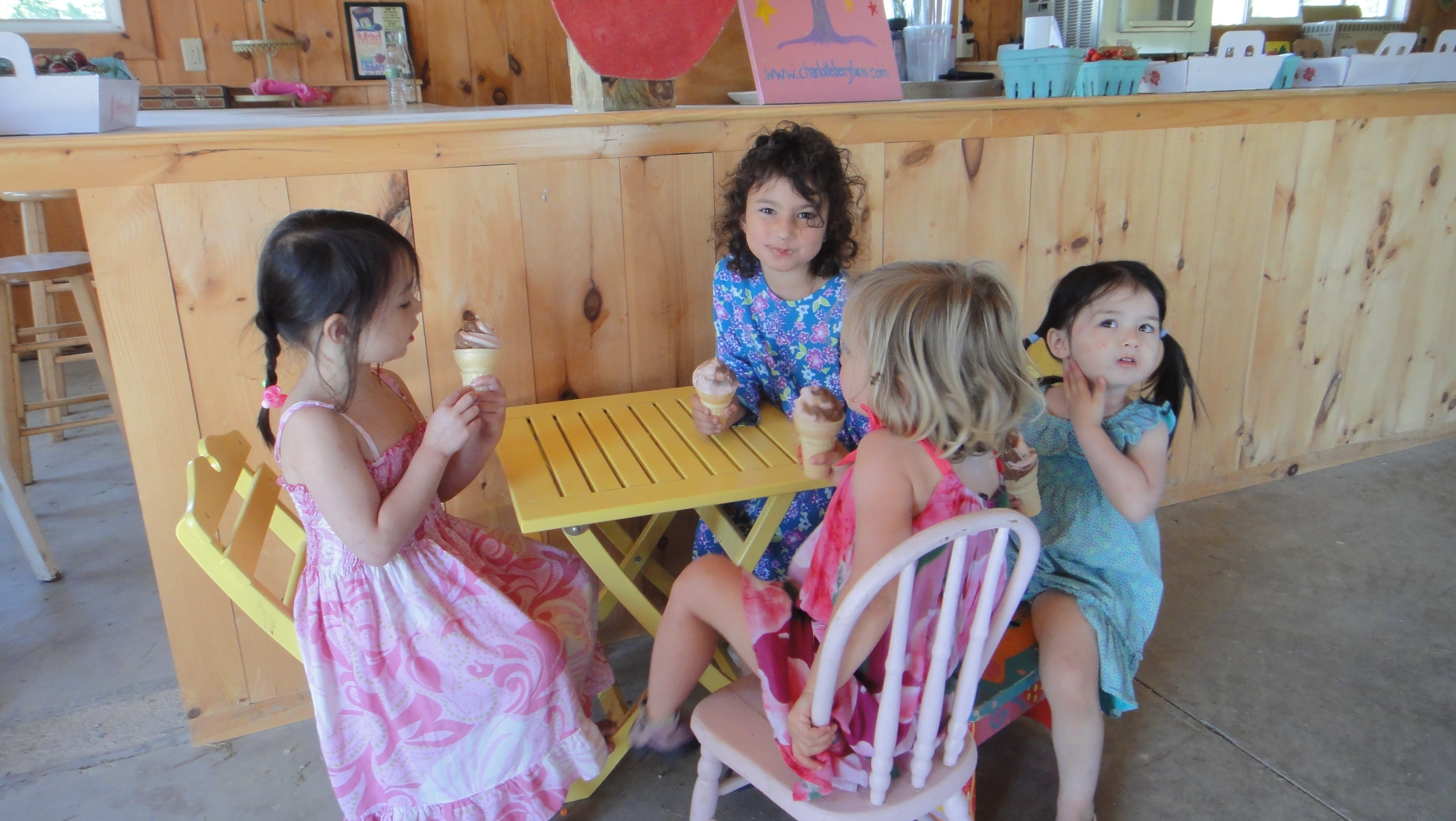
ICE CREAM. This is a dairy state, and Vermonters take their ice cream seriously. The first thing to know about Vermont ice cream is that it comes in two varieties: hard ice cream, and soft serve, which Vermonters call “creemees.” Vermont is famously the home of Ben & Jerry’s ice cream, but aside from the generous free samples we received during the Ben & Jerry’s factory tour, we haven’t eaten much of this bran. Our favorite places to go for ice cream are Sama’s Cafe when we’re in town, and the Kampersville Deli when we’ve been swimming at Lake Dunmore. Both places serve Hershey’s Ice Cream.
Campbell enjoys a sample at the Ben & Jerry’s factory.
A bit further afield, but worth the drive, is The Inside Scoop in Brandon. The Inside Scoop is a old house crammed with antiques and memorabilia for sale, but one of its rooms has been converted into a huge, old-fashioned ice cream counter. They dish out Wilcox’s Ice Cream, which is a family-run business in Manchester Center, VT.
The newest contender on the ice cream scene is Lu Lu Ice Cream in Bristol. Lu Lu opened at the beginning of the summer, and would be at home in either of our two previous cities: New York City or Berkeley. They make their own exotic and delicious flavors like “Salted Caramel.” Fiona calls Lu Lu “the fancy ice cream place,” and she’s right.
Creemees with friends.
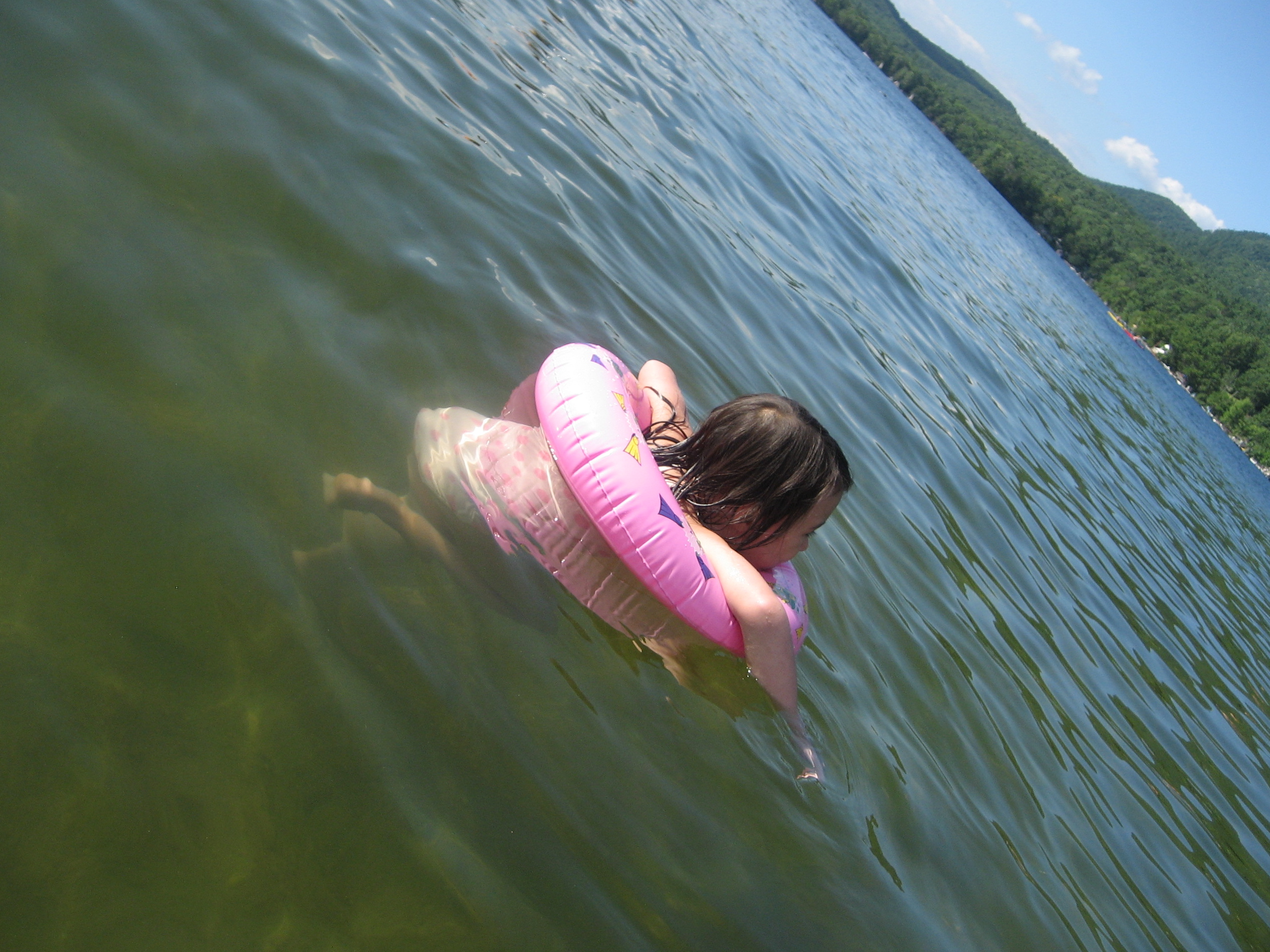
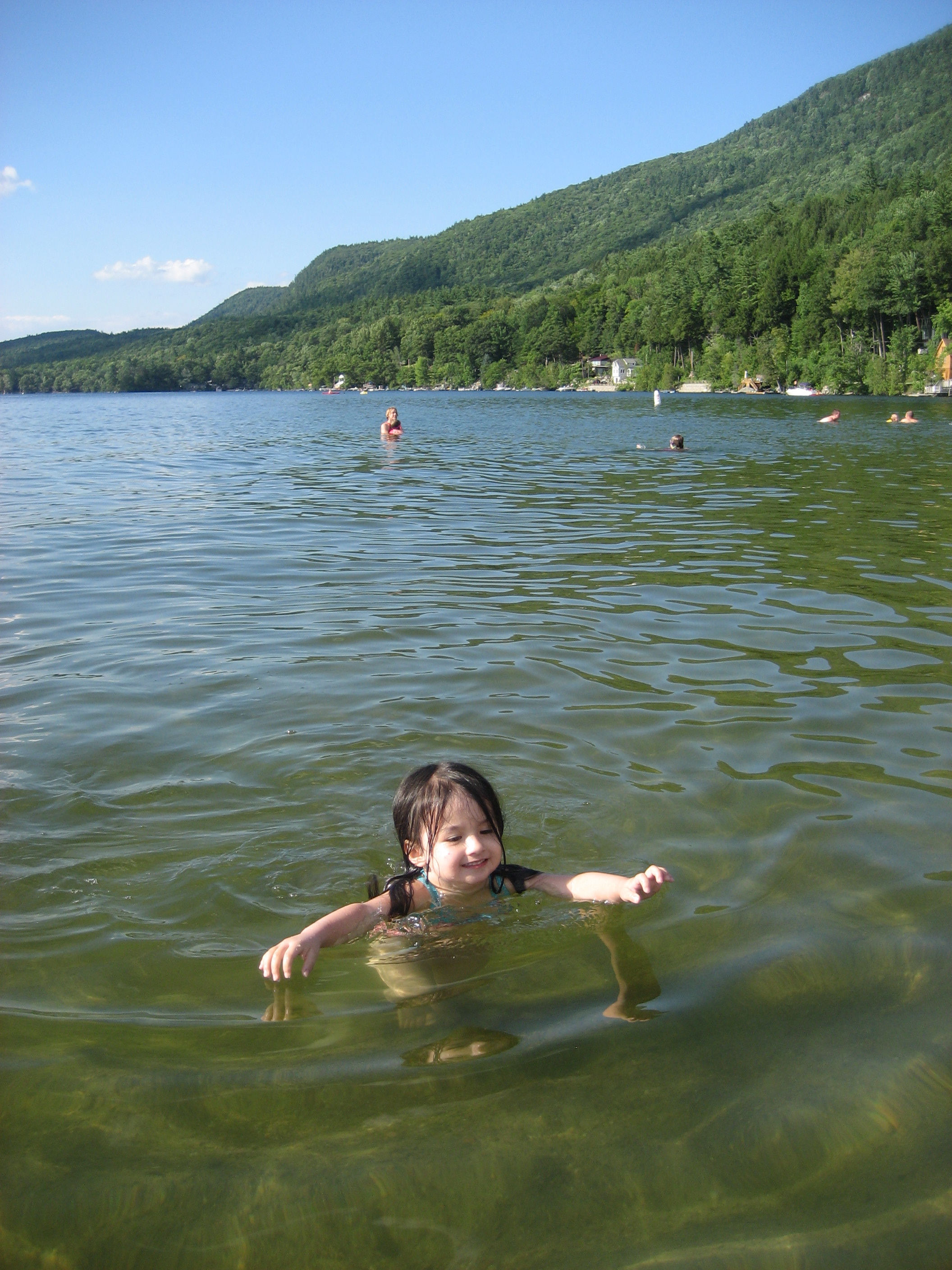
Head for the Water! Our town has a pool, but we’ve never been to it because this area affords so many opportunities to enjoy water in its natural state. As we did last summer, we’re back in the groove of weekly visits to Branbury State Park, the public beach on the shores of Lake Dunmore. This year, we discovered the fun of taking the ferry across Lake Champlain; if you board in Charlotte, VT, you’ll land in Essex, NY, a charming little town with an ice cream parlor conveniently located a stone’s throw from the ferry dock. Another new adventure in Summer 2012: swimming in a river, which is slightly more exciting and –in our family, at least — requires adult back-up due to the slippery rocks that line the banks. There are several rivers and swimming holes to choose from around town, but our girls’ favorite is the New Haven River at Dog Team Falls.
Cooling off in Lake Dunmore.Georgia loves the water!
When none of these options are a possibility (in other words, when I’m lacking adult back-up), we stick to the wading pool in our yard.
Seek out air conditioning. Because Vermont summers usually have only a few weeks’ worth of really hot weather, most residences here don’t have central air conditioning. Our house is no exception, and although the woods and some strategically-placed ceiling fans usually keep things comfortable, at times we feel the need to head out in search of air conditioning. In our family, this generally means: THE LIBRARY.
It’s a rare summer week that we’re not at the library on multiple days — either the main Ilsley Library in town OR the smaller Sarah Partridge branch in East Middlebury. Both libraries are air conditioned, and during the summer they offer much more than just cool air: weekly story and craft times, special performances, “Itsy-Bitsy Yoga,” AND the annual Family Tie Dye extravaganza.
Also, the girls end up naked a lot. No pictures of that, though.
This summer, we took some visiting friends on a hike along the Robert Frost Interpretive Trail, a short drive up the mountain behind our house. The trail begins with a boardwalk spanning a beaver pond, crosses the Middlebury River, continues on through the woods, and then loops back through an old field. Although I’ve hiked the trail several times before, this time one of the wooden signs that stands at the border of the field caught my attention.
Here’s how it began: Fields are only temporary.
As I sit to write this, I’ve been turning those simple, beautiful words around in my head for over 24 hours. Fields are only temporary. I can’t quite get at what those words mean to me, why they’ve stirred my heart for the past day — but you can probably guess that I’m going to try.
What the sign meant was that fields, left to their own devices, never remain fields. At least, not in Vermont. Fields have to be created, cleared by either human or natural effort. If left untended, pioneer plants will take root: tall grasses and wildflowers and bushes. And before long, the trees will move in, quickly overshadow the lower plants, and a forest will be born. It’s a growth pattern that’s beautifully captured in Robert Frost’s poem “The Last Mowing” (the text of which is also on a sign along the trail).
A brief history of Vermont land use:
Throughout the latter half of the eighteenth century, settlers descended upon Vermont’s fertile Champlain and Connecticut River Valleys, seeking agricultural land that was in increasingly short supply throughout the rest of New England. In order to create fields for planting and pasture, they had to clear the land of trees and rocks; no small task, as the Vermont landscape had been dominated by six million acres of dense woodlands for roughly 12,000 years. But these were hardy, determined folk; between farming and the booming logging industry, settlers had removed more than half of Vermont’s forest by the late 1800s. It wasn’t until the effects of this deforestation became visible — nutrient-deprived soil, altered drainage patterns, and endangered and extinct wildlife — that conservation efforts began. Those efforts, along with the decline of Vermont’s agricultural industry, resulted in the reforestation of 77 percent of Vermont’s landscape. In other words, there are more trees in Vermont now than there were a century ago.
Fields are only temporary.
I live in the woods, and whenever I have anything to do with our “yard,” I’m awestruck by those early settlers. The trees grow thick together, and taking them down is backbreaking work — as my father’s four broken ribs and two fractured vertebrae will attest. We have a small area of grassy “yard” and several flowerbeds, and throughout most of the year I spend at least one day a week pulling up or chopping down the small saplings that are constantly trying to turn all of our yard to forest. Then there are the rocks: wonderful to play on, but try digging a hole anywhere around our house and you’ll quickly be frustrated. My husband and father-in-law broke a metal post driver while attempting to put some fence posts a few inches into the ground for our chicken coop. We are no match for these woods.
Fields are only temporary might sound like bad news if you’re trying to create a farm — or even just a yard. It’s a poignant reminder of the futility of our labor; no matter how much we chop and dig and pull, the woods will always win in the end.
But looking at it another way, maybe this means we don’t have to try so hardto change things. Maybe, just maybe, we don’t need as much field or yard as we think we do. Maybe we can be okay with the pioneer plants and the trees growing up; we can stop fighting and let the woods be the woods.
Woods, you know, are very beautiful.
Fields are beautiful, too. And useful: the kids and dogs need places to run, or perhaps your livelihood is farming and you need fields in order to feed others — and your own family. It can be a very worthwhile thing to clear a field, while remembering that fields are only temporary.
I’m talking in metaphors now, of course. Not just about fields, but about relationships and possessions and vocations and life. Just like fields, our lives have growth stages. And I’m learning that the important thing is to see the particular beauty of the growth stage we’re in, be it field or grassland or forest. To know when to stop pulling up the seedlings and digging up the rocks. To realize that, after a while, if you insist on a field remaining a field, you don’t even have a very good field anymore, just parched, denuded dirt.
Or maybe I’m just looking for an excuse to stop weeding my flowerbeds….
Having now witnessed one full cycle of seasons in the Vermont woods, I continue to be amazed at just how much LIFE there is all around us, all the time. I never saw life like this in the other places I’ve lived: the Northern Virginia suburbs, South-Eastern Connecticut, New York City, or the Bay Area. The contrast has made me realize what an unnatural environment we create when we chop, pave, and develop an area to within an inch of its life.
So, what kind of life have I seen in these woods? Any moose, the holy grail of Northern New England wildlife? No, not yet. (But I did eat some at a potluck: not bad). Bear? No, although there were rumors of one walking through the woods in our neighborhood last summer. Deer? Fewer than I can count on one hand. Fox, raccoons, weasels, skunk? Nope, nope, nope, nope. My tally of “big game” sightings is pretty low, probably because they still have such a large natural habitat to roam here; why should they bother coming into our yard?
Here’s what I have seen, in abundance: squirrels, chipmunks, toads, salamanders, birds of every variety (including two barred owls), and LOTS AND LOTS OF BUGS.
The bugs are so numerous, so varied, and so season-specific, that I’ve started to think of our family as charter members of the “Bug of the Month Club.”
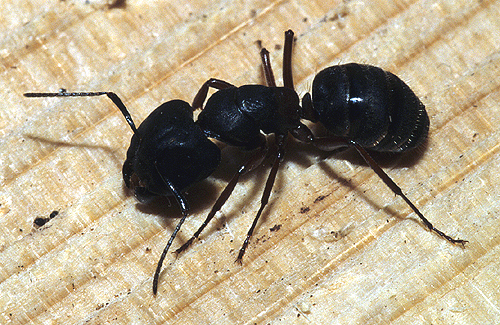
We’ve now witnessed a full cycle of the Bugs of the Month. I’ll start with June, which is the month for CARPENTER ANTS. These are huge, black, slow-moving ants that like to build their nests in damp, dead wood. Since our entire house is made of wood, we don’t like to have these ants around, so we set out bait stations to kill them. Generally, those do the trick. Thankfully, these ants don’t march in endless army formations like California ants; they tend to travel alone, which makes them easier to catch. On some days, particularly after a rainstorm, I feel like a cold-blooded killer.
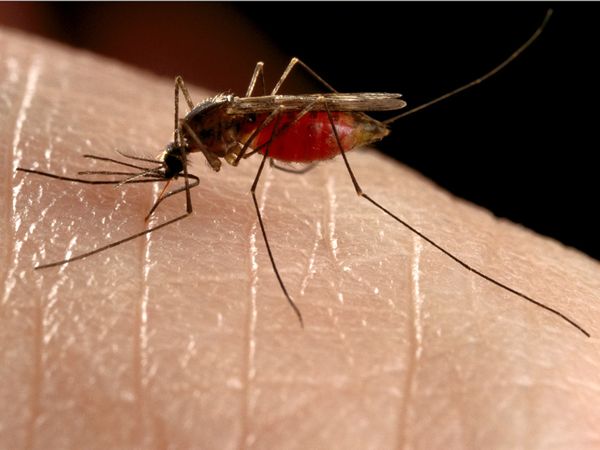
Summer is also the high season for MOSQUITOES, and we have plenty of them out here in the woods. Vermont mosquitoes are hardy, and they are vicious. This year, they started biting us in early April, and they’ll probably hang around, in diminishing numbers, through October. Unfortunately, Erick and the girls all have extreme reactions to mosquito bites, which leave them covered in grotesquely swollen red welts. The girls scratch these bites until they bleed, and because it’s summer and we’re all in shorts and t-shirts, there’s no way to conceal the dermatological nastiness that results. So I walk around all summer feeling like I should hold a sign above my bloodied, bumpy girls: “No, they aren’t contagious.”
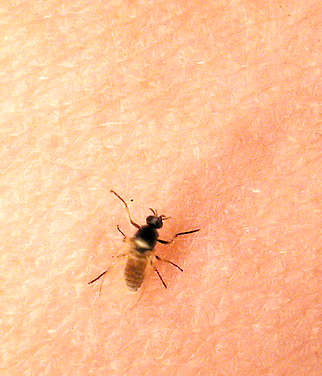
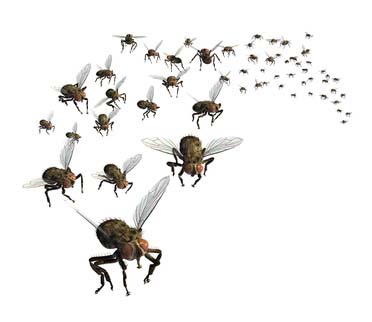
Aside from the mosquitoes, the most irritating summer bugs are those that, around these parts, are called “NO-SEE-UMS.” The official name for these nuisances is “biting midges,” but “no-see-ums” is just as accurate. They’re teeny-tiny little specks, so you don’t see ‘um, you see? But you sure as heck can feel them. They seem to travel in packs of no less than 100, and swarm around your head whenever you stop moving.
I’ve already written about TICKS in detail, but they were out in force this summer. We’ve pulled three off of our family so far, and in late July I was treated for what my doctor suspected was either Lyme disease or another tick-borne bacteria. Fun times!
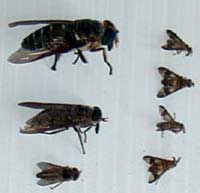
Rounding out the summer lineup are DEER FLIES and HORSE FLIES. We have plenty of both of these annoying, buzzy flies. They’re distinguishable because horse flies tend to be a little larger, and to have longer, thinner wings. The females of each type can give nasty bites.
Last year the horse flies seemed particularly prevalent in September, so I consider them a “carry-over” bug, if you will: a bug that transitions us from summer into fall.
You’d think there would be a respite from the bugs once September ends. After all, fall in Vermont turns quickly to winter: last year we had snow before Halloween. Given the notoriously long and bitter Vermont winters, you might expect that the “Bug of the Month Club” goes on hiatus — down to Florida, perhaps — for a few months.
But you’d be wrong, my friends, because all winter long we have:
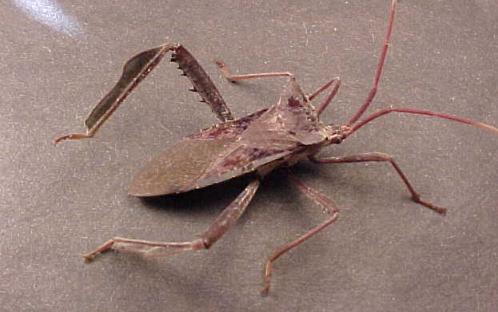
Yes, that’s right! As all of nature goes to sleep for the winter, the stink bugs are just waking up in our house. Last year, we started noticing them around November, and they stuck around — or STUNK around — until May. There are thousands of varieties of stink bugs, but the variety we have is the “Leaf Footed Bug.” Beautiful name, but the stink is just as stinky: squash one of these insects, and the smell that emanates is like super-ripe, rotting fruit. By the end of last winter, Campbell was so fed up with these bugs that she was starting to crush them with her bare hands, which of course meant that she smelled like a stink bug.
It’s almost a relief when winter starts winding down, because at least you know you’ll be getting some variety apart from the stink bugs. ALMOST a relief, because when winter ends, that’s when the BLACK FLIES come out.
This part of New England is notorious for its black flies; so notorious that an entire season is named after these bugs. “Black fly season” usually encompasses a couple of weeks between May and July; some people say that it begins around Mother’s Day and ends by Father’s Day.
Black fly season may be short, but it can be horrible. Being bitten by a black fly is, according to a friend, “like being bitten with teeth.” One of our neighbors forewarned me that, for the two weeks when the black flies are at their height, “we just don’t go outside.” If you look up “black fly season” on Google, you’ll find entire message boards dedicated to the topic, with people trying to schedule their Vermont vacations around the black flies. Thankfully, perhaps because of the mild winter, black fly season seemed fairly tame this year.
And that brings us full-circle, because immediately following the black flies come the carpenter ants, and mosquitoes, and ticks.
You may have noticed one glaring omission in my Bug of the Month Club catalogue: SPIDERS. That’s because we have spiders all year round! Spiders weaving their webs in every corner of our house, across our windows, around our outdoor light fixtures, over anything that doesn’t move. Spiders everywhere! Of course, the spiders proliferate in the spring and summer. This past May, I saw the largest, most gorgeous spider I’ve ever seen outside of a zoo: it was an Orb Weaver, and it had woven an enormous web right over one of our sunroom windows. Orb Weavers aren’t harmful to humans, so we let it be, and it disappeared on its own.
So there you have it: the variety and excitement that come with being a member of the Bug of the Month Club. If you don’t have this kind of variety and excitement in your neck of the woods, we’d be happy to send you some of ours!
ADDENDUM: A friend pointed out, after reading this, that I’ve failed to mention the wonderful, lovely bugs that are also a part of Vermont life. She’s absolutely right, so let me set the record straight: I am NOT anti-bug. Around our house we have many delightful bugs: ladybugs, moths, butterflies, dragonflies, fireflies, and some enormous shiny beetles. I’m only opposed to the irritating bugs that want to munch on my house and my family.
HERE IT IS!! My first “Faith in Vermont” blog column in The Addison Independent. Click on the link below to read it. Click even if you DON’T want to read it!
“Vermont?!? Wow, I’m not sure I could handle those New England winters again. Especially with kids.”
It was January 2011. My husband, Erick, and I were standing in the kitchen of our little rented bungalow in Berkeley, California, discussing his job prospects. Our two daughters, aged 3 and 1, were asleep in the bedroom next door, and I was eight months pregnant with daughter number three. Erick had just told me that Middlebury College, a small liberal arts school of about 2,000 students in central Vermont, was flying him out to interview for a position as assistant professor of economics.
A few exciting new goings-on here in the green summer woods:
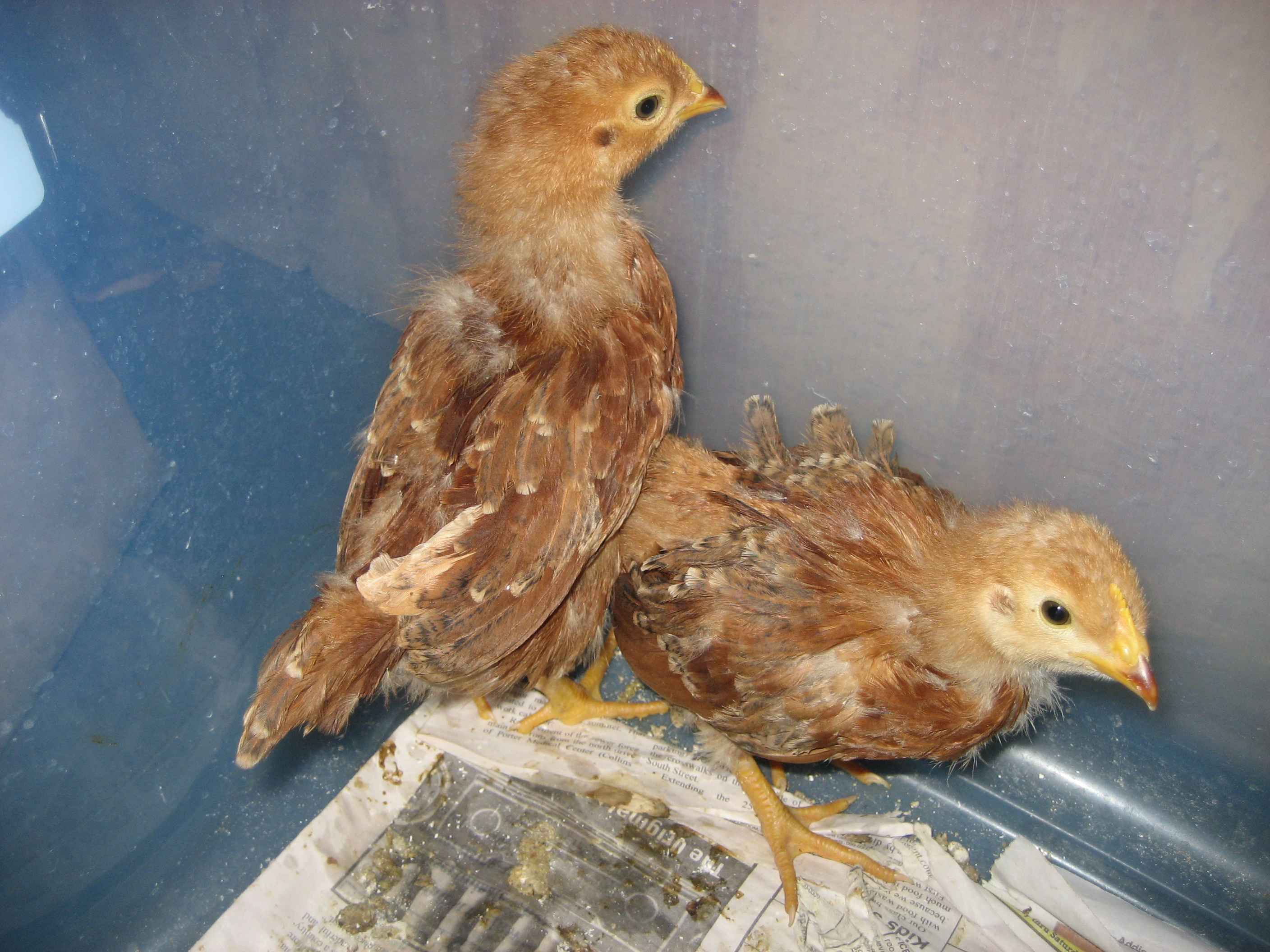
The new chicks are here!
We returned from a week at the beach to find that our rooster had started crowing. Or rather, our rooster had been taught to crow by one of the men painting our house. This being a small town, the crowing coach is also the uncle of two of the girls’ best friends, and he lives on 25 acres of land with assorted free-range poultry. So I operated on the age-old rule: You teach my rooster to crow, it’s yours. Off went our rooster to the country — although the beautiful thing is that, in this case, that’s NOT a euphemism for putting an animal down: the country really IS the country, and it’s just down the road.
Finding a good home for our rooster neatly coincided with a friend offering us some extra chicks. So, on Campbell’s birthday, we picked up two Rhode Island Red chicks. The girls used this as an excuse to shuffle around the names of our chickens; we now have two white Leghorn hens named Daisy Flower and Sunny, and two brown chicks named Scaredy-cat Simba and Grace. We’re fairly sure that they’re all hens.
The new chicks are really, really cute, so they’ve been girl-handled quite a bit. I’m hoping that’ll make them a little more cuddly than the Leghorns, who are still pretty flighty.
We’ve got a new venue!
Starting tomorrow, I’m going to have a regular, bi-weekly column in the online edition of our local paper, The Addison Independent! I’ll be writing about life in central Vermont from the perspective of a mother of young children who’s a recent transplant to the area — in other words, I’ll be doing pretty much what I do here, it’ll just be a little more Vermont-y. (Just like how, when I write over at On the Willows , it’s pretty much what I do here, just a little more God-y).
I don’t expect that this new gig will significantly change anything here at The Pickle Patch. In fact, I’ll likely be re-using some of my more Vermont-focused material for the Independent column. As I do with On the Willows, I’ll post a link on this site whenever I have an article over at the Independent.
The new chicks and new column are both very happy things. But for whatever reason, life usually doesn’t hand you pure, undiluted joy — at least, not for very long. I’m not quite sure why it seems to work this way — that, when you’re given something, something else is taken away — but in my experience it’s usually been a good thing. Helps keep you from getting too full of yourself, if nothing else.
Which leads us to:
A tick made me sick (maybe)…
I’ve had to slow down quite a bit over the past couple of weeks, because I have not been entirely well. You may recall my mentioning the pain in my knee joints that started out of nowhere on our trip to Maine. You may even recall my joking that I assumed it was either Lyme disease or Lupus; if you expectthe worst-case scenario, it can’t possibly be the worst-case scenario, right?
Turns out that’s not always true. The pain didn’t improve, I started feeling it down my arm and into my hand, and by the time we got home from Maine I was crushed by exhaustion. Not the normal, I-have-three-young-kids exhaustion, but an exhaustion so intense that by the end of the day I could barely lift my arms. All of which gave new meaning to the headaches and vague feeling of not-rightness I’d been having on an almost daily basis.
This is Georgia impersonating Jack Nicholson. (It’s a cuter picture than sick me laying on the couch).
So, I went to my doctor, who took four vials of blood out of me and began treating me for Lyme disease. (In our area, if doctors even suspect Lyme, they go ahead and begin treating it with antibiotics, because the cost of NOT treating it quickly can be the onset of chronic Lyme). The conclusion? My bloodwork came back completely clean: negative for Lyme and all other suspects. Unfortunately, that doesn’t mean that it wasn’t Lyme, because the test for Lyme is notorious for giving false negatives. Whatever the ultimate culprit — and my doctor thinks it could be another tick-borne bacteria that isn’t picked up by the Lyme test — the GREAT news is that I’m starting to feel better. A few days after beginning antibiotics, my energy returned to its normal level of exhaustion. The joint pain seems to be taking a little longer, but I’ve started to have some good days in that regard. (And honestly, I’ll take a little joint pain over the fog of exhaustion).
There are, of course, other changes brewing around here: summer is on its downslope into fall, Fiona and Campbell will start preschool in a few weeks, Erick will go back to teaching next month. And change, as we all know, can be difficult and disorienting. But this go-around, I’m trying to handle all these changes like a rooster.
Yes, like a rooster. The aforementioned rooster, who started crowing and had to be sent away, showed me how to deal gracefully with change.
The best way to transport a mature rooster is in a burlap sack. The rooster has to be enclosed, or else they’ll flap and fly all over your car. But a cage isn’t a good option, because they might bang around and damage their comb. So, when it came time to bid our rooster adios, we caught him, put him in a burlap sack, and tied the neck of the sack with twine.
I expected drama. I expected squawking and flapping and fighting and feathers flying. But instead, our rooster, who up to this point has spent his days posturing and crowing and bossing the hens around, got very still and quiet as soon as we placed him in that burlap sack. No noise, no movement; we could have been lugging around a bowling ball.
The rooster was nervous, of course — probably even terrified. But I think that this is how I’d like to handle change when it comes in my life: not by squawking or fighting, but by getting still and quiet. Change is like being shoved in a burlap sack and driven to an unknown destination; you’re never quite sure if you’ll be dropped off at the Purdue slaughtering plant or 25 acres of bucolic free-range countryside. But fighting this change is pointless, and it just makes the ride unpleasant. I’d rather be still and quiet, like a rooster.
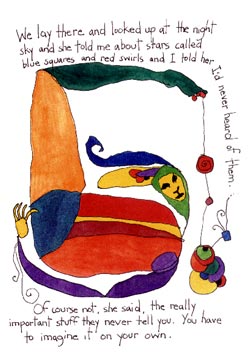
This print was our introduction to the charming work of California artist and storyteller Brian Andreas. In case you can’t read the text around the image, here’s what it says:
We lay there and looked up at the night sky and she told me about stars called blue squares and red swirls and I told her I’d never heard of them. Of course not, she said, the really important stuff they never tell you. You have to imagine it on your own.
From what we’ve already seen of Middlebury and our new house, we hope and expect that we’ll spend a good long time there. And that may well be the biggest adjustment. With relatively few breaks, Erick and I have spent most of our adult lives moving, following jobs or graduate degrees. In the past 15 years of my life, I’ve moved 7 times — that’s roughly every 2 years. And I’ve gotten to be pretty good at moving; saying goodbye and pulling up the stakes. So the thought of staying, of committing to a house and a town, is an unknown challenge.
I drove the girls to the library this morning. Usually, trips in our minivan are not times of great conversation. We keep a wide variety of CDs in the van, ranging from “The Disney Princess Collection” to “The Barbie Princess Collection.” As we pull out of the garage, the girls bark, “Turn it up!” and “Louder!” from the comfort of their carseats. Once the volume is up as high as I will allow (the point past which we’ll sound like cruising princess gang-bangers), they zone out. (As do I, but whether I should be allowed to operate a motor vehicle is a subject for another day).
Anyway, this morning, as we were driving through some cornfields, Campbell piped up: “This is the same way we drove to church yesterday.”
“Yeah,” added Fiona, “we always drive this way. We always see the same things. It’s so boring. Can’t we drive another way?”
Have I mentioned that we live in a small town? Or rather, we live just outside a small town. In order to do most anything, we need to drive into town, and there are only two possible routes for doing so; one route spits us out at the south end of Main Street, the other drops us at the north end. So if our girls feel like we’re always driving the same way, it’s because we are.
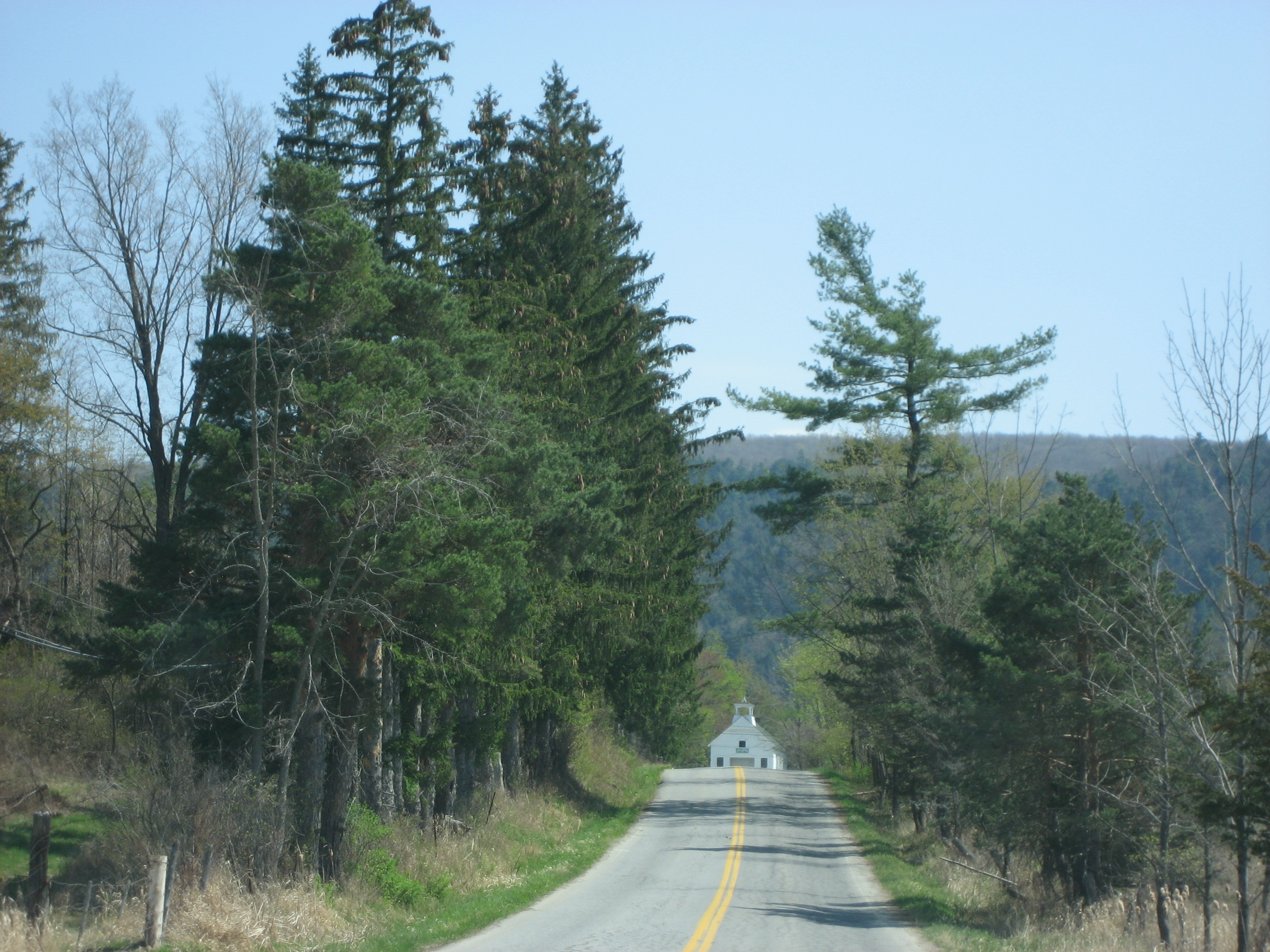
The way we usually drive home.
I explained all of this to Fiona, and offered that, as a special treat, we could drive home the other way!
The other way home.
But then, sensing a teachable moment, I started in on one of my zen motherhood speeches: “Even though we always drive the same way, what you see isn’t always the same. It changes with the seasons and the time of day. When you see something over and over again, sometimes you just have to look a little deeper and you’ll notice things you haven’t seen before.” Then I pointed out little details in the scenery, like the rusty old tractor by the barn, the flags flapping in the breeze.
Fiona audibly rolled her eyes. “I know, Mommy. I’ve noticed that all before.”
Oh my, I thought, it’s going to be a long life.
If you’ve been following this blog from the beginning, you will recall that on the eve of our relocation to Middlebury I expressed some apprehension about the potential permanence of this move (the quote reprinted at the beginning of this post). Here’s the situation: whether we stay here depends largely on whether Erick gets tenure at the college, which is a 7-year process. So, we will be in Middlebury a minimum of 7 years. Seven years is the longest I’ve lived in any one place in my adult life.
If Erick does get tenure, we’re here for the long haul. I’m not really sure what “the long haul” is, but it means that there would be no forseeable endpoint. Erick and are I finally done with school, we will never need a bigger house, and as long as Erick is happy with his job, there will be no reason for us to leave Vermont. According to the 2007 U. S. Census, the average person in the United States can expect to move 11.7 times in their lifetime. This is the 11th time I’ve moved in my life, so if averages apply to me, my moving days are winding down.
What I’m saying is that — as children will do — Fiona was actually expressing some of my own concerns: that I’ll get bored with being in the same place, seeing the same things and people over and over again.
Maybe. But even though Fiona blew me off, I stand by what I told her: that living in the same place, seeing the same things, being settled, is actually a wonderful opportunity to look deeper.
I didn’t always feel this way. In fact, until recently I embraced travel, adventure, big cities, and frequent moves. Which is probably the way it should be when you’re young.
But unless you are fabulously wealthy, with an entire staff at your disposal, travel and moving become increasingly miserable the more children you have. One thing I used to like about moving was that it forced me to “travel lightly,” to weed out anything that wasn’t necessary. But it’s very hard to “travel lightly” with three young children. In fact, moving is now on the list of things I least want to do, just above cleaning up mousetraps. Yes, I know that travel is fun and horizon-expanding for children; up until we had our second child, I swore that children would never slow down our ability to travel. “They’ll just have to adjust to our plans,” I may have actually said (a number of times). And God rolled on the floor laughing. Because honestly, you should see the logistics involved in just driving down the street. Even living in a city with more things to do is no longer as attractive to me; I’m already exhausted by our limited options here.
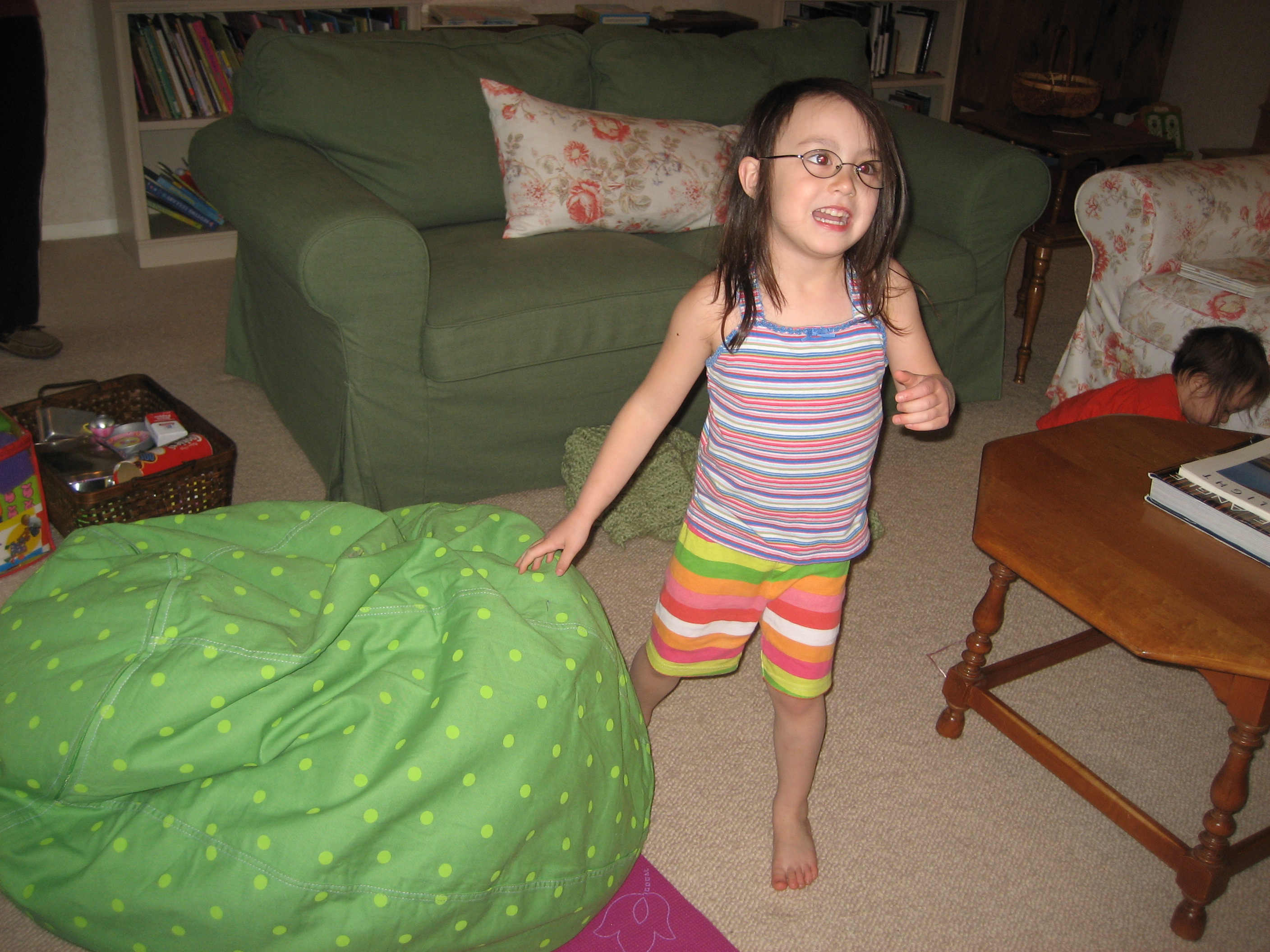
Here and below: Three scenes from a “boring” rainy Sunday: Making Sun Bread.Fiona (wearing my glasses) attempts to lead us in “yoga.” (Yoga, apparently, involves kicking a beanbag chair while yelling “Hi-YA!”)
Looking back, I think that most of my previous travels and moves were, at root, an excuse to stay busy. Fiona is very into the idea of opposites right now, so all day long she asks me things like, “Mommy, what’s the opposite of eating?” If she asked me, “What’s the opposite of looking deeply?” I would answer, “Staying busy.” Because when you’re staying busy, you don’t have to look around or — God forbid — look inside yourself. You don’t have to notice things. Your priority is to keep moving.
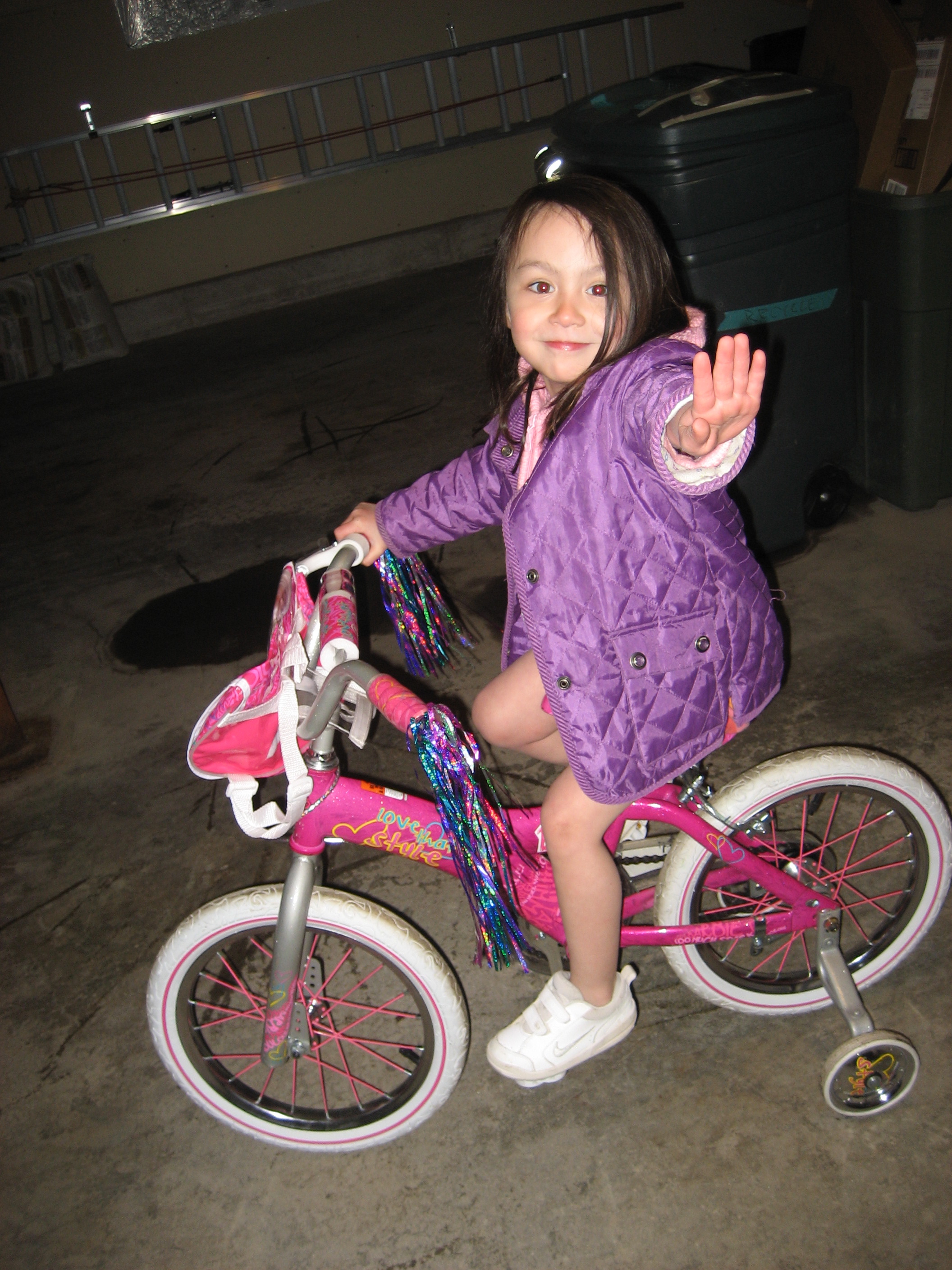
Riding bikes in the garage.
Here’s what living in Vermont for the past year has forced me to do: slow down, look deeply, and notice things. There are so few distractions here, it’s so much harder to stay “busy,” and we’re feeling so settled. Now I have time to notice things like the way the woods change with the seasons, I have time to look deeply into myself and think about who I am and what I believe, I have time to sit down and read and write. We’re also starting to form friendships, which need time to take root. I’m looking forward to forming friendships that we won’t have to uproot in a few years (always the hardest part of moving).
So no, I can’t see myself getting bored anytime soon. I’m not so sure about the girls, who already have plans to become singers in New York City when they grow up. But then again, on our recent vacation to Maine, Fiona sat on a rock by the ocean with her grandparents and drew this picture of mountains, a sunset, and our minivan on a road:
If you scroll up in this post, you’ll see that it looks uncannily like our usual, boring drive. When I asked Fiona what she was thinking of when she drew it, she said, “I was thinking of home.”
Today is Campbell’s 3rd birthday, so today’s Pickle Patch is dedicated to celebrating the life of our second child. Our middle child. I’ve always been particularly sympathetic to Campbell’s place in our family, because my mother is a middle child. (And she doesn’t have many good things to say about holding that title). This year, for Fiona’s birthday, I listed Five Fun Facts About Fiona; out of fairness, which is important when you have multiple kids, I’m now going to do the same for Campbell.
1. Campbell loves lions. Campbell has always had an affinity for anything feline. When she was almost one year old, she started crawling around under the table after meals and meowing — pretending to be a cat. This past year, she received a book based on the Disney movie The Lion King, and it’s been all about lions for her ever since. Most days, Campbell is Simba, the lion cub in that story: she calls herself Simba, and refers to her family members as various characters from The Lion King. There are people in town who probably think I’m the girls’ babysitter named Surabi, because that’s how Campbell usually addresses me (Surabi is Simba’s mother). And yes, when she’s feeling angry or scared, she has been known to roar. Interesting factoid: I don’t usually put any stock in the zodiac signs beyond thinking they’re fun, but Campbell’s a Leo. The lion. Go figure.
2. Campbell loves her sisters. Campbell can be prickly. In group settings, she prefers to do her own thing, by herself. She’s highly protective of her things: try to take something she’s playing with, and she will roar at you. Because Campbell hasn’t started preschool yet, she doesn’t have her own set of same-age friends (nor have I sought to create a social group for her, honestly, because she’s a second child). All of these things might cause me to worry about her chances for socialization, but I don’t for one reason: Campbell is nuts about her two sisters. As I’ve mentioned before, Campbell and Fiona have a bond so strong that they’re a little lost without each other; any time we drop Fiona off at preschool or a friend’s house, it’s only a matter of minutes before Campbell wistfully says, “I miss Fiona.” Lately, she’s been insisting that she’s going to marry Fiona, legal or not. (I sometimes worry that she and Fiona will turn into those spinster sisters who still share a room and sleep with dolls at age 80, but at least they won’t be lonely). And, much to everybody’s surprise, Campbell is displaying signs of becoming a sweet big sister: she’s been known to coo over Georgia’s cuteness, to watch out for her safety in public, and to patiently share the occasional toy with her baby sister. So Campbell may be prickly, but she’s well socialized within her own family, which probably counts for a lot.
3. Campbell is our most independent child (so far). Campbell was born with a remarkable amount of self-confidence, and an equally remarkable lack of concern over what anybody else thinks. These qualities make her exceedingly difficult to discipline, but they’re also traits that I admire — probably because they’re so foreign to me. When Fiona started going to preschool three days a week this past year, I thought that Campbell — as the classically overlooked middle child — would relish having my (almost) undivided attention. Nope. When she’s not missing her sister, she’ll often say, “Mommy, I just want to play by myself.” Her potty training was kind of a nightmare, because once she decided she was ready for it, she refused ANY help. “I need PRIVACY!” she shouts, shutting the bathroom door on me (a move I wasn’t expecting for at least another decade). And perhaps her most-used phrase? “I’m not afraid of ANYTHING!”
4. Campbell is hilarious. Thankfully, all of our girls have well-developed senses of humor, but Campbell is THE FUNNIEST. She loves telling us her own original “Knock-Knock” and “Why did the chicken cross the road?” jokes. (Her latest: “Knock, knock.” “Who’s there?” “Chair!” “Chair who?” “PERFUME!” I don’t get it, either, but it cracks her up every time). She also has an amazing ability to remember lines from the books she reads, and she’ll trot out these lines at just the right moment and have us all in stitches. Her favorite quote-able books are the George and Martha series and the Frances series: “Cute little critters!” “Here comes the rain!” and (pretending to have her mouth full of gum), “It’s not Gloria’s Chompo Bar YET.”
Some of Campbell’s funniness is unintentional. She’s fearless with her body, and she’s usually trying to keep up with Fiona, which means that she falls down A LOT. She’s the most likely Gong to fall out of her chair during meals. A typical day includes multiple moments when Campbell trips/slips/crashes, followed by a pause and an “I’m okay!” It’s like living with a klutzy romantic comedy heroine.
And my own personal favorite unintentional Campbell funniness: when she plays by herself, she always, ALWAYS uses this little Julia Child-on-helium voice for her characters, be they dolls, toy animals, or imaginary friends. It’s hilarious.
5. Campbell always surprises us. Just when you think you’ve got Campbell pegged as a tough, independent, wisecracking little spark-plug, she’ll do something that completely destroys any effort to pigeonhole her. She may not be afraid of anything…but really she is. And she may prefer to play by herself…but she also really wants Fiona to play with her, and she’ll snuggle up with me and a book on the couch for an hour. She may be hilarious…but she’s also a girl who’s already asking big questions about God and love and death.
Kooky waters run deep, I guess.
Happy 3rd Birthday, Campbell Josephine! You may be in the middle in terms of birth order, but you’re in a class all your own.
Looking down into Smuggler’s Notch from the Long Trail North.
Erick and I have always loved hiking, and we used to hike fairly often…pre-kids. The last substantial hike we took was when we left 6-month-old Fiona with her grandparents and took off on a day hike in California’s Pt. Reyes State Park. If you do the math, that was FOUR YEARS AGO.
Unless you’re a masochist, hiking any further than 1/2 mile with children under the age of 5 is just not very fun. Somebody — usually the oldest, heaviest child, NOT the baby who’s already strapped to your back — is always whining to be carried, somebody always has to pee and then misses and gets soaked, somebody always needs a drink or a snack. Our two older girls are reaching ages at which we can see the glimmer of pleasant future hikes together, but for now we still have to catch them both on a good day.
So, when Erick’s parents were visiting this June, we jumped at the chance to leave the girls with them for a night, and headed off for a hike in Smugglers’ Notch State Park in Stowe, VT. Smugglers’ Notch got its name back in 1807, when President Jefferson banned trade with Great Britain and Canada. This was rough on northern Vermonters, who relied on trade with Montreal. So, during the trade embargo and later during Prohibition, goods were smuggled to and from Canada through this narrow pass in the Green Mountains.
And let me tell you: those smugglers had a tough job — I seriously doubt that much of the liquor made it through the Notch untouched. Erick and I opted for the Long Trail North to Sterling Pond, a 6.6-mile round trip hike with an 1,800-foot elevation change. The trail was rated “difficult,” which was no overstatement: it was steep, and rocky, and muddy in many places. But it afforded some stunning panoramic views of Mt. Mansfield (Vermont’s highest peak) to the west and Spruce Peak to the east. We ate our picnic lunch of bread, cheese, and salami overlooking pristine Sterling Pond. Best of all, the hike gave us FIVE HOURS of peace and quiet; Erick and I aren’t big talkers on our hikes, and on this hike we were so winded most of the time that talking wouldn’t have been an attractive option in any event.
A portion of the trail: believe me, this looks much easier than it was.
During those five hours of quiet, I thought about a question that my sister-in-law had asked me a week earlier, a question that had been weighing on my mind because I wasn’t satisfied with my initial answer. And on that hike, I arrived at a much better response.
The question was this: “So, it gets easier, huh?”
By “it,” she meant parenthood.
My sister-in-law, who is an amazing mother to the most adorable two-year-old nephew on the planet, was not the first person to ask me this. I’ve been asked versions of this question for most of my parenting career by mothers who are just a step behind me, and I’ve asked the same question of mothers who are a step ahead of me. With three children under the age of five, I’d hardly seem like an expert. But when my sister-in-law posed her question, I got it: I no longer have a newborn, and I’m right on the cusp of having multiple children in school. With kids in my house who can feed themselves, dress themselves, forgo diapers, and verbalize their needs without screaming (often), I’ve reached the next level: the level that comes after the brain-fogged survival of the newborn years.
So when my sister-in-law asked if parenthood gets easier, my first response was: “Yes,” because you should always give people hope.
But you should also be honest, so I added: “Well, it gets different.” That’s what mothers of older children are always telling me, and from my limited experience I know that it’s true. Then I floundered around that statement for awhile without accurately conveying what I think it means. Our hike helped show me what it means, so here goes:
I think the first couple years of parenting, especially the first couple years of parenting your first child, are like the initial ascent on a mountain hike. They’re HARD: the terrain is unfamiliar, you’re using muscles that you probably haven’t used in a while, you’re weighed down by a ton of gear in your pack (say, for instance, three bottles of water, a two-pound bag of trail mix, and a rain parka), you have to keep your eyes down on the ground because if you look ahead you’ll get discouraged, and sometimes the only thing to do is just to crawl on all fours.
I’ve done a fair number of these mountain hikes, and each time I make the same mistake, even though I know better; while I’m scaling that trail, I think to myself, “This’ll be MUCH easier on the way back down.”
Of course, it’s NOT AT ALL easier on the way back down, it’s just…different. Your pack is probably a little lighter, because hopefully you’ve drunk some of your water and eaten some trail mix. And the going may be a bit faster, but descending that slope is hard on the knees and toes, the tree roots that supported your feet on the way up now want to trip you, and sometimes the only thing to do is to scootch down on your bottom.
It’s kind of like the parenting that follows those first years: you’re done with diapers and middle-of-the-night feedings, sure. But instead you get to see your children’s hearts broken by friends, you start to see all of the neuroses and flaws that you know will plague them for life, you have to deal with their various anxieties in areas that you never expected. You’re up in the middle of the night again, but this time you’re wondering whether your child will ever have friends, and whether those friends will be good friends or will introduce your kid to crack cocaine and reality TV, and whether your child is just going through normal development or whether you need to call in a child psychiatrist stat.
It gets different, not easier.
But the things that keep me going during a hike are pretty much the same things that keep me going in parenthood. Sometimes the trees open up on a vista — mountains, sky, valley — that truly takes your breath away, a view you wouldn’t have experienced without that climb. Sometimes there are simple, quiet, delicious lunches by the pond. And sometimes you meet people like the couple we passed on the trail: not a day under 70, coming back down as we were going up, and chipper as could be. After we saw them, there was no way we were complaining for the rest of the hike.
A view of Mt. Mansfield from the trail.
And on the way back down, I found it easier to drop my worries about whether it was going to rain or how much longer it would be to our destination, and instead I just felt thankful. Thankful for the smallest things: the breeze, that cloud that provided a minute of shade, my hardworking legs — especially my knees, my awesome moisture-wicking hiking socks, the evergreen branches that some kind hiker had laid across the muddiest patches.
After all, you don’t want to get back to the parking lot and realize that you spent the entire hike wondering when it was going to get easier.



















 The Pickle Patch
