Adding It Up

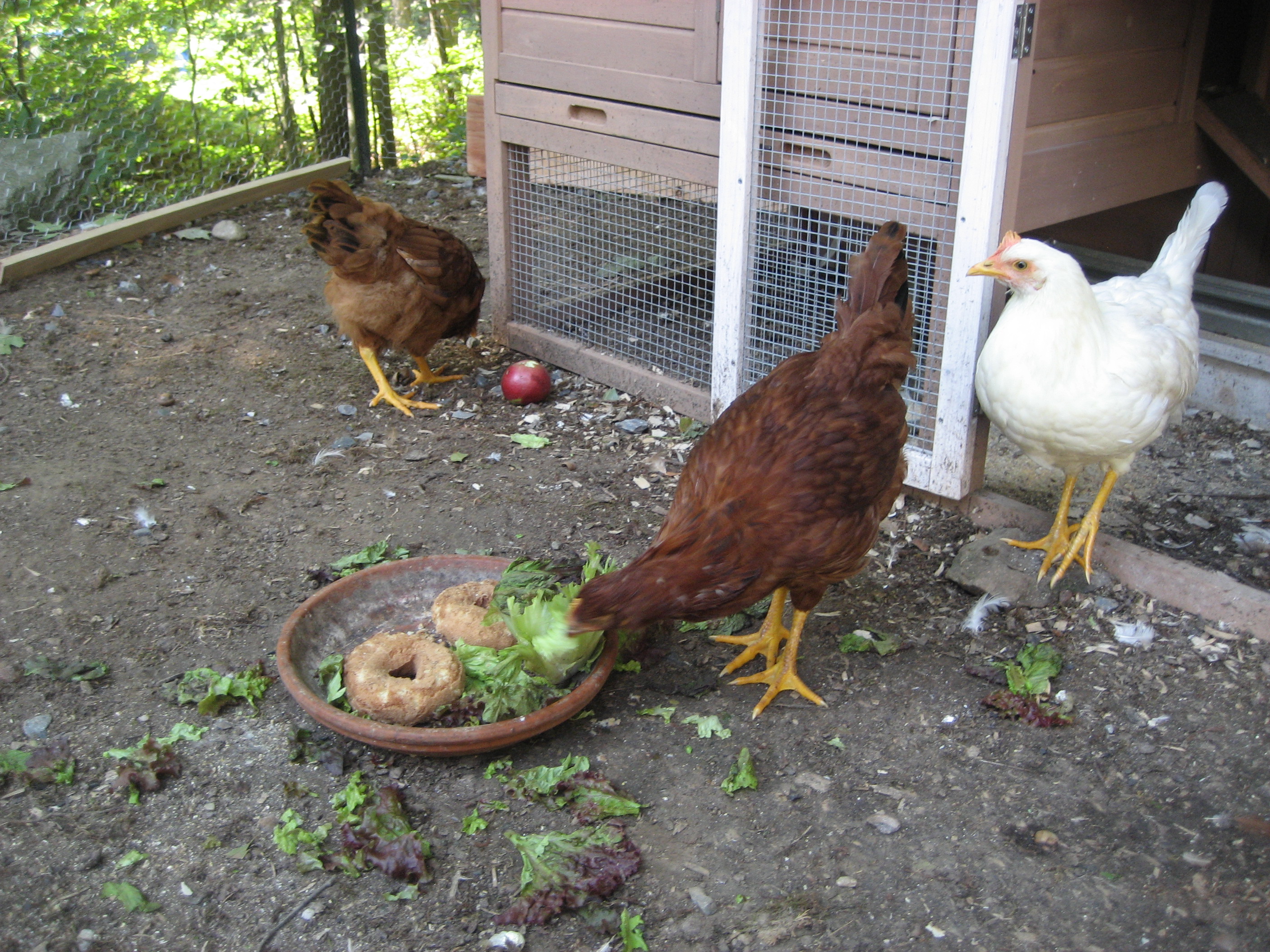
And then there were three: two smart ones and a lucky one. (The doughnuts were a little post-trauma treat, not a regular occurrence!)

Brinkley killed one of our chickens last week.

Here’s how it happened: For those of you who don’t know, Brinkley is our neighbor’s Golden Retriever, but we’ve “adopted” him to the point that our neighbors looped their electric dog fence around our yard. So Brinkley has the run of our yard, and we love him. Since July, when we first put the chickens outside, Brinkley has shown admirable restraint — he’s been interested in them, but until lately he never made any aggressive moves.

We keep the chicken coop inside a fenced yard. Here’s the weakness: because our yard is so rocky, we can’t sink the fence deeply into the earth to keep predators from digging under it. The fence is chicken wire strung between metal posts, but the chicken wire sits level with the ground. So last week, when Brinkley started digging under the fence and pushing up the wire with his 80 pounds of doggy energy, he won. I’d caught him inside the chicken yard several times, but luckily no harm was done.

Then, last Friday, as I pulled into the driveway with Georgia (the other two girls were in preschool), expecting a quiet, uneventful afternoon, our neighbor from across the street came up the driveway. She was watching Brinkley while his owners were away, and had caught him with one of our white Leghorns in his mouth. She saved the chicken — who was a little slobbery and wobbly and traumatized, but otherwise unhurt — and returned her to the chicken coop. I went to check on the chickens — and found only the lucky Leghorn and one of our Rhode Island Reds inside. That left TWO chickens unaccounted for.

My quiet afternoon turned into a frantic chicken hunt. It’s unclear exactly what happened, but it appears that three of the chickens may have escaped their yard by squeezing under part of the fence that Brinkley had warped with his digging. Once they became totally free-range chickens, they were also fair game for Brinkley. Amazingly, the OTHER Rhode Island Red eventually fluttered down from a tree branch above the chicken yard, where she’d taken shelter during the chicken massacre. As for the other Leghorn, all I found of her was a pile of feathers and a dismembered leg.

I wasn’t totally devastated; it’s pretty rare for a chicken to die of old age. Although I’d have liked to have gotten a few eggs out of this hen before she became Brinkley’s chew toy, chickens don’t usually inspire deep affection. They’re not cuddly creatures; even as chicks, our chickens hated to be held, and now it’s almost impossible to catch them. They’re nervous, flighty creatures whose main interest is food.

But I felt worse than I expected. Those chickens were my responsibility. I was prepared for them to die at some point, but it was still my job to keep them alive as long as possible. If you were looking for someone to pin the blame on in this situation, all evidence pointed straight to: ME. It was hard to be mad at Brinkley; he was just a dog being a dog. And the chickens were just being chickens. But I was the one who’d wanted the chickens to begin with, and I was the one who’d invited our neighbors to include our yard in Brinkley’s fenced run. I’d brought a hunting dog and chickens together, and when the inevitable happened, I had only myself to blame.

“You just keep adding and adding and adding,” my mother said to me during her latest visit. She was concerned after we told her that we were thinking of getting a dog of our own. And she’s right: three children in four years, four chickens, our neighbor’s dog, and now possibly our own dog. I DO have a little problem with adding things to my life. But here’s why: I think it’s almost never bad to add something else to love. Don’t most of us add and add? We form new relationships, get married, have children, acquire pets. Isn’t love the motivation behind all of those things?

I have a hard time saying that I love our chickens. I got them because we go through at least a dozen eggs a week, and because I thought it would be nice for the girls to have some animals around to watch and care for. But I raised them from chicks, I feed them and clean their coop, and I guess that’s a form of love.

Here’s the scaly underbelly of love, though, the thing we try to fool ourselves into forgetting: nothing lives forever. My husband, my children, my chickens, Brinkley, myself — we’re all going to die. When we add things to our lives, we’re adding present-tense love, with the promise of future-tense pain and loss.

So why keep adding at all?

I thought about that while I checked on my lonely Leghorn all that afternoon — a chicken who’d just suffered shock and loss herself, and appeared about as depressed as it’s possible for a chicken to be. I thought about that when Brinkley came running up to me proudly, carrying a mouthful of white feathers. I thought about that when I told my two oldest girls that Brinkley had killed one of their chickens.

Guess what the girls wanted to do after I picked them up from preschool? I am absolutely not making this up: they wanted to go play hide & seek in the cemetery. So we did.

And then I thought: we can live with loss. We can feel the pain and learn from it and work through it and heal. But I cannot, I cannot, live without love. So I will keep adding.

Also, I will reinforce that chicken fence.

When You Don’t Like Your Kids

You know that thing that you’re always supposed to say when your kids are acting up? (And by “acting up,” I mean behaving inappropriately, driving you crazy, whining and crying and not listening and pouting defiantly…)

You’re supposed to say: “I love you, but I don’t like this behavior.”

To see whether I succeed in loving my children while not liking their behavior, click here to continue reading over at On The Willows.

Mystery

Because it was highly recommended to me by several respected friends, I’ve finally gotten around to reading Wendell Berry’s novel Jayber Crow. I tend to be suspicious of things that come highly recommended, but this turned out to be a phenomenal book: a beautiful portrait of a man, a community, agriculture, religion, and life in general.

I’m glad I didn’t read it until I moved to Vermont. Berry set Jayber Crow in Port William, a small town in Kentucky during the mid-20th-century, but in many ways he could be describing my own small town in Vermont today. For instance, there’s this sentence about halfway through the book that I probably wouldn’t have noticed until this past year:

“Like, I think, most of the people in Port William, Roy lived too hard up against mystery to be without religion.”

Roy is a very minor character, and this sentence is tossed off in a tangential plotline, but it nearly smacked me with its truth.

The story leaves vague exactly what Wendell Berry meant when he wrote that “Roy lived too hard up against mystery.” He might be talking about agriculture; the character of Roy in Jayber Crow is a farmer. It’s hard to escape mystery when you live in a town where agriculture and nature are still closely intertwined with daily life. I’m not sure how you can watch a chick hatch, or a field of corn push up through the earth, and not feel it in your heart. To be a farmer, it seems, you’ve got to have faith in something — if only that the eggs will hatch and the seeds sown will push up. And to be a farmer, you have to come to some understanding with death; it’s a fact that everything you sow and grow will die eventually, either by your own hand or someone else’s. I’m not a farmer, but I do raise chickens and plants, I live in close proximity to farms and have friends who are farmers — and I’ve been changed by a year of watching these mysterious cycles of life and death unfold.

But I think agriculture is only part of it: every person has these same mysterious cycles of life and death, joy and grief, weaving in and out of their lives. This is true no matter where you live, but living in a small town makes it easier to see. When there are fewer people to know, you get to know them better. You learn their stories.

Last month, NPR aired an interview with the band The Avett Brothers, during which Seth Avett said, “The older you get…in some ways you’re just biding your time between tragedies.” The mystery that comes with small town life is that you KNOW about the tragedies, and you also get to SEE, close up, people biding their time between the tragedies — and not just biding their time, but LIVING, carrying on. How most people are able to continue with life is a great mystery. Some days, I feel like I’m surrounded by unsung heroes.

Here’s an example:

At our church, we sometimes sing a song called “Glory be to God.” (You can listen to a version of it here). It was a new song for me when we moved to Vermont, and it’s just pure praise. The other Sunday, we sang “Glory be to God” again. Standing where I was, I could see in my peripheral vision people who had recently suffered unimaginable loss, people who were struggling with mental illness, people who had escaped dangerous situations, single parents trying to raise their children through heartache, people who had no idea what their next step in life would be. And ALL THESE PEOPLE stood there, singing “Glory be to God…Forever and ever!”

Talk about mystery; it was almost too much for me — my heart felt like it was in a tug of war between joy and sorrow. What I saw that Sunday was my vision of heaven: not perfect cherubim flitting around playing their harps, but broken, hurting, totally IMperfect people standing up together and singing “Glory be to God.”

Now, here’s the thing: this doesn’t just happen in small towns. It happens everywhere. It was happening in my previous churches, but I didn’t notice it as much because those churches were large, so I didn’t really know people’s stories. Also, the people who went to these churches were mostly young, which meant that they looked like they had it all together, or they hadn’t yet lived enough to accumulate an impressive series of tragedies.

This doesn’t just happen in places of worship, either; you don’t have to go to church (or mosque, or synagogue) to experience this kind of mystery. The  people around us are singing with their lives every day. Maybe, in larger towns, it’s easier to hide your tragedies, keep your story private, and give the appearance of everything being okay. But everything is never okay. Like I said, it’s just that small towns make this easier to see.

I wish that everybody could experience what I did in church that day, that little vision of heaven.  It took living in a small town for me to see the mysterious pain, love, grace, strength, and redemption everywhere, in nature and in people. But we all live “hard up against mystery,” it just might require more attention — eyes and ears and hearts a little more open — to notice it in the suburbs.

According to Wendell Berry, once you’ve lived “hard up against mystery,” it’s hard to avoid religion. Do with that word what you will; I mean it as “faith in something outside yourself.” Whatever it is that keeps chicks hatching, corn sprouting, and people surviving, it’s certainly not me. It’s a mystery — and most of us, I think, are detectives, spending our lives gathering clues, trying to get closer to figuring out whodunnit.

There is a Season

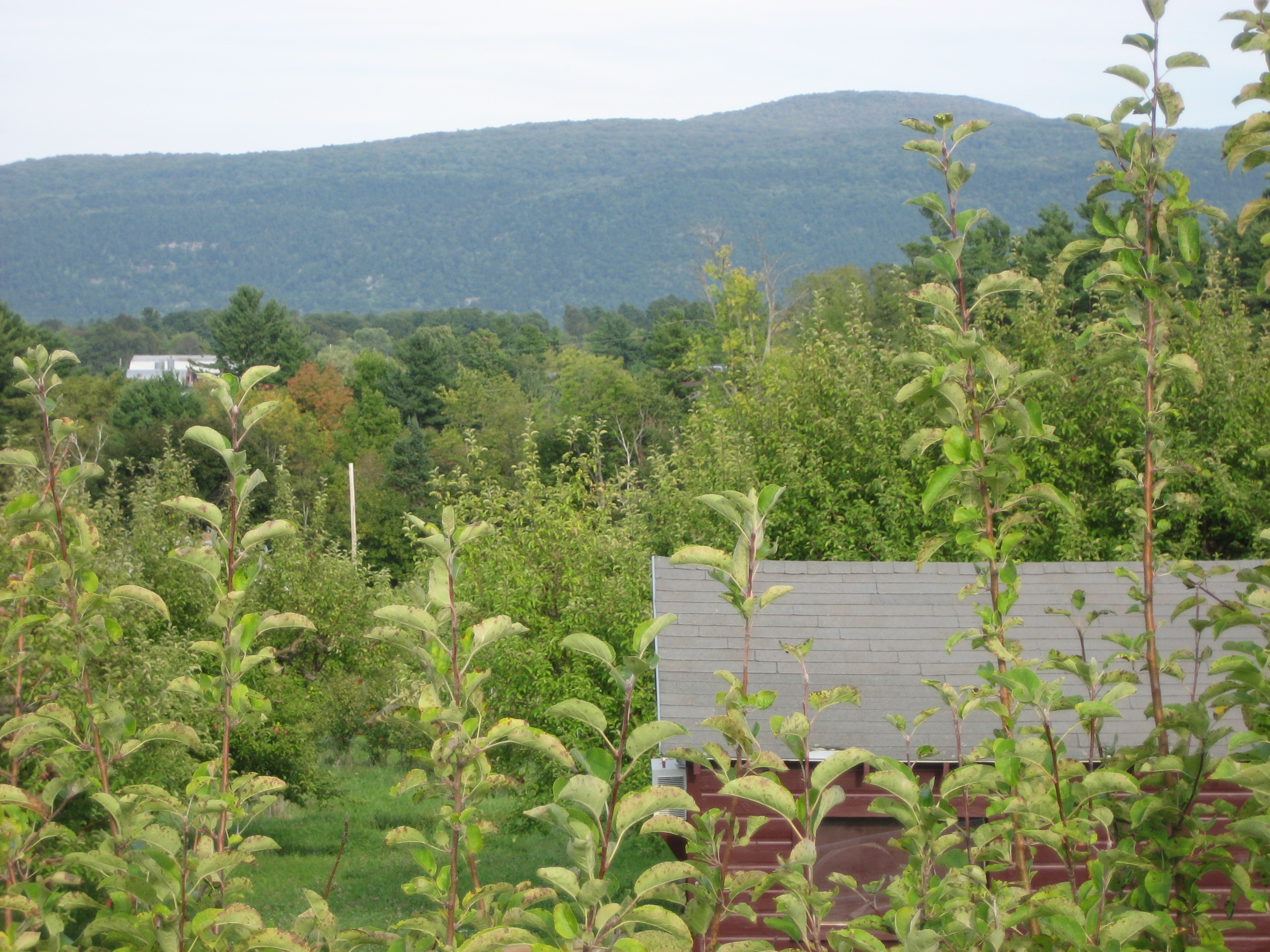
One of our favorite fall views, from the top of the treehouse at Happy Valley Orchard.

We’re sleeping with the quilt on almost every night. In the mornings, we wake to the sound of acorns crashing onto the roof as squirrels busily gather them from the oak tree. The sunlight has turned a deeper gold, and our eyes are peeled for new, colorful patches of foliage. Our second fall in Vermont is beginning.

When our family moved from California to Vermont, everyone assumed that our biggest adjustment would be the weather….

Click here to continue reading this, my latest column for The Addison Independent.

The Second Day

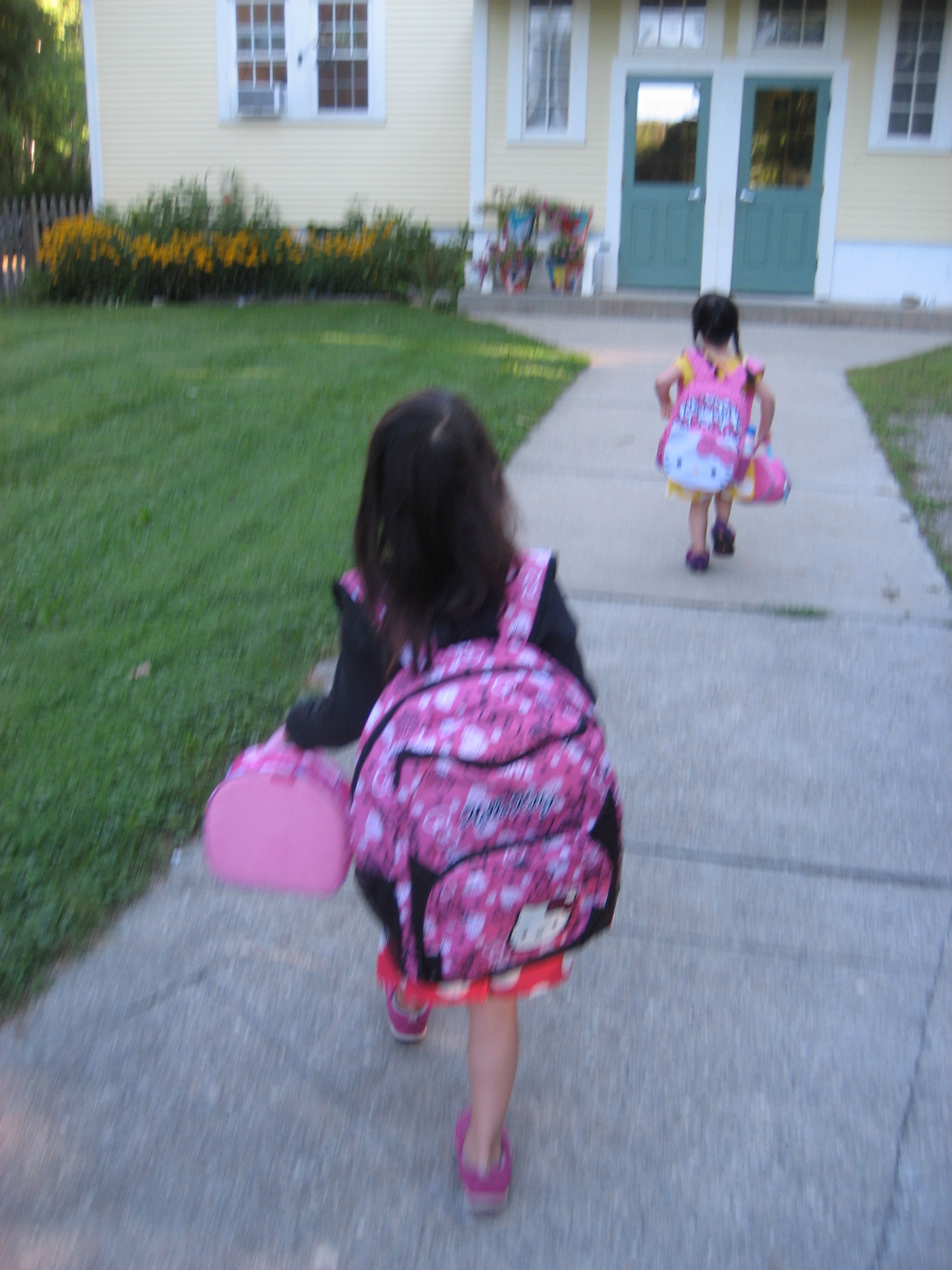
Fiona and Campbell started preschool at the end of August. For Fiona, this was a return to the same preschool, same classroom, and same teacher as last year. Her fellow students, however, were almost entirely new to her. (Because of Fiona’s November birthday, she was placed in the four-year-old class last year; because the cut-off date for kindergarten is September 1, Fiona and a few other classmates will spend another year in the four-year-old class, while most of their peers from last year move on to kindergarten).  For Campbell, starting out in the three-year-old class next door to Fiona, the whole experience was new.

Both of them were hugely excited for the first day of school — but not as excited as I was!

There’s a lot of build-up before the first day of school each year: anticipation, nervousness, new clothes and shoes and supplies. Even I felt a little nervous, although my main priority was just getting the kids out of the house. I hoped and prayed that Fiona would make friends and be happy with her new peer group. I hoped and prayed that Campbell would respect her teachers and be kind to the other students and avoid inappropriately using the word “poo-poo” — at least for the first day.

But, having done the first-day-of-school thing last year, I also knew this: It’s not the first day of school that’s the issue; it’s the SECOND day.

See, the first day, everything is fresh and exciting. There may be jitters, there may be wrenching goodbyes — but in my experience, adrenaline mostly carries everyone through. I’ve been the mom patting myself on the back after the first day of school, proudly relieved that my child had NO PROBLEM saying goodbye.

And then the second day hit.

By the second day, the kids have wised up. It’s not fresh and exciting anymore; instead, they can see past the new clothes and school supplies to the rules, expectations, and social minefield that they’re going to have to navigate EVERY SINGLE DAY. You mean I have to KEEP GOING?!? their eyes seem to say.

I was thinking about this as school began, and I realized that much of what makes life hard has to do with The Second Day. It’s not always literally the second 24-hour day, but it’s the state of mind we face when the newness has worn off. Think about it: You get married, and at first you’re swept along through the wedding and honeymoon, but pretty soon comes that Second Day, when you stare at your partner across the table and think, You mean I have to KEEP GOING?!?

Or, say, you have a baby, and you’re all jazzed up because you survived labor and now you have this cute little munchkin and you’re getting all sorts of attention and your house is stuffed with nifty new baby supplies…but then you come home from the hospital and have to face the Second Day, when nobody cares anymore that you have a new baby (except your parents — they’ll always care), and all your clothes are covered with bodily fluids and that munchkin is STILL waking up every two hours and you think, You mean I have to KEEP GOING?!?

OR maybe you do something really great in your profession/vocation/calling/art: you win an award, or obtain a degree, or invent something new, or create a painting/performance/book/film/play/blog post that people really like. Congratulations! You feel like your existence is finally validated…for about 24 hours. Because then comes that Second Day, when you have to sit at your desk or computer or easel again, and you think, You mean I have to KEEP GOING?!?

OR EVEN, let’s say you move to a small town in Vermont, and everything is new and wonderful. You love your new house, your new friends, the new landscape — your entire new lifestyle. But then the second year rolls around, and suddenly nothing’s quite so new anymore. You’ve seen all these seasons before, done just about everything there is to do at least once. And one dark and freezing winter morning, when you’re heading outside to feed those damn chickens AGAIN, you think, You mean I have to KEEP GOING?!?

Hey, it could definitely happen.

That Second Day is no joke. Based on the examples above, I’d venture that it’s the root cause of many cases of divorce, postpartum depression, and personal and professional burnout. I myself have experienced it plenty. In fact, I abandoned my first profession — teaching — because after four years I just couldn’t face a lifetime of Second Days in the classroom.

I have no tips for avoiding the Second Day phenomenon. It’s an inescapable part of life. Nothing stays new forever; if every day were a FIRST day, life would eventually become hyperactive and exhausting. All I have is this insight: the Second Day is difficult and depressing, but if you persevere through it, that’s when things start to take root and get really interesting. Marriage and parenting will always be HARD WORK — filled with multiple Second Days — but when I think back to my husband on our wedding day, or my kids when they were first born, I realize that I love them now with much more richness and complexity. I wouldn’t go back to that first day for anything.

I suppose the best way to handle Second Days is to anticipate them. I know now that I need to be just as prepared — if not more — to help my kids navigate that second day of school. I need to linger with a few extra hugs and kisses at the door, maybe even slip a little love note or special chocolate treat into their lunch bags. I need to offer encouragement that the most worthwhile thing in life — deep and genuine LOVE: for others, for what you do, for where you live — requires pushing past that Second Day. Perhaps we should all treat ourselves accordingly when we face life’s Second Days. Especially the extra chocolate treat.

So, now I’ve thought this through, and I feel more equipped to tackle those Second Days. But you know what?

I still have to get up tomorrow morning and feed those damn chickens.

Chancy Cows

Badlands Cow in the Road #1, by Jim McKinniss

I never considered that, when I became a parent, a major part of my job description would include fighting death. But it’s true: at its most basic, parenting is about trying to keep your kids alive into adulthood. No easy task, that. Every day I fight to keep my children and myself alive. I know it’s crazy to think that I have any control over death, that it’s something I can “fight.” I know that death is inevitable. But, inasmuch as I can control anything, I want to see my daughters flourish during the time that we all have.

And it’s not just my children and myself; these days I’m also responsible for the lives of three houseplants, numerous garden plants, four chickens, and one monarch caterpillar.

I’m starting to feel like my resume for 2011-12 should read: Anti-Death Warrior. [Anti-Death Warrior is a deceptively glamorous term for a job that, most days, involves managing food on one end and poop on the other. But still.]

I’ve had varying degrees of success in my attempt to keep the living things within my orbit alive and prospering. Thus far, I’ve been most successful with the girls. The garden plants are doing well, although truth be told they receive the least of my efforts. I may have managed to kill one of our houseplants, a gift from my parents with the promise that “It’s IMPOSSIBLE to kill.” It’s not dead yet, but it’s pretty brown around the edges.

And a few weeks ago, it looked like things were really falling apart for the chickens and me.

One of our new chicks started limping for no obvious reason, a development that filled me with the alternating emotions of fear (Could it be a disease that would wipe out the whole flock?), guilt (Was it something I did, or failed to see?), and indecision (Do I take her to a vet? Or just wait and see?).

And then there was me.

You may recall that, about a month ago, I was treated for Lyme disease. It now seems that I didn’t have Lyme disease, after all, but during the last few weeks of August I wished I did. Compared with what I was going through, Lyme disease looked simple, clear-cut, and treatable.

I’ll spare you all the medical details, except to say that a second round of blood tests for my Lyme-like symptoms — joint pain, headaches, fatigue — revealed elevated muscle enzymes, suggesting that my muscles were inflamed, possibly to the point of breakdown. In an instant, I found myself in medical hell: during the course of ONE WEEK, I went back and forth from the hospital for FOUR separate rounds of bloodwork and a brain MRI. I received daily voicemail updates from my doctor, including reassuring statements like, “By the way, I’m very concerned.” I alternately hugged my girls too tightly and snapped at them. I teared up at the smallest things, like Fiona saying, “Mommy, this winter I’m planning to make a HUGE snowman!” And I learned that sometimes, the more medical attention you receive, the sicker you feel.

My medical drama happened during the SAME week that our chick started limping. Everything was crashing.

I’d like to tell you that I handled all of this like a rooster in a sack: by getting still and quiet, meditative and contemplative. But I handled it more like a stressed hen: flapping and fighting and squawking. I cried so hard in that space-age, clanging MRI tube when the Coldplay song “Fix You” was piped in over the speakers from my iPod, that the technician came over the intercom to ask if I’d fallen asleep: “We’re getting some motion in the pictures.” I was furious at God for what was, in my humble opinion, his terrible timing: I have young kids, Erick’s semester was about to start, and this put a stop — either temporary or permanent — to various plans we’d been making. I was terrified that the tests results would turn up something truly awful, but I was also terrified that they’d turn up nothing; that all this drama and trauma would leave us just as stupefied as we were now, that I’d be achy and exhausted forever with no clear reason. I wanted a reason, I wanted a treatment, and I wanted a NAME.

I also spent inordinate amounts of time out by the chicken coop, watching our limping chick and wondering what I should do. “Why is Mommy always with the chickens?” Fiona complained to Erick when she came downstairs one morning to find that I was out at the coop again.

Then, that same week — the week of the limping chicken and my elevated enzymes — I just happened to read an article in the June 25 issue of The New Yorker by Jill Lepore, about Barack Obama’s family history. It turns out that when Obama’s grandfather, Stanley Dunham, was a young man, he was supposed to go with some friends to the movies. His grandmother kept him at home, and his friends’ car swerved to avoid a cow on the road and crashed into a tanker truck, killing all passengers. Lepore concludes: “Every family has a chancy cow or two roaming the meadows of its past.”

It’s a beautiful thought, but that week it struck me as a massive understatement. No, I thought to myself, it’s more like every PERSON has a HERD of chancy cows roaming the meadows of their life. By “chancy cows,” I mean things that could have happened but didn’t — or things that DID happen but might not have — due to something that seemed insignificant at the time. Like a cow in the road, or a grandmother’s decision.

Even right smack in the middle of that crappiest of crappy weeks, I could see chancy cows all over the place.

For instance, the reason I was being sent to the hospital for repeated lab tests, instead of sitting at home wondering why my knees were still hurting after I’d finished the antibiotics for Lyme, is that we just happen to live next door to a doctor — an experienced diagnostician whose practice is closed to new patients. And we just happen to be seeing a lot of this doctor lately, because he happens to have a Golden Retriever puppy named Brinkley whom our girls have adopted, so the doctor often has to trek through the woods to our yard, to retrieve his Retriever. The other week, when this doctor came to take Brinkley home, Erick just happened to mention that I was being treated for Lyme. “Well,” said the doctor, “you need additional tests. Call my office and I’ll fit you in.”

See? Chancy cows everywhere. And if it sounds like I’m saying that a Golden Retriever puppy might just be an agent of God, it’s because I am. Chancy cows are like God’s fingerprints; they reassure me, even when everything seems to be crashing at the worst possible time, that I’m part of a larger story that’s still unfolding. There’s a reason why we all love those movies in which seemingly random, disparate plotlines turn out to be connected at the end; I think it’s because we know, deep inside, that these movies are a lot like life.

Where life and movies diverge, of course, is that movies usually have neatly tied-up endings. Life, not so much.

Later that week, Fiona called to me one morning: “Mommy? I think that chick’s walking just fine now.” And she was right; I can’t explain what made our chick limp to begin with, or how it got better, but out of nowhere it made a full recovery.

On the other hand, our monarch caterpillar spun a gorgeous sparkly green chrysalis, and then never hatched. This happens — the monarch dies in utero — and it’s been happening a lot more lately now that farmers are spraying their crops with NPV, which is a deadly virus for caterpillars.

And me? After a clean MRI but continuing funky bloodwork, my doctor referred me to a neurologist up in Burlington. Last week I drove an hour in order to have little needles stuck into my muscles, and to be told that it’s still unclear what’s going on. I have no answers, just orders for MORE bloodwork and another MRI.

Driving back from Burlington, through the cow fields (seriously!), I decided I didn’t care anymore about finding a name for what ails me. I’m tired of doctors and tests, and I’m satisfied that whatever’s going on, it’s nothing life-threatening. I’ll do this next round of tests to humor my doctor, and then I’m going to stop and accept that my “new normal” may include some aches and fatigue.

I’m okay with all of that. I may not have answers, but I know I’m not in a free fall — there are two many chancy cows wandering around for that. Who knows? Looking back, this whole episode may turn out to have been just another chancy cow.

In Praise of School Days

If you see me around town these days, you may notice my crazed grin. You may notice an extra bounce in my step. You may notice that I appear to be missing two-thirds of my children.

This year, two of our three daughters are in preschool three days a week.

This is my third “Faith in Vermont” column for The Addison Independent. Click here to continue reading.

The Birthday Dilemma: To Party, or Not To Party?

Campbell’s big birthday gift: a lion costume.

Campbell turned three last month, and we threw her a party. More accurately, she had THREE parties: an early extended-family celebration orchestrated by her grandparents when we were in Maine, a family day with presents and cake on her actual birthday, and a small party with friends. We come from a family, on both sides, that likes to celebrate.

Campbell and her cake at her family party.

And celebrations are right and good. But what I’m concerned with here is what I’ll call the “Friend Party:” the party that involves a theme, balloons on the mailbox, matching cups and plates and napkins, activities or entertainment for the children who attend, and goodie bags on the way out.

We’ve never made a big deal of our girls’ first birthdays, since they clearly won’t remember the event — and also because, at one year old, they don’t have any friends to speak of. (At that age, friendships are arranged along the lines of: I like your mom, so we’re going to prop our babies up and pretend that they’re friends so that we can hang out together.)  However, we’ve done some version of a Friend Party for each of our girls starting with their second birthdays. Not big-deal parties, mind you: we’ve never hired entertainment, I make the cake myself, and we try to stick to the rule of inviting as many friends as the child is turning in years (two for the second birthday, three for the third, etc.) — although that rule becomes almost impossible once school starts.

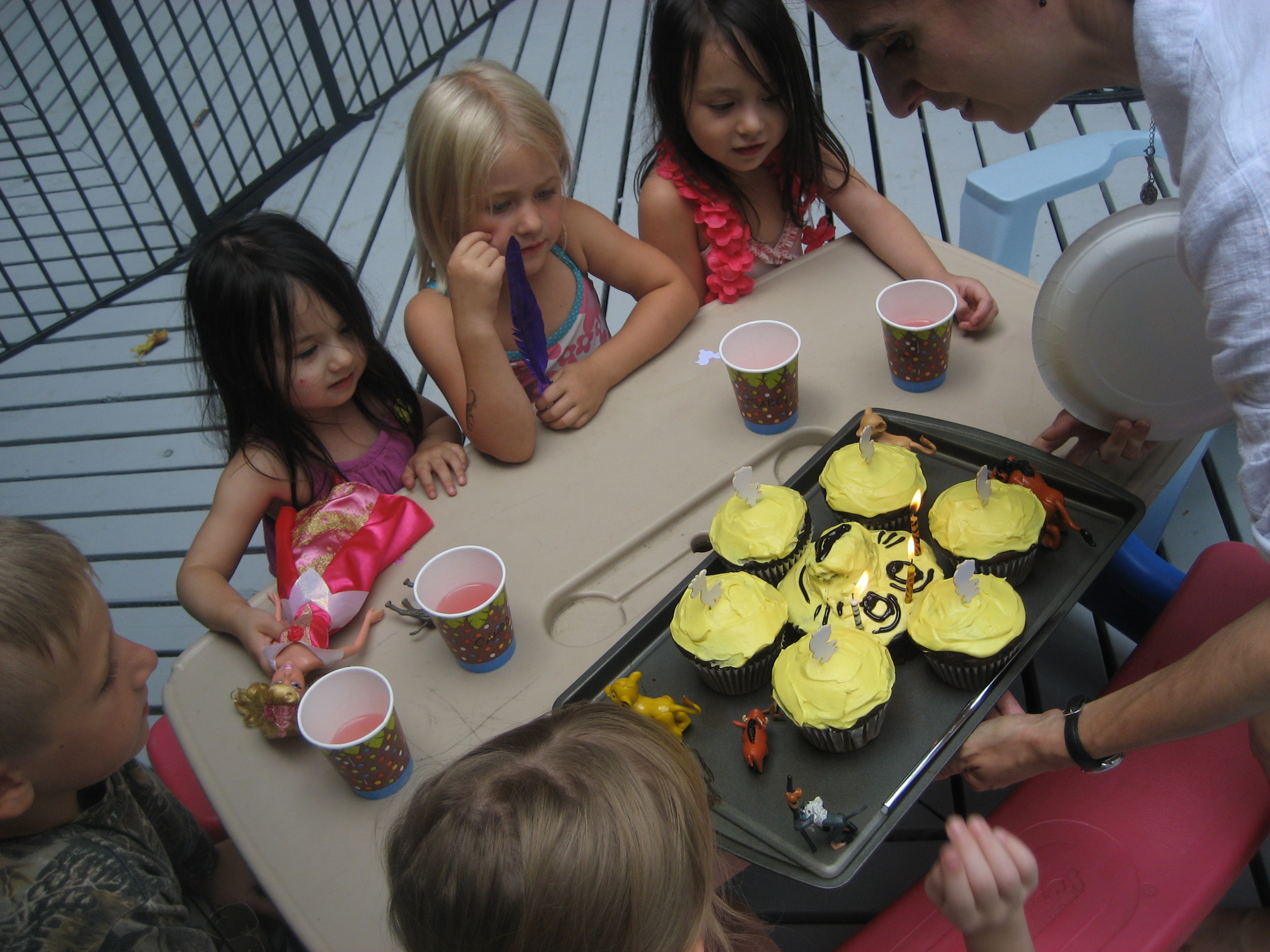
Campbell’s Friend Party was fairly low-key. We successfully limited the guest list to three children. It had a lion theme, but I got all the trimmings at the Dollar Store and made the cake myself. The kids decorated toilet-paper-roll binoculars, went on a little “safari” for plastic animals around our yard, played “Pin the Mane on the Lion,” ate cake, and splashed in the wading pool.

Campbell and cake #2, at her Friend Party.

It was a LOT of work. I was EXHAUSTED. We had a 2:1 child to adult ratio, and still the party seemed always to be on the verge of disaster: Brinkley (our adopted dog) running over and jumping in the wading pool, lemonade spills, goodie bags that fell apart, fights over who got which cupcake.

The goodie bags….

Did Campbell have a good time? I guess. When questioned as to whether she had fun, she said, “Yeah,” and went on about her business. I’m not sure that she actually shrugged when she said it, but that was the implication.

Will Campbell remember her third birthday party in 30 years? Almost certainly not, if Erick and I are any indication. After Campbell’s party, as we sat our wrecked bodies on the couch to debrief, Erick pointed out that both of our mothers had probably put a lot of time and effort into Friend Parties for US. From old photos, I know this to be true. Do Erick and I remember a single  childhood birthday party? Not a one.

I’m starting to think that Friend Parties don’t provide a very good return on investment.

I’m starting to think that Friend Parties are more for the parents than for our children: I felt like a GREAT mother while I was spending hours decorating the cake and the house. (And no parent wants “lack of adequate birthday celebrations” to be added to the list of reasons our children end up in therapy in 20 years).

In short, I’m starting to think that Friend Parties are not a very good idea, and I’m trying to find a way to stop throwing them — or at least, to stop throwing them for EVERY child, EVERY year.

In fact, it’s recently come to my attention, through conversations with family and friends, that many — if not MOST — parents do not throw each of their children a Friend Party for every birthday. I don’t know why I never got this memo, but I sincerely wish that somebody had told me this before Fiona turned two. What do I know? I grew up an only child; EVERY year was a Friend Party year.

The problem is, now I’m locked in to throwing Friend Parties for each of my children from the ages of two to five, because that’s what we did for Fiona. Isn’t it a rule of parenting that what you do for one child, you pretty much have to do for all the others? I don’t want Campbell and Georgia telling their therapists that we loved Fiona more, because she got the most Friend Parties.

So, here is my resolution, and you can hold me to it: I’m going to keep any Friend Parties as small and simple as possible, and after age five, my girls will be told that since they are more “grown up,” they can now have “Big Girl Birthday Parties” involving a special family celebration and perhaps a tea party or movie date with up to two friends.

Friend Parties are NOT at all a bad thing, and I’m sure many mothers throw them every year for every child without feeling the least bit frazzled. But for us, it’s time to downsize. When the amount of pleasure my children take in a party isn’t outweighing the amount of blood, sweat and tears I’ve put into planning the party, something’s got to give.

And really, aren’t birthday parties supposed to be about love? About celebrating the special life of a loved one? If I’m sending my girls — and myself — the message that love always has to come with balloons and streamers and matching paper products and goodie bags, I’m just setting them up for disillusionment. I’m setting them up to become like me: the me who was crushed our first Easter as a married couple because Erick didn’t get me a gift or a card. Who expects gifts and cards on Easter beyond childhood?!? you may ask. I did.

In the immortal words of Leonard Cohen: Love is not a victory march. It’s a cold and it’s a broken “Hallelujah.” It’s a silly luxury to ruminate so much about birthday parties. But it just may be that birthday parties are as good a place as any to begin preparing my girls for the world, by teaching them to accept love in smaller ways.

Broody

As I was cramming my head with chicken information before the arrival of our first three chicks, one of the most fascinating facts I came across had to do with “broodiness.”

For those of you who aren’t versed in the ways of the chicken, “broodiness” is when hens get maternal. They stop laying, and their bodies undergo hormonal changes that turn them into egg-hatching machines: their breast feathers thin out in preparation for 21 days of sitting on a clutch of eggs, and somehow their bodies are able to maintain the precise heat and humidity that the eggs need to mature — conditions that have to be painstakingly replicated by an incubator if no broody hen is available.

Not all hens become broody, and nobody knows exactly why certain hens do. Among some serious chicken raisers, broodiness is not seen as an admirable trait, and it’s been bred out of many commercial chickens. A broody hen will stop laying eggs for almost a month. She’ll sit and sit and sit, with only occasional breaks for food, water, and elimination. Not only that: she’ll get grumpy, pecking at anyone who tries to disturb her or her clutch; this is why the word “broody” has come to mean “moody,” even in humans.

All of that is interesting enough, but what REALLY got me was this: When a hen goes broody, it has nothing to do with whether she herself has laid a fertilized egg. To put it another way, the eggs she feels compelled to hatch may not even be her own. Broody hens will sit on the eggs of other hens. They will sit on unfertilized eggs. They will sit on nothing if no eggs are available; I’ve read stories of broody hens spending 21 days attempting to hatch a dirt pile.

This behavior sounds a little silly. It’s also one of the most beautiful things I’ve ever heard. What could be more selfless than sacrificing your own comfort and convenience to raise babies that aren’t even yours? Why aren’t WE more like broody hens? I wondered.

And then I realized that WE ARE.

This past year, I’ve had the humbling pleasure of getting to know a number of women — and some men — who might best be described as “broody.” What I mean is that these are people who make it a regular habit to care for children who aren’t their own. In many cases — but certainly not all — these men and women have raised or are raising their own children. Here’s what else they do: take in foster children, host Fresh Air Fund children (kids from the inner city who come to Vermont during the summer to experience the rural outdoors), act as second parents to college students, and open their homes and lives to friends’ children on a regular basis. Some people do ALL FOUR of those things.

I don’t know why I feel like I’m surrounded by more “broody” people right now than at any previous point in my life. It could be that this behavior is more common — or more visible — in a small town. It could be that I know more people who have older children or no children at home, which makes it easier to care for other people’s children. Without a doubt, I am one of the least broody people I currently know, if for no other reason than that I have my hands pretty full with my own brood at the moment.

But, regardless of how I compare to others, I HAVE been feeling broodier this year. Lately I’ve been thinking that one of the most helpful things we can do is to take care of each others’ kids.

Speaking strictly for myself, the BEST gift that anyone can give me is to watch my kids. Most of life — errands, housework, quality time with your spouse, mental health — is much easier if you don’t have the kids around. If I’m trying to love my neighbors as myself, I need to ask myself: “Self, what would you most love?” The answer: for somebody to watch my kids.

So, my broody self has been trying to notice when people seem like they might need a little kid-less time, and then offering to watch their kids.

Some friends have been desperate enough to take me up on this, and dropped off their kids at our house when they needed to deal with other things. Another friend and I have being doing a “kid exchange” all summer: one day a week her two children come over to our house, and the next day she takes all of the Gong girls. It’s been fun for us, and for the kids.

Back when we were expecting our third child, a more experienced parent told us, “Once you have 3 kids, you might as well have 33.” I think that’s true; adding one or two more kids to our house doesn’t significantly increase the noise, chaos, or my stress level. In fact, it’s often helpful to have a couple of non-Gongs around; when our girls are playing with friends, they stay out of my hair for longer periods of time.

These drop-off playdates are also special chances for me to get to know other children. There’s not a lot of turnover in our small town, so these kids are going to be our girls’ friends (maybe even – ulp! – significant others) for years to come. I hope I’ll get to watch most of these children grow up — not just watch them, but be an active participant in showing them love and care.

Best of all, I get to support other parents by doing this. Parenting can chew way down to your soul; we need to help each other out.

I’ll be honest: sometimes it IS really hard being in charge of a houseful of kids, especially if any one child is having a bad day. Even on good days, our house gets torn apart, our snack supply is decimated, and I often feel like the whole operation is about to spiral out of control.

But then again, I feel that way on days when I’m just in charge of my own children. And, like most things worth doing, this is not about my own personal comfort; it’s about something I can do to love other children and parents.

I often wish I could do more, like teaching in Tanzania, or caring for orphans in Calcutta, or volunteering at the local senior center. And maybe someday, when I don’t have to schedule everything around naps, I will. But if you’re feeling the same way, I hope this might encourage you: sometimes you don’t even have to leave your home to change the world. Like broody hens, you don’t even need to be a parent yourself. Maybe you can change the world a little just by watching somebody’s kids for a couple of hours. Giving parents a break, and giving kids some love, can start endless good things in motion. It reminds me of my favorite Anne Lamott quote: “Lighthouses don’t go running all over an island looking for boats to save; they just stand there shining.”