All the Days and Nights

playdough ice cream
Look for the candy gems….
Photo via

“Once upon a time there was a man who asked himself, ‘Where have all the days and nights of my life gone?'”

-from “All the days and nights” by William Maxwell

The past month was rough on our family’s immune systems. In early March, Fiona, Georgia, and (to a lesser degree) Erick were knocked out by a fever/upper respiratory virus. The next week, Georgia developed her first ear infection. And THEN, days later, Fiona, Campbell, and (to a lesser degree) Erick were taken down by one of the nastiest stomach bugs I’ve ever witnessed.

Throughout most of this (until the stomach bug knocked me out for a couple of days), I was the only Gong left standing. This was a REALLY mixed blessing. I’m happy to care for my sick loved ones, but it’s a lot of work: running around with food trays, bringing books and markers and DVDs, changing pajamas and bed linens (I did about 25 loads of laundry the day the stomach bug hit), forcing antibiotics into a screaming toddler. Plus, there was always ONE healthy girl to be entertained separately from her sisters.

For several weeks, I barely left the house. Playdates were cancelled. School was missed (which makes me verrrry grumpy). The days seemed endless, but at the close of each day I felt a nagging frustration that I’d accomplished nothing.

I started thinking about time. Time is a strange thing, because it seems to work in two ways at once. And my experience of parenthood has only served to highlight time’s dual nature.

It’s like this: The days ARE endless. My first thought each morning is usually, “How am I going to get through this one?” I do get through it, like we all do, by putting activities on the calendar, running errands, preparing meals, washing dishes, doing laundry, reading to the girls, and keeping them supplied with coloring books and stickers and craft materials. But every day there’s a chunk of time — sometimes it’s the entire day, sometimes it’s just the hour before dinner — when the clock seems to slow, when I’m counting the minutes until Erick gets home, when I wonder how I can possibly usher us all through the next hour (or two, or three) without losing my mind.

And yet, time flies. The phrase is overused because it’s true. It’s as if, somehow, all those endless days get smushed into a space capsule at the end of each year and blasted forward at light speed. The last thing I remember, I was holding a brand new hairdryer in a Macy’s bag and meeting a guy I barely knew at Grand Central Station so he could come to an Indigo Girls concert with some friends of mine…and now we’ve been married ten years, we own a home in Vermont, he’s a college professor, and we have three kids and a dog.

I’ve only had children for five years, but I already know that older parents speak the truth when they say, “It goes so fast!” The last thing I remember, you were no bigger than a doll and your eyes were closed but your tongue was sticking out when they handed you to me in the delivery room…and now you have the longest legs I’ve ever seen and you’re a big sister to two and when you grow up you say you’re going to be a swim teacher/singer/mommy.

Life is a series of endless days that fly. So how do we get through the endless days, those eternal minutes until dinner? Are we each destined to become someone who asks longingly, Where have all the days and nights of my life gone? Does every parent inevitably become the empty-nester who says wistfully, Enjoy every minute; it goes so fast! 

Maybe. And maybe that’s not a bad thing; the idea of looking back over time and feeling that it’s flown doesn’t particularly bother me. What does irk me are all the days, here and now, when I think, This day seemed endless, yet I’ve accomplished NOTHING.

Because, as we’ve all heard, time flies…when? WHEN YOU’RE HAVING FUN! But these days — these endless days that will someday be the sum of my time that’s flown — let me tell you: most of them aren’t “fun.” They are lunches to pack and dishes to wash and children to dress and relationships to maintain and bills to pay and errands to run. Even when I purposefully create “fun” moments — painting, baking, craft-making — they’re honestly not much fun for ME; there’s a lot of preparation and clean-up for a few minutes of messy joy. There are transcendent moments, sure, but the majority of the day is dragging drudgery.

To look back and realize that time flew and you didn’t have fun seems to me a recipe for regret.

Unless…we’ve forgotten that what we do today IS fun. Perhaps it takes the distance of years to realize: All those endless days and nights, those times when I thought I accomplished nothing — those really were FUN.

How to capture that future perspective, and transport it into the present? Can we live each endless day while holding the hope that this may someday look like flying fun?

I’m not big on Pollyanna-ish denial of reality. Let’s face it: some days will just not EVER be fun. We lose loved ones, we struggle with depression, we clean up bodily fluids from every member of our family.

So I’m trying to think of my days like ice cream. In particular, Fiona’s favorite flavor of ice cream: Playdough (sold at a deli in town). Playdough is a horrifyingly sweet concoction; the ice cream base is something like “vanilla cake,” but Fiona doesn’t get it for the ice cream. In fact, I don’t think I’ve ever seen her touch the ice cream portion of this flavor. She gets it for the colored “candy gems” mixed into the ice cream, and she’ll spend enormous amounts of energy digging through the ice cream with her spoon, tracking down every last candy gem.

Our days are like Playdough ice cream because every day, no matter how terrible, has at least one candy gem in it. You may have to go digging for it, you may not find it until the day is past, but I promise it’s there. Maybe it’s something as basic as: I’ve never been more thankful for a working washer/dryer, because I just did 25 loads of vomit-stained laundry today. Candy gem!

I’m going to take my plastic spoon and go digging at the end of each day, so that I won’t have to wait until the time has flown to appreciate all my days and nights.

Squish

MuddyKids

A picture of four mud-soaked and delighted children was recently posted on the Facebook page of a children’s museum that we frequented when we lived in California, under the caption: This is how kids should be playing.

I chuckled when I saw it, with a mixture of amusement and bitterness. In that instant, here’s what I thought:

-This is what my own kids, and our dog, have looked like for the past month.

-YES, at my core, I do believe that’s how kids should be playing.

-It’s very easy to sit in Berkeley, California — where THERE IS NO MUD SEASON — and say that’s how kids “should” be playing. Never, in the five years I lived in the Bay Area, did I see kids who really looked like this.

It’s mud season here in Vermont, that fifth season that marks the transition between winter and spring. The snow melts, the ground thaws, and until the trees burst open green leaves we spend weeks squishing through inches of mucky mud.

Click here to continue reading my mud season reflection over at The Addison Independent.

Daddy Ears

IMG_3777

My husband, Erick, has what we jokingly refer to as Daddy Ears. Here’s what I mean:

In a house with three children, we have plenty of “Miss Clavel” moments — Miss Clavel being the nun in charge of the Parisian girls’ boarding school in Ludwig Bemelmens’s classic book Madeleine. Remember? “In the middle of the night, Miss Clavel turned on her light and said, ‘Something is not right!'”

In our house, there are cries in the night, and bumps, and potty emergencies. The noise announcing these crises may range from a whimper to a shriek, but I can guarantee that noise will pull me out of a sound sleep and send me running down the hall.

These days, our dog, Gracie, is always a few steps ahead of me. Gracie usually sleeps in her doggie bed downstairs, but she has the sharpest ears in the house and she loves her girls, so she comes barreling upstairs at the slightest sound of upset. (When she knows that things are really bad — a terrifying nightmare, say — Gracie plops herself down next to the bed in question, where she’ll sleep protectively for the rest of the night. Never have I understood so well why the Darling family in Peter Pan used a Newfoundland as their nanny).

Guess who never, ever comes running, who rarely cracks an eyelid at these moments? Erick. Once I’ve put out the fire in question and returned to bed, I’m impressed if he turns to me and mumbles, “‘It okay?” Usually he’ll slumber on, blissfully unaware.

That’s because Erick has Daddy Ears.

Point of clarification, before I get in trouble: We call them “Daddy Ears,” because in our house it’s always the mommy who comes running in the night, while the daddy snores. This may not be the case in other houses. I’m sure there are some daddies who are the first responders. For that matter, there are plenty of homes in which there’s only one parent, and it’s up to that particular mommy or daddy to handle all nighttime emergencies.

But in our house, we have Daddy Ears.

One more point of clarification: Erick is an amazing father. Really, I couldn’t ask for a better co-parent — when he’s awake. During the daylight hours, Erick is fully engaged with his daughters. His job keeps him busy, but he makes a point of being home for breakfast and dinner. He tries to limit his weekend work, and frequently takes all three girls out of the house on Saturday mornings to give me a break. When I have moms’ nights out or book club meetings, Erick has no problem handling the dinner/bath/bedtime routine solo.

When Fiona was born, we got a lot of advice about how to include Erick in the newborn experience — like introducing the baby to the bottle as soon as possible, so that Erick could take over one middle-of-the-night feeding. Erick gamely went along with this plan, and since Fiona was such an exceptionally tiny baby that she had to be fed through a dropper for the first few weeks of her life, his help was invaluable. Of course, we were both completely wasted with exhaustion, but I was such a believer in this equal-opportunity parenting that, when one wise family member (and experienced parent) advised us: “Do NOT make Erick do nighttime feedings; someone has get sleep!” I was horrified.

It wasn’t until we were expecting our second child — who, thankfully, was less tiny than the first — that Erick and I began to re-think our newborn parenting duties. And the re-thinking stuck.

In this time and place, we (rightly) strive for equality in the division of labor within our relationships. Having children, like marriage, forces us to wrestle with what “equality” actually looks like. At the beginning of my marriage, I defined “equality” as “doing the same things.” In other words, if I was cooking and cleaning, then Erick should be cooking and cleaning, too. It soon became clear that this wasn’t a good model for us; Erick is the better cook, I am the better cleaner, and our ability to complete these tasks shifted based on who was working and when.

The same proved true when we had kids. When Campbell — and later Georgia — arrived, Erick no longer participated in nighttime feedings. Since I nursed the girls for most of their first years, Erick was of limited usefulness to begin with. Then there’s this: I can function with far less sleep than Erick. Also this: When Erick did nighttime feedings and the baby woke up in the night, I’d shake Erick awake, then lie awake until I knew the baby was fed and back to sleep. Nowadays, there’s also this: Erick has to report to work in a public place every morning. And Erick himself will honestly tell you that no matter how many nighttime bottles or daytime cuddles he gives, he never feels very connected to any of our children until they’re about one year old.

And that is why, when our fourth child is born, Erick will not be taking paternity leave.

This arrangement makes sense for us. Do I sometimes glare at Erick across the breakfast table after I’ve been up every two hours all night? Of course. Do I sometimes feel snarky when Erick comes home from work and I ask, “How was YOUR day?”  — meaning, really, “Did you enjoy sitting at a desk, eating leisurely meals, and interacting with adults?” You bet. But I’ve learned that Daddy Ears work just as well as Mommy Ears, they just function at a different frequency — like when a tickle pile is required, when chocolate chip pancakes need to be made, and when Mommy really needs a break.

So, there will be no paternity leave with Kiddo 4. On the contrary, about one month after this baby arrives Erick will spend three weeks conducting research in Africa. And I’m really okay with that. I’ll have lots of help: We have two sets of amazing grandparents who’ll be here for most of the summer, and we have a very supportive community of friends. (I’m seven months pregnant, and people are already bringing us meals, which is either an indication of how kind they are or what a mess I am).

Then, by late summer, I’ll have a pair of Daddy Ears sleeping next to me again, although it may be a few more months until he realizes there’s a fourth child in our house.

Doctor, Doctor, Gimme the News!

chickenhypo

[In an odd bit of timing, this post (written a couple weeks back) happens to be appearing during one of our family’s bleakest health weeks: three days ago, Fiona, Campbell, and Erick were attacked in the middle of the night by a nasty stomach bug that’s been sweeping through our community. After the first 24 hours, I blithely assumed that Georgia and I had some sort of super-resistance, that we’d escaped with stomachs intact. Not so; yesterday, it got me. So we’re limping along over here, and as soon as I finish typing this intro I’m letting the girls watch their fifth episode of “Dinosaur Train” and going straight back to bed. Looking forward to putting this week behind us. Hope you stay healthy and enjoy what follows!]


Despite how calm and self-assured I may appear in my writing (Right?!? Don’t I?!?), in reality I am neither laid-back nor confident. I worry about many things. Like everyone, I’m a work in progress; I’m working on my worry, as I have been for my entire life. My excuse for retaining just a little bit of worry is that I am married to an exceptionally laid-back man, so somebody has to take care of the worrying in this house. I see it as adding a necessary dose of neuroticism to life, for the sake of our children; it’s boring to grow up too well-adjusted. (Right?!? Isn’t it?!?)

One of the things I sometimes worry about is my health. Thankfully, I don’t have to worry about this too much, because in general I’m very healthy. But the second a symptom appears, my mind immediately fixates on the worst-case scenario; I’ve been at death’s door many times because of a simple tension headache.

Here’s where it gets tricky for me: most people, convinced they’re at death’s door, would be knocking on the doctor’s door. They’d be phoning the on-call nurse in the middle of the night, insisting on more tests, tracking down specialists for second opinions.

Not me. Because, although I may worry about my health, I’m more worried about annoying my doctor. My worst nightmare is that I’ll visit the doctor to check out a symptom, and all the tests will come back negative, leading the doctor to conclude: She’s a neurotic hypochondriac. I’m convinced that every doctor’s office has special “Freak-Out Case” stickers that they place on the files of all patients who annoy them with baseless symptoms; when a “Freak-Out Case” patient calls to report a symptom, the on-call nurse rolls her eyes, while the other nurses in the staff room try to contain their laughter. (Doctor friends, now’s your chance to tell me if this is actually true….)

I want to avoid a “Freak-Out Case” sticker on my medical file. So I delay calling the doctor, debate endlessly whether I should call the doctor, try to diagnose myself online (I know, I know!), and end up even more convinced that I have days to live. But at least when I die, the doctor won’t hate me.

I guess you’d call me a “blocked hypochondriac.” If you could personify my inner life, it would probably look an awful lot like Woody Allen.

One of the BEST things about pregnancy is that it gives you license to be a little bit of a Freak-Out Case; after all, you’re  responsible for another life growing inside you. I don’t worry (as much) about appearing neurotic and self-absorbed if I call the doctor when I’m pregnant; it’s not about ME, it’s about the BABY. And since Fiona’s dramatic birth placed me forever in the “high-risk” pregnancy category, I think I deserve a few extra-credit worry points.

And believe me, I need those worry points. If you’ve thought, “Gee, by the fourth pregnancy I bet it’s REALLY EASY. After all, you’ve done it three times before. You probably don’t worry at all!” think again, my friend.

An unfair and counter-intuitive fact about pregnancy — at least MY pregnancies — is that it doesn’t get easier the more times you do it. In my experience, pregnancy gets a little more difficult each time: more aches, more pains, more nausea. Whether this is because I have more children and less time to rest, or because I’m older with each pregnancy and my body’s more worn out, I’m not sure. On the whole, I don’t have very difficult pregnancies, but it’s certainly not something that gets easier with practice.

Which brings us to the worry. Oddly, my most worry-free pregnancy was probably my first; back then, I was blissfully ignorant. I didn’t know how many things could go wrong. Then I read What to Expect When You’re Expecting, which is possibly the most terrifying book ever written. My edition has a whole chapter titled, “When There’s A Problem.” (I’ve advised first-time mothers to avoid this book. Is it really helpful to fill your head with all the worst-case scenarios? In the unlikely event that I ever write a pregnancy handbook, this will be the full text: “You’re probably going to be okay. Women have done this for centuries without the benefit of modern medicine or What to Expect. Eat healthily, rest when you can, see your doctor, and guilt your spouse into doing as much as possible.”)

Unfortunately, it’s not just pregnancy literature that’s filled my head with worst-case scenarios; it’s also life. I’ve lived five years in between my first pregnancy and my fourth. During that time, a LOT of friends have gotten pregnant and had babies. The stories are mostly happy — but some aren’t. I’ve been a bystander to unimaginable tragedy and heartbreak.

By now the worry arsenal of my imagination is fully stocked with tales of what could possibly go wrong. Add to that the maddening fact that, while my pregnancies don’t get EASIER, they do get DIFFERENT. None of my four experiences have been identical; there’s always something new and surprising going on. “What’s that ache?!? I’ve never felt that before! Let me check What to Expect….”

The bottom line to all of this? Worrying about my health in general and pregnancy in particular has forced me to accept the difference between RESPONSIBILITY and CONTROL. For instance:

I am RESPONSIBLE for my pregnancy — I should take my prenatal vitamins, get rest and exercise, and lay off the Scotch for 9 months (boo!) — but I can’t CONTROL the outcome of my pregnancy.

I am RESPONSIBLE for my behavior — I should treat others kindly, try to manage my worry, and avoid harassing my doctors — but I can’t CONTROL how others see me.

All of which is outstanding preparation for parenting. Because I’m RESPONSIBLE for my children — I should feed them, clothe them, teach them appropriate manners, and keep them out of the street — but I will never, ever be able to CONTROL my children.

I hate having to accept this, but it’s the truth.

Little Girls

IMG_0837

Today is International Women’s Day. This is not a day I’ve noted before, because until recently I didn’t think much about being a woman.

Growing up, in the time and place that I did, I had the strange “luxury” of feeling ambivalent about my female-ness. It was something that I took for granted; Hair: Brown, Race: Caucasian, Sex: F. I never disliked being a woman, but neither did I take any particular pride in it. I emerged from adolescence with some vaguely negative stereotypes about what it meant to be a woman: women were overly emotional, too sensitive, too talkative, bad drivers, and subject to the ultimate Sophie’s Choice of career vs. motherhood: no matter how you chose, your life was doomed to be less than satisfying. Back then, I would’ve been afraid to say I was proud to be a woman; such a statement might align me with the angry voices of second-wave feminism. Granted, those angry voices were necessary in order to get the culture’s attention, but anger doesn’t usually speak to me. I was brought up to be polite; I still don’t do angry very well.

It’s gradually dawned on me that I am a woman. Not only that: I am the mother of three little girls who will one day be women. As such, I am my daughters’ first example of what it is to be female.

That’s a charge I shouldn’t take lightly.

My role as a mother, I repeatedly tell my girls, is to help each one of them become “the best YOU that you can be.” How do I help my girls become their best selves, and instill pride that their SELF includes being a WOMAN?

I think pride in being a woman begins with recognizing that there’s something unique about womanhood. Men and boys are special, of course, but women are special because they’re not men — we bring something different to the table. My daughters, despite being raised in the relative cultural isolation of small-town Vermont — few chain stores, no billboards, no T.V., and the only magazine we get is The New Yorker — STILL gravitate towards fairies and princesses and ponies and pastels. They choose to dress and play differently than the boys we know. I can either fight this apparently inborn female-ness, or I can encourage them to find the strengths in who they already seem to know they are.

Those female stereotypes I grew up with, many of them are in some way true. But they also encompass some of the qualities I love best in my girls, qualities that I think make them uniquely female. In trying to get at what’s special about women, I’ll take each stereotype I grew up with and highlight its strengths:

Women are too emotional: Emotion results from feeling things deeply. Being able to feel deeply is a gift; like any gift, it has a dark underbelly, but its bright side is an ability to be passionate about ideas, causes, people. Passion is what gets things done. If nobody was emotional, we’d end up with a world of economists, and TRUST ME, that would be tragic.

-Women are too sensitive: Like emotion, sensitivity can be problematic if overindulged, but it’s a necessary ingredient for successful relationships. Being sensitive may mean that you’re easily hurt, but it also makes you more aware of the feelings of others.

-Women are too talkative: Sorry, but as a writer I don’t have a problem with this. Aren’t words the essence of life? Isn’t the moral of the story of the Tower of Babel that, without the ability to communicate, our cities end in ruins?

Women are bad drivers: I don’t really know where this one came from, but I DO know that when I’m a bad driver, it’s usually because there are three little people screaming at me from the backseat. Which gets at something that I think is a female strength: the ability to multitask. Just about every woman I know thinks nothing of talking on the phone while preparing dinner with one hand and bouncing a baby on her hip. Or writing her PhD dissertation with one side of her brain while simultaneously solving her best friend’s relationship troubles with the other side. So pardon us if we’re distracted! (In contrast, when my husband watches the girls, he’ll get dinner cooked…while the girls run around naked setting small fires in every corner).

-Work vs. motherhood: This is a whole can of worms, but the WONDERFUL thing about being a woman is that you GET a choice. You can become a MOTHER, for crying out loud! That’s an amazing thing that only women can do. But, thankfully, in this day and age, you can also choose a CAREER! The world needs women represented in all fields — and with fewer and fewer restrictions, you can do what you love. Nowadays, there are creative ways to cobble motherhood and career into something that works. But it’s NOT easy: it’ll never be easy to be a mother, it’ll never be easy to carve out a career, it’ll NEVER be easy to balance both. But women do it, and have done it forever — since back when “career” meant “keeping a farm running.” And that’s why the toughest people I know are all women.

Those are a few strengths that I’d claim for women. But what makes me PROUDEST about being a woman is the company in which it puts me. Powerful women have surrounded me my entire life, it’s just taken me a while to notice. There are the women in my own family. There are the six years’ worth of students I taught at two girls’ schools (two of them recently re-introduced herself to me here; they’re students at Middlebury — talk about feeling old!). There’s the Pakistani woman I tutored for six years in Manhattan, who’s currently pursuing her bachelor’s degree. And there are my friends across the world: women who have amazing careers, women who are mamas, women who have careers and are mamas, single women, partnered women. Women who stay in hard marriages; women who leave impossible marriages. Women who show up with a meal at the perfect time (because it’s always the perfect time!). Women who create things of beauty. Women who tell the truths you need to hear. Women who raise the children — and not just their own. Women who care for the sick and comfort the grieving and fight for justice.

These women are beautiful. They make the world more beautiful. They keep life going. I’m so grateful that my own little girls can grow into women, surrounded by women like these. As my oldest daughter said the other day, “Every girl’s a princess, even if she doesn’t live in a castle.” Amen, and Happy International Women’s Day!

Georgia, Bustin’ Out All Over

IMG_2006

I am six months pregnant: I feel large, Kiddo 4 is making it increasingly difficult to breathe, and I get winded from walking up one flight of stairs. Not much gets me running these days.

Except for these words: “Mommy, come look what Georgia’s doing!!!”

When I hear that, I know that I can expect to see Georgia balancing on top of a piece of furniture. Or removing all of our  CDs from their cases. Or sitting on the floor holding an empty bottle, surrounded by Erick’s allergy pills. Or programming my computer. Or pummeling one of her sisters.

This kid is a firecracker. She makes Campbell, the child we thought was our “wild one,” look like the Dalai Lama. Our children seem to be getting progressively wilder, which makes us worry about the outlook for Kiddo 4.

It just goes to show that you never really know your child until they turn two. Georgia turns two today.

And no, I am NOT having a Friend Party for her, because sometimes you just have to break from tradition and say, “Enough!” (Or, to put it more mildly, we ARE having a two-year-old Friend Party for Georgia, and the two friends she gets to invite are Fiona and Campbell, with a bonus visit from three of her cousins).

But I am going to stick with tradition and tell you a few fun facts about Georgia as she is right now, just as I’ve done in the past for Fiona and Campbell. Because, unlike last year, this year we’re starting to really know Georgia.

1) Georgia is a lunar girl. I don’t know where this comes from, but Georgia loves the moon. If there’s a moon in any book, she’s the first to point it out (which may explain why her favorite books are Goodnight Moon and Owl Moon). She’s also the first to spot the moon in the sky, even if it’s just the hint of a moon during the day. For some reason, on a family nighttime stroll this fall, we thought it would be fun to howl at the moon. So now, whenever Georgia sees the moon, she yells, “Moon! HOOOOOOOWWWWLLLLL!”

IMG_1889

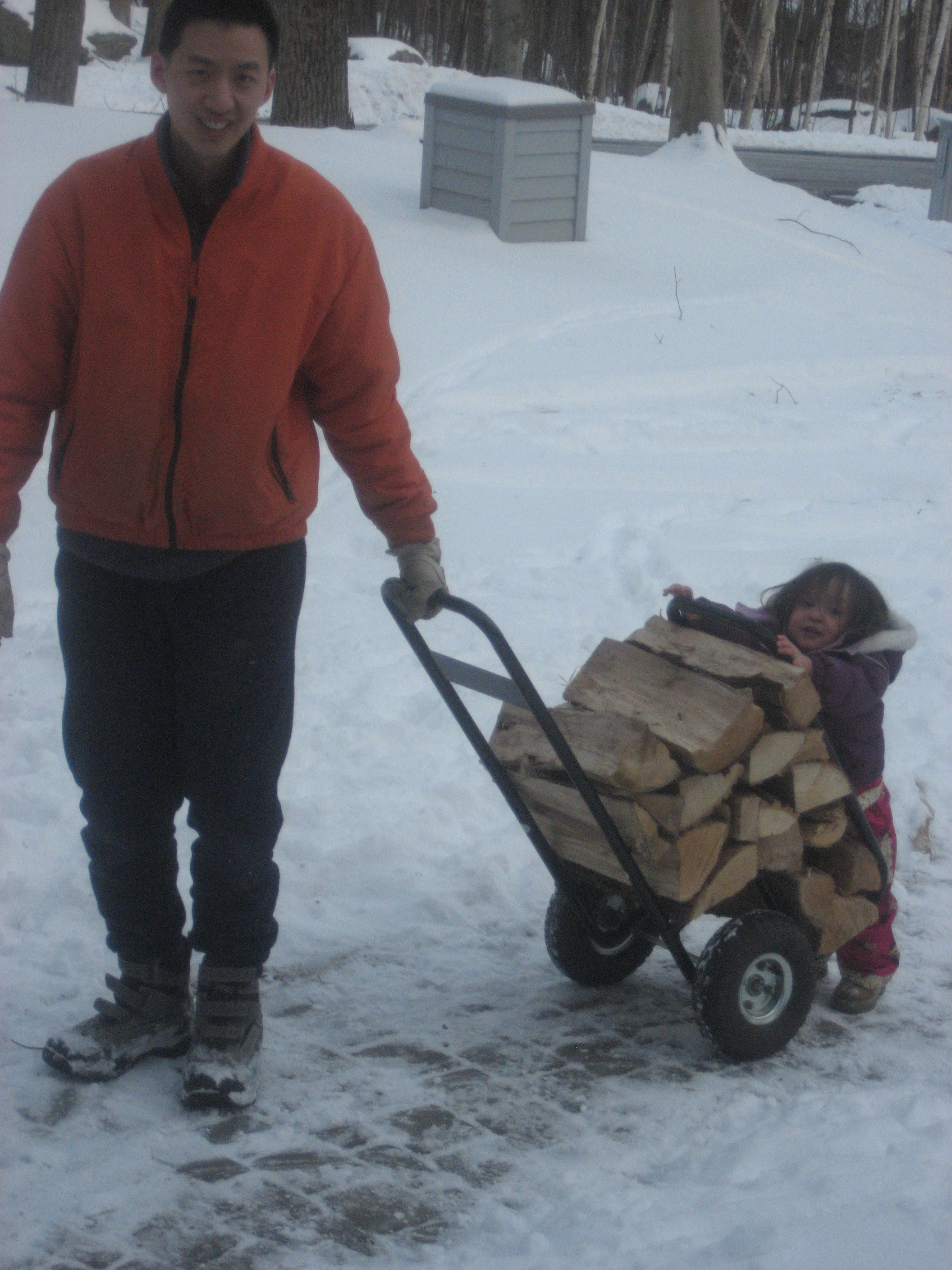
2) Georgia is the most independent of the Gong Girls. I say “independent;” her sisters say “rascally.” This is partly because she wants to be just like her two big sisters, partly because she’s received less supervision than her sisters (so sue me, I’m exhausted!), and partly because she’s lived almost her entire life in Vermont — which breeds a certain kind of independence. Georgia, at barely two, wants to do everything herself: dress herself, cut her food, wash the dishes, and drive the car. She throws herself wholeheartedly into life: art projects, singing and dancing, and temper tantrums. The girl has no fear, which is nice when she’s not afraid to help Erick stack wood outside on freezing pitch-black nights, and not so nice when she disappears upstairs with a mischievous agenda. [Note: Last year, I proclaimed Campbell the “most independent” of our daughters. I proclaimed wrong.]

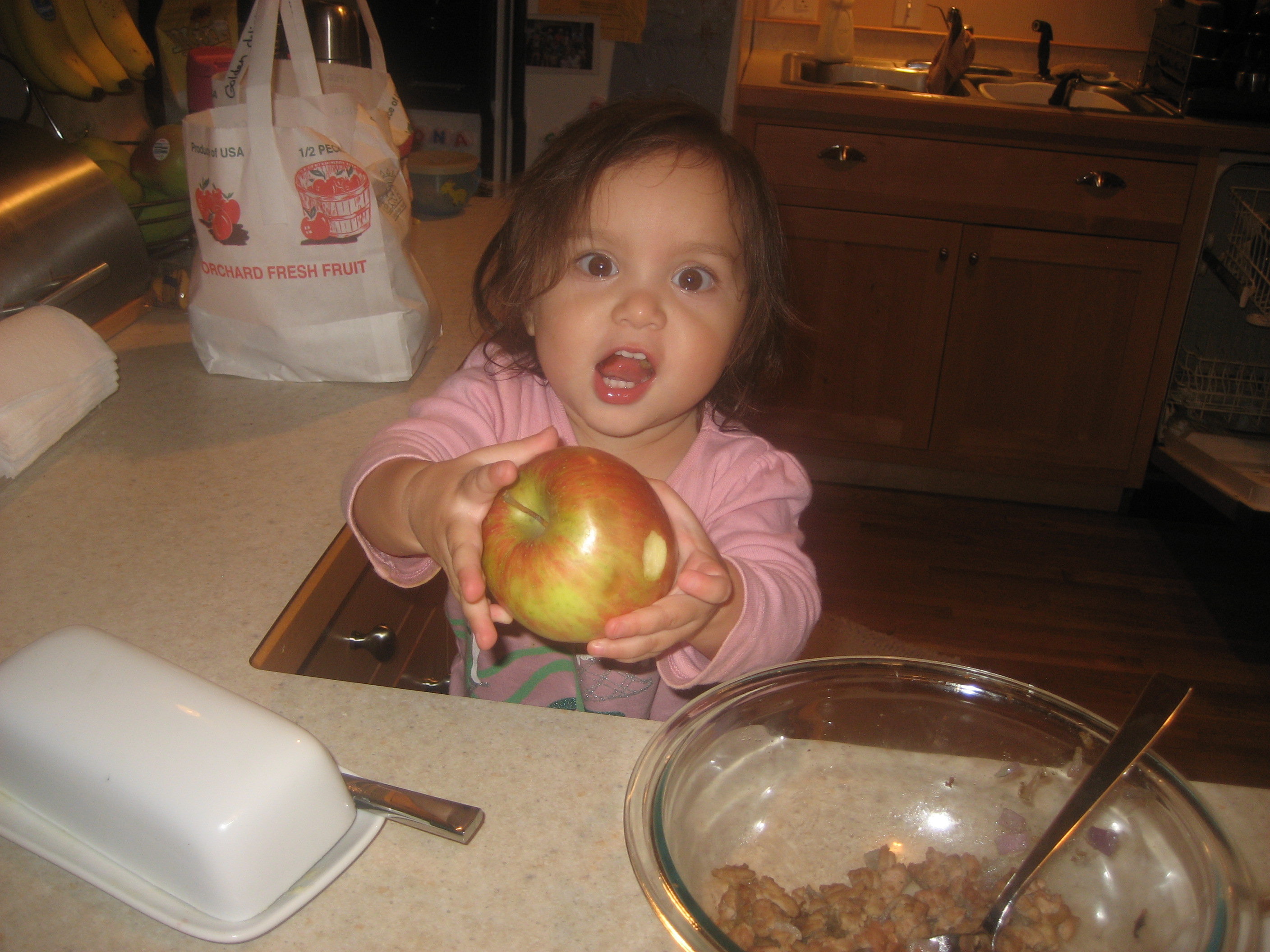
Georgia, helping herself to an apple.

3) Georgia never met a dog she didn’t LOVE. All of our girls love dogs, but Georgia takes it to extremes. She responds to dogs the same way she responds to the moon: “DOOOOG!!!” If the dog is within reach, she immediately wants to cuddle. “Cuddling,” for Georgia, includes putting each hand on the dog’s cheeks and kissing it square on the mouth. If Gracie, our own amazingly tolerant dog, is sleeping, Georgia will throw her entire body across Gracie’s. I think the only reason Gracie puts up with this is because Georgia’s other favorite activity is to “Give treats!”

Can't a dog get a minute's peace around here?
Can’t a dog get a minute’s peace around here?

So, there you have it: two fun Georgia facts, and one to grow on. We love this third daughter of ours like crazy. But we’re still holding out hope that Kiddo 4 will be “the laid-back one.”

Daddy's little helper.
Daddy’s little helper.

The Awful Truth

One (of MANY) Christmas card outtakes.

Something’s been bothering me lately. Looking back over the past month’s posts on this blog, here’s what I see: an essay about how I stay sane because all my children still nap; a Valentine’s day guest post in which my husband reveals his secret for recapturing married bliss; and a smattering of more spiritual, serious, almost advice-y pieces.

It all comes across as a little too good to be true.

Someone reading this blog over the past month might get the impression that I Have It All Together. That I Have It All Figured Out. That I sit here in my perfect little life in Vermont, enjoying my perfect marriage, dispensing advice while my perfect children nap.

This bothers me, because of course it’s NOT true. It bothers me because, once we get other people believing that we have it all together, 1) we damage our relationships with those people (Who’s going to be honest about the muck in their own lives with someone who’s perfect? Too embarrassing.), and 2) we run the risk of believing our own hype. I’ve lived long enough to know that once WE — by which I mean the average person — start believing that we have it all together, that we’re pretty dang okay, then we’re in BIIIIIG trouble. Life has a way of keeping us in check, keeping our egos in balance, smacking us down to size just when we think we’re at the top of our game.

And it bothers me because it’s completely NOT the point of this blog. Inasmuch as this blog has a point, it’s that somewhere around December 2011, I decided that I was bored with posting happy pictures about superficial events in our family’s life. So I slowly started experimenting with what would happen if I told the truth, if I wrote honestly about what I was thinking and feeling and experiencing at any given moment.

Therefore, in an effort to avoid coming across as Together and thus risking the wrath of the universe, I’m going to lay out some total honesty right now.

1. My Marriage is NOT Perfect. I deeply love and respect Erick, and I’m thankful every day that he’s my partner in this crazy life. We get along pretty well. But we’re real people with real, annoying quirks. As Erick was working on his Valentine’s Day blog post, he talked through some of his ideas with me. One night, he pulled out this line: “One of the biggest ways I show you ‘costly love’ is by listening to you at the end of the day.”

I almost fell off the couch laughing. Because, at that point, I had just spent at least 20 minutes listening to Erick talk about HIS day. He’d been home for three hours; had he asked once about my day? No, he had not.

Erick hit it out of the park this Valentine’s Day, which is usually a pretty minor holiday in our household. In addition to the blog post, he came home with flowers and candy, and surprised me by getting a sitter and taking me out to a nice dinner. All of which, he said, was “to build up credit for the next time I screw up your birthday.”

I’m hardly at my most romantic these days, either. I’m six months pregnant, and I  feel about twelve months pregnant. I’m trying to get through this pregnancy without buying any maternity clothes (I gave away all my old ones back in California, because, remember, we were done having children?), which means that I cycle through the same four outfits each week.  So, when Erick gets home, he finds a massive wife in the same old yoga pants and oversized sweater, who’s been chasing after three kids and a puppy all day long, and who’s prepared a meal based on the simplest thing that the kids might actually (maybe, just possibly) eat — which means crockpot, mac & cheese, or nachos.

It may be a comedy, but trust me, it ain’t a romantic one.

2. My Kids Are NOT Perfect. My kids are normal, average kids, which means that they’re people-in-training. I’m not going to list all of their individual issues — that’s just not fair to them — but let me assure you that they’re a long way from  being presentable to polite society, let alone perfect. About every fourth day, I’m flooded with love and awe and gratitude over these remarkable little creatures who’ve graced our lives. On the days in between, I mostly feel like jabbing an ice pick into my temple.

They squabble with each other all day long. The oldest two want meals made to order, and Georgia demands whatever she sees anybody else having — which sometimes means she wants four meals at once. They aren’t always nice to their friends. They often have to be asked ten times to do something. And, while they really are pretty good nappers, bedtime feels like psychological torture: an hour-long party of screams and thumps, punctuated by at least three call-backs per night. Also, these days, they want to listen to the Annie soundtrack around the clock.

3. I Am NOT Perfect. Want to know what I said to Erick this month? I said, “How many kids do I have to have before people stop asking me to do things?!?” How’s that for kindness and love and repentance and all the other nice things that I write about and try SO HARD to live out?

What I said was awful, with its implication that I really don’t care about others — that my motivation for having kids, in fact, is mostly to put a buffer between myself and the needs of the world — and it’s not even accurate. In many ways, my life now is simpler than it’s ever been: I’m not working outside the home, life in Vermont is slower and less stressful than anywhere else we’ve lived, and people aren’t really asking me to do much at all right now. (Even if they were, we live in a small town, so there are fewer people to do the asking).

What that comment really reveals is my own guilt. People aren’t asking me to do too much; I’m asking too much of myself, and then falling short. I do believe in living out love and kindness, but sometimes I get my motivations and self-expectations all mixed up. I start comparing myself to others, or I start feeling overwhelmed by the needs all around me, and I wonder why I don’t deliver as many meals to the ill or infirm as other people, why I accomplish so much less than mothers who work two jobs, why I don’t feel able to reciprocate the countless acts of kindness that others lavish on our family.

I am selfish, and lazy, and it’s hardest for me to love well the people who are closest to me — the people in my very family.

Remember how Erick surprised me with a babysitter and a dinner out on Valentine’s Day this year? Want to know my reaction when he came home from work and announced that we were going to a nice restaurant in 45 minutes? I thought: You mean I don’t get to have a relaxed pizza dinner with the girls, take a shower, and eat popcorn on the couch in my pajamas? I have to make myself presentable, when the only clean clothes I have are the yoga pants I’m wearing? I have to make this disastrous house and these messy kids presentable for a sitter? 

So, no, I Do Not Have It All Together. I am imperfect, a poor source to be dispensing any sort of advice. But in the course of a life spent dealing with my own imperfections and the imperfections of those around me, I have learned a couple things.

I’ve learned that when someone close to me — husband, child, family member, friend — asks me to do something reasonable that gives me a chance to show love, I should always say “Yes,” no matter how I really feel. So I try to always say “Yes” to a husband who wants to take me out, to a daughter who asks to be excused from nap to read together, to a friend who needs me to take her children. When I say “Yes” against my feelings, the feelings will eventually follow.

And I’ve learned that the only way to avoid guilt over my own imperfections and anger over the imperfections of others is to embrace grace. Grace — a word overused so that its meaning gets lost — means “unmerited favor.” I am a bad wife, a bad mother, a bad friend, a bad daughter, and most days I don’t deserve the love of those close to me. But they — husband, children, friends, family — somehow love me anyway. And when they don’t love me perfectly, the way I want — because they, too, are imperfect — that’s when I need to remember that I believe in a God who has the grace thing perfectly covered.

And that’s my Awful Truth.

When It’s Not Fair

Fish
Photo via

This past autumn was rough.

It began promisingly enough: my two oldest daughters started preschool, giving me three glorious days a week with only the baby; I was cranking away on my writing and had just landed a bi-weekly column in our local paper; and we’d decided to get a dog.

Click here to continue reading over at “On the Willows.”