Scanning the Skies and Picking Up Messes
IMG_6112

Life has been busy here.

Life is always busy, of course, but the past few months of our family’s existence have felt like a three-ring circus: preparing for our semester-long sabbatical in California, planning the renovations that will happen in our new house while we’re away, and readying our current house for sale (also while we’re away.)

Then, this week, our 4-year-old daughter caught pneumonia when the cough-and-congestion bug making its way through our entire family decided to park in her lungs.

She’s fine now — the worst part of the whole ordeal has been convincing her to take 9 mL of amoxicillin three times a day — but there were two days during which I was mostly housebound, save for a couple of trips to shuttle other daughters to their activities.

On the afternoon of the day her fever broke, my girl and I walked down to the end of the driveway to meet her sisters’ school bus.

“Look!” I said to her as we stood there, blinking in the strange sunlight, “Almost all of the leaves are off of the trees now. The branches are all bare. Winter’s really coming.”

This should not have surprised me. For one thing, we’ve enjoyed an autumn that an octogenarian friend informs me has encompassed one of the loveliest and longest foliage seasons in her memory; we are overdue for those leaves to hit the ground. And for another thing, earlier in the week I had spent upwards of an hour sweeping piles of dried leaves off of our deck.

But my nose had been so buried in my earthbound tasks that I hadn’t taken the time to scan the skies; I hadn’t noticed that the season was really and truly changing.

Something similar has been happening with my children.

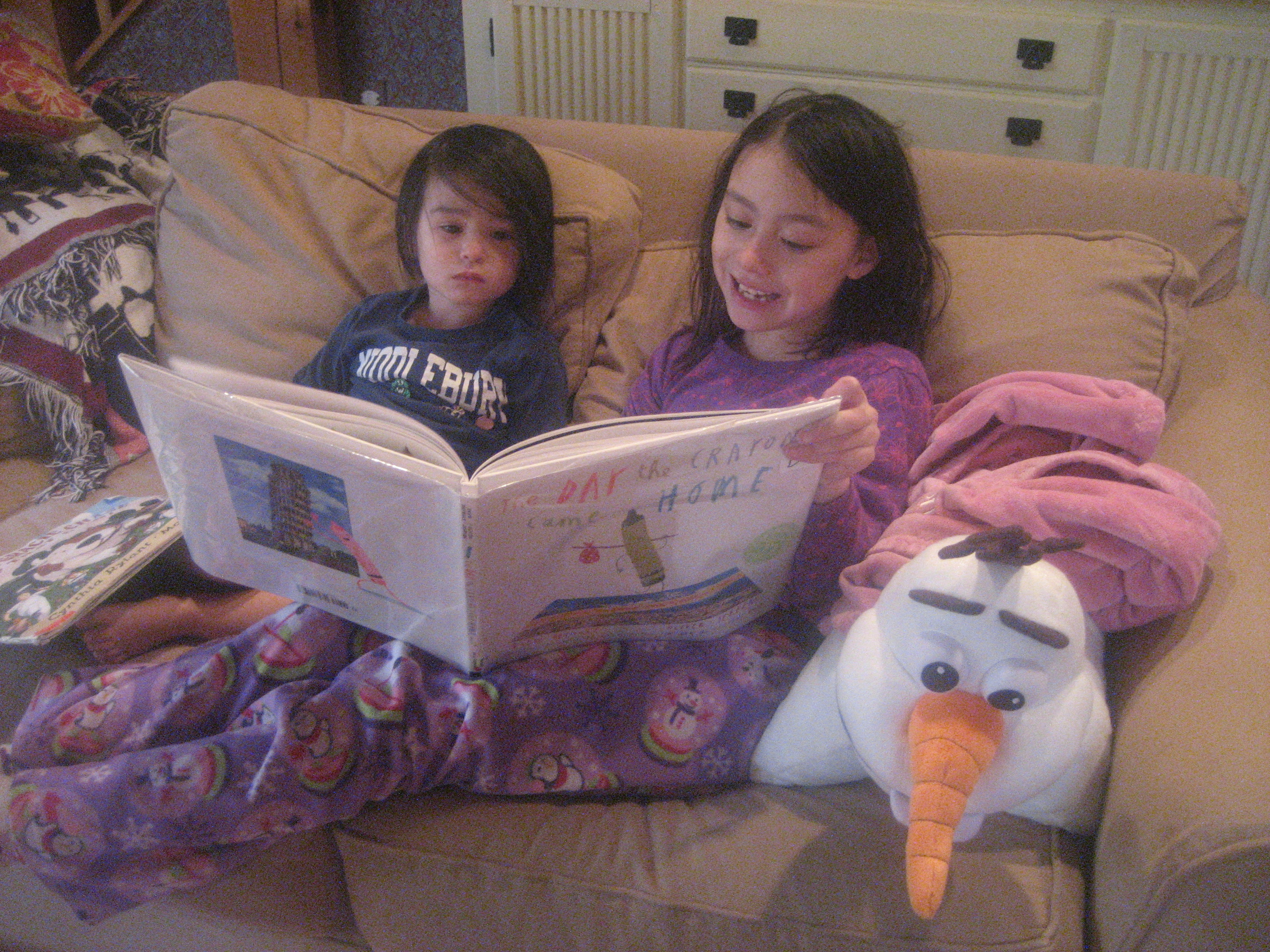
This past weekend I arrived home from a full morning out (shuttling a daughter to activities, meeting with a Middlebury College student) in order to prepare for company that afternoon, only to find that our house, by no means perfectly tidy when I’d left it, looked as if it had been torn apart by hooligans. Because it had, and the hooligans were three of my daughters.

My first response was to get angry with my husband, who’d gone outside to blow leaves off of the lawn (those leaves again!), leaving three young children — including our terrible 2-year-old — unattended in the house, and then neglected to have them pick up the resulting, inevitable mess.

Then I realized that, as valid as that anger may be, my husband was not solely responsible for the situation. The terrible 2-year-old has almost no impulse control, but my other children are old enough to know that they need to clean up after themselves.  Next week, my oldest daughter will celebrate her eighth birthday; that is more than old enough to take responsibility for household tasks.

My children were growing up, and I’d been missing it. The season was changing and I hadn’t noticed; I hadn’t scanned the skies.

So part of the fault for the situation in which I found myself, having to spend 45 minutes cleaning the house for our guests (not making it perfect, mind you, just making it somewhat welcoming) — part of that fault lay with me.

Children rarely take responsibility for themselves, for their possessions, for household tasks, unless they are given that responsibility. And I had clearly been lax in equipping my children with responsibility.

I had been lax because I had been dealing only with what was right under my nose: the logistics of a year involving three houses and three moves, shuttling daughters around to activities, trying to keep the 2-year-old from playing in raw sewage. Those are important things, but I’d neglected the big picture: I didn’t have a plan for my children growing up.

And more important than a plan — Because who really has a plan for parenting that doesn’t get chewed up and spit out by our offspring? — I hadn’t made time for my children growing up.

It takes time and effort to confer responsibility. It is so, so much easier to just keep buying velcro sneakers rather than to teach my children to tie their own laces. It’s much easier to pack their lunches myself rather than endure the mess of a 4-year-old attempting to make her own peanut-butter-and-jelly sandwich. And, I confess, it’s easier to pick up their messes myself rather than nagging them to pick up after themselves. It’s also quieter, because you skip all the screaming.

But the season is changing. If I sent my daughters outside in tank tops and flip flops in December, people would consider me an irresponsible parent. How much more so if I unleashed children upon the world who wouldn’t clean up after themselves?

So we sat the girls down, and we had a talk that went something like this:

“You know how we always try to be on time, because if we’re late we’re showing that we’re inconsiderate of other people’s time? Well, cleaning up is like that, too: If you don’t clean up after yourself, if you just leave your mess laying around, then you’re showing that you’re inconsiderate of other people’s time. Because if you don’t clean up your own mess, then somebody else has to — somebody who didn’t make it in the first place. Back when you were much younger, Daddy and I would clean up your messes because that was our job. But just like it’s not our job to change your diapers anymore, it’s not our job to clean up your messes anymore. 

“So from now on, when you take something out to play with, you need to put it away when you’re finished playing with it, and we shouldn’t have to remind you of that. If you want to come back to it later, put a little note on it that says ‘Save.’ Otherwise we’re going to assume it’s trash, and that’s where it will end up.”

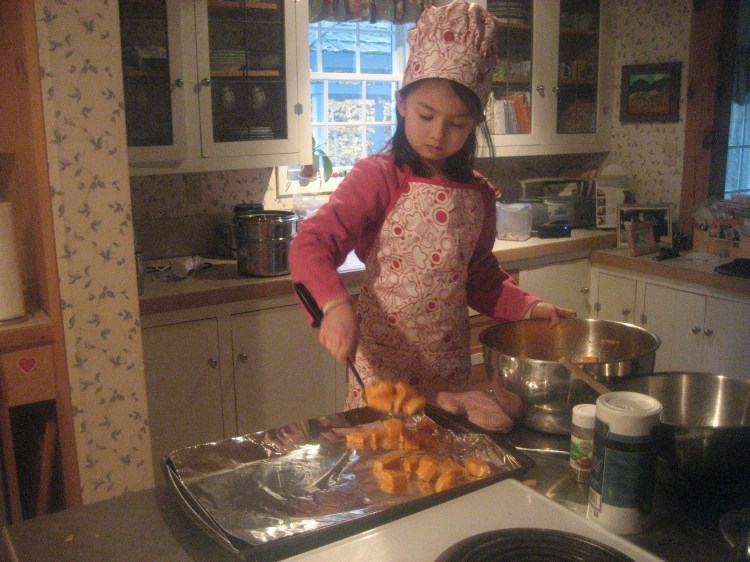
These course corrections in parenting can feel like turning a cruise ship around, but they’re well worth the effort. When I take the time to scan the skies, I find so many areas in which I can start training my girls in responsibilities commensurate with their growing maturity: they can cook, they can clean, they can help their younger sisters — they can even, with adult supervision, use knives and light fires in the wood stove.

And you know what? For the most part they relish taking on these responsibilities. They feel proud of themselves. So do I.

Oh! The Places We Didn’t Go!

IMG_6104

It was early August, and our family’s minivan was midway across the Connecticut River bridge between New Hampshire and Vermont, headed home from a visit to Rhode Island, when it hit me: Road trips with our children no longer felt like extended torture sessions! In fact, road trips with our children had become…enjoyable!

I’d like to think that this is because our children are gaining maturity and patience as they grow up, but I suspect it has more to do with the fact that all of our children are now big enough to see the portable DVD player.

After that trip, I made a list of day trips for our family to take on weekends throughout the fall. There are so many wonderful spots within a few hours’ drive of Addison County, and we’ve explored so few of them because, until now, the drawbacks of a car trip with four young children far outweighed any possible enjoyment.

Click here to read more about our [exciting fall travels?/failure to motivate?] in this week’s “Faith in Vermont” column in The Addison Independent. 

How School Does Not Solve All Problems

IMG_5696

At the start of every summer, I focus all my hope on the first day of school. When school begins again, I tell myself, everything will be okay. I can survive those long, hot days of summer vacation because the first day of school will arrive to usher in a new era of sanity. On that day, I will bid a fond farewell to my oldest children at 7:30 AM, and greet them as they thump down the bus steps at 3:20 PM, exhausted and full of knowledge. I picture myself leaving their school after that first morning drop-off like a Disney princess: birds singing sweetly around my head, deer approaching me shyly – maybe I’ll even attempt a twirl for good measure.

And every year I am shocked — shocked! – at how school fails to be the happy ending I’d expected.

Click here to continue reading this week’s “Faith in Vermont” column in The Addison Independent.

The Second Day


IMG_5974

The two oldest Gong Girls started 1st and 2nd grades today. We did it! Or, as Dora would say: Lo hicimos! We survived another summer vacation!

Of course, it’s not all that clean and simple. I have complicated thoughts about school starting. For instance, all day I have had to respond to the repeated query of my lonesome two-year-old: “Where sisters?”

As I was mingling with other liberated parents over coffee and muffins in the school gym this morning, I remembered this post from a few years back. All of the parents were swapping stories about that first drop-off: Some children had been fine after suffering from weeks of anxiety, some had had terrible mornings, some had raced into their classrooms without looking back.

This was my fifth first day of school, and our morning went quite well as it turned out. But I’ve learned never to trust the first day: It’s always, always the second day — and the month that follows — that requires true parenting elbow grease. 

For the record, most of this essay still rings true: The chickens are no longer with us (for now), and Campbell has graduated to saying “poop” instead of “poo,” but the rest stands. 

***

Fiona and Campbell started preschool at the end of August. For Fiona, this was a return to the same preschool, same classroom, and same teacher as last year. Her fellow students, however, were almost entirely new to her. (Because of Fiona’s November birthday, she was placed in the four-year-old class last year; because the cut-off date for kindergarten is September 1, Fiona and a few other classmates will spend another year in the four-year-old class, while most of their peers from last year move on to kindergarten).  For Campbell, starting out in the three-year-old class next door to Fiona, the whole experience was new.

Both of them were hugely excited for the first day of school — but not as excited as I was!

There’s a lot of build-up before the first day of school each year: anticipation, nervousness, new clothes and shoes and supplies. Even I felt a little nervous, although my main priority was just getting the kids out of the house. I hoped and prayed that Fiona would make friends and be happy with her new peer group. I hoped and prayed that Campbell would respect her teachers and be kind to the other students and avoid inappropriately using the word “poo-poo” — at least for the first day.

But, having done the first-day-of-school thing last year, I also knew this: It’s not the first day of school that’s the issue; it’s the SECOND day.

See, the first day, everything is fresh and exciting. There may be jitters, there may be wrenching goodbyes — but in my experience, adrenaline mostly carries everyone through. I’ve been the mom patting myself on the back after the first day of school, proudly relieved that my child had NO PROBLEM saying goodbye.

And then the second day hit.

By the second day, the kids have wised up. It’s not fresh and exciting anymore; instead, they can see past the new clothes and school supplies to the rules, expectations, and social minefield that they’re going to have to navigate EVERY SINGLE DAY. You mean I have to KEEP GOING?!? their eyes seem to say.

I was thinking about this as school began, and I realized that much of what makes life hard has to do with The Second Day. It’s not always literally the second 24-hour day, but it’s the state of mind we face when the newness has worn off. Think about it: You get married, and at first you’re swept along through the wedding and honeymoon, but pretty soon comes that Second Day, when you stare at your partner across the table and think, You mean I have to KEEP GOING?!?

Or, say, you have a baby, and you’re all jazzed up because you survived labor and now you have this cute little munchkin and you’re getting all sorts of attention and your house is stuffed with nifty new baby supplies…but then you come home from the hospital and have to face the Second Day, when nobody cares anymore that you have a new baby (except your parents — they’ll always care), and all your clothes are covered with bodily fluids and that munchkin is STILL waking up every two hours and you think, You mean I have to KEEP GOING?!?

OR maybe you do something really great in your profession/vocation/calling/art: you win an award, or obtain a degree, or invent something new, or create a painting/performance/book/film/play/blog post that people really like. Congratulations! You feel like your existence is finally validated…for about 24 hours. Because then comes that Second Day, when you have to sit at your desk or computer or easel again, and you think, You mean I have to KEEP GOING?!?

OR EVEN, let’s say you move to a small town in Vermont, and everything is new and wonderful. You love your new house, your new friends, the new landscape — your entire new lifestyle. But then the second year rolls around, and suddenly nothing’s quite so new anymore. You’ve seen all these seasons before, done just about everything there is to do at least once. And one dark and freezing winter morning, when you’re heading outside to feed those damn chickens AGAIN, you think, You mean I have to KEEP GOING?!?

Hey, it could definitely happen.

That Second Day is no joke. Based on the examples above, I’d venture that it’s the root cause of many cases of divorce, postpartum depression, and personal and professional burnout. I myself have experienced it plenty. In fact, I abandoned my first profession — teaching — because after four years I just couldn’t face a lifetime of Second Days in the classroom.

I have no tips for avoiding the Second Day phenomenon. It’s an inescapable part of life. Nothing stays new forever; if every day were a FIRST day, life would eventually become hyperactive and exhausting. All I have is this insight: the Second Day is difficult and depressing, but if you persevere through it, that’s when things start to take root and get really interesting. Marriage and parenting will always be HARD WORK — filled with multiple Second Days — but when I think back to my husband on our wedding day, or my kids when they were first born, I realize that I love them now with much more richness and complexity. I wouldn’t go back to that first day for anything.

I suppose the best way to handle Second Days is to anticipate them. I know now that I need to be just as prepared — if not more — to help my kids navigate that second day of school. I need to linger with a few extra hugs and kisses at the door, maybe even slip a little love note or special chocolate treat into their lunch bags. I need to offer encouragement that the most worthwhile thing in life — deep and genuine LOVE: for others, for what you do, for where you live — requires pushing past that Second Day. Perhaps we should all treat ourselves accordingly when we face life’s Second Days. Especially the extra chocolate treat.

So, now I’ve thought this through, and I feel more equipped to tackle those Second Days. But you know what?

I still have to get up tomorrow morning and feed those damn chickens.

Marriage, Thirteen Years Later

IMG_4089

July 20, 2002, 8 AM

I spent the night with my mother at The Colony Club on Park Avenue in New York City, where the wedding reception will take place.

I didn’t sleep much; I was too excited. Instead, I finished reading The Things They Carried, Tim O’Brien’s masterful novel about the Vietnam War: an odd reading choice for a bride-to-be, perhaps, but it definitely takes my mind off of the wedding.

Click here to continue reading my latest “Faith in Vermont” column in The Addison Independent.

The Moms Are All Right

IMG_5521


This column will be published immediately following the last day of Addison County’s 2014-15 school year.

But I’m not going to write about the complex bundle of emotions that summer vacation inspires in parents: the relief of no longer having to get up before dawn to pack lunches and sign reading logs, versus the dread of 71 long days filled with sibling squabbles, sunscreen and bug spray, and the logistical gymnastics of camps and classes and vacations.

I’m not going to write about that, because now I know that the moms are all right. I’m sure that the dads are all right, too, but I haven’t had coffee with them.

Click here to continue reading this week’s “Faith in Vermont” column in The Addison Independent. 

Take It Easy

IMG_5486

My daughter stepped off of the school bus the other day, handed me her heavy backpack, and – as is her custom – made her way slowly up towards our house by walking on top of the rock wall alongside the driveway. As she neared her destination she stopped, dropped into a squat, and called the rest of us – her sisters and me – over. She’d discovered two inchworms hanging from their invisible filaments over the edge of a large rock. For the next ten minutes, two of my daughters remained there, transfixed, watching the two inchworms “race” up and down their threads.

Yes, I am still taking a summer vacation from The Pickle Patch, but as promised, here is the link to this week’s “Faith in Vermont” column in The Addison Independent. 

Wake Me Up When September Starts


I just feel like nothing’s going right.

I said this to my husband, standing in our living room one recent Sunday evening.

The night before, I had said: I feel like I have nothing to look forward to for at least the next year.

The four weeks between mid-April and mid-May were hard; some of the hardest weeks I’ve ever lived. During those four weeks, a nasty stomach virus ripped through our family. By the time it had finished, all of our children had gotten it: two of our girls were struck twice, and one had three distinct bouts of vomiting. Multiple days of school were missed. I didn’t keep track of how many loads of laundry I did, although I did count 7 in one day; the total was well into the double digits. Even my husband succumbed, spending two days in bed and canceling his classes.

Somehow I was spared, which — if you’ve spent any amount of time caring for vomiting children and spouses — can feel like a mixed blessing. More than once I thought: If I got sick, at least I could spend a day in bed. 

But I was dealing with emotional struggles, instead.

Because during this same time, a house came on the market that I wanted. You can read more  details here; suffice it to say that I longed for this house. Against all reason — even against my better judgment — I really thought that this was our house.

My husband was less convinced, which launched us into one of those times when it feels like your marriage is a neglected closet that needs to be cleaned out: We had faith that the outcome would be good, but the work wasn’t going to be much fun. We weren’t fighting, exactly: We were pondering our family’s mission and vision and goals, and how to best live those things out. That might sound noble, but it felt mostly hard. We both spent the better part of two weeks feeling sad and confused.

And then, just when it looked like we might be gaining some clarity, the house sold. Not to us.

[Note: After I wrote this post, a second house on my “interest list” went on the market — and believe me, that this would happen in the current Vermont real estate climate is highly improbable. It was gorgeous, move-in ready, 12 acres with a barn; almost too nice. Also, it was waaaaaaay out of our price range. Another loss, which felt like a cruel joke.]

I dropped into an ugly pit of depression and self-pity: I had thought something, and I’d been wrong. I had wanted something, and I hadn’t gotten it. I had to be patient, but I didn’t feel any hope. And I still had vomiting children home from school.

This is not the first time I’ve found myself in the pit; nor, I’m sure, will it be the last. And as awful as I felt, I knew that I would claw my way out eventually.

What was different this time was my foreboding that, once I clawed my way out of the pit, I was going to have a climb a mountain. That mountain involved a summer at home with all of our children (We don’t do much by way of summer camps or vacations, so there’s a lot of unscheduled togetherness. It’s both lovely and crushingly exhausting.) Following the summer, we faced a year of change and logistical challenges, as we welcomed a young woman who’d be living with us for the year and also prepared to move our family to California for five months — where I would homeschool our children for the first time.

On top of this, I received news that a friend had been diagnosed with cancer — the fourth friend with this diagnosis in a year.

Finally — and least importantly, as it was neither uncommon nor unexpected — an essay I’d sent to a literary journal was rejected.

It was that whole snowball of a month that caused me to say: I just feel like nothing’s going right. I feel like I have nothing to look forward to for at least the next year.

I realized it was ridiculous as soon as I’d said it. There I was, standing in my large, cozy house with a belly full of dinner, complaining to my compassionate husband while our four (mostly) healthy children slept upstairs.

It was a sign that I needed to step back and give myself room to regain perspective. To rest. To recover my mental and emotional and physical and spiritual health.

“There’s nothing in life that you can’t get out of,” my mother used to say when I was growing up. She meant this as reassurance for an overanxious child, and she meant it in reference to things like boyfriends, college, jobs, and drug parties. At that time, she was right. But I’ve realized recently that her saying stops being true once one reaches a certain age: Now, there really are things that one can’t get out of — or rather, there are things which, in order to get out of them, would involve so much ugly collateral damage as to render that option horribly selfish. Things like children, marriage, a whole host of decisions and relationships. Just at the point when one’s bone density decreases, one’s life choices begin to harden and calcify.

But I can get out of blogging.

So I am going to take a break from blogging until sometime in September.

Blogging is a wonderful thing. It enables writers to share their work, build a readership, and receive comments in what can be an isolating and discouraging field. On the other hand, it can start feeling a little bit like a non-stop treadmill: There is self-imposed pressure to keep producing blog posts, there is the fear that one is spending too much time writing 900-word essays instead of focusing on bigger projects, and there is the unhealthy habit of looking for validation in one’s site visit statistics.

Blogging did not put me in the pit, but taking a break is one small step towards getting out of that pit.

I will continue writing for The Addison Independent (and posting those links.) I will also take the time to focus on some book-length projects.

I’m not arrogant enough to assume that my blogging break will be a big loss to anybody. Okay, then, you think, So WHY did you bother telling us all of this? Why not just say: “I’m taking a break from this blog for the summer?” We didn’t need to know about the vomiting kids and lost real estate.

I told you all this because, on several occasions over the past year, it has come to my attention that some people (who may not be paying much attention to this blog) perceive me as “having it all together.”

When someone tells me that, my heart sinks. I used to try so hard to make people think that I had it all together; now, I think that if I’m giving the impression of having it all together, then I am failing to do my human duty.

If I had it all together, I would have no stories left to tell. If I had it all together, I would have no ability to form meaningful relationships; relationships depend on being relate-able, which someone who wears the armor of perfection is not.

Recently, I read an old Asian proverb: “Man finish house, man die.” I think people are like that, too, not just houses. I hope that I am never finished in this lifetime — there’s too much work to do.

On the other hand, I don’t revel in my imperfection. I get the sense from some writers out there — various “mommy blogs” come to mind — that it’s become a point of pride to say “I finish a bottle of Scotch every day during nap time and never clean my house and send my kids to school without their shoes on.”

I’m not saying that. I try. Like most people. I try my best. I get out of bed early each morning, I ask God for help, I do my chores.

And every so often, I fall into a deep pit and have to claw my way out.

You might not know this if you met me in person. I’m a little shy, and I write better than I speak. (Whenever someone introduces themselves to me, saying that they’ve read and enjoyed my writing, I want to apologize because I’m probably a little bit disappointing in person; I can’t edit myself in real life.)

So I suppose that I’m writing all this as a kind of public service announcement, because it never hurts to be reminded that everybody is human. And it never hurts to be reminded that there are times when it is good, appropriate, necessary to take a break.

I wish you all a peaceful summer. See you in September!

Lust for Land

My desire for land started gradually, until suddenly it had gripped me like the unbearable compulsion some pregnant women feel to eat dirt. It was a primal urge. I felt it in my mouth, back near my molars. I felt it in my hands, which wanted to clutch.

To clarify: I never felt the need to eat dirt during my pregnancies. My strongest craving occurred during my third pregnancy: It was 9 o’clock at night, and I had to have walnut shrimp (an Americanized dish served at most Chinese restaurants: batter-fried shrimp and walnuts slathered in a creamy sweet sauce.)

“I would crawl over broken glass for walnut shrimp,” I moaned to my husband, who tracked down the only place where it could be obtained so late at night: the Panda Express at the Oakland Airport.

My craving for land was like that.

It began rationally enough, almost as an intellectual exercise. I was researching Vermont dairy farming for a book I’m working on, and I kept reading heartbreaking stories about the demise of small family farms: farmers who could no longer afford to keep farming, children who didn’t want to continue farming, land that was worth more to sell off or develop than to keep.

In the five years since our family moved to Vermont, I have come to love this place passionately. I want to raise my children here, and when they grow up I hope that some of them will choose to stay, because I certainly plan to grow old in Vermont. So the fact that part of what makes Vermont Vermont was at risk — small farms, undeveloped land, local agriculture — hit me right in the heart.

What could I do?

I’m married to an economist, so I’m somewhat of a realist when it comes to the ability of government programs or agricultural subsidies to effect change. But what I could do was some version of Voltaire’s exhortation at the end of Candide: “We must cultivate our own garden.” What I could do was to get a plot of land in Vermont, care for it, and not develop it.

Once I had this idea, it was difficult to shake. It also seemed do-able. Vermont is the second least populous state in the nation (after Wyoming); due to an abundance of supply and lack of demand, it is possible to buy a house with multiple acres of land in Vermont for a relatively reasonable price.

The more I thought about it, the better it seemed. Our current house is a perfectly lovely 25-year-old cape set on one wooded and rocky acre along a paved road in a neighborhood where the houses are close enough together that we can see four other homes from our windows (when the leaves are off of the trees.) After five years in Vermont, this seems suburban and wimpy.

I craved a hundred-year-old farmhouse down a dirt road on multiple open acres with outbuildings. Such a setting would allow me to garden without my spade hitting solid rock 1/2 inch into the ground. It would allow me to plant vegetables and fruit trees and flowers that need at least partial sunlight in order to thrive. It would allow my children to range freely, without my having to worry about cars on the paved road out front. It would allow us to try raising chickens for a second time. (Our first flock of hens was massacred by neighborhood dogs; I know that massacres are a rite of passage for chicken owners, but these dogs had broken easily into our coop because we couldn’t sink fence posts securely enough into the rocky ground.) It would allow for the future possibility of larger animals: a few sheep, a couple of pigs, perhaps even a horse one day if our daughters continue to love riding.

This would be a lot of work, but it would be my work. Writing is a stationary and solitary profession. The idea of caring for some livestock and land in between hours of sitting at my computer was appealing: I could be a female version of E.B. White or Wendell Berry. And yes, we have four children: four children who, in another year, will all be in school at least part of the week. Four children who could help with chores, fondly recall their childhood on the family farm, get married on the land where they were raised.

It made so much sense to me, on both an idealogical and a practical level.

Notice that all of the pronouns thus far have been in the first person singular. And I am no longer a first person singular: I am part of a marriage, a family of six. In order to make this dream a reality, I would have to convince my un-dreamy, un-handy, and un-willing-to-take-financial-risks husband — and, to a lesser degree, my children — that it was a good idea.

So I put some logical limits on my dream. My children are incredibly happy in our town school, and nobody wants my husband to have a longer commute, so this land would have to be located in our current town. It should have 3 or more acres, and preferably some usable outbuildings. Odds are that the house wouldn’t be a new construction, but it couldn’t be a dump, either. And, of course, there were financial limits.

I kept my eyes open as I shuttled our children around town, and narrowed my focus to three or four properties that would be appealing if they ever went on the market. I settled down to wait; we weren’t going anywhere, so I was in a great position to be patient and watchful.

Then one of those properties went on the market.

It was an 1890’s farmhouse with 5 outbuildings, set on 16 gorgeous acres of mostly-cleared land with stunning views of the Green Mountains. It was actually closer to town — to the schools, my husband’s office, and my parents’ house — than our current home.

Of course, the timing was terrible: Our entire family is relocating to California for the first five months of 2016 for my husband’s sabbatical.

Also, it was outside our price range.

I went to look at it anyway, first with my parents and all my children in tow, then with my husband. The house needed a complete interior lead paint abatement and re-painting, a new perimeter drain, possible asbestos tile removal, and there were five rooms that appeared to have gone untouched — used only for storage — for 40-some years.  Still, the potential was there if we were willing to work towards it; I could see the beautiful house it would become over time.

So I held onto hope, because that’s what you do when you have a dream, right? I held onto hope for 25 days, up until that house sold. And then I mourned it hard.

It has occurred to me that this desire for land is my version of a midlife crisis; that, at almost 40 years of age, I’m hoping to rediscover my purpose and youth in a plot of land rather than a sports car or a tattoo or an affair. And it occurs to me that there are two ways of responding to a midlife crisis: either you come around to peacefully accepting that all the paths that once seemed open to you have narrowed down to the path that you’re on — or else you get bitter. Maybe I need to accept that my life — our life — is not going to end on a multi-acre small-scale farm. As I’m constantly reminding my daughters (and quoting Mick Jagger): “You can’t always get what you want.”

But maybe, maybe, this isn’t so much a midlife crisis as it is a natural desire: the desire to find a little corner of creation and sink roots down deep, to have the ability to raise your own food, to preserve some of the world’s beauty and pass it on to your children.

My husband and I had dinner with a couple who’ve lived in Vermont far longer than us, who have first-hand experience with farming. We discussed my dream of land. “Feel free to talk me out of it,” I quipped.

They didn’t. “There’s nothing wrong with wanting to own a piece of Vermont,” said the husband. “Go down the rabbit hole.”

His wife’s response was more serious. “This is what we were made for,” she said. “We were created to be stewards of the land. And if that’s what God is prompting you to do, then maybe you should listen to it.”

Maybe I should; maybe I will. In the meantime, there’s a book of Wendell Berry essays beside my bed, a brand-new membership card to our local food co-op (finally!) in my wallet, and our weekly CSA starts up next month. I guess that’ll do.


American Girl Dolls and the Decline of Civilization

IMG_5419

Grandparents get to do whatever they want — that’s my philosophy.

It wasn’t always; like most first-time parents, I tended to be overly controlling when it came to toys, food, and naps. But my children are blessed with four grandparents who love them and respect reasonable boundaries, and I realized that, after the arduous task of raising my husband and me, these grandparents are entitled to spoil their grandchildren. So these days, my default response to grandparent inquiries is: “Sure!”

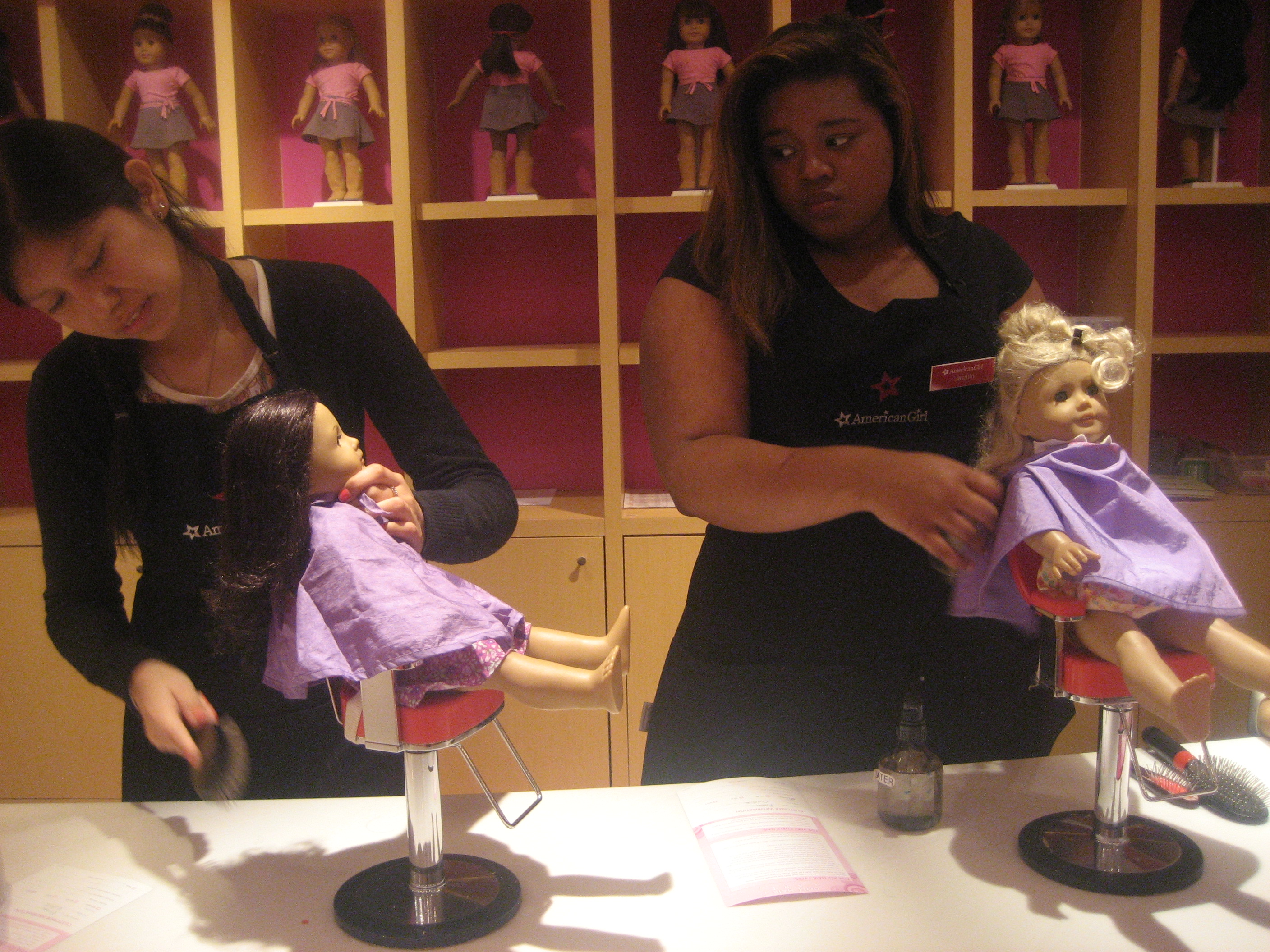
And that’s how we wound up getting my daughters’ dolls’ hair styled at the American Girl store in Tysons Corner, Virginia. (“You’re doing what?” my husband asked, incredulous, before we left. “Grandparents get to do whatever they want,” I shrugged.)

Click here to continue reading this week’s “Faith in Vermont (travel edition)” column in The Addison Independent.