The Cow on the Wall

img_8666

The cow was hanging on the wall, opposite the checkout counter at the Sweet Charity resale shop in Vergennes, and I fell in love with it immediately.

That I was in Sweet Charity, without children, on a Saturday afternoon, was due to a series of anomalous events. My husband was in Chicago for work, so a generous friend had taken pity on me and invited all four of my children over to her house to play for a couple of hours.

Faced with two precious hours of free time after two days of single parenting, I did what any woman would do: I went shopping for home furnishings with my mother, of course.

Click here to continue reading my latest “Faith in Vermont” column in The Addison Independent. 

Three (Very Humble) Suggestions for Behaving Ourselves

My mistake was logging on to Facebook.

It was a bit of a rough weekend, wasn’t it? This weekend that began with Donald Trump’s inauguration as the 45th President of the United States on Friday, continued through the Women’s Marches around the world on Saturday, and whimpered to a close on Sunday. And from what I observed, it was rough regardless of whom you voted for in the November election.

I am not a Trump supporter, for reasons that transcend ideological differences (outlined here), so on Friday I was filled with a deep sadness. But by Saturday afternoon, when I logged on to Facebook and saw so many loving, empowered dispatches from friends and family who were participating peacefully in Women’s Marches across multiples states, I felt hopeful, maybe even a little joyful.

Then, the comments started up on social media. The comments came from liberal and conservative alike; those opposed to Trump, and those in favor. For a good 24 hours, Facebook was filled with discord and critique. The hundreds of thousands who took part in Women’s Marches might have been peaceful, but the couple hundred protestors who damaged property and scuffled with police in Washington, D.C. the day before were “animals.” Or maybe the Women’s Marches were too peaceful, because they were mostly attended by white women who are seldom targeted by police. While the Trump administration quibbled with the media over attendance estimates for the inauguration, my fellow citizens nitpicked the numbers on social media. Also: Some of the signs at the Women’s Marches were vulgar (mostly because they quoted our new President, but still, keep it classy ladies!) Even children weren’t immune: I saw statements ridiculing the youngest Trump child, statements raking the ridiculers over the coals (“monsters”), and all “liberals” branded incompetent parents based on one child who apparently set a fire on the sidewalk outside of a Trump hotel. All this between people who label themselves “friends.”

And a confession: Even I wasn’t immune. Although it’s long been my policy to refrain from making any political comments on Facebook, I broke with myself and responded to a relative who’d been spewing a steady stream of social media vitriol. While I don’t regret my comments, which I attempted to keep respectful, logical, and brief, I still felt icky after the fact: I had fed the beast.

Sunday night, I lay shaking in bed. My body had been in fight-or-flight mode, cortisol pumping through my system for the entire day. My heart and head both ached and my breathing was shallow; I felt like dark clouds were gathering over our little house. Trump’s election had shaken my faith in our country and our government; the past 24 hours of Facebook comments had shaken my faith in humanity.

So here are three small suggestions that I am making to myself for how to behave well in a politically charged climate. I write them here to keep myself honest; if they help anybody else out there, so much the better.

In the coming days, I plan to breathe deeply and:

1. Avoid passing judgement on other humans.

On inauguration morning, I woke up early to read my Bible, and my passage for the day began with Romans 2:1 (here in The Message translation): “Those people are on a dark spiral downward. But if you think that leaves you on the high ground where you can point your finger at others, think again. Every time you criticize someone, you condemn yourself. It takes one to know one. Judgmental criticism of others is a well-known way of escaping detection in your own crimes and misdemeanors. But God isn’t so easily diverted. He sees right through all such smoke screens and holds you to what you’ve done.”

Uh, okay God.

Let me be absolutely clear: The verse does not mean that we should all become doormats or moral relativists. It is not saying that there’s no such thing as right or wrong. It’s not even saying that we shouldn’t speak out against injustice, corruption, oppression, or other immoral or hateful acts.

It’s just saying that we have no right to condemn other people. We are not in the judgment seat for humanity. It is not for us to assign people to heaven or hell. Because, frankly, turn the spotlight around and we are all a mess (And boy, was that apparent on Facebook this weekend, myself most absolutely included.)

This may be related to my personal religious beliefs, but I think it’s also just good human practice: The more we get wrapped up in critiquing the deeds of others, we ourselves become hardened little nuggets of bitterness and anger.

The lovely flip side of this is that there is no person who is not redeemable. No matter what foul things a person has said or done in their lifetime, as long as they are still breathing there is the opportunity for them to change for the better. In other words: We are all deserving of grace.

This was beautifully illustrated by my child’s preschool teacher on Monday morning. During circle time, she showed the 3- and 4-year-olds the preschool’s handmade “Book of Peacemakers,” which included Dr. Martin Luther King, Jr., John Lewis, Bernie Sanders (this is Vermont!), and all of the preschoolers themselves.

“Donald Trump’s not in that book!” commented one little boy.

“No, he’s not,” said the teacher calmly, without missing a beat. “He’s not, because he just became President and we don’t know how he’ll be a peacemaker yet. But when you see him doing some peacemaking, you let me know and we’ll add him to the book.”

As difficult as it may be for me to swallow the fact that he will be the leader of my children’s country for the next four years, Donald Trump is my fellow human. No matter how deeply I abhor his words or actions, he is redeemable and worthy of grace. It is not up to me to condemn him.

Also: No human being should ever be referred to as an “animal” or “monster.”

Finally: Leave the children alone.

2. Take a long, honest look at what our country actually is and has been.

Many of the emotional comments on social media this weekend could have benefited from a remedial civics lesson.

For instance, I am no fan of vulgarity. Not in my home, not outside my home, and not as a means of making a point. But our country has a very special governing document called the Constitution, and according to this Constitution, we all have the right to free speech. We have the right to put whatever words we want on a sign and march with it as a means of protest. Our right to expound upon our personal religious and political views is a massive freedom that is not available to many throughout the world; whether or not we happen to approve of someone else’s choice of words seems a rather minor concern. (I do, however, draw the line at someone running for public office who brags about having acted on his offensive words.)

I am also no fan of violent protests or property damage; I’ll pick Gandhi or Martin Luther King, Jr.’s peaceful protests every time. But the curious thing about our country is that it was actually birthed out of violent protests and property damage. The early colonists rioted and burned paper products that were being taxed under the British Stamp Act in bonfires in the middle of the street. They dumped tons of tea into Boston Harbor, which probably would’ve gotten some scathing comments if the Brits had Facebook back then. They targeted Tory sympathizers and rode them on rails through town. And then they fought a war, featuring actual weapons and death. (I bet they used some choice language, too.)

We gloss over these facts, although they’re in every American history book; we teach them to our children like they’re quaint historical points of pride. We Americans just wouldn’t stand for the tyranny! And then we call people who use similar forms fo protest today “animals.”

I am not advocating violence; I am simply reminding us that there have been times in our country’s past when we felt that violence and property destruction were legitimate ways to be heard. If people are protesting similarly today, perhaps we need to listen more closely.

Finally, a wise friend reminded me yesterday afternoon that the very things that make the character of Donald Trump so repugnant to many — his greed, his unfettered speech, his objectification of women, his self-aggrandizement — are, in fact, the very things that American culture has come to represent. As a country in general, we consume like gluttons, we worship sex and beauty, we post unfettered comments on social media, we think only about our own comfort. Perhaps, my friend suggested, we have elected exactly the President we deserve. Perhaps Donald Trump is our mirror, our Picture of Dorian Gray.

3. Take a rest from social media.

When I go fiery, my husband goes calm. So, after my weekend in the social media maelstrom, he kindly reminded me that Facebook is a company, interested in making money. In order to do this, the Facebook folks want people to stay on Facebook as much as possible. In order to do this, they’ve developed a clever little system of likes an dislikes.

Here’s how it works: We post a little nugget of our identity on Facebook. People like it! So we feel great, and we keep coming back for more. Or people don’t like it. So we feel angry and inflamed, and we keep coming back for more. We’re like those rats in neuroscience experiments who keep pushing buttons for food until they die — except that instead of buttons, we post comments.

Facebook is great for posting photos, personal updates, and for sharing information. Got a good recipe or a thought-provoking article? I’d love to see it!

But Facebook is a terrible place to air political opinions. Our “friendships” on Facebook are pale substitutes for actual, in-person relationships. The Facebook “community” is an anemic substitute for real community. Engaging in heated political debate in this forum changes nobody’s mind, and it only encourages more emotion and division. True understanding and change happen best when we sit with people in the flesh and look them in the eyes; when we listen to each other, not when we post comments at each other.

I put a 30-minute-per-day limit on my Facebook access after this weekend, and I may go further. It felt like social media was draining my time and energy, which are needed for far better things these days.

The Revolution will not happen on Facebook.


The Day After

I am not marching today, the day after Donald J. Trump’s inauguration as 45th President of the United States. I feel far more conflicted about this than I expected. Today, my fellow women in all 50 states and on all 7 continents (yes, even Antarctica!) are marching in opposition to Trump’s stances on various issues. Among these women are dozens whom I’m privileged to call friends. My hearts are with them.

Marching — an action I’m not naturally quick to jump on — proved to be too logistically complicated on this particular weekend. Instead, I am protesting by writing. My two oldest daughters are protesting by going to see Hidden Figures (a film about three female African-American mathematicians who worked behind the scenes of NASA’s early space missions) with our Victoria. My two youngest daughters are protesting by assembling furniture with my husband. This morning, we all protested by driving up the mountain for some cross-country skiing.

Barack Obama began his first term in office when my firstborn was one year old. She rode on her father’s shoulders as we joined a jubilant crowd to watch the inauguration on a big screen in U.C. Berkeley’s Sproul Plaza. We felt so fortunate that our children would be born into this historic era of hope and promise.

The hope and promise of that day eight years ago didn’t last, of course. And here we are.

I have now lived through 11 Presidential inaugurations. But never in my life have I felt the type of crushing sadness that I felt yesterday.

In trying to figure out exactly why I felt the way I did — why this inauguration felt so different from all others to me and many of my friends — here is what I came up with:

For me, this is not, first and foremost, about political parties, or even policies. I’ve seen Presidents from both parties come and go. Some have espoused views and policies that I agreed with, and some have not. There have been times in the past when I’ve been disappointed — distressed, even — over the person taking office. But I’ve always had faith in democracy and the political process. I’ve been able to take the view that “You win some, you lose some.” And while we’ve had some very flawed leaders on both sides of the aisle, for the most part I’ve had confidence that our government was trying to be on the right side of history, to do what would best promote freedom and justice in the United States and the world, even when those efforts proved sloppy or misguided.

No, my sorrow yesterday was not sour grapes; it was not whining because my side lost.

Nor were my feelings, at root, targeted anger towards Trump’s policies. Yes, he made campaign promises that, if he’s able to deliver on them, are incredibly alarming; policies that, if implemented, I believe will harm people I love, their children, and our nation as a whole. If some of these things come to pass, then you likely will see me marching. But the fact is that, as of yesterday, Trump hadn’t been in office. He’d made some troubling promises and nominated some troubling people, but he hadn’t really done anything yet. So I cling to a small strand of hope that what’s said on the campaign trail and what’s actually possible to accomplish are two very different things. I’m willing to wait and see what unfolds, instead of wasting my energy on “what-ifs.”

When I questioned my own sadness, I remembered a discussion that I’d had with my eldest daughter right after the November election.

She’d started saying, repeatedly, that she was “scared about the wall.” She meant, of course, Trump’s promise that he would build a wall along our country’s southern border with Mexico — and make Mexico pay for it.

Just where my daughter heard about “the wall,” I’m not sure. Certainly not from my husband or me: My daughters are so prone to fear and drama that I try to shield them from the darker facts of life, for better or worse. And honestly, for much of the election cycle my husband and I (foolishly) thought that a Trump Presidency was a logical impossibility, so we didn’t bother discussing anything he said in front of the children.

But wherever she heard about it, the fact remained that my daughter was scared about this idea of a wall. Finally, I asked her why: Just what was it that she was afraid of?

“I guess because it means that we’re just not that nice,” she said.

And that right there — my daughter giving voice to her realization that this election revealed that “we’re just not that nice” — that is why my heart broke a little yesterday.

We have just installed as the highest leader in our land a man whose entire career has been built unabashedly upon greed, self-promotion, and the objectification of women. A man who tweets out knee-jerk, angry, demeaning, juvenile insults at anybody who questions him. A man who has used the most offensive language possible to talk about women — and bragged about acting on that language. A man who, throughout his campaign and even in his inaugural address, has fed off of anger and fear — which, as any young Star Wars fan can tell you, basically means that you’re going over to the Dark Side.

There is a darkness around our new President. I cannot trust him to be responsible with his words or his actions, and thus I would not trust him — our country’s leader — in a room with my children. (And note that I’ve not even touched upon the possible dark deals with Russia and issues of business ethics.)

Have we had morally questionable leaders in the past? Absolutely. But in the past, they’ve always tried to hide their misdeeds behind polite rhetoric. And, when discovered, they usually apologized and paid the price in terms of loss of public confidence and votes. What’s different about this situation is that we knew all of these things about Trump before the election, and we elected him anyway.

I recognize that there may be value in ripping the band-aid off of the polite rhetoric that we’ve come to expect from our politicians. I recognize that the anger and fear that Trump tapped into have been simmering for a long time among certain citizens of this country, and that the needs of these citizens deserve to be heard and addressed. And yet, it feels as if we’ve sold our souls in a misguided attempt to save our country.

“We’re just not that nice,” my daughter said. “Nice” can be an insipid term, difficult to define. But when I think of my country, I think of a place that’s always tried (in halting, imperfect fashion) to enfranchise as many people as possible, to welcome refugees, and to fight for justice worldwide. “America First” may appeal to our patriotism, but it’s essentially a defensive posture, a circling of the wagons that leaves a lot of people out in the cold.

This is probably idealistic; the reality may well be that the United States isn’t “nice,” and hasn’t been for a long time. What breaks my heart, though, is that now my daughters know it.

Like any mother, I try to shield my daughters from the darkness. I attempt to preserve their innocence for as long as possible. I teach them that love wins, and that bullies and cheaters lose in the end: I teach them to be “nice.” So yesterday I mourned that, in order to continue to instill these ideals in my daughters, I now have to shield them from their President.

For the past two days, my eldest daughter has worn her Star Wars “Resistance” pin, which she promises she’ll wear daily for the next four years. We discussed what “resistance” really means, for our family. The answer, of course, is that to resist the slide into being “not that nice,” we will have to be nice.

So we resist by hugging loved ones, by having friends over to play, by going to church, by playing “Ode to Joy” on the piano, by finally getting our compost bin built. We resist by sharing meals, volunteering, donating what we have, reading March and listening to Hamilton. By promoting what is loving and beautiful and true. Until grander actions become clear, this is how we resist: Small things with great love.

Teaching Our Children About History

img_8637

One afternoon earlier this month, my daughters and I gathered around our kitchen island for a snack. I began asking my eldest daughter about a book she was reading. After a few one-syllable responses, she was tired of my questioning. Looking me right in the eyes, she said:

“’Every man his own priest,’ Mommy.”

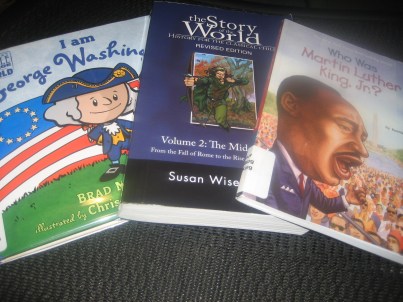
She was quoting the followers of Martin Luther (“The original, not King, Jr.,” as my daughters are fond of saying.) During the Protestant Reformation in 16th century Europe, Martin Luther started a movement that changed many of the practices of the Catholic Church and put the Christian faith more firmly in the hands of the people. “Every man his own priest,” was the rallying cry of those who advocated translating the Bible and making copies more widely available, so that people could read and interpret it for themselves.

In other words, my daughter was using a cheeky historical reference to tell me: “If you’re so interested in what I’m reading, read it yourself!”

One year ago I started homeschooling my two oldest daughters, who are now in 2nd and 3rd grades. As much as I’ve taught them over this year, they’ve taught me more. One of the most valuable lessons I’ve learned is just how much children love history.

Click here to continue reading this week’s latest “Faith in Vermont” column in The Addison Independent.

The Stars At Night

by Campbell Gong

Drawing by Campbell Gong

The other night, I took the dog for a walk down our driveway.

The job of walking our dog after dinner usually falls to my husband; on these frigid winter nights, he dons hat and gloves, ski goggles and earmuffs, snow pants and winter parka, before disappearing into the snowy, blow-y dark. “Hope you make it to base camp!” I’ve been known to holler (unhelpfully) into the mudroom after him, while our daughters collapse in a pile of giggles.

Those daughters are the primary reason why my husband is the designated evening dog-walker: I’m usually occupied by dinner dishes, bedtime stories, and tuck-ins.

But on this particular night, a few days before Christmas, I needed the fresh air and the quiet. My vision was getting fuzzy from all the gift-wrapping, baking, and holiday logistics. Besides, I had a few last-minute Christmas cards to put in the mailbox.

So, after donning my warmest gear (minus the ski goggles and earmuffs), I set out down the driveway with Gracie, our clinically anxious labradoodle.

Let me set the scene, for those who have a more suburban vision of the word “driveway:” Our driveway is a ¼ mile-long, dirt-and-gravel road. We share its initial length with a neighboring house; about halfway down, the driveway branches in two, with one section leading left towards our neighbors’ house, and the other section winding to its conclusion at our front door. The driveway is unlit, as is the main road where it ends. At night, the only light comes from the single bulb outside our front door, and a handful of lights from neighboring houses – the neighbors with whom we share our driveway, the farm beyond the trees, and one or two homes across the main road.

All this to say: At night, the walk down our driveway is dark – very dark. The journey may take upwards of ten minutes round-trip, because ice and snow on the gravel drive make it necessary to step carefully. Ten minutes in single-digit temperatures can feel like a long time.

The night I walked our dog was cold and dark. It was also a clear night, so when I looked up about halfway through my walk, I gasped aloud.

We don’t see the stars much these days, do we?

Click here to continue reading this week’s “Faith in Vermont” column in The Addison Independent. 

A Brief Meditation on Failing Christmas (Again!)

Every year, I make a concerted, intentional effort to keep Christmas low-key. I buy only four gifts per child (something you want, something you need, something to wear, something to read.) I try to keep our schedule reasonable and open. I attempt to keep expectations — my own and my family’s — low. I wrestle to emphasize the quiet, reflective practice of Advent, and de-emphasizse the unwrapping frenzy of Christmas morning. I would not touch an elf on a shelf with a ten-foot pole.

So, here we are on Christmas Eve. The boxes are checked: Tree and decorations up. Presents bought and wrapped. Advent candles lit and calendar doors opened. Goodies baked. Christmas cards with smiling photograph of family addressed and sent. My children will likely be dressed, with hair (mostly) brushed, when we attend tonight’s Christmas Eve service. There is even, as I write this, a perfect snow falling over the fields.

It would look to any outside observer like I’ve nailed another Christmas. But I know better: I’ve failed. Again.

I’m not referring to minor logistical slip-ups (I forgot stocking-stuffers for the grandparents, we didn’t make it to the train display before Christmas.) I’m not even referring to more noble goals (We could’ve done more for the needy in our community.) I’m referring to my heart.

Every year, I expect to reach Chrismas Eve filled with a sense of inner peace, of quiet joy, of spiritual renaissance. I expect to feel the way that every nativity scene Mary looks: Serene. Holy. Full of love.

Instead, I feel unsettled. Stressed. Frustrated with myself and others. Exhausted. All the Advent devotionals in the world can’t made me feel more holy. If you were to look inside, I would appear more Lady MacBeth than Mary.

One thing is different this year, though: This year, it hit me that it’s okay to approach Christmas feeling broken. Not only is it okay, it’s kind of the point of Christmas. Christmas is, after all, about a light shining in the darkness. And me? I’m part of that darkness.

It’s a good thing to try and downsize Christmas, to deemphasize consumption and packed schedules and all of the other perfect trappings that we expect from ourselves. But it’s important to recognize that we can’t, by ourselves, live up to the ideal of a peaceful, holy, “Silent Night” kind of Christmas, any more than we can expect piles of gifts and mounds of food to fill up our emptiness.

We are the darkness. And if we’re trying too hard to be the light, then we’re not letting the real light — the real point of Christmas — shine as brightly as He should. We’re the moon, not the sun. And the moon by itself is just a dark lump of rock.

Put another way: The baby Jesus was laid in the straw of a feeding trough in a dark cave-stable, and that was good enough for Him.

When I remind myself of this, then I can relax into my unsettled, imperfect Christmas. I hope that you can, too. Maybe this will be the year when we rejoice at having failed Christmas, again.

A Thank-You to Snow (with correct link!)

img_8515

Sorry — this post went out to many of you prematurely yesterday, without an active link. Here it is, with a link to the full article. 

For the past several months, I’ve sensed a heaviness in my writing, an unbroken seriousness that leaves me with the uncomfortable feeling that it’s time to crack a joke.

My recent columns have reflected what I believe to be the prevailing mood of late. The news, both national and international, has been mostly bad – at least for those who did not vote for Donald Trump at home, or who are distressed by humanitarian disasters abroad. Closer to home, family members have been ill, friends have lost parents, appliances have needed repair, and the pace of life has afforded little time for rest or reflection.

The time will come when this column will again regale you with lighthearted stories about how our daughter introduced herself to a stranger by saying “Prepare to meet your doom!” (“I said it in a welcoming way!” she protested later.) Or about how our dog escaped and ran over to the neighbors’ Christmas tree farm to harass their horses – at the exact moment a charter bus full of camera-toting tourists pulled into their driveway. Or about how the very loud smoke detectors that my super-safe husband placed all over our house, keep malfunctioning at late hours.

But this will not be that column; today I’m going to write about snow.

Click here to continue reading this week’s “Faith in Vermont” column in The Addison Independent.

Lessons from a Lightsaber

img_7293

The cultural world of our daughters – our two oldest daughters, in particular – currently revolves around the Star Wars saga. They have watched four of the seven films created by George Lucas: a multi-generational epic of the Skywalker family’s adventures on the dark and light sides of the Force, “a long time ago, in a galaxy far, far away.” They have read every book about Star Wars that they can get ahold of, including a biography of Lucas himself. They are so well versed in Star Wars trivia that they know the backstory of every minor character, can sketch out the Star Wars galaxy from memory, and measure time in terms of B.B.Y. (Before the Battle of Yavin) and A.B.Y. (After the Battle of Yavin.)

Last month, one of our daughters celebrated a birthday (Star Wars-themed, of course.) Her aunt and uncle gave her an online gift certificate for Amazon.com. It was hardly a surprise when she decided to use that gift to buy herself a lightsaber: the weapon of choice for both Jedi and Sith.

She spent a great deal of time perusing the lightsaber options. “I want to make sure that it’s not junky,” she explained. She counted the days until it was delivered to our doorstep. When the chosen lightsaber arrived, it was all that she had wanted: an extendable blade, complete with lights and sound effects.

Several minutes later, I was preparing to break down the lightsaber box for recycling when this same daughter approached me with a melancholy expression.

“What’s wrong?” I asked.

“I don’t know,” she sighed. “I guess the lightsaber’s just not as exciting as I expected.”

Click here to continue reading this week’s “Faith in Vermont” column in The Addison Independent.

Let’s Act Like the Kids Are Watching

On the morning after the 2016 Presidential election, I took my daughter to preschool. This preschool – a magical place that looks and feels like a throwback to 1970s Vermont – has a daily morning “circle time,” during which parents and children sit around the carpet to hear a story, sing songs, and greet each other. As I looked around the circle that morning, the contrast between parents and children was dramatic. The adults were haggard; nearly everyone appeared exhausted from staying up late watching the election returns. And although I can’t pretend to know how everyone had voted the day before, most of the adult faces around that circle bore glazed looks of shock.

Then there were the children: These three-, four-, and five-year-olds did not look exhausted, shocked, or anything other than excited and ready to begin the morning’s activities. If their world had changed overnight, they seemed unconcerned. They were busy just being kids.

So, in a performance that felt slightly unreal, we adults put on the show of a normal morning for our children. We helped stash lunch sacks and choose daily chores, we listened to a story, we discussed the day’s craft. We kissed our children goodbye and told them to have great days. We saved urgent, whispered conversations for the parking lot.

It felt like the best thing I could have done that morning. Even when the world does change overnight, what can we do but continue to breathe in and out, to put one foot in front of the other, to take our children to school?

Click here to continue reading my latest “Faith in Vermont” column in The Addison Independent.

Amnesia: Thoughts After the Morning After the Election

After my husband announced the results of the 2016 Presidential election to our daughters when they came barreling downstairs the following morning, they thought he was kidding. Like this was some kind of April Fools’ Day joke. “Mommy, tell Daddy to stop and tell the truth!”

When we showed them the headlines, it became:

“I’m going back to bed; wake me up in four years.”

“I’m gonna need a LOT of Cheerios!”

and, “See, I TOLD you they should let kids vote!”

Then, we prayed for President-elect Donald Trump: that his heart would be soft and that he would be a good President.

You probably gleaned two bits of information from this anecdote: First, that our family did not support Donald Trump in this election, and second, that we’re Christians — not just the social, church-on-Christmas-and-Easter type of Christians, but the type who actually believe this stuff.

You’d be right on both counts.

To clarify a bit: While my husband and I were definitely not Trump supporters, neither were we ardent Hilary Clinton enthusiasts. It’s just that our tepidness over Clinton was outweighed by our horror over Trump. (Also, we thought it would be pretty great for our four daughters to see a woman elected President.)

And those four daughters, who range in age from 3 to 8 years old: we allowed them to reach their own conclusions about this election. We live in a small town in Vermont, we do not have a television, the only periodical we receive is our local paper, and we homeschool our two oldest daughters, so they were exposed to remarkably little media hysteria relative to other children in this county. Furthermore, politics are not a major focus of our family’s conversations; because beloved members of our immediate family vote on both sides of the aisle, our rule is “no talking politics at the dinner table.”

Nevertheless, based on the information they did have, our daughters reached the independent conclusion that Donald Trump would not have received their votes for President.

That’s where we were on the morning after the election. So we prayed. We talked. We put one foot in front of the other. I asked the same questions that many were and are asking: How did we get here? and What do we do now? 

Because I have to do most of my feeling and thinking while simultaneously feeding, caring for, teaching, and chauffeuring four young children, ideas bounce around in my head quite a bit. But somewhere in between washing the dishes and scrubbing the bathroom sink, I came to the conclusion that these two questions,  How did we get here? and What do we do now?, are grounded in the same fundamental issue. That issue is our amnesia: the collective amnesia of our country, which is perhaps the collective amnesia of the human race. We got here because we forgot, and what we can do now is to remember.

I believe the things we have forgotten can be broken into three broad categories:

  1. We have forgotten the lessons of history.
  2. We have forgotten the lessons of childhood.
  3. We have forgotten the lessons of Jesus.
  1. We have forgotten the lessons of history.

On the morning after the election, I was reminded of some verses from the Old Testament book of 1 Samuel, which our pastor had preached on some weeks before. To set the scene, it’s somewhere around the 9th century BC, and the Israelites have just asked Samuel, one of their priestly judges, to choose a king to rule over them:

1 Samuel 8: 10-18  So Samuel told them, delivered God’s warning to the people who were asking him to give them a king. He said, “This is the way the kind of king you’re talking about operates. He’ll take your sons and make soldiers of them—chariotry, cavalry, infantry, regimented in battalions and squadrons. He’ll put some to forced labor on his farms, plowing and harvesting, and others to making either weapons of war or chariots in which he can ride in luxury. He’ll put your daughters to work as beauticians and waitresses and cooks. He’ll conscript your best fields, vineyards, and orchards and hand them over to his special friends. He’ll tax your harvests and vintage to support his extensive bureaucracy. Your prize workers and best animals he’ll take for his own use. He’ll lay a tax on your flocks and you’ll end up no better than slaves. The day will come when you will cry in desperation because of this king you so much want for yourselves. But don’t expect God to answer.”

19-20 But the people wouldn’t listen to Samuel. “No!” they said. “We will have a king to rule us! Then we’ll be just like all the other nations. Our king will rule us and lead us and fight our battles.”

21-22 Samuel took in what they said and rehearsed it with God. God told Samuel, “Do what they say. Make them a king.”

So, even as early as 1000 BC, people were looking for human leaders to solve their problems, despite clear warnings that human leaders were more likely to come at a cost than to offer salvation.

My daughters and I have been studying the Middle Ages worldwide as part of our homeschool curriculum, and they’ve picked up on the repeated patterns of history: One or two good and unifying rulers, followed by centuries of corruption, weak rule, and decline. “Oh no! Bad idea!” they exclaim, when they see the fall coming.

Why do we fail to remember this? Why do we never see it coming?

Throughout my forty-one years of life as a United States citizen, every new President has been elected in reaction to the previous administration. Every new President brings the promise of change. And the people who voted for that new President always think: “At last, we’ve found the one who will solve all of our problems!”

And every single time, they are disappointed. Sometimes the disappointment is vague, as when a President is merely ineffectual; sometimes it’s more acute, when Presidents lead our country into choices and conflicts that we’re still struggling to untangle.

This isn’t just a pattern in United States history; it’s a pattern throughout human history.

But the world is still turning. I’m not denying the atrocities that have resulted from dangerously evil human leadership, both in ancient and recent history. But somehow, still, people have gone on, have had children and planted gardens and found joy in small things, and — for a time, at least — been more cautious about the leaders they choose.

It may be that we’re on the downslope of this particular, tiny moment in history. And nobody wants to be on a downslope. But wherever we are, we’d do well to remember these lessons from history: That, thus far, no human leader has solved all our problems, nor has any human leader ended the world.

  1. We have forgotten the lessons of childhood. 

One of the most instructive and potentially positive lessons from this election year was that it opened many of our eyes to the number and breadth of people in this country who feel threatened and disenfranchised. There are the young, white, non-college-educated males who suffer from a lack of employment, purpose, and opportunity. There are those who feel that our country has gone off the moral rails. There are racial, religious, ethnic, and sexual groups who feel the oppressive hatred of prejudice. This year we were reminded that our country has yet to overcome the evil unleashed by slavery and segregation. The leering specter of sexism reared its ugly head as well.

How we got in this mess is complicated. It’s the human mess that we’ve been dealing with since the beginning of time, but it’s a mess that’s found particularly fertile soil in today’s American culture, with its lust for wealth and power. This culture is perpetuated by a free market capitalism that values only growth, at the expense of our communities, our environment, and our health and happiness. We want more: more money, more stuff, more food, more and bigger houses, more technology. To quote Dr. Seuss’s The Lorax, we just keep on “biggering and biggering.”

It strikes me that we could have avoided much of this — or at least failed to be surprised by it — had we simply remembered some of the basic lessons of childhood. These are simple tenets of kind and responsible human behavior that we teach our preschoolers, and I don’t even have to leave Dr. Seuss’s oeuvre to lay them out.

There’s Yertle the Turtle, in which the title character, a turtle king, insists on making a teetering tower of his fellow turtles so that he can be the highest of all. Lesson: If you try to get ahead on the backs of other people, you will topple eventually.

There’s The Lorax, in which unrestrained greed leads to environmental destruction. Lesson: If you try to get ahead on the back of the environment, everything will topple eventually.

There’s The Sneetches, in which segregation leads to a ridiculous race for sameness. Lesson: We should celebrate our differences, not use them as divisive power plays.

And, of course, there’s Horton Hears a Who, which reminds us repeatedly that, “A person’s a person, no matter how small.”

One possible way forward out of the mess we’ve made is offered in a lesser-known Dr. Seuss poem, called “What was I Scared of?” In this story, the main character continually has frightening run-ins with an ominous “pair of pale green pants with nobody inside them!” Finally, he comes face-to-face with the pants:

“I yelled for help. I screamed. I shrieked.

I howled. I yowled. I cried,

‘Oh, save me from these pale green pants

With nobody inside!’


“But then a strange thing happened.

Why, those pants began to cry!

Those pants began to tremble.

They were just as scared as I!”

It’s this realization that they share a fear of each other that dissolves that fear and paves the way for a happy ending:

“And, now, we meet quite often,

Those empty pants and I,

And we never shake or tremble.

We both smile

And we say

‘Hi!'”

We can allow this election to increase our fear of each other; to become more divided along party, racial, sexual, economic, educational, and religious lines. Or we can recognize that, if we share nothing else, we share fear. We all fear the loss of dignity, of life, of livelihood, of freedom. We all fear for our children. Maybe, if we can start there and meet face-to-face, the fears we have in common might even begin to dissolve.

  1. We have forgotten the lessons of Jesus.

And now, a few words for my fellow Christians (although, even if you don’t share my particular set of beliefs, you’re still welcome to listen in!)

Throughout this election cycle, I heard Christians on both sides loudly, passionately endorsing their candidate as the more Chrisitan choice, implying that those who thought otherwise weren’t “real” or “good” Christians.

Whenever I hear or read some version of the question, “How would Jesus vote?” I chuckle a little. Not because we shouldn’t attempt to figure out how to vote in alignment with our spiritual values, but because if we claim to have a lock on whom Jesus might elect, we’re forgetting who Jesus was.

How would Jesus vote? The fact is, Jesus never voted — he never had the chance. Jesus was born into the family of a humble tradesman in a small, backwater town in the far-flung reaches of the Roman Empire. The Israel of Jesus’s time was chafing from a combination of abuse and neglect by Rome, and one of the reasons that people overlooked Jesus as a possible Messiah was because they expected any Messiah worth his salt to overthrow Roman rule.

That Jesus did not overthrow Rome and had no intention of leading a political revolt is clear, both from history and from his famous exhortation to “Give back to Caesar what is Caesar’s, and to God what is God’s.”

So, if we’re looking to Jesus for political guidance, we’ll have to stick to how he lived. He hung out with the lowest, most despised, least touchable elements of his culture. Lepers, prostitutes, common fishermen, women, and corrupt officials who did Rome’s dirty work — these were the people Jesus spent the most time with. And he urged others to do the same: To feed the hungry, clothe the naked, care for the sick, and love our neighbors (even, especially, when that neighbor was a member of an enemy ethnicity.) Jesus was always direct about telling people to turn from their sin, but he was never not loving and respectful to these marginalized individuals. His harsh words were reserved for the religious leaders of his day.

The only time that Jesus came face-to-face with political power was when he was being dragged around by an angry mob that was demanding his execution on false pretenses. And what did Jesus do when he had the full attention of Herod, of Pontius Pilate? Launch into a theological defense? Urge them to change their policies? Lament the injustice of his treatment?

Nope. Jesus barely spoke to these political leaders. If we look at all four Gospels, we see Jesus making roughly four statements to Pilate in which he essentially confirms his identity, and nothing at all to Herod. By thus refusing to engage with the political powers of his day, Jesus effectively condemned himself to death.

American Christians, are we really following Jesus’s lead? I don’t know; a lot of Christians I see seem to have the idea that our mission should be to make this a Christian Nation, that the country should be run entirely based on a set of cherry-picked Biblical priorities.

Here is how modern America has tended to experience Christians in the political arena: We complain that we’re “under attack” because the country is failing to conform to some (primarily conservative) vision for our nation that we ascribe to God. We want this country’s laws to reflect our religious beliefs. We insist that others should respect our (primarily conservative) moral code so as not to offend our delicate sensibilities. We demand respect from people with other lifestyles and belief systems, without in any way affording them that same respect.

Where this behavior came from, I don’t know, but it sure wasn’t from Jesus. Among his last words to Pilate: “My kingdom is not of this world.” Jesus wasn’t interested in power or politics. He was in the business of changing hearts, not laws. And, while I can’t say for sure, I have a feeling that Jesus would be puzzled by a two-party political system that seems to force us to prioritize either the rights of unborn babies or the rights of women, minorities, the sick, and the poor – but, apparently, you can’t choose both.

A word about abortion before I close: The Christians I know who supported Trump almost always cite abortion as one of the most important issues influencing their voting. They hoped that a vote for Trump would result in the repeal, or at least the rolling back, of this country’s abortion laws.

I am a huge fan of babies and children, having four myself. I would not characterize myself as a “supporter” of abortion. But I also understand that abortion is never a lighthearted act. The reasons a woman might choose to obtain an abortion are myriad, running the gamut from economic and lifestyle concerns to trauma and health issues. I imagine that women enter the doctor’s office for an abortion as a result of panic, agonizing decision-making, or something in between, and that they feel a mix of relief, sorrow, fear, and anguish. But I cannot imagine that ever in history has a woman received an abortion because she thought it would be something fun to do in her free time.

Do we, as Christians, consider all of these things when we advocate outlawing abortion? Do we consider the women? And, most importantly, do we consider what really causes so many women to end up with unwanted pregnancies?

Blaming promiscuity and moral laxity is too simple. I point my finger at a culture that tells our children in a variety of ways, at ever younger ages, that their worth is determined by their bodies, that affirmation is to be found only in relationships, that loving relationships must necessarily be sexual, and that the purpose of life is to do what makes you feel good. If our country’s culture continues to separate people from community and meaningful work and good affordable healthcare, to separate relationships from anything other than pleasure, and to separate sex from fertility and partnership, is it any wonder that so many of our young women end up with unwanted pregnancies?

It seems to me that Jesus would deal with these heart issues, these root causes of abortion. And he’d do it within the context of relationships, not in the halls of power. American Christians want to make laws, because, frankly, it’s easier. But outlawing abortion treats only the symptoms, not the cause, like offering a Tums to someone who’s dying of starvation.

And I may be wrong, but I doubt that electing a President who has made a career of presiding over beauty pageants, who speaks of women as bodies rather than people, who refers to his own daughter as “smoking hot,” and who attempts to normalize offensive comments as “locker room talk,” will help us make strides towards addressing the root cultural issues underlying abortion.

But here’s the good news: As Christians, we of all people should not be surprised to find that there is great evil, injustice, and darkness in the world. It’s what Jesus said all along. And we’re supposed to be lights in this darkness, remember? Something else to remember: The most repeated phrase in the Bible is, “Do not be afraid.”

And those two exhortations — to be brave and be light — are not the exclusive property of Christians. They belong to us all.