Singing An Old Song

After my most recent column appeared, I ended up taking an unintentional sabbatical from writing. Teaching full-time while ushering my family through the winter holidays occupied most of my energy. Then, on New Year’s Eve, various members of our family began falling ill with what would become a cycle of every virus on the market. (I’m still not sure we’re completely in the clear, but we’re running out of germ options).

During this time, a Presidential election occurred. Now that I have enough bandwidth to lift my head and survey the terrain, I find that the landscape is depressingly familiar. Some people are triumphant, some are grieving, and nearly everyone is angry at someone else. Despite knowing better, mature adults can’t seem to resist posting polarizing items on social media; despite knowing better, other mature adults can’t seem to resist responding, and our divisions deepen and harden. It’s a difficult time for those who prioritize kind discourse and caring for others, who flinch at policies and rhetoric that seem designed to shock and divide further; these people stare at each other with desperate eyes and whisper, “What can we do? How can we help?”

We have been here before. Same song, second verse, a little bit louder and a little bit worse.

 Of course, it’s not just the second verse: It’s an old, old song. I was reminded of this recently, when I took my children to New York City for February vacation to see the Broadway musical Hadestown, written by our Addison County neighbor, the brilliant Anais Mitchell. 

Hadestown is a retelling of the ancient Greek myth of Orpheus and Eurydice. Mitchell portrays Orpheus’s attempt to rescue his beloved Eurydice from Hades’s underworld as a struggle of art, beauty, and love against the forces of death, industrialization, and power. Mitchell re-tells the myth faithfully rather than concocting a Disney-fied happy ending, which is to say: death, industrialization, and power win in the end.

Or do they?

Click here to continue reading this week’s “Faith in Vermont” column in The Addison Independent.

Herons and Forgiveness

I don’t know why birds so often show up in my life, and therefore in my writing. But they do, often serving as conduits for some sort of metaphor about life. Birds have a particularly Vermont association for me: Before moving to Vermont 13 years ago I lived mostly in suburban or urban spaces and rarely noticed birds. I was younger then, and didn’t have the time or curiosity to pay my avian neighbors any mind. I can’t say that I have more time now, but those birds keep breaking in on me.

Over the past 18 months, great blue herons seem to be following me. My house is situated between two streams, so it’s not unusual for me to glimpse a great blue heron standing gracefully atop its long legs in a stream bed. I’m always stirred by the beauty of these birds’ curved silhouettes. But in the past year-and-a-half, it’s great blue herons in flight that have burst repeatedly into my field of vision and stopped me in my tracks. 

In case it’s been a while since you’ve seen a great blue heron, here are some quick facts: The average great blue stands about 4.5 feet tall, has a wingspan of roughly 6 feet, and weighs between 4 and 6 pounds. These are large birds. When you see one lift off and fly, if you’re anything like me, your first thought is, “Holy cow, that bird has no business flying! How does it do that?!?”

Until recently, I’d almost never seen a great blue heron in flight. Now, I see at least one great blue propelling itself across my field of vision every month. Sometimes they’re flying across my back field or over the trees alongside my driveway, but I’ve seen them all over Vermont. I’ve seen them in California. And one magical afternoon by the Nubble Lighthouse in Maine, I saw an entire flock of them flying over the rocky Atlantic coast. 

Maybe they have been there all along; maybe I’m just noticing them now because I’m looking for them, like a self-fulfilling ornithological prophecy. Still, it’s gotten to the point where I’ve started to wonder:  Is someone trying to tell me something? And not far behind that thought: Should I write about this? 

I just wasn’t sure what, or how.

Click here to continue reading this week’s “Faith in Vermont” column in The Addison Independent.

Some Labor Day Meditations

It was cool this morning when I walked the dogs, and the driveway is lined with the flowers of transition: goldenrod and New England asters. When I came back inside, I changed the wreath on our front door from the summer version (purple silk hydrangea flowers) to the fall (twigs and berries.) I spent much of breakfast talking to my children about Labor Day, which is today: why we don’t have a Labor Day parade (I suspect it’s because school has just started up and everyone needs the weekend to rest), why Labor Day exists (to recognize the labor movement and our nation’s workers), and why tradition forbids wearing white after Labor Day (apparently because some wealthy women in the 1880s decided to make an arbitrary rule to separate “old money” people from vulgar newcomers.) 

Last week, two of my daughters and I started school: They went as students, and I returned to the classroom as a teacher for the first time in many years. This week, my three remaining children will go back to school. Given all the change that this entails — five children at five different schools (and in five different sports after school), two of those children starting at new schools, and me working full time – we are doing remarkably well. I sit here on the day that symbolizes the divide between summer and fall, and I am deeply grateful for my renewed sense of teaching as a vocation, and for this job that I love already; I am thankful that my children who have started school are happy where they are, and that my children who will begin school tomorrow are feeling ready and excited; and I am beyond fortunate to have a supportive husband and nearby grandparents who make these logistics possible! 

But there is loss and there is pain in any transition, no matter how welcome or necessary the change. I am thinking of another type of labor on this Labor Day: the labor of childbirth. The most painful stage of labor – the moment I always thought, “I can’t do this one more second!” – is called “transition.”  As excruciating as it is, transition is also the signal that the long-awaited baby is immanent. 

Click here to continue reading this month’s column in The Addison Independent.

The Mystery Behind the Winchester Mystery House

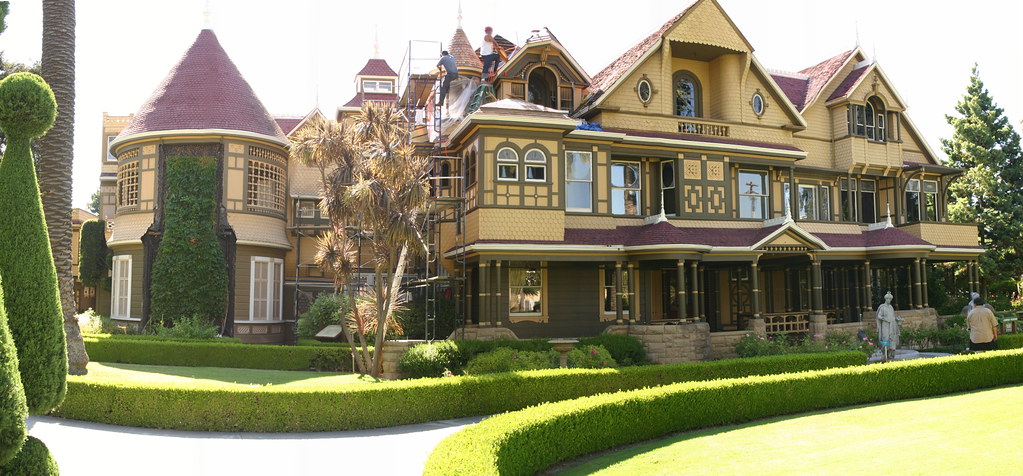
Our family recently enjoyed an epic trip to California – a trip that lasted two weeks and spanned 6,500 miles as we traveled from Vermont to Montreal, Canada, flew to San Francisco, drove to Los Angeles, and returned to Vermont again by way of Montreal. We slept in five different locations and reconnected with numerous dear friends and family members. 

The three days that we spent in the San Francisco Bay Area marked our first return to the region since 2016. The Bay Area is where my husband, Erick, grew up and lived until his college graduation; we’d lived there for half of our first decade of marriage and it’s where our first three children were born. We barely scratched the surface of our family history during this visit, but we did take our children to the Winchester Mystery House. 

Erick and I had visited the Winchester Mystery House once, before we had children. It was shortly after we’d moved to Berkeley, something to do on a free Saturday when we were still exploring the new landscape we now inhabited. Come to think of it, we probably even slept late and then read the newspaper over brunch; we may even have watched an entire movie the night before! 

The details of that first visit were fuzzy in my mind, but I still remembered the bizarre story behind the Winchester Mystery House. Here is the story as I relayed it to my children: 

Sarah Winchester, who had married into the family that owned the Winchester Repeating Arms Company, moved to San Jose, California in the 1880s after the deaths of her husband and infant daughter. She was consumed with guilt over the people who’d been killed by Winchester rifles, and was told by a medium that she had to continually build a house for their ghosts; if construction ever stopped, she would have bad luck – or die (or perhaps both.) So, she bought an old farmhouse and began a 38-year construction project that ballooned the house to 500 rooms, complete with bizarre features like doors to nowhere, curving staircases with tiny steps, trapdoors, and walled-off windows. The building was, of course, never finished. 

Click here to continue reading this week’s “Faith in Vermont” column in The Addison Independent.

Looking Backward, Moving Onward

A couple of weeks ago, I spent the afternoon cleaning out the basement. Our basement is unfinished, cement floors and exposed beams, and it has become a repository of everything that we want out of sight. 

We keep the off-season holiday decorations in the basement. Some toys that aren’t currently being played with but that may rotate back upstairs when our youngest child is older. Many bins of clothes that are either off-season or waiting for various children to grow into them. A couple of survivalist shelves filled with nonperishable food and medications; a reminder of our COVID days. Our cat’s food, litter box, and bed are in the basement. And, until a couple of weeks ago, there were piles of files. 

These files were filled with school books and papers dating back to 2016, when our oldest daughter was 8, our youngest daughter was two, and our son was not yet born. In 2016 we began homeschooling our children while on sabbatical in California, and we kept homeschooling after we returned to Vermont: first two children, then three, then four. 

In 2021 we began to stop homeschooling our children: first two children, then three, and after this school year there will be none. 

Click here to continue reading this week’s “Faith in Vermont” column in The Addison Independent.

Driver’s License

I’m not the type of mother who typically makes a big deal out of my children’s major life milestones. 

With five children, my brain simply lacks the capacity to keep track of when everyone first walked, talked, and lost their first tooth. This makes for some awkward conversations when my children come to me looking to fill in the gaps of their developmental histories: To the question, “When did I take my first steps?” my answer is, “Uhhh, I can’t remember exactly…. Around the usual time?” And somehow, I have absolutely no memory of my fourth child’s first word. 

While everyone else plasters social media with “first day of the new school year” photos featuring all their beaming children lined up on the front steps in matching outfits, holding little printouts of the grades they’re entering…I routinely forget to take a first day of school photo. During the years when I homeschooled my children, it was hard to muster much enthusiasm for a photo-op when at most they were walking up a flight of stairs (often still in their pajamas.) Now the majority of my offspring leave the house for school: different schools, with different start times and different first days. How do I work with that?!?

I think we do a nice job as a family celebrating birthdays and holidays, but we certainly don’t do anything flashy or extravagant. Presents, cards, a cake, the option of a little party with friends or family – what more could you want? 

I love my children fiercely, I just don’t like to put all my celebratory energy into a single event, and over time I’ve learned that it’s better that way. The bigger the buildup of expectations, the harder the letdown afterwards – not to mention the increased stress during the event itself.

But just yesterday my eldest daughter got her driver’s license, and to my shock it feels like a really big deal

Click here to continue reading this week’s “Faith in Vermont” column in The Addison Independent.

Looking for the Light

At the close of my last column, in September 2023, I announced that I’d be taking a brief sabbatical and expressed my hope that I’d return to writing early in 2024. Well, here I am!

In that column, I explained my need for a fall sabbatical: Of our five children, three were entering new schools.  We’d have one child up in Burlington (one hour to the north), two in Ripton (30 minutes to the southeast), one in preschool (a blessed 10 minutes away), and one child still being homeschooled. There were assorted fall sports, music lessons, and a driver’s ed class. We’d gained a puppy over the summer. And my husband was returning to teaching after a year’s sabbatical.

Those are just the facts. 

Here is what the facts don’t tell you:

The facts don’t tell you that, between 2016 and 2019, I homeschooled all my children. One of them told me that they consider those years “The Golden Days” – and they were. We read wonderful literature, wrote, and learned together in the mornings. The afternoons stretched long; I remember them as seen through the window above our kitchen sink: my four oldest children dressed in various costumes, romping in the amber light with the boy next door or assorted friends – there was always a spare child or two around in those days. 

The facts don’t tell you what our particular experience of COVID was like, with a baby still recovering from a stint in the ICU for respiratory distress, and isolation from our beloved friends and homeschool community. How our eldest child turned 13 alone in her bedroom, celebrating with the faces of friends arrayed on a laptop screen, and how she spent much of the next year behind her closed door. 

Click here to continue reading this week’s “Faith in Vermont” column in The Addison Independent.

Living the Questions

There was a moment in my mid-20s when I realized that I might not have my own opinions about anything.

A lifelong people-pleaser, I’d become adept at absorbing the ideas and mores of the people around me. On a superficial note, this was manifested when I went to a summer enrichment program in high school with many students from Southern Virginia and returned home one month later with a pronounced Southern accent. On a more serious level, I had lived two decades without really being sure of what I believed.

Looking back, I have compassion on my younger self. Having lived nearly twice as long now, I would never expect a 25-year-old to have completed the final draft of their life’s vision statement (and if they claimed they had, I’d give them a sympathetic pat on the head.) 

But back then, I assumed that a marker of maturity was having the answers to life’s questions figured out. If I was doing life correctly, I’d continue collecting fixed opinions until I arrived at some future point where there would be no more uncertainty, just clarity. To be an adult was to be sure.

That looks ludicrous when I put it in writing. But don’t most of us believe this, at some level? How does our culture deal with uncertainty? 

Click here to continue reading this week’s “Faith in Vermont” column in The Addison Independent.

Things We Don’t Talk About: The Sadness

I first noticed The Sadness over the past couple of years. 

It feels like various things at various times: a lump in the throat, a bitter feeling on my tongue, tears springing to my eyes, the sense that if you peered into my chest you’d see a visible crack running down the center of my heart. 

It’s not constant, but it washes over me almost daily. And it’s not just sad or difficult events that bring it on. The Sadness can be most pronounced in the midst of a joyful situation: snuggling up and reading a book to a child, celebrating a happy life milestone, walking the dogs down our driveway at sunset, or laughing with my family or friends. Beauty is almost certain to bring it on: art, music, literature or drama that contain deep kernels of truth. Often, I feel The Sadness most strongly when I’m in a crowd of people.

You might think that a certain degree of sadness would be appropriate given our current cultural moment — and you’d be right. A two-year pandemic that amplified anxiety and isolation is likely to increase sadness. The news is almost always bad and divisive; that’s sad. And my daughter just told me that she heard many people are especially sad this summer because of the weather: Here in the Northeast United States, at least, frequent rain and haze from the Canadian wildfires have resulted in fewer sunny days, which may be causing a sort of off-season Seasonal Affective Disorder. (I can’t confirm her source for this.)

But I don’t think The Sadness I’m feeling can be explained entirely by external circumstances. The COVID-19 pandemic hasn’t affected my daily life for almost a year. After discovering my tendency to doom-scroll during the pandemic, I’ve blocked daily access to most news outlets on my devices. And while this summer’s weather has been a bummer, The Sadness predates Summer 2023. 

Let me also assure you that I am not clinically depressed. I have a generally positive outlook on life. I get out of bed and function at a productive level day-to-day: I parent multiple children (and pets), keep a house in decent order, work part-time, and maintain close relationships. The Sadness happens regardless of my mood at any given moment. 

We don’t talk about sadness much in our culture; it makes us uncomfortable. I live in a country founded on the ideals of progress, the ability to pull oneself up by one’s bootstraps, and “the pursuit of happiness.” In a capitalistic society, acquiring money and possessions is supposed to correlate with greater happiness. The booming health and wellness industry promises a plethora of treatments for all our pain and discomfort – physical and mental. Sadness threatens these scripts. If we measure success by how happy we are, and progress by our ability to continually get happier, then sadness has no purpose. It’s something to be avoided at all costs. 

Click here to continue reading this week’s “Faith in Vermont” column in The Addison Independent.

Why You Should Watch “Barbie”

“This movie is going to change my life,” my 15-year-old daughter stated confidently.

I looked over to where she sat in the passenger seat, swathed in an oversized pink sweatshirt. I was taking her to meet a friend, with whom she would watch the new “Barbie” film. The film that would, apparently, change her life.

I’m getting used to hyperbolic statements from my teenagers, but I still tend to pause and assess the underlying intent before I respond. Is she being serious? Sarcastic? Humorous? Dramatic? If you see me looking confused for the next decade or so, this is why. 

“Well, that sounds really…exciting,” I responded slowly. “Although in my experience, life change is a slightly…longer process.”

“Well, this movie’s going to change my life,” she asserted. “When you pick me up, I’ll be a different person.”

When I picked her, she still looked the same. 

“So?” I asked, “How was it? Did it change your life?”

Click here to continue reading this week’s “Faith in Vermont” column in The Addison Independent.