Uphill and Down

Looking down into Smuggler’s Notch from the Long Trail North.

Erick and I have always loved hiking, and we used to hike fairly often…pre-kids. The last substantial hike we took was when we left 6-month-old Fiona with her grandparents and took off on a day hike in California’s Pt. Reyes State Park. If you do the math, that was FOUR YEARS AGO.

Unless you’re a masochist, hiking any further than 1/2 mile with children under the age of 5 is just not very fun. Somebody — usually the oldest, heaviest child, NOT the baby who’s already strapped to your back — is always whining to be carried, somebody always has to pee and then misses and gets soaked, somebody always needs a drink or a snack. Our two older girls are reaching ages at which we can see the glimmer of pleasant future hikes together, but for now we still have to catch them both on a good day.

So, when Erick’s parents were visiting this June, we jumped at the chance to leave the girls with them for a night, and headed off for a hike in Smugglers’ Notch State Park in Stowe, VT. Smugglers’ Notch got its name back in 1807, when President Jefferson banned trade with Great Britain and Canada. This was rough on northern Vermonters, who relied on trade with Montreal. So, during the trade embargo and later during Prohibition, goods were smuggled to and from Canada through this narrow pass in the Green Mountains.

And let me tell you: those smugglers had a tough job — I seriously doubt that much of the liquor made it through the Notch untouched. Erick and I opted for the Long Trail North to Sterling Pond, a 6.6-mile round trip hike with an 1,800-foot elevation change. The trail was rated “difficult,” which was no overstatement: it was steep, and rocky, and muddy in many places. But it afforded some stunning panoramic views of Mt. Mansfield (Vermont’s highest peak) to the west and Spruce Peak to the east. We ate our picnic lunch of bread, cheese, and salami overlooking pristine Sterling Pond. Best of all, the hike gave us FIVE HOURS of peace and quiet; Erick and I aren’t big talkers on our hikes, and on this hike we were so winded most of the time that talking wouldn’t have been an attractive option in any event.

A portion of the trail: believe me, this looks much easier than it was.

During those five hours of quiet,  I thought about a question that my sister-in-law had asked me a week earlier, a question that had been weighing on my mind because I wasn’t satisfied with my initial answer. And on that hike, I arrived at a much better response.

The question was this: “So, it gets easier, huh?”

By “it,” she meant parenthood.

My sister-in-law, who is an amazing mother to the most adorable two-year-old nephew on the planet, was not the first person to ask me this. I’ve been asked versions of this question for most of my parenting career by mothers who are just a step behind me, and I’ve asked the same question of mothers who are a step ahead of me. With three children under the age of five, I’d hardly seem like an expert. But when my sister-in-law posed her question, I got it: I no longer have a newborn, and I’m right on the cusp of having multiple children in school. With kids in my house who can feed themselves, dress themselves, forgo diapers, and verbalize their needs without screaming (often), I’ve reached the next level: the level that comes after the brain-fogged survival of the newborn years.

So when my sister-in-law asked if parenthood gets easier, my first response was: “Yes,” because you should always give people hope.

But you should also be honest, so I added: “Well, it gets different.” That’s what mothers of older children are always telling me, and from my limited experience I know that it’s true. Then I floundered around that statement for awhile without accurately conveying what I think it means. Our hike helped show me what it means, so here goes:

I think the first couple years of parenting, especially the first couple years of parenting your first child, are like the initial ascent on a mountain hike. They’re HARD: the terrain is unfamiliar, you’re using muscles that you probably haven’t used in a while, you’re weighed down by a ton of gear in your pack (say, for instance, three bottles of water, a two-pound bag of trail mix, and a rain parka), you have to keep your eyes down on the ground because if you look ahead you’ll get discouraged, and sometimes the only thing to do is just to crawl on all fours.

I’ve done a fair number of these mountain hikes, and each time I make the same mistake, even though I know better; while I’m scaling that trail, I think to myself, “This’ll be MUCH easier on the way back down.”

Of course, it’s NOT AT ALL easier on the way back down, it’s just…different. Your pack is probably a little lighter, because hopefully you’ve drunk some of your water and eaten some trail mix. And the going may be a bit faster, but descending that slope is hard on the knees and toes, the tree roots that supported your feet on the way up now want to trip you, and sometimes the only thing to do is to scootch down on your bottom.

It’s kind of like the parenting that follows those first years: you’re done with diapers and middle-of-the-night feedings, sure. But instead you get to see your children’s hearts broken by friends, you start to see all of the neuroses and flaws that you know will plague them for life, you have to deal with their various anxieties in areas that you never expected. You’re up in the middle of the night again, but this time you’re wondering whether your child will ever have friends, and whether those friends will be good friends or will introduce your kid to crack cocaine and reality TV, and whether your child is just going through normal development or whether you need to call in a child psychiatrist stat.

It gets different, not easier.

But the things that keep me going during a hike are pretty much the same things that keep me going in parenthood. Sometimes the trees open up on a vista — mountains, sky, valley — that truly takes your breath away, a view you wouldn’t have experienced without that climb. Sometimes there are simple, quiet, delicious lunches by the pond. And sometimes you meet people like the couple we passed on the trail: not a day under 70, coming back down as we were going up, and chipper as could be. After we saw them, there was no way we were complaining for the rest of the hike.

A view of Mt. Mansfield from the trail.

And on the way back down, I found it easier to drop my worries about whether it was going to rain or how much longer it would be to our destination, and instead I just felt thankful. Thankful for the smallest things: the breeze, that cloud that provided a minute of shade, my hardworking legs — especially my knees, my awesome moisture-wicking hiking socks, the evergreen branches that some kind hiker had laid across the muddiest patches.

After all, you don’t want to get back to the parking lot and realize that you spent the entire hike wondering when it was going to get easier.

Sterling Pond.

You’ve Got Hope

Photo credit.

I’m writing this from a family “vacation” at the beach in Maine. “Vacation” is in quotes, of course, because with three young children the idea of vacation falls into the same category as The Myth of Weekends. Back when we had fewer children, I remember asking our former pastor — himself the father of three girls — how his family vacation had been. He looked at me sideways for a minute, and then said, “We have three kids, Faith. It wasn’t a ‘vacation’; it was a trip.” I couldn’t have put it better myself.

So here we are in Maine, not really having a “vacation,” but having a wonderful trip. A week-long trip that took a week to pack for. Late nights and early mornings with girls hopped up on ice cream and the excitement of seeing their grandparents and cousins. The unbelievable logistics involved on either end of a single hour spent at the beach.

Another reason this feels more like a “trip” than a “vacation” is that we live in Vermont. And an interesting thing about living in Vermont is that almost anywhere else you travel is bound to be more congested and bustling than Vermont. So, while most people take vacations to places where they can relax and enjoy a slower pace of life, we’ve noticed that it’s harder to find those places when you live in Vermont. This small beach town in southern Maine is hopping compared to our home base.

When we arrived last night, I was holding on to my sanity for dear life, and grasping to recover my sense of joy. The week I’d spent packing everybody up for this trip had been a hot one in Vermont, and we’d had to keep the windows closed (we have no air conditioning) because a crew of six men is painting the outside of our house. We’d hit traffic jams — something else we’re not used to in Vermont — two times after crossing over the New Hampshire border. The four hour trip to get here was the longest amount of time we’d spent in our car with the three girls, and now that they’ve become little outdoor-sy Vermont hooligans, they’re not very good at spending hours trapped in the car (not that ANY kid is good at this, but I guarantee ours are worse than most). With 2/3 of our girls now potty-trained (yaaay!), we had to stop at almost every rest station in New Hampshire to use the potty (boo!). And then we had to explain why, yes, you DO have to actually use the potty, because at rest stations it’s not appropriate to “pee in the grass.” (See aforementioned Vermont hooligan comment). Also during this drive I’d begun to have burning, aching pain in both of my knees for no apparent reason. In my typical calm, rational style, I determined that I had either Lyme disease or Lupus, and would probably be suffering chronic knee pain for years to come.

We didn’t think that the cottage we were renting had internet access, but it turned out that it does. So, after the girls were in bed (very late) that first night, I logged on to my email for the first time all day. And among all the Amazon Mom and library book due-date notices, I had these two emails:

1. A friend from our Berkeley days, mother of a son the same age as Fiona, who tragically lost a baby girl late into her second pregnancy — this friend’s husband sent an email announcing the healthy birth of their second son.

2. A friend from Vermont, mother of one of Fiona’s preschool classmates with whom I’d just been discussing chickens and the sad fact that we’re going to have to give up our rooster and be left with two lonely hens — this friend had gone to pick up her own litter of baby chicks and, thinking of us, had asked whether the farm supply store had any extras. When she heard from the store that there were, in fact, extra chicks to be had, she drove back and picked up more chicks, which were ours for the taking. Chicks of the EXACT breeds that I’d been wanting to try out next. (Rhode Island Reds and Barred Rocks, if you’re interested).

These two emails were — on the surface — small, small things. But to me they were so huge that I let go of the sanity I’d been holding on to for dear life, and instead, for the past 24 hours, I’ve been holding on to these emails. Because they’re not just email updates; they’re little seeds of hope. Hope that pain can be redeemed and sorrow can turn to joy; hope that people are kind and sometimes things all come together at just the right time and in just the right ways.

My knees still hurt, and I don’t know why, or if or when they’ll feel better. And we still have another four hours in the car ahead of us when we travel back to Vermont. But somehow those two little seeds of online hope are all I need to get me through this moment.

There’s a plant that grows along the Maine coast called a sow-thistle. It’s a weed that looks like a dandelion, except it grows to be 1-4 feet tall. The sow-thistle isn’t a native plant — it was introduced to the United States from Europe — but it’s become an invasive species, found in almost every state. So, when Fiona took a handful of its tiny, feathered seeds and tossed them into the wind on our walk back from the beach yesterday, she was helping to birth plants that can grow taller than her, that can take root in the rocky Maine coast, in the cracks of New York City sidewalks, and in cultivated agricultural fields in California.

That’s how hope is. The tiniest thing — a new baby coming into a space of loss, or extra chicks at the perfect time — can take root in the parched, rocky soil of our lives and give us all the hope and joy we need to keep going.

So, I wish you many tiny little seeds of hope in your inbox, today and always.

Put Down the Duckie!

Photo credit.

Sometimes I’m concerned about how many of my recent life lessons come from children’s literature and music. But then I figure that truth is truth; when it comes to the basics, what’s true at 4 is true at 40. My latest case in point: “Put Down the Duckie.”

“Put Down the Duckie” is a song from Sesame Street. You can watch it here. To summarize: Ernie’s having trouble playing his saxophone, so he solicits the advice of Hoots the Owl. Hoots tells Ernie that his problem is simple: he has to put down the rubber duckie he’s clutching in his hand if he wants to play the saxophone.

I don’t remember this song from my own Sesame Street days, but it’s included on a “Sesame Street’s Greatest Hits” CD that we keep in our minivan, which means I get to listen to it a lot while I’m cruising the back roads of Vermont with my peeps.

To be honest, it’s not my favorite song on the CD. But one morning — maybe it was that extra cup of coffee — I suddenly had a revelation. The saxophone is LIFE, I thought to myself, and the duckie stands for the things we won’t let go of, that prevent us from doing life as well as we could.

Whoa.

Of course, my next thought was: What’s MY duckie? What’s the thing that I refuse to put down, that’s getting in my way?

In truth, I probably have about twelve duckies. But the most glaring one, the one I’ve been trying hard to put down, is my pride in being self-reliant. To put it another way: I have a very, very hard time accepting help.

Here’s what my life looked like last year in California: Erick cooked us breakfast and dinner almost every day, and was always home mornings, evenings, and weekends to help with the kids. Erick’s parents would drive over two days a week to watch the girls from 10-5, while I worked. And on those days, Erick’s mom cooked us all dinner. I was so spoiled. It was wonderful. And the whole time, I was consumed with guilt.

Guilt because, when I looked around at my other mom friends (always a bad idea), they didn’t seem to have anywhere near the level of support that I did. It must look like I can’t handle my life on my own, I would think to myself. And in my darkest moments: Everybody is offering me this help because THEY THINK THAT I’M INCOMPETENT.

I can take care of multiple kids and keep the house clean and cook all the meals, just like everybody else! I would wail inwardly, But nobody’s giving me the chance to TRY!!

If my inner monologue sounds ridiculous, that’s because it was. And sometimes it became an outer monologue. After one of my self-bashing sessions, Erick looked at me and said calmly, “Why do you have to feel guilty about having help? Why can’t you just feel grateful?”

Huh.

So, for my final months in California, I tried to replace guilt with gratitude. And I really WAS grateful, because during those months I was buying a house, finishing out a job, packing up our lives for a cross-country move, and caring for three children ranging from newborn to three years old. If ever it was understandable to need some help, that was the time.

When we moved to Vermont, things were different: Erick started an intense full-time job, and we had no family anywhere nearby. I got my wish to be just like everybody else, loading three kids in and out of the minivan all day, taking care of all the grocery shopping, cooking, and cleaning. It’s been wonderful in most ways, and I’ve mentioned before that this was the year that I finally felt like a grown-up.

But you know what? I’m still holding on to that duckie.

Because even though my family members are now limited by busy-ness and distance, they still just want to help. Erick usually takes all three girls on Saturday mornings so that I can get things done around the house. And sometimes, instead of gratitude, I catch myself thinking, I don’t see many other dads doing as much. Despite the distance, Erick’s parents have spent 6 weeks in Vermont this year; my parents have visited every month except one. (To put it in perspective, Erick’s done a lot of traveling in the past months, but thanks to the grandparents I’ve only had to spend three nights on my own). And sometimes, instead of gratitude, I catch myself thinking, Wow, our parents seem to spend more time here than other grandparents, and people are noticing.

I know exactly where this comes from. During a recent  four-day visit by my parents, I noticed that even though my dad had, among other things, re-caulked a sink, repaired a shelf, built a gravel box, built and hung a birdhouse, planted a garden, hung a hammock, made a pancake breakfast, and played with three granddaughters, all with two broken vertebrae, he felt like he wasn’t doing enough. He seemed guilty that he was more limited, less self-reliant, than he used to be. It was kind of like the old Cat Stevens song “Cat’s Cradle,” but in reverse: My dad was just like me, yeah.

So I’m once again trying very hard to put down this duckie. Because I won’t be able to play my saxophone very well if I’m always feeling guilty that I’m not doing enough on my own. What good are flying fingers if they’re wrapped around a duck? And the truth is that life isn’t a solo, at least not most of the time; if we want to make powerful music, we need to let other instruments jam with us.

One more truth: there’s nothing fundamentally wrong with self-reliance. If I were overly dependent on help from everyone around me, that would be another sort of duckie. But it’s like Hoots the Owl tells Ernie: “You don’t have to lose your duck; you can pick it up when you’re finished!” At this point in my life, I can stand to accept a little extra help with grace and gratitude; there’s plenty of time for self-reliance in the future. And having people around me now who are offering help is a blessing. Just because I can handle life on my own doesn’t mean that I have to. In the words of Hoots, I don’t wanna be a “stubborn cluck,” I wanna lay aside the duck. And the first step is this:

Thank you, Erick. Thank you, Nana and Boom. Thank you, Grandmommy and Granddaddy. I am so grateful for each of you, and I love you.

Happy Independence Day, everyone! Perhaps we can all celebrate freedom by putting down our duckies, whatever they are.

The Thing I Don’t Want to Write

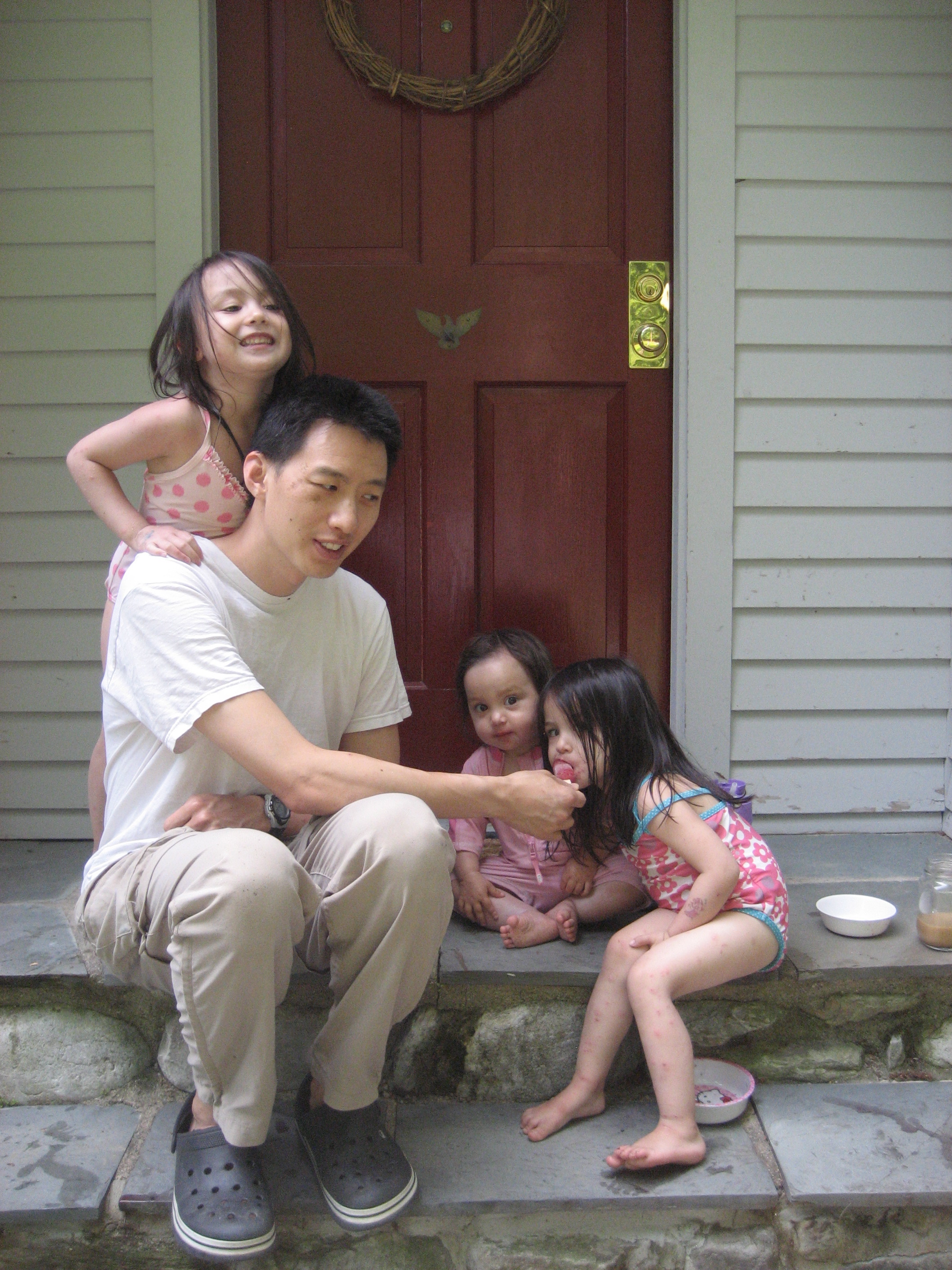
Just for fun: “Having it all”  – popsicles after the wading pool – this past weekend.

Last week, several friends forwarded me Anne-Marie Slaughter’s article in The Atlantic, titled “Why Women Still Can’t Have it All.”  Usually I keep my mouth shut after I read articles on this topic, which I file under “The Mommy Wars”: the emotionally charged battle over work-family balance for American women today. But this time I didn’t keep my mouth shut. For better or worse, my response is published today over at On the Willows. Click here to read it.

The Myth of Weekends

What our weekends looked like pre-kids.

I’m not a fan of making doomsday predictions to women who are expecting their first child. You know: “Ooooh boy, prepare to have your life turned upside down!” “Sleep now, because you’ll never sleep for the next decade!” “Say goodbye to your white couches!” and so on. Regardless of the truth of these statements, they’re not helpful. When I was pregnant for the first time, well meaning friends — many of them mothers — told me to get lots of sleep. In retrospect, these were clearly people who had either no idea or no memory of what it’s like to be pregnant: by the latter half of most pregnancies, no position is comfortable, breathing is difficult, the bathroom calls every 5 minutes, and when you finally do drift off, you have vivid nightmares about misplacing your newborn. Sleep is not really happening in any normal sense. So I spent the final trimester of my first pregnancy exhausted AND stressed that I wasn’t following everyone’s sleeping advice.

That said, there is one thing that I advise friends who are expecting for the first time, because I think it is helpful: Eat brunch as often as possible.

I vaguely remember brunch: sleeping in on a Saturday morning, then ambling down to whatever restaurant we chose for some delicious pancake-y or egg-y food, drinking multiple cups of coffee while leisurely perusing The New York Times and deciding whether to nap before or after we went jogging, which museum we should visit, what movie to see that night.

Nowadays, all of that would be impossible. Let’s start with the sleeping in: our kids have no concept that weekend sleep patterns should differ from the rest of the week, so they stubbornly refuse to sleep in on the weekends. To them, Saturday is just a day like any other, and they come barreling out of their room at 7 AM — if we’re lucky.

Then, there’s the timing of brunch; as a general rule, I believe the ideal time for brunch is about 10 AM. That’s a completely unrealistic time to be eating the first meal of the day if you have kids — including a baby — who are used to eating at 7 AM. By 10 AM, we’ve all eaten, dressed, washed up, and Georgia is waking up from her morning nap. In order to do brunch, we’d have to eat breakfast first, which kind of defeats the purpose.

And I won’t even bother explaining why we can’t possibly read The New York Times during meals these days.

I’d say our brunch days are on hold for at least another 5 years. And that’s why I tell expectant moms to eat brunch while the brunching’s good.

Now, I know all kids are different. I know that some preschoolers sleep until 9 AM, will patiently wait an hour before eating, and sit quietly at the table during meals. (I make myself feel better by assuming that these preschoolers aren’t as interesting as our kids). But brunch is only part of what I refer to as “The Myth of Weekends.”

One of the many refining features of parenthood — and life — is that it forces us to abandon our expectations. By the time we had kids, I’d built up a couple decades worth of expectations about weekends: that weekends were times of rest, restoration, and recreation…usually involving brunch. Every weekend post-kids, I brought those expectations with me: Maybe THIS will be the weekend when we all sleep late, when we all live in perfect harmony, when I will feel completely recharged by Sunday night. And every weekend my expectations exploded and I felt more exhausted by Sunday night than I did on Friday night.

I’ve already explained why sleeping late and brunch no longer happen on our weekends. Then there’s recreation: our family has a lot of fun on weekends, but it’s hardly restorative fun; it’s exhausting fun. All recreational activities involve wrangling three kids. So, for instance, if we decide to take a hike: someone has to lug around 19 pounds of baby, then Campbell wants to be carried, Fiona wants to charge ahead, Campbell wants to walk, Fiona needs to pee, Campbell is thirsty, Fiona wants to be carried, Fiona is hungry, Campbell wants to be carried again. (And that’s just at the trail head).

But the MAIN source of my mistaken weekend expectations stems from the simple fact that, in our family, there is one extra person who is around more on weekends: Erick. During the week, Erick vanishes from our house during the hours between breakfast and dinner, but for the most part he’s home all weekend long. Which is wonderful, and you’d think it would make at least the child-wrangling part of weekends easier.

But it doesn’t.

Again, PLEASE don’t get me wrong: Erick is a superstar husband and father. We all adore him, and are thrilled to have him home on the weekends. In fact, he usually takes all three girls on Saturday mornings so that I can spend a few hours wrestling the house back into submission. But I’ve had to accept that his presence doesn’t automatically transform weekends into restful and restorative times of family togetherness.

Here’s why: During the week, the girls and I have a flow, a rhythm that gets us through the days. We stick to a relaxed but predictable schedule, everybody knows her role and — for the most part — follows it, and the girls (usually) respect the fact that I’m the only parent available and cut me some slack. Then the weekend hits. Suddenly, there’s another exhausted person around who doesn’t necessarily know the routine, and who’s been moving to his own rhythm the rest of the week. The girls are all jazzed up because Daddy’s home, and I’m inclined to loosen the reins a little because there’s another adult to pick up the slack. In other words, we’re all out of whack with each other.

The bottom line is: if two adults are each expecting the weekend to be a time of rest, but they’re outnumbered by three kids, the math just doesn’t work out.

Anybody else have this experience?

After a few years’ worth of deflated weekend expectations, I solved the problem of “The Myth of Weekends” in the only grown-up way I could: I left my expectations at brunch, back about four-and-a-half years ago. Maybe I’ll pick them up again someday, maybe not. In the meantime, I’ve decided to redefine the conventional idea of “Weekend = Saturday + Sunday.” Instead, I try to take little weekends where I can find them throughout the week: early in the morning before the kids are awake, naptime, after the kids are in bed at night, solo trips to the grocery store or the dentist, date nights with Erick when grandparents are in town.

And, I tell you, these little weekends have brought me joy and gratefulness in a way that conventional weekends never did. These days, nothing beats being able to read an entire copy of People in the doctor’s waiting room.

Not even brunch.

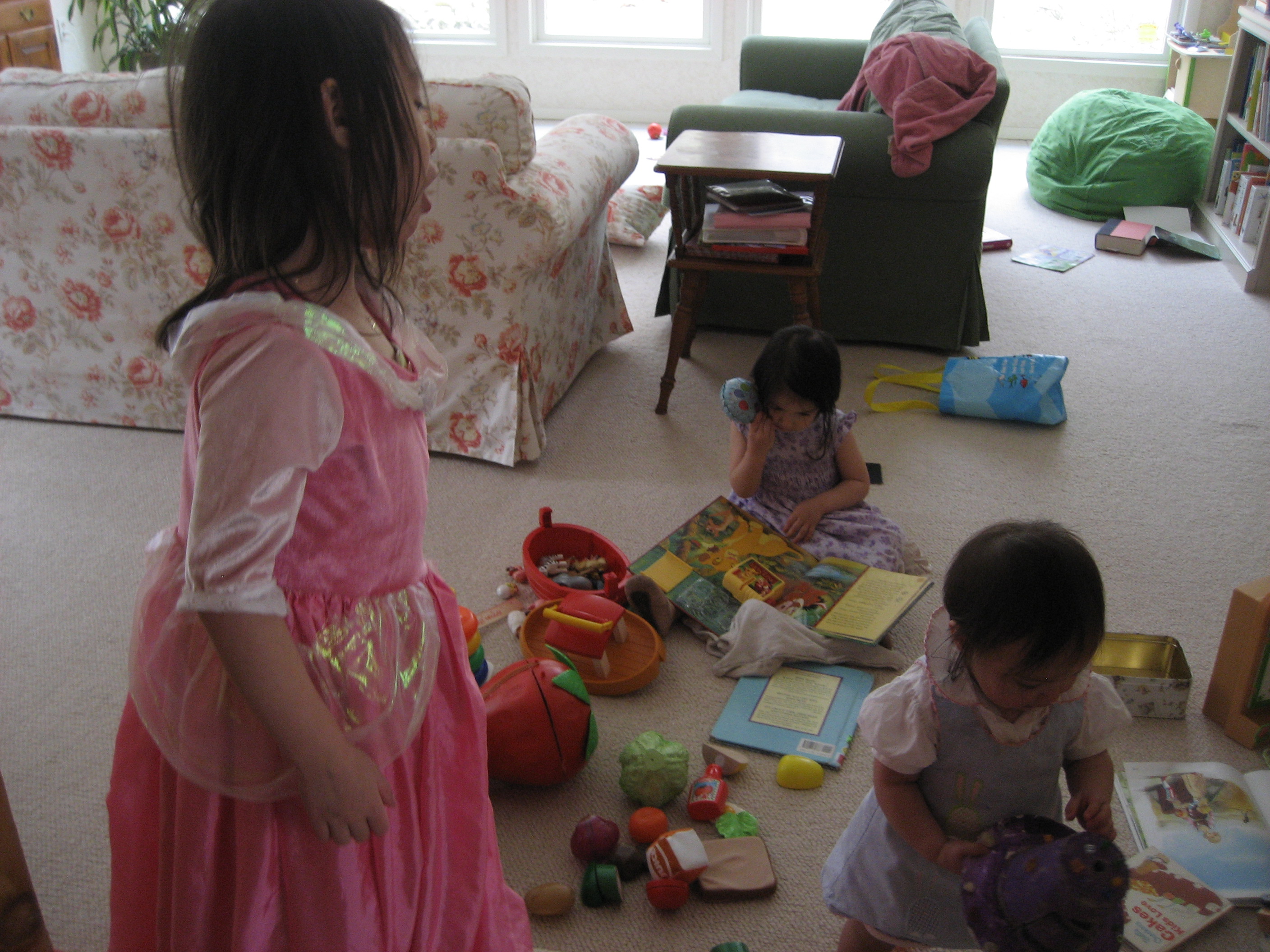
What our weekends look like now.

Me and Fiona Down by the Graveyard

Fiona in St. Mary’s Cemetery, goofy pose and all.

I’ve mentioned before that Erick and I attempt to have a monthly “date” with each of our older girls. This has gotten a little trickier lately, because the girls are so close these days that they often don’t want time alone with Mommy or Daddy — they want their sister to come along, too.

But last month, as the time rolled around again for Fiona’s “Mommy Date,” she had a plan:

“I want to go to the ceremony,” she declared one day.

“The what?” I asked. “What ceremony?”

“You know,” she said, starting to get agitated, “the CEREMONY. The one next to campus, with all the stones in it.”

“Ohhhhhhhh. You mean the cemetery.”

And so I took Fiona on a Mommy Date to St. Mary’s Cemetery.

St. Mary’s Cemetery is one of about seven cemeteries in Middlebury. Compared to the more urban places we’ve lived, where cemeteries tend to be sprawling operations that still somehow stay tucked away out of sight, the Middlebury cemeteries are older, smaller, and much more visible — right next to the main roads, in many cases. St. Mary’s Cemetery is directly adjacent to the Middlebury College campus, so Fiona had seen it numerous times during our walks and drives around campus. And, because she’d never seen a cemetery before, she was interested.

Photo by Fiona.

“What will we do on our Mommy Date to the cemetery?” I asked her that morning.

“Walk around, and sit, and I’m going to bring some markers and paper to draw,” she answered, matter-of-fact.  “And then we can meet Daddy, Campbell, and Georgia for ice cream.”

I couldn’t argue with that kind of conviction, so that’s exactly what we did. And it turned out to be the nicest afternoon I’ve spent in a long, long time.

It was a gorgeous Sunday, with temperatures in the mid-80s. We parked on campus and walked through the cemetery’s front gate. During the almost two hours that we spent there, we were almost entirely alone. A few people stopped in to tend various gravesites, a woman walked her dog, and a handful of undergraduates jogged by.

Unflattering photo of me on the steps of the Munroe family crypt, by Fiona.

Fiona and I spent some time wandering among the headstones, and she asked me to tell her the stories of the ones she liked (mostly the ones with sparkly hearts carved into them). I’d forgotten how interesting graveyards can be. In St. Mary’s, there are plenty of brand new headstones, some still lacking an end date. But there are also some very old ones, dating back to the 1800s. It was fascinating to piece together the stories of these people, their family history, their relationships. Because this is a small town, we recognized many of the family names as belonging to people we currently know.

Of course, cemeteries can be poignant — even tragic. One particular family appeared to have lost three children, aged 20, 16, and 6, during a six-month period in 1824. There’s even a section of the cemetery dedicated to miscarried babies.

Photo by Fiona.

But mostly, I found that the cemetery fulfilled its purpose as a resting place. It was incredibly quiet and peaceful. Even Fiona, at four years old, stretched her arms and declared, “This is so relaxing.”

Because it was hot in the sun, after our initial wandering we sought out the shady places: first a low stone wall, where Fiona asked a lot of questions about cemeteries and burial and death while we watched a fat bumblebee in action; next, the steps of the Munroe family crypt, where we drew pictures with the markers and paper; and finally, a bench by the babies’ gravesite, where Fiona directed me in telling her a long, meandering, made-up fairytale. And since Fiona has recently discovered the joys of photography, I brought along our little camera so that she could snap pictures throughout the visit.

Photo by Fiona.
Photo by Fiona.

That was it. Nothing profound; I didn’t come away with any new insights on life or death. I just learned that we don’t need to hide cemeteries, or be afraid of them; a cemetery was the perfect, peaceful place to spend an afternoon with my girl.

Also, the post-cemetery ice cream was delicious.

I’ll Be Selfless in Just a Minute….

Portrait by Fiona. This is usually how I look by the end of the day.

I’ve started sneaking into the girls’ bedroom at night to watch them while they’re sleeping.

This isn’t something I’ve ever done before. As first time parents for whom a sleeping baby seemed like a magical accomplishment, then second and third time parents with increasing numbers of children — and always one baby — sharing a room, once the girls’ room goes quiet it’s never something we want to risk disturbing. But now we have three pretty sound sleepers, all over the age of one, and I feel fairly confident that if I tiptoe into their room after 9:30 PM, nobody will wake.

I watch them while they’re sleeping to remind myself how much I love them.

There is nothing more sweetly innocent than the sight of a child — or anybody, really — asleep. Their faces are peacefully blank slates, wiped clear of the tantrums, whining, anger, and sullenness that might have been written across them during the day. These are my girls: sprawled out in ridiculous poses (on top of the covers, turned completely upside down in bed, arms stretched out towards each other), and when I watch them sleep like this, emptied of the emotion and action of the day, I can re-center myself in my love for them. I can feel that night really is the time when we hit “Reset,” that tomorrow really is a chance to make a fresh start. It always amazes me that, no matter how difficult the day, no matter how contentious the bedtime, when everybody wakes up first thing in the morning, it’s like we’re each returning from a long journey and we’re all SO happy to see each other. Watching my girls sleep helps me pick at these threads of hope: that I love these girls, and that tomorrow we have a new chance to do things better than we did today.

I need those threads of hope, because I am struggling with what I currently consider to be the hardest part of parenting, the thing I was least prepared to handle: my annoyance at how intrusive kids can be.

I was expecting to be tired. I was expecting to have my heart busted open. I was expecting to be confused about discipline. I was even expecting to be angry – once in a while.

I never expected that I’d grind my teeth and feel like tearing out my hair whenever their needs intrude into my time.

To be clear: I did expect that motherhood would push me to make sacrifices, to be more selfless. And as hard as it is to make sacrifices and be more selfless, those are ultimately the challenges that I most appreciate about motherhood; I’ve written before about how miserable I was back when I had too much time for myself. Motherhood is helping shape me into a happier, more caring person. So I think my problem is this: I prefer to be selfless on a predictable schedule.

Whenever I’ve taken a personality assessment, like the Meyers-Briggs test, I’m branded an introvert. Introverts find their strength and sanity by being alone.  Certainly true in my case: if I don’t have some chunk of quiet time every day to read, write, or just wash the dishes in peace, I’m a frazzled mess.

And it’s endlessly frustrating how my 1-year-old, 2-year-old, and 4-year-old don’t seem to understand this.

I don’t think I ask for too much. I expect to be on duty when the girls are awake and active; I only hope for some predictable quiet, “selfish” time during the pre-scheduled blocks when they’re (supposed to be) asleep.

For instance: Naptime. Our two youngest girls still need at least a couple hours of sleep each afternoon. They go down without a fight, and every day I’m guaranteed a good chunk of quiet time while they sleep or talk happily to themselves in their beds. The challenge is our oldest: she’s always been our weakest sleeper, and at four years old she’s about ready to abandon naptime all together. But I force her to have “quiet rest time” while her sisters are sleeping, because she still has to nap at preschool and — I’ll be honest — I need the break.

Now I find myself dreading the days when she’s not in preschool, because almost without fail it means 90 minutes of continuous interruptions and frustration for me. She goes to bed with a stack of books, markers, and paper. We’ve tried books on CD. We’ve tried a “sleep ticket” that entitles her to call me ONE TIME and one time only, with penalties for repeated call-backs. I set the clock alarm so that she doesn’t have to call every 5 minutes to ask how much longer until 3:00. NOTHING WORKS.

Then there’s: Bedtime. This is slightly better than naptime, because at least we know that all three girls will eventually fall asleep. They love sharing a room together, so most of the noises we hear after closing the door are happy noises. Still, that last “Goodnight” is never the LAST “Goodnight.” There always seems to be something — on average, FOUR things — that require our immediate presence. Which means that the hour after we’ve put them to bed is completely unpredictable.

I’ve even tried this: Waking up 90 minutes earlier each morning in order to have some quiet time to write. I need to write daily, if possible, both because I love doing it and because it helps clear out my brain. I figured that if I had a guaranteed, predictable time to write every morning, I’d feel less frustrated by inconvenient, unpredictable interruptions throughout the rest of the day.

But I tell you, those girls are like heat-seeking missiles! It’s as if they can SENSE that I’m awake somewhere in the house, no matter how early it is or how quiet I am. And down they come. They’re supposed to stay in their room until the clock reads 7:00 — another attempt at creating a predictable schedule — and sometimes it’s possible to send them back upstairs until then. But if they’ve woken up the baby in the process, it’s all over.

And then there are those times when I’m not being selfish at all: I just need five uninterrupted minutes — FIVE MINUTES — to do something for the greater good of the family, like cook dinner or schedule a check-up or pay a bill. Even then –– always then — it’s urgent that I do or watch or wipe something. Right now!

By the end of the scenarios listed above — which means at least once a day — I feel like I’m reduced to some unrecognizable Mommie Dearest caricature: “What?!? WHAT?!? What do you need NOW?!? What’s so important?!? WHAT?!? And sometimes even, ridiculously: “Mommy needs this time to rest and get things done!”

Not that it’s wrong for Mommy to need time to rest and get things done, but it’s probably a waste of breath to try and make a four-year-old understand that.

I sometimes imagine that if you sliced me open, my insides would look like an onion: layers and layers of the next thing I have to work on. Peel away one thing (patience, say, or perfectionism), and there’s another flaw just waiting to be tackled. I’ve decided that this annoyance with my children’s inconvenient demands is the next thing I need to deal with.

So I tell myself that it’s not wrong to want quiet, to need “selfish” time, but that perhaps I should stop expecting these times to be predictable and convenient — for now. I tell myself that it’s okay to work on laying down boundaries, to help my daughters understand that their parents also need rest, but that maybe I could lose some of my annoyance with the process. I tell myself that this is a finite season, that soon enough I’ll have three daughters in school all day long, and soon after that I’ll have an empty house. And, as blissful as those things seem right now, I’m told that one actually misses the inconvenient, unpredictable interruptions.

And I sneak into their room at night to watch them sleeping. In order to remind myself how much I love them, in order to grasp at the thread of hope that we (I) can do better tomorrow. And because when I do this, it means I’m choosing to spend some of my precious “selfish” time not reading, not writing, not even washing dishes, but just being near my girls when they don’t even need me. I figure that’s a start.

The Jumping Couch

We chose not to know the gender of any of our babies before they were born, because surprises are fun. Then, about three weeks before Fiona’s birth, I had a pregnancy massage. Towards the end, the masseuse asked if I wanted her to “read the baby’s energy” to predict whether it was a boy or girl. (Remember, this was in Berkeley). Sure, what the heck, I thought. Based on the amount of rock ‘n roll that was happening in utero, Erick and I expected (for admittedly stereotypical reasons) that the baby would be a boy. Based on the way I was carrying the baby — all in front — everybody else predicted it would be a boy, too. Unsolicited opinions were flying my way daily; what was the harm in one more?

The masseuse held her hands above my stomach and concentrated very, very hard.

“Huh,” she said, “I think it’s a girl, but I’m also getting a lot of boy energy.”

And there you have it. To this day, I can’t think of a better way of describing all three of our daughters than “Girls with boy energy.”

Which leads me to the problem of the jumping.

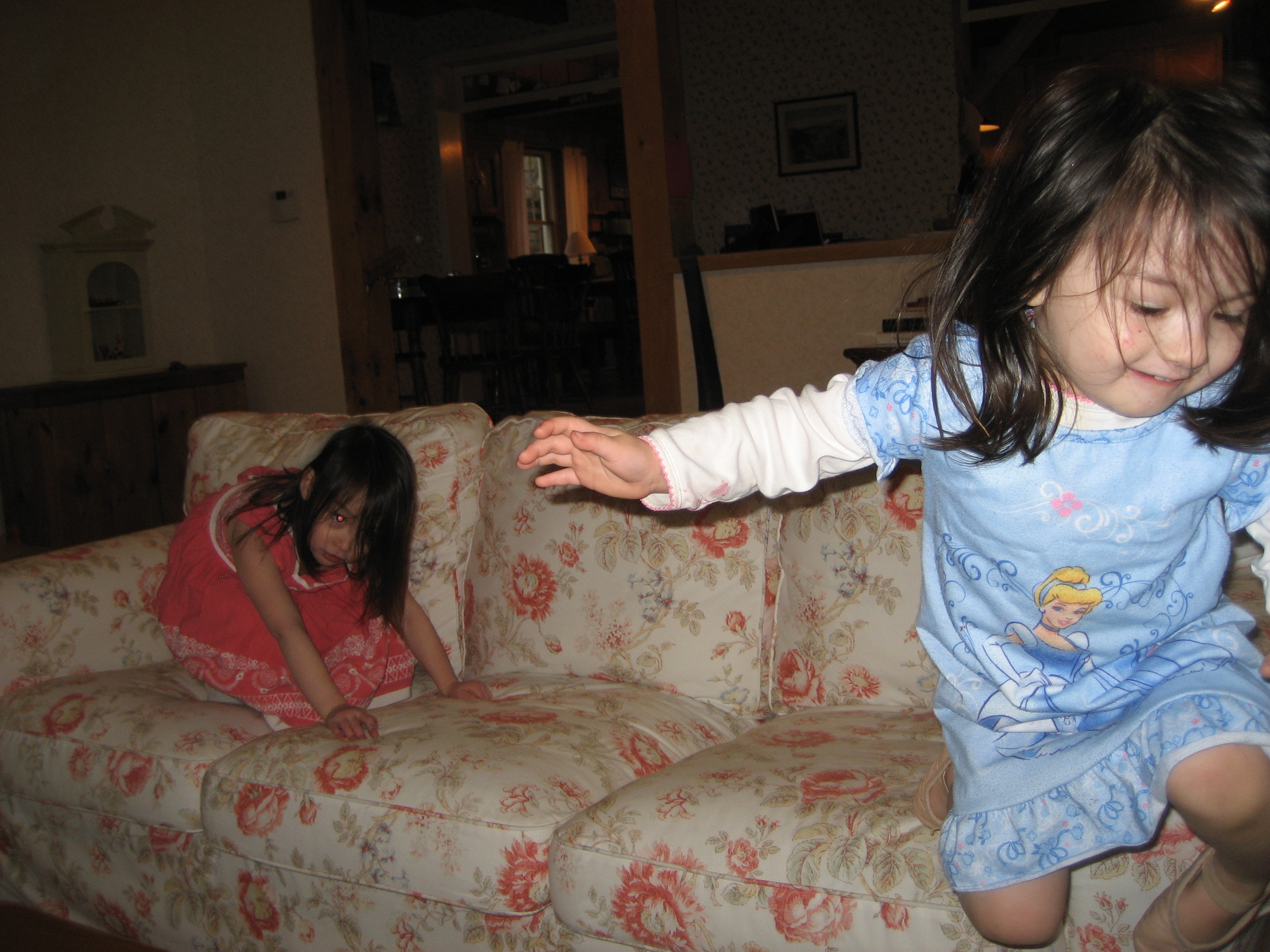
Like most kids, our daughters like to jump. And, presumably because they have “boy energy,” they like to jump A LOT. Get them near any bouncy house or trampoline, and they’re happy for upwards of an hour. Unfortunately, all that our house has to offer are beds and couches.

I know some moms who have very strict rules about their big-ticket possessions: there are couches in their houses that the kids can’t even sit on, entire rooms that are off-limits, cars that can’t be eaten in, etc. etc. I am not that kind of mom, and even if I wanted to be, it’s too late — it would be like announcing one morning that from now on, we’re all going to be speaking Greek. The bottom line is: I just don’t care that much about stuff. It’s only stuff, subject to entropy like everything else. I don’t want our kids to care too much about stuff, either, and I want them to feel cozy and comfortable in their own home. But my bottom line is actually a fine line to walk: even if you don’t care much about stuff, there’s still a basic level of care or maintenance required for your stuff — otherwise it gets trashed quickly and you end up having to buy more stuff.

Getting our girls to understand that fine line has been a challenge.

Here’s how it is: I let the girls jump on their beds. They’re not allowed to jump on my bed, because it’s my bed and I said so. But I figure that in their own room, they deserve a measure of autonomy. So far, nobody’s gotten hurt, and the beds (cheap Ikea deals) have held up. But that’s because they don’t really want to jump on their beds; they want to jump on the couch.

In all honesty, it’s couches since we moved to Vermont, which still seems crazy to me. When Erick and I got married, his boss gave us the brown suede couch that had been in Erick’s office. Or, not so much “gave” as “begged us to take it,” since the thing was covered with drool stains from all the naps Erick took on it. And that was our couch, in our New York City apartment and all three of our Berkeley homes. We’ve all recuperated on it when we were sick, I napped on it when I was pregnant and exhausted, and Erick and I both took turns sleeping on it while holding newborn Fiona when she was fussy and couldn’t settle down. It’s been a great couch for almost a decade. And, when we lived in Berkeley, in a 900-square-foot bungalow with no yard, I wasn’t too strict about not jumping on it.

Our original couch. (I think the dark spot on the right is from repeated rubbing by Erick’s head during his many naps).

Then we moved to Vermont, where, in addition to a living room, we also have a sun room — a whole other family space that needed furniture. Our old couch ended up in the living room, and I ordered a slip-covered sofa and loveseat from Ikea for the sun room. I used the move to attempt to hit “reset” on our jumping policy: their beds were still okay, but there was to be no jumping on the couches in our new home. After all, we now had plenty of space to run, jump, and play.

It hasn’t worked. Every day I have to tell our girls to stop jumping on one of the couches. They’re getting older and smarter, so they’re starting to use semantics to try and get around the rules: “I wasn’t jumping, Mommy, I was diving/dancing/walking/practicing my cartwheels.” It reminds me of when we had a cat (pre-kids) who would always jump up on the dining room table. We tried everything to make her stop, and finally resorted to getting a “Scat Mat” — a plastic mat that delivers a little electric shock to the paws. Needless to say, she didn’t like the Scat Mat at all, but did it stop her from jumping on the table? No, it did not; she just jumped on the table and carefully walked around the mat.

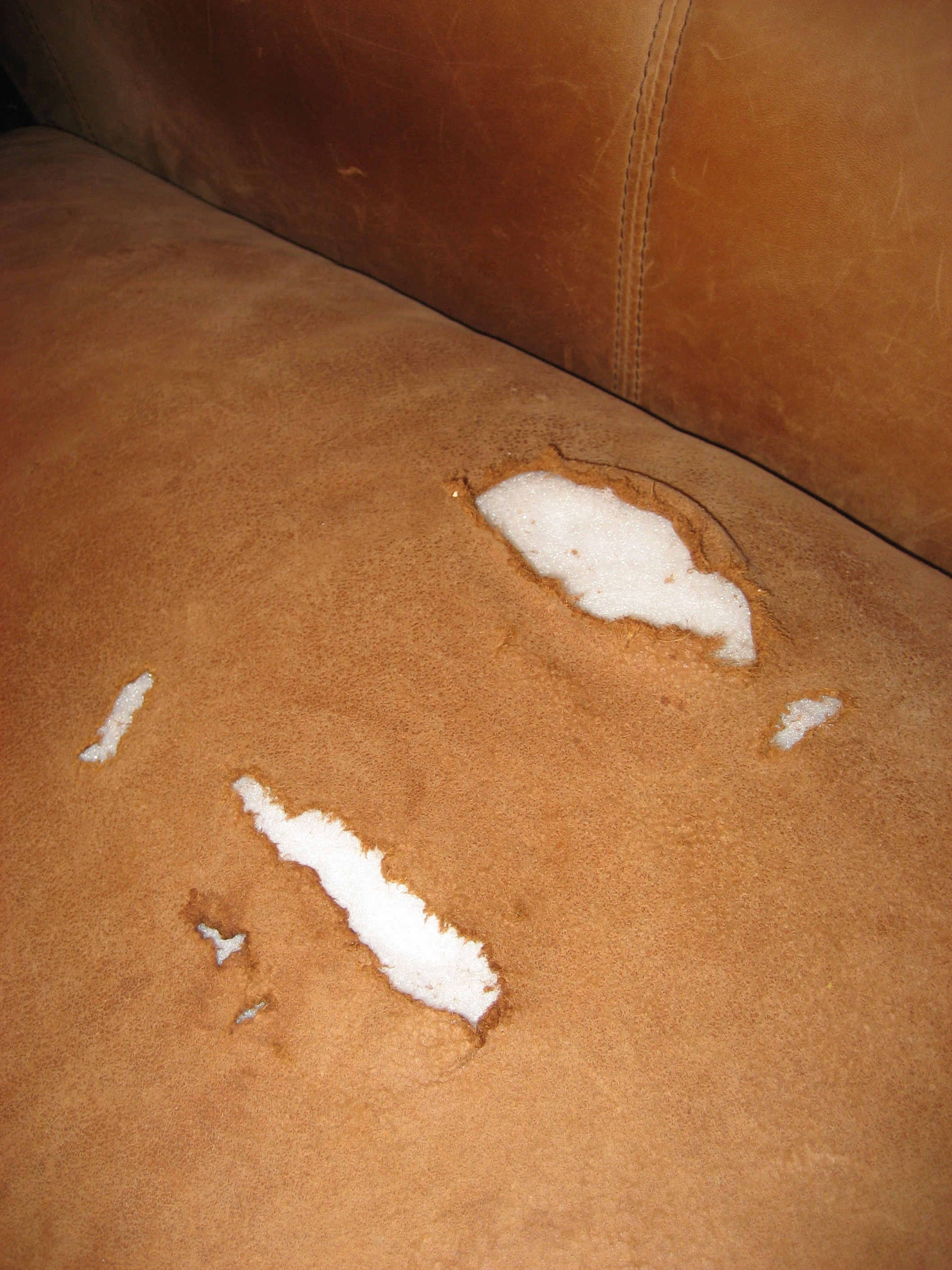
There is a point, of sorts, to this post, and I’m coming to it now. Probably due to a combination of years of Erick’s naps, scratching by our former cat, jumping by our daughters, and neglect by me, our good old living room couch started to die earlier this year. It started as a teeny-tiny hole, which became a bigger hole, which suddenly became three large, gaping holes spilling white fuzz. Even Erick admitted that it was time for a new couch.

A closer look at some of the holes.

Given the amount of wear-and-tear that our furniture takes in a day, it didn’t make sense to get anything too fine to replace our old couch. So, based on a quick calculation of what would be cheap but durable, look nice but withstand three kids, and simplest for me (a combination of easy to find, quality assured, and delivered to my door), we settled on a basic light brown slip-covered couch from Pottery Barn. It arrived last month, and it looks great.

The new couch!

The ridiculous thing is that we now have three couches in our house — four if you count the loveseat. (Which is probably what I deserve after years of trying to keep life simple and downsized, and for probably judging people who live in big houses and own a lot of stuff just a little too harshly). This plethora of couches might just be the solution to our jumping problem, however. (Aside: Does anybody else out there have trouble using the word “plethora” without hearing El Guapo from The Three Amigos: “What ees a plethora?” Anybody?!? Besides my dad, I mean?)

So, here’s the plan: the old couch, the one with the holes in it, will be moved up to the rec room the next time we have family or friends visiting (family or friends who haven’t already broken multiple bones helping us with house projects, that is), where it will become “The Jumping Couch.”  All other couches in the house, especially the new couch, are “No Jumping Allowed” couches. This has been clearly explained to the girls, who seem to understand. Fiona even proclaimed that the new couch was “too hard for jumping — you’d break your head on it!”

Out with the old, in with the new.

I hope this works, or else I’m going to start researching child-sized Scat Mats.

Crafty, Continued…

So as not to leave a narrative thread dangling, I want to follow up on my original post about my efforts to become more “crafty”  by sewing a birthday dress for Fiona.

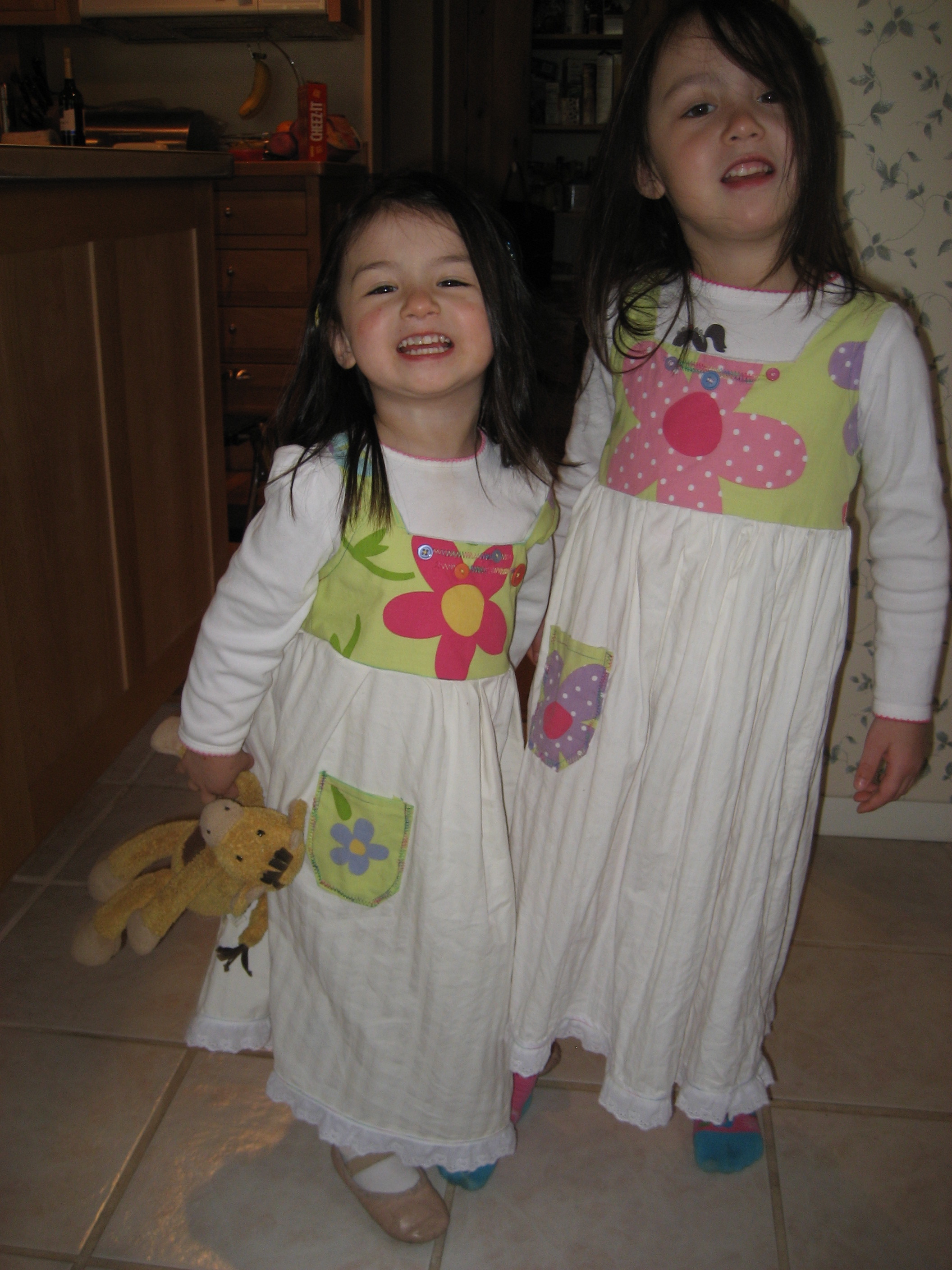
As it happens, I did succeed in sewing a dress for Campbell out of the remaining fabric.

Then, with winter winding down, I figured my crafting would slow down, too. Dark, cold nights at the sewing machine would be replaced by light, warm nights sipping margaritas on the deck.

I was wrong. My crafty days were just beginning.

Four-year-old girls and fashion are a funny combination. It amazes me how opinionated and stubborn Fiona is about her wardrobe; what she deigns to wear or rejects as unwearable follows no logic that I can discern. This can be heartbreaking for parents who have bought or made special clothes. Case in point: the mother of one of Fiona’s friends sewed her daughter an absolutely gorgeous dress — this is a dress that I would wear in a heartbeat. Her daughter refuses to wear it.

As the mother of daughters, you learn not to take their fashion choices too personally.

Fiona has loving and generous grandparents, and she’s also benefited from the generosity of friends here in Vermont who pass along clothes from their older daughters (figuring that, in our house, these clothes will get worn at least three times over). In other words, Fiona has a LOT of clothes for a little person. And I’d estimate that she wears about 1% of what’s in her closet.

A quick peek into the girls’ ridiculous (and horrifying) closet.

Fortunately, the dress I sewed for her made the cut.

Just as I’ve learned not to take the refusal to wear certain clothes personally, I also don’t take Fiona’s love for this dress personally. She wears her “pink Mommy dress” not out of any sentimentality over the fact that I made it with my own hands, or because it’s a unique one-of-a-kind creation just for her. No: she wears it because it’s the longest dress in her closet.

I used a 5T pattern for Fiona’s dress — a full size larger than what she’s currently wearing — because, frankly, if I’m going to the effort of sewing her a dress, that dress had better fit her for longer than 6 months. The dress does fit her, if a bit generously, but because Fiona is kind of a peanut for her age the skirt reaches nearly to her ankles. And the length of this dress happens to correspond with Fiona’s latest fashion goal: to popularize the maxi-dress for preschoolers.

Around the time of her third birthday, just about when life became all about princesses, Fiona decided to wear only dresses. And then, a funny thing happened: due to some curious combination of increased modesty and a desire to look as princess-y as possible, the acceptable hem length for these dresses became longer and longer.

They don’t make many long dresses for preschoolers, for the obvious reason that they’re completely impractical for running, climbing, bike riding, or most other preschooler activities. Then my dress showed up in the closet, and Fiona had suddenly found her fashion ideal.

“Fashion” joins “eating” and “Disney princesses/Barbies” on my (alarmingly) growing list of “Things Not Worth Fighting Over.” I don’t much care whether my girls match or look ridiculous; as long as they’re properly covered, my inclination is to let them make their own fashion choices. Being “properly covered” was not an issue with this dress; what became an issue was the 72-hour stretch during which Fiona refused to wear anything else. At all. She’d sleep in the dress, and then wake up and announce that she was going to wear the dress to school. At bedtime that night, she’d insist that the dress wasn’t dirty and was her only choice for sleepwear.

Clearly something had to be done.

So, I made another dress.

I used the exact same pattern, so that the skirt length would match. And I’m particularly excited about the fabric, which is recycled/found material from our house: the top is from the pillow shams that came with the girls’ bedding set (our family doesn’t do pillow shams), and the skirt is made from the duvet cover that Erick and I have used since we were first married, but recently replaced due to massive holes that kept tangling around our feet while we slept.

The plan worked: now, Fiona rotates between the two dresses. There was just one thing left to do:

Make a matching dress for Campbell.

How to Talk to a Mom

Since becoming a mom, I have become a terrible conversationalist.

As with anything I write here, I can only speak for myself. So this may be particular to a mother of three young children who is a recovering social perfectionist, doesn’t work outside the home, and has moved cross-country within the past year. I’m also not sure that I was a master of sparkling conversation before having children. I can’t remember those days very well; if I had to guess, I’d say I was only average with the chit-chat back then.

Which is much, much better than what I am now.

If you attempt a conversation with me these days, you will find me in one of two modes, neither of them eloquent. Whichever mode I’m in depends entirely upon external circumstances: whether or not my kids are with me.

Scenario #1: The Kids Are With Me.

I will be able to have, at most, two minute blocks of uninterrupted conversation with you. I will probably never make eye contact; instead, I’ll be scanning the room continuously to make sure I keep tabs on all three children. My side of the conversation will go something like this: “Uh-huh… yeah…. Excuse me just a minute. Campbell, SHARE!… Sorry, where were we?… Oh, right….Excuse me. Fiona, I’m talking with a grown-up. Just a minute, please…. So, wait, you were saying…? Oh, yup….Sorry, hang on. Oh, Georgia, what’s wrong?”

And so on. The conversation will end in one of two ways: either I’ll become engrossed in our conversation and establish eye contact for four seconds, in which case I will inevitably lose one of the kids (Campbell) and have to excuse myself to search frantically for her, OR one of the kids will have a complete melt-down (this is more likely the closer it gets to mealtime) and I’ll have to make a quick exit with a screaming child. I will smile apologetically and say, “I’ll catch up with you later.” (“Later,” I believe, is code for “in about five years”).

Scenario #2: The Kids are NOT With Me

This is a very rare occurrence. These days, this scenario applies mostly to occasional Moms’ Nights Out, or to doctor appointments. You’d think that being free of the kids, free of distractions, would liberate me to spread my wings and emerge as a conversational butterfly. Not the case, unfortunately for you.

First of all, I’m used to conversations that have to be crammed into two-minute time slots. It’s like eating: I usually bolt down my food as quickly as possible in order to deal with the numerous crises that happen every meal with three children, but if I’m eating without my children, I still bolt down my food in a matter of seconds. It’s become a habit. The same habit applies to conversation: I’m used to rushing in order to get the most conversational bang for the time I have, so even without children around I talk waaay too fast. And I start to feel panicked if the conversation extends beyond two minutes.

Also, you may be the first adult, aside from my husband, whom I’ve spoken with in over a week. (Not counting harried two-minute exchanges with other moms or brief pleasantries with check-out clerks). If we’re standing face-to-face and I’m looking you in the eyes and none of my kids are on the premises, this is an Event. And I have so much to say; all of the me that I can’t share with my kids will come gushing out like a horrible case of verbal Montezuma’s revenge. I can’t help it. I suspect that this is why so many moms have blogs: so they’ll have an outlet for those spillover thoughts and will talk less in social situations. It kind of works.

Finally, I’m really tired. I can’t claim that mind-numbing exhaustion that you have with a newborn; I’m fortunate that all three of our kids now sleep through the night. But I’m still really, really tired. Which just exacerbates the speedy talking, the verbal runs, and possibly some bizarre comments or tripping over words, because I’m lacking my full filtering capacities.

So, How to Talk to a Mom?

First, even if all of the above scares your pants off, you definitely should talk to moms. Because it’s a nice thing to do. Moms are usually starved for conversation with other grown-ups. Look at it as your act of charity for the week. But here are a few tips to get you through it:

1. Be patient, merciful, and understanding. Remember that you’re talking with someone who’s used to having to rush through all interactions, who may not have had a sustained social conversation with another adult in quite some time, and who is probably exhausted. If the mom rattles on or overshares, give her the benefit of the doubt.

2. Don’t feel like you have to ask about the kids. If you ask me about my kids, I’m going to have to tell you about my kids. And that might become a conversational snowball, rolling downhill out of my control. I can tell you a lot about my kids, but while I’m doing it I’ll be feeling horrible remembering how much I used to hate having to listen to other people talk about their kids (before I had kids, of course). So, I promise that I won’t be offended if you don’t ask about my kids. And I’ll be delighted if you treat me like any other normal person who thinks about things other than her kids. Because I do. Ask what I’ve read lately, ask about current events, ask about my vacation plans, whatever.

3. Talk about yourself. These days, if you ask me about what I’ve read lately, current events, or my vacation plans, I may have nothing much to say. In this case, I suggest that you talk about yourself. Usually, talking too much about oneself is frowned upon in social situations, but talking with a mom is an exception.  I say: Please feel free to rattle on about yourself. Give me the whole monologue — you’ll be doing me a favor. In talking about yourself, you’re taking the pressure off of me. I won’t worry about talking too long or too fast or too much about my kids if I can’t get a word in, and I’ll feel like I’m doing a swell job holding up my end of the conversation by just smiling, nodding, and asking the occasional question. I may be fascinated by what you’re saying, or I may zone out and plan what I’ll make for dinner the next week, but either thing is a gift to me.

Okay, then. I’ll catch up with you later!