Like most parents of young children, my husband and I block out the days between Christmas and New Year’s Day — dates that correspond roughly with the school winter vacation. During this two week period, we set aside our to-do lists, check email less frequently, and abandon our typical schedule in order to devote ourselves to more sacred pursuits, like celebrating the birth of Jesus, decorating candy canes to look like reindeer, and breaking up sibling quarrels that erupt every five minutes over nothing at all.
I never return to my to-do list so enthusiastically as I do when school resumes after the holidays. Buoyed along by the fresh energy of the new year, I’m ready to accomplish things that have nothing to do with whether the Calico Critters are distributed justly. Rarely am I so content to stay indoors and catch up on correspondence, tackle home improvement projects, and cook gallons of soup.
This new year, my husband wanted to tackle something that’s been on his to-do list since 2011: He wanted to fight radon.
This is a follow-up to my “Fall Cleaning” post a couple of weeks ago, in which I mentioned that, as part of an uncharacteristic burst of domestic energy I’ve had this fall, I was planning to work with my daughters to create brighter artwork for our walls.
I did. I dove headlong into my home mania and ordered a large blank canvas from Amazon. (If you don’t live in Vermont, chances are you have an art supply store within easy driving distance and don’t have to support massive, evil, online retailers. I do not have that option.) I bought a fresh pack of Crayola’s Washable Kids’ Paint from the grocery store. There were exactly six colors in the box — one for each member of our family. Perfect!
Armed with these simple materials, I was ready to make my vision a reality. I used pencil to trace the outline of a heart on the canvas. My vision was to have each member of our family — our four girls plus my husband and me — dip their hands into a different color of paint and make two colored handprints on either side of the heart. The finished product would be a heart shape outlined neatly by our family’s handprints.
I decided to start with our youngest child, 17-month-old Abigail (paint color: orange.) She’s the wiggliest, so I’d get her out of the way first. I scooped her up and dipped her palms into the pool of orange paint that I’d poured onto a paper plate. She looked at her hands, looked at me as if to say, “What are you doing???,” then balled up her fists and started yelling. I tried to pry open her palms and press them onto the canvas: no dice. She was all resistance. After a few fruitless minutes, I had two orange blobs up at the top of our heart.
Not an auspicious beginning, but not a huge problem. She’s the baby; one day, we’ll point to those blobs and laugh about her paint panic (this from a child who ends every meal covered with food — I don’t get it.)
Next up was daughter #2: five-year-old Campbell (paint color: yellow.) Campbell was enthusiastic; so enthusiastic that, after making her first two handprints on the heart, she re-dipped her hands in the paint and — before I could stop her — smeared yellow around the inside of the heart.
“No, Campbell, that’s –” I began, then stopped myself. Almost seven years of parenting to get to this point, but at that moment I realized that this was no longer my project. And that was okay. This was a family effort, and if my family wasn’t behaving according to my perfect plan, I’d just have to roll with it.
So I stood by and watched while Campbell made several more sets of handprints around the canvas, until she was satisfied.
Then came Georgia, three years old, who’d be adding red handprints. Her preschool does a lot of handprint art, so I was dealing with a pro. She dipped her hands neatly into the paint, wiped off the excess, and made multiple sets of beautiful red prints across the canvas.
Six-year-old Fiona approached the canvas and wailed, “They didn’t leave any space for me!” When I pointed out the few white patches still visible, she dipped her hands into the purple paint and got busy making her mark, proudly smearing purple around and over everyone else’s prints like a true firstborn.
Our artwork no longer bore any resemblance to a heart; instead, it was a big, colorful, smeary mess of handprints. But I wasn’t giving up: two grown-ups to go. So, Erick and I used our handprints (green and blue, respectively) to trace out the original heart on top of the girls’ impressionistic prints.
Here is the result:
I stood back and looked at our artwork, and it wasn’t at all like my original vision. It was perfect: The perfect representation of our family. There are Erick and I, trying with love to give some shape to the chaos. And the chaos itself: these colorful, exuberant, uncontainable girls. Showing me how lack of control is more beautiful than perfection.
Fiona thought we should write a Bible verse in the middle of the heart, so in light pencil I inscribed her favorite verse: “With man this is impossible, but with God, all things are possible.”
Which is also a very accurate representation of our family.
I’ve never really felt the compulsion to do “spring cleaning,” unless spring happened to coincide with an upcoming move or the arrival of a new baby. I understand the point of it: You’ve been cooped up in the house all winter, and once warmer weather arrives you direct a burst of energy at the house in which you’ve been imprisoned. Time to open the windows, shake the rugs, clear the cobwebs!
Because I live in a climate that’s subject to dramatic temperature swings, from sub-zero winters to 90-degree summers, there are certain seasonal tasks to be done; spring is when I put up the screen doors, remove the plastic insulation from my daughters’ bedroom windows, set up outdoor furniture and planters, and do a final sweep around the now-cold wood stove. But these are chores, and I do them without enthusiasm while steeling myself for the approaching summer “vacation,” knowing I’ll spend the next three months refereeing sibling squabbles, shuttling four girls to various activities, and applying sunscreen to squirmy little limbs.
So I’m not inspired by spring cleaning. But this year, I had a burst of home-focused energy that began in September, a couple weeks after the start of school, and is still going strong. I think of it as “fall cleaning.”
I should probably clarify, right here and now, that my version of fall cleaning has very little to do with what the average person defines as “cleaning.” I’m not talking about the type of cleaning one does with sponges and rags and chemicals. I’m talking about making one’s living space more beautiful and comfortable.
Fall cleaning makes a lot more sense to me than spring cleaning. In spring cleaning, you’re essentially beautifying a space in which you won’t spend much time for the next several months. Sure, detritus has built up over the winter and everything needs a good airing-out, but chances are that you’ll be out in the yard or at the pool, lake, or beach more than you’ll be indoors, so who really cares?
Fall cleaning is preparing the space in which you will be shut up for the next several months. Who wouldn’t want to make their cell a little more comfortable?
So I’ve been giving our house a critical eye, and applying my energy to making it a place where I’ll enjoy spending most of my time over the winter months, often in the company of four small children.
Here’s what my fall cleaning does not involve:
1. Lots of money.
2. Major projects.
The primary reason I’ve ruled out both of the above is the reality of life with four small children. Why spend large amounts of money and time making significant improvements to our house, when our daughters will undo them in seconds with the swipe of a marker, a sudden spill, or a misdirected ball?
Instead, here is what my fall cleaning has involved:
1. Small touches to make the house more bright and fun. Winter is dark. Our house is in the woods, and gets very little light. Most of the interior walls, ceilings, and floors are exposed wood in the “post-and-beam” style. It’s suddenly occurred to me that there are very small things I can do to brighten our house. This winter, I’m painting two large pieces of wooden furniture, which will lighten them and the rooms in which they reside. I’m going to work with my daughters to create brighter, more colorful artwork to hang on the walls. I replaced the dingy old white duvet cover on our bed with one in a bright pattern. And I finally got some new light slipcovers for an ancient couch and chair that have been spilling their upholstered intestines for over a year. (Slipcovers, I figure, can be light, because I can always wash them.)
2. GETTING RID OF STUFF! More than all the small decorating touches combined, the major reason why our house feels dark and cluttered is because it’s got too much STUFF in it. Again, the kids are a major factor here: all of their toys, their artwork from school, their books, their “craft projects,” and the little pieces of junk they pick up at birthday parties and doctors’ offices and arcades…it piles up. Back when I had only one child, I heard parenting advice that went like this: Your house is not the kids’ house — it is YOUR house. Your children are guests in YOUR HOUSE. Their stuff must stay within a small, designated area rather than taking over YOUR HOUSE. It seemed so reasonable at the time; now, I say, “Yeah, right!” Houses are set up to serve their inhabitants; there are now twice as many children as adults in our house, so whose house is it, really?
Without giving up my parental authority (i.e., I still nag them about cleaning), I’ve given up on trying to make our house look like only grown-ups live here. There are signs of our daughters everywhere, as there should be at this stage. But I have not given up on waging war against stuff; this fall, I’ve been merciless. If anything is broken, it’s out. If it hasn’t been played with in over a year, it’s donated. If it’s small, plastic, and not a Lego, its days are numbered. And, finally, now that we’ve had our last child (I hope), I’m donating clothing the second our youngest outgrows it.
I love, love, love getting rid of stuff!
This burst of domestic energy is not like me. (Did I mention I’m also sewing dresses for my three oldest daughters???) I’m assuming it won’t last; I’ll spend some months brightening and painting and throwing things away, and then revert to my lazy habit of writing a blog instead of paying attention to my house. I can’t account for this change, other than to say that it’s fall cleaning, or maybe the fermenting leaves in our well water.
****
I rarely promote things on this blog, but The Nesting Place by Myquillyn Smith has been a major inspiration to me as I’ve been fall cleaning. It’s an easy read with lots of pictures, and it’s basically a decorating book for domestic imperfectionists. Highly recommend.
I’m an ambivalent gardener. This stems from my upbringing: As the only child of parents who have Miracle Gro running through their veins, I grew up observing the obvious pleasure that gardening bought my parents, along with the beautiful results. Weekends at our house were often spent in the backyard, where my parents’ tireless weeding, mulching, planting, and cutting turned our suburban acre into a verdant paradise.
On the other hand, I spent a lot of time playing alone in that backyard, breathing in the fertilizer fumes, and I may have resented — just a tiny bit — the time that my parents spent focusing on the flowerbeds when they could have been driving me to the mall.
Since our family moved to Vermont from more urban environs, I’ve often thought — and sometimes said — “It’s wonderful to live in a place where our children can see a variety of wildlife in its natural habitat, where the animals around us aren’t limited to those that managed to survive having their environment paved over and built upon.”
I say this during the magical moments when my daughters are catching toads in our yard, or when they spot an owl in a tree across the street, or when a doe and her fawn run right in front of us. I find it harder to say when my husband is emptying the 857th mousetrap, or when I’m digging a deer tick out of my child’s back, or when the smell of close-range skunk drifts through the bedroom window at night.
You take the bad with the good.
Like the other day, when I entered my husband’s home office to put our one-year-old daughter down for a nap in the playpen where she’d been sleeping because we’d had weekend houseguests. The shades were pulled, the room dim, but out of the corner of my eye I saw something that made me think, “What a large moth!” As the thing reversed direction and came straight towards me, I thought, “That’s no moth, that’s a BAT!”
In two weeks, my parents will move to Vermont from the town in Northern Virginia where I grew up, their home for 37 years.
More on that later; for today all you need to know is their new front door in Vermont needs work. Everyone – the real estate agent, the sellers, the contractors they consulted – agreed that the door should be repainted or replaced, and that the doorstep needs to be repaired.
My parents told me about the front door as they were listing all of the work to be done on their new Vermont house, which isn’t really “new” at all; it’s a 1928 beauty that requires the kind of upkeep you’d expect of an 86-year-0ld house. But when they mentioned the front door, I said, “Don’t worry too much about that; nobody’s going to be coming through your front door, anyway.”
In my previous “Faith in Vermont” column, I wrote about the sickness season that’s hard upon us. This time of year is also mouse season; as the weather turns colder, the mice peek out of their frozen burrows at our warm, well-lit house and think, Heyyyyy! That’s not a bad idea! The Gong residence gets mice year-round, but this past month we’ve been catching almost a mouse a day in our mudroom, which is apparently some sort of mouse superhighway.
I have issues with mice. Not to be overly dramatic, but: The WORST thing about living in Vermont is that there are mice here. Lots and lots of mice.
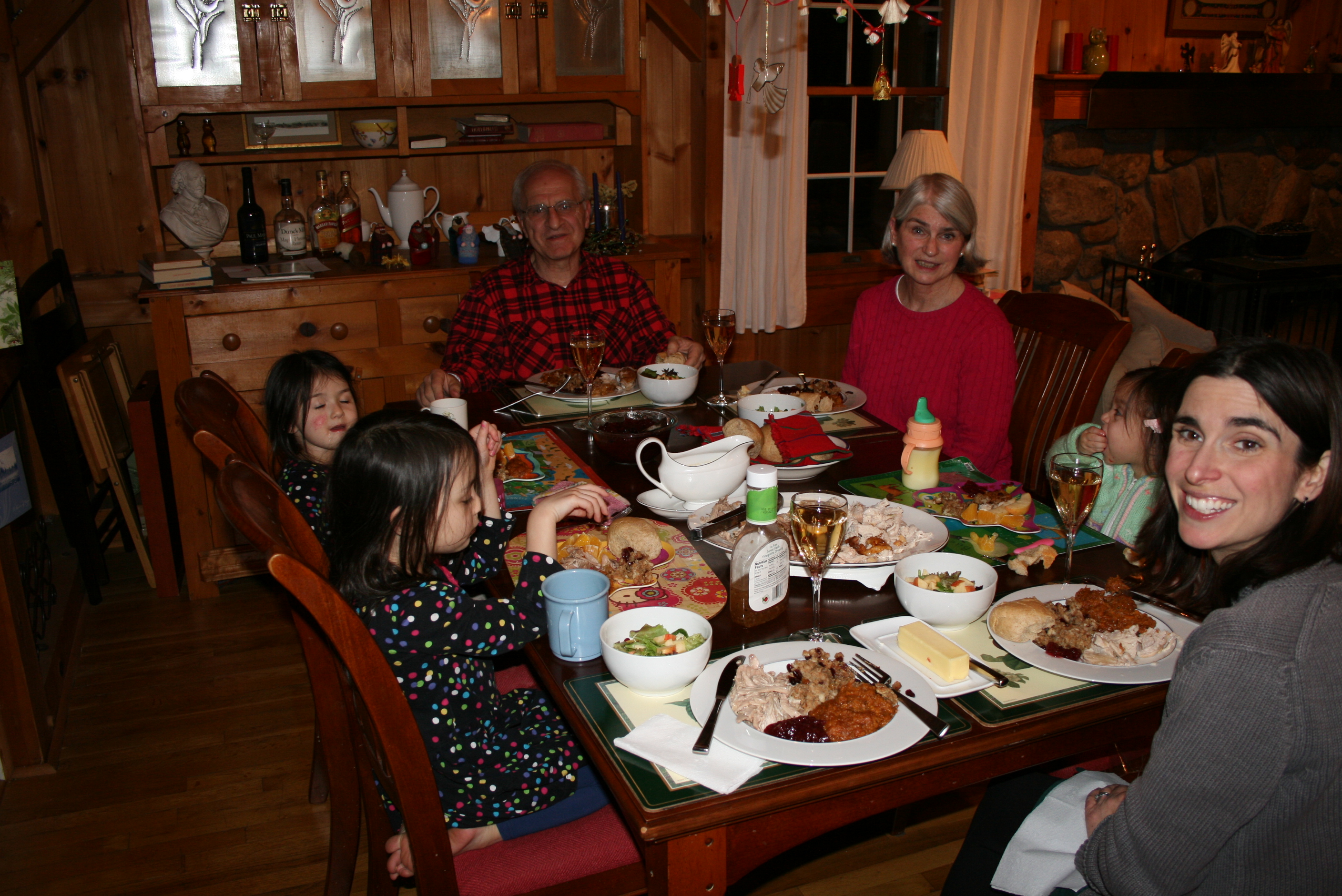
Last Christmas: Everyone scrunched around the old dining table.
Now that I’m at home with four children in a climate that sometimes keeps us housebound, I’m grateful every day for our house. When Erick and I worked with Habitat for Humanity in Tanzania, their motto was: “Nyuma ni Mama,” which is Swahili for “A house is a mother.” I never really thought about what that meant until I became a mother and bought a house in Vermont; now I realize that our house performs much the same functions for our family as I do: it shelters us, and by its very layout it guides our activities and helps shape our family culture.
If a house is a mother, I think that the beating heart of that house is the dining table.
All of which is a wordy and roundabout way of getting to this point: We have a new dining table!!
In Chinese culture, it’s typical to get generous amounts of cash as wedding gifts. After Erick and I were married, we took our wedding cash over to Macy’s and used it to buy two things: an oversized armchair and a dining set. Both purchases were made quickly; we just needed a place to sit and a place to eat in our new apartment. We had no vision of a future in which we’d live in a house and have children, so we took neither scenario into account when making our selections.
The dining table we chose seemed absurdly large: It came with six upholstered chairs. It wasn’t exactly “real” wood, but had a dark cherry finish. Eleven years later, the seat cushions bore crusty stains from our girls’ daily spills, the dark finish showed every fork gouge, and six chairs were only enough to seat our immediate family.
Remember that oversized armchair that we bought at the same time as the dining table? Eleven years later it, too, wasn’t looking its best. I even wrote about it here. The cat we’d had when we were first married had scratched up its base, Gracie the dog lay across its top whenever we left the house, our children had contributed numerous food and marker stains, and both arms were ripped and spilling stuffing.
That was liveable. Then I cut Gracie’s nails.
(Okay, clearly this whole post is going to be kind of wordy and roundabout. Brace yourselves.)
I cut Gracie’s nails because they had gotten so long that whenever she walked within six inches of one of our girls, they’d collapse on the floor wailing, “Gracie scratched me!” (We raise ’em tough around here). I don’t cut her nails often (obviously), so I failed to realize that cutting a dog’s nails is very different from cutting a cat’s nails. When we had a cat, I’d pin her down and chop away. Dogs’ nails have capillaries running through all but the very tip. So I cut Gracie’s nails — not too short, in my opinion — and she seemed fine and went about her business. But then I noticed pools of blood on the floor.
I mopped up the floor and Gracie, and then rushed off to pick up one of the girls from school. Another failure: I should have also bandaged Gracie’s paw. When we returned home, it looked like somebody had been murdered in our armchair: blood everywhere. Gracie had laid across the top, as is her habit, and licked at her cut nail until it opened up again.
Thankfully, my mother was visiting that weekend. If you know my mother, then you know that she can clean anything. (If she’d been alive back in MacBeth’s day, that play would have had a very different ending because Lady MacBeth wouldn’t have gotten all hung up over any “damn’d spot.”)
So, my mother worked her magic and got the blood out of the upholstery. Then she said, in her tactful Mom way, “Isn’t there somewhere we could go to look for a new armchair?”
In most places in the U.S., that would be a simple question to answer. But remember, we live in Vermont. There are no Ikeas or Crate & Barrels in this state. (And the few times I’ve attempted to order Ikea furniture online, the shipping costs exceeded the price of the furniture). There are furniture stores in Vermont, but to reach most of them I’d have to drive at least 45 minutes, at which point I’d just have to sit down and feed the baby. And even if I found a replacement armchair, I’d probably have to spend a lot of money to buy it and have it delivered 45 minutes away.
But then I remembered that a friend had told me about a used furniture store the next town over. I looked it up on Google, searching under “Vermont used furniture.” I was not at all hopeful, but there it was. Turns out its name is “Vermont Used Furniture,” it was a 15 minute drive away, and it was open right then.
Still not particularly hopeful, I agreed to check out Vermont Used Furniture, mostly because I love my mom.
We pulled up at the “store,” which is more like a hangar in the front yard of the couple that owns and operates it. We walked in, and there was the armchair — the same dimensions as our old armchair, but a little fancier and without the rips and dog blood — priced at approximately 1/4 of what we spend on groceries each week.
I walked a little farther into the hangar, and there was the dining table. As soon as I saw it, I knew it was our table. It was a slab of solid pine, and it glowed. It was large enough to easily seat 8 (possibly 10), which meant it could accommodate our whole family, plus a couple of guests. I wasn’t even looking for a dining table, but it was priced so that, together with the armchair and a set of (uncushioned!) dining chairs, it cost us less than a new slipcover for the old armchair. The guy from Vermont Used Furniture delivered them both to our house for free, and even bought our old dining table off of us.
So, we have a new dining table, and it’s made both Erick and me happier than you might imagine. Remember what I wrote way back, about a dining table being a house’s beating heart? That’s because we all sit at the dining table together at least twice a day. It’s the only space in our house that seats all of us, and it forces us to look at each other. We share food and conversation at this table, both of which keep our family healthy. During non-mealtimes, Erick and I often work at the table, the girls have snack at the table, Fiona does her “homework” at the table, we read books around the table.
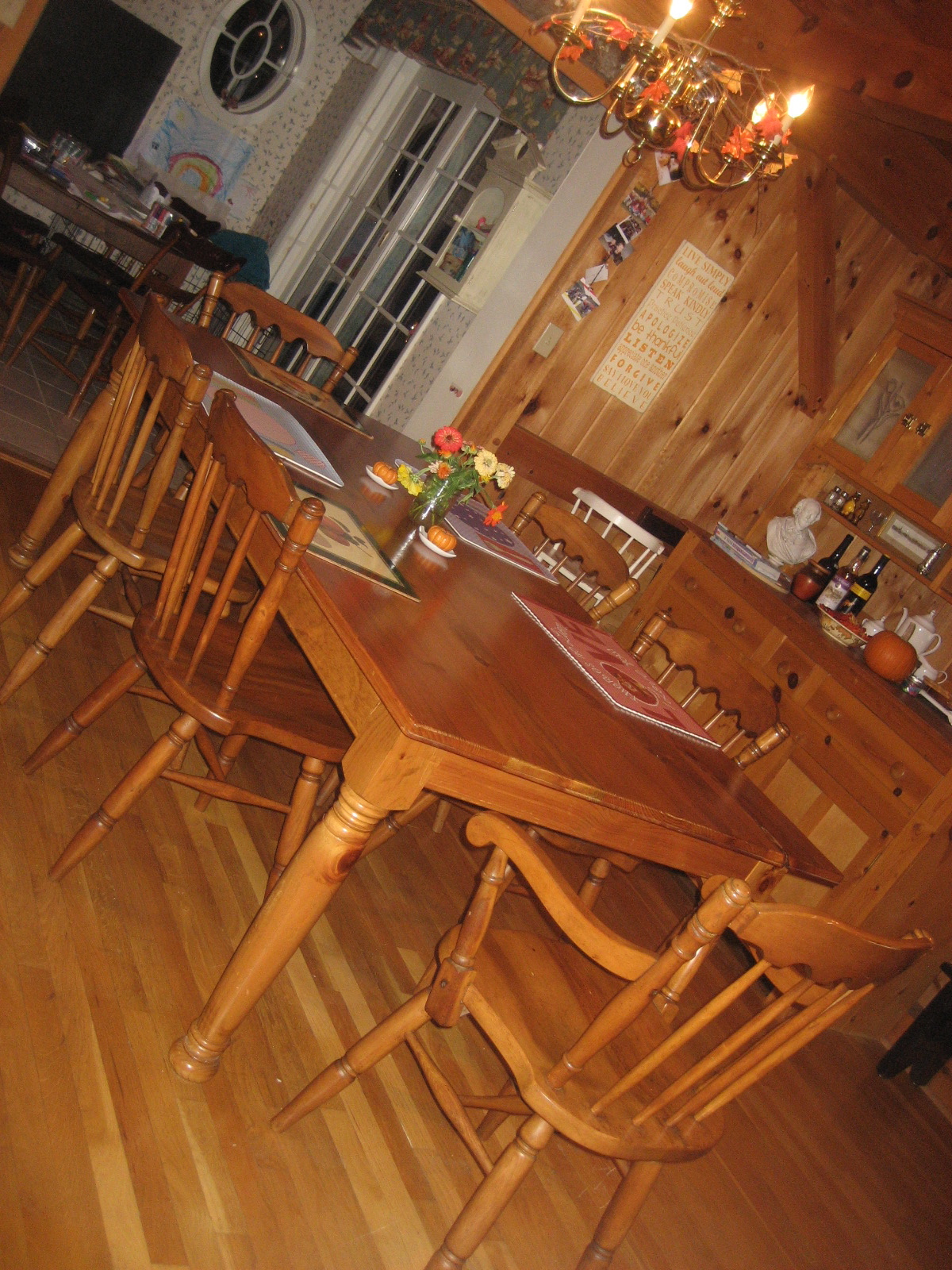
The new table!
I look at this dining table, and I see what I want our family to be. Sometimes (okay, MOST times) it’s still a struggle to keep all the girls seated for an entire meal, or to keep conversations from devolving into potty talk. But I look at our new table and imagine all of the life that will happen around it; it’s solid enough to be our table for the rest of our family’s time together. It’s not perfect; the wood has some knotholes and cracks, and pine is soft enough to show the inevitable marks that we’ll put in it. All of which is fine by me, because that’s also how I want our family to be: solid, but not perfect.
Shortly after we installed our wonderful new table, I sat across from the girls during dinner and said, “Girls, here’s a little advice for you: Someday you’ll probably settle down with families of your own. And when you do, the most important thing is to invest in a dining table that you LOVE.”
My daughters stared at me for a moment, and then they said:
This year, signs of fall started appearing in our part of Vermont around early September: splashes of colored leaves in the trees, the apple orchard open for business, the grocery store’s Back-to-School display gradually giving way to Halloween. The sunlight turned a deeper gold, and the nights became crisp enough to sleep under the comforter. As the month wore on, squirrels and chipmunks got busy in our yard laying aside acorns for the winter – and driving our dog to fits of frenzied barking at the windows. Channeling my own inner chipmunk, I started baking like a maniac.
The last week of September was glorious: the mountaintops were red-orange, and driving home each afternoon I felt like I was living inside a scenic Vermont calendar. Tour buses full of “leaf peepers” pulled into town; tour groups of fluorescent-spandexed bikers made driving backcountry roads an exercise in caution. The foliage wasn’t quite at its peak, but clearly we were in for some spectacular color over the next couple of weeks.
On October 2, I woke up and noticed that there were leaves covering the ground.
[Cue sound effect: brakes squealing as my fall euphoria turned to realism]. Oh, right…RAKING.
Shortly after the birth of our fourth daughter, with a brain grown mushy from sleep deprivation and a newspaper column deadline looming, I posted a plea on Facebook asking people to send me their questions, particularly questions about life in Vermont. I received a variety of responses, which I answered in the subsequent column.
But one astute reader sent this comment: Four little girls so close in age made me think about hand-me-downs.
Clearly this person understands. Because a major, daily facet of life with “four little girls so close in age” is The Clothing Situation.
You may assume that I’m talking about laundry.
Although laundry has now become something I do daily without thinking, like brushing my teeth, I am not talking about laundry.
There are two components of The Clothing Situation: Input and Storage.
INPUT
Let’s say you have a baby. Chances are that you get a large, up-front influx of clothes for that baby. These clothes come from friends and family as baby shower and “Welcome, Baby!” gifts. Some may also be hand-me-downs. All of this is great; you need baby clothes, and the apparel flood usually slows after a month or two.
But the grandparents keep going. If you’re lucky, you have some loving and generous grandparents who continue buying clothes for your child on a regular basis. This is helpful, because 1) your child keeps growing and needs new clothes long after the baby clothes are in storage, and 2) clothes are expensive.
So far, so good. But complications arise when you have the next baby. And the next. And the next.
Because with the birth of each new baby, you will again receive an influx of clothes (though fewer each time, it’s true) from well-wishers who say, “Thought it’d be nice for baby to have some clothes that aren’t hand-me-downs!” The grandparents will continue to buy clothes for Child #1, but they’ll also buy clothes for Children #2, 3, and 4, despite the fact that these children are all receiving hand-me-downs from the ones who came before. You can try telling the grandparents that Child #1 — the oldest — is the only one who needs new clothes, but they’ll ignore you and buy new clothes for everyone, “because otherwise it wouldn’t be fair.”
Now let’s assume that all of your children turn out to be of the same gender. Good news! That means they can all wear the clothes you’ve been receiving since Child #1 was born. You see where this is leading? By the time Child #4 comes along, she has four babies’ worth of clothing in her wardrobe!
Around this time, people with slightly older children of the same gender as your children will start to take notice. Hey, Faith and Erick have four girls, they’ll think. That means they’ll be able to use our hand-me-downs FOUR TIMES! Because you offer such good bang-for-the-buck, bags full of fantastic, gently-used clothing will begin arriving on your doorstep. (**We love these friends, and we’re genuinely grateful for these clothes!)
You may be thinking: But surely, by the time clothes trickle down to Child #4, a good many of them can be discarded due to wear and tear. It’s true that some of the baby clothes — particularly those worn around the time solid foods are introduced — become irreparably stained and have to be tossed. But if your children are anything like mine, each child tends to rotate through only four or five favorite outfits, and those favorite outfits are different for each child. So despite the clothing needs of four children, there are plenty of clothes in every size that have never, ever been worn.
To put it succinctly: We have a lot of clothes. And that’s where the storage problem comes in.
STORAGE
When Fiona was born, we bought a small bureau with a changing table on top. Simple and efficient: we stored her clothes in the drawers below, and changed her diapers above.
Then Campbell was born, and it made sense to store her clothes in the bureau, since we’d be changing her diapers on top. What to do with Fiona’s clothes? There wasn’t space in their small, shared room for another bureau. Also, Fiona was beginning to select her own clothes, which I wanted to encourage without having to deal with bureau drawers left open or pinching little fingers. My solution: I went to Target and bought some cloth bins — one each for tops, bottoms, pajamas, socks, and underwear. The bins fit perfectly into the bottom shelf of a bookcase, where Fiona could easily pull them out to grab her clothes.
When we moved to Vermont, the clothing storage problem followed us. Because our girls all share a room, they got the largest room in our new house — the former master bedroom. Because our girls all share a room, however, there still wasn’t space for additional bureaus. No matter: this room included one of the biggest closets I’d ever seen. I decided to continue my strategy of baby’s clothes in the bureau/changing table, big girls’ clothes in cloth bins.
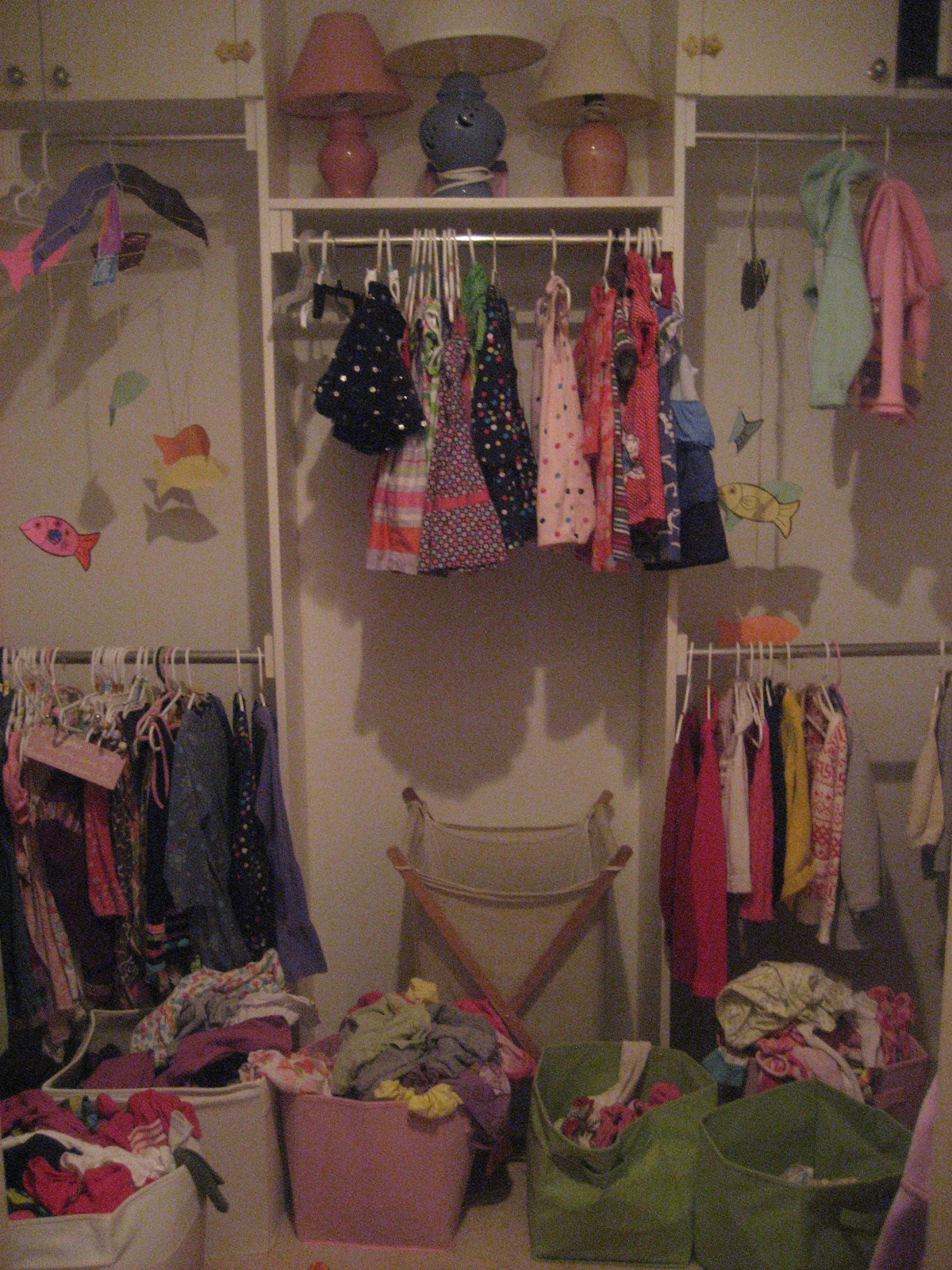
So now we have one child’s clothing in the bureau, and three children’s clothing in bins on the floor. Which is why their closet looks like this:
Mind you, those are just the clothes they’re wearing right now. What you don’t see are the storage bags filled with clothes that don’t fit anybody at this moment, or the garbage bags stuffed with hand-me-downs that are waiting for Fiona to grow into them.
There is no bigger point here; The Clothing Situation isn’t a metaphor for anything more meaningful. I freely admit that this is a very minor first-world problem. It’s just one of those things that I never anticipated when I signed up for parenthood; who knew that closet organizing would be such an important life skill?
I do have hope that things will improve. After all, we’re finished having children — and to make sure of that, I’ve already started donating all of our maternity and newborn clothes. As the girls get older, they’ll be able to stay in each clothing size a little longer. Before too long, all four of them will probably be able to share the same clothes, and then we’ll just have to deal with screaming clothing battles every morning….
In closing, a warning to any local friends who recently had/will have baby girls: I willbe dropping garbage bags full of clothes on your doorsteps in the near future. Be prepared.












 The Pickle Patch