Bring in the Noise

IMG_3095

Last spring, I was doing what I used to do before our town entered the 21st century and instituted online registration for recreation programs: standing in a serpentine line outside the town gym, waiting 30 minutes for the doors to open upon gymnastics registration. In retrospect, I look back fondly on the hours I spent in those lines; they were great chances to catch up with friends and to make new acquaintances. In this case, I was chatting with a friend, who then introduced me to a new acquaintance: a woman with four sons.

“Wow,” I said, “four SONS! I don’t know anything about sons, but I hear they’re harder to raise than daughters.”

“Well, sons are very energetic, very physical,” she said, “but I personally would find daughters much harder –“

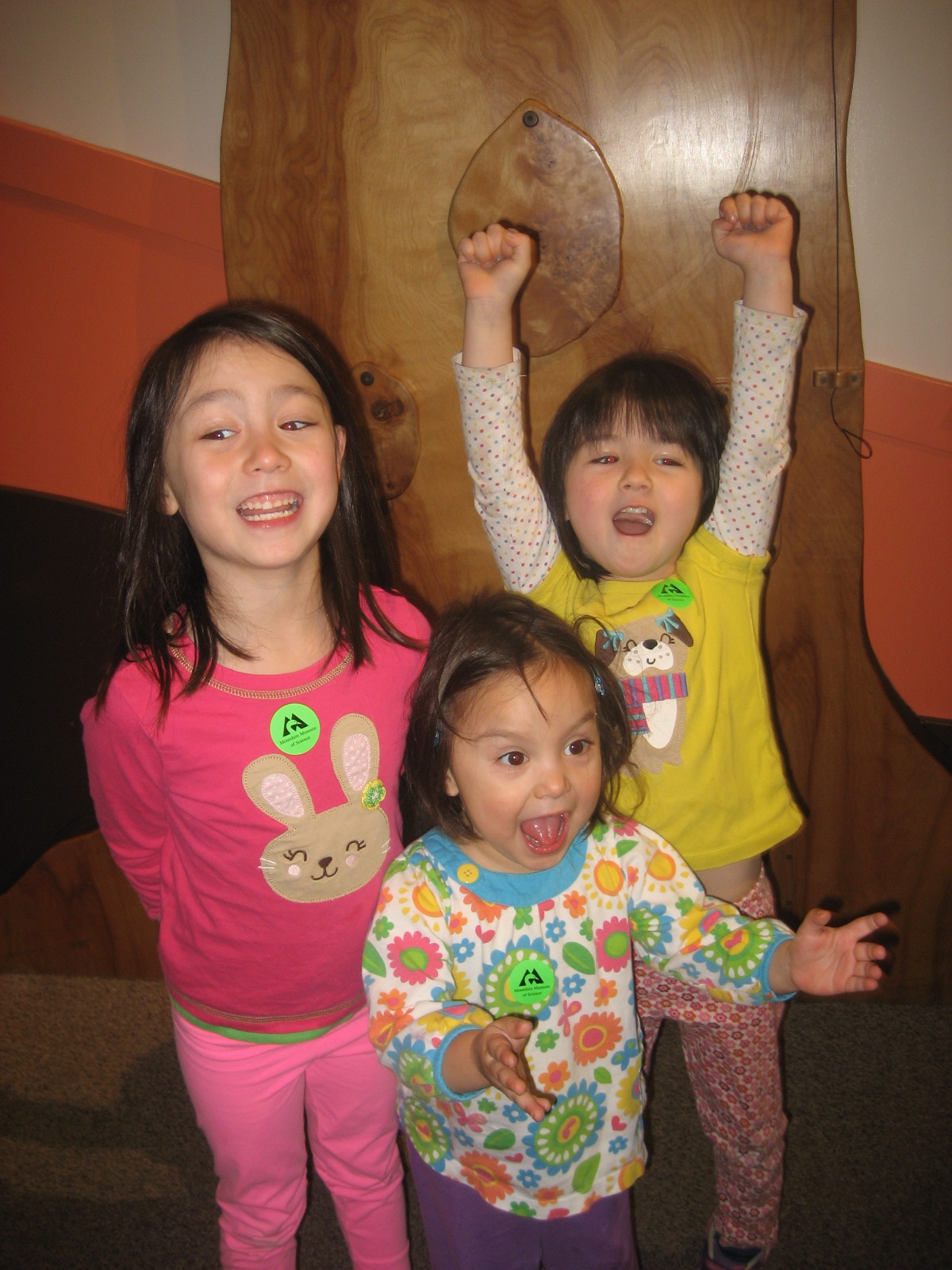
At just this moment, all three of my girls (Abigail still being in utero) came shrieking down the hall, doing their  best impersonation of an air raid siren.

“– for that very reason,” my new acquaintance continued. “The noise would drive me crazy.”

Now, I don’t put much stock in gender stereotypes. What I said to that woman is true: I don’t know ANYTHING about sons. My information about young boys comes mostly from observing my daughters at play with their male friends — and from what I can tell, my girls run circles around these boys. So I can’t say with any authority that boys are harder, or more energetic, or quieter than girls.

Here’s what I can say with authority: MY GIRLS ARE LOUD.

They scream. They scream with joy while playing, they scream at each other (and us)  in anger, they scream for no apparent reason — just for fun. And when they’re not screaming, they’re talking. They talk all the time, about everything. Also, because there are four of them, they’ve learned that they need to talk loudly.

Mealtimes at our house are probably just as you’d imagine: Four girls verbally elbowing each other to get a work in edgewise (even though Abigail isn’t using words yet, she still adds noise), ratcheting up the volume to make themselves heard above their sisters — and above their parents’ increasingly loud pleas to stop interrupting and take turns.

The problem is, even when they’re not jockeying to be heard, they’re still loud. It’s as if, due to the constant noise in our house, they’ve lost all sense of what a normal “indoor voice” is. So whether in a restaurant, a store, the library, or on the phone to their grandparents, my girls continue to shout. More than once I’ve said, “Please, you don’t need to shout,” only to have the daughter in question look at me with confusion and shout, “I’m not shouting!” During our conference with Campbell’s preschool teachers last year, her teachers reported — with disbelief bordering on concern — that Campbell had told the class that her house was “really quiet.” Campbell knows what “quiet” means, she’s just deluded about what it actually is.

I’m sure that most people in our town can hear us coming long before they can see us.

And that’s just when they’re being well-behaved. Then there are the fights. It may be that boys fight by beating each other to a pulp; my girls beat each other to a pulp while screaming at the top of their lungs. Kicking, biting, scratching, hitting, all accompanied by, “MOMMY! She’s not SHARING!” (The item not being shared is usually an equine-shaped piece of plastic from My Little Pony: Friendship is Magic. I’ll say it’s magic; ah, the irony!)

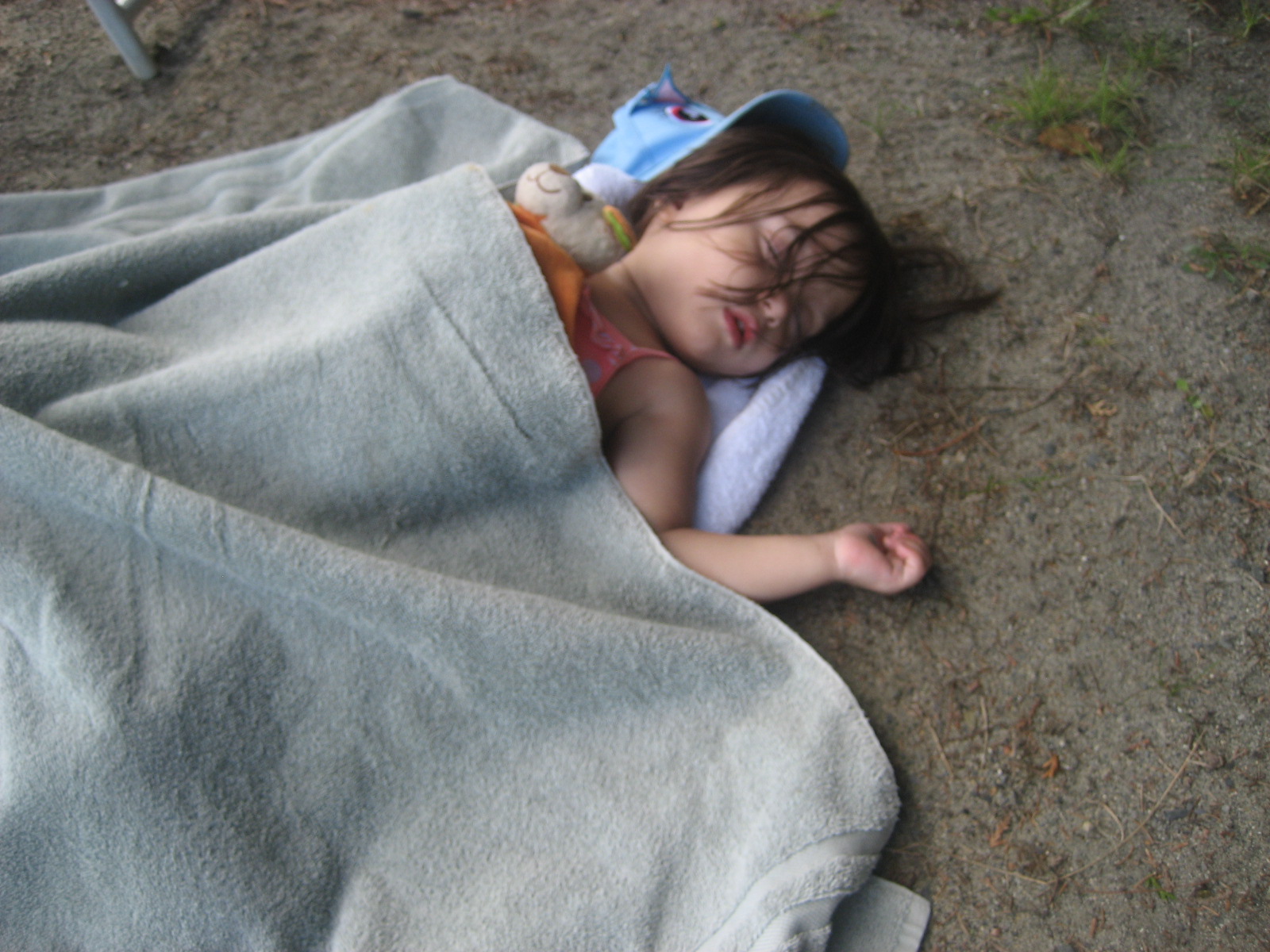
Even when they’re supposed to be quiet, the noise doesn’t stop. Since they all share a room, bedtime sounds like a college party in full swing until all goes abruptly quiet when they pass out from exhaustion (we’ve decided not to intervene as long as they stay behind closed doors).

Even when they’re alone, the noise doesn’t stop. There are moments during the week, when the older two girls are in school and Abigail is napping, that Georgia is all alone. Does she sit and play quietly? No. Instead, Georgia has taken to narrating her life. For instance, Georgia will say, “She takes out a book and sits on the couch. She looks at the book,” as she does just that. Yes, she refers to herself in the third person, like she’s providing the voiceover for an Animal Kingdom segment on herself. I’m not sure whether to be concerned, or to steer her towards a future career in reality T.V.

Even when they’re quiet, the noise doesn’t stop. Usually they’ll stop talking after a while in the car (especially on these cold, grey winter days when the heat is turned up), but they always want to listen to music. These days, their music of choice is the soundtrack to the Broadway production of Annie. At first, I welcomed this as a relief from the Disney Princess CD that we’d played on repeat for years, but I’d never realized how much of Annie consists of prepubescent girls shrieking songs at the top of their lungs. At least, those are the only songs we listen to — we’ve never listened to the entire show all the way through, because my daughters insist on “‘Tomorrow,'” and…”‘Tomorrow,’ again!” until I’m about to lose my mind. It’s only a day A-WAY! PLEASE, make it STOP!!!!

For all these reasons, we’re not big on toys that make noise. But sometimes they’re impossible to avoid, like when they’re given as gifts. Last Sunday, one of my daughters unearthed a little fuzzy duckling that says, “QUACK QUACK QUACK QUACK!” when you squeeze its belly — a gift to one of the girls when she was a newborn. Somehow, this duckling made it out of the house, into the car, and into church, where the girls sit with us for the first part of the service. Of course, right in the middle of the offertory prayer, the duckling got squeezed. QUACK QUACK QUACK QUACK!

But I’m told that we’ll miss the noise when the girls are grown and gone. I’m told by no less a parenting authority than Brad Pitt, who said in a May 21 interview to People magazine:

“There’s constant chatter in our house, whether it’s giggling or screaming or crying or banging. I love it. I love it. I love it. I hate it when they’re gone. I hate it. Maybe it’s nice to be in a hotel room for a day – ‘Oh, nice, I can finally read a paper.’ But then, by the next day, I miss that cacophony, all that life.”

As I write this, with all my girls at school or napping and my ears still ringing from the noise of an hour ago, I think: Spoken like a person who gets to spend lots of days reading the paper in hotel rooms, Mr. Pitt.

But I’m sure he’s right, and so when the ringing in my ears subsides just in time for the girls to wake up again, I’ll try to enjoy the noise while it lasts.

Channelling the Oyster

IMG_3017

October in Vermont this year was stunning: warm, with temperatures hovering around the 70s, and fairly dry. This year we also seem to have hit a sweet spot for taking nature outings with our girls: Our two oldest can hike on their own with a minimum of complaining; our baby can be toted around easily in the carrier. Georgia alternates between running headlong into the nearest puddle (or off of the steepest cliff), and needing to be carried — but one out of four ain’t bad.

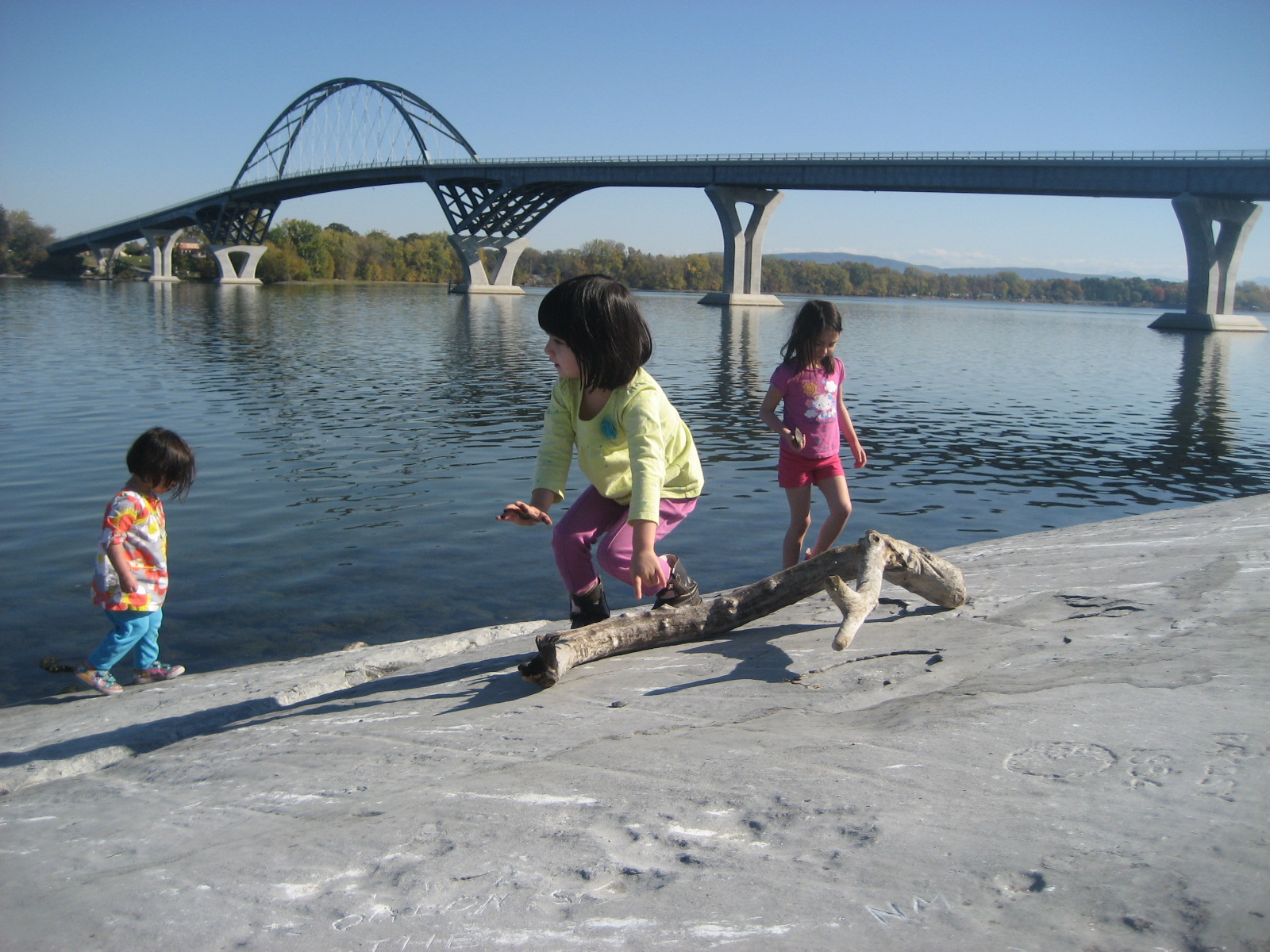
So on a warm, sunny October weekend, when the foliage was at its peak, we headed west along Route 125 and crossed the Lake Champlain Bridge for a picnic at New York’s Crown Point Historic Site. Crown Point boasts the ruins of 18th century French and British forts, stunning views across Lake Champlain, and a small strip of beach littered with mussel shells.

Our girls went right for the beach, where they started a frenzied mussel shell collection effort. The goal was to find mussel shells that (1) were “angel wings” (two shells still attached on one side), and (2) contained pearls.

We found plenty of angel wings, but no pearls (freshwater mussels sometimes DO make pearls, but it’s a rare occurrence). The pearl hunt was inspired by a Magic Tree House book we’d recently read (#9, Dolphins at Daybreak, to be exact). These days, the Gong girls are all about the Magic Tree House series, in which Jack and his sister Annie travel through time and space in — you guessed it — a magic tree house. Each book includes facts about nature or history, and in this particular book we’d all learned how oysters make pearls.

I write “we’d all” learned, because although I’m sure at one point in my life I’d been told how pearls are made, I’d forgotten until I found myself reading about it to my girls.

So in case you, like me, haven’t contemplated the pearl-making process in a while, here it is:

Pearls are made when some foreign substance, like a grain of sand, gets in between an oyster’s two shells. In order to avoid irritation, the oyster coats the intruder with layers of a mineral called nacre; as those layers build up, a pearl is formed.

Is that the most awesome thing you’ve ever heard, or what?!? I don’t know why we aren’t using pearl-making as a metaphor for everything. I’ve heard over and over again how “A diamond is a lump of coal that made good under pressure.” But a pearl, a pearl is an irritant that became something beautiful.

I deal with irritants a lot lately, because I now have four girls who are very close in age. As an only child, this sibling thing is uncharted territory for me, so those of you with siblings may understand best when I say that these girls irritate each other all day long. And the darndest thing is, they really love each other; our house is filled with hugs and kisses and “You’re my best friend!” and generally good playing-together skills. Except that every five minutes, they hate each other: something gets grabbed, someone is hit, words like “stupid” start flying around. “I’m my OWN PERSON, Fiona!” Campbell shouts, whenever her big sister gets too bossy. “Campbell, I live in this house, too!” Georgia barks when Campbell pushes her around. “Nobody is LISTENING to ME!” Fiona wails when her sisters don’t toe the line.

The worst is when I don’t hear anything at all; that’s when I find two sisters locked in a silent death-grapple — a wrist grabbed here, a fistful of hair there — each determined to annihilate the other in order to get that My LIttle Pony (or doll, or piece of paper).

Just because you’re family doesn’t mean that you don’t irritate the heck out of each other. I’d reckon that unless your family was in some serious denial, then you know that it’s usually those in our family, the people who are closest to us, who are capable of irritating us the most. Like a grain of sand in an oyster, we can’t really get away from them. They’re between our shells, literally under our skin.

But an oyster handles that irritant not by scratching at it until it gets infected, not by trying to spit it out, not by ignoring it, but by covering it again and again with a beautiful, durable, shiny substance. The irritant doesn’t go away, but it’s transformed into something that’s not irritating anymore — something smooth and lovely.

This may be stretching it a little, but I think we can all channel oysters in how we handle the people who drive us nuts (they don’t even have to be family members). Only, instead of nacre, we can cover irritating people or their irritating behavior with love.

For instance, after 11 years of marriage Erick occasionally does things that irritate me. If I approach him about these things from a position of love — as opposed to frustration, anger, or even just passive-aggressive sighing — he’s much more open to hearing me. Even then, I’ll never be able to change every single thing about Erick that irritates me, but that’s where more love comes in: Without those things that drive me crazy, Erick wouldn’t be Erick. And I figure that, if suddenly Erick wasn’t around anymore, the things that irritated me the most (the water glasses left out, the cabinets left open, the socks on the floor) would be the very things I’d miss the most.

Similarly, whenever one of our daughters is driving me bonkers with whiny, fussy, defiant behavior, I’m learning that she’s the one who needs the love poured on. She may be acting about as lovable as an angry wasp, but if I grab her in a hug and act like I love her (whether or not I actually feel that way), it usually snaps the irritation out of both of us more quickly than if I yell or lecture or ignore.

The next time I feel that itch of irritation under my skin, I’ll try to act like an oyster; instead of scratching, I’ll coat it with some love. If I can get my daughters to do the same for their sisters, then we’ll be in business!

Addy Indy Article: It’s That [cough, cough, sneeze] Time of Year

Flu season is upon us yet again.

I can afford to be a little smug about flu season, because in our house – with a four-month-old baby around – we’ve all had our flu vaccines. My husband got his flu shot in the quiet peace of the Middlebury College flu clinic. I got my flu shot on a whim during a shopping trip to Hannafords, because the baby was asleep in her carrier and the 2-year-old was being unusually compliant. My two middle daughters received the FluMist nasal spray during a visit to their pediatrician. And my oldest daughter decided she wanted a flu shot because she hadn’t liked the FluMist last year, then panicked when she saw the needle and demanded the nasal spray, then panicked at the memory of having a mist sprayed up her nose, and finally had to be held down in order to get the shot. So, in our own ways, we’re all covered.

It’s not the flu I’m concerned about this flu season; it’s everything else.

Continue reading about everything else in this week’s “Faith in Vermont” column in The Addison Independent.

While You Were Sleeping…

IMG_2666
NOT a morning person…

I love my bed.

It wasn’t always this way. Growing up, I equated sleep with struggle. I was never a napper, and I remember some fierce bedtime battles with my parents. Even after I stopped throwing tantrums at bedtime (probably at a much later age than most children!), I found that I could function pretty well on less than eight hours of sleep. Sleep, in my opinion, was wasted time.

But these days, it often feels like the best part of the day is when I lay my head down on my pillow and pull up the comforter. And the worst part of the day is when the alarm wakes me at 5:30 in the morning, and I stumble out into the cold darkness to fix breakfast and lunches, and  contemplate how little rest I got the night before.

These days, I’m exhausted.

I expected to be exhausted right after Abigail was born this summer; those every-two-hour-round-the-clock newborn feedings warp time in a way I never understood until I had children. I look back on the months following the births of each of our daughters like I’m seeing them through a glass of water; they’re all blurred and I can’t remember much of what I said or did.

But I wasn’t expecting to be this crushingly exhausted four months after Abigail’s birth. Abigail’s a pretty easy baby and a good sleeper, logging in two solid naps during the day and roughly 11 hours of sleep overnight. The problem is that she’s still waking up to nurse several times a night. And sleep deprivation, I’m coming to find, is cumulative. Other factors may be that I have three other children to take care of, and I’m getting older. Whatever the reason, when Abigail wakes up twice a night to eat — as she usually does — I feel wrecked in the morning. When Abigail wakes up THREE TIMES a night to eat — as she occasionally does — I lose the will to live.

I know we’ll get through this; we have before. I know some people have it much worse. I know that my exhaustion is partly my own fault; if I could just NAP during the day, that might make things better, but I’m still a terrible napper.

So right now I’m like a dehydrated person who can only think about water; sleep is my obsession.  For instance, I’ve noticed that every member of our family has their own “sleep profile,” just as they each have their own personality and role in the family.

First, there’s Erick. Historically, Erick has been the sleep yin to my yang: He needs sleep, at least eight hours. If Erick had his own way, he would go to bed early and sleep late, and then throw in a couple of naps during the day. He can fall asleep anytime, anywhere. He’ll drop into a deep slumber while in a plane that’s taking off (How is that possible?!? I’m always gripping the armrests in an effort to keep the plane aloft). He always falls asleep during bedtime stories with the girls (“Daddy, wake UP!”). He once fell asleep at the table in the middle of dessert with friends at a crowded NYC restaurant (he’ll tell you that it was a late dessert, which is true but beside the point).

Fiona is the most like me, sleep-wise; she doesn’t need much sleep in order to function. She hasn’t napped in years, and it used to be a battle to put her to bed each night. We’d give babysitters instructions like they were Jason about to face the sirens: “Stuff your ears with cotton, lash yourself to the couch, and no matter what she says or how loud she screams, do NOT let her out of that room!” Things got much better once she had sisters sharing her room, and have only improved since she started school full-time. Now she’s pretty easy-breezy at bedtime: she’ll look at a few books and then drop off to sleep. A little slow in the mornings, but not a beast.

Campbell is the most like Erick as a sleeper; she needs a lot of it. She’s still a great napper, she regularly konks out in the car, and she falls asleep almost immediately at bedtime. One key difference between her and her dad: Campbell is our morning person. She’s the first sister awake in the morning (often we’ll hear her crowing like a rooster in an attempt to wake her sisters), and she bounces out of bed cheerful and ready to go.

Then there’s Georgia. Georgia equates sleep with party time. She never complains about naptime or bedtime — but neither does she sleep. Instead, we hear her thumping around upstairs, talking and singing to herself. I never know where I’ll find Georgia when I go in to get her from a nap: sometimes she’s on top of the changing table (where she may have changed her own diaper several times), sometimes she’s in a sister’s bed, sometimes she’s collapsed on the floor in a pile of blankets and stuffed animals. And because she stays up so late partying, Georgia is NOT a morning person. Usually we have to carry her downstairs, rumpled and half-asleep. We prop her up at the breakfast table, where she’ll sit and sob for the next ten minutes.

I find it interesting that members of the same family, who’ve been raised with roughly the same schedule, can have such vastly different sleep habits. When it comes to sleep, I’m definitely a believer in nature over nurture. Another interesting thing is that all three of these girls share a bedroom, and all six of us (including Abigail, whose sleep patterns are still too newborn to be determined) have to share a house. So, that’s fun.

Now, if you’ll excuse me, there’s miles to go before I sleep.

The Clothing Situation

IMG_2930

Shortly after the birth of our fourth daughter, with a brain grown mushy from sleep deprivation and a newspaper column deadline looming, I posted a plea on Facebook asking people to send me their questions, particularly questions about life in Vermont. I received a variety of responses, which I answered in the subsequent column.

But one astute reader sent this comment: Four little girls so close in age made me think about hand-me-downs.

Clearly this person understands. Because a major, daily facet of life with “four little girls so close in age” is The Clothing Situation.

You may assume that I’m talking about laundry.

Although laundry has now become something I do daily without thinking, like brushing my teeth, I am not talking about laundry.

There are two components of The Clothing Situation: Input and Storage.

INPUT

Let’s say you have a baby. Chances are that you get a large, up-front influx of clothes for that baby. These clothes come from friends and family as baby shower and “Welcome, Baby!” gifts. Some may also be hand-me-downs. All of this is great; you need baby clothes, and the apparel flood usually slows after a month or two.

But the grandparents keep going. If you’re lucky, you have some loving and generous grandparents who continue buying clothes for your child on a regular basis. This is helpful, because 1) your child keeps growing and needs new clothes long after the baby clothes are in storage, and 2) clothes are expensive.

So far, so good. But complications arise when you have the next baby. And the next. And the next.

Because with the birth of each new baby, you will again receive an influx of clothes (though fewer each time, it’s true) from well-wishers who say, “Thought it’d be nice for baby to have some clothes that aren’t hand-me-downs!” The grandparents will continue to buy clothes for Child #1, but they’ll also buy clothes for Children #2, 3, and 4, despite the fact that these children are all receiving hand-me-downs from the ones who came before. You can try telling the grandparents that Child #1 — the oldest — is the only one who needs new clothes, but they’ll ignore you and buy new clothes for everyone, “because otherwise it wouldn’t be fair.”

Now let’s assume that all of your children turn out to be of the same gender. Good news! That means they can all wear the clothes you’ve been receiving since Child #1 was born. You see where this is leading? By the time Child #4 comes along, she has four babies’ worth of clothing in her wardrobe!

Around this time, people with slightly older children of the same gender as your children will start to take notice. Hey, Faith and Erick have four girls, they’ll think. That means they’ll be able to use our hand-me-downs FOUR TIMES! Because you offer such good bang-for-the-buck, bags full of fantastic, gently-used clothing will begin arriving on your doorstep. (**We love these friends, and we’re genuinely grateful for these clothes!)

You may be thinking: But surely, by the time clothes trickle down to Child #4, a good many of them can be discarded due to wear and tear. It’s true that some of the baby clothes — particularly those worn around the time solid foods are introduced — become irreparably stained and have to be tossed. But if your children are anything like mine, each child tends to rotate through only four or five favorite outfits, and those favorite outfits are different for each child. So despite the clothing needs of four children, there are plenty of clothes in every size that have never, ever been worn.

To put it succinctly: We have a lot of clothes. And that’s where the storage problem comes in.

STORAGE

When Fiona was born, we bought a small bureau with a changing table on top. Simple and efficient: we stored her clothes in the drawers below, and changed her diapers above.

Then Campbell was born, and it made sense to store her clothes in the bureau, since we’d be changing her diapers on top. What to do with Fiona’s clothes? There wasn’t space in their small, shared room for another bureau. Also, Fiona was beginning to select her own clothes, which I wanted to encourage without having to deal with bureau drawers left open or pinching little fingers. My solution: I went to Target and bought some cloth bins — one each for tops, bottoms, pajamas, socks, and underwear. The bins fit perfectly into the bottom shelf of a bookcase, where Fiona could easily pull them out to grab her clothes.

When we moved to Vermont, the clothing storage problem followed us. Because our girls all share a room, they got the largest room in our new house — the former master bedroom. Because our girls all share a room, however, there still wasn’t space for additional bureaus. No matter: this room included one of the biggest closets I’d ever seen. I decided to continue my strategy of baby’s clothes in the bureau/changing table, big girls’ clothes in cloth bins.

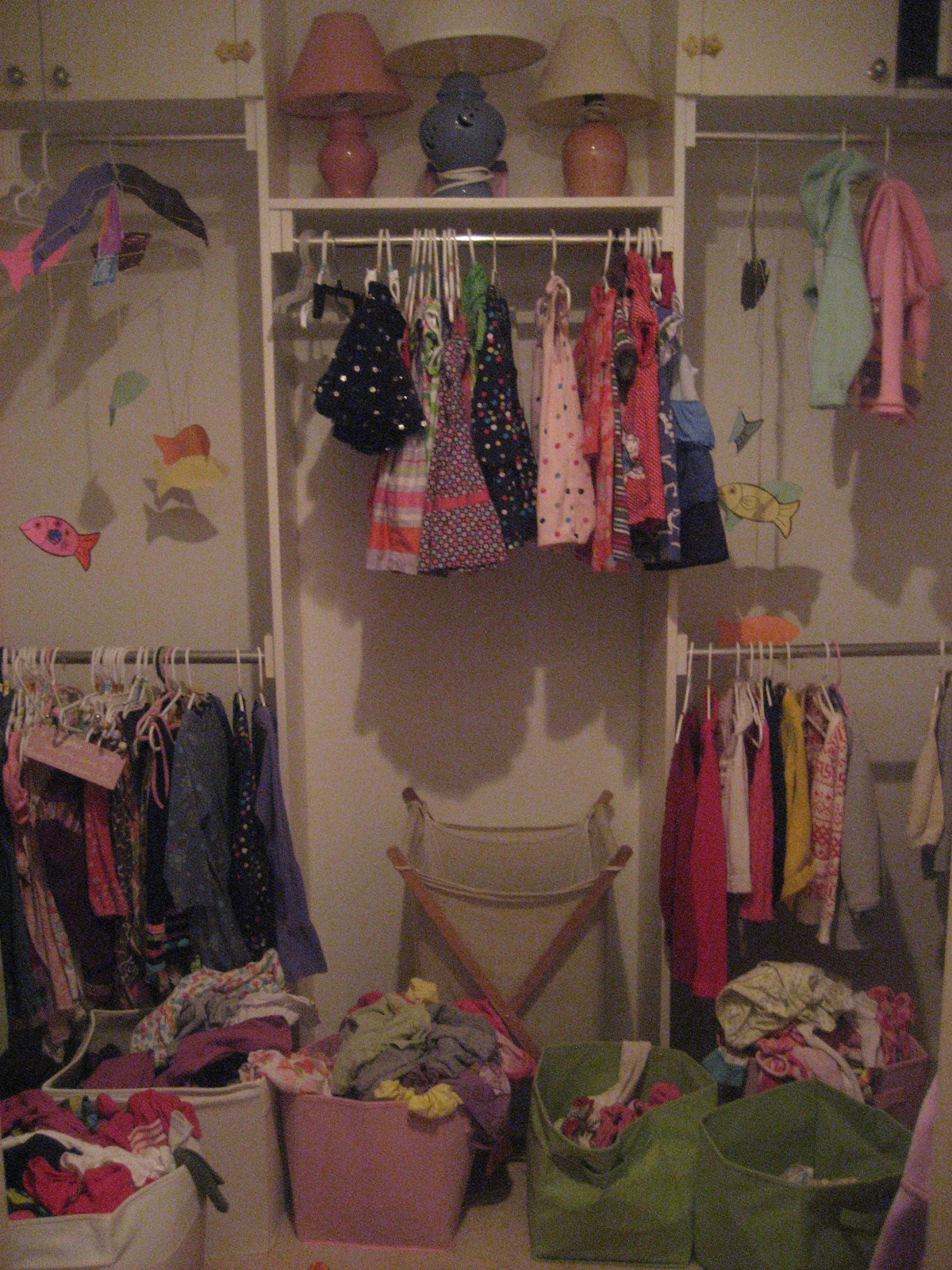
So now we have one child’s clothing in the bureau, and three children’s clothing in bins on the floor. Which is why their closet looks like this:

IMG_2914

Mind you, those are just the clothes they’re wearing right now. What you don’t see are the storage bags filled with clothes that don’t fit anybody at this moment, or the garbage bags stuffed with hand-me-downs that are waiting for Fiona to grow into them.

There is no bigger point here; The Clothing Situation isn’t a metaphor for anything more meaningful. I freely admit that this is a very minor first-world problem. It’s just one of those things that I never anticipated when I signed up for parenthood; who knew that closet organizing would be such an important life skill?

I do have hope that things will improve. After all, we’re finished having children — and to make sure of that, I’ve already started donating all of our maternity and newborn clothes. As the girls get older, they’ll be able to stay in each clothing size a little longer. Before too long, all four of them will probably be able to share the same clothes, and then we’ll just have to deal with screaming clothing battles every morning….

In closing, a warning to any local friends who recently had/will have baby girls: I will be dropping garbage bags full of clothes on your doorsteps in the near future. Be prepared.

Teenage Wasteland

"Happy Sweet 16! Here are your wheels!"
“Happy Sweet 16! Here are your wheels!”

Our fourth daughter was born this summer. We now have four girls, aged 5, 4, 2, and 3 months.

Which means that in 13 years, we will have four teenaged girls.

I didn’t consider that scenario when we were planning our family, for the very simple reason that we didn’t plan our family. It all just happened, fast and furious, and when the dust settled this past July we suddenly had four daughters staring at us.

But I’m reminded of our teenaged future almost daily now, because whenever I venture into public with my daughters, someone will inevitably look at us and say, “Four daughters?!? Wow, that’s going to be interesting when they’re all teenagers!” And instead of “interesting,” they sometimes use words like “challenging,” “crazy,” or “horrible.”

Click here to continue reading at On the Willows.

The War on Fruit Chews

IMG_2913

We’re almost a month into Fiona and Campbell’s school year, and the update is: it’s been the BEST back-to-school experience in our family’s history. This year, there was no Second Day trauma; everything went as smoothly as we’d hoped and prayed for (Please don’t hate me; I know I’m lucky and it’s probably just this year. But of all years, with a new baby at home, I’m grateful that the universe decided to kick an easy transition our way!)

I was never particularly concerned about Campbell. To start with, Campbell barely notices where she is as long as there are toy animals to play with. Also, she was returning to the same preschool she attended last year, for the same three days a week.

But Fiona started Kindergarten at our town’s public elementary school. That seemed like a BIG DEAL: new school, new teachers, new kids, new routine, and riding the school bus home. She loves all of it.

And we — Erick and I — love it, too. Whenever someone asks us how Kindergarten is going, we respond in unison, “We LOVE Kindergarten!!” I realize that they’re probably asking how Fiona likes Kindergarten, but whatever. As far as I’m concerned, Kindergarten is the best invention on the planet, and I don’t know why nobody told us earlier.

Get this: Kindergarten takes my child all day long, five days a week! And they return her to me filled with newly acquired knowledge! Just the other day, Fiona asked me to play school with her; she was the teacher, I was the student. And out of nowhere, she writes on the board: 17-0=17. My jaw dropped. Yes, ma’am, that’s MY daughter doing double-digit subtraction! Where’d she learn it? Not from me — from Kindergarten!!

The thing about Kindergarten is that I feel much more distant from the classroom than I did when Fiona was in preschool. I had to drop her off and pick her up from preschool, so I was in her classroom twice a day. I’d exchange greetings with her teacher and hear immediately if anything notable had happened.

Now that Fiona’s in Kindergarten, Erick drops her off on his way to work in the morning (it’s on his way, in the opposite direction from the preschool where I drop Campbell), and she takes the bus home in the afternoon. Fiona does a decent job of reporting on her day, and her teacher sends home a weekly newsletter, but that’s all I have to go on.

In the middle of second week of school, Fiona came home and announced, “I can’t have fruit chews in my lunch anymore.”

I’ve written before about fruit chews: small packets officially labeled “Fruit Flavored Snacks,” known to most non-Gong children as “gummies.” I’m not quite sure how fruit chews became a staple of my children’s diet, since I never ate them as a child and wouldn’t have purchased them on my own. I’m guessing they were introduced to our girls by friends, or even (gasp!) grandparents.  I feel vaguely shameful about giving my children daily fruit chew snacks, since I’m aware that they’re probably bad for the teeth and have little nutritional value. But I’ve continued to buy them because my daughters have to eat something, and I figure that if you can’t eat a little junk when you’re a kid, when can you???

I was baffled by this anti-fruit chew edict that Fiona had proclaimed, but far be it from me to show disrespect to her teachers. Instead, I remained calm and mature, and asked, “Okay…why can’t you have fruit chews in your lunch?”

“Because,” she said, “the teachers want us to have nutritious food in our lunches, and fruit chews are just a little bit of fruit juice and mostly colored sugar.”

BAM!

Okay, so it’s quite possible that I’m not getting the full story from my five-year-old. It certainly wouldn’t be the first time that she’d misunderstood something and given me information that was slightly off. I’m choosing to believe that’s the case here, because…

WHY, out of all the nutritionally-challenged lunchbox options, would the teachers choose to pick on fruit chews??? Certainly they’ve seen worse, right?

In a good faith effort to determine how bad fruit chews really are, I took a closer look at the box. Right there on the front, it said: “Made with Real Fruit Juice*”

That’s right: an asterisk. Uh-oh.

But that asterisk just leads to a statement that these snacks are made from fruit juice concentrate, and aren’t supposed to replace actual fruit in the diet. Well, duh!

So here’s the skinny: Fruit chews are mostly artificial colors and sugars, including corn starch. But they’re also only 80 calories, and they provide 20% of the recommended daily value of Vitamin C.

That’s not great, but it’s not terrible. In a lineup of snack foods, fruit chews strike me as fairly innocuous. Which begs the question: If you ban fruit chews, where do you draw the line? What about fruit chews’ flat cousin, the Fruit Roll-Up? Potato chips and Fritos? Cheez-Its and Goldfish? What about those “Pizza Fridays” in the school cafeteria? What about a cookie for dessert? (Fiona tells me that baked desserts are okay, but not chocolate bars — another fine line, it seems).

But let’s assume the teachers are okay with their morally ambiguous food restrictions: WHY wouldn’t they draft a letter to the parents informing us of what’s on the banned list? I never received any written instructions as to what I could or couldn’t pack in Fiona’s lunch. Which leaves me, now, in the anxiety-prone position of having to second-guess whether the lunches I pack meet some unknown nutritional standard.

Do I seem overly defensive here?!?!

I suppose I am. In truth, I’m embarrassed that Fiona’s teachers have seen my shame and refused to look away.

That, in a nutshell, is probably the biggest challenge for parents entering this new world of school: We’re sending out our most precious things — these little beings in whom we’ve invested so much of ourselves — into a larger world where they’ll be judged according to standards that are not always clear or fair. And we have no control over it.

If we don’t watch ourselves, we may end up getting defensive over silly things like fruit chews.

Jump in a Lake

IMG_2663

One of my favorite things about living in Vermont is that my daughters have become lake swimmers.

I was raised with the belief that the world is divided into two types of people: lake people and ocean people. My mother, who grew up spending summers at her family’s camp on New Hampshire’s Merrymeeting Lake, is a lake person. My father, who grew up escaping industrial Lawrence, Massachusetts, by packing into a car with friends and heading for the New Hampshire beaches, is an ocean person. Since as a daughter it was my job to reject everything relating to my mother, I grew up proclaiming myself an ocean person.

Click here to continue reading my latest “Faith in Vermont” column for The Addison Independent.

Little Women

Little-Women-book-cover-2

Since the birth of our fourth daughter, several people have made the comparison between the four Gong Girls and the four March sisters — protagonists of Louisa May Alcott’s classic novel, Little Women. It happens that our daughters are familiar with Little Women (in the form of an abridged version by Usborne Books), and the comparison is not lost on them. “Which one is Georgia?” they’ll ask whenever I read it to them, “Which one am I?”

Louisa May Alcott divided the March sisters into easily identifiable types; the types you might expect based on the conventional wisdom of birth order. Meg, the oldest, is responsible and steady, with a weakness for fashion. Second-born Jo is the tomboy, a temperamental writer. Beth is sweet, sickly, self-sacrificing, and prefers quietly playing her piano. The youngest, Amy, is a spoiled, petulant, artistic type.

In families with multiple children, each sibling tends to carve out a distinct role. But when we read Little Women and they ask, “Which one am I?” the most honest response would be: “Not the one you think!”

Our girls don’t conform to the sisterly types created by Louisa May Alcott. Sure, the Gong girls are still in the process of becoming, and Abigail’s still an unknown quantity, but I’m fairly confident that our family has no sweet, quiet, sickly Beth. Most days it feels like we have four Jo-Amy hybrids: independent, temperamental, outspoken bundles of energy.

The thing is: None of my girls is turning out to be whom I thought she’d be.

Like most parents, I brought certain expectations to the table based on my own upbringing, the birth order archetypes I’d learned in college psychology classes, and sibling characters like those in Little Women. But I’m finding that one of the most fun and rewarding parts of parenting is setting those expectations aside and watching as my children are gradually revealed to me. I know that some parents never let go of their expectations and force their children into molds of their own making. To me, parenting feels more like archaeology: My children came to me already themselves, like fossils embedded in rock, and it’s my delight to gently chip and brush away the extraneous dirt to uncover who they really are. (And hopefully instill some manners along the way).

Take my first- and second-borns, for instance. Fiona: a sweet people-pleaser with a strong dramatic streak and a love of all things pink and princess-y; I’d pegged her for the shy, girly girl who’d gravitate towards dance and theater. And Campbell, who’s always been a little bit of a rebel, who loves yellow and lions and seemed tougher than her older sister; I assumed she’d be the outgoing, sporty one.

It looks like, in both of these cases, my first assumptions were totally wrong. Fiona is definitely the classic firstborn responsible people-pleaser, but she’s not particularly shy. And she’s not interested in dance or theater; her love is sports, something I never saw coming. She’s already a solid swimmer, she’s proud of her fast running and will race anything that moves, and she’s looking forward to playing soccer next year (although apparently, despite never having picked up a racket, she’s “mostly interested in tennis.”)

IMG_2633

Campbell has little interest in sports. She’s certainly independent and “tough,” in the sense that she doesn’t care what others think of her. But she’s also the most introverted of all my daughters.  She loves animals and nature: She’s happiest playing ponies by herself, or picking a bouquet of flowers. and her career plans at the moment vary between veterinarian, florist, artist, and mountaineer.

IMG_2727

And then there’s Georgia. It’s hilarious that Georgia is the one in the “sweet third daughter” position, because she bears absolutely zero resemblance to Louisa May Alcott’s Beth. Georgia is a fireball: She’s outgoing, never stops talking, fiercely independent, afraid of nothing, and she loves to eat. She’s only two, so it’s still hard to separate the essential Georgia from the terrible two-ness, but she seems inclined to grab life by the neck and throttle it. (Or maybe the frequency with which she bites her sisters is really an indication that she wants to take a big bite out of life).

IMG_2762

The poet Sylvia Plath wrote in “Morning Song:” “I’m no more your mother than the cloud that distils a mirror to reflect its own slow effacement at the wind’s hand.” I used to think Plath had a detached view of motherhood because she was depressed, but now I understand that line differently. I don’t know where these kids came from. Sure, there are certain aspects of their personalities that I recognize as coming from me or Erick, but there are other, HUGE parts of who they are that I can’t even relate to. One of Fiona’s favorite parts of kindergarten is P.E., which was exactly what I dreaded for my entire school career. Where did THAT come from???

Of course, my girls are still very young, and all of the things I’ve just written about them are subject to change in the coming years. The essential point remains, and here’s an illustration: Now that Campbell and Fiona are attending separate schools, Campbell is emerging from her big sister’s shadow and into her own. This mostly means horrible fights, but the other day when Fiona was getting a little too bossy, Campbell looked at her and said: “I am NOT you! I am A DIFFERENT PERSON!”

And that’s just the thing about parenting: Our children are, and always have been, different people. That’s either scary or exciting. At the moment, I’m choosing to focus on the exciting.

IMG_2689
Too early to tell who this one’ll be….

Secrets and Truths

IMG_2645
Shortly after this picture was taken, I imposed a “bottoms must be worn at all times” rule in our house. (Because really, you never know when the Queen might drop by).

When I feel guilty as a mother, it usually stems from the vast distance between the parent I thought I’d be, the parent I’d LIKE to be, the parent I present myself as in public and on Facebook — and the reality. I know I’m not alone here, but because I try to keep certain parts of my parenting under wraps, it sometimes feels like I’m alone. In an effort to correct this, here are some of my guilty parenting secrets:

-We have a drawer full of Barbies in our living room. We also have Barbie books, and the girls check out Barbie movies from the library on a weekly basis. I don’t love this, but I’ve allowed it.

-Speaking of the library: I live in fear that someday our local library will be able to trace all of the books that are repaired with packing tape back to our family, and we’ll have our library cards revoked for life.

-While I make feeble attempts to provide a variety of healthy food options, my daughters essentially live on a diet of Cheez-Its and what I optimistically refer to as “fruit chews.” Every non-Gong child I know calls “fruit chews” “gummies,” which is a more accurate term, since these processed snacks contain absolutely no natural fruit products.

-My daughters drink a lot of water, and each one has a personal water bottle — a stainless steel bottle with a plastic flip-top and rubber straw. I tote these bottles around in our diaper bag, and if you were to take one apart you would probably be appalled at the musty odor and visible mold on the rubber straw. I blame Thermos for creating a water bottle that’s a pain in the neck to clean, but I also credit Thermos with my daughters’ hardy immune systems.

-I have an iPod, but it’s no longer really mine; it now contains more Tinkerbell, Sesame Street, and My Little Pony games than my own apps. That’s because the only way I’ve been able to get my oldest daughter to stay out of my hair while her younger sisters nap is to hand her the iPod. She probably spends way too much time on it, and I’ve had to limit her to downloading one new game per week. But without that iPod, this blog wouldn’t exist.

-We don’t own a T.V., but the portable DVD player we received last Christmas has saved my sanity many times — and not just during long road trips. In an attempt to be a good mother, I limit the girls to 30 minutes of daily “screen time,” watching DVDs they choose at the library. This means that, especially during the summer months, they almost always watch 30 minutes of videos per day. How did anyone cook dinner before videos existed?

-I usually forget to give Abigail her daily vitamin D drops. She rarely gets daily “tummy time.” Abigail spends most of her time in her carseat or in the Moby wrap.

-On the first day of school, when every other parent is putting up Facebook posts about how they cried while dropping off their kids, I am gripped by the fear that I don’t love my kids enough. I have never once, not EVER, even become mildly choked up when dropping my kids off on the first day of school. Instead, I fly out the door with arms spread wide yelling, “FREEEEDOM!!!!” (Then I buckle the remaining 2 kids into their carseats and go grocery shopping).

-While we’re on the subject of school attendance: On those rare days (thank you, Thermos!) when a daughter is sick and can’t attend school, I don’t feel sympathy so much as I feel wrathful and vengeance-seeking.

Well, it felt good to get THAT off my chest. Who’s with me?