It can be humbling to write a bi-weekly newspaper column: Few things more effectively highlight one’s capacity for change – or inconsistency, denial, and flip-flopping. I’m not convinced that this is a bad thing; isn’t the point of individual human existence to grow and change? Isn’t it natural that the ideas expressed in a column should evolve along with the human writing that column?
For some reason, though, we expect writers – particularly writers of regular columns – to emerge with a fully formed set of ideas that remain consistent for the life of their column. Writing, it seems, sets one’s opinions in cement, and to deviate from a previously written opinion is to reveal a weak character.
If that seems extreme, imagine Ann Coulter suddenly begging our forgiveness and espousing the ideology of the liberal left, or Nicholas Kristof announcing that he’s been wrong and human trafficking is really just a natural extension of free market capitalism. One scenario might be wonderful, one might be awful, but each would call into question the journalistic integrity of the writer.
It has been nearly three years since I began writing “Faith in Vermont.” In terms of genre, “Faith in Vermont” is best described as a “lifestyle” rather than a “political” or “opinion” column. But lifestyles, politics, and opinions are all subject to change, and such change has happened in our household:
Last month, we joined the Middlebury Natural Foods Co-op.
My desire for land started gradually, until suddenly it had gripped me like the unbearable compulsion some pregnant women feel to eat dirt. It was a primal urge. I felt it in my mouth, back near my molars. I felt it in my hands, which wanted to clutch.
To clarify: I never felt the need to eat dirt during my pregnancies. My strongest craving occurred during my third pregnancy: It was 9 o’clock at night, and I had to have walnut shrimp (an Americanized dish served at most Chinese restaurants: batter-fried shrimp and walnuts slathered in a creamy sweet sauce.)
“I would crawl over broken glass for walnut shrimp,” I moaned to my husband, who tracked down the only place where it could be obtained so late at night: the Panda Express at the Oakland Airport.
My craving for land was like that.
It began rationally enough, almost as an intellectual exercise. I was researching Vermont dairy farming for a book I’m working on, and I kept reading heartbreaking stories about the demise of small family farms: farmers who could no longer afford to keep farming, children who didn’t want to continue farming, land that was worth more to sell off or develop than to keep.
In the five years since our family moved to Vermont, I have come to love this place passionately. I want to raise my children here, and when they grow up I hope that some of them will choose to stay, because I certainly plan to grow old in Vermont. So the fact that part of what makes Vermont Vermont was at risk —small farms, undeveloped land, local agriculture — hit me right in the heart.
What could I do?
I’m married to an economist, so I’m somewhat of a realist when it comes to the ability of government programs or agricultural subsidies to effect change. But what Icould do was some version of Voltaire’s exhortation at the end of Candide: “We must cultivate our own garden.” What I could do was to get a plot of land in Vermont, care for it, and not develop it.
Once I had this idea, it was difficult to shake. It also seemed do-able. Vermont is the second least populous state in the nation (after Wyoming); due to an abundance of supply and lack of demand, it is possible to buy a house with multiple acres of land in Vermont for a relatively reasonable price.
The more I thought about it, the better it seemed. Our current house is a perfectly lovely 25-year-old cape set on one wooded and rocky acre along a paved road in a neighborhood where the houses are close enough together that we can see four other homes from our windows (when the leaves are off of the trees.) After five years in Vermont, this seems suburban and wimpy.
I craved a hundred-year-old farmhouse down a dirt road on multiple open acres with outbuildings. Such a setting would allow me to garden without my spade hitting solid rock 1/2 inch into the ground. It would allow me to plant vegetables and fruit trees and flowers that need at least partial sunlight in order to thrive. It would allow my children to range freely, without my having to worry about cars on the paved road out front. It would allow us to try raising chickens for a second time. (Our first flock of hens was massacred by neighborhood dogs; I know that massacres are a rite of passage for chicken owners, but these dogs had broken easily into our coop because we couldn’t sink fence posts securely enough into the rocky ground.) It would allow for the future possibility of larger animals: a few sheep, a couple of pigs, perhaps even a horse one day if our daughters continue to love riding.
This would be a lot of work, but it would be my work. Writing is a stationary and solitary profession. The idea of caring for some livestock and land in between hours of sitting at my computer was appealing: I could be a female version of E.B. White or Wendell Berry. And yes, we have four children: four children who, in another year, will all be in school at least part of the week. Four children who could help with chores, fondly recall their childhood on the family farm, get married on the land where they were raised.
It made so much sense to me, on both an idealogical and a practical level.
Notice that all of the pronouns thus far have been in the first person singular. And I am no longer a first person singular: I am part of a marriage, a family of six. In order to make this dream a reality, I would have to convince my un-dreamy, un-handy, and un-willing-to-take-financial-risks husband — and, to a lesser degree, my children — that it was a good idea.
So I put some logical limits on my dream. My children are incredibly happy in our town school, and nobody wants my husband to have a longer commute, so this land would have to be located in our current town. It should have 3 or more acres, and preferably some usable outbuildings. Odds are that the house wouldn’t be a new construction, but it couldn’t be a dump, either. And, of course, there were financial limits.
I kept my eyes open as I shuttled our children around town, and narrowed my focus to three or four properties that would be appealing if they ever went on the market. I settled down to wait; we weren’t going anywhere, so I was in a great position to be patient and watchful.
Then one of those properties went on the market.
It was an 1890’s farmhouse with 5 outbuildings, set on 16 gorgeous acres of mostly-cleared land with stunning views of the Green Mountains. It was actually closer to town — to the schools, my husband’s office, and my parents’ house — than our current home.
Of course, the timing was terrible: Our entire family is relocating to California for the first five months of 2016 for my husband’s sabbatical.
Also, it was outside our price range.
I went to look at it anyway, first with my parents and all my children in tow, then with my husband. The house needed a complete interior lead paint abatement and re-painting, a new perimeter drain, possible asbestos tile removal, and there were five rooms that appeared to have gone untouched — used only for storage — for 40-some years. Still, the potential was there if we were willing to work towards it; I could see the beautiful house it would become over time.
So I held onto hope, because that’s what you do when you have a dream, right? I held onto hope for 25 days, up until that house sold. And then I mourned it hard.
It has occurred to me that this desire for land is my version of a midlife crisis; that, at almost 40 years of age, I’m hoping to rediscover my purpose and youth in a plot of land rather than a sports car or a tattoo or an affair. And it occurs to me that there are two ways of responding to a midlife crisis: either you come around to peacefully accepting that all the paths that once seemed open to you have narrowed down to the path that you’re on — or else you get bitter. Maybe I need to accept that my life — our life — is not going to end on a multi-acre small-scale farm. As I’m constantly reminding my daughters (and quoting Mick Jagger): “You can’t always get what you want.”
But maybe, maybe, this isn’t so much a midlife crisis as it is a natural desire: the desire to find a little corner of creation and sink roots down deep, to have the ability to raise your own food, to preserve some of the world’s beauty and pass it on to your children.
My husband and I had dinner with a couple who’ve lived in Vermont far longer than us, who have first-hand experience with farming. We discussed my dream of land. “Feel free to talk me out of it,” I quipped.
They didn’t. “There’s nothing wrong with wanting to own a piece of Vermont,” said the husband. “Go down the rabbit hole.”
His wife’s response was more serious. “This is what we were made for,” she said. “We were created to be stewards of the land. And if that’s what God is prompting you to do, then maybe you should listen to it.”
Maybe I should; maybe I will. In the meantime, there’s a book of Wendell Berry essays beside my bed, a brand-new membership card to our local food co-op (finally!) in my wallet, and our weekly CSA starts up next month. I guess that’ll do.
Last month, we loaded our four daughters into the minivan on a Sunday afternoon and drove to Duclos & Thompson Farm in Weybridge to see the new lambs and piglets.
This was our first time at the Duclos & Thompson open barn, an event that for many local families is an annual sign of spring — much like the appearance of sap buckets on the maple trees, or red-breasted robins, or removing your snow tires. Like those other rites of spring, it’s quite possible that the new lambs and piglets will arrive when there’s still snow on the ground; that March weekend, there was a mountain of snow next to the Duclos & Thompson barn that served as a secondary diversion for all the children present.
The primary attraction, of course, was inside the barn: lambs! Two floors worth of black and white lambs sleeping, eating, frolicking, and climbing atop the bigger sheep. So many lambs, plus a little pile of piglets nursing on their mama. It was a cuteness bonanza.
This is about fresh starts, new beginnings, and healing.
If you’ve been reading this blog for a few months, you’ll recall that earlier this fall, two neighborhood dogs broke into our chicken coop and killed all of our chickens. Our next-door neighbor notified the dogs’ owner, who called and was very apologetic and offered to help in any way possible. But really, what can you do?
I received some responses to that post, written and verbal, that were ANGRY with the dogs’ owners. Things like: They should do more! and Did you report the dogs to the police?!
I’d like to say that Erick and I maintained only peaceful, loving thoughts towards those neighbors, but I’ll be honest: not always. Especially when the dogs CONTINUED to escape their fence and run through our yard, we went grumble grumble.
And then, one afternoon in early December, the dogs’ owner showed up at our front door, carrying an ENORMOUS basket of doggie treats. She’d somehow gotten word that we had a new puppy, and wanted to welcome our “new addition.” Attached to the basket was a note, including another apology for the chicken massacre. This was the first time I’d met her in person; we chatted a few minutes, and she was just lovely.
From the note attached to the gift basket, we learned that the dogs’ names are Chloe and Kylie. My two oldest girls were fascinated by that fact, and the day after the basket arrived they showed me a little something about healing.
It started as they were getting dressed in the morning. “Hey, Campbell,” said Fiona, “want to pretend to be Chloe and Kylie?”
“What’re you going to play?” I asked, in my always wise, mature mothering style, “Chloe and Kylie Kill the Chickens?”
“YES!!!!!!” screamed my girls in unison. And for the next 30 minutes, they alternately pretended that their stuffed animals and Georgia were chickens. They chased, and bit, and ate. The game included lines like, “Hey, I just threw up a whole bunch of feathers!”
My girls are weird, yes, but they are also resilient. Over the course of a few months, they were able to take the sight of their chickens torn apart, and turn it into a game. They LAUGHED.
I mention this to give us all closure, especially those of you who shared in our grumbling. And also, as we start a New Year, to give us all hope: that fresh starts are possible, that healing happens, and that most people, when you get right down to it, are pretty freakin’ great.
*Latin for “Rest in Peace, Chickens.” Yep, I took a little Latin in college.
I’m gonna keep this brief, because if you know me well or keep up with me on Facebook, it’s old news. But I figure it’s a narrative thread that I need to tie up, so here goes:
We no longer have any chickens.
You may recall that, a couple of weeks ago, Brinkley killed one of our chickens, bringing the total down to three. Earlier this week, two neighborhood dogs finished the job.
It was a grey Monday morning, and it’d been raining for three days. As usual, I’d fed the chickens and let them out of their coop at around 6:30 AM, but what with the rain and the recent Brinkley attack, they were inclined to stay up in their roosting area.
At around 9 AM, as I came downstairs from wrestling the girls into a relative state of cleanliness and dressed-ness, I looked out the kitchen window and froze: there were two chocolate labs, dogs that I’d seen running through our yard from time to time, INSIDE the chicken fence with mouths full of feathers. Chicken corpses littered the ground at their feet. I knew right then that they were all dead.
I pulled on my boots and raced out the door to yell at the dogs and get them out of the coop. The girls followed me outside. “HEY! Get outta there!” I shouted. The dogs looked at me calmly and ambled away. I suggested that the girls stay inside, because the scene looked pretty gory, but they insisted on coming with me.
It was a mess. The dogs had bashed their way through the wire fence, and then ripped a wall out of the chicken coop in order to pull the chickens down from their roost. Body parts and pieces of wood were everywhere. I checked around to see if there were any survivors, because it was hard to count the total kill based on the partial bodies strewn around. No survivors.
“Gross,” Fiona said. “That’s even grosser than the dead chipmunk.” (A small specimen of roadkill that represented her grossest dead animal — until now).
I don’t know what made me think it, but I decided to call our next-door neighbor, Brinkley’s owner. I figured she’d know who owned the dogs, and she might also appreciate knowing that she wouldn’t have to worry about Brinkley killing our chickens anymore. This was one of the best calls I’ve ever made. Not only did she know the dogs’ owner (turns out these dogs have a reputation for breaking out of their electric fence and roaming the neighborhood, and were even on the Forest Service’s “warning” list for chasing deer), but she offered to call the owner for me.
Then she asked, “Have you cleaned it up yet?” I told her I hadn’t.
“I’m coming over right now to take care of it for you. You shouldn’t have to clean that up with little ones in the house,” she said. And no matter how much I protested, she insisted.
A few hours later, the dogs’ owner called and was as sweet and apologetic as could be. But, what can you do?
Aside from the four dead chickens, the worst thing about this is the sense of waste. It took a LOT of time, effort, and expense to raise these chickens over the past five months. They would’ve started laying eggs next month, and we never even saw that pay-off.
But the way I see it, the good things outweigh the bad. Here they are:
1. I learned that I have the absolute best neighbor in the world. I would give our next-door neighbors my kidney, my right arm, even one of our girls (hmmm….) for the asking. At the very least, I hope I have a chance to clean up some dead animals for them in the future.
2. I got to have some good conversations with our girls about death and nature throughout the day — about dogs being dogs, chickens being chickens, and death being part of life.
3. I have one less thing to take care of. It’s funny that I’d just written about adding things to my life, and my mom’s concern that I was taking on too much. Apparently the universe agreed with my mom. (Don’t you hate it when that happens?) The way I see it, these chickens were taken out of our lives at the perfect time, making way for the new puppy that’s set to arrive later next week. And I can’t say that I’m sorry not to have to feed the chickens on those cold, dark winter mornings when I’ll already be taking the dog out to relieve herself.
We learned a lot. We had fun with those chickens. We’re not the only people we know who’ve lost an entire flock to predators. And if we get more chickens next spring, we’re also getting an electric chicken fence.
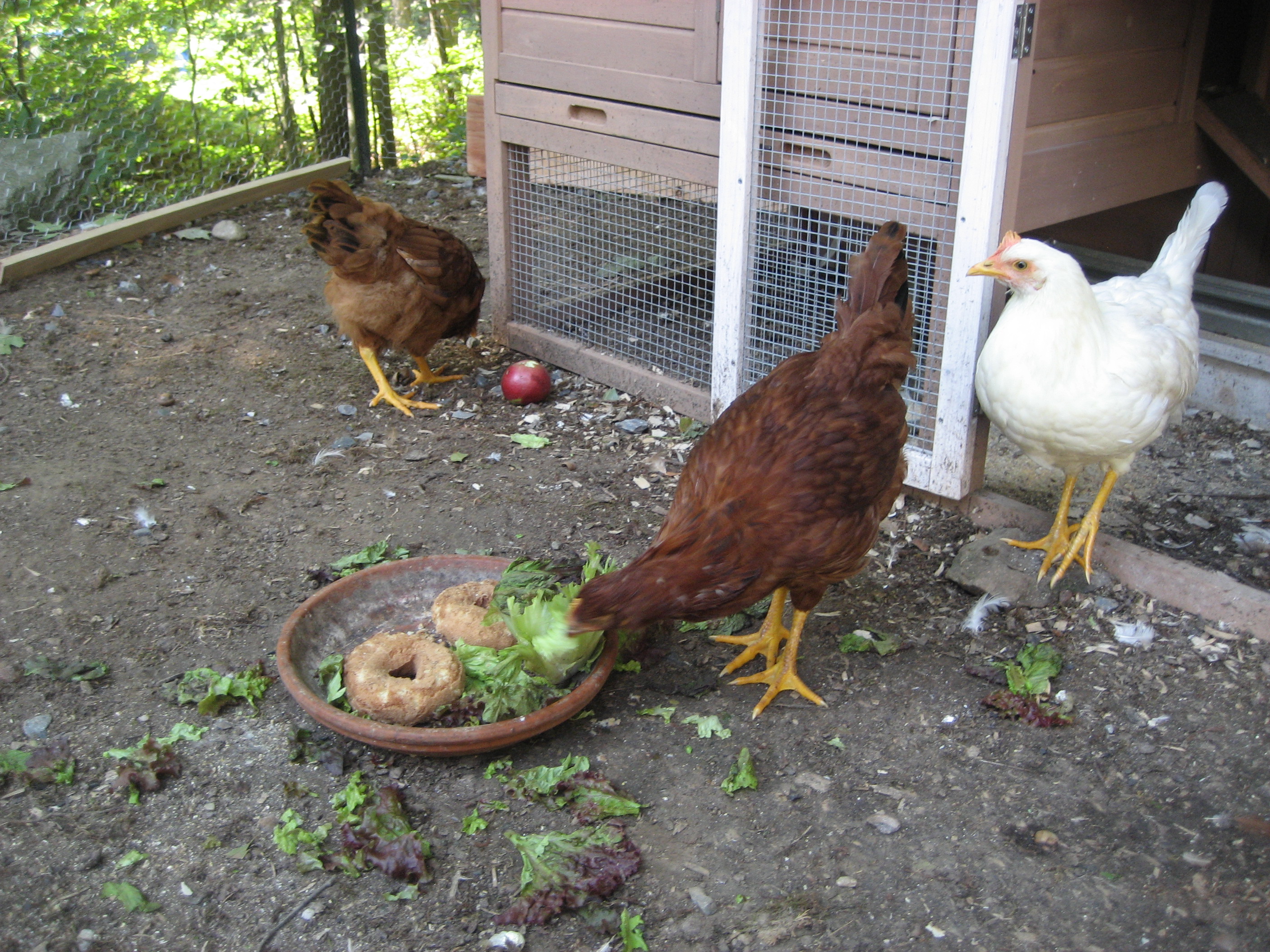
And then there were three: two smart ones and a lucky one. (The doughnuts were a little post-trauma treat, not a regular occurrence!)
Brinkley killed one of our chickens last week.
Here’s how it happened: For those of you who don’t know, Brinkley is our neighbor’s Golden Retriever, but we’ve “adopted” him to the point that our neighbors looped their electric dog fence around our yard. So Brinkley has the run of our yard, and we love him. Since July, when we first put the chickens outside, Brinkley has shown admirable restraint — he’s been interested in them, but until lately he never made any aggressive moves.
We keep the chicken coop inside a fenced yard. Here’s the weakness: because our yard is so rocky, we can’t sink the fence deeply into the earth to keep predators from digging under it. The fence is chicken wire strung between metal posts, but the chicken wire sits level with the ground. So last week, when Brinkley started digging under the fence and pushing up the wire with his 80 pounds of doggy energy, he won. I’d caught him inside the chicken yard several times, but luckily no harm was done.
Then, last Friday, as I pulled into the driveway with Georgia (the other two girls were in preschool), expecting a quiet, uneventful afternoon, our neighbor from across the street came up the driveway. She was watching Brinkley while his owners were away, and had caught him with one of our white Leghorns in his mouth. She saved the chicken — who was a little slobbery and wobbly and traumatized, but otherwise unhurt — and returned her to the chicken coop. I went to check on the chickens — and found only the lucky Leghorn and one of our Rhode Island Reds inside. That left TWO chickens unaccounted for.
My quiet afternoon turned into a frantic chicken hunt. It’s unclear exactly what happened, but it appears that three of the chickens may have escaped their yard by squeezing under part of the fence that Brinkley had warped with his digging. Once they became totally free-range chickens, they were also fair game for Brinkley. Amazingly, the OTHER Rhode Island Red eventually fluttered down from a tree branch above the chicken yard, where she’d taken shelter during the chicken massacre. As for the other Leghorn, all I found of her was a pile of feathers and a dismembered leg.
I wasn’t totally devastated; it’s pretty rare for a chicken to die of old age. Although I’d have liked to have gotten a few eggs out of this hen before she became Brinkley’s chew toy, chickens don’t usually inspire deep affection. They’re not cuddly creatures; even as chicks, our chickens hated to be held, and now it’s almost impossible to catch them. They’re nervous, flighty creatures whose main interest is food.
But I felt worse than I expected. Those chickens were my responsibility. I was prepared for them to die at some point, but it was still my job to keep them alive as long as possible. If you were looking for someone to pin the blame on in this situation, all evidence pointed straight to: ME. It was hard to be mad at Brinkley; he was just a dog being a dog. And the chickens were just being chickens. But Iwas the one who’d wanted the chickens to begin with, andI was the one who’d invited our neighbors to include our yard in Brinkley’s fenced run. I’d brought a hunting dog and chickens together, and when the inevitable happened, I had only myself to blame.
“You just keep adding and adding and adding,” my mother said to me during her latest visit. She was concerned after we told her that we were thinking of getting a dog of our own. And she’s right: three children in four years, four chickens, our neighbor’s dog, and now possibly our own dog. I DO have a little problem with adding things to my life. But here’s why: I think it’s almost never bad to add something else to love. Don’t most of us add and add? We form new relationships, get married, have children, acquire pets. Isn’t love the motivation behind all of those things?
I have a hard time saying that I love our chickens. I got them because we go through at least a dozen eggs a week, and because I thought it would be nice for the girls to have some animals around to watch and care for. But I raised them from chicks, I feed them and clean their coop, and I guess that’s a form of love.
Here’s the scaly underbelly of love, though, the thing we try to fool ourselves into forgetting: nothing lives forever. My husband, my children, my chickens, Brinkley, myself — we’re all going to die. When we add things to our lives, we’re adding present-tense love, with the promise of future-tense pain and loss.
So why keep adding at all?
I thought about that while I checked on my lonely Leghorn all that afternoon — a chicken who’d just suffered shock and loss herself, and appeared about as depressed as it’s possible for a chicken to be. I thought about that when Brinkley came running up to me proudly, carrying a mouthful of white feathers. I thought about that when I told my two oldest girls that Brinkley had killed one of their chickens.
Guess what the girls wanted to do after I picked them up from preschool? I am absolutely not making this up: they wanted to go play hide & seek in the cemetery. So we did.
And then I thought: we can live with loss. We can feel the pain and learn from it and work through it and heal. But I cannot, I cannot, live without love. So I will keep adding.
I never considered that, when I became a parent, a major part of my job description would include fighting death. But it’s true: at its most basic, parenting is about trying to keep your kids alive into adulthood. No easy task, that. Every day I fight to keep my children and myself alive. I know it’s crazy to think that I have any control over death, that it’s something I can “fight.” I know that death is inevitable. But, inasmuch as I can control anything, I want to see my daughters flourish during the time that we all have.
And it’s not just my children and myself; these days I’m also responsible for the lives of three houseplants, numerous garden plants, four chickens, and one monarch caterpillar.
I’m starting to feel like my resume for 2011-12 should read: Anti-Death Warrior. [Anti-Death Warrior is a deceptively glamorous term for a job that, most days, involves managing food on one end and poop on the other. But still.]
I’ve had varying degrees of success in my attempt to keep the living things within my orbit alive and prospering. Thus far, I’ve been most successful with the girls. The garden plants are doing well, although truth be told they receive the least of my efforts. I may have managed to kill one of our houseplants, a gift from my parents with the promise that “It’s IMPOSSIBLE to kill.” It’s not dead yet, but it’s pretty brown around the edges.
And a few weeks ago, it looked like things were really falling apart for the chickens and me.
One of our new chicks started limping for no obvious reason, a development that filled me with the alternating emotions of fear (Could it be a disease that would wipe out the whole flock?), guilt (Was it something I did, or failed to see?), and indecision (Do I take her to a vet? Or just wait and see?).
And then there was me.
You may recall that, about a month ago, I was treated for Lyme disease. It now seems that I didn’t have Lyme disease, after all, but during the last few weeks of August I wished I did. Compared with what I was going through, Lyme disease looked simple, clear-cut, and treatable.
I’ll spare you all the medical details, except to say that a second round of blood tests for my Lyme-like symptoms — joint pain, headaches, fatigue — revealed elevated muscle enzymes, suggesting that my muscles were inflamed, possibly to the point of breakdown. In an instant, I found myself in medical hell: during the course of ONE WEEK, I went back and forth from the hospital for FOUR separate rounds of bloodwork and a brain MRI. I received daily voicemail updates from my doctor, including reassuring statements like, “By the way, I’m very concerned.” I alternately hugged my girls too tightly and snapped at them. I teared up at the smallest things, like Fiona saying, “Mommy, this winter I’m planning to make a HUGE snowman!” And I learned that sometimes, the more medical attention you receive, the sicker you feel.
My medical drama happened during the SAME week that our chick started limping. Everything was crashing.
I’d like to tell you that I handled all of this like a rooster in a sack: by getting still and quiet, meditative and contemplative. But I handled it more like a stressed hen: flapping and fighting and squawking. I cried so hard in that space-age, clanging MRI tube when the Coldplay song “Fix You” was piped in over the speakers from my iPod, that the technician came over the intercom to ask if I’d fallen asleep: “We’re getting some motion in the pictures.” I was furious at God for what was, in my humble opinion, his terrible timing: I have young kids, Erick’s semester was about to start, and this put a stop — either temporary or permanent — to various plans we’d been making. I was terrified that the tests results would turn up something truly awful, but I was also terrified that they’d turn up nothing; that all this drama and trauma would leave us just as stupefied as we were now, that I’d be achy and exhausted forever with no clear reason. I wanted a reason, I wanted a treatment, and I wanted a NAME.
I also spent inordinate amounts of time out by the chicken coop, watching our limping chick and wondering what I should do. “Why is Mommy always with the chickens?” Fiona complained to Erick when she came downstairs one morning to find that I was out at the coop again.
Then, that same week — the week of the limping chicken and my elevated enzymes — I just happened to read an article in the June 25 issue of The New Yorker by Jill Lepore, about Barack Obama’s family history. It turns out that when Obama’s grandfather, Stanley Dunham, was a young man, he was supposed to go with some friends to the movies. His grandmother kept him at home, and his friends’ car swerved to avoid a cow on the road and crashed into a tanker truck, killing all passengers. Lepore concludes: “Every family has a chancy cow or two roaming the meadows of its past.”
It’s a beautiful thought, but that week it struck me as a massive understatement. No, I thought to myself, it’s more like every PERSON has a HERD of chancy cows roaming the meadows of their life. By “chancy cows,” I mean things that could have happened but didn’t — or things that DID happen but might not have — due to something that seemed insignificant at the time. Like a cow in the road, or a grandmother’s decision.
Even right smack in the middle of that crappiest of crappy weeks, I could see chancy cows all over the place.
For instance, the reason I was being sent to the hospital for repeated lab tests, instead of sitting at home wondering why my knees were still hurting after I’d finished the antibiotics for Lyme, is that we just happen to live next door to a doctor — an experienced diagnostician whose practice is closed to new patients. And we just happen to be seeing a lot of this doctor lately, because he happens to have a Golden Retriever puppy named Brinkley whom our girls have adopted, so the doctor often has to trek through the woods to our yard, to retrieve his Retriever. The other week, when this doctor came to take Brinkley home, Erick just happened to mention that I was being treated for Lyme. “Well,” said the doctor, “you need additional tests. Call my office and I’ll fit you in.”
See? Chancy cows everywhere. And if it sounds like I’m saying that a Golden Retriever puppy might just be an agent of God, it’s because I am. Chancy cows are like God’s fingerprints; they reassure me, even when everything seems to be crashing at the worst possible time, that I’m part of a larger story that’s still unfolding. There’s a reason why we all love those movies in which seemingly random, disparate plotlines turn out to be connected at the end; I think it’s because we know, deep inside, that these movies are a lot like life.
Where life and movies diverge, of course, is that movies usually have neatly tied-up endings. Life, not so much.
Later that week, Fiona called to me one morning: “Mommy? I think that chick’s walking just fine now.” And she was right; I can’t explain what made our chick limp to begin with, or how it got better, but out of nowhere it made a full recovery.
On the other hand, our monarch caterpillar spun a gorgeous sparkly green chrysalis, and then never hatched. This happens — the monarch dies in utero — and it’s been happening a lot more lately now that farmers are spraying their crops with NPV, which is a deadly virus for caterpillars.
And me? After a clean MRI but continuing funky bloodwork, my doctor referred me to a neurologist up in Burlington. Last week I drove an hour in order to have little needles stuck into my muscles, and to be told that it’s still unclear what’s going on. I have no answers, just orders for MORE bloodwork and another MRI.
Driving back from Burlington, through the cow fields (seriously!), I decided I didn’t care anymore about finding a name for what ails me. I’m tired of doctors and tests, and I’m satisfied that whatever’s going on, it’s nothing life-threatening. I’ll do this next round of tests to humor my doctor, and then I’m going to stop and accept that my “new normal” may include some aches and fatigue.
I’m okay with all of that. I may not have answers, but I know I’m not in a free fall — there are two many chancy cows wandering around for that. Who knows? Looking back, this whole episode may turn out to have been just another chancy cow.
As I was cramming my head with chicken information before the arrival of our first three chicks, one of the most fascinating facts I came across had to do with “broodiness.”
For those of you who aren’t versed in the ways of the chicken, “broodiness” is when hens get maternal. They stop laying, and their bodies undergo hormonal changes that turn them into egg-hatching machines: their breast feathers thin out in preparation for 21 days of sitting on a clutch of eggs, and somehow their bodies are able to maintain the precise heat and humidity that the eggs need to mature — conditions that have to be painstakingly replicated by an incubator if no broody hen is available.
Not all hens become broody, and nobody knows exactly why certain hens do. Among some serious chicken raisers, broodiness is not seen as an admirable trait, and it’s been bred out of many commercial chickens. A broody hen will stop laying eggs for almost a month. She’ll sit and sit and sit, with only occasional breaks for food, water, and elimination. Not only that: she’ll get grumpy, pecking at anyone who tries to disturb her or her clutch; this is why the word “broody” has come to mean “moody,” even in humans.
All of that is interesting enough, but what REALLY got me was this: When a hen goes broody, it has nothing to do with whether she herself has laid a fertilized egg. To put it another way, the eggs she feels compelled to hatch may not even be her own. Broody hens will sit on the eggs of other hens. They will sit on unfertilized eggs. They will sit on nothing if no eggs are available; I’ve read stories of broody hens spending 21 days attempting to hatch a dirt pile.
This behavior sounds a little silly. It’s also one of the most beautiful things I’ve ever heard. What could be more selfless than sacrificing your own comfort and convenience to raise babies that aren’t even yours? Why aren’t WE more like broody hens? I wondered.
And then I realized that WE ARE.
This past year, I’ve had the humbling pleasure of getting to know a number of women — and some men — who might best be described as “broody.” What I mean is that these are people who make it a regular habit to care for children who aren’t their own. In many cases — but certainly not all — these men and women have raised or are raising their own children. Here’s what else they do: take in foster children, host Fresh Air Fund children (kids from the inner city who come to Vermont during the summer to experience the rural outdoors), act as second parents to college students, and open their homes and lives to friends’ children on a regular basis. Some people do ALL FOUR of those things.
I don’t know why I feel like I’m surrounded by more “broody” people right now than at any previous point in my life. It could be that this behavior is more common — or more visible — in a small town. It could be that I know more people who have older children or no children at home, which makes it easier to care for other people’s children. Without a doubt, I am one of the least broody people I currently know, if for no other reason than that I have my hands pretty full with my own brood at the moment.
But, regardless of how I compare to others, I HAVE been feeling broodier this year. Lately I’ve been thinking that one of the most helpful things we can do is to take care of each others’ kids.
Speaking strictly for myself, the BEST gift that anyone can give me is to watch my kids. Most of life — errands, housework, quality time with your spouse, mental health — is much easier if you don’t have the kids around. If I’m trying to love my neighbors as myself, I need to ask myself: “Self, what would you most love?” The answer: for somebody to watch my kids.
So, my broody self has been trying to notice when people seem like they might need a little kid-less time, and then offering to watch their kids.
Some friends have been desperate enough to take me up on this, and dropped off their kids at our house when they needed to deal with other things. Another friend and I have being doing a “kid exchange” all summer: one day a week her two children come over to our house, and the next day she takes all of the Gong girls. It’s been fun for us, and for the kids.
Back when we were expecting our third child, a more experienced parent told us, “Once you have 3 kids, you might as well have 33.” I think that’s true; adding one or two more kids to our house doesn’t significantly increase the noise, chaos, or my stress level. In fact, it’s often helpful to have a couple of non-Gongs around; when our girls are playing with friends, they stay out of my hair for longer periods of time.
These drop-off playdates are also special chances for me to get to know other children. There’s not a lot of turnover in our small town, so these kids are going to be our girls’ friends (maybe even – ulp! – significant others) for years to come. I hope I’ll get to watch most of these children grow up — not just watch them, but be an active participant in showing them love and care.
Best of all, I get to support other parents by doing this. Parenting can chew way down to your soul; we need to help each other out.
I’ll be honest: sometimes it IS really hard being in charge of a houseful of kids, especially if any one child is having a bad day. Even on good days, our house gets torn apart, our snack supply is decimated, and I often feel like the whole operation is about to spiral out of control.
But then again, I feel that way on days when I’m just in charge of my own children. And, like most things worth doing, this is not about my own personal comfort; it’s about something I can do to love other children and parents.
I often wish I could do more, like teaching in Tanzania, or caring for orphans in Calcutta, or volunteering at the local senior center. And maybe someday, when I don’t have to schedule everything around naps, I will. But if you’re feeling the same way, I hope this might encourage you: sometimes you don’t even have to leave your home to change the world. Like broody hens, you don’t even need to be a parent yourself. Maybe you can change the world a little just by watching somebody’s kids for a couple of hours. Giving parents a break, and giving kids some love, can start endless good things in motion. It reminds me of my favorite Anne Lamott quote: “Lighthouses don’t go running all over an island looking for boats to save; they just stand there shining.”
A few exciting new goings-on here in the green summer woods:
The new chicks are here!
We returned from a week at the beach to find that our rooster had started crowing. Or rather, our rooster had been taught to crow by one of the men painting our house. This being a small town, the crowing coach is also the uncle of two of the girls’ best friends, and he lives on 25 acres of land with assorted free-range poultry. So I operated on the age-old rule: You teach my rooster to crow, it’s yours. Off went our rooster to the country — although the beautiful thing is that, in this case, that’s NOT a euphemism for putting an animal down: the country really IS the country, and it’s just down the road.
Finding a good home for our rooster neatly coincided with a friend offering us some extra chicks. So, on Campbell’s birthday, we picked up two Rhode Island Red chicks. The girls used this as an excuse to shuffle around the names of our chickens; we now have two white Leghorn hens named Daisy Flower and Sunny, and two brown chicks named Scaredy-cat Simba and Grace. We’re fairly sure that they’re all hens.
The new chicks are really, really cute, so they’ve been girl-handled quite a bit. I’m hoping that’ll make them a little more cuddly than the Leghorns, who are still pretty flighty.
We’ve got a new venue!
Starting tomorrow, I’m going to have a regular, bi-weekly column in the online edition of our local paper, The Addison Independent! I’ll be writing about life in central Vermont from the perspective of a mother of young children who’s a recent transplant to the area — in other words, I’ll be doing pretty much what I do here, it’ll just be a little more Vermont-y. (Just like how, when I write over at On the Willows , it’s pretty much what I do here, just a little more God-y).
I don’t expect that this new gig will significantly change anything here at The Pickle Patch. In fact, I’ll likely be re-using some of my more Vermont-focused material for the Independent column. As I do with On the Willows, I’ll post a link on this site whenever I have an article over at the Independent.
The new chicks and new column are both very happy things. But for whatever reason, life usually doesn’t hand you pure, undiluted joy — at least, not for very long. I’m not quite sure why it seems to work this way — that, when you’re given something, something else is taken away — but in my experience it’s usually been a good thing. Helps keep you from getting too full of yourself, if nothing else.
Which leads us to:
A tick made me sick (maybe)…
I’ve had to slow down quite a bit over the past couple of weeks, because I have not been entirely well. You may recall my mentioning the pain in my knee joints that started out of nowhere on our trip to Maine. You may even recall my joking that I assumed it was either Lyme disease or Lupus; if you expectthe worst-case scenario, it can’t possibly be the worst-case scenario, right?
Turns out that’s not always true. The pain didn’t improve, I started feeling it down my arm and into my hand, and by the time we got home from Maine I was crushed by exhaustion. Not the normal, I-have-three-young-kids exhaustion, but an exhaustion so intense that by the end of the day I could barely lift my arms. All of which gave new meaning to the headaches and vague feeling of not-rightness I’d been having on an almost daily basis.
This is Georgia impersonating Jack Nicholson. (It’s a cuter picture than sick me laying on the couch).
So, I went to my doctor, who took four vials of blood out of me and began treating me for Lyme disease. (In our area, if doctors even suspect Lyme, they go ahead and begin treating it with antibiotics, because the cost of NOT treating it quickly can be the onset of chronic Lyme). The conclusion? My bloodwork came back completely clean: negative for Lyme and all other suspects. Unfortunately, that doesn’t mean that it wasn’t Lyme, because the test for Lyme is notorious for giving false negatives. Whatever the ultimate culprit — and my doctor thinks it could be another tick-borne bacteria that isn’t picked up by the Lyme test — the GREAT news is that I’m starting to feel better. A few days after beginning antibiotics, my energy returned to its normal level of exhaustion. The joint pain seems to be taking a little longer, but I’ve started to have some good days in that regard. (And honestly, I’ll take a little joint pain over the fog of exhaustion).
There are, of course, other changes brewing around here: summer is on its downslope into fall, Fiona and Campbell will start preschool in a few weeks, Erick will go back to teaching next month. And change, as we all know, can be difficult and disorienting. But this go-around, I’m trying to handle all these changes like a rooster.
Yes, like a rooster. The aforementioned rooster, who started crowing and had to be sent away, showed me how to deal gracefully with change.
The best way to transport a mature rooster is in a burlap sack. The rooster has to be enclosed, or else they’ll flap and fly all over your car. But a cage isn’t a good option, because they might bang around and damage their comb. So, when it came time to bid our rooster adios, we caught him, put him in a burlap sack, and tied the neck of the sack with twine.
I expected drama. I expected squawking and flapping and fighting and feathers flying. But instead, our rooster, who up to this point has spent his days posturing and crowing and bossing the hens around, got very still and quiet as soon as we placed him in that burlap sack. No noise, no movement; we could have been lugging around a bowling ball.
The rooster was nervous, of course — probably even terrified. But I think that this is how I’d like to handle change when it comes in my life: not by squawking or fighting, but by getting still and quiet. Change is like being shoved in a burlap sack and driven to an unknown destination; you’re never quite sure if you’ll be dropped off at the Purdue slaughtering plant or 25 acres of bucolic free-range countryside. But fighting this change is pointless, and it just makes the ride unpleasant. I’d rather be still and quiet, like a rooster.
I’m sure you’ve all been asking yourselves, How are Grace, Simba, and Hermione doing? You’ve been desperately hoping each time you click on a Pickle Patch post that I’ll include some news about our chickens. And each time, I’ve let you down.
Until today, my friends.
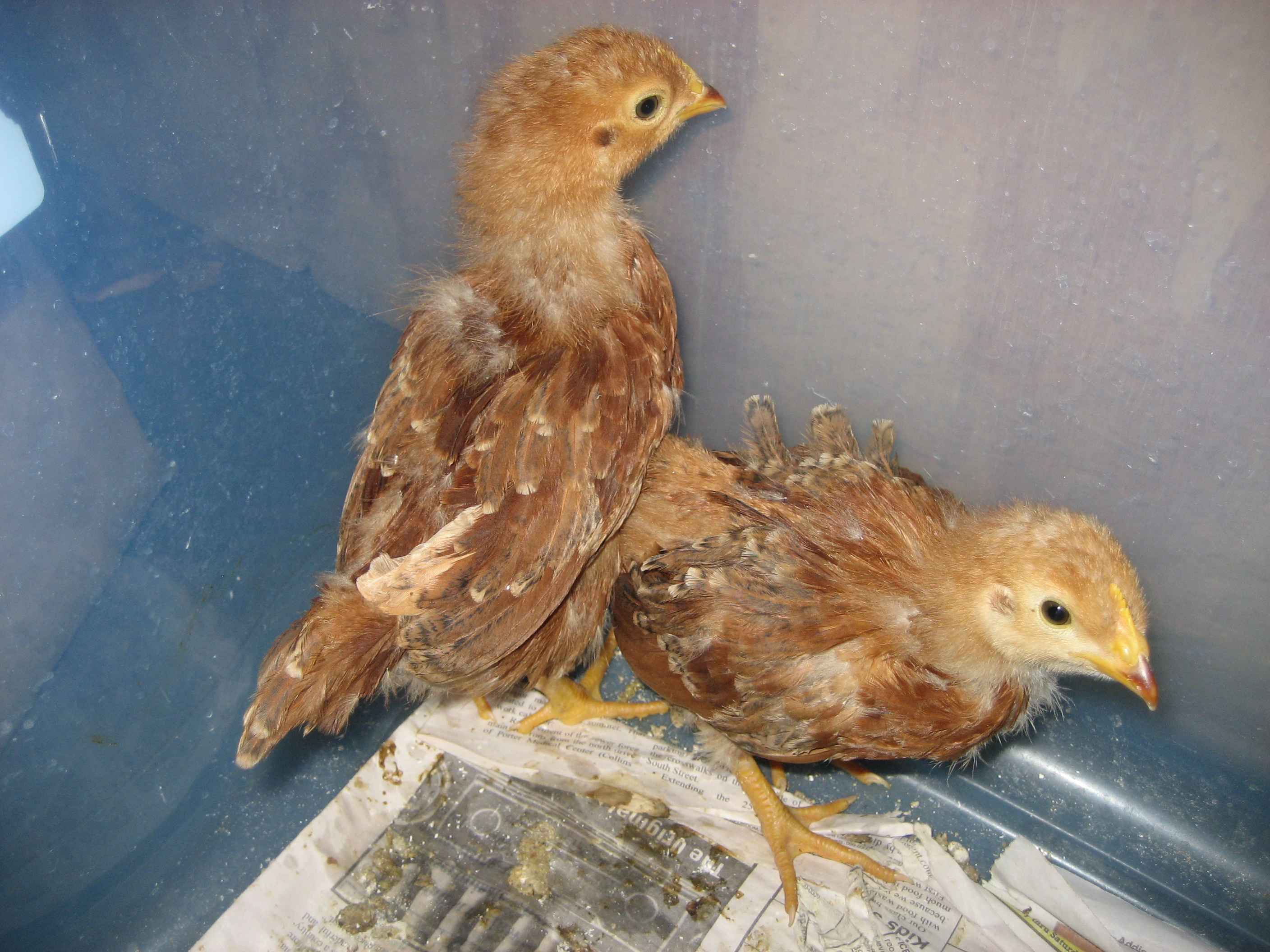
Grace, Simba, and Hermione are thriving. Every day they look less like cute, fuzzy little chicks, and more like full-grown chickens. I can’t imagine that any other animal illustrates the concept of adolescence better than chickens: for several weeks, they had yellow, downy fuzz on their necks and heads, but feathers down below: half chick, half chicken. Throw in some pimples and a squeaky “cluck,” and you’ve got the universal 13-year-old.
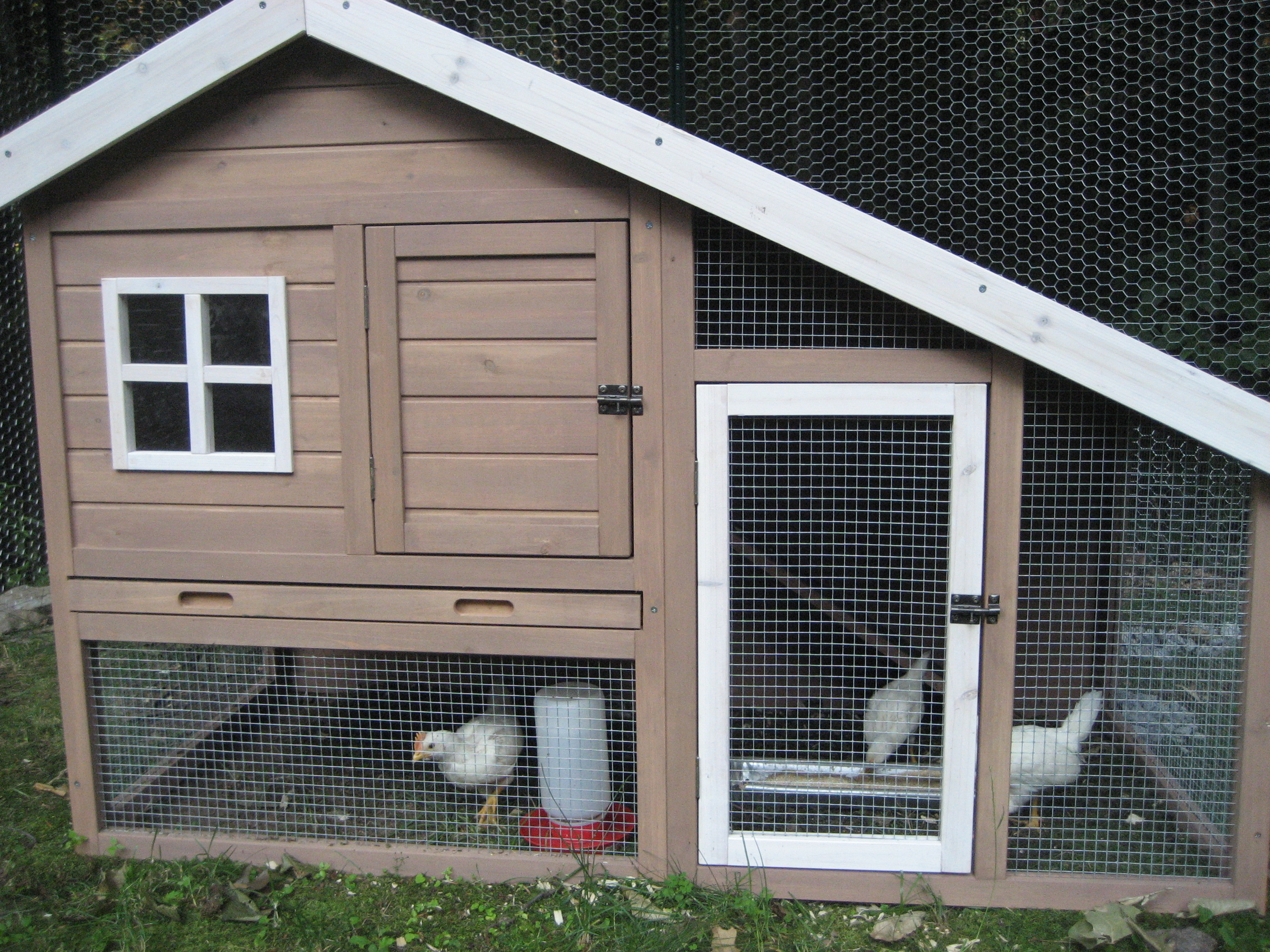
After about 4 weeks in a large plastic bin under a heat lamp in our garage (the very impressive, chicken-raising term for this setup: “The Brooder”), they were large enough to move out to the chicken coop in our yard. And, I’m proud to say, they have survived! I honestly feel a greater sense of accomplishment about keeping these chickens alive outside than I did about keeping our newborn children alive. As clueless as first-time parents are, at least we’re the same species as our children; when it came to chickens Erick and I had ABSOLUTELY NO IDEA what we were doing. We ended up ordering the chicken coop from Wal-Mart (yes, Wal-Mart sells chicken coops; who knew?), and Erick and his father constructed a rudimentary fence from metal posts and chicken wire. This probably won’t be our final set-up; it’s too flimsy to withstand predators and Vermont winters for long. But until Erick gets around to his winter project of building a chicken coop by hand in our basement (which he claims he’s “getting excited about;” who knew?), it’ll do.
The new digs.
Of course, it hasn’t all been smooth sailing. First we had to resolve the tiny little issue of whether we were allowed to keep chickens in our neighborhood at all. Our kind neighbors, neither of whom minded us keeping chickens, both mentioned in passing that we should know that there was some sort of “Neighborhood Covenant” forbidding the keeping of farm animals. Huh?!? In Vermont?!? But we wanted to be good neighbors; I didn’t relish the idea of trying to keep chickens secret. We hadn’t been told of any “Neighborhood Covenant” when we bought the house, but there was a reference to it in our Deed. Good girl that I am, I went over to the Town Clerk’s office and pulled up the Covenant. It does exist, it does forbid the keeping of “anything other than domestic animals,” (and sets strict limits on what color you can stain your house), AND…it expired the year we moved in! So our chickens are legal. (And now we’re now planning to paint our house purple and start grazing cows on the lawn).
The first day the chickens were out in the coop was pretty harrowing. I was like a new mother, checking her baby obsessively in the bassinet; I kept peeking in the coop, to make sure that they were eating and drinking and alive. Our coop has a fenced-in “grazing” area on the bottom, and a ramp leading “upstairs” to the roost and nesting box. By nightfall, I noticed that our chickens were still hanging out in the downstairs grazing area, which made me a little nervous; safer for them to be up in the roost, protected from predators. Something wasn’t right. By about 10 PM, I couldn’t stand it any longer. I threw boots and a coat on over my pajamas, strapped on a headlamp (since it was pitch dark outside), and tromped out to the coop with Erick wearily following along behind. It was like a scene from every zany “clueless people raising animals” comedy ever made.
There were the chickens, cuddled up and sleeping in the grazing area. We picked them up (thankfully sleepy chickens are much easier to get a handle on than wide-awake chickens) and moved them up to the nesting area. That was all it took; “OH, there’s an UPSTAIRS?” you could see their little chicken brains clicking.
The chickens venture “downstairs.”
Moral of the story? Chickens: not so smart.
In their chicken bedroom.
And now for the bad news: It looks like we have one rooster. This isn’t exactly bad news, since in my darkest moments I imagined that somehow we’d end up with three roosters, and that all our efforts on behalf of these chickens would be for naught; we’d be left with an empty chicken coop and no eggs. And I’m still not entirely sure, since supposedly you can’t really tell which chickens are hens and which are roosters until about the fourth or fifth month, when the roosters will start to crow. But all I can say is that one of our chickens has a huge, bright red comb on top of its head, and the other two don’t. I’m calling it: Rooster.
Thankfully, our girls have enough experience with other roosters to agree that we don’t want to keep a rooster. “That one’s a rooster,” they’re already telling their friends. “We’re going to give it away…or EAT it.” And no, we have no idea which girl’s chicken turned out to be the rooster, because really, these chickens are impossible to tell apart. But Fiona keeps insisting that she’s sure the rooster is Campbell’s (Simba).










 The Pickle Patch