Pain in the Back

I’ve been middle aged for a while now, but it didn’t feel official until last month, when I threw out my back. 

My husband, who has spent much of his adult life sitting at desks and working on computers, was throwing out his back and neck on a regular basis long before he hit middle age. Sometimes he’d just roll out of bed the wrong way, and he’d spend the next few days with his head cocked to one side, moaning painfully. But I have spent much of my adult life chasing after children rather than sitting at desks; this was my first experience with severe back pain.

It happened in the least glamourous way possible. My husband and I had to participate in the same meeting on Zoom, so we were sharing a single laptop screen. Attempting to hide from our children, we chose to attend the meeting in my “office” (a desk and chair set up between the washer/dryer and the sewing machine). My husband arrived first to set up, so he took the chair; I arrived several minutes late, after getting the kids settled, so I perched on a stepladder. I spent the entire 90-minute meeting atop that stepladder, hunched slightly forward and to the right so that I could see the laptop screen. When the meeting ended, I could barely stand. 

Click here to continue reading this week’s “Faith in Vermont” column in The Addison Independent.

The Vaccine and Me

The National Guardsman standing by the front door of our town’s rec center had a copy of War and Peacetucked under his arm. 

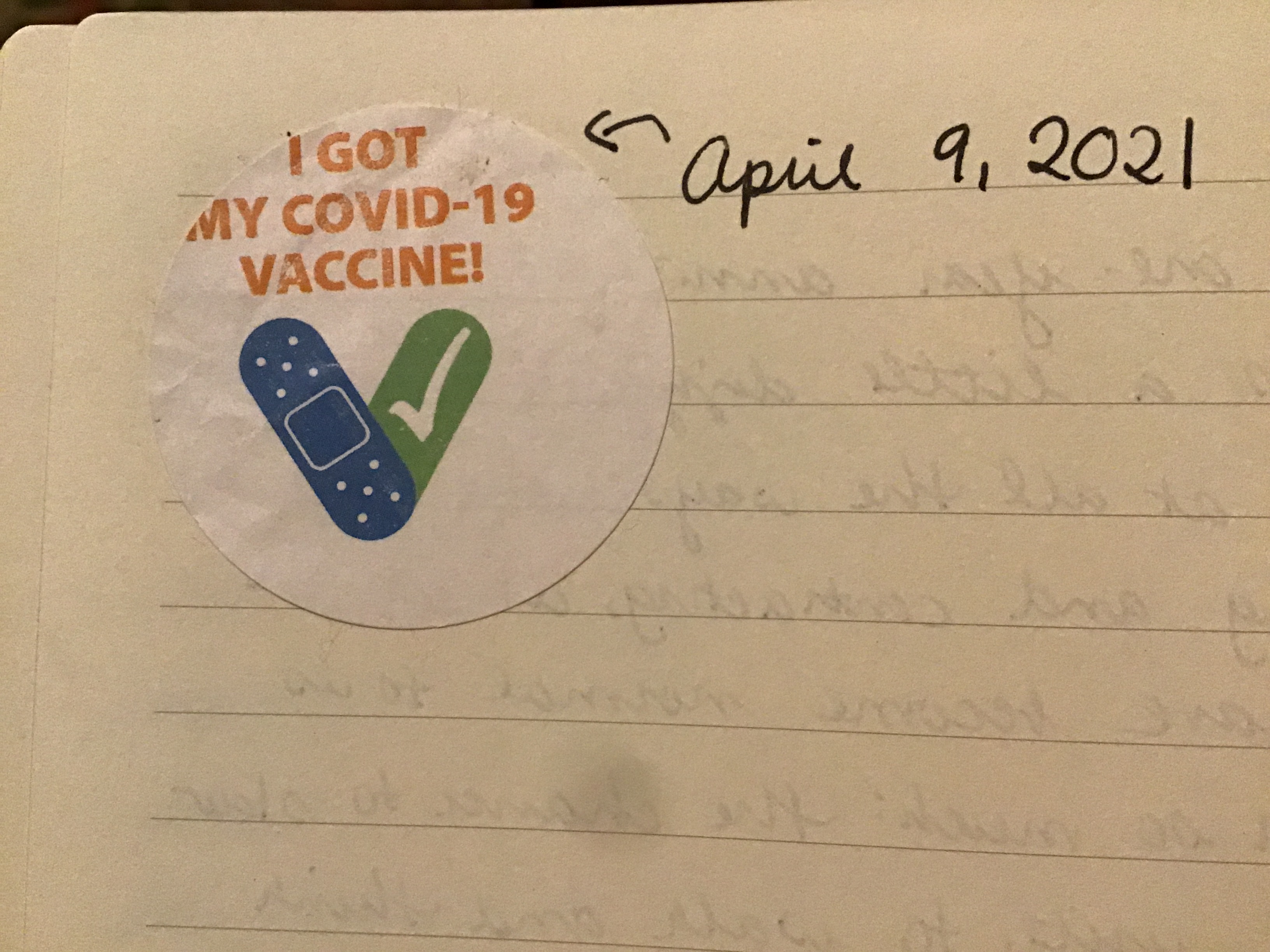
He wouldn’t be able to read his book for some time, because the line of people waiting for temperature checks stretched into the parking lot. I was standing in that line on a sunny April morning, ready to receive my first dose of the Pfizer vaccination against COVID-19.

My fellow vaccine recipients were a diverse group: Judging by appearances, I stood in line with people of numerous races and occupations, ranging from teens to senior citizens. This may have been the most diversity I’ve seen in one place since moving to Vermont a decade ago. 

After the Tolstoy-reading National Guardsman checked my temperature, I was ushered inside the town gym, which was filled with orderly rows of chairs and tables where dozens of National Guard members ushered people through the vaccination process. Cheerful music blared as I checked in at the front desk, filled out my health history paperwork on a clipboard, got my first shot, sat for 15 minutes of observation, checked out, and received my appointment for the second vaccine dose. The entire process took less than 30 minutes. 

 “Are you scared?” my daughter had asked before I left for the appointment. 

My response was honed from years of parenting children who fear shots: “Well, I don’t think many people are usually excited about getting a shot, but I know I’m going to be OK, and I want to help get us one step closer to ending this pandemic.”

What I didn’t say was the phrase I’d been repeating to myself all morning: I’m doing this for my kids; I’m doing this for YOU.

Click here to continue reading this week’s “Faith in Vermont” column in The Addison Independent.
Miracles

My daughter found the caterpillar during a hike in Wright Park on Labor Day 2020. 

We hadn’t seen this type of caterpillar before, its bands of green interspersed with black and gold dots. Thankfully we were with friends who knew: “It’s a swallowtail caterpillar.”

Could we bring it home to hatch? my children wanted to know. 

We could try. 

We installed the caterpillar in our butterfly house, where it coexisted with our final monarch butterfly chrysalis of the season. We researched what swallowtail caterpillars eat (plants in the carrot family) and picked it plenty of Queen Anne’s Lace leaves from our yard. We didn’t have to wait long: After a couple of days, the caterpillar had enclosed itself into a chrysalis hanging from the top rim of the butterfly house. Unlike the lovely green-and-gold chrysalis of the monarch butterfly, the swallowtail chrysalis looked more like a dead, rolled-up leaf. 

Having raised numerous monarch butterflies, we knew how to wait. We waited and waited. Our final monarch butterfly hatched and was released. Still, we waited for the swallowtail.

Click here to continue reading this week’s “Faith in Vermont” column in The Addison Independent.

After the Tornado

Words I never expected to say: “After the tornado went through our front yard….”

Yet I heard myself say exactly that to my children on the evening of March 26, 2021. It sounded so ludicrous, so absolutely unbelievable, that I broke down in giggles.

“Uh, Mommy,” my daughter asked, “do you have post-traumatic stress?”

Maybe. Probably. I suppose some degree of trauma is inevitable in a year when I’m learning that no matter how ludicrous, how absolutely unbelievable something seems, it can still happen. “Is this actually happening?” I’ve wondered numerous times over the past year: when the COVID-19 pandemic began, when I saw news coverage of mobs storming the U.S. Capitol building, and when I watched a tornado pass by our house – in Vermont, in March. 

Vermont is not known for tornadoes, although they do happen: The state has averaged one tornado a year since 1950, which makes Vermont one of the ten states with the fewest tornadoes in the nation.  Only one other tornado in history has been recorded in Vermont in March, a month not known for thunderstorms or tornadoes.

The forecast on March 26 called for a chance of severe afternoon thunderstorms. It rained off-and-on all morning, but by lunchtime the sun was out. My daughters headed outside for their weekly (masked, distanced – we’re still in a pandemic) “nature group” playdate with two friends. Because of the forecast, I settled the six girls with painting and games in our backyard yurt, with instructions to stay in the yurt at the first sign of thunderstorms.

As I walked back to our house to put the baby down for his nap, the rain had started up again. When I reached the kitchen, the power clicked off. “That’s strange,” I thought. “It’s not all that bad outside; the storm must be much worse somewhere nearby.”

Then I looked out the window.

Click here to continue reading this week’s “Faith in Vermont” column in The Addison Independent.

The Pod Swing

The pod swing hangs from a beam in our living room like some overripe fruit in a tropical rain forest. It is tear-shaped, made of durable lime green fabric with electric blue trim. You enter the swing through a narrow opening in the fabric; when you settle onto the round, electric blue cushion inside, you are surrounded by lime green on all sides, encased like a pupa in a chrysalis. 

The pod swing was not an intentional act of interior decorating. I never cast a critical eye on our living room and said, “You know, what this place really needs is a pod swing.” We purchased the swing on the advice of our son’s physical therapist; it’s supposed to give him practice in “not feeling in control.” 

Click here to continue reading this week’s “Faith in Vermont” column in The Addison Independent.

Reflections on A Decade

My third daughter turned ten on March 1. 

The momentousness of the occasion didn’t hit me at first. With birthdays, I’m usually just relieved to have them successfully behind us: Gifts purchased, wrapped, and opened. Cake baked, frosted, lit, and consumed. Birthday child feeling sufficiently loved and celebrated for another year. 

But after the last candle was extinguished, I did the math, and it seems that I now have three children with ages in the double digits. This leaves only two children in the single digits (and without pierced ears, ten being the age at which our family considers you responsible enough to handle earrings.) 

Maybe that doesn’t seem momentous to you. To me, it marks the shocking realization that the majority of my children are more than halfway to adulthood. 

My daughter’s birthday points to another milestone: If she is ten, then our family has now lived in Vermont for ten years. 

Click here to continue reading this week’s “Faith in Vermont” column in The Addison Independent.

Why We Are Celebrating

“Daddy, don’t forget to pick up some cupcakes at the store, okay?” 

My husband, who was heading out the door to run his usual Saturday morning errands, turned to look questioningly at our 9-year-old daughter. “What are the cupcakes for?”

“For Pip’s birthday party!”

“Wait…sorry…um…. Who is Pip?”

“You know,” she said, undaunted. “Pip is my little china dog figure.”

My poor husband: You could almost see him thinking, this is not what I signed up for, as he spluttered, “Your china dog…? NO. I’m not going to get cupcakes for a china…. Oh, okay, fine.” 

My husband wasn’t aware of It, but Pip’s birthday had been in the planning stages for nearly a week. My daughter had chosen a date, made posters to invite her sisters, and designed teeny-tiny little invitations for the other animal figures in our house. While my husband was at the store buying cupcakes, my daughters made a little “Happy Birthday” banner for Pip, blew up some balloons, and created an animal-figure-sized dance floor.

Later that afternoon, my daughters celebrated Pip the china dog’s birthday with store-bought cupcakes.

We are approaching the one-year anniversary of the moment when the COVID-19 pandemic changed our lives. This was a year none of us expected to have, nor was the experience uniform: Restrictions were added, lifted, and added again. Some suffered horrific loss, others were inconvenienced. Fear, frustration, and hope danced crazily through our emotional landscapes. 

As I look back over the past year – still at close range — it struck me that if someone in the future were to ask me how our family spent the pandemic, one of my first responses would be: “We celebrated more.”

Click here to continue reading this week’s “Faith in Vermont” column in The Addison Independent.

Crying At the Movies

We were snuggled up on the couch (or crammed in, depending on your perspective) for our family’s weekly Friday movie night. In the flickering light from the screen, I could see three pairs of worried eyes staring at me.

“Uh, Mommy,” whispered one of my daughters, “Are you okay?”

“I’m okay,” I sobbed. “This scene just gets me every time.”

We were watching the 2015 Pixar animated feature, Inside Out. The last time I’d seen this film was in a theater five years earlier, and I’d broken down in sobs during the exact same scene. 

Inside Out takes place largely inside the brain of an 11-year-old girl named Riley. Riley’s emotions go haywire during a time of major change in her life, and the film follows Joy and Sadness as they try to get Riley back on track. In the scene that always shreds me, the two emotions have met Riley’s old imaginary friend, “Mr. Bing Bong,” in her long-term memory. Joy and Bing Bong become trapped in the Memory Dump, where memories fade into oblivion. They attempt to ride a toy wagon out of the dump, but Bing Bong realizes that the two of them are too heavy. He helps Joy launch the wagon, and then he bails out in mid-air. Joy escapes, realizes he’s no longer with her, and looks back down into the Memory Dump. Bing Bong, as he vanishes, waves up at her and calls, “Take [Riley] to the moon for me, okay?”

Gah! 

It seems I will never be able to watch this scene without dissolving into tears. My children don’t understand (yet). I’m not sure I understand entirely, either: Why should I weep repeatedly over the disappearance of an animated pink cat-elephant-dolphin hybrid that only ever existed in a fictional child’s imagination? 

Click here to continue reading this week’s “Faith in Vermont” column in The Addison Independent.

Anxiety, Hand-Washing, and eye Contact: A Report From the Kids

The temperature hasn’t risen above freezing all day, but the sky is a brilliant blue traversed by wispy clouds and the sun is shining on the sparkling white snow. In our front yard, my four daughters are zipping around on their skates, playing broomball on the ice rink that my husband built to keep them outdoors and active during the winter months. After a disappointingly mild December, January finally brought the requisite three days of below-freezing temperatures necessary for skate-worthy ice, and my daughters’ joyful voices proclaim that it was worth the wait. 

They are young, happy, and carefree. 

Or are they?

Over the past week I’ve heard this question asked repeatedly: How will having lived through the COVID-19 pandemic affect this generation of young people? Surely it will have some impact on their outlook on life and their behavior, much in the way that the Great Depression, World War II, and the Vietnam War impacted the generations that lived through them. 

I’ve heard this question pondered by fellow parents, by elderly adults, and even from the (live-streamed) pulpit of my church. So, since I have a sample size of five children in my house, I decided to ask their opinion: How do they think they’ve been changed by COVID-19? 

Click here to continue reading this week’s “Faith in Vermont” column in The Addison Independent.

On Giving Up Coffee

I fell in love with coffee slowly. I wasn’t until midway through college, when a friend took it upon herself to introduce me to coffee in the form of a sugary sweet hazelnut latte, that I became interested in the beverage at all. I continued to guzzle hazelnut lattes (which I now consider “adulterated coffee”) at Starbucks franchises during my post-college years, working my way up to the “venti” size (which I believe is Italian for “the approximate volume of a bucket.”) Over time my coffee drinks included less sweetener and milk, so that when my family was living in California’s Bay Area – the epicenter of coffee snobbery – I was a coffee purist. 

For over a decade, I drank my coffee black, preferably from freshly ground beans. Although the caffeine kick was helpful as our household filled with young children, I drank coffee for love. Quality was more important to me than quantity: My habit was to drink two cups of coffee per day, one in the morning and one in the afternoon. I loved the taste of coffee, loved cradling the warm mug in my hands and inhaling its aroma, loved anticipating my second cup during those endless afternoons of early motherhood.

Which made it acutely painful when I had to give up coffee. 

Click here to continue reading the final “Faith in Vermont” of 2020 in The Addison Independent.