Mary & Me

Our pastor (trustingly and graciously) asked me to write and deliver a brief reflection on a Bible passage during our church’s Lessons & Carols service yesterday. She gave me a choice of two passages: one was the well-known, bare facts version of Jesus’s birth; the second was a little flashier, about the angels appearing to the shepherds. 

I chose the less exciting Bible passage, because I felt like I would benefit from spending time digging into a story I’ve heard so often that I barely hear it anymore. What follows is that passage, and my reflection upon it. 


Luke 2:1-7

In those days Caesar Augustus issued a decree that a census should be taken of the entire Roman world. (This was the first census that took place while Quirinius was governor of Syria.) And everyone went to their own town to register.

So Joseph also went up from the town of Nazareth in Galilee to Judea, to Bethlehem the town of David, because he belonged to the house and line of David. He went there to register with Mary, who was pledged to be married to him and was expecting a child. While they were there, the time came for the baby to be born, and she gave birth to her firstborn, a son. She wrapped him in cloths and placed him in a manger, because there was no guest room available for them.

***

I have a really difficult time relating to Mary.

Joseph confuses me, too, but I feel like Mary should be a kind of soul sister: she was a woman, I’m a woman; she was a mother, I’m a mother.

Still, I just don’t get her. Almost every other Biblical character turns out to have been a lot like us – or, better yet, worse than us. The big names in the Bible were liars, murderers, cheats, prostitutes. But not Mary; read the Christmas story for the hundredth time, and Mary looks exactly like she did back when I was in Sunday School: humble, obedient, and perfect. Too perfect.

This is a young woman who, when an angel visits her early in Luke and tells her that she’s going to be fodder for the Nazareth tabloids by being an unwed mother to God’s son, essentially says, “Huh? Okay!” Then she starts singing poetry.

That would not exactly be my response if I were in her sandals.

Then there’s this census trip to Bethlehem with Joseph. Mary and Joseph probably traveled about 90 miles from Nazareth to Bethlehem. And, although most pictures seat Mary on a donkey, the Bible never mentions any donkey, so she may have been walking. The trip would have taken them about a week, give or take. And Mary was in her last trimester of pregnancy.

During my last trimester of pregnancy, I was either buying baby supplies or on the couch watching Downton Abbey. I was emotional, uncomfortable, and impatient. If I’d had to walk or – only slightly better – ride a donkey 90 miles, somebody would have heard about it, loudly and often.

As for the actual birth of Jesus, it seems that our Western image of Mary and Joseph arriving in Bethlehem, finding no vacancy at the Motel 6, and spending the night in a barn is about as accurate as Mary riding on a donkey.

Many Biblical scholars believe that the word “inn” is a bad translation of the original Greek word “katalymati,” which is more accurately interpreted as “guest chamber” or “upper room.” Mary and Joseph were probably traveling with members of Joseph’s extended family, and because Bethlehem was Joseph’s ancestral home, they may well have been staying with his family. A truer description of what happened on Christmas Eve is probably: Because the home where they were staying was so jam-packed, Mary had no privacy and nowhere to put her baby. So she retreated to what was either – depending on the house’s setup – a cave in the backyard where animals were kept, or a lower room where the animals and servants stayed.

You want to see my husband’s eyes widen with fear? Just try presenting him with this scenario: Hey, Erick, how about if, when Faith was 9 months pregnant, she had to walk for a week to a house full of in-laws? And then, because the in-laws wouldn’t leave her alone and hadn’t gotten the crib on her baby registry, she had to give birth among animals and lay the baby in a feeding trough?

But in the Bible, Mary never makes a peep. Western Christmas culture has interpreted this to mean that she plodded along without complaint or resentment. Also: She was blonde, pink-cheeked, and beaming peacefully the whole time.

I can’t relate to any of that.

Then I re-read this passage in Luke, which most of us have heard so often that it barely registers, and I realized that we have no idea how Mary acted or felt. There’s simply not enough information. We get a brief outline of events – just the facts, ma’am — from the journey to Bethlehem through Jesus’s birth, but nothing about Mary’s reactions. For all we know, she could have nagged at Joseph the entire 90 miles to Bethlehem. She could’ve resented the heck out of her in-laws for not having a spare crib. She could’ve been terrified about delivery, and bitter that it wasn’t the birth she’d expected. (“I gave birth to the Savior, and all I got was this lousy manger.”)

Or maybe not.

But here’s what else I realized: It doesn’t matter.

I don’t have to understand Mary in order to be rocked to the core by the Christmas story, because Mary is not the point.

The one and only point is: That’s GOD lying there in the manger.

And my guess is, God was going to do his work through Mary whether she grumbled or humbly accepted it. When the angel told her God’s plan, he didn’t present it as an option. So maybe the most remarkable thing about Mary isn’t that she was perfect, but that she recognized God’s power better than I do.

This year, God has been teaching me in many ways, most of them uncomfortable, that I am not the point: that the world, the arc of history, and even God’s plans for my own life do not hinge on my personal comfort or convenience.

That kind of thinking’s not popular in our culture today. We think in terms of self- esteem and self-actualization. We say that God has a plan for our lives, and we assume that means a fairytale ending.

The Christmas story shows that God’s plan will be worked out through us regardless of whether we agree, complain, or are comfortable. We are not the point.

But not being the point doesn’t mean that we don’t matter. We know we matter, because that’s God in that manger. For us.

We can plan all we want for a comfortable birth, but God?  God’s plan is to save us.

***

I’m now beginning two full weeks at home with all four children, all day long. So, aside from my regular obligations at The Addison Independent you probably won’t hear from me for a while. I wish you and yours a wonderful Christmas, and a joyful 2015.

Powerless

IMG_4977

Life changes with the phone’s ring and a single recorded sentence:

“Good morning, this is Peter Burrows, ACSU Superintendent.”

That’s the call we received at roughly 5:30 AM last Wednesday. These calls always seem to come when I’m already up, dressed, and halfway through washing my face. Which leads to the conundrum: Do I go back to bed fully clothed? Will this be the day when my children finally sleep late?

The call informed us that school would be closed for the day: the first snow day of the 2014-15 school year. What had started as an unimpressive slushy rain the day before had turned to thick, wet snow overnight. The snow would continue, on and off, for the next two days, ultimately dropping about 16 inches in our yard.

So, once again, I was forced to confront my ambivalence about snow days. This ambivalence started only when I became a parent; as a child — and as a childless working adult — snow days were welcome chances to relax and recreate. Now that I’m at home with young children, snow days don’t affect my movements or my work as much as they once did. Instead, snow days bequeath me four children — two of whom are usually in school all day and one of whom attends morning preschool — all day long.

Click here to continue reading this week’s “Faith in Vermont” column in The Addison Independent.


Keeping the Cards

IMG_4969

When On the Willows invited contributors to write about a favorite holiday tradition, I signed up immediately.

Then I stared at the wall for several weeks.

Our family is still a little new to this holiday tradition thing.

Neither my husband nor I brought a stockpile of holiday traditions to our marriage. I’m an only child who grew up many hours away from my extended family; my parents produced festive holidays, but it seems to me that at least one sibling is necessary to create a family culture in which holiday traditions are remembered and carried on. And my husband is the son of first-generation Chinese immigrants; they combined Western Christmas traditions with Chinese cooking, which would be wonderful if either of us could cook like my mother-in-law.

It was only four years ago, when our third child was born and we moved to Vermont, that we declared ourselves officially “Home For The Holidays.” Henceforth, we would celebrate Christmas in our home rather than alternating between grandparents; extended family was welcome to come to us.

Four years isn’t a long time to develop traditions, especially with three young children and a fourth baby in the mix; we’re mostly just trying to stay afloat through the holidays.

Click here to continue reading about our holiday tradition (we do have one!) over at On the Willows.

The Slumber Party

A 1924 slumber party.


When my oldest daughter turned seven last month, she requested a slumber party.

I’m not sure where the idea originated; she’d never attended a slumber party before. Sure, she’d spent nights at her grandparents’ houses. She and her sister once slept over at a friend’s house. We’ve had company come to stay, which often involves a few extra children sleeping on her bedroom floor. And because my daughter shares a bedroom with three younger sisters, one could argue that every night of her life is a slumber party.

But she wanted a birthday slumber party, with three friends from school. This is a girl who has a vision of her birthday party each year, down to the color scheme; she’s a force when it comes to celebrations.

As it happens, I have a fraught history with slumber parties. After a few innocuous sleepovers, when I was around my daughter’s age I attended what has become known as — in my mind — The Slumber Party From Hell. Not because it was a bad party, but because I behaved badly. I was not prone to bad behavior, but as an only child from a quiet, orderly household, I found slumber parties overly stimulating: More girls than parents! Whoo-hoo! At this particular party, I hoisted a large ceramic ball (a sculptural item belonging to my hostess’s parents) over my head in an attempt to impress my friends, which I inevitably dropped and broke. Then I laughed so hard that I wet my pants.

Click here to continue reading my latest “Faith in Vermont” column for The Addison Independent. (I promise this link will open; sorry for the “Subscription Only” limitation on yesterday’s feature. If it’s in the print version, apparently, it’s protected.)

Something New

A little something new today:

In November, I sat down for coffee with my editor at The Addison Independent — the local paper that runs my “Faith in Vermont” column in their online edition. The point of the meeting was to discuss how I could branch out a little, do a bit more at the paper.

Today, I’m happy to share the result: I’ll now be reporting regularly on some select stories for the Independent. These stories will run in both the print and online editions, and today the first of them, a profile of Bert LaBerge, hits the stands.

Aside from some tricky childcare juggling, this new reporting gig has been even more fun than I could have imagined. I’m an introverted person, so the idea of cold-calling people for interviews might seem terrifying. But as long as I can hide behind the “I’m a reporter for the Independent,” line, I’m fine. Then I get to ask questions, be nosy, put a story together. And the best thing: It’s not at all about me! Don’t get me wrong: I love writing this blog and my little column, but they’re essentially personal essays. They deal with what I did, saw, or thought. Reporting cuts me out of the story, which is a nice break for everybody!

So here’s my first piece of reportage: Bert LaBerge, a 74-year-old man with Parkinson’s disease who’s been slowly chopping up two big trees over at the Methodist Church. I probably won’t share all of my stories on this site (my next one, for instance, is about a new treatment at the local spa — probably limited regional interest in that one!), so you’ll have to look for them on the Indpenedent‘s site, but I’ll share my favorites — like this one. I feel like I lucked out getting this for my first assignment: everyone I talked to was just lovely, I thoroughly enjoyed chatting with Bert as he worked and while driving him to #1 Auto Parts so he could get a new spark plug for his Ranger, and it’s just an all-around good story. Enjoy!

(And local friends: You may now feel free to pitch me stories!)

Family Art

This is a follow-up to my “Fall Cleaning” post a couple of weeks ago, in which I mentioned that, as part of an uncharacteristic burst of domestic energy I’ve had this fall, I was planning to work with my daughters to create brighter artwork for our walls.

I did. I dove headlong into my home mania and ordered a large blank canvas from Amazon. (If you don’t live in Vermont, chances are you have an art supply store within easy driving distance and don’t have to support massive, evil, online retailers. I do not have that option.) I bought a fresh pack of Crayola’s Washable Kids’ Paint from the grocery store. There were exactly six colors in the box — one for each member of our family. Perfect!

Armed with these simple materials, I was ready to make my vision a reality. I used pencil to trace the outline of a heart on the canvas. My vision was to have each member of our family — our four girls plus my husband and me — dip their hands into a different color of paint and make two colored handprints on either side of the heart. The finished product would be a heart shape outlined neatly by our family’s handprints.

I decided to start with our youngest child, 17-month-old Abigail (paint color: orange.) She’s the wiggliest, so I’d get her out of the way first. I scooped her up and dipped her palms into the pool of orange paint that I’d poured onto a paper plate. She looked at her hands, looked at me as if to say, “What are you doing???,” then balled up her fists and started yelling. I tried to pry open her palms and press them onto the canvas: no dice. She was all resistance. After a few fruitless minutes, I had two orange blobs up at the top of our heart.

Not an auspicious beginning, but not a huge problem. She’s the baby; one day, we’ll point to those blobs and laugh about her paint panic (this from a child who ends every meal covered with food — I don’t get it.)

Next up was daughter #2: five-year-old Campbell (paint color: yellow.) Campbell was enthusiastic; so enthusiastic that, after making her first two handprints on the heart, she re-dipped her hands in the paint and — before I could stop her — smeared yellow around the inside of the heart.

“No, Campbell, that’s –” I began, then stopped myself. Almost seven years of parenting to get to this point, but at that moment I realized that this was no longer my project. And that was okay. This was a family effort, and if my family wasn’t behaving according to my perfect plan, I’d just have to roll with it.

So I stood by and watched while Campbell made several more sets of handprints around the canvas, until she was satisfied.

Then came Georgia, three years old, who’d be adding red handprints. Her preschool does a lot of handprint art, so I was dealing with a pro. She dipped her hands neatly into the paint, wiped off the excess, and made multiple sets of beautiful red prints across the canvas.

Six-year-old Fiona approached the canvas and wailed, “They didn’t leave any space for me!” When I pointed out the few white patches still visible, she dipped her hands into the purple paint and got busy making her mark, proudly smearing purple around and over everyone else’s prints like a true firstborn.

Our artwork no longer bore any resemblance to a heart; instead, it was a big, colorful, smeary mess of handprints. But I wasn’t giving up: two grown-ups to go. So, Erick and I used our handprints (green and blue, respectively) to trace out the original heart on top of the girls’ impressionistic prints.

Here is the result:

IMG_4880

I stood back and looked at our artwork, and it wasn’t at all like my original vision. It was perfect: The perfect representation of our family. There are Erick and I, trying with love to give some shape to the chaos. And the chaos itself: these colorful, exuberant, uncontainable girls. Showing me how lack of control is more beautiful than perfection.

Fiona thought we should write a Bible verse in the middle of the heart, so in light pencil I inscribed her favorite verse: “With man this is impossible, but with God, all things are possible.”

Which is also a very accurate representation of our family.

IMG_4879

Timber!

IMG_4919

Since we bought our house in Vermont, a lovely Cape in the woods, our homeownership approach has been: Act first, think later.

This was certainly true when it came to the trees. “Oh look,” I exclaimed the first time we saw the house, “there are so many beautiful trees!” (We learned later that our neighborhood sits within the administrative boundaries of the Green Mountain National Forest; beyond our acre, the woods are protected by law.)

The trees are beautiful. They are important: alive and life-giving. We are big fans of trees. We’ve read The Lorax — many times.

But because we saw the house first in April, before there were leaves on the trees, we didn’t think about the leaves. Or the acorns. Or the lack of sunlight. Or the effects of leaves, acorns, and lack of sunlight on the roof and wooden decking. We didn’t question why there were massive trees two feet from the house (the prior owners had built an addition without clearing any additional space.)

Perhaps you can predict what I’m working up to here: This August, we had 20 trees taken down in our yard.

Click here to continue reading my “Faith in Vermont” column for The Addison Independent.

Fall Cleaning, or: I Love Getting Rid of Stuff

IMG_4876
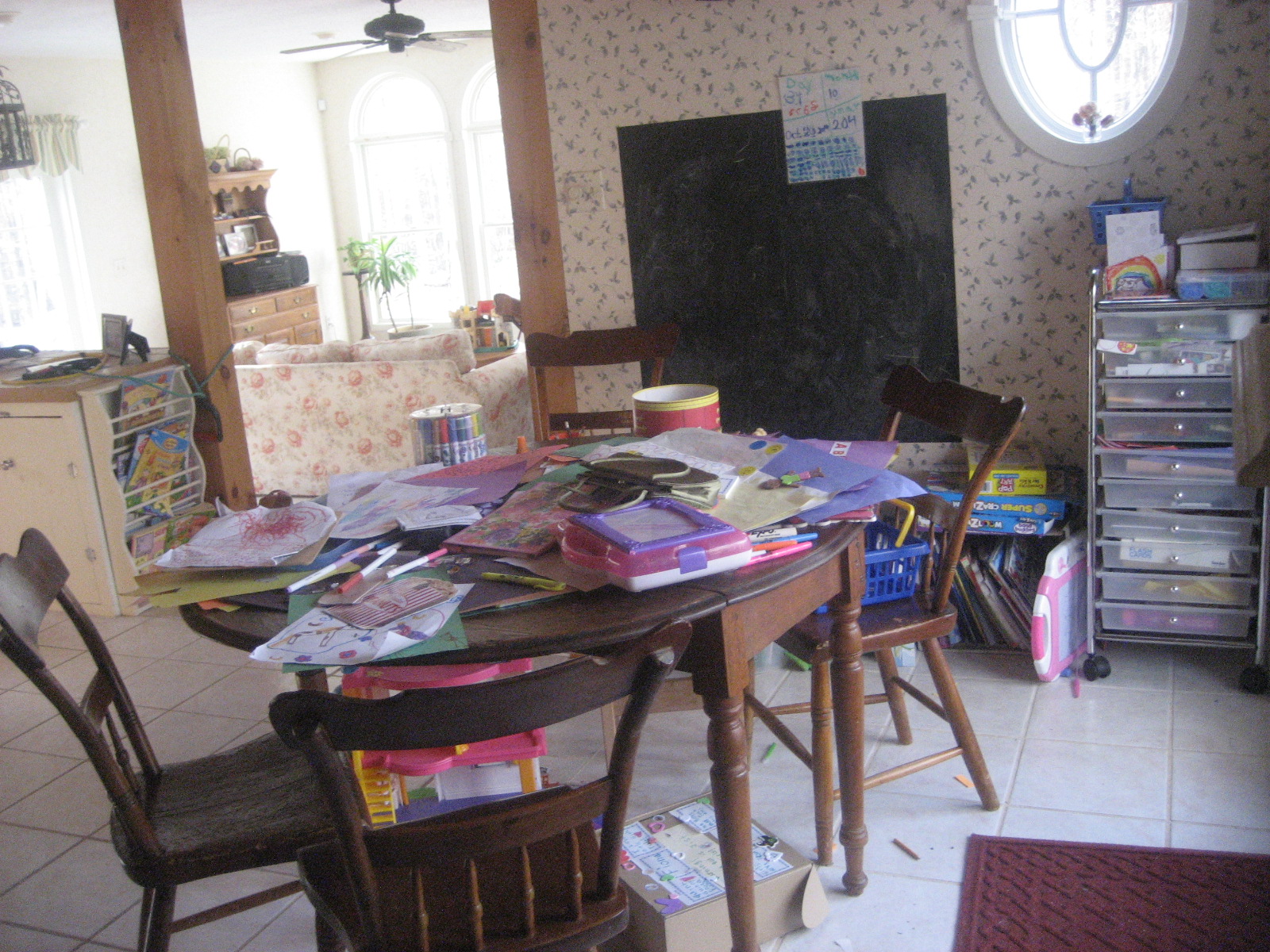
Our school/craft area: A major site of pile-up!

I’ve never really felt the compulsion to do “spring cleaning,” unless spring happened to coincide with an upcoming move or the arrival of a new baby. I understand the point of it: You’ve been cooped up in the house all winter, and once warmer weather arrives you direct a burst of energy at the house in which you’ve been imprisoned. Time to open the windows, shake the rugs, clear the cobwebs!

Because I live in a climate that’s subject to dramatic temperature swings, from sub-zero winters to 90-degree summers, there are certain seasonal tasks to be done; spring is when I put up the screen doors, remove the plastic insulation from my daughters’ bedroom windows, set up outdoor furniture and planters, and do a final sweep around the now-cold wood stove. But these are chores, and I do them without enthusiasm while steeling myself for the approaching summer “vacation,” knowing I’ll spend the next three months refereeing sibling squabbles, shuttling four girls to various activities, and applying sunscreen to squirmy little limbs.

So I’m not inspired by spring cleaning. But this year, I had a burst of home-focused energy that began in September, a couple weeks after the start of school, and is still going strong. I think of it as “fall cleaning.”

I should probably clarify, right here and now, that my version of fall cleaning has very little to do with what the average person defines as “cleaning.” I’m not talking about the type of cleaning one does with sponges and rags and chemicals. I’m talking about making one’s living space more beautiful and comfortable.

Fall cleaning makes a lot more sense to me than spring cleaning. In spring cleaning, you’re essentially beautifying a space in which you won’t spend much time for the next several months. Sure, detritus has built up over the winter and everything needs a good airing-out, but chances are that you’ll be out in the yard or at the pool, lake, or beach more than you’ll be indoors, so who really cares?

Fall cleaning is preparing the space in which you will be shut up for the next several months. Who wouldn’t want to make their cell a little more comfortable?

So I’ve been giving our house a critical eye, and applying my energy to making it a place where I’ll enjoy spending most of my time over the winter months, often in the company of four small children.

Here’s what my fall cleaning does not involve:

1. Lots of money.

2. Major projects.

The primary reason I’ve ruled out both of the above is the reality of life with four small children. Why spend large amounts of money and time making significant improvements to our house, when our daughters will undo them in seconds with the swipe of a marker, a sudden spill, or a misdirected ball?

Instead, here is what my fall cleaning has involved:

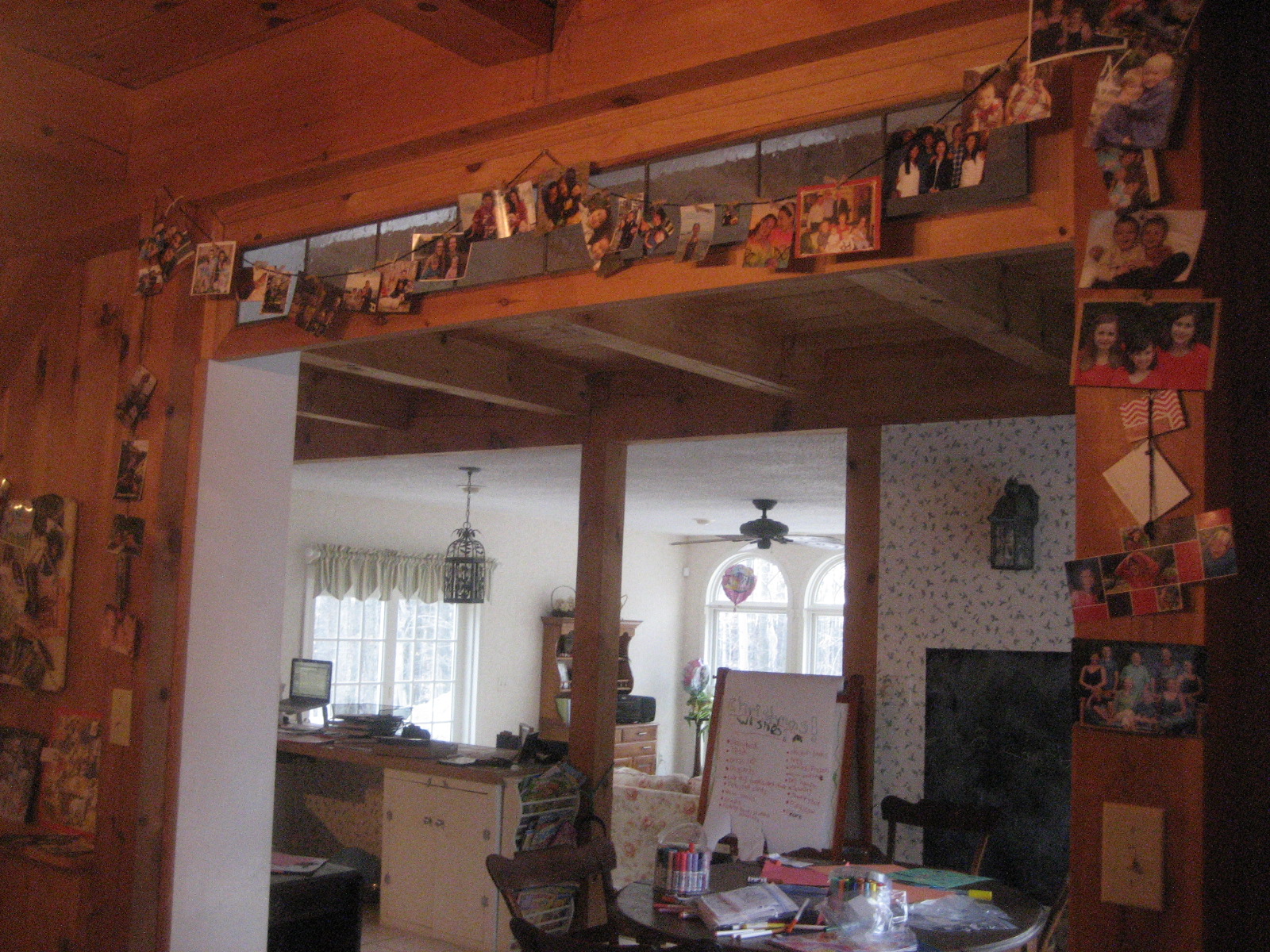
1. Small touches to make the house more bright and fun. Winter is dark. Our house is in the woods, and gets very little light. Most of the interior walls, ceilings, and floors are exposed wood in the “post-and-beam” style. It’s suddenly occurred to me that there are very small things I can do to brighten our house. This winter, I’m painting two large pieces of wooden furniture, which will lighten them and the rooms in which they reside. I’m going to work with my daughters to create brighter, more colorful artwork to hang on the walls. I replaced the dingy old white duvet cover on our bed with one in a bright pattern. And I finally got some new light slipcovers for an ancient couch and chair that have been spilling their upholstered intestines for over a year. (Slipcovers, I figure, can be light, because I can always wash them.)

2. GETTING RID OF STUFF! More than all the small decorating touches combined, the major reason why our house feels dark and cluttered is because it’s got too much STUFF in it. Again, the kids are a major factor here: all of their toys, their artwork from school, their books, their “craft projects,” and the little pieces of junk they pick up at birthday parties and doctors’ offices and arcades…it piles up. Back when I had only one child, I heard parenting advice that went like this: Your house is not the kids’ house — it is YOUR house. Your children are guests in YOUR HOUSE. Their stuff must stay within a small, designated area rather than taking over YOUR HOUSE. It seemed so reasonable at the time; now, I say, “Yeah, right!” Houses are set up to serve their inhabitants; there are now twice as many children as adults in our house, so whose house is it, really?

Without giving up my parental authority (i.e., I still nag them about cleaning), I’ve given up on trying to make our house look like only grown-ups live here. There are signs of our daughters everywhere, as there should be at this stage. But I have not given up on waging war against stuff; this fall, I’ve been merciless. If anything is broken, it’s out. If it hasn’t been played with in over a year, it’s donated. If it’s small, plastic, and not a Lego, its days are numbered. And, finally, now that we’ve had our last child (I hope), I’m donating clothing the second our youngest outgrows it.

I love, love, love getting rid of stuff!

This burst of domestic energy is not like me. (Did I mention I’m also sewing dresses for my three oldest daughters???) I’m assuming it won’t last; I’ll spend some months brightening and painting and throwing things away, and then revert to my lazy habit of writing a blog instead of paying attention to my house. I can’t account for this change, other than to say that it’s fall cleaning, or maybe the fermenting leaves in our well water.

****


Nesting place

I rarely promote things on this blog, but The Nesting Place by Myquillyn Smith has been a major inspiration to me as I’ve been fall cleaning. It’s an easy read with lots of pictures, and it’s basically a decorating book for domestic imperfectionists. Highly recommend.


Riding for Home: Thoughts on Election Day

IMG_4837

Because this column will run on Election Day, I feel compelled to write about local politics.

I typed that sentence, and then spent five minutes staring at my computer screen. The truth is, I’m terrified to write about politics.

Click here to continue reading my latest “Faith in Vermont” column for The Addison Independent.


Regrets (I’ve Had a Few)

IMG_4854

October in Vermont is a month that tugs your heart back and forth. It is undeniably beautiful: peak foliage season, bringing busloads of “leaf peepers” and wavering chains of backroad cyclists into our town. Looking out the windows from where I sit at my computer, I feel like I’m inside a golden box. The woods are yellow and brown and red and just the tiniest bit of green, and they glow. It’s a breathtaking time of year.

But it tugs at your heart because you know it won’t last. It’s a quick transition between the emerald warmth of summer and the white freeze of winter. And, like all transitions, it’s not without mess: the green leaves mixed in among the autumn colors, the temperatures that swing wildly from the 30s to the 70s.

It is quite possible that I’m in the October of my life right now.

I spent the first part of the month looking backwards with some regret. “If I’d known then what I know now, I’d have had all the kids right away, in my 20s, and then gone to college,” I told my husband one night. Never mind the glaringly obvious logistical problems with that statement (like: How is it in any way easier to go to college AFTER having four kids?); what I meant was that it seems wasteful that I invested in my education when I was mentally young (i.e. immature), thus delaying offspring until I was physically older. Childbirth and rearing would’ve probably been less taxing when I was physically younger, and higher education would’ve been less wasted on my when I was mentally older.

That’s all beside the point; the point is that I didn’t know then what I know now, and that’s the crucial fly in the ointment of all regrets. If I’d had children earlier, I’d have been a very different mother with very different children. If I’d waited to launch my education and career (such as it is), I’d have skipped over some vitally important formative experiences. Flip-flopping my timeline doesn’t get me to where I am now, just younger and with a better vocational plan: It changes everything.

But there I sat, in October of 2014 and in my own emotional October, looking back with regret, wondering why I hadn’t made better use of my summer.

Blah.

Then the other night, my husband pointed out that this week is the 15-year anniversary of when we started dating. That news sent me into a completely different sort of backward glancing.

It sent me back to that Halloween weekend of 1999, when a young couple on their third date had just finished a nice dinner in Greenwich Village. As they crossed lower Sixth Avenue, they held hands for the first time.

This sort of backward glancing always makes me think about how much fun it must be to be God. Because I see this couple, as if from above, and I think: They have no idea.

We didn’t know then what we know now.

We didn’t know that three years later we’d get married, after a dating relationship that tested every bit of faith and commitment we had in us.

And then, when we were newly married, there was a certain little girl who lived in our building and who always made us chuckle when we shared an elevator with her and her mother. My husband called her “the sassy Asian girl.” He’d say, “It would be fun to have a sassy Asian girl someday.”

He had no idea.

So I’ve spent these final days of October looking back over the past 15 years with this “God’s-eye view.” Revisiting the quarrels and the make-ups, the trips around the world, the years of graduate school and jobs, the loving moments with friends and family, the illnesses and the childbirths. And the thing is, when I take this view, there’s just so much joy. Joy, and wonder at it all.

And yes, there were hard and sorrowful and horrible times. But when I take the “God’s-eye view,” I don’t see any of those times with regret. I just think: I didn’t know then what I know now. I didn’t know that it would be okay in the end. I didn’t know how those moments would become crucial pieces of the whole.

Where does that lead me?

Having looked back with regret, and having looked back with joy and wonder, the common denominator is: I didn’t know then what I know now. Our cosmic ignorance in each present moment can lead to regret, or it can lead to joy and wonder. And, like most things — like October — it’s a both/and. Regrets can coexist with joy and wonder.

But, given the choice, it’s probably better for your heart to try and take the “God’s-eye view.” It’ll keep you warmer come winter.