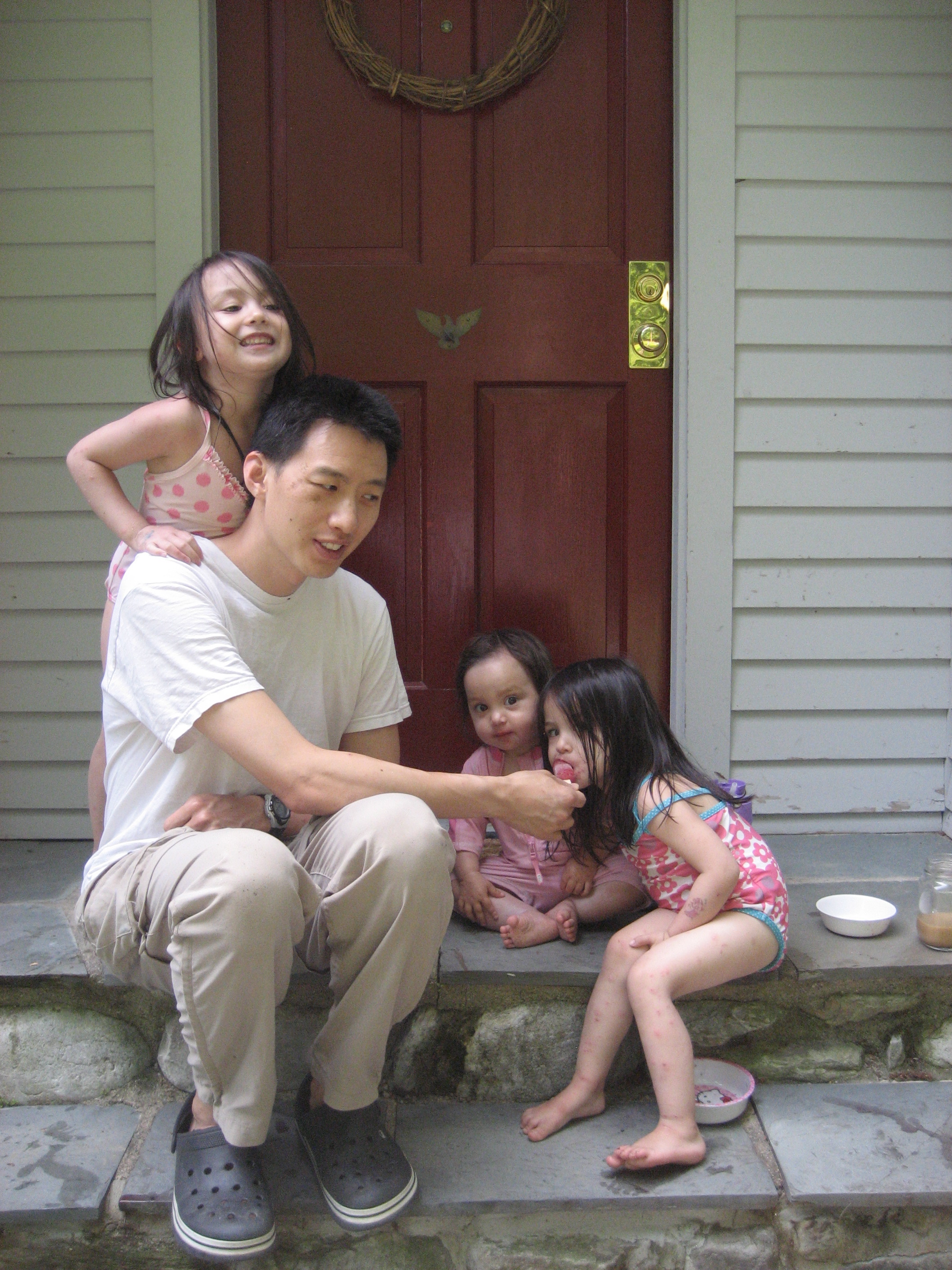
Just for fun: “Having it all” – popsicles after the wading pool – this past weekend.
Last week, several friends forwarded me Anne-Marie Slaughter’s article in The Atlantic, titled “Why Women Still Can’t Have it All.” Usually I keep my mouth shut after I read articles on this topic, which I file under “The Mommy Wars”: the emotionally charged battle over work-family balance for American women today. But this time I didn’t keep my mouth shut. For better or worse, my response is published today over at On the Willows. Click here to read it.
I’m not a fan of making doomsday predictions to women who are expecting their first child. You know: “Ooooh boy, prepare to have your life turned upside down!” “Sleep now, because you’ll never sleep for the next decade!” “Say goodbye to your white couches!” and so on. Regardless of the truth of these statements, they’re not helpful. When I was pregnant for the first time, well meaning friends — many of them mothers — told me to get lots of sleep. In retrospect, these were clearly people who had either no idea or no memory of what it’s like to be pregnant: by the latter half of most pregnancies, no position is comfortable, breathing is difficult, the bathroom calls every 5 minutes, and when you finally do drift off, you have vivid nightmares about misplacing your newborn. Sleep is not really happening in any normal sense. So I spent the final trimester of my first pregnancy exhausted AND stressed that I wasn’t following everyone’s sleeping advice.
That said, there is one thing that I advise friends who are expecting for the first time, because I think it is helpful: Eat brunch as often as possible.
I vaguely remember brunch: sleeping in on a Saturday morning, then ambling down to whatever restaurant we chose for some delicious pancake-y or egg-y food, drinking multiple cups of coffee while leisurely perusing The New York Times and deciding whether to nap before or after we went jogging, which museum we should visit, what movie to see that night.
Nowadays, all of that would be impossible. Let’s start with the sleeping in: our kids have no concept that weekend sleep patterns should differ from the rest of the week, so they stubbornly refuse to sleep in on the weekends. To them, Saturday is just a day like any other, and they come barreling out of their room at 7 AM — if we’re lucky.
Then, there’s the timing of brunch; as a general rule, I believe the ideal time for brunch is about 10 AM. That’s a completely unrealistic time to be eating the first meal of the day if you have kids — including a baby — who are used to eating at 7 AM. By 10 AM, we’ve all eaten, dressed, washed up, and Georgia is waking up from her morning nap. In order to do brunch, we’d have to eat breakfast first, which kind of defeats the purpose.
And I won’t even bother explaining why we can’t possibly read The New York Times during meals these days.
I’d say our brunch days are on hold for at least another 5 years. And that’s why I tell expectant moms to eat brunch while the brunching’s good.
Now, I know all kids are different. I know that some preschoolers sleep until 9 AM, will patiently wait an hour before eating, and sit quietly at the table during meals. (I make myself feel better by assuming that these preschoolers aren’t as interesting as our kids). But brunch is only part of what I refer to as “The Myth of Weekends.”
One of the many refining features of parenthood — and life — is that it forces us to abandon our expectations. By the time we had kids, I’d built up a couple decades worth of expectations about weekends: that weekends were times of rest, restoration, and recreation…usually involving brunch. Every weekend post-kids, I brought those expectations with me: Maybe THIS will be the weekend when we all sleep late, when we all live in perfect harmony, when I will feel completely recharged by Sunday night. And every weekend my expectations exploded and I felt more exhausted by Sunday night than I did on Friday night.
I’ve already explained why sleeping late and brunch no longer happen on our weekends. Then there’s recreation: our family has a lot of fun on weekends, but it’s hardly restorative fun; it’s exhausting fun. All recreational activities involve wrangling three kids. So, for instance, if we decide to take a hike: someone has to lug around 19 pounds of baby, then Campbell wants to be carried, Fiona wants to charge ahead, Campbell wants to walk, Fiona needs to pee, Campbell is thirsty, Fiona wants to be carried, Fiona is hungry, Campbell wants to be carried again. (And that’s just at the trail head).
But the MAIN source of my mistaken weekend expectations stems from the simple fact that, in our family, there is one extra person who is around more on weekends: Erick. During the week, Erick vanishes from our house during the hours between breakfast and dinner, but for the most part he’s home all weekend long. Which is wonderful, and you’d think it would make at least the child-wrangling part of weekends easier.
But it doesn’t.
Again, PLEASE don’t get me wrong: Erick is a superstar husband and father. We all adore him, and are thrilled to have him home on the weekends. In fact, he usually takes all three girls on Saturday mornings so that I can spend a few hours wrestling the house back into submission. But I’ve had to accept that his presence doesn’t automatically transform weekends into restful and restorative times of family togetherness.
Here’s why: During the week, the girls and I have a flow, a rhythm that gets us through the days. We stick to a relaxed but predictable schedule, everybody knows her role and — for the most part — follows it, and the girls (usually) respect the fact that I’m the only parent available and cut me some slack. Then the weekend hits. Suddenly, there’s another exhausted person around who doesn’t necessarily know the routine, and who’s been moving to his own rhythm the rest of the week. The girls are all jazzed up because Daddy’s home, and I’m inclined to loosen the reins a little because there’s another adult to pick up the slack. In other words, we’re all out of whack with each other.
The bottom line is: if two adults are each expecting the weekend to be a time of rest, but they’re outnumbered by three kids, the math just doesn’t work out.
Anybody else have this experience?
After a few years’ worth of deflated weekend expectations, I solved the problem of “The Myth of Weekends” in the only grown-up way I could: I left my expectations at brunch, back about four-and-a-half years ago. Maybe I’ll pick them up again someday, maybe not. In the meantime, I’ve decided to redefine the conventional idea of “Weekend = Saturday + Sunday.” Instead, I try to take little weekends where I can find them throughout the week: early in the morning before the kids are awake, naptime, after the kids are in bed at night, solo trips to the grocery store or the dentist, date nights with Erick when grandparents are in town.
And, I tell you, these little weekends have brought me joy and gratefulness in a way that conventional weekends never did. These days, nothing beats being able to read an entire copy of People in the doctor’s waiting room.
Portrait by Fiona. This is usually how I look by the end of the day.
I’ve started sneaking into the girls’ bedroom at night to watch them while they’re sleeping.
This isn’t something I’ve ever done before. As first time parents for whom a sleeping baby seemed like a magical accomplishment, then second and third time parents with increasing numbers of children — and always one baby — sharing a room, once the girls’ room goes quiet it’s never something we want to risk disturbing. But now we have three pretty sound sleepers, all over the age of one, and I feel fairly confident that if I tiptoe into their room after 9:30 PM, nobody will wake.
I watch them while they’re sleeping to remind myself how much I love them.
There is nothing more sweetly innocent than the sight of a child — or anybody, really — asleep. Their faces are peacefully blank slates, wiped clear of the tantrums, whining, anger, and sullenness that might have been written across them during the day. These are my girls: sprawled out in ridiculous poses (on top of the covers, turned completely upside down in bed, arms stretched out towards each other), and when I watch them sleep like this, emptied of the emotion and action of the day, I can re-center myself in my love for them. I can feel that night really is the time when we hit “Reset,” that tomorrow really is a chance to make a fresh start. It always amazes me that, no matter how difficult the day, no matter how contentious the bedtime, when everybody wakes up first thing in the morning, it’s like we’re each returning from a long journey and we’re all SO happy to see each other. Watching my girls sleep helps me pick at these threads of hope: that I love these girls, and that tomorrow we have a new chance to do things better than we did today.
I need those threads of hope, because I am struggling with what I currently consider to be the hardest part of parenting, the thing I was least prepared to handle: my annoyance at how intrusive kids can be.
I was expecting to be tired. I was expecting to have my heart busted open. I was expecting to be confused about discipline. I was even expecting to be angry – once in a while.
I never expected that I’d grind my teeth and feel like tearing out my hair whenever their needs intrude into my time.
To be clear: I did expect that motherhood would push me to make sacrifices, to be more selfless. And as hard as it is to make sacrifices and be more selfless, those are ultimately the challenges that I most appreciate about motherhood; I’ve written before about how miserable I was back when I had too much time for myself. Motherhood is helping shape me into a happier, more caring person. So I think my problem is this: I prefer to be selfless on a predictable schedule.
Whenever I’ve taken a personality assessment, like the Meyers-Briggs test, I’m branded an introvert. Introverts find their strength and sanity by being alone. Certainly true in my case: if I don’t have some chunk of quiet time every day to read, write, or just wash the dishes in peace, I’m a frazzled mess.
And it’s endlessly frustrating how my 1-year-old, 2-year-old, and 4-year-old don’t seem to understand this.
I don’t think I ask for too much. I expect to be on duty when the girls are awake and active; I only hope for some predictable quiet, “selfish” time during the pre-scheduled blocks when they’re (supposed to be) asleep.
For instance: Naptime. Our two youngest girls still need at least a couple hours of sleep each afternoon. They go down without a fight, and every day I’m guaranteed a good chunk of quiet time while they sleep or talk happily to themselves in their beds. The challenge is our oldest: she’s always been our weakest sleeper, and at four years old she’s about ready to abandon naptime all together. But I force her to have “quiet rest time” while her sisters are sleeping, because she still has to nap at preschool and — I’ll be honest — I need the break.
Now I find myself dreading the days when she’s not in preschool, because almost without fail it means 90 minutes of continuous interruptions and frustration for me. She goes to bed with a stack of books, markers, and paper. We’ve tried books on CD. We’ve tried a “sleep ticket” that entitles her to call me ONE TIME and one time only, with penalties for repeated call-backs. I set the clock alarm so that she doesn’t have to call every 5 minutes to ask how much longer until 3:00. NOTHING WORKS.
Then there’s: Bedtime. This is slightly better than naptime, because at least we know that all three girls will eventually fall asleep. They love sharing a room together, so most of the noises we hear after closing the door are happy noises. Still, that last “Goodnight” is never the LAST “Goodnight.” There always seems to be something — on average, FOUR things — that require our immediate presence. Which means that the hour after we’ve put them to bed is completely unpredictable.
I’ve even tried this: Waking up 90 minutes earlier each morning in order to have some quiet time to write. I need to write daily, if possible, both because I love doing it and because it helps clear out my brain. I figured that if I had a guaranteed, predictable time to write every morning, I’d feel less frustrated by inconvenient, unpredictable interruptions throughout the rest of the day.
But I tell you, those girls are like heat-seeking missiles! It’s as if they can SENSE that I’m awake somewhere in the house, no matter how early it is or how quiet I am. And down they come. They’re supposed to stay in their room until the clock reads 7:00 — another attempt at creating a predictable schedule — and sometimes it’s possible to send them back upstairs until then. But if they’ve woken up the baby in the process, it’s all over.
And then there are those times when I’m not being selfish at all: I just need five uninterrupted minutes — FIVE MINUTES — to do something for the greater good of the family, like cook dinner or schedule a check-up or pay a bill. Even then –– always then — it’s urgent that I do or watch or wipe something. Right now!
By the end of the scenarios listed above — which means at least once a day — I feel like I’m reduced to some unrecognizable Mommie Dearest caricature: “What?!? WHAT?!? What do you need NOW?!? What’s so important?!? WHAT?!?“ And sometimes even, ridiculously: “Mommy needs this time to rest and get things done!”
Not that it’s wrong for Mommy to need time to rest and get things done, but it’s probably a waste of breath to try and make a four-year-old understand that.
I sometimes imagine that if you sliced me open, my insides would look like an onion: layers and layers of the next thing I have to work on. Peel away one thing (patience, say, or perfectionism), and there’s another flawjust waiting to be tackled. I’ve decided that this annoyance with my children’s inconvenient demands is the next thing I need to deal with.
So I tell myself that it’s not wrong to want quiet, to need “selfish” time, but that perhaps I should stop expecting these times to be predictable and convenient — for now. I tell myself that it’s okay to work on laying down boundaries, to help my daughters understand that their parents also need rest, but that maybe I could lose some of my annoyance with the process. I tell myself that this is a finite season, that soon enough I’ll have three daughters in school all day long, and soon after that I’ll have an empty house. And, as blissful as those things seem right now, I’m told that one actually misses the inconvenient, unpredictable interruptions.
And I sneak into their room at night to watch them sleeping. In order to remind myself how much I love them, in order to grasp at the thread of hope that we (I) can do better tomorrow. And because when I do this, it means I’m choosing to spend some of my precious “selfish” time not reading, not writing, not even washing dishes, but just being near my girls when they don’t even need me. I figure that’s a start.
This is a long one, and a little rambling, but that’s because it’s our One Year in Vermont Anniversary Post!
“Wake up! It’s time to move to Vermont!” (Fiona and Campbell one year ago, on the morning we flew out of San Francisco to the East Coast).
Songs are the road markers for my personal history. Like most people, I have very strong associations between certain songs and specific moments or people. Alphaville’s “Forever Young” immediately transports me back to high school. “Omaha” by The Counting Crows reminds me of the football player who lived next door in my freshman dorm and used to belt out that song on sunny Sunday afternoons. And almost any song by the Indigo Girls, Elvis Costello, or Diana Krall will recall various memories from my relationship with Erick.
Each of our girls has their own song. Georgia’s is the most obvious, since we named her after Ray Charles’s “Georgia on My Mind.” Fiona’s song is “And She Was” by Talking Heads — a song that I heard repeatedly on the radio when I was pregnant with her, to the extent that I finally said, “If the baby’s a girl, this will have to be her song.” And she was. Campbell’s song is a little trickier (figures). I’ll always associate her with U2’s “Yahweh,” which I was listening to as I started labor with her, looking out the floor-to-ceiling windows in Kaiser Hospital as the sun rose over downtown Oakland. But this past year, our family was listening to Ray Charles sing Georgia’s song, and the next song to play was “Hit the Road, Jack.” Fiona turned to me and asked, “Is this Campbell’s song?” And I thought, Yup, that’s a much better fit.
*****
Erick and I tend to make multiple major life transitions all at once, and then I look back and wonder, How did we do all of that?!? The craziest time in our family’s history was a two-week period in February 2011. During those two weeks, Erick flew to the East Coast to do four consecutive second-round interviews at various colleges, universities, and organizations (including a certain small liberal arts college in Vermont). These were the interviews that would ultimately land him a post-PhD job (we hoped), and thus would determine where our family would spend roughly the next decade of our lives. I stayed at home, nine months pregnant with Georgia, caring for a 1-year-old and a 3-year-old, and finishing out my part-time job. It felt like we’d thrown all the puzzle pieces of our lives up in the air, and whichever piece landed first would determine our entire future. In other words, everything felt unknown, and everything felt hugely important.
Erick, on his first visit to Vermont, finds his long-lost twin: the orange safety cone. (Picture courtesy of kind passing stranger).
The song I associate with those two weeks is “The Cave” by Mumford & Sons. (You can watch the original music video here, or see a breathtaking live performance here). I first heard this song on the car radio, on one of the rare times during those 14 days when I was running child-less errands (Thanks, Grandmommy & Granddaddy!). I listened to it and said, “WOW.” And I immediately felt like everything was going to be okay.
I can’t tell you exactly why this song spoke to where I was at that precise moment. I couldn’t even tell you what all the lyrics mean, or what the songwriters’ original intent was. But to me, at least, this song is all about hope. The music itself, as it swells at the end (Those chiming guitars! Those trumpets!) is hopeful, uplifting. And my favorite part is the chorus, particularly the last line:
But I will hold on hope
And I won’t let you choke
On the noose around your neck
And I’ll find strength in pain
And I will change my ways
I’ll know my name as it’s called again
Isn’t that really what we’re all after in life? To know our names as they’re called again? Isn’t that basically the point?
I suppose another phrase for what I’m talking about is “finding yourself,” but I prefer the idea of knowing your name. Names are slippery things; to a large degree they completely define us – we are called by our names, sign our names, we are our names — but do our names describe the truth of us? You may like your name just fine, but chances are that it was bestowed upon you within days of your birth, out of some combination of family history and parental inclination. Through repeated use, our given names tend to lose all meaning; most of us probably never think about our names — we take them for granted. Names don’t really tell you all that much about a person; I can recall all sorts of facts about someone I’ve just met, but their name is always the hardest thing to remember.
Of course, we acquire other names throughout our lives: daughter, sister, Mrs., Program Director, B.A., M.D., Mommy, Nana. These names describe parts of who we are, but I doubt that any of these names, or even all of them together, accurately describe the totality of who we are — our core selves.
And who ARE we? I suspect that most of us feel that we aren’t quite the people we should be; we don’t fully know our names. We spend our lives circling the goal of being who we are, and everything we do gets us nearer to or farther from that goal.
*****
One year ago today, June 6, a green minivan carrying the five members of the Gong family pulled into Vermont for the first time. The 9-months-pregnant me who listened to “The Cave” while running errands around Berkeley feels like a character from another life. The song still speaks to me, though. And looking back over the past year, I see that moving to Vermont brought us all a little closer to knowing our names.
Last supper in California. (Georgia’s under there somewhere).
I think of 2011-12 as the year we finally became grown-ups. For starters, it’s the first year since our marriage that neither Erick nor myself has been in graduate school, so it lacked the sense of impermanence that goes along with student-hood. Erick has a real job, and we came here to settle. We have three very real kids. This year was our first experience with home-ownership, and all that responsibility and hilarity. It was also a year book-ended by loss: the death of a friend we were just getting to know right after we moved here, and the death of a friend’s baby last month. Both deaths were untimely, unfair, and hit close to home — and our girls were aware of them, so we had to figure out how to quickly process these losses through the filter of what we believe.
In brief, this was the year we bought instead of renting, in every sense of the word.
Here’s how I’ve come closer to knowing my name this year:
I‘ve learned the importance of being honest about who I am. When we moved to Vermont, we had no prior history here. We didn’t know a single person in our town, and we have no family anywhere nearby. Clean slate. So it would have been easy for me to fool everybody by constructing a perfect front, by pretending to have it all together, by trying to make everybody like me.
For the first time in my life, I didn’t do that. I’m not exactly sure why I didn’t. Partly, I’m just too exhausted to bother. Writing also helped; as I tell my stories on this blog, it’s the most honest ones — the ones that are scariest to publish — that tend to get the warmest response. I think this carries over to life: the more honest we are about ourselves, the more open we are to honest relationships. So I’m learning that it’s not a virtue to put up a good front. I’m supposed to love my neighbor, which does not mean that I have to please my neighbor.
This fresh start in Vermont also helped me realize that I spend a lot of time spinning my wheels over what I shoulddo. What should I be doing with my kids? Should I be volunteering? Looking for a job? Staying home full time? Finally, one of the wise women whom I’ve gotten to know here said to me (well, she said it to God, but really to me) something like: “I hope that Faith won’t worry so much about what she does, as about who she is.”
Huh. That brought me up short. And she’s RIGHT. If I don’t know WHO I AM — if I don’t know my name — then it follows that I won’t be doing whatever I DO very well. It matters less what I do with my daughters than that I provide them with an example of a woman who knows her name. And whatever future work or volunteer duties I take on will also benefit from me knowing who I am. It’s like one of my favorite Anne Lamott quotes: “Lighthouses don’t go running all over an island looking for boats to save; they just stand there shining.”
Here’s who I am after a year in Vermont: I’m a wife, and I love my husband. I’m a mom, and I love my kids — most of the time. I’m a daughter, and I wish I were a better one, but I’m working on it. I believe in God and Jesus, and I’m working on that, too. I’m kind of a flaky friend right now, but I trust that’ll improve once I can sustain conversations for longer than 2 minutes. I don’t particularly excel at anything around the house — cooking, housekeeping, crafting — but I try to enjoy all these things while keeping them in their place. I have a messy, imperfect past, mostly because I was trying to be too perfect and kept falling on my face (I may write more about this soon, but it’s scary). I have a messy, imperfect present, too, but at least I know it’s covered by grace (God’s, mine, others’).
I LOVE to write and to tell stories, and rediscovering that through this blog has been one of my favorite things about the past year. Thank you so much for reading.
Me, with the girls, in town this spring. (Another beautiful photo by Zoe Reyes).
Over at On the Willows today: my little reflection on Charlotte’s Web, or: how to change the world, one web at a time. Click here to read.
As a bonus, here are a couple Memorial Day weekend photos of Fiona and Campbell. (Georgia is covered in mosquito bites and looks kind of leprous right now, so we’re hiding her).
Dipping their toes in Iver’s Pond.Preparing to march in the Middlebury Memorial Day Parade with the Public Library group. (It was WAY more fun than it looks).
Since becoming a mom, I have become a terrible conversationalist.
As with anything I write here, I can only speak for myself. So this may be particular to a mother of three young children who is a recovering social perfectionist, doesn’t work outside the home, and has moved cross-country within the past year. I’m also not sure that I was a master of sparkling conversation before having children. I can’t remember those days very well; if I had to guess, I’d say I was only average with the chit-chat back then.
Which is much, much better than what I am now.
If you attempt a conversation with me these days, you will find me in one of two modes, neither of them eloquent. Whichever mode I’m in depends entirely upon external circumstances: whether or not my kids are with me.
Scenario #1: The Kids Are With Me.
I will be able to have, at most, two minute blocks of uninterrupted conversation with you. I will probably never make eye contact; instead, I’ll be scanning the room continuously to make sure I keep tabs on all three children. My side of the conversation will go something like this: “Uh-huh… yeah…. Excuse me just a minute. Campbell, SHARE!… Sorry, where were we?… Oh, right….Excuse me. Fiona, I’m talking with agrown-up. Just a minute, please…. So, wait, you were saying…? Oh, yup….Sorry, hang on. Oh, Georgia, what’s wrong?”
And so on. The conversation will end in one of two ways: either I’ll become engrossed in our conversation and establish eye contact for four seconds, in which case I will inevitably lose one of the kids (Campbell) and have to excuse myself to search frantically for her, OR one of the kids will have a complete melt-down (this is more likely the closer it gets to mealtime) and I’ll have to make a quick exit with a screaming child. I will smile apologetically and say, “I’ll catch up with you later.” (“Later,” I believe, is code for “in about five years”).
Scenario #2: The Kids are NOT With Me
This is a very rare occurrence. These days, this scenario applies mostly to occasional Moms’ Nights Out, or to doctor appointments. You’d think that being free of the kids, free of distractions, would liberate me to spread my wings and emerge as a conversational butterfly. Not the case, unfortunately for you.
First of all, I’m used to conversations that have to be crammed into two-minute time slots. It’s like eating: I usually bolt down my food as quickly as possible in order to deal with the numerous crises that happen every meal with three children, but if I’m eating without my children, I still bolt down my food in a matter of seconds. It’s become a habit. The same habit applies to conversation: I’m used to rushing in order to get the most conversational bang for the time I have, so even without children around I talk waaay too fast. And I start to feel panicked if the conversation extends beyond two minutes.
Also, you may be the first adult, aside from my husband, whom I’ve spoken with in over a week. (Not counting harried two-minute exchanges with other moms or brief pleasantries with check-out clerks). If we’re standing face-to-face and I’m looking you in the eyes and none of my kids are on the premises, this is an Event. And I have so much to say; all of the me that I can’t share with my kids will come gushing out like a horrible case of verbal Montezuma’s revenge. I can’t help it. I suspect that this is why so many moms have blogs: so they’ll have an outlet for those spillover thoughts and will talk less in social situations. It kind of works.
Finally, I’m really tired. I can’t claim that mind-numbing exhaustion that you have with a newborn; I’m fortunate that all three of our kids now sleep through the night. But I’m still really, really tired. Which just exacerbates the speedy talking, the verbal runs, and possibly some bizarre comments or tripping over words, because I’m lacking my full filtering capacities.
So, How to Talk to a Mom?
First, even if all of the above scares your pants off, you definitely should talk to moms. Because it’s a nice thing to do. Moms are usually starved for conversation with other grown-ups. Look at it as your act of charity for the week. But here are a few tips to get you through it:
1. Be patient, merciful, and understanding. Remember that you’re talking with someone who’s used to having to rush through all interactions, who may not have had a sustained social conversation with another adult in quite some time, and who is probably exhausted. If the mom rattles on or overshares, give her the benefit of the doubt.
2. Don’t feel like you have to ask about the kids. If you ask me about my kids, I’m going to have to tell you about my kids. And that might become a conversational snowball, rolling downhill out of my control. I can tell you a lot about my kids, but while I’m doing it I’ll be feeling horrible remembering how much I used to hate having to listen to other people talk about their kids (before I had kids, of course). So, I promise that I won’t be offended if you don’t ask about my kids. And I’ll be delighted if you treat me like any other normal person who thinks about things other than her kids. Because I do. Ask what I’ve read lately, ask about current events, ask about my vacation plans, whatever.
3. Talk about yourself. These days, if you ask me about what I’ve read lately, current events, or my vacation plans, I may have nothing much to say. In this case, I suggest that you talk about yourself. Usually, talking too much about oneself is frowned upon in social situations, but talking with a mom is an exception. I say: Please feel free to rattle on about yourself. Give me the whole monologue — you’ll be doing me a favor. In talking about yourself, you’re taking the pressure off of me. I won’t worry about talking too long or too fast or too much about my kids if I can’t get a word in, and I’ll feel like I’m doing a swell job holding up my end of the conversation by just smiling, nodding, and asking the occasional question. I may be fascinated by what you’re saying, or I may zone out and plan what I’ll make for dinner the next week, but either thing is a gift to me.
NOTE: I’m kind of terrified to publish this. It wasn’t written for public consumption; I wrote it for myself last week, as a way of processing a tragic fight that I’d been witnessing. It’s also, because of its frank discussion of faith, something I’d usually submit over at On The Willows. But it just feels right to publish it here. For some reason I’ve heard from numerous people over the past weeks who are also struggling with loss. Just about everybody who reads this blog knows me, and many probably know the family in question (whose names and identifying details I’ve removed in order to respect their privacy during this horrible time). I’m putting this out there and trusting that whoever needs to will read it, and that maybe it will help a little. (Lighter fare coming soon).
Some weeks, faith feels like the middle miles of a marathon, or the transition stage of childbirth, or 4:30 PM everyday in our house: when you say to yourself, “I just don’t think I’m going to make it.” This has been one of those weeks.
A beautiful baby’s fight ended this morning. We met her parents several years ago at our church in California. Around the same time we moved to Vermont, they moved overseas to work as missionaries — missionaries with a deep respect for their host culture, who wanted to know their community and be helpful in meaningful ways. Her mama started work as an English teacher at a local school, and her papa was researching various business ventures. Shortly after they moved, they sent out an email announcing the happy news that they were expecting their first child. And shortly after that, the trouble started: about halfway through the pregnancy, her mama started leaking amniotic fluid. She was put on bed rest and received various treatments, but things didn’t improve. Miraculously, despite low fluid levels, the baby continued to thrive. And then, about a week ago, their baby girl was delivered two months early. She was born with a systemic infection that affected her vital organs, and a lung condition that prevented oxygen from being absorbed into her bloodstream. This sweet newborn was put on a ventilator in intensive care, where she fought for her life. Hundreds of people all over the world were praying for her by this point. Her life ended today, at 9 days old.
Her parents’ faith, as expressed in their email updates, appears to be Teflon-strong. But then, they’ve been in the middle of a fight. I know from experience that, faith-wise, it’s often harder to watch a fight from the sidelines than to be one of the participants — at least while the fight’s going on. When you’re dodging blows and trying to land punches, you don’t have time to think about whether it’s fair.
Here’s what I think, though (not that anybody’s asking): What’s up with THIS, God?!? Here’s a faithful couple that’s just trying to do everything you told them to do — to love and serve others — and what did it get them? Stranded in a faraway country with a high risk pregnancy and a premature baby, THAT’S what it got them. This was your chance to pull out all the stops, move some mountains. Miracle Time! WHERE WERE YOU?!?
This type of situation is where my faith starts to fray. And I know I’m not alone. Of course, there’s lotsof suffering in the world, and all of it is tragic. But when it’s a baby or young child who is sick, suffering, dying — someone who’s barely had the chance to live — what’s the point? I can’t think of anything more unjust. As a mother, I can barely process these stories, because they’re the worst of my worst-case scenarios. Then I look at my three healthy daughters, and it’s an embarrassment of riches. It’s. Just. Not. Fair.
Frankly, God doesn’t give me a whole lot of help here. One example of many, which we tend to gloss over in the joy of Christmas, is that a direct consequence of Jesus’s birth was the Slaughter of the Innocents: King Herod ordering that all babies under age two be killed. What’s up with THAT, God?!?
I have no good answers. I have nothing helpful to say to our friends, these mourning parents, other than: “I’m so sorry. We’re still praying for you.”
But it’s not all radio silence from God, either. Because, the same week that this baby girl was born, I happened to be reading Annie Dillard’s essay, “Teaching a Stone to Talk,” in which she writes:
It is difficult to undo our own damage, and to recall to our presence that which we have asked to leave….What have we been doing all these centuries but trying to call God back to the mountain, or, failing that, raise a peep out of anything that isn’t us?…At a certain point you say to the woods, to the sea, to the mountains, the world, Now I am ready. Now I will stop and be wholly attentive. You empty yourself and wait, listening. After a time you hear it: there is nothing there….There is a vibrancy to the silence, a suppression, as if someone were gagging the world.
Oddly, reading this passage started to reweave my fraying faith. Annie Dillard reminded me that when we wait for answers that don’t come, it’s not because that’s just how things are; it’s because things are wrong. People end up in trouble far from home, babies get sick and die, and nature itself is gagging.
Wait a minute, you may be thinking, that’s the GOOD news? Well, yes. That things are horribly wrong at this moment in history doesn’t disprove the existence of God, or his ultimate goodness. Because the wrong-ness of a baby having to fight for life, and of nature’s silence as recorded by Annie Dillard, IS answered, almost directly, by Isaiah 55:8-13 (This is for my mom: See, Mom, I’m listening!) I’m going to quote the entire passage, because it’s good stuff:
“For my thoughts are not your thoughts, neither are your ways my ways,” declares the Lord. “As the heavens are higher than the earth, so are my ways higher than your ways and my thoughts than your thoughts. As the rain and the snow come down from heaven and do not return to it without watering the earth and making it bud and flourish, so that it yields seed for the sower and bread for the eater, so is my word that goes out from my mouth: It will not return to me empty, but will accomplish what I desire and achieve the purpose for which I sent it. You will go out in joy and be led forth in peace; the mountains and hills will burst into song before you, and all the trees of the field will clap their hands. Instead of the thornbush will grow the pine tree, and instead of briers the myrtle will grow. This will be for the Lord’s renown, for an everlasting sign, which will not be destroyed.”
I’ve mentioned before that Erick and I help our daughters — and ourselves — grapple with the unanswerable questions of sadness and fear by paraphrasing from The Return of the King: One day everything sad will come untrue. Praying for this baby, and then reading Annie Dillard and Isaiah, I realized that I often dwell in the everything sad, but I have so little vision for the will come untrue. Isaiah 55 helped me color in that vision a bit. Mountains and hills bursting into song? Trees clapping their hands? I tend to read that as poetic hyperbole, but what if it’s literal? I can hardly imagine singing mountains or clapping trees that don’t look like some corny CGI effect, and every day I see mountains and trees when I look out my window. What if that’s what actually happens when nature regains its voice?
And if mountains are singing and trees are clapping, what might this baby girl be doing on that day? You will go out in joy and be led forth in peace.
I usually forget to remember that when we pray, we’re praying for eternity. Not just for what will happen tomorrow, or next week, or next year. Our prayers stretch out of time through forever. My thoughts are not your thoughts, neither are your ways my ways. God has all the time in the world to make wrong things right, sad things untrue. And when that’s what we’re praying for, I have to believe that the answer will always, eventually, be YES.
I took all the photos in this post during a 2007 trip down the California coast (I was pregnant with Fiona but didn’t know it yet). They seemed strangely to fit.
I have a little piece over at On The Willows today, about some of the amazing women I’ve met this year in Vermont. Click here to read it.
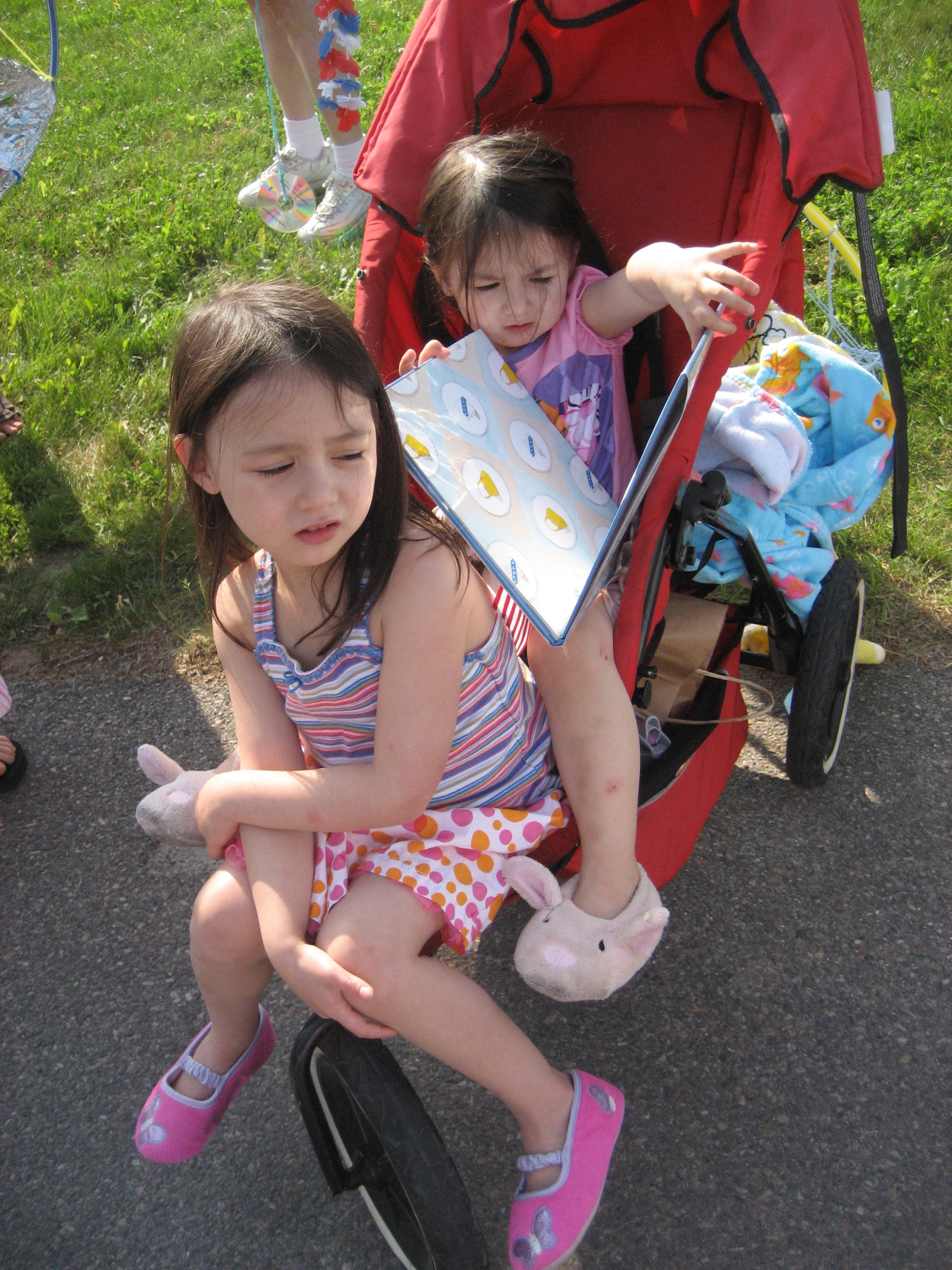
And yes, we do still have three daughters. I know you haven’t seen them in a while. Here’s confirmation that they still exist, as feisty as ever. Especially Georgia.
One of the lifeboats from the Titanic. National Archives photo.
I just read a fascinating article about the sinking of the Titanic, which addresses the question: Why didn’t the passengers panic while the Titanic was going down? Apparently, this is of great interest to economists (economists are strange), because they believe that people usually act out of their own self-interest. Three years after the Titanic sunk, the Lusitania, another luxury ship with a similar number of passengers, also sank. But the passengers on the Lusitania panicked, whereas while the Titanic went down, the band famously began playing music, doomed men strolled around smoking cigars, and order prevailed. What made the difference?
The answer to this question is proposed by an economist (so you can take it with a shaker full of salt); he theorizes that the Titanic passengers didn’t panic because the boat took longer to sink. The Titanic took about 2.5 hours to go down, whereas the Lusitania sank in under 20 minutes. David Savage, the economist who proposed this theory, says, “If you’ve got an event that lasts two and a half hours, social order will take over and everybody will behave in a social manner. If you’re going down in under 17 minutes, basically it’s instinctual.”
In other words, it takes time for our best instincts to win out.
This article fascinated me because it seems to support something I’ve been telling myself repeatedly over the past couple of months: “No sudden moves.”
I track time by the photos that show up in the “Last 12 Months” category in my iPhoto program, so I can tell you that exactly one year ago, we had just bought our house in Vermont, Erick was graduating from his PhD program at Berkeley, Georgia was getting baptized, and our California house was slowly filling with moving boxes. Around the same time, Erick and I decided that since he finally had a full-time job, and since our family was going through so many major transitions, I should take a year to focus solely on the home front. A year without thinking about any work outside the home. A year in which my job was to help a husband and three young children adjust to our new life. It turned out to be a great decision, I’m thankful that I had the luxury to even consider it, and it’s been a special year for our family.
But that year is almost up.
Which means that I’m thinking about thinking about what my next move, if any, should be. And that’s why I keep telling myself, “No sudden moves.”
This doesn’t come naturally to me. In fact, the reason I’m telling myself to slow down is because I’ve done the opposite for most of my life. I’ve never been someone with what you might call a “life plan.” I went to college with no firm idea of what I wanted to major in or what I wanted to be. Post-college, if I liked something, I decided that’s what I should do. If I got accepted for a job or graduate school, I jumped. When we reached a stage at which it seemed like we should be thinking about kids, we tried to have kids (and, fortunately for us, everything happened pretty quickly). I bopped through about a decade of post-college life in this completely unintentional, take-whatever-comes-my-way fashion. Even moving to Vermont, though practical and wonderful, followed this pattern: Erick was offered a job in February, we had a baby in March, bought a house in April, and by June we were here.
I can’t say that I entirely regret my lack of a coherent path; all of that strikes me as what you should be able to do in your 20s, and each experience was important in its way. But now I want to do things differently. Thoughtfully. Slowly. No knee-jerk reactions, no taking a job just because it’s there.No sudden moves.
In other words, I’m trying to behave more like a passenger on the Titanic. Because I think that David Savage is probably right; given more time, it’s our better instincts that tend to prevail.
I’m actually trying to behave this way throughout my life, because I don’t think this rule applies only to sinking ships or career decisions. Give anything a little more time — be it parenting, relationships, or major purchases — and I’m less likely to act out of instinctual panic, more likely to make wise choices. Sometimes this means closing my eyes, biting my tongue, and taking several deep breaths before dealing with a kicking, screaming child, but it usually leads to a better outcome.
Of course, taking too much time can also be counter-productive, the equivalent of “rearranging the deck chairs on the Titanic.” Whether or not there’s an open spot on the lifeboat, at some point you have to get off of the sinking ship. So, I’m aware of the need for balance; no sudden moves, but no spinning my wheels for years waiting for some unattainable “perfect thing.” (And, by the way, I’m also aware that EVERYTHING I’m writing about here is a luxury: being able to find jobs after college, being able to take a year at home, being able to take time making decisions. If I were a single mother or if Erick lost his job or if I’d graduated college a decade later, I might suddenly find myself on the Lusitania, even if I wanted to have a Titanic mindset.)
Here’s one more fascinating fact I learned from the article: regardless of the passengers’ behavior, the Titanic and the Lusitania each had roughly the same number of survivors. Which means that whether they behaved calmly or panicked, the same percentage of people made it off each boat.
That could be a discouraging fact: whether you calmly light up a cigar while allowing women and children to board the lifeboats first, or whether you crawl over fellow passengers in order to make it to safety, your chances of survival are the same. If you’ll allow me to extend the ship metaphor a little further, I suppose what it comes down to is this: we all know that the ship sinks in the end, but none of us really know how long that’s going to take. So, how to behave in the time we’ve got?
I say: take a stroll, light up a cigar, listen to the music, let other people go first.
Some of my thoughts are published over at On the Willows today, as part of their “April Fools” series. WARNING: If you tune in to this blog primarily for cute pictures or stories of the Gong Girls, this post includes none of those. It’s also one of my more “faith-y” pieces: I quote Jesus. But I also quote Al Franken.

















 The Pickle Patch