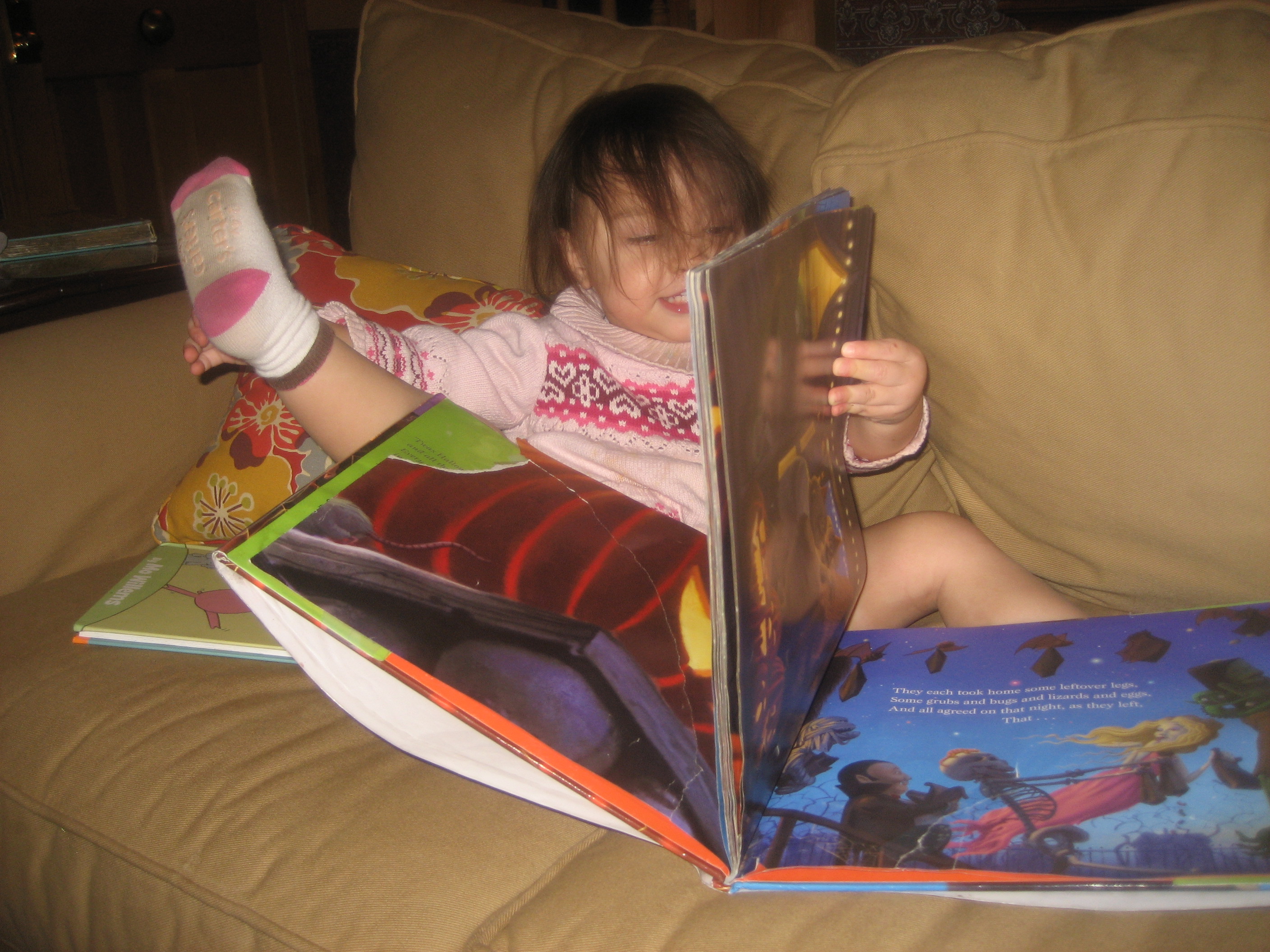
How I Met Your Mother (Bonus Valentine’s Day Post!)

A NOTE FROM FAITH:

Okay, folks, something new today: for the first time ever, we have a guest blogger! Let me introduce my husband, Erick: development economist, lone male among 5 women in our house, and most recently the first place Asian finisher in the Southern Vermont Primitive Biathlon (read: the ONLY Asian finisher…). Today being Valentine’s Day, Erick announced that in lieu of flowers he had written me a blog post. (His exact words, I believe, were, “The demand curve for long-stemmed roses on Valentine’s Day is very inelastic.” I have no idea what that means; life with an economist).

Anyway, Erick steers clear of the econ-speak here. He’s been thinking a lot about love lately, which will make a nice change of pace on this blog. (I have NOT been thinking much about love lately; I’ve mostly been thinking about sleep). Here he is! Enjoy, and Happy Valentine’s Day!

A recent attempt at a date night. (Photo taken by our babysitter).

Part I: How I Met Your Mother…

When I think of Valentine’s Day, I think first of all, “Phew! I remembered!”  This is followed by some thoughts about love.  I remember the opening scene of the film Love Actually, where couples run into each others’ arms; love is the first date, the honeymoon period, it’s wonderful bliss.  Of course, love doesn’t stay this way forever.  But since it’s Valentine’s Day, let’s linger a bit on the bliss.

I first met Faith at a small dive restaurant.  She was waitressing, and I usually came in near closing time. She would serve me and then sit behind the counter and read. The first time I saw her, I thought to myself, Wow, she’s pretty AND she reads books. Hey, I read books too.  Well, sometimes, more like book reviews- in inflight magazines.  I wonder if we have a connection?

Thus, my first words to Faith were, “So, what are you reading?”

And from that moment, I was filled with the tingling nervousness of attraction. From the over-analysis of brief encounters (She smiled at me when she gave me the check! That must mean something.), to longer conversations, and finally to the big question of any initial relationship:

“I was wondering, uh, well, if you’d like to join me, at a baseball game, I mean, if you don’t already have plans, because if you don’t, it would be great if you could come, but I totally understand if you can’t make it?”

The first date became several dates, and long phone conversations, and intense longing desire set in.  And of course, the earnest compatibility checks:

“Wow, she likes to eat.  I like eating.  We’ll be perfect together!”

“She loves the Indigo Girls.  I just heard one of their songs on the radio.   We’re a match!”

“She runs. I know how to run.  We could run together. Forever! And then eat! And then listen to the Indigo Girls…. “

Love was easy.  Anything Faith did was magical.  I felt like the luckiest guy in the world just to be near her.  We got married (as you probably figured out).  And the honeymoon period kept going – for quite a while.  Of course, these intense feelings tempered as time went by.

And then we had kids.

Part II: …And Why I’m Still In Love With Her.

“ …researchers tracked 1761 people who got married and stayed married over 15 years.  The findings were clear: newlyweds enjoy a big happiness boost that lasts, on average, for just two years.  Then the special joy wears off and they are back where they started….[T]he good news…is that if couples get past that two-year slump and hang on – they may well recover the excitement of the honeymoon period 18 to 20 years later, when children are gone.”

New York Times, “New Love: A Short Shelf Life” Dec 1, 2012

As the New York Times article cited above points out, wedded bliss doesn’t last forever.  Our own lives became really busy: graduate school, careers, more graduate school, church involvement, and of course, kids.  Three kids.   If I spent all my time thinking about how amazing Faith is, I would neglect everything else: my research, my teaching, my friends and family, my kids, and personal hygiene.  And the Times mentions another reason for the limited shelf-life of wedded bliss: the charming term, “hedonic adaptation.”

What is this hedonic adaptation that stands between me and bliss?  In short, scientists say we are hard-wired to take positive experiences for granted.  I was elated when Faith agreed to marry me, and I’m still really happy.  But I wouldn’t describe each day as euphoric.  The same can be said for all positive experiences: new job, new clothes, new anything; eventually the excitement fades.

So, does this mean I’ll never “fall in love” again with Faith?  Well, marriage scientists have a simple solution to the problem of hedonic adaption:  Novelty.  Doing new and exciting things with your spouse – new restaurants, skiing, dancing — can reignite passionate feelings. The key is to share new experiences.

I see two big problems with this approach.  First, with three kids (and a fourth coming), it’s really hard to do novel and surprising things with your spouse.  For example:

ME: Surprise, dear! I booked us a weekend in New York. We can visit a few museums, see a play….

FAITH: Uh, what about the kids?

ME: You think they’ll be okay for a few days? They could watch Dora. How about we put a few pounds of mac & cheese in the timed kitty feeder?

Hence the Times’s qualification that Faith and I have to wait 18 to 20 years before we recapture our honeymoon period — that’s longer than the average prison sentence!

The second problem?  If reigniting passion for one’s spouse involves a continual series of novelties, where does it end? There’s constant pressure to find a new novelty.   It might begin with, “Let’s try out that new Italian-Japanese fusion place,” and end with “Let’s try skydiving…in the winter… nude.”

I think sharing new experiences is great.  But I think it misses the point.  I believe what renews our feelings for each other is another type of love.  A difficult love.  The love you give when you don’t feel like it.

I call this type of love “costly love,” because it takes effort.  When I first met Faith, it was easy to love her. But 10 years into marriage, love takes more effort. Work responsibilities get in the way; sometimes the time I spend with Faith is time I worry should be spent on research.

But it’s costly love that’s necessary to sustain our marriage.  It has different forms: taking the kids for a few hours so that Faith can have some quiet time, preparing a meal, tidying the house. Planning date nights is costly love; it’s not easy – or cheap – finding a babysitter for three kids.  For me, the most costly act of love is sitting down after a long day and listening to how Faith’s day went.  I’m not a great listener, but this is how I show Faith I love her.

And I’ve learned that costly love – loving someone even when you don’t feel totally into it – mysteriously reignites wedded bliss.   When I make the effort to spend time with Faith instead of working, I recapture those magical love feelings that I experienced when we first met.  These moments are brief, but they are much more valuable now.

Costly love forces me to stop what I’m doing and realize what’s really important: Faith.  I put down my work and think of her.  Simply thinking about Faith, realizing how lucky I am to be with her, and making the effort to share life together (date nights, late evening conversations, primitive biathlon, nude winter skydiving) reignites the passion that I experienced in our first years.  And being on the receiving end of costly love is amazing – Faith certainly has loved me even when I wasn’t particularly “lovable.”

For the record, I still have a LOT of work to do on this whole costly love thing; I’m very self-absorbed and too often get lost in my work.  Which reminds me, I better call the florist; those roses aren’t going to be cheap.

Ashes

Teach us to care and not to care

Teach us to sit still.

-“Ash Wednesday,” by T. S. Eliot

Since moving to Vermont, I’ve thought about ashes more than ever before. Now that we heat our home by wood stove, ashes are part of daily life.

Today is Ash Wednesday, which is the start of the season of Lent (40 days of preparation for Easter) in the Christian church. For Protestants, Lenten practices are sort of all over the place; we’ve been part of churches that barely noticed Lent, and churches that took Lent very seriously. Our family observes Lent in various ways, although we’ve never done the ashes-on-the-forehead thing on Ash Wednesday. (Also, as Ash Wednesday services tend to be quiet, solemn affairs, and we have three very loud, rambunctious children, we don’t do the church thing either).

Wearing ashes on Ash Wednesday is a sign of repentance — regret for past mistakes — to kick off the spiritual journey towards Easter. Throughout the Bible, when people are deeply sorry or sad, they cover themselves with ashes (frequently combined with tearing their clothes). This is the origin of the term “sackcloth and ashes” — an outward manifestation of grief and repentance.

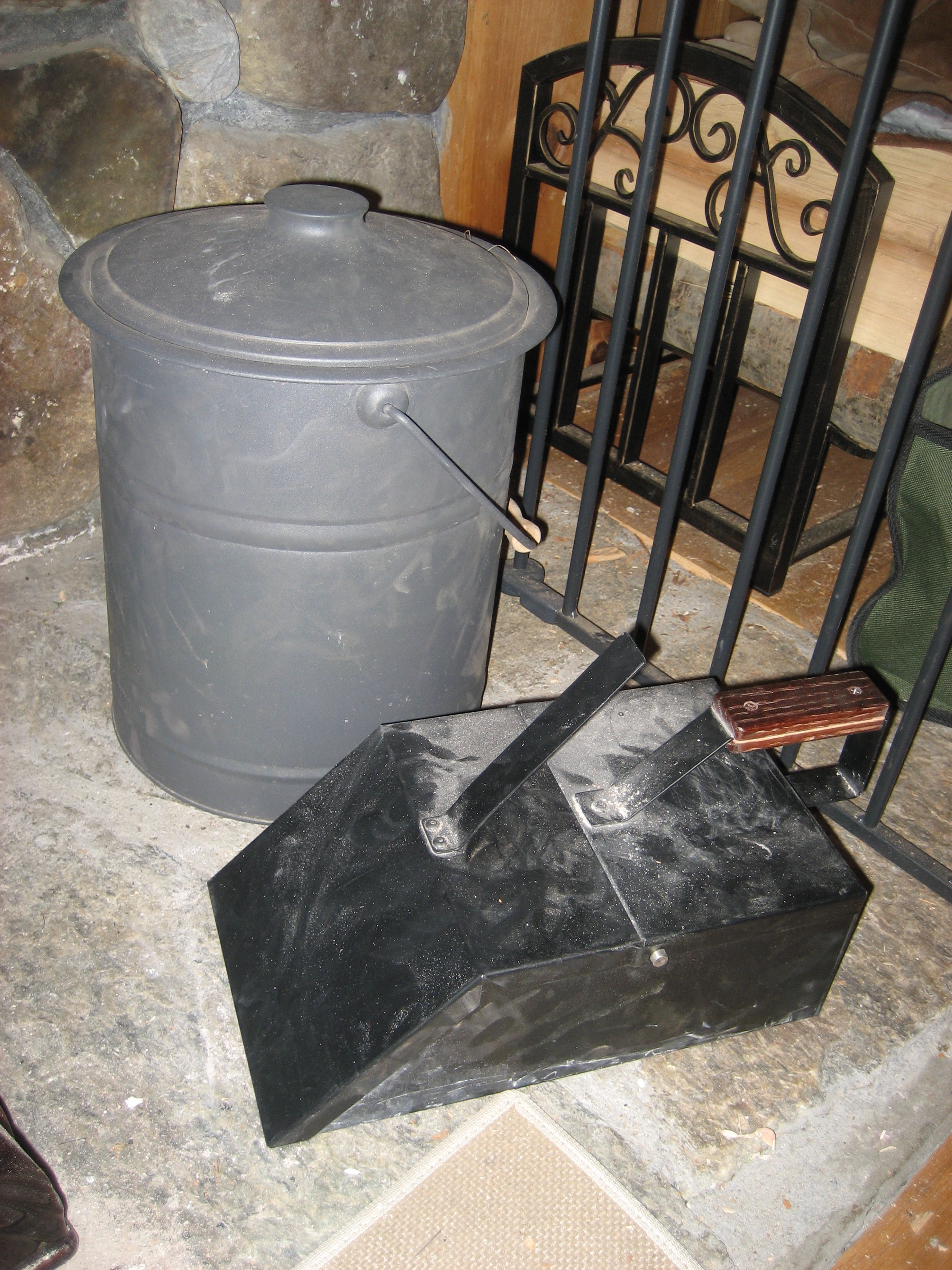
I have a more literal understanding of ashes now that I have to handle them every day. I feel like I’m covered in ashes half the time. Proper ash disposal has become an obsession of Erick’s. Many of his latest “man toys” have something to do with the safe removal of ashes from our fireplace; we even have the “Ash Dragon.”

The ash can and Ash Dragon!

Because the thing is, ashes are really REALLY messy, and they’re also dangerous.

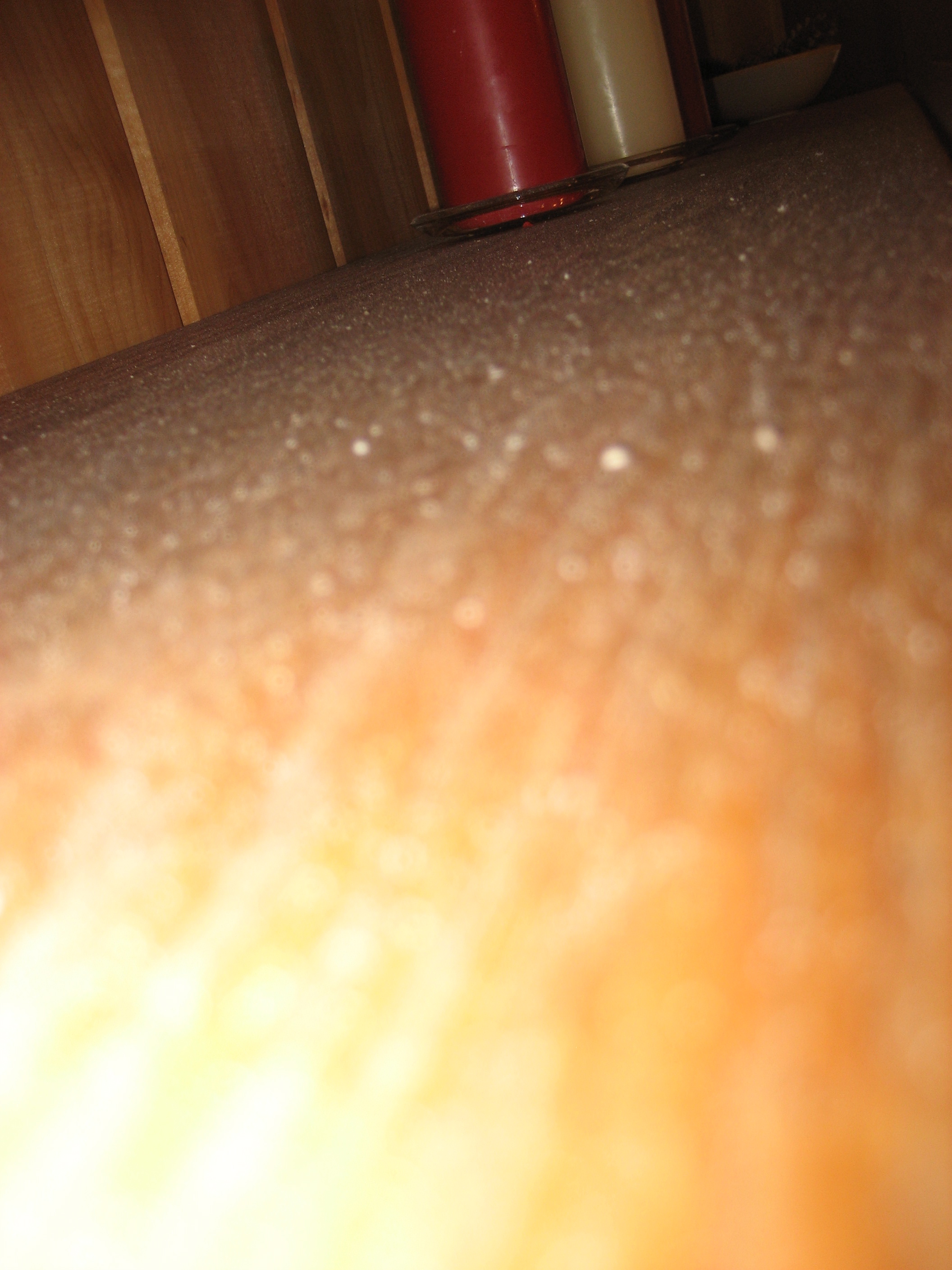
They’re messy because, no matter how careful we are, whenever we open our wood stove little puffs of ash come floating out. Ashes are light, so it only takes the slightest breath of air to make them swirl in all directions. Our entire house now has a fine coating of ash over everything. I could honestly spend every day dusting and sweeping up ashes, and still feel like I’d made no progress. (Which is either depressing, or a nice excuse to just give up dusting).

Some of our dust.

Ashes are dangerous because they’re deceptive: they hide the glowing embers underneath. When we go down to the wood stove in the morning, it looks like the fire has burned itself out and the bottom of the stove is filled with harmless ash. But one stir of the ashes will uncover enough orange-pulsing embers to start up the fire for the day. That’s why proper ash disposal involves transferring the ashes to an airtight ash bin, where we let them sit for at least a day before dumping them on the ash heap in our yard (yes, we have an ash heap!). And even then, Erick is paranoid enough to pour water on top of them.

Our ash heap.

But ashes are necessary. They’re the by-product of what we do to survive the winter.

Ashes: messy, dangerous, necessary.  It occurs to me that those same three qualities also apply to repentance. The word “repentance” probably makes a lot of people shut down right away — it sounds too harsh, too judgmental, too “churchy.” But I’m referring here to all types of repentance: spiritual and/or interpersonal. (Although I’m not sure that there’s a big difference). When we realize we’ve been wrong and ask forgiveness — whether from god or another person — it’s a messy business: nobody likes to admit that we’re to blame when things go wrong. It’s also dangerous: we could get hurt in the process, by losing our pride or failing to win forgiveness.

In the end, though, repentance is as necessary to our lives as the heat sources that help us to survive. Without acknowledging the ways we fail ourselves and others, and without seeking to right those wrongs, we go cold.

The Secret to My Sanity

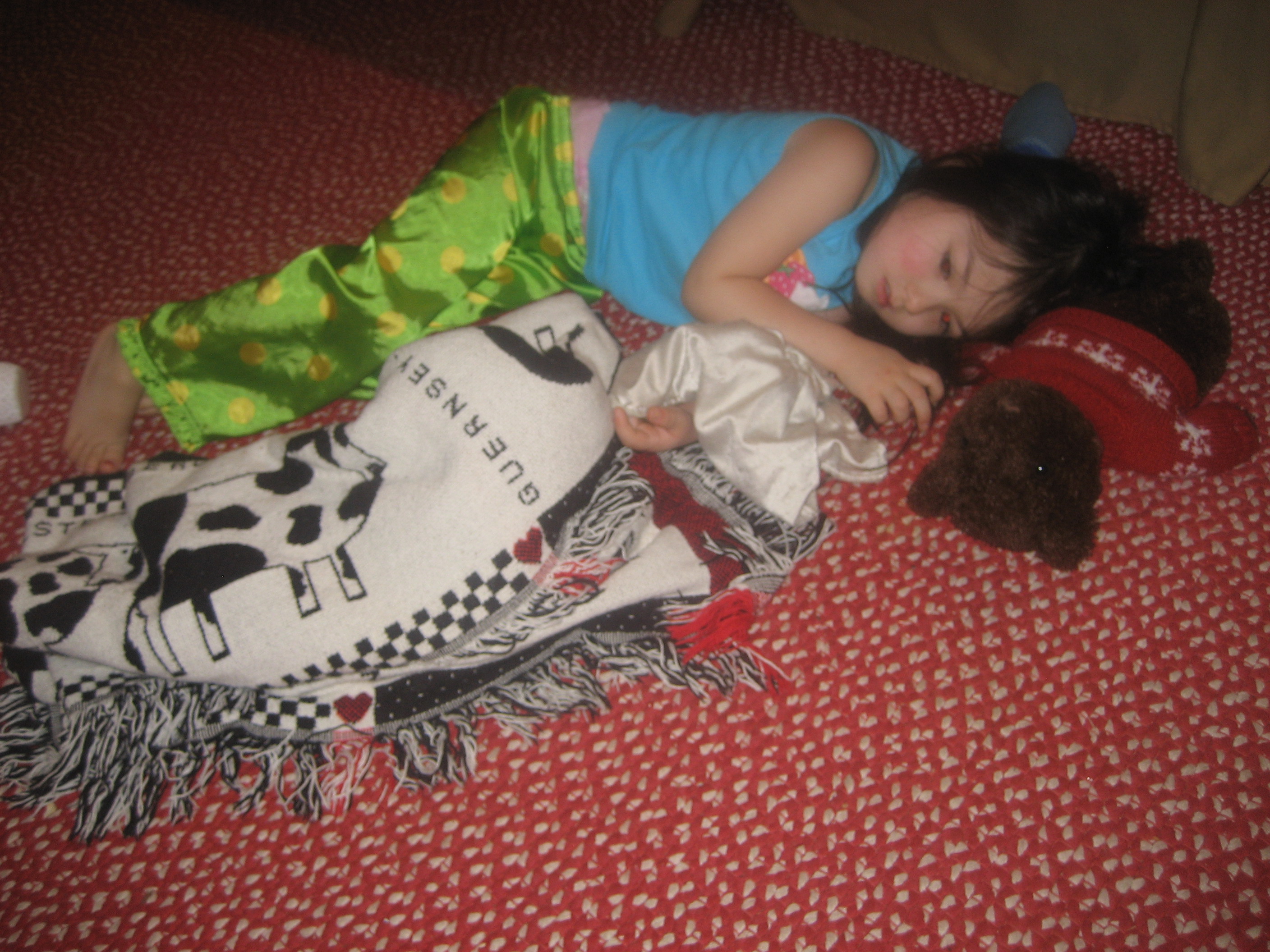
Snowed in today, with all three rugrats and a kicking tummy tenant. It’s actually been delightful, despite my worst fears: I find that much of parenting can be delightful if I don’t worry about the house being torn apart. And, thankfully, it’s nap time now….

An impromptu nap on the floor.


I write this without judgement; by now I certainly know that all children are different, all parents are different, and God help us if we think we alone have it figured out. But here goes: sometimes, as I’m talking with other moms, they’ll reveal that their child doesn’t nap, hasn’t napped since infancy, or has never napped. Whenever I hear this, I’m filled with a mixture of awe and concern — not for the child, but for the MOTHER.

I don’t know what I’d do without nap time.

The title of this piece is highly subjective, I know; anybody can call themselves sane and believe it, even if they’ve just heard the voices in their head telling them it’s true. I do (occasionally) scream at my children, weep during episodes of “This American Life,” and forget to pay preschool tuition. But still, I think I qualify as relatively sane. With three nonstop children, a fourth child halfway incubated, a puppy who tracks in everything from outside, and a husband who comes home every night saying things like, “I’ve just spent all day staring at this regression,” how do I manage to hold things together? Answer: all my kids still take naps.

Any discussion of sleep training can be polarizing, so I’m not going to get too detailed here. Again: all kids are different, all parents are different, and my own philosophy runs towards “whatever gets you through the night.” I will say that our first child was — and remains — by far our most difficult sleeper. Whether that’s because we didn’t know what we were doing, or because that’s just who she is, I’ll never know. I remember pushing Fiona in her stroller, screaming (SHE was screaming; I was just screaming on the inside), through the Berkeley Hills when she was three months old, and thinking “This child is NEVER going to nap.”

But she did. It took effort, but by the time Campbell and Georgia came along — both of whom are more natural sleepers than Fiona ever was — I had my compass firmly pointed towards NAP. “Okay, baby,” I would tell them, “now is when you nap.” And they did.

I guard those naps fiercely. I know some families feel that younger siblings get cheated on naps because they’re always running around to their older sibling’s activities. That’s not how I roll. It was clear once we went from one child to two that coordinated naps would be even more essential to my sanity. So, if I can avoid it, I don’t schedule playdates or activities during nap times. (It may help that our children are so young; there still aren’t many afternoon activities happening in our lives).

WHY is nap time essential? Well, at this point, nap time and bed time are the two guaranteed moments in each day when I’m not with any of my children. Wait a minute, you may say, you’re telling us that the key to sanity is getting rid of your kids? YES. Yes, I am. I know that the rest children get during naps is beneficial to their overall health and development, blah blah blah — but for me nap time is a selfish thing. I love my kids, I’m thrilled to be a mama; but the thing that feeds me, the thing that energizes me, the thing that enables me to function better as a mama, is the daily quiet time when all children are behind closed doors.

How do I spend my two hours of child-less time? Here’s what I DON’T do: I don’t nap. “Nap when the baby’s napping,” they say when you have your first child. To which I reply: Are you KIDDING?!?! This is MY time, my only chance to breathe during the day. I want to use it, savor it, roll around in it, make the most of every minute! The only time I’ll nap at nap time is during the first trimester of a new pregnancy, or if I’m sick. Otherwise, I use nap time to DO things. During the first months of Fiona’s life, “doing things” included re-watching all 95 episodes of Sex and the City on my computer. (I filed that under the “mental health” category). Later, when I started working again, naps went toward my 20-hour work week. Now that I have more children, a larger house, and a fully employed husband, I spend naps cleaning, prepping dinner, paying bills — and writing. And no matter what I’m doing, I usually drink a cup of coffee to gas up for the afternoon ahead.

I already feel nostalgic for nap time. We’re on the threshold of some big changes around here, and the day is fast approaching when I won’t be able to depend on naps. Fiona no longer sleeps during naps. Because her preschool still has afternoon nap time, I enforce a “quiet rest time” on the days when she’s home. By “enforce,” I mean that I shut her in the guest room with a bin full of library books, my iPod (which I’ve filled with wholesome, educational games, like choosing outfits for Tinkerbell), and the dog. When she starts kindergarten next year (full-day, five days a week) I’m certain that she’ll no longer be napping. Campbell begins kindergarten the following year, so her napping days are similarly limited.

I’m filled with terror at the thought of weekends — not to mention entire summers — when I’ll have one, two, three, and then FOUR children who are awake all day. I can only hope that the benefits of full-day school and increased independence balance out the loss of naps. In the meantime, here’s the best advice I have for new mothers: NAP TIME. Do it — not for your kids, but for yourself.

So, An Only Child Walks into a Bar…

How did this happen to me?

FACT: I am an only child.

FACT: I am about to be the mother of four children.

The other day, a friend asked me, “How did you, an only child, end up with FOUR children?” And the answer is: I have no idea. When Erick and I were having all those premarital, heart-to-heart discussions about our future, the subject of kids did come up. As I recall, we both sort of shrugged and said, “Yeah, we probably want kids someday — not right now. Probably more than one.”

Once we started having children, the only thing that was important to me was the “more than one.” I had a happy childhood, but I spent a lot of time with adults. I always wanted a sibling. So we gave Fiona a sibling (with a vengeance). Then, after Campbell was born, I felt like we weren’t quite done. Our days in California were numbered, and we wanted the same doctors we’d had for our first two children, so we went for a third without giving it too much thought.

And our fourth, as regular readers know, was a total surprise.

As an only child attempting to raise three (going on four) children, I often feel like I’m missing the playbook.

But the more I talk with other mothers, the more I realize: THERE IS NO PLAYBOOK. It doesn’t matter whether you had no siblings or 44; we’re all running around out on the field with no idea what we’re doing. Do we catch, throw, or pass? What game are we even playing?

That said, there are daily occurrences in our house that I never experienced as an only child: sibling fights, simultaneous calls for attention, vastly divergent food preferences, and — above all — three distinct personalities.

The other day, out of nowhere, Fiona said, “Mommy, me and my sisters are really aliens from another planet. We knew each other before we were born, and then we decided to become babies in your tummy.” (She assured me that they’re planning to stick around for the long haul, though they might go back to their home planet when they’re grown up, “just to visit.”)

This was one of the most helpful things anyone’s ever said to me. It made perfect sense, and it explained a lot; until Fiona laid it all out for me, I had NO IDEA where my children came from.

Oh sure, our children have certain traits that Erick and I recognize as coming from us, or from our parents. (Anxiety and drama, for example, and a peculiar inclination to listen to the same song over and over and OVER). But for the most part, each one of my children is — and always has been — stubbornly, beautifully HERSELF. Where did she get that idea? Who taught her to say that?

Unfortunately, each child’s self is also completely unique from that of her siblings (aside from the shared desire to play with the exact same toys at the exact same moment). And therein lies the rub of parenting multiple children: these three unique individuals are stuck with two parents who are also stubbornly themselves. Erick and I came to parenthood with our own styles, ways of giving love that are natural to us. But having a child is not like buying a pair of shoes; you don’t get to choose what fits you. One child only feels loved through constant affirmation and attention, and another child wants to be left alone, and the third child needs to be prevented from climbing into the medicine cabinet — all at the same time. Needless to say, it doesn’t always work; I can’t simultaneously give undivided attention, grant freedom, and vigilantly tail a determined toddler, though God knows I try!  Each of our children needs a personalized parent.

And that’s just what you get as an only child: two parents who can focus entirely on YOU. It’s a blessing and a curse, of course. But I will say this: it’s simpler, and it’s definitely quieter. (Sometimes, when all three girls are clamoring to be heard at the top of their lungs, Erick and I helplessly stare at each other across the dinner table and shake our heads).

Where am I going with this? Well, I’m NOT going to make a judgement about whether it’s better to be an only child or have siblings, or whether it’s better to parent one child or more than one. As an only child, I learned to be happy spending lots of time alone, and I had enriching experiences that wouldn’t have been possible had my parents had multiple children. On the other hand, my daughters have best friends right in their own house, and they’re learning interpersonal skills much earlier than I did. Parenting multiple children often feels like trying to play a video game that’s been sped up, but parenting only one child seems like it might be a lot of pressure.

In the end, you get the childhood you get, and you handle it accordingly. Then you grow up and get the children you get, and you handle that accordingly, too. We all seem to be slightly mismatched, but I’m holding out hope that we’re mismatched for a purpose. To some degree you can plan and “choose” what your family will look like, but to an even larger degree things happen the way they will. One morning you wake up and have four children, and planning had very little to do with it.

Unless you’re an alien from another planet; then you get to choose your host family, or so I’m told.

Backstage at the Pageant

My little lambs at last year's pageant (I have NO photos from this year!)
My little lambs at last year’s pageant (I have NO photos from this year!)

This Christmas, I directed our church’s annual Christmas pageant.

Notice that I don’t say, “I volunteered to direct our church’s annual Christmas pageant,” because I didn’t. How I came to head up this massive production is still unclear to me. Say you’re standing on a dock, looking up at an enormous cruise ship, and you turn to a nearby crew member to inquire where the ship is going. The crew member whisks you inside, dresses you in the captain’s uniform, sits you behind the controls, and says, “Anchors away!”

THAT’S how I became the director of the Christmas pageant.

Click here to continue reading over at On the Willows.

Aw, Shoot….

Image via Southern Vermont Primitive Biathlon

Every Friday this winter, my husband woke up early, put on warm layers, ate a huge breakfast, and went target shooting before work with a friend’s grandfather, a 70-something hunter and biathlete. Right before Christmas, they invited me to join them. So, I went target shooting, too. Three times.

Just to be clear, I’m saying that my husband and I shot guns. We had fun. It could be only a matter of time until we consider hunting….Click here to continue reading about our adventures over at The Addison Independent.

Where the Woods Have No Trails

IMG_1882

To say that we live in the woods is accurate enough, but after a couple of years in Vermont you learn that there are “woods” and there are WOODS. Behind our house is a long stretch of “woods” that rises up to a rocky ridge, and then slopes down to a small local road. Our official property encompasses 1.25 acres. In contrast, we know people who own 350 acres of WOODS, making our own woodsy setting seem tame and suburban by comparison.

Nevertheless, the woods back there are relatively unspoiled. Beyond our own property line the woods are protected land, which means no hunting or logging allowed. No trails, just pure forest.

Here’s what I’ve learned about trails during my time in Vermont: it takes BACKBREAKING labor to make them. Somebody — most likely our house’s previous owner — created two trails running from our backyard to our property line (where the trail-less forest starts), and it’s all I can do during the warmer months to keep these trails marginally clear of brush and saplings.

This past summer, I blazed my own trail. Because our dog is best friends with the neighbors’ dog, and our girls are best friends with both dogs, someone is always having to tromp through the woods that separate our house from our neighbors’. To make the going easier, I cleared a 40-foot path between the trees. After that, I declared my work done for the summer. Ever since, in order to enjoy trail hikes through the woods, I have to force myself NOT to obsess about how much work it took to create the trail.

On the other hand, whenever I hike a trail these days I appreciate the fact of there BEING a trail. As difficult as it is to create trails, it’s also extremely difficult to walk through the woods without them. Once our little backyard trails drop us off in untouched forest, it’s tough going. There are roots and sticks to trip you up, piles of leaves to slow you down, rocks cropping up every few feet, and branches smacking you across the face. Each time we decide to hike in “our” woods, we set off with the highest of family-bonding expectations. By the time we start heading for home, usually about 10 minutes later, 2/3 of the girls are being carried, 3/3 of the girls are whining about something (cold hands, sore feet, impending starvation), and Erick is cursing under his breath.

This winter, Vermont is doing its job and giving us some lovely snow; between Christmas and New Year’s, over a foot of powder was laid down in our woods. As we eagerly strapped on the snowshoes that we never got to use last year, I expected that snow would make our woodland trek much easier by leveling the terrain and making a path clear. It turns out that, NO: Snow only gives the illusion of level terrain and clear paths; once your snowshoe sinks into that powder, you’re just as likely to slip on a rock or get tangled in a root as when the ground is clear.

Trail-less hiking always makes me think of The Last of the Mohicans — the Daniel Day Lewis movie, not the book. Somebody in my college dorm owned this movie, and during the winter of my freshman year I watched it about 28 times. If you’ve seen this movie even once, you’ll probably recall that it includes numerous scenes of Mr. Day Lewis and his Native American counterparts running through the woods. Not stumbling, never falling flat on their faces, but RUNNING full speed ahead, gracefully dodging trees, in complete silence (save for the swelling music of the score).

Now that I’ve had my direct experience with trail-less woods, I wonder: HOW IS THIS POSSIBLE?!?!? I’m sure that the actual Native Americans who once populated Northeastern forests were amazing and knew the woods like the back of their hands, but I still can’t fathom silent, graceful running through the woods, no matter how much practice you have. For that matter, how did they even film those scenes in The Last of the Mohicans? The movie was made in 1992, which, as far as I know, was before post-production technology that allowed digital addition of trees. I can only assume that Daniel Day Lewis had to undergo months of tree-evasion training to prepare for his role.

But what do I know? Not a whole lot, as it turns out. One of the neatest things about snowshoeing in the woods is that you can see the deer tracks in the snow. And let me tell you: those deer and I are not on the same wavelength. Whenever I cross their tracks, I cross their tracks; I think I’m choosing the obvious, easiest route, and they’re going in a completely different direction. Granted, deer are created to know things about the woods that I never will. Granted, the deer were not also lugging Georgia behind them in her baby sled (as I was). But it got me thinking.

The next time I go snowshoeing out in our woods, I’m going to take a closer look at the deer trails. It could be that what I consider to be the path of least resistance isn’t the best choice after all. There’s probably a lesson in there somewhere….

IMG_1880

Fix You

This is my current Fix-It Pile:

IMG_1816

It sits on the kitchen counter next to my “desk” (and yes, that’s leftover Halloween candy in the background, and also a pile of cookbooks opened to recipes I intend to make…someday).

You may have something similar.

The Fix-It Pile, as its name suggests, is a collection of broken things that need fixing. When our girls break something and want it repaired, they add it to the Fix-It pile. Once the Fix-It Pile reaches a size that I can no longer ignore, I plug in my magic hot glue gun (what did I EVER do without a hot glue gun?) and get to work.

The Fix-It Pile in the photo above is obviously seasonal, since it features a beard-less Nutcracker and an angel ornament with broken wings. Usually, the Fix-It Pile includes a rotating selection of the same items: animal figurines with missing limbs, wingless fairies, and headless Barbies. (My girls went through a “Barbie Hospital” phase; Barbie Hospital apparently specialized in head transplants).

I was staring at my Fix-It Pile the other day (in lieu of actually fixing anything), and thinking how it’s an example of something I didn’t expect when I became a parent: I never expected that parenting would require me to spend so much time fixing broken things. In truth, like most parents, I didn’t give much advance thought to what parenting would require of me — but if you’d asked me five years ago, I probably would’ve mentioned quality time with my children: going on outings, doing crafts together, reading to them, and generally shaping them into independent adults.

I do all of those things as a parent — but much less than I expected. I have to squeeze in the quality time between fixing things. Once I set down the hot-glue gun, I pick up the packing tape and become “Book Doctor.” As Book Doctor, I repair the torn pages and broken spines of countless books that have either been well-loved by three children over time, or ill-loved by our youngest daughter. And when THAT’S done, I pick up a rag and a bottle of Kids & Pets (what did I EVER do without a bottle of Kids & Pets?) to clean up bodily fluids. Not to be gross, but as Erick told an acquaintance recently: with three young children and a dog in the house, “there’s always a bodily fluid SOMEWHERE that it shouldn’t be.”

And those are just the physical things that I have to fix. Because here’s the thing: I love my children very much, but they weren’t born knowing how to share, or knowing how to speak politely, or with any desire to think about others. They were born broken. We all were.

So every day, I also get out my spiritual hot glue gun, my psychological packing tape, and I try my best to repair broken relationships and mend fragile egos. I’d like to say that my invisible work lasts longer than my Fix-It Pile efforts — but it doesn’t. Just as the same toys and books keep coming back for fixing, the same hurts and injuries keep opening up in our family. I’ve already said numerous times to Fiona — who’s only five: “WHY do we keep having the same conversation over and over again?!” It’s the same question I ask Erick. And my own parents. And myself. Also, God.

Parenting is a relationship, and it occurs to me that all relationships — at least the real, meaningful ones — ARE essentially about having the same conversation over and over again. And that conversation boils down to the soul-cry: Why can’t you love me the way I want to be loved? We’re all waiting on the Fix-It Pile with our broken hearts, and sometimes a parent or friend or spouse will paste us together for a time. Sometimes we gather the tools and strength to repair our own cracks. But in my experience there’s never a permanent fix — not in this life, at least. We keep breaking, and having the same conversations over and over again. I’m unaware of a single person who’s made it to the end of their life, and who couldn’t have used another dab of glue or piece of tape.

I don’t mean this to sound completely hopeless, because I think it’s the opposite. I think it’s liberating. There are fairy figurines in this house whose wings I will NEVER permanently affix to their bodies; there are cracks in my children that I can NEVER mend. But in parenting, as with the rest of life, I think we get points for trying. And trying again.

Sleeper Hits of 2012: Five Books That Unexpectedly Delighted Our Family

IMG_1895

Apparently I’m starting off the new year by making “Top 5” lists, since this is the second such list I’ve posted this week. But this is EXCITING, a FIRST! Here’s the story:

Annie is a friend from college: inspiring high school English teacher, gifted writer, hip Brooklynite, long-suffering wife (of another college friend), and mother to two bright and creative daughters (with a son due very soon). Somehow, in her “spare time,” she and her aunt created a wonderful blog about children’s and young adult literature, Annie and Aunt. Her blog has given me many great book tips over the years, and this month she asked me to be a guest blogger!

So, here it is: Click here to read my post about our family’s favorite “sleeper books,” and then keep following Annie’s blog!

IMG_1897