In all the places our family lived before moving to Vermont, we felt that we were part of wonderful, caring communities. There are kind people everywhere, people who take care of each other. But I’ve been especially overwhelmed by the kindness we’ve experienced since coming to Vermont. This past year in particular, throughout my pregnancy and the birth of our fourth child, I never felt alone. Even before Abigail was born, we were the recipients of countless meals, childcare, and transportation for our children. Our list of “People to Take the Kids if Baby Arrives Before Grandparents” ran into the double digits.
I look around our town and I see little acts of goodness everywhere: people volunteering to serve meals to the hungry, moms watching other moms’ children so that they can go to doctor’s appointments, friends generously sharing the bounty of their fields and kitchens. It warms my heart.
In a way, it’s unfortunate that Thanksgiving is an official holiday.
Don’t get me wrong: I love the turkey feast with all the trimmings, love the excuse to gather family and friends, love telling my daughters about that first Thanksgiving at Plymouth in 1621 when the English settlers thanked the Native Americans for helping them produce a successful harvest.
But sometimes I think that the act of proclaiming an Official Holiday has the unintended consequence of trivializing the very thing we’re supposed to be celebrating. When we set aside one day in honor of something, most people — because we’re lazy and selfish and busy — tend to feel like we’re off the hook for the other 364 days of the year.
Of course there’s value in holidays, in celebrations. But have you ever thought, for instance, that Valentine’s Day is a little strange? Aren’t we supposed to show love to those we love every day? Why set aside February 14 for that specific purpose? I feel the same way about Mother’s Day. I even wonder whether the birth of Jesus would feel closer to us all year long if we didn’t confine it to December 25.
In my previous “Faith in Vermont” column, I wrote about the sickness season that’s hard upon us. This time of year is also mouse season; as the weather turns colder, the mice peek out of their frozen burrows at our warm, well-lit house and think, Heyyyyy! That’s not a bad idea! The Gong residence gets mice year-round, but this past month we’ve been catching almost a mouse a day in our mudroom, which is apparently some sort of mouse superhighway.
I have issues with mice. Not to be overly dramatic, but: The WORST thing about living in Vermont is that there are mice here. Lots and lots of mice.
The second you become a parent, whether or not you’re ready, you are forced to become a turbo-charged problem solver. My days are like a never-ending loop of MacGyver episodes (MomGyver?), in which I figure out how to change a diaper in a changing-table-less public restroom; how to simultaneously bathe, feed, and clothe four unattentive children; how to rig up a harness to attach My Little Pony figures to a Fisher Price carriage; how to answer questions like whether ghosts are real.
No problem. But here’s one that, after nearly six years of parenting, I still haven’t figured out: The problem of how my children should address non-family adults.
My husband and I grew up on opposite sides of the country, in families with different cultural backgrounds. Yet we agree that, as children, there was never a question as to how one addressed a grown-up. They were all “Mr./Mrs. [LAST NAME],” with the exception of extremely close family friends, who might ask you to call them “Uncle/Auntie [FIRST NAME]” (and even then, I usually felt uncomfortable doing so).
I’m not saying that was the best system, but it was simple. It was clear. There was no awkward bumbling around with names when introductions were made.
Now, it’s all an awkward, bumbling mash-up. The etiquette for how children should address adults seems to vary by geographical location, age group, and even between different social circles.
In Northern California, where we started having children, things were a bit simpler. At that point, most of our friends with children were roughly our age and attended our church. For some reason, the people who’d had children first tended to be Southern transplants, so they set the culture for naming adults: Children addressed grown-ups as “Mr./Miss [FIRST NAME],” as in “Miss Daisy.” Since that’s what most of our friends did, that’s what we did. At times I felt like a character in The Help, but at least it was simple. It was clear. And it seemed to strike a nice balance: informal without being too casual.
Then we moved to Vermont, and everything got confusing. Here, our friends are all over the place: We have friends from the college, friends from town, friends from church, friends who are our age up through friends who are in their 80s. So, when the Gong Girls blazed into town with their “Mr./Miss [FIRST NAME],” it wasn’t always quite right. Clearly that’s too informal for most New Englanders over age 70. But it also seems a little too formal for some of the friends in our own age group, most of whom introduce adults to their children by their first names. (I don’t necessarily have anything against children calling close family friends by their first names — I personally feel ancient and confused when somebody calls me “Mrs. Gong” — but Erick tends to bristle when a two-year-old saunters up to him and says, “Hey Erick!” “I have 20-year-old students who address me more formally than most toddlers,” he’ll grumble). Then there’s a whole group of people in the 40-60 age range, which I consider a panic-inducing grey area.
Add to this another problem: Despite living in a small town, we know a lot of people who share the same names. For instance, there are about ten Deborahs in our life. So we call some by their last names, and some by their first names with qualifying details — “Miss Deb with the horses,” for instance.
I know you’re probably thinking: Relax, Faith! This doesn’t have to be a problem. Why don’t you just ASK people what they’d LIKE your children to call them? Ah, but I do. I have no qualms about asking someone, minutes after we’ve met, “What would you like my children to call you?” The problem is, most people are just so NICE! They’ll smile and say, “Oh, whatever! It doesn’t matter to me. Anything’s fine.” And then I’m left fishing around for an appropriate form of address, carefully watching my new acquaintance’s face to see if they’re offended: “Fiona, this is Sue. Miss Sue. Mrs. Bridge.”
That’s why I end up having exchanges like the following with my children:
ME: So, Fiona, did Mrs. Jones teach Sunday School today?
FIONA: Who?!?
ME: You know, Mrs. Jones. Miss Deborah.
FIONA: Who?!?
ME: Janie’s mom.
FIONA: Oh. Yeah.
Anyone else having this problem? If so, I say we band together and start a movement to standardize how children should address their elders. I don’t care if it’s first name, last name, or social security number, just as long as it’ll save me this awkward stumbling around for an appropriate title. At the risk of being overly political, maybe we need something like ObamaName (but with a better computer program). Who’s with me?
October in Vermont this year was stunning: warm, with temperatures hovering around the 70s, and fairly dry. This year we also seem to have hit a sweet spot for taking nature outings with our girls: Our two oldest can hike on their own with a minimum of complaining; our baby can be toted around easily in the carrier. Georgia alternates between running headlong into the nearest puddle (or off of the steepest cliff), and needing to be carried — but one out of four ain’t bad.
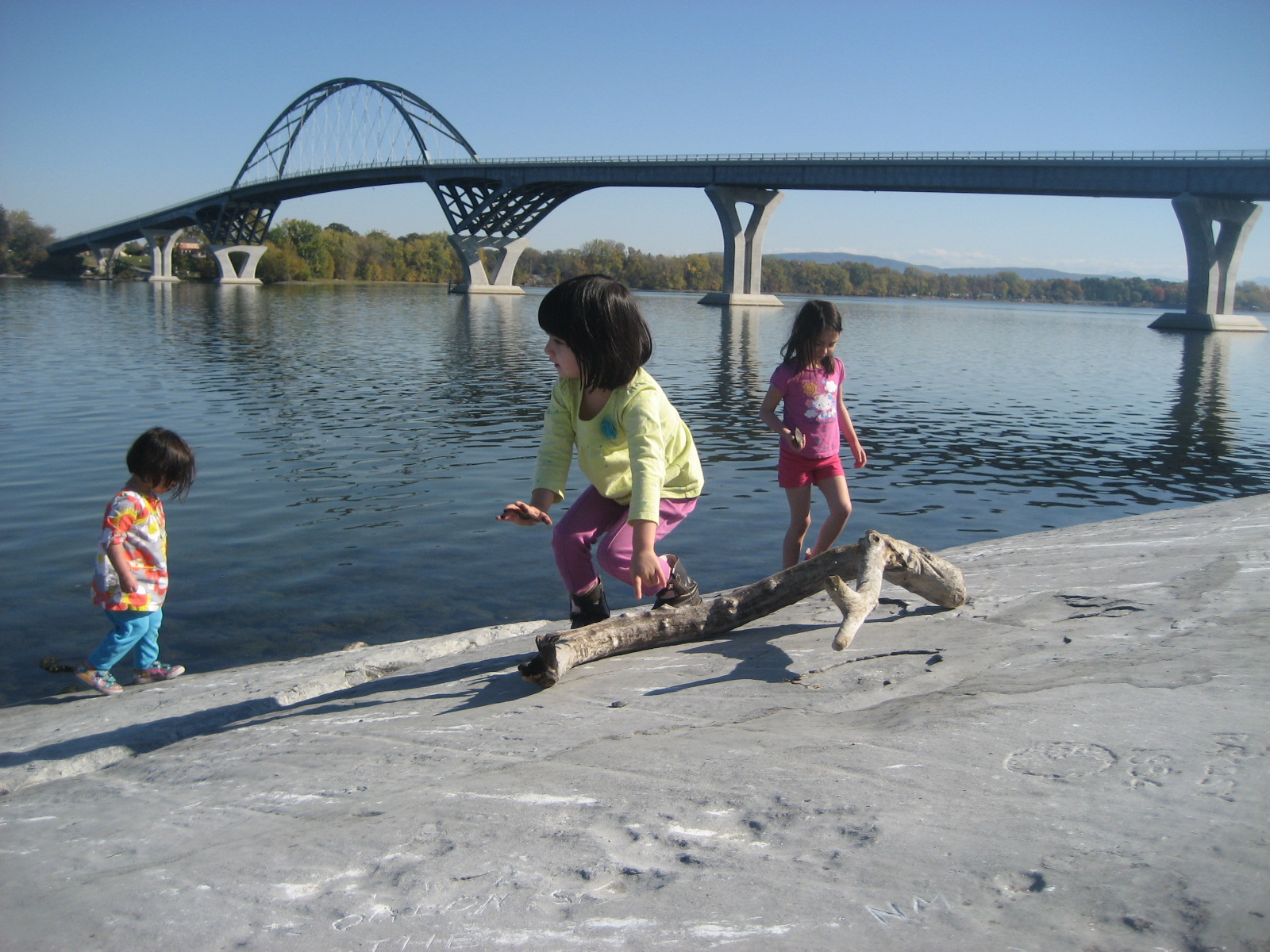
So on a warm, sunny October weekend, when the foliage was at its peak, we headed west along Route 125 and crossed the Lake Champlain Bridge for a picnic at New York’s Crown Point Historic Site. Crown Point boasts the ruins of 18th century French and British forts, stunning views across Lake Champlain, and a small strip of beach littered with mussel shells.
Our girls went right for the beach, where they started a frenzied mussel shell collection effort. The goal was to find mussel shells that (1) were “angel wings” (two shells still attached on one side), and (2) contained pearls.
We found plenty of angel wings, but no pearls (freshwater mussels sometimes DO make pearls, but it’s a rare occurrence). The pearl hunt was inspired by a Magic Tree House book we’d recently read (#9, Dolphins at Daybreak, to be exact). These days, the Gong girls are all about the Magic Tree House series, in which Jack and his sister Annie travel through time and space in — you guessed it — a magic tree house. Each book includes facts about nature or history, and in this particular book we’d all learned how oysters make pearls.
I write “we’d all” learned, because although I’m sure at one point in my life I’d been told how pearls are made, I’d forgotten until I found myself reading about it to my girls.
So in case you, like me, haven’t contemplated the pearl-making process in a while, here it is:
Pearls are made when some foreign substance, like a grain of sand, gets in between an oyster’s two shells. In order to avoid irritation, the oyster coats the intruder with layers of a mineral called nacre; as those layers build up, a pearl is formed.
Is that the most awesome thing you’ve ever heard, or what?!? I don’t know why we aren’t using pearl-making as a metaphor for everything. I’ve heard over and over again how “A diamond is a lump of coal that made good under pressure.” But a pearl, a pearl is an irritant that became something beautiful.
I deal with irritants a lot lately, because I now have four girls who are very close in age. As an only child, this sibling thing is uncharted territory for me, so those of you with siblings may understand best when I say that these girls irritate each other all day long. And the darndest thing is, they really love each other; our house is filled with hugs and kisses and “You’re my best friend!” and generally good playing-together skills. Except that every five minutes, they hate each other: something gets grabbed, someone is hit, words like “stupid” start flying around. “I’m my OWN PERSON, Fiona!” Campbell shouts, whenever her big sister gets too bossy. “Campbell, I live in this house, too!” Georgia barks when Campbell pushes her around. “Nobody is LISTENING to ME!” Fiona wails when her sisters don’t toe the line.
The worst is when I don’t hear anything at all; that’s when I find two sisters locked in a silent death-grapple — a wrist grabbed here, a fistful of hair there — each determined to annihilate the other in order to get that My LIttle Pony (or doll, or piece of paper).
Just because you’re family doesn’t mean that you don’t irritate the heck out of each other. I’d reckon that unless your family was in some serious denial, then you know that it’s usually those in our family, the people who are closest to us, who are capable of irritating us the most. Like a grain of sand in an oyster, we can’t really get away from them. They’re between our shells, literally under our skin.
But an oyster handles that irritant not by scratching at it until it gets infected, not by trying to spit it out, not by ignoring it, but by covering it again and again with a beautiful, durable, shiny substance. The irritant doesn’t go away, but it’s transformed into something that’s not irritating anymore — something smooth and lovely.
This may be stretching it a little, but I think we can all channel oysters in how we handle the people who drive us nuts (they don’t even have to be family members). Only, instead of nacre, we can cover irritating people or their irritating behavior with love.
For instance, after 11 years of marriage Erick occasionally does things that irritate me. If I approach him about these things from a position of love — as opposed to frustration, anger, or even just passive-aggressive sighing — he’s much more open to hearing me. Even then, I’ll never be able to change every single thing about Erick that irritates me, but that’s where more love comes in: Without those things that drive me crazy, Erick wouldn’t be Erick. And I figure that, if suddenly Erick wasn’t around anymore, the things that irritated me the most (the water glasses left out, the cabinets left open, the socks on the floor) would be the very things I’d miss the most.
Similarly, whenever one of our daughters is driving me bonkers with whiny, fussy, defiant behavior, I’m learning that she’s the one who needs the love poured on. She may be acting about as lovable as an angry wasp, but if I grab her in a hug and act like I love her (whether or not I actually feel that way), it usually snaps the irritation out of both of us more quickly than if I yell or lecture or ignore.
The next time I feel that itch of irritation under my skin, I’ll try to act like an oyster; instead of scratching, I’ll coat it with some love. If I can get my daughters to do the same for their sisters, then we’ll be in business!
I can afford to be a little smug about flu season, because in our house – with a four-month-old baby around – we’ve all had our flu vaccines. My husband got his flu shot in the quiet peace of the Middlebury College flu clinic. I got my flu shot on a whim during a shopping trip to Hannafords, because the baby was asleep in her carrier and the 2-year-old was being unusually compliant. My two middle daughters received the FluMist nasal spray during a visit to their pediatrician. And my oldest daughter decided she wanted a flu shot because she hadn’t liked the FluMist last year, then panicked when she saw the needle and demanded the nasal spray, then panicked at the memory of having a mist sprayed up her nose, and finally had to be held down in order to get the shot. So, in our own ways, we’re all covered.
It’s not the flu I’m concerned about this flu season; it’s everything else.
The forecast calls for rain today in our part of Vermont, which is causing some consternation among our daughters. Whether or not we get to trick-or-treat outdoors, we’ll be in costume and eating candy. The theme this year is apparently “wings;” the Gong girls will be dressed as a ladybug, a pegasus, a bumblebee, and a chicken. Here’s a little reflection I published last Halloween in The Addison Independent. Happy Halloween!
It’s Halloween again, the holiday our daughters have been anticipating for the past nine months.
Halloween is generally acknowledged to be a “fun” holiday — nothing too deep involved, a brief diversion — particularly if you have children under the age of 10. But it’s come under attack in recent decades, what with its pagan origins and rampant sugar-consumption. At the very best, it’s meaningless entertainment for children; at the worst, it’s something evil to which an alternative distraction must be found.
Last Halloween, we took our three daughters trick-or-treating, with the rest of Addison County, along Middlebury’s South Street and into Chipman Park. This was the first time our two-year-old had been trick-or-treating outside of a stroller, and in her mind it was a race to the finish. It was like somebody wound her up and let her go: The minute her feet hit the sidewalk, she barreled ahead of the rest of us, sparkly shoes and Cinderella dress blurring in the twilight. It took her a while to grasp that we had to stop at each house for the ultimate goal: candy. When we got to the first house and managed to head her off toward the door, she burst right through the open door, past the baffled teenager holding the candy bowl, into the living room, where she finally skidded to a stop and looked around with confusion. Where was that candy?
My daughter’s faux pas, her lack of understanding that Halloween etiquette requires stopping at each open door, got me thinking about a deeper meaning to Halloween, apart from the costumes and the candy and the pagan undertones. The really remarkable thing about Halloween, it seems to me, is that it’s a night when we open our doors.
It’s so rare that we open our doors to each other, even to those we know and love. Usually, when passing our neighbors’ houses, we see closed doors, few signs of life. But on Halloween, when the colder weather is beginning to drive us further behind closed doors, we open our doors not just to those we know and love, but to total strangers. Not only that, but we give them treats and receive very little in exchange. Sure, the occasional cute kid or clever costume make us smile, but having been on the candy-giving end, I know that often the best one can expect is a mumbled “Thanks.” Still, we keep the treats coming. It’s so seldom that we practice this kind of grace in life.
And for those who are on the receiving end, it’s not just about the candy. Each open door on Halloween offers a chance for connection, with neighbors we know and neighbors we don’t. Through every doorway, we see snippets of lives a lot like ours, with pictures on the walls and the smells of food in the oven and over-stimulated children running wild. Sometimes there’s a party going on inside. Sometimes it’s quiet save for the television. Two years ago, trick-or-treating in Northern California during Game 4 of the last World Series in which the San Francisco Giants were playing, each house we visited provided us with score updates. In a world of closed doors and computer screens, the open doors of Halloween allow us to reconnect with our community, our humanity.
Of course, the doors will open wider and the grace will be given even more freely during the holidays that follow Halloween. But from now on, I’m going to consider the open doors of Halloween as the official start of the holiday season.
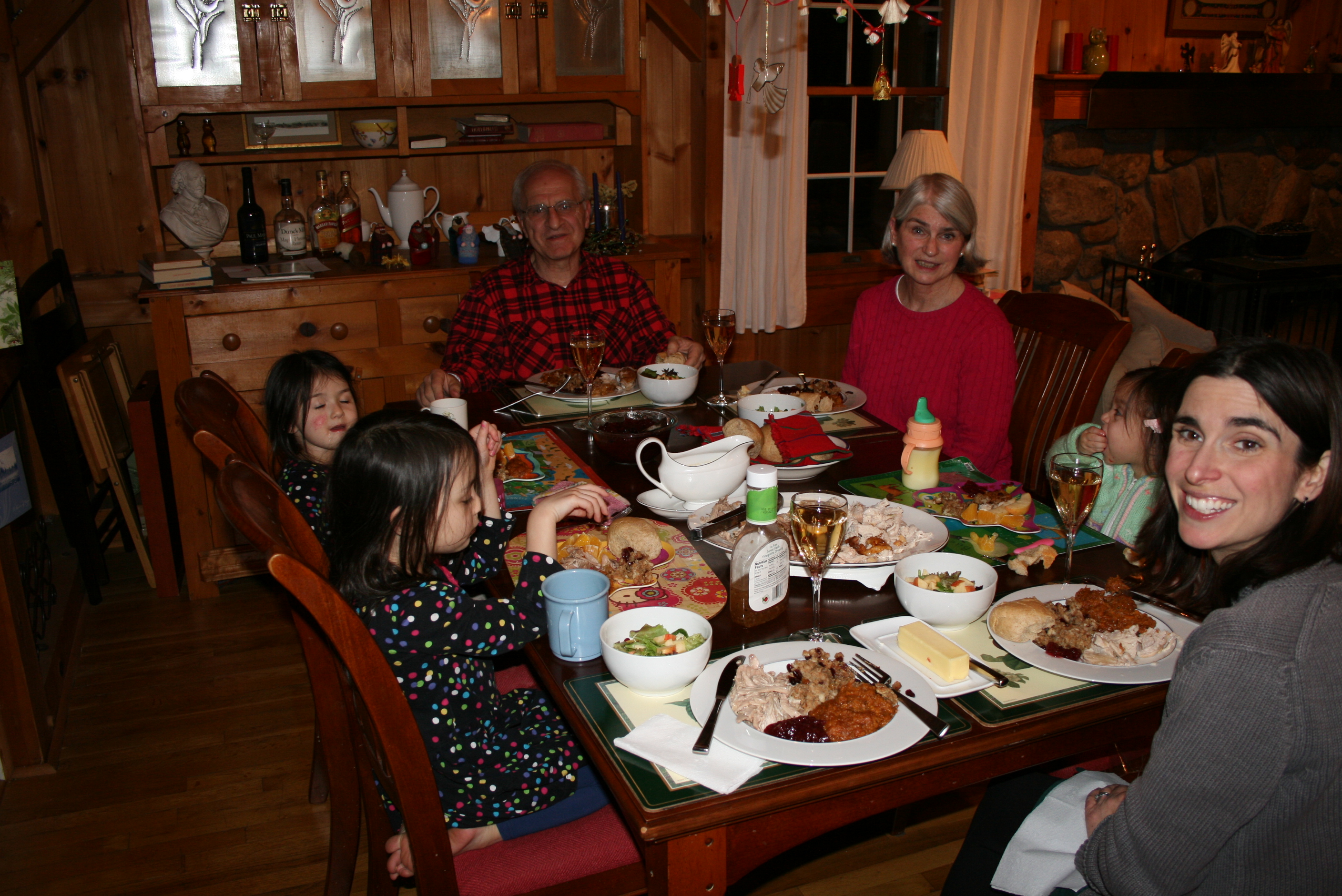
Last Christmas: Everyone scrunched around the old dining table.
Now that I’m at home with four children in a climate that sometimes keeps us housebound, I’m grateful every day for our house. When Erick and I worked with Habitat for Humanity in Tanzania, their motto was: “Nyuma ni Mama,” which is Swahili for “A house is a mother.” I never really thought about what that meant until I became a mother and bought a house in Vermont; now I realize that our house performs much the same functions for our family as I do: it shelters us, and by its very layout it guides our activities and helps shape our family culture.
If a house is a mother, I think that the beating heart of that house is the dining table.
All of which is a wordy and roundabout way of getting to this point: We have a new dining table!!
In Chinese culture, it’s typical to get generous amounts of cash as wedding gifts. After Erick and I were married, we took our wedding cash over to Macy’s and used it to buy two things: an oversized armchair and a dining set. Both purchases were made quickly; we just needed a place to sit and a place to eat in our new apartment. We had no vision of a future in which we’d live in a house and have children, so we took neither scenario into account when making our selections.
The dining table we chose seemed absurdly large: It came with six upholstered chairs. It wasn’t exactly “real” wood, but had a dark cherry finish. Eleven years later, the seat cushions bore crusty stains from our girls’ daily spills, the dark finish showed every fork gouge, and six chairs were only enough to seat our immediate family.
Remember that oversized armchair that we bought at the same time as the dining table? Eleven years later it, too, wasn’t looking its best. I even wrote about it here. The cat we’d had when we were first married had scratched up its base, Gracie the dog lay across its top whenever we left the house, our children had contributed numerous food and marker stains, and both arms were ripped and spilling stuffing.
That was liveable. Then I cut Gracie’s nails.
(Okay, clearly this whole post is going to be kind of wordy and roundabout. Brace yourselves.)
I cut Gracie’s nails because they had gotten so long that whenever she walked within six inches of one of our girls, they’d collapse on the floor wailing, “Gracie scratched me!” (We raise ’em tough around here). I don’t cut her nails often (obviously), so I failed to realize that cutting a dog’s nails is very different from cutting a cat’s nails. When we had a cat, I’d pin her down and chop away. Dogs’ nails have capillaries running through all but the very tip. So I cut Gracie’s nails — not too short, in my opinion — and she seemed fine and went about her business. But then I noticed pools of blood on the floor.
I mopped up the floor and Gracie, and then rushed off to pick up one of the girls from school. Another failure: I should have also bandaged Gracie’s paw. When we returned home, it looked like somebody had been murdered in our armchair: blood everywhere. Gracie had laid across the top, as is her habit, and licked at her cut nail until it opened up again.
Thankfully, my mother was visiting that weekend. If you know my mother, then you know that she can clean anything. (If she’d been alive back in MacBeth’s day, that play would have had a very different ending because Lady MacBeth wouldn’t have gotten all hung up over any “damn’d spot.”)
So, my mother worked her magic and got the blood out of the upholstery. Then she said, in her tactful Mom way, “Isn’t there somewhere we could go to look for a new armchair?”
In most places in the U.S., that would be a simple question to answer. But remember, we live in Vermont. There are no Ikeas or Crate & Barrels in this state. (And the few times I’ve attempted to order Ikea furniture online, the shipping costs exceeded the price of the furniture). There are furniture stores in Vermont, but to reach most of them I’d have to drive at least 45 minutes, at which point I’d just have to sit down and feed the baby. And even if I found a replacement armchair, I’d probably have to spend a lot of money to buy it and have it delivered 45 minutes away.
But then I remembered that a friend had told me about a used furniture store the next town over. I looked it up on Google, searching under “Vermont used furniture.” I was not at all hopeful, but there it was. Turns out its name is “Vermont Used Furniture,” it was a 15 minute drive away, and it was open right then.
Still not particularly hopeful, I agreed to check out Vermont Used Furniture, mostly because I love my mom.
We pulled up at the “store,” which is more like a hangar in the front yard of the couple that owns and operates it. We walked in, and there was the armchair — the same dimensions as our old armchair, but a little fancier and without the rips and dog blood — priced at approximately 1/4 of what we spend on groceries each week.
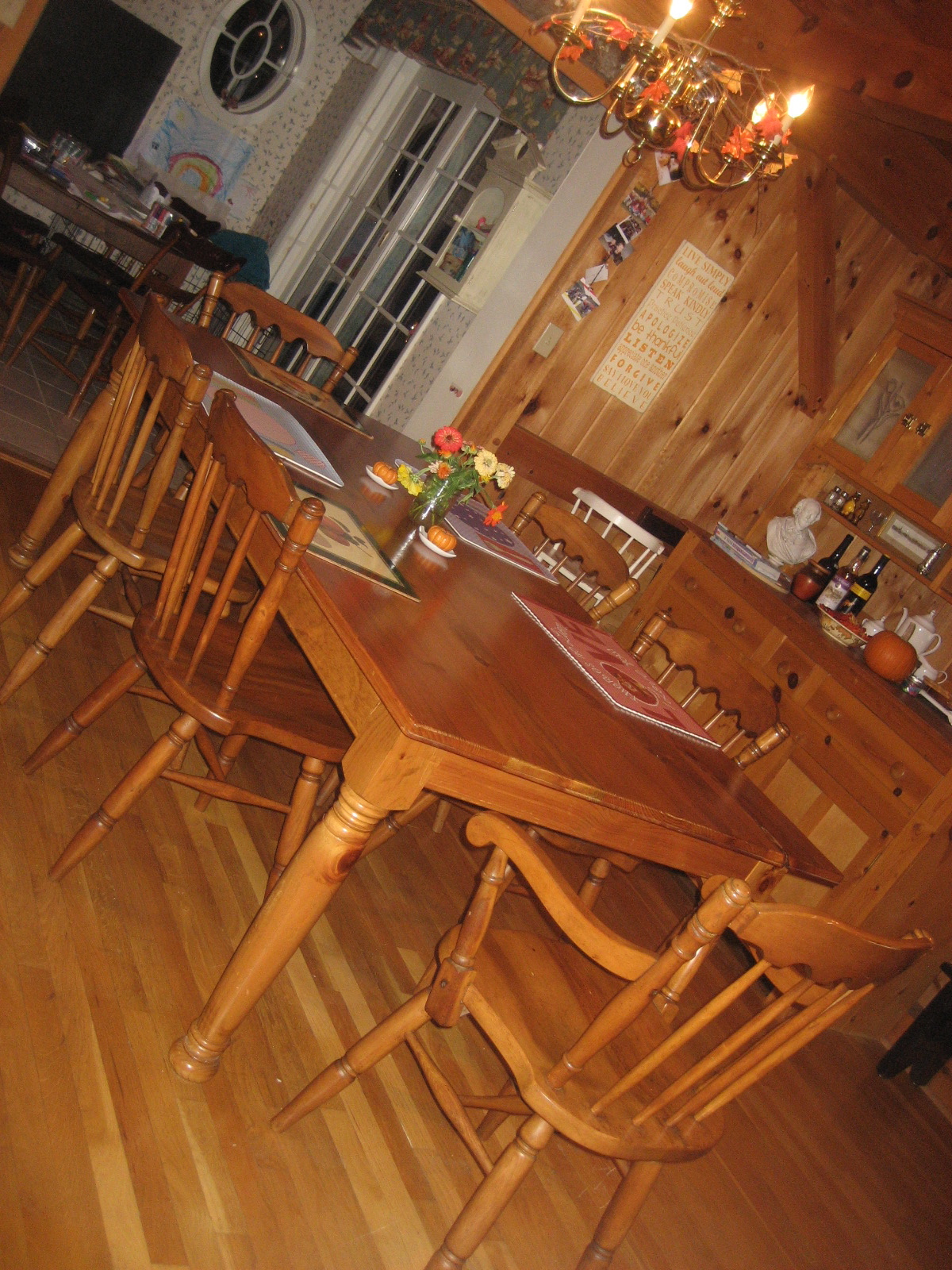
I walked a little farther into the hangar, and there was the dining table. As soon as I saw it, I knew it was our table. It was a slab of solid pine, and it glowed. It was large enough to easily seat 8 (possibly 10), which meant it could accommodate our whole family, plus a couple of guests. I wasn’t even looking for a dining table, but it was priced so that, together with the armchair and a set of (uncushioned!) dining chairs, it cost us less than a new slipcover for the old armchair. The guy from Vermont Used Furniture delivered them both to our house for free, and even bought our old dining table off of us.
So, we have a new dining table, and it’s made both Erick and me happier than you might imagine. Remember what I wrote way back, about a dining table being a house’s beating heart? That’s because we all sit at the dining table together at least twice a day. It’s the only space in our house that seats all of us, and it forces us to look at each other. We share food and conversation at this table, both of which keep our family healthy. During non-mealtimes, Erick and I often work at the table, the girls have snack at the table, Fiona does her “homework” at the table, we read books around the table.
The new table!
I look at this dining table, and I see what I want our family to be. Sometimes (okay, MOST times) it’s still a struggle to keep all the girls seated for an entire meal, or to keep conversations from devolving into potty talk. But I look at our new table and imagine all of the life that will happen around it; it’s solid enough to be our table for the rest of our family’s time together. It’s not perfect; the wood has some knotholes and cracks, and pine is soft enough to show the inevitable marks that we’ll put in it. All of which is fine by me, because that’s also how I want our family to be: solid, but not perfect.
Shortly after we installed our wonderful new table, I sat across from the girls during dinner and said, “Girls, here’s a little advice for you: Someday you’ll probably settle down with families of your own. And when you do, the most important thing is to invest in a dining table that you LOVE.”
My daughters stared at me for a moment, and then they said:
It wasn’t always this way. Growing up, I equated sleep with struggle. I was never a napper, and I remember some fierce bedtime battles with my parents. Even after I stopped throwing tantrums at bedtime (probably at a much later age than most children!), I found that I could function pretty well on less than eight hours of sleep. Sleep, in my opinion, was wasted time.
But these days, it often feels like the best part of the day is when I lay my head down on my pillow and pull up the comforter. And the worst part of the day is when the alarm wakes me at 5:30 in the morning, and I stumble out into the cold darkness to fix breakfast and lunches, and contemplate how little rest I got the night before.
These days, I’m exhausted.
I expected to be exhausted right after Abigail was born this summer; those every-two-hour-round-the-clock newborn feedings warp time in a way I never understood until I had children. I look back on the months following the births of each of our daughters like I’m seeing them through a glass of water; they’re all blurred and I can’t remember much of what I said or did.
But I wasn’t expecting to be this crushingly exhausted four months after Abigail’s birth. Abigail’s a pretty easy baby and a good sleeper, logging in two solid naps during the day and roughly 11 hours of sleep overnight. The problem is that she’s still waking up to nurse several times a night. And sleep deprivation, I’m coming to find, is cumulative. Other factors may be that I have three other children to take care of, and I’m getting older. Whatever the reason, when Abigail wakes up twice a night to eat — as she usually does — I feel wrecked in the morning. When Abigail wakes up THREE TIMES a night to eat — as she occasionally does — I lose the will to live.
I know we’ll get through this; we have before. I know some people have it much worse. I know that my exhaustion is partly my own fault; if I could just NAP during the day, that might make things better, but I’m still a terrible napper.
So right now I’m like a dehydrated person who can only think about water; sleep is my obsession. For instance, I’ve noticed that every member of our family has their own “sleep profile,” just as they each have their own personality and role in the family.
First, there’s Erick. Historically, Erick has been the sleep yin to my yang: He needs sleep, at least eight hours. If Erick had his own way, he would go to bed early and sleep late, and then throw in a couple of naps during the day. He can fall asleep anytime, anywhere. He’ll drop into a deep slumber while in a plane that’s taking off (How is that possible?!? I’m always gripping the armrests in an effort to keep the plane aloft). He always falls asleep during bedtime stories with the girls (“Daddy, wake UP!”). He once fell asleep at the table in the middle of dessert with friends at a crowded NYC restaurant (he’ll tell you that it was a late dessert, which is true but beside the point).
Fiona is the most like me, sleep-wise; she doesn’t need much sleep in order to function. She hasn’t napped in years, and it used to be a battle to put her to bed each night. We’d give babysitters instructions like they were Jason about to face the sirens: “Stuff your ears with cotton, lash yourself to the couch, and no matter what she says or how loud she screams, do NOT let her out of that room!” Things got much better once she had sisters sharing her room, and have only improved since she started school full-time. Now she’s pretty easy-breezy at bedtime: she’ll look at a few books and then drop off to sleep. A little slow in the mornings, but not a beast.
Campbell is the most like Erick as a sleeper; she needs a lot of it. She’s still a great napper, she regularly konks out in the car, and she falls asleep almost immediately at bedtime. One key difference between her and her dad: Campbell is our morning person. She’s the first sister awake in the morning (often we’ll hear her crowing like a rooster in an attempt to wake her sisters), and she bounces out of bed cheerful and ready to go.
Then there’s Georgia. Georgia equates sleep with party time. She never complains about naptime or bedtime — but neither does she sleep. Instead, we hear her thumping around upstairs, talking and singing to herself. I never know where I’ll find Georgia when I go in to get her from a nap: sometimes she’s on top of the changing table (where she may have changed her own diaper several times), sometimes she’s in a sister’s bed, sometimes she’s collapsed on the floor in a pile of blankets and stuffed animals. And because she stays up so late partying, Georgia is NOT a morning person. Usually we have to carry her downstairs, rumpled and half-asleep. We prop her up at the breakfast table, where she’ll sit and sob for the next ten minutes.
I find it interesting that members of the same family, who’ve been raised with roughly the same schedule, can have such vastly different sleep habits. When it comes to sleep, I’m definitely a believer in nature over nurture. Another interesting thing is that all three of these girls share a bedroom, and all six of us (including Abigail, whose sleep patterns are still too newborn to be determined) have to share a house. So, that’s fun.
Now, if you’ll excuse me, there’s miles to go before I sleep.
This year, signs of fall started appearing in our part of Vermont around early September: splashes of colored leaves in the trees, the apple orchard open for business, the grocery store’s Back-to-School display gradually giving way to Halloween. The sunlight turned a deeper gold, and the nights became crisp enough to sleep under the comforter. As the month wore on, squirrels and chipmunks got busy in our yard laying aside acorns for the winter – and driving our dog to fits of frenzied barking at the windows. Channeling my own inner chipmunk, I started baking like a maniac.
The last week of September was glorious: the mountaintops were red-orange, and driving home each afternoon I felt like I was living inside a scenic Vermont calendar. Tour buses full of “leaf peepers” pulled into town; tour groups of fluorescent-spandexed bikers made driving backcountry roads an exercise in caution. The foliage wasn’t quite at its peak, but clearly we were in for some spectacular color over the next couple of weeks.
On October 2, I woke up and noticed that there were leaves covering the ground.
[Cue sound effect: brakes squealing as my fall euphoria turned to realism]. Oh, right…RAKING.








 The Pickle Patch