I have a little piece over at On The Willows today, about some of the amazing women I’ve met this year in Vermont. Click here to read it.
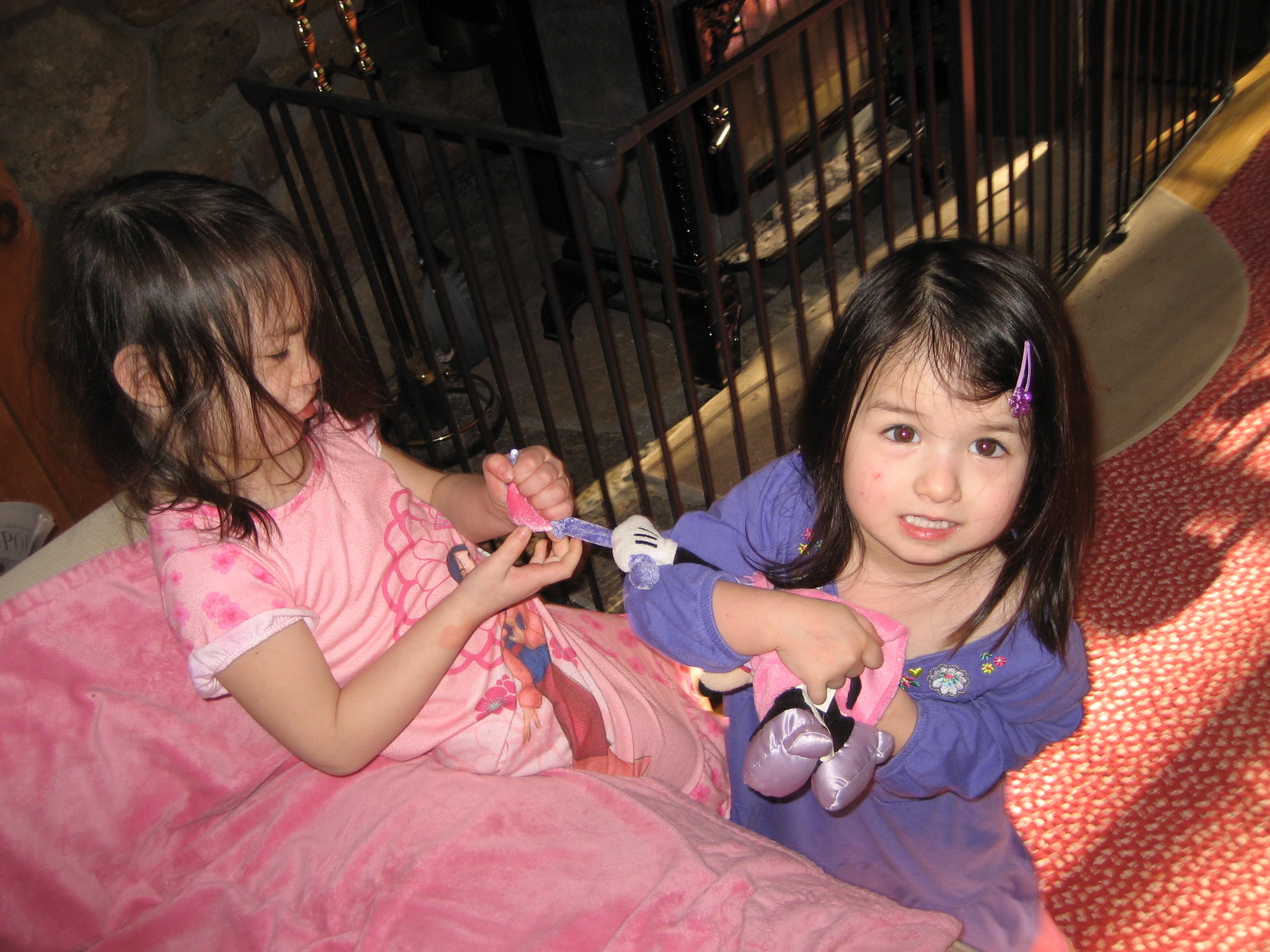
And yes, we do still have three daughters. I know you haven’t seen them in a while. Here’s confirmation that they still exist, as feisty as ever. Especially Georgia.
Current reality: we live at the foot of Vermont’s Green Mountains. Whenever we look out our front windows, walk out our front door, or drive home, we see the mountains.
The Green Mountains, seen from our front yard.
True confession: I’ve never been much of a mountain person.
It’s not that I actively dislike mountains, it’s just that for most of my life they haven’t been the scenery that most fills me with awe, inspiration, or deep thoughts about life. I’ve never said, “Boy, I’m feeling pretty wrung out. I think I’ll head to the mountains for some restoration!”
No, that would be the ocean for me. Maybe I’m lazy when it comes to awe, inspiration, and deep thoughts, but I’ll take the ocean every time. The ocean is powerful; it’s in constant motion, crashing onto land and grinding everything in its path to sand, just as it’s done without pause for millenia. Talk about awe: try standing on a beach watching the waves break, hearing the roar of the water, and thinking about how vast all that ocean is, and how deep! Then, for inspiration and restoration, nothing beats a walk along the beach. It’s so flat, so easily traversed, you could walk forever (as long as you don’t hit a gated condominium complex) — free foot exfoliation included. Added bonus: because of the breeze off the ocean, there are usually no bugs.
Now, let’s take the mountains. They may be strong and solid, but they just sit there and stare. They’ve sat for millenia, like sleeping bullfrogs in the sun. The Green Mountains, which have been weathered down so that their highest peak (Mt. Mansfield) is only 4,380 feet, especially look like squat, lumpy bullfrogs. Not exactly awe inspiring; the first time he saw them, Erick said, “I see the foothills, but where are the mountains?” That’s because he’s from Northern California, which does boast some pretty impressive mountains: the Sierra Nevada. But even those mountains never inspired awe in me so much as fear; they’re so harsh and steep and forbidding, all I can think about driving through the Sierras is the Donner Party and whether I’d eat somebody else for survival.
The other thing about mountains is that, to really experience them, you have to climb them, which is a lot of hard work. Not much time for reflection or inspiration when you’re huffing and puffing and trying not to roll down. All that work so you can reach the summit and look around — but I’ve never been a big fan of heights. And mountains usually host lots of bugs: ticks, mosquitoes, and any number of other annoying, buzzing, stinging insects.
To sum it up, my impression was always that you go to the ocean to feel small. How else could you feel next to that immense pounding, crashing, noisy motion? On the other hand, it always seemed to me that you go to the mountains to feel big. You climb a mountain, it doesn’t fight back or even move, but you earn a sense of victory; when you look down from the summit, you get to feel like God.
I’d generally rather feel small than big, so I’ve never been much of a mountain person.
Which is funny, because when I left my childhood home (in a flat, flat suburb), it was to attend college in Massachusetts’s Berkshire Mountains. A college that had as its alma mater song a little ditty called “The Mountains” (“The mountains! the mountains! we greet them with a song….”) My maternal grandmother’s favorite Psalm, read at her funeral, was Psalm 121, which begins: “I lift my eyes up to the hills — where does my help come from?” and which has been set to music as a song called “I Lift My Eyes Up To The Mountains” — a song that I’ve sung at every church I’ve attended. In New York City, we lived in a 28th floor apartment. We then moved to Berkeley, which has a landscape dominated by the Pacific Coast hill range (the “Berkeley Hills”) along its eastern border. And now we live at the foot of the Green Mountains. Rather than the ocean, it’s mountains, hills, and heights that have chased me throughout my adult life. And mostly I’ve shrugged and thought, “Meh.”
But since I’ve been staring at the mountains for almost a year now, I thought I should probably write about them. And you know, it’s pretty daunting to write anything in this age of the internet, because I could probably Google any topic and find 1,895,947 people who’ve written down my exact thoughts, only better. Clearly, I had to take a walk. So I walked around our house, and looked up at the mountains, and said, “Okay, mountains, gimme something. Anything.”
They just sat there and stared.
Our drive home, towards the Green Mountains.
It took me a minute, but then I realized that that was the answer. I saw the mountains like I’d never seen them before. These Green Mountains, they extend 280 miles through Vermont, but they’re part of the Appalachian Mountain range, which was formed about 480 million years ago. They were once among the tallest mountains in the world, until time wore them down to their current rounded form. The Green Mountains support a dense boreal forest that withstands harsh winters, which is why they can honestly be called “green” year-round. In other words, these mountains are survivors. They don’t need to show off, or move, or make noise (although I have found that on nights when the wind races down them, the roar rivals any ocean). They’re so humble, they let you climb all over them. All they need to do is sit there, and we can turn our eyes to them for help because in their massive silence they say: “Whatever it is that you’re going through, we’ve seen it. We’ve survived four hundred million years of wind, rain, snow, and sun, and we’re still here. We’re weathered, but we’re still here.”
When I saw the mountains this way, I finally felt small — small in the best, most comforting sense, like a little child who crawls into a parent’s arms and knows it’ll be okay. The ocean, I realized, is like life: it beats and batters without stopping. But the mountains, they’re US.
One of the lifeboats from the Titanic. National Archives photo.
I just read a fascinating article about the sinking of the Titanic, which addresses the question: Why didn’t the passengers panic while the Titanic was going down? Apparently, this is of great interest to economists (economists are strange), because they believe that people usually act out of their own self-interest. Three years after the Titanic sunk, the Lusitania, another luxury ship with a similar number of passengers, also sank. But the passengers on the Lusitania panicked, whereas while the Titanic went down, the band famously began playing music, doomed men strolled around smoking cigars, and order prevailed. What made the difference?
The answer to this question is proposed by an economist (so you can take it with a shaker full of salt); he theorizes that the Titanic passengers didn’t panic because the boat took longer to sink. The Titanic took about 2.5 hours to go down, whereas the Lusitania sank in under 20 minutes. David Savage, the economist who proposed this theory, says, “If you’ve got an event that lasts two and a half hours, social order will take over and everybody will behave in a social manner. If you’re going down in under 17 minutes, basically it’s instinctual.”
In other words, it takes time for our best instincts to win out.
This article fascinated me because it seems to support something I’ve been telling myself repeatedly over the past couple of months: “No sudden moves.”
I track time by the photos that show up in the “Last 12 Months” category in my iPhoto program, so I can tell you that exactly one year ago, we had just bought our house in Vermont, Erick was graduating from his PhD program at Berkeley, Georgia was getting baptized, and our California house was slowly filling with moving boxes. Around the same time, Erick and I decided that since he finally had a full-time job, and since our family was going through so many major transitions, I should take a year to focus solely on the home front. A year without thinking about any work outside the home. A year in which my job was to help a husband and three young children adjust to our new life. It turned out to be a great decision, I’m thankful that I had the luxury to even consider it, and it’s been a special year for our family.
But that year is almost up.
Which means that I’m thinking about thinking about what my next move, if any, should be. And that’s why I keep telling myself, “No sudden moves.”
This doesn’t come naturally to me. In fact, the reason I’m telling myself to slow down is because I’ve done the opposite for most of my life. I’ve never been someone with what you might call a “life plan.” I went to college with no firm idea of what I wanted to major in or what I wanted to be. Post-college, if I liked something, I decided that’s what I should do. If I got accepted for a job or graduate school, I jumped. When we reached a stage at which it seemed like we should be thinking about kids, we tried to have kids (and, fortunately for us, everything happened pretty quickly). I bopped through about a decade of post-college life in this completely unintentional, take-whatever-comes-my-way fashion. Even moving to Vermont, though practical and wonderful, followed this pattern: Erick was offered a job in February, we had a baby in March, bought a house in April, and by June we were here.
I can’t say that I entirely regret my lack of a coherent path; all of that strikes me as what you should be able to do in your 20s, and each experience was important in its way. But now I want to do things differently. Thoughtfully. Slowly. No knee-jerk reactions, no taking a job just because it’s there.No sudden moves.
In other words, I’m trying to behave more like a passenger on the Titanic. Because I think that David Savage is probably right; given more time, it’s our better instincts that tend to prevail.
I’m actually trying to behave this way throughout my life, because I don’t think this rule applies only to sinking ships or career decisions. Give anything a little more time — be it parenting, relationships, or major purchases — and I’m less likely to act out of instinctual panic, more likely to make wise choices. Sometimes this means closing my eyes, biting my tongue, and taking several deep breaths before dealing with a kicking, screaming child, but it usually leads to a better outcome.
Of course, taking too much time can also be counter-productive, the equivalent of “rearranging the deck chairs on the Titanic.” Whether or not there’s an open spot on the lifeboat, at some point you have to get off of the sinking ship. So, I’m aware of the need for balance; no sudden moves, but no spinning my wheels for years waiting for some unattainable “perfect thing.” (And, by the way, I’m also aware that EVERYTHING I’m writing about here is a luxury: being able to find jobs after college, being able to take a year at home, being able to take time making decisions. If I were a single mother or if Erick lost his job or if I’d graduated college a decade later, I might suddenly find myself on the Lusitania, even if I wanted to have a Titanic mindset.)
Here’s one more fascinating fact I learned from the article: regardless of the passengers’ behavior, the Titanic and the Lusitania each had roughly the same number of survivors. Which means that whether they behaved calmly or panicked, the same percentage of people made it off each boat.
That could be a discouraging fact: whether you calmly light up a cigar while allowing women and children to board the lifeboats first, or whether you crawl over fellow passengers in order to make it to safety, your chances of survival are the same. If you’ll allow me to extend the ship metaphor a little further, I suppose what it comes down to is this: we all know that the ship sinks in the end, but none of us really know how long that’s going to take. So, how to behave in the time we’ve got?
I say: take a stroll, light up a cigar, listen to the music, let other people go first.
This message, although cute, has always confused me. Now, bear in mind that I moved here from Berkeley, California — I KNOW WEIRD. When I think about Vermont, “weird” is not the first description that comes to mind. Vermont is pretty much like you’d imagine: red barns, green mountains, lots of good dairy products and maple syrup, plenty of outdoor romping year-round. Bucolic? Sure. A slow pace of life? Definitely. Like living in a Norman Rockwell painting? Often. Weird?!? Gosh, I dunno.
That is, I didn’t know, until we left Vermont.
Erick had a week off from his teaching duties for Spring Break, so we decided to take a 2-day family vacation. This trip was significant because 1) it was the first vacation we’d taken with three children (moving cross-country does NOT count as a vacation), and 2) with the exception of a 24-hour jaunt that Erick and I took to Montreal for our anniversary in July, it was the first time the girls and I had left Vermont since arriving here 10 months ago.
Hitting the road.
Our destination was the Six Flags Great Escape Lodge and Indoor Waterpark in Queensbury, NY. This is a massive hotel complex near Lake George that is focused on whipping your children into a state of chlorinated hysteria. Attached to the hotel is a 38,000 square foot indoor water park, featuring water slides, a “river” you can float along in inner tubes, and a kiddie pool with fountains and swings. The scene is Dante-esque: hundreds of people in bathing suits, parents clutching enormous drinks, overstimulated children, noise, humidity, tepid chemical-smelling water. As Erick pointed out, “it’s kind of like Las Vegas for kids” — the water park even has that sense of casino timelessness: artificial light and NO clocks anywhere.
It is the sort of place that seems like a GREAT idea by about mid-March, with four months of housebound winter behind you.
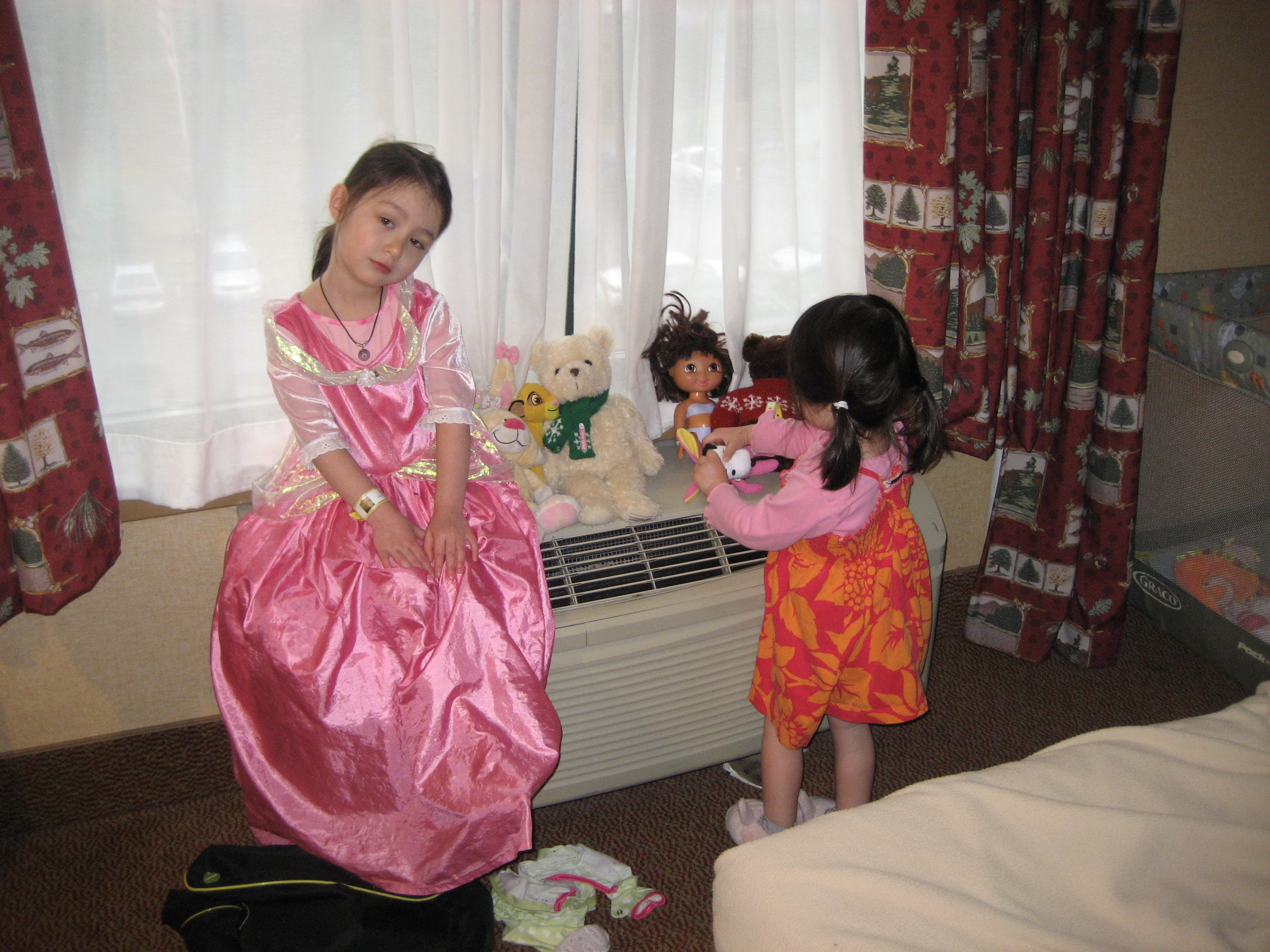
Campbell meets the bear in the hotel lobby.A ride in the luggage cart.The Gong Girls make themselves at home in our hotel room. (Note that Fiona thought to pack her dress-up clothes).The luxurious sleep sofa.
And really, it was a great idea. The kids had fun, family memories were made, and everyone was successfully exhausted after two days of “vacation.”
Fiona discovers a new talent.How Campbell fell asleep after a day at the water park.
My point here is not to comment on our vacation; my point is that the moment we left Vermont, we could tell.
This was surprising, because we were traveling a mere two hours from our house, to a region of New York State famed for its rustic scenery: the Adirondack Mountains, Lake George, log cabins. And the scenery as we crossed over the New York border was lovely, really no different from the rolling Vermont farmland we’d just left behind. But then we noticed the increased amount of trash along the highway. Not that Vermont highways are trash-free, but until we drove to New York I hadn’t realized how little trash there is blowing along Vermont roads.
The next thing we noticed were the billboards. I’ve lived here less than a year, but I realized that during that time I’d seen no billboards in Vermont. I’m not talking about signs next to the road — we have those — I’m talking HUGE advertising billboards. This got me wondering about Vermont’s zoning ordinances, so when we returned home, I looked it up. Turns out that, yes, Vermont is one of four states (the others being Maine, Alaska, and Hawaii) to have banned billboards entirely. Vermont’s law was the first to be passed, in 1968.
As we drove further west into New York, the landscape became more and more developed. Suddenly we were in the land of strip malls, big box stores, multiplexes, putt-putt golf, roadside hotel chains, and Drive-Thru Starbucks.
It was shocking.
But when in Rome, right? We ate at Panera Bread and Johnny Rockets, we stocked up on diapers and trash bags at Target. These were the types of things I was sure I’d miss when we left California. Instead, we felt like we needed some fresh-veggie transfusions after two days of chain-restaurant food. And Target? As soon as I walked in, grabbed an enormous cart, and inhaled that familiar powdered-butter-popcorn smell, I felt a sense of panic. There was so much to buy! I should’ve made a list! SURELY I needed ALL of these things!
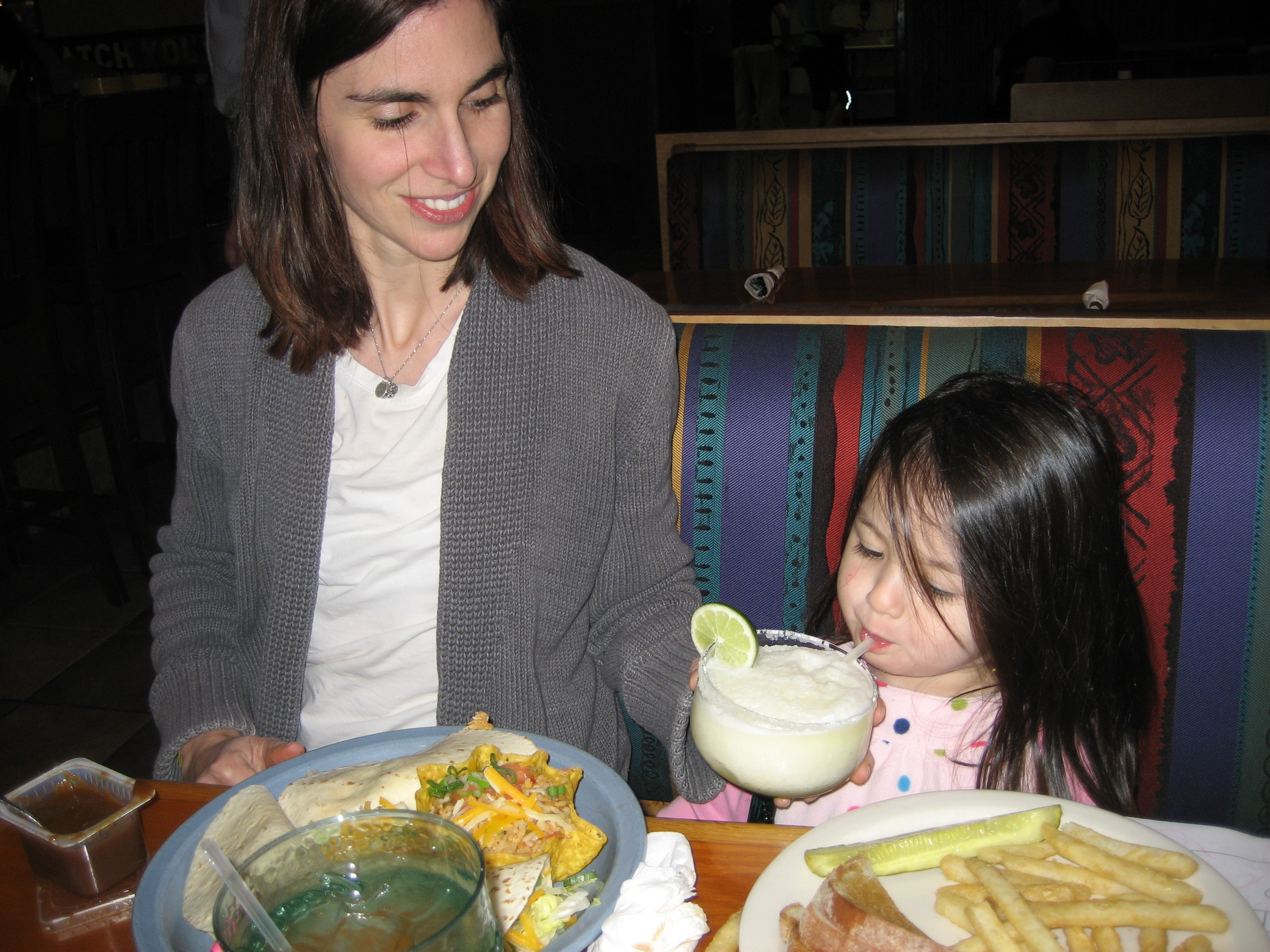
The girls in a Target shopping cart.Fiona at Johnny Rockets.Campbell tries her first Margarita (don't worry, it was virgin), declares "I like it!"
As we pulled out of the shopping mall parking lot with our meager Target plunder in the trunk, it hit me: Vermont is weird! Because, as far as I can tell, these concrete temples of consumerism, this multiplex-entertainment-land, ARE WHAT IS NORMAL IN THIS COUNTRY. It’s where we used to live, it’s exactly what my hometown and my husband’s hometown now look like. In fact, we could have been just about anywhere in the United States at that very moment. There was nothing weird about it, just normal people doing their normal shopping, eating their normal food, having their normal fun.
What’s weird is that somehow Vermont seems to have kept most of these “normal” things out. Because, you see, Vermont doesn’t have a single Target. Or an Ikea. There are 3 Wal-Marts, one Costco, and four Starbucks in the entire state of Vermont, and to get to any of those I’d need to drive at least one hour. Our movie theater in town has two screens; to get to any other movie theater, I’d also have to drive at least one hour. What we saw at the southern end of beautiful Lake George was a summer vacation honky-tonk paradise, including a tiki hotel, a wax museum, and more putt-putt courses than I’ve ever seen in one place. Vermont has lakes, too, but I’ve never seen anything remotely approaching this kind of commercial development along them; usually the most you get is a deli and a bait store.
Which got me wondering some more about Vermont’s zoning laws. How have they kept so much of this commercial development out of the state? Did Vermont enact some sort of “anti-tacky” legislation?
As it happens, in 2006 the Vermont Senate passed Senate Bill 175, which requires any proposed retail store over 75,000 square feet (about half the size of a typical big box store) t0 pay for an economic and community impact analysis. I’m guessing that’s a lot for large corporations to stomach, especially when they’ll have to get it by a local group of Vermonters.
I’m hoping that this doesn’t come across as judgmental and self-righteous. If I were truly righteous, I wouldn’t ever shop at Target, or order things from Amazon, or (sometimes) crave Chipotle burritos and Starbucks lattes. I’m just saying that the difference between Vermont and what I would classify as a pretty normal, mid-sized American town was dramatic.
A cynical explanation might be: Vermont’s economy depends on tourism, so Vermonters have an economic incentive to keep things charming and pristine, the way tourists expect Vermont to look. Big box stores are about economics, too, and I was willing to be forgiving; surely these stores are great job-creators for a region of New York that is booming over the summer but depressed the rest of the year, right? So I looked it up. Unemployment in Glens Falls, NY (where most of these malls were located) was 9.5 for January 2012; statewide unemployment was 8.3. During the same period, Vermont’s unemployment was 5.0.
Huh. So I don’t know. I’m not an economist, but I do live with one and I hear from him that these things are complicated.
I do know that I was SO HAPPY to get home to Vermont; this was the trip that really made Vermont feel like home to me. On the way home, we stopped by the New England Maple Museum in Pittsford, VT. We were the only people there. We took a self-guided tour that probably hasn’t been updated in 25 years, watched a slide show (just like the ones you used to watch in elementary school) on how maple syrup is made, and sampled some maple-y goodies. The girls had just as much fun as they did swimming in a chlorinated pool under fluorescent lights.
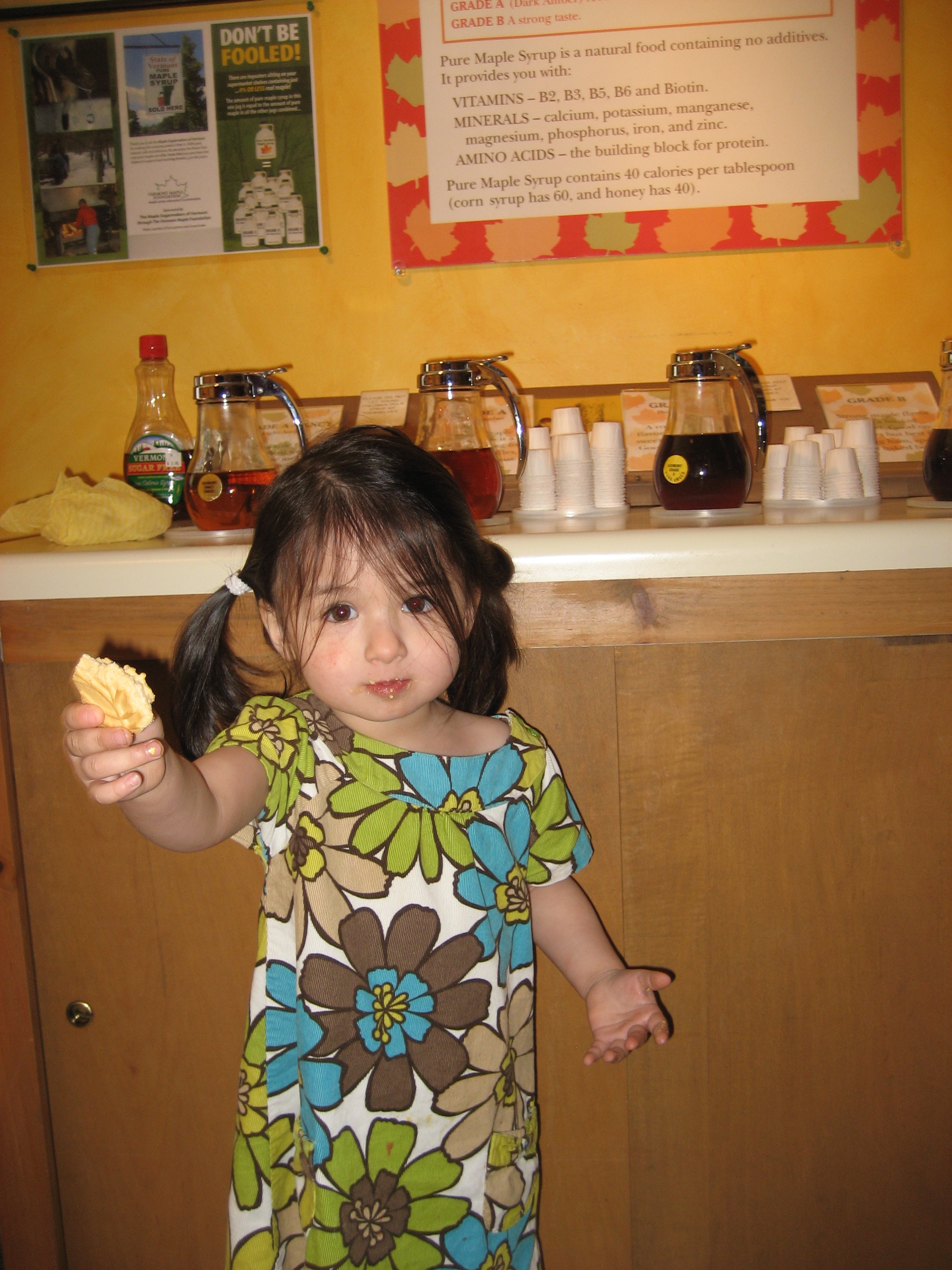
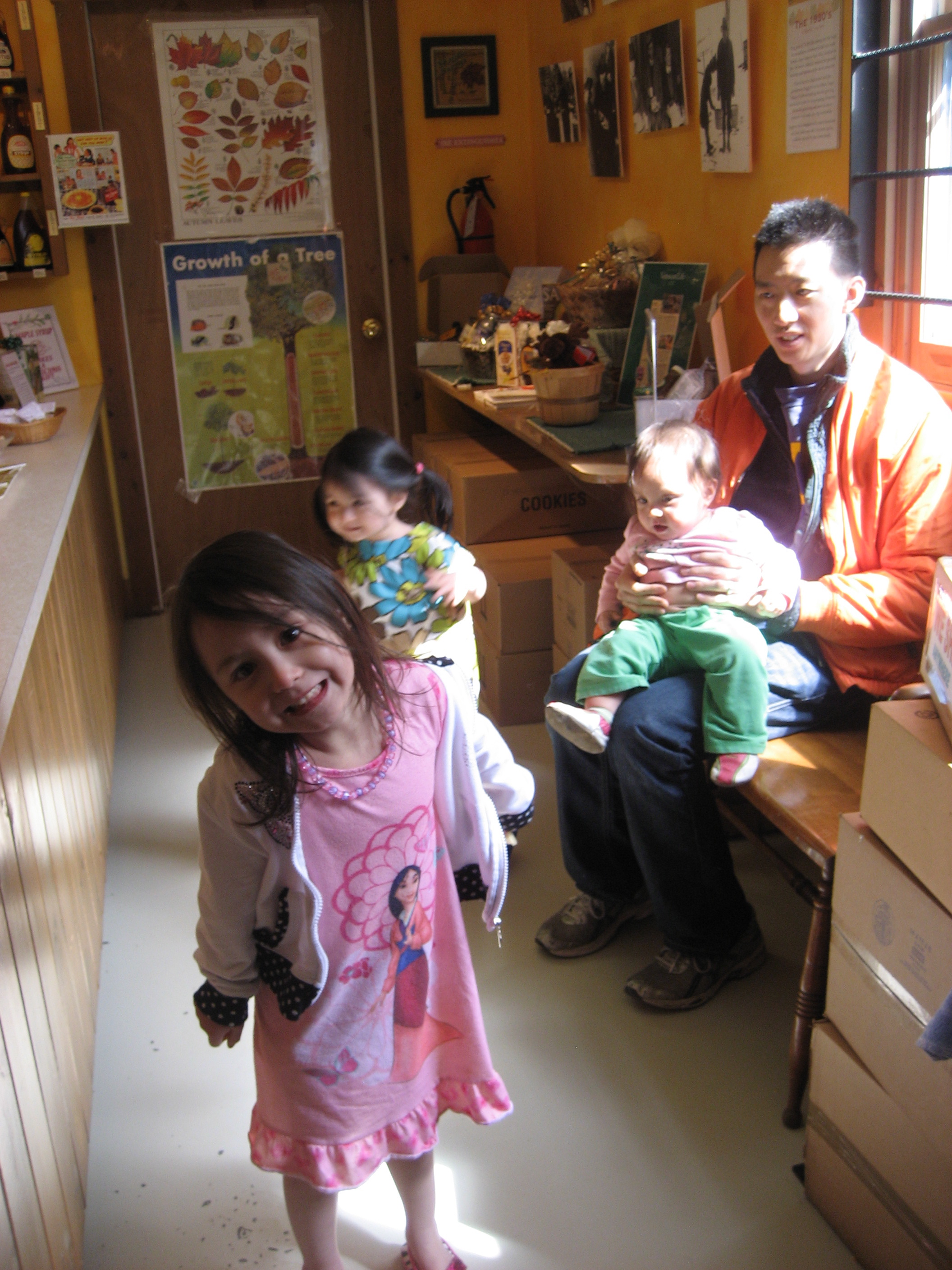
The dairy farmer mannequin that greets you at the New England Maple Museum.Sampling a maple cookie.Happy Vermonters.
That’s pretty weird, right? Vermont is weird. I think I may have to pick up one of those t-shirts.
Some of my thoughts are published over at On the Willows today, as part of their “April Fools” series. WARNING: If you tune in to this blog primarily for cute pictures or stories of the Gong Girls, this post includes none of those. It’s also one of my more “faith-y” pieces: I quote Jesus. But I also quote Al Franken.
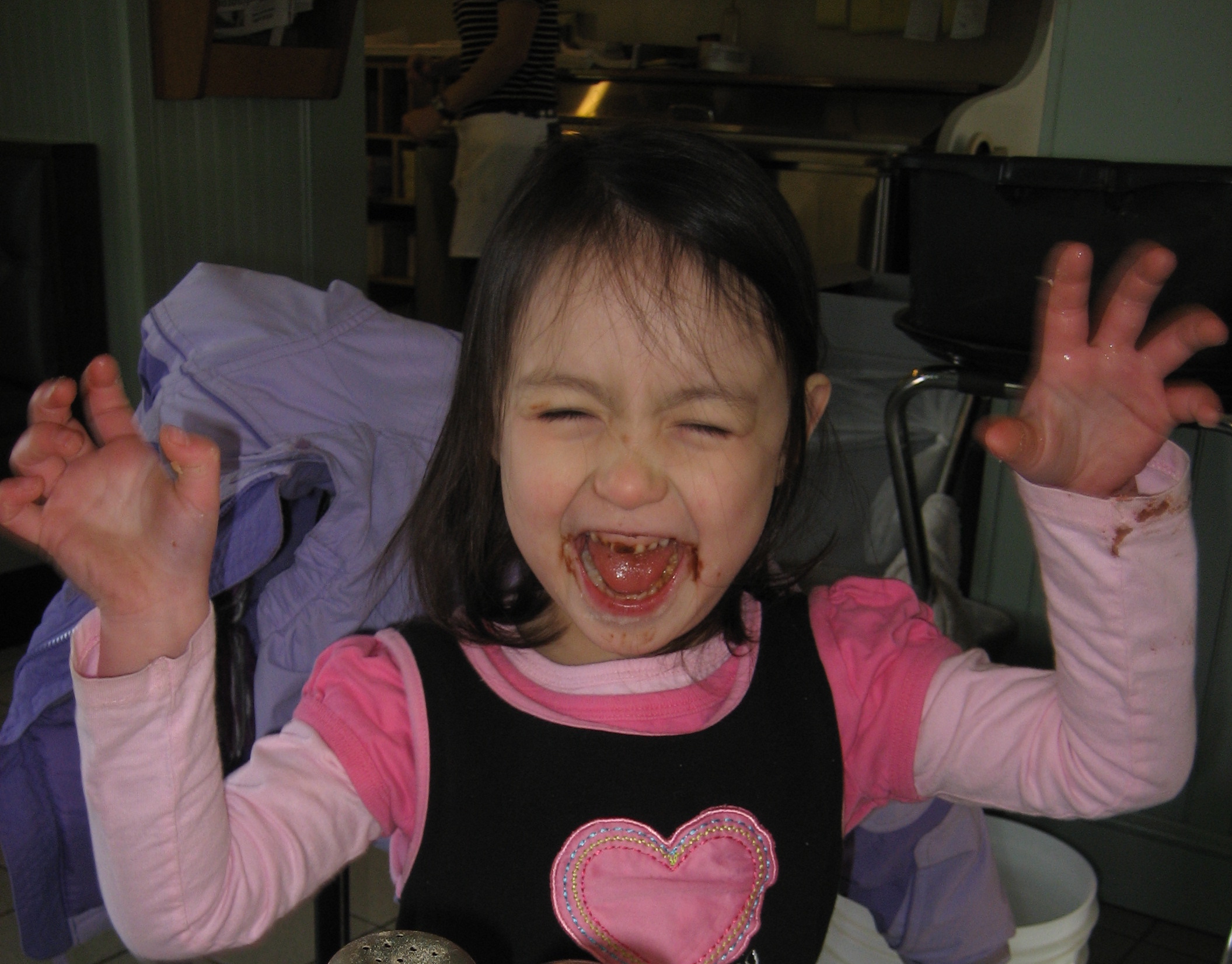
Fiona's impression of "panic" -- with a mouthful of chocolate doughnut.
Hello, my name is Faith, and I’m a perfectionist.
Actually, I’m a recovering perfectionist. I expect to be in recovery for the rest of my life.
This is not intended as a cute, “Boo hoo, I’m soooo perfect!” quasi-lament. On the contrary, I consider perfectionism to be equally as addictive as controlled substances, and potentially as damaging.
It sounds so positive, so socially acceptable: PERFECTIONISM. Like you’re packaging an admirable quality as an -ism so that it doesn’t come across as bragging. Saying “I’m such a perfectionist” is in the same league as, “Gosh, I wish I could put on weight!” or “Really, celebrity isn’t all it’s cracked up to be.”
But don’t be fooled: if you truly desire perfection, you have put yourself in an untenable position. NOTHING in life is perfect — or if it is, it doesn’t stay that way for long. So, by proclaiming yourself a perfectionist, you are placing yourself in opposition to the universe. And if that isn’t a recipe for bitterness, disappointment, and strained relationships, I don’t know what is.
Just as there are a variety of substances available for addiction, there are a variety of outlets for perfectionism. You may be a perfectionist when it comes to your work, your food and coffee (that was a big one when we lived in the Bay Area), your appearance. I am a (recovering) social perfectionist, which means that I care too much about what other people think of me in social situations. I believe this is the perfectionism equivalent of crack cocaine: you can’t win.
One thing that my perfectionism sometimes leads me into is a little game I call “Script the Social Interaction.” In this game, before I head into a social situation, I script it out in my head beforehand. I think about how I want to come across, and I plan what I’ll say to the various people who will be there. Then, during the social interaction, I will actually give myself direction (“Nod less, smile more. NO, don’t talk about your kids!”). And of course, afterwards the critics weigh in (“Idiot! NEVER ask an economist about their research!!”). It’s like having the entire motion picture industry inside my head: crowded and exhausting.
(And please tell me that some of you do this, too. Even if you’re telling me very slowly and hoping that I don’t notice you dialing 911 behind your back).
ANYWAY, my point is that sometimes I do this, but I’m trying to stop as part of my perfectionism recovery. Because if you can’t be real and open with people, it’s impossible to have genuine relationships. If I’m only concerned with maintaining a perfect front during social interactions, what’s the fun in being my friend? I’ll bring nothing interesting to the relationship, and will only make you feel bad that you’re not as perfect as I appear to be. If, on the other hand, I’m able to relax and be myself and share imperfections like (theoretically): “Sometimes I yell at my kids and feel like a horrible mom,” or “Sometimes when my husband is talking about his day, I’m really wondering whether he’ll make us popcorn after dinner,” — well, you still may not want to be my friend, but at least you won’t feel inadequate by comparison.
And you know what’s really helping me get over this perfectionism? KIDS.
One of the greatest things about children is that they force you to be real. I can script out social interactions all I want, but it’s hard to maintain a slick front when a little person is pulling at my sleeve yelling, “Mommy, I need to pee! RIGHT NOW!”
I’ve found that the power of kids to cut through my social perfectionism is exponentially stronger in a small town. Since we moved to Vermont, we see the same people EVERYWHERE we go: the park, the library, the playgroup, the pizza place. So when Campbell pitches a massive tantrum at the library (not that this happened just last week or anything), we likely know every single witness. Not only that, but we’ll see them all again the next day, and the day after that, until forever. The lovely thing about this is that when this tantrum happened (okay, it was last week), I had several moms offering to help push our stroller out. The drawback is that I worry that I’ll always be known around here as “That poor gal from California who’s in over her head with those three crazy kids!”
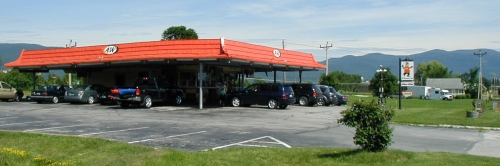
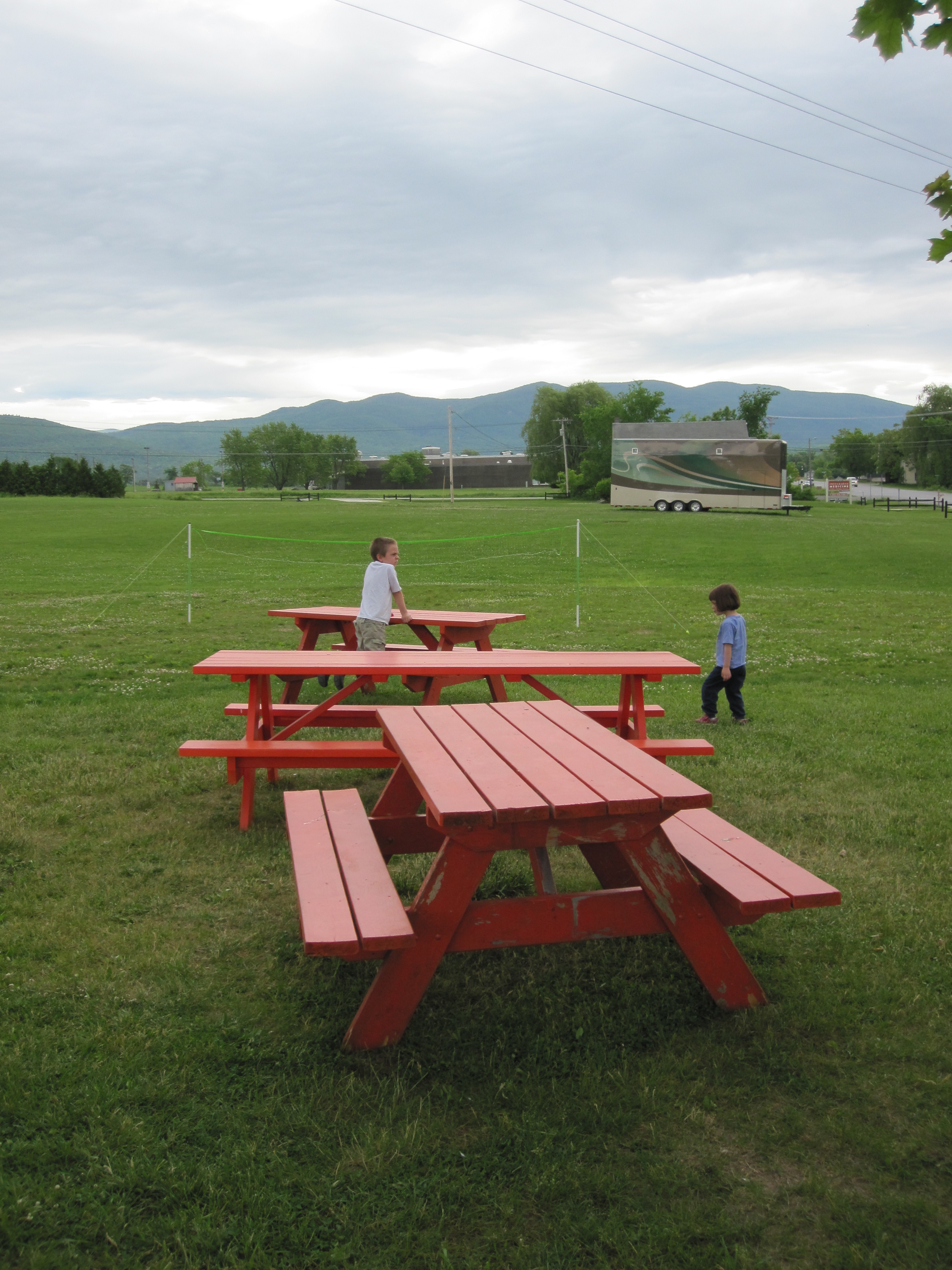
A perfect example of this happened last summer at the A & W. This is a classic drive-in restaurant with simple, greasy food. It’s only open during the warm weather months. (The A & W is Campbell’s favorite place; she calls it “The ABC,” and all summer long, whenever we’d drive past it, she’d scream: “Look! The ABC!!”) You can either eat right in your car, or at picnic tables in a large grassy field next to the parking lot. The Gong Girls prefer the picnic tables, because there’s a big bucket of plastic outdoor toys (balls, bats, frisbees, etc) nearby. The Gong adults prefer the picnic tables, too, because WHY would we be having 3 kids eat in our car if we could have them running around in a grassy field instead?!?
One evening in late summer, we met the girls’ friend Ruth and her parents for dinner there. It was a magical summer night: golden sunset, pleasant adult conversation, the girls running through the grass pretending they were being chased by aliens. It was when all three girls were happily dancing on top of an unused picnic table that we heard it: “Mommy, Mommy, I’m POOPING!” Turns out Fiona had been having so much fun that she’d neglected to tell us she had to use the bathroom. So there she was: holding up her dress, laying one right on top of the picnic table in full view of Rte. 7 and the other A & W diners. (This was one of those moments when my entire parenting life flashed before my eyes. I wasn’t sure whether to laugh or be horrified, so I sort of did both).
This being a small town, the A & W diners were: us, Ruth’s parents, and another family that we know from church. So the good news was that everybody there knew us…aaaand the bad news was that everybody there knew us.
So, if you’re ever in Middlebury and you’re not sure where to find us, just ask anybody for “That mom whose kid pooped on top of the picnic table at the A & W” and they’ll point you the right way.
And yes, we will be telling this story at Fiona’s wedding.
Bonus post! I have a piece published over at On The Willows today — a little reflection on Fiona’s birth in particular and maternal health in general. Click here to read it.
It might be just me, but sometimes my children behave irrationally.
When this happens, my first instinct — usually indulged — is to return the child in question to whatever passes for “normal” behavior, as quickly as possible.
My second instinct, increasingly, is to reflect upon whether this irrational behavior might — just possibly — be something that I myself display, albeit in a more “mature” form.
It’s not really news that if you stand back and compare the behavior of children and adults, you’ll probably find more similarities than differences. For all the living and learning that we do, I think we mostly just add protective layers on top of our childlike instincts. We’re kind of like those Russian nesting dolls; we may look all grown up on the outside, but at our deepest core is a tiny little person. A tiny little person full of basic wonder, love, anger, fear, and who often screams, “It’s not fair!”
For instance:
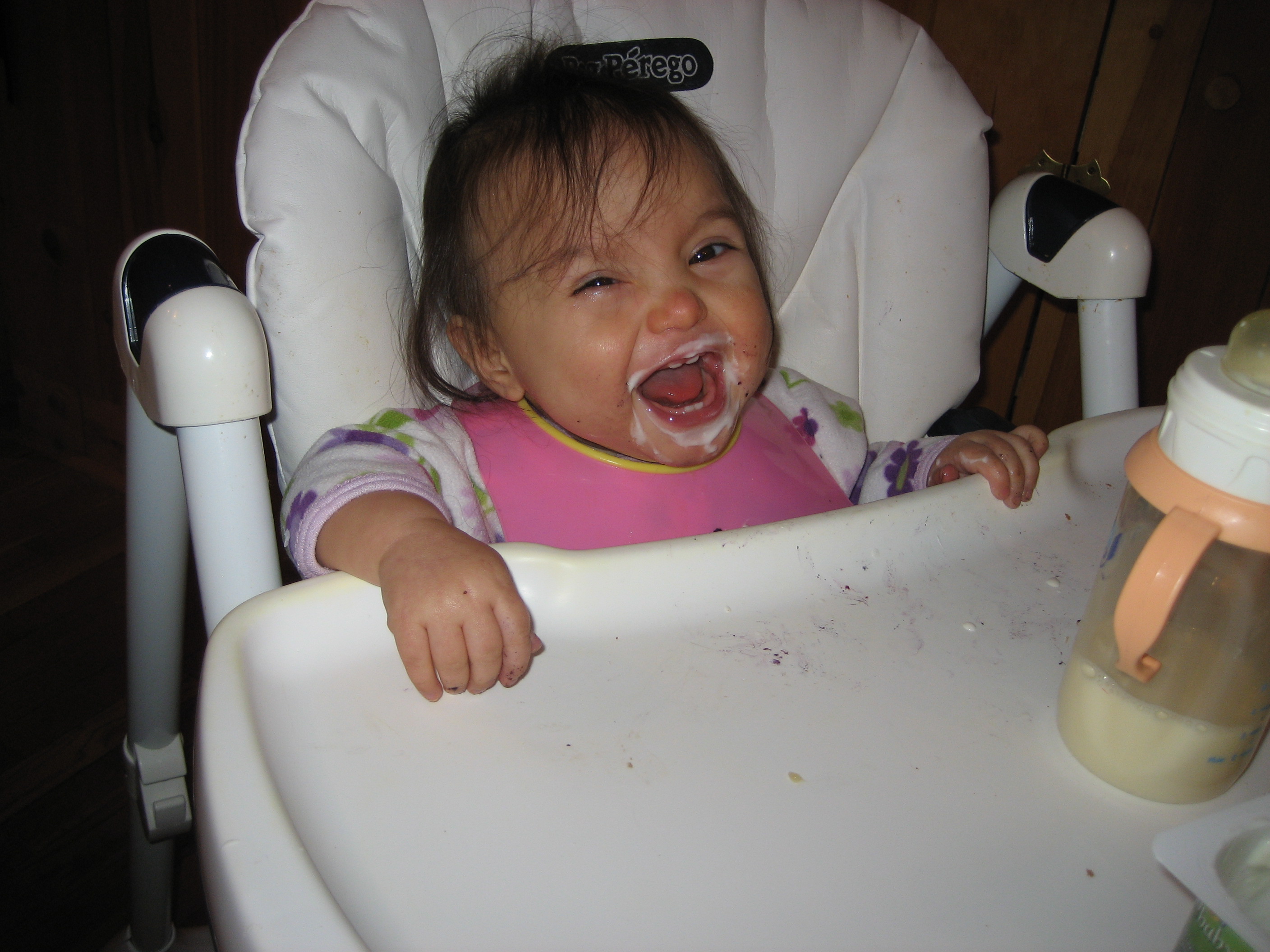
-When each of our daughters started sitting in a high chair and eating solid foods, they did so quite messily. So, at the end of each meal, we would wipe their hands and faces with a wet washcloth to prevent them from looking like human sculptures of mashed sweet potatoes. Remember, now, we did this following every single meal, three meals a day, for at least a year. We applied gentle pressure as we wiped, and the washcloth was pleasingly warm. In a spa setting, you’d pay good money for this kind of service. But every single one of our daughters would SCREAM like we were taking a Brillo pad to them, every single time we wiped them down. Now that it’s Georgia’s turn for the thrice-daily screamfest, I again find myself wondering, “WHY is this such a traumatic surprise to you? Isn’t this the exact same thing I did after your LAST meal? Not to mention EVERY meal?!?”
Don't even THINK about coming near me with that washcloth!
And yet, don’t we all miss the patterns and react with shock and outrage when we find ourselves repeating the same scenario over and over?
-At least 37 times a day, Campbell comes to me complaining (loudly): “Mommy, Sister won’t give me the doll/toy/marker/book.” I’ve learned that my first question should be, “Well, Campbell, did you ASK her for it?” Because over half the time, the answer is “No.” And once Campbell goes back to Fiona and simply asks for whatever it is she wants, chances are good that she’ll get it. (Or at least, she’ll get it after Fiona’s “done with it,” which often requires persistent requests every few seconds).
Campbell taking (not asking).
And yet, don’t we all angrily assume that something’s being withheld from us, when maybe all we had to do was ask?
-Our two oldest daughters sometimes lose control of themselves, in which case the best solution is for them to have a little “time out” alone in a quiet room where they can cool down. Recently, Fiona has started shouting, “FINE! I’m NEVER coming out!” from behind the door that we’ve just closed on her. As if, all along, this has been her idea; she’s the one in control, AND she’s punishing us. Because, you see, she’s NEVER coming out.
Fiona, alone with her principles.
And yet, oh my gosh, don’t we all do this? We get so tangled up in our need to appear in control that we turn things around and punish other people without even realizing that we’re really the ones being punished.
-Finally, FAIRNESS. Ah, fairness! Four-year-old Fiona has just latched on to the concept of fair/unfair, so we’re all living with the refrain of “It’s NOT FAIR!” these days.
She says the words, because she’s four, but don’t adults — all of us — still feel it so painfully in our hearts? It’s NOT fair that other people live in Manhattan townhouses, that some people’s children sleep until 9 AM, that Erick gets to leave the house all day. WAAAAAH!
Of course, the appropriate response, to both Fiona and myself, is: “Life’s not fair.” That’s certainly true, but it’s trite and hopeless and a bit too Archie Bunker-ish for me.
So I’ve come up with my own little saying for our whole family: Never expect fairness for yourself; never accept unfairness for others.This is how I express my desire to quit whining about my own circumstances, and to start thinking instead about how I could help people who REALLY live in unfairness.
Here’s an example of this in action:
Two weeks ago, Fiona raised the “It’s NOT FAIR!” cry in the car, because (I’m not kidding) Campbell had frost on her window, while there were only “boring” water droplets on Fiona’s window. Armed with my nifty new slogan, I said: “At some point, Fiona, you will have frost on your window, so this is not really a question of fairness. But you know what’s not fair? Some children don’t have parents. Some children don’t have three meals a day. Some children don’t have nice soft beds to sleep in and roomfuls of toys to play with. Life ISN’T fair, but in the scheme of things, kiddo, you’re on the blessed side of the fairness seesaw. So, what are you going to do about it? Never expect fairness for yourself, but never accept unfairness for others!”
She hasn’t claimed unfairness again this week.
And that, my friends, is why my children will run away from home to become investment bankers.
So, the very next time you happen to be Just sitting there quietly watching TV, And you see some nice lady who smiles As she scours or scrubs or rubs or washes or wipes or mops or dusts or cleans, Remember, nobody smiles doing housework but those ladies you see on TV. Your mommy hates housework, Your daddy hates housework, I hate housework too. And when you grow up, so will you. Because even if the soap or cleanser or cleaner or powder or paste or wax or bleach That you use is the very best one, Housework is just no fun.
-Lyrics to “Housework” by Marlo Thomas, from “Free to Be You and Me”
People often say to me: “Faith, your house is so clean and tidy. How DO you do it?”
HA HA! No, not really. In fact, nobody has ever said anything remotely like that to me. (The closest I’ve ever come to this kind of praise was a friend who complimented me on having it “all zipped up,” but I assume she was talking about my pants).
I’ve never been a huge fan of housework. This probably springs from growing up in the cleanest house ever. You may think that your moms kept their houses clean, you many even think that YOU grew up in the cleanest house ever, and that’s very sweet…but you’re wrong. Of course, the natural outcome of growing up in the cleanest house ever was that I vowed never to spend as much time cleaning as my mom. And the PROBLEM with this is that I have high standards of cleanliness — I can see the mess, it bothers me — but I don’t want to be the one dealing with the mess. It gets ugly, I tell you: it’s like Fight Club up there in my brain, with Tyler Durden played by my cleanliness standards.
My war with myself over housework had the potential to become a huge problem when we moved to Vermont. Back in Berkeley, our family rented a 900-square-foot, 2-bedroom, 1-bath bungalow; upon moving to Vermont, we tripled our living space. I’m still embarrassed about this, because I’ve never considered myself a Big House Person. Big houses tend to get filled up with more stuff (I fear accumulating too much stuff), and they tend to require more time spent cleaning (enough said). But we chose the house we are in because: (1) we had 3 days with a month-old baby to find a place, and this was the obvious best choice, (2) we are now a family of 5 and also want space to host people (especially grandparents), (3) we moved to Vermont, where real estate is waaaaay cheaper than anywhere else we’ve lived. So, here we are, and I have to say: the housework hasn’t been so bad.
How have I managed the increased housework load? Well, I had this little revelation shortly after we moved here: Did you know that big tasks become more manageable if you break them into smaller pieces? (That’s how it is with my revelations: takes me a decade to achieve an “Aha!” moment, to which everyone else says, “Duh!”). For instance, it doesn’t take long to clean one bathroom (at least not the way Iclean a bathroom). We have 2.5 bathrooms, so I clean one a day on Monday, Tuesday, and Wednesday. And so on with the other chores. (This all, of course, until I can get the girls to take over for me — and trust me, that’s already beginning). Eat your heart out, Good Housekeeping!
Aside from basic housework, however, we have another issue: creeping kids’ stuff. Back when we had only one child, I was determined that kids’ toys, books, and other kid-related paraphernalia would not take over our house. When I was growing up (in the cleanest house ever) there were certain rooms that were set aside for adults, like the Living Room and the Dining Room. It seemed right and proper that adults — who, after all, OWN THE HOUSE — should have spaces where they can walk freely, unafraid of stepping on Legos or tripping over Exersaucers. We handled the problem of kids’ stuff in our Berkeley bungalow by stacking everything in a towering pile in one corner of the living room.
But that pile grew and grew, and we kept having more kids. Then the older kids needed new toys, because an Exersaucer isn’t much fun when you’re 3, but the new baby still needed the old toys, so we couldn’t get rid of them. The kids’ stuff took over our house like kudzu.
Moving to a bigger house should have solved the problem of creeping kids’ stuff. But it didn’t.
Here was the plan: in our new house, we have a room we call the Rec Room. It’s a funny room built over the garage, up a small flight of stairs from the Mud Room. As such, it’s separated from the rest of the house in a way that makes it unusable for much, but PERFECT as a dumping ground for kids’ toys. The idea was that all of the girls’ toys would live in the Rec Room, keeping the rest of the house clutter-free.
It hasn’t worked. Oh, the girls were initially excited about having a toy room, but they quickly saw through the plan. The first problem is that the Rec Room is far away from wherever I tend to be. Of course, this is precisely the point, but it turns out that our girls prefer to play directly underfoot so that I’m immediately at hand to help them change clothes 53 times, mediate disputes every 3 minutes, and wrestle Barbies into complicated outfits.
Then winter came, and the problem became one of climate. Our Rec Room is so cut off from the main house that it has its own heating zone. It’s also cut off by a door that we close in the winter to keep cold air from the garage/mud room from entering the main house — which means that the heat from our wood stove doesn’t reach the Rec Room. In other words: the Rec Room is completely impractical to heat, so during the winter it’s freezing. Unless I go up there an hour in advance of any playtime to crank up the heat, the girls have to wear full winter gear just to play with their toys.
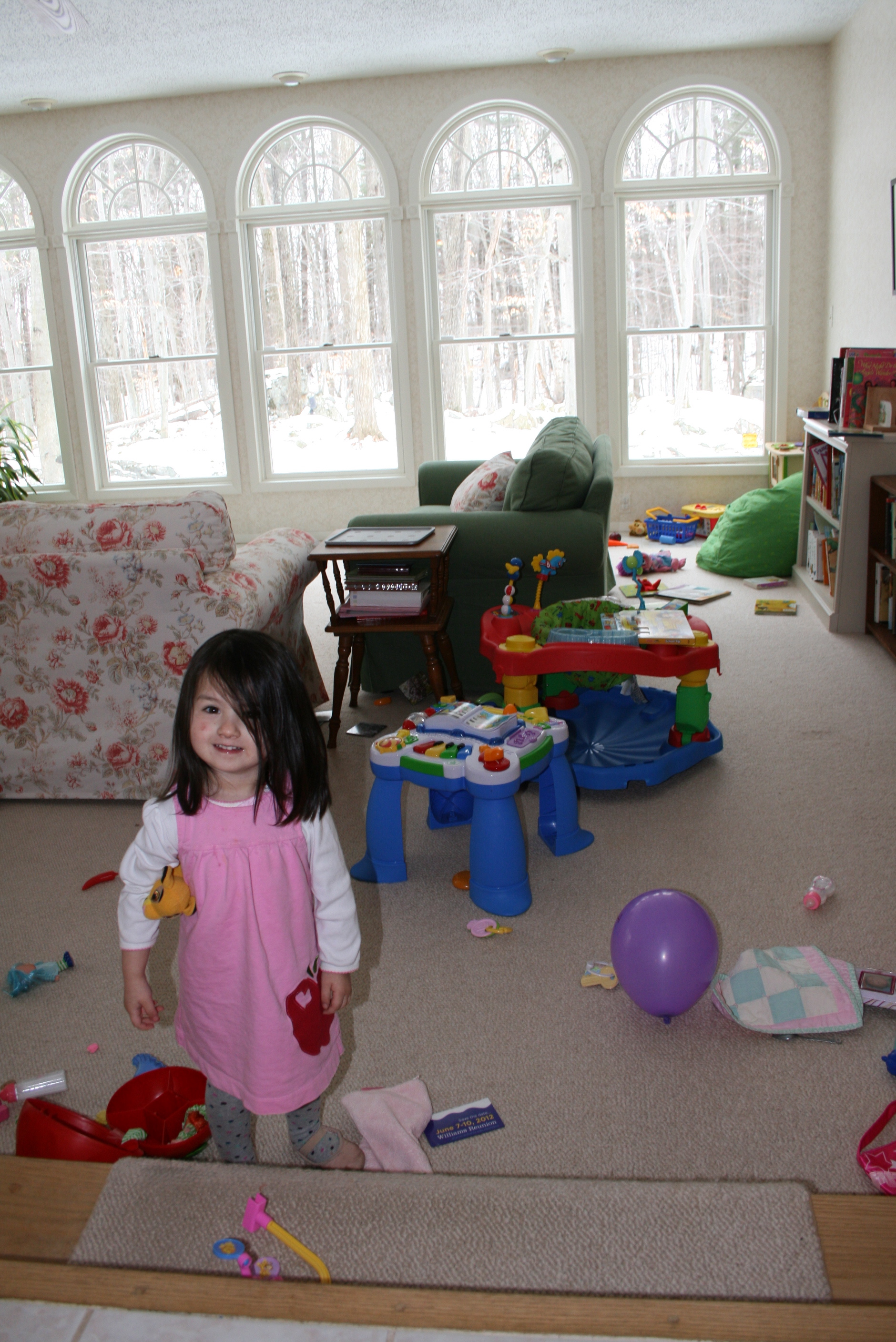
Result? Our sun room, which I’d envisioned as a space for quiet reading and art projects, now looks like this:
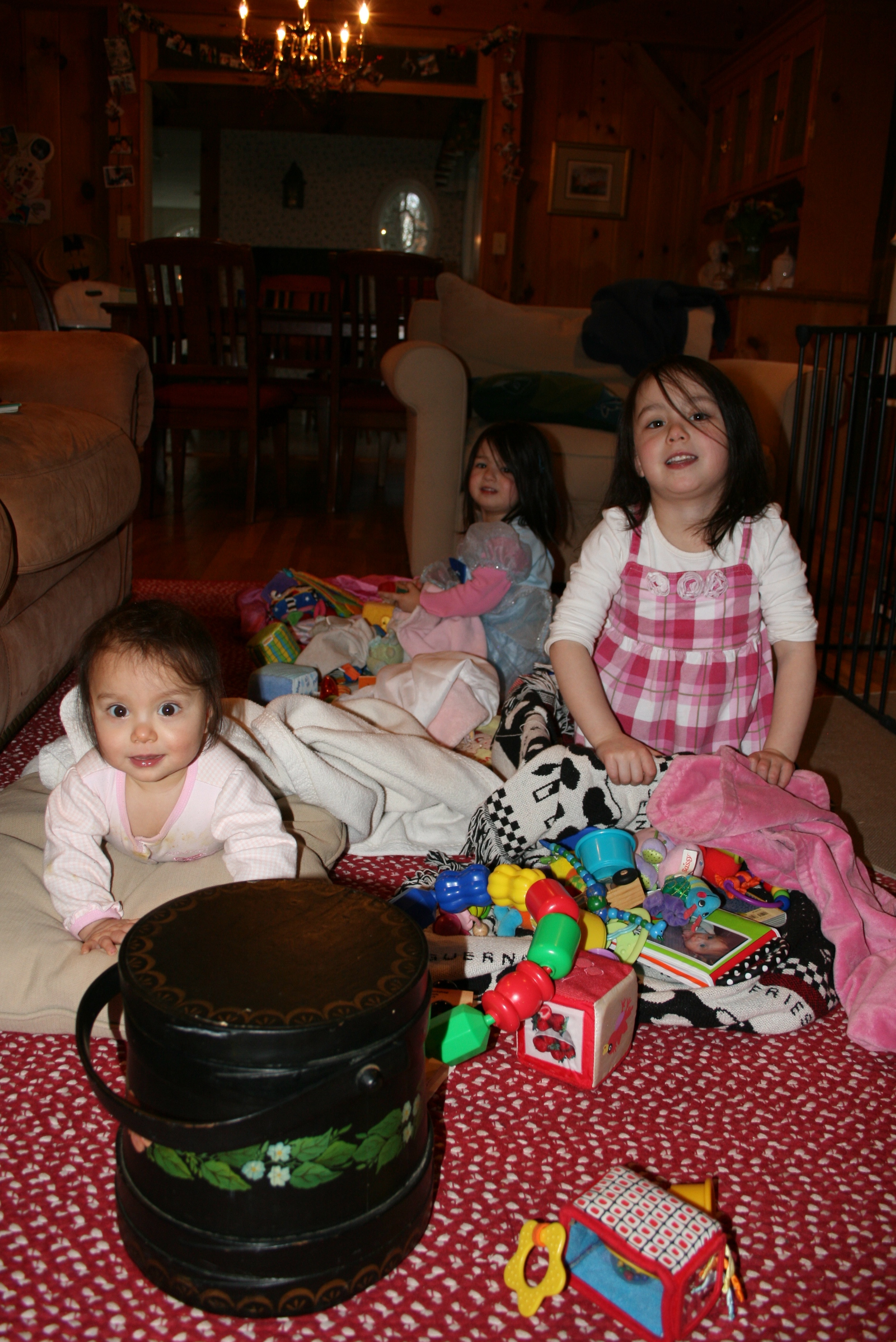
And our living room, which I’d imagined would remain a completely “adults only” zone, looks like this:
The girls and I tidy it up, but the creeping kids’ stuff inevitably re-explodes. So I’ve decided to relax. I’m not going to waste too much time or energy fighting it. These kids outnumber us now; it’s natural that their stuff is taking over our house. Instead, I’ve decided to file this situation under the “I have three young children” excuse.
This is another nifty revelation of mine: if you have three young children (say, between the ages of 1 and 4), most people tend to cut you a lot of slack. My theory is that they’re just so relieved that you’re not lying on the floor sobbing with exhaustion and desperation, that people are willing to excuse all manner of bizarre behavior from mothers of young children. Behavior that in any other situation would earn me a label as a substandard person suddenly becomes perfectly acceptable, even understandable. Twenty minutes late? “I have three young children.” Wearing sweats for the fourth day in a row? “I have three young children.” Chugging a third cup of coffee and wolfing down old birthday cake for lunch? (That’s just a theoretical situation, mind you). You guessed it. Certainly Playmobile figures strewn across the carpet, applesauce on the walls, and marker on the couch fall into this category as well.
Obviously there will come a time when the girls will be older and more mature, and the “I have three young children” excuse will no longer work for me. At this point, I will have to begin behaving like an upright citizen with a tidy house. OR, it’s just struck me that there may be another solution:
Keep having more children, for as long as possible!
That’s clearly the answer! I can get away with a messy house for years! What a revelation!
I can’t wait to tell Erick when he gets home from work.
I never made a conscious list, but if you’d asked me what kind of mom I’d be before I had kids, I would have said:
-My children would play primarily with non-toxic, sustainably harvested wooden toys.
-I would nurse every child until at least age 1.
-Organic fruits and veggies would be part of every meal (after age 1).
-Cloth diapers only!
-My children would not watch videos — or anything on a screen — until at least age 2.
-Disney princesses, Barbies, and any other plastic characters hawked by ginormous toy companies with questionable ethics would NOT be part of our family culture!
Now, to be fair to myself, I did do a few of those things…for the first year of our first child’s life. But somehow, three years later, Barbie has taken over our house.
More accurately: the Disney princesses wore down our resolve, and Barbie was the second line of attack.
It’s still a mystery to me HOW Fiona first became obsessed with the Disney princesses. You may be thinking: “You don’t KNOW? Where were you? Weren’t you watching?!?” All I can say is: Yes, I was watching, but I still don’t know. What I do know is that — despite the fact that I’d never bought her anything Disney, never knowingly exposed her to anything Disney — a few months before Fiona turned 2 it was like a switch flipped on in her brain and suddenly it was ALL about Disney princesses. Almost exactly one year later, the Barbie switch flipped on. As younger sisters, Campbell and Georgia never had a chance of avoiding the obsession.
Of course, nobody really had a chance of avoiding the obsession, and I was naive if I thought that this was something I could control. One mom vs. the combined force of Disney and Mattel: sounds like a pitch for the next Michael Moore documentary (Mike, call me). Maybe, maybe if we never left the house, I could have shielded them from the pervasive marketing of these two companies. Because this is how I think the switches in Fiona’s brain were flipped: all it took was one trip to Target — or, for that matter, the grocery store, where today she noticed Barbie mouthwash. And we don’t even go shopping very often, but the girls can (and do) check out Disney/Barbie books and DVDs from the public library.
It’s a humbling business, this parenting. Could I have fought against the marketing that spurred Fiona’s insatiable desire for anything Disney princess/Barbie? Could I have sat her down and said, “In our house, we don’t play with these things?” Of course I could have.
Did I? No, I did not.
And sometimes, I feel guilty about that decision. But mostly I’m okay with it.
Why? Well, first of all I’m not convinced that Disney princesses and Barbies pose an inherent danger to my children. I’m aware that they’re not the most intellectually enriching toys — although they certainly keep the girls engaged in imaginary play for hours — but it’s not as if these are the only toys or books available in our house. I do recall a big brouhaha over Barbie dolls some years before I had kids; I believe the debate centered around the (valid) accusation that Barbie dolls provided young girls with unhealthy body images and shallow role models. I’m also fairly certain that, if I scratched the surface, I could come up with numerous ethical concerns attached to both Disney and Mattel companies. I could easily look both of these issues up online, but I haven’t, because I know what I’ll find: lots of loud opinions.
You could accuse me of moral laziness, and to some degree you’d be right. Especially when it comes to corporate ethics; I’d like to take ethics into account in everything I do, but frankly, I just don’t have the energy. I’m more than willing to boycott some obviously bad things, and write letters, and so on. But my first priority is to keep a household (mostly) afloat and relatively peaceful.
I’m also trying to equip my children to function in the big bad world out there, not subject them to some experiment in absolute moral purity — in the same way that I’d prefer to allow my kids to have chocolate and learn how to eat it in moderation, rather than ban sweets altogether. As for the morals of the Disney princesses and Barbie themselves: they’re certainly shallow, cliched, and unrealistic looking — plastic, in every sense. But if a 6-inch plastic toy is what my daughters are ultimately going to choose for their lifelong role model, there’s a lot more wrong in our house than the toys we play with. Furthermore, the stories that go along with these plastic princesses ultimately have to do with the power of love, friendship, and being true to yourself. And that I can work with.
The other reason I haven’t banned the plastic princesses from our lives is because, in the big scheme of things, any gains to be had from booting out Barbie don’t seem worth the ensuing battle. If my preschoolers love a certain toy (and they DO), and I don’t believe it’ll ruin their characters for life (and I don’t), then it’s not worth the fight. Some things are worth the fight, like sharing and washing your hands and keeping your underwear pulled up, and sometimes I feel like I’m fighting all day long. But who was it that said: “Tyranny breeds resentment”? (Just Googled it: turns out it was me, and a handful of online gamers. But nobody suitably quotable). I think that my kids will be more likely to respect my position in the bigger fights later on if they know that I’m selective but serious, rather than if they perceive me as wantonly denying them anything fun. You may ask: “But aren’t you worried that you’ve already lost control, and that they’ll be smoking crack outside the A & W at age 16 because you let them play with Barbies?” Absolutely. I’m worried about a lot of things, but only time will tell.
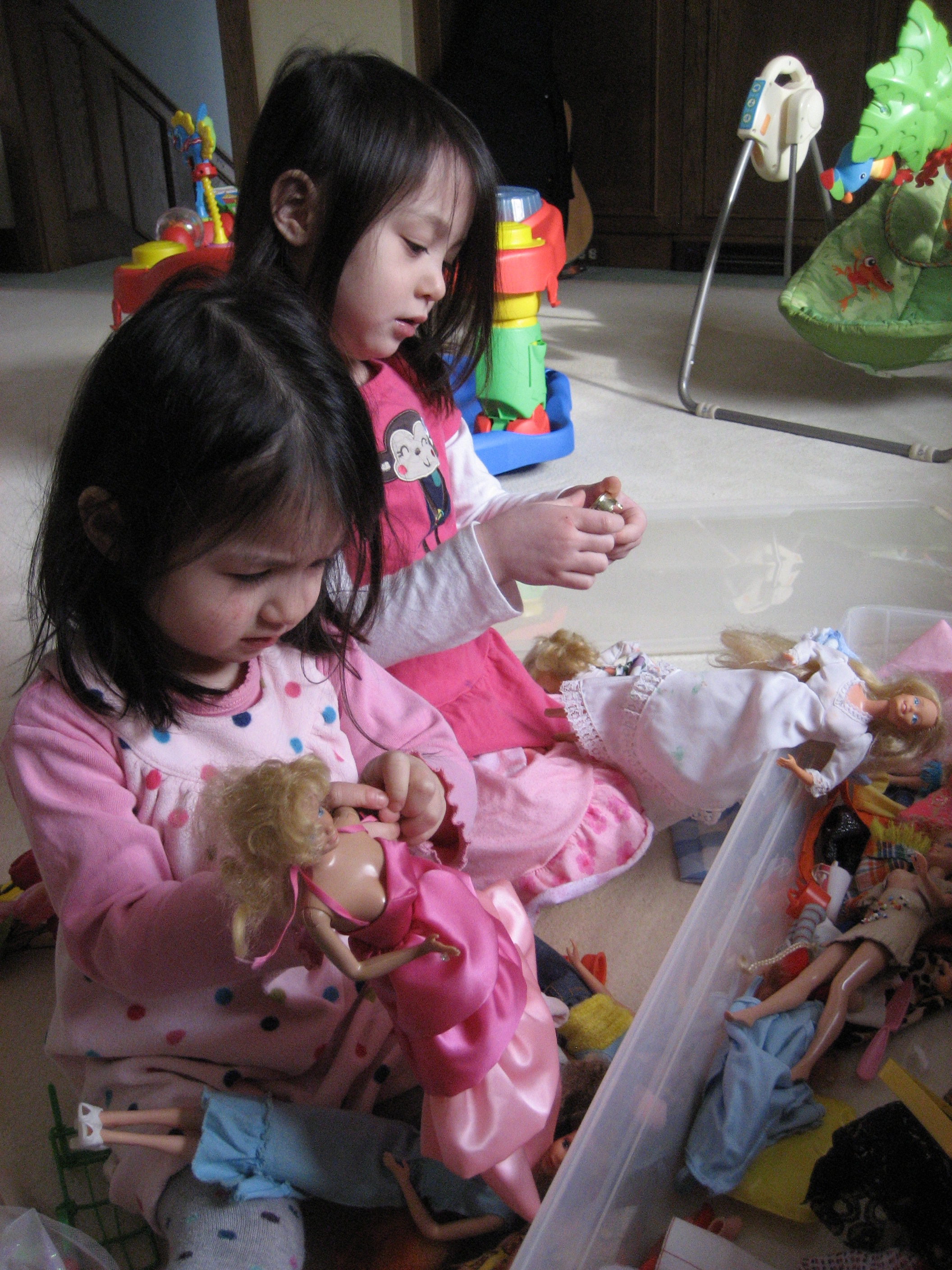
Here’s what I can control: the attitudes I model to my girls about Disney princesses and Barbies. So I don’t go overboard with enthusiasm when it comes to these toys. During Fiona’s Disney princess mania, I quietly steered her towards Pocahontas and Mulan, and she remarked, with admiration, that they were the “strongest” princesses. I have personally bought them almost nothing related to Disney princesses or Barbies; they have one tub of my old Barbies (Doesn’t recycling offset the ethical concerns?), and their grandparents supply the rest (and if parenting’s taught me anything about grace, it’s that you don’t muzzle the grandparents!). Never once have I said, “Hey, let’s play princesses/Barbies!”
But Erick and I still feel like Barbie has taken over our house.
POSTSCRIPT: Just so we’re good: I did not write this to justify myself, or, GOD FORBID, to suggest that anybody should go and do likewise. I wrote this because it’s something I’m right in the middle of, something I’m still struggling with. I wrote it to share, because I’m more and more convinced that the best thing we can do for each other as people – aside from babysitting each others’ children – is to share: that it’s hard, that it’s confusing, that we’re not the parents we expected to be, that if we hear the theme to “Barbie’s Fairy Secret” one more time we are going to LOSE IT! So please, feel free to share back. Feel free to completely disagree with me, and pass along any tips on how I can get this stuff out of the house without alienating my children forever!

















 The Pickle Patch