Navigating the Corn Maze Tradition

The holiday season for our family begins at Halloween and passes through Thanksgiving and Christmas before culminating on New Year’s Eve. During that same timespan we also celebrate three birthdays, so it feels like two-and-a-half months of continual celebration, which is both wonderful and exhausting. 

We’ve accumulated a series of traditions that anchor these holiday celebrations: things we “always do,” things we “have to do,” lest the holidays not feel properly acknowledged. On the one hand, I love having family traditions that my children will recall with nostalgia: Halloween pumpkin carving and pizza at their grandparents’ house before trick-or-treating, the annual Thanksgiving football game and play, carrying our Christmas tree home from our neighbors’ farm, cookie decorating and beeswax candle-making, our enormous 25-candle Advent wreath (one candle for each day of December) and the gigantic smoke cloud it generates when extinguished for the final time. 

But I’ll be honest: Sometimes I feel like I’m a hostage to our traditions. The things we “always have to do” dance around on my cluttered mental to-do list throughout the holidays, torturing me with whispers of parental guilt: If you can’t fit me in, you’ll be letting down your kids. This will always be remembered as the year we DIDN’T (bake cookies/see the train display/have a Thanksgiving play). After ALL they’ve missed out on during the pandemic, can you really disappoint them like this? 

And that is why, a week before Halloween, I realized that we had to find a way to shoehorn a visit to the corn maze into a busy weekend. 

Click here to continue reading this week’s “Faith in Vermont” column in The Addison Independent.

The Grace of Decorative Gourds

I tried to resist the urge to write about gardening this year. In past years I’ve always produced at least one column focused on the agony and ecstasy of my horticultural ventures, but this year it dawned on me that talking about your gardening is a little bit like talking about your health: It’s personal, and – while people will nod politely – nobody really cares.

Still, here I am, writing about my garden, because something unusual happened this fall. 

My gardening trajectory is roughly the same from year to year. Sometime around March, full of optimism, I sit down with the seed catalogue to make a plan. I start some seeds indoors, in trays placed by my bedroom windows. Planting begins in late April and lasts through June. Tiny shoots and sprouts begin to appear – a miracle every time. I tend these new plants lovingly, with water and weeding.

Things start to fall apart every July, when we spend a week in Maine. Gardening, apparently, is incompatible with summer travel: The neglect of a single week sets my garden on a path to chaos. When I return, the weeds have asserted control for the rest of the summer. Some garden plants are flourishing, producing so much that I can never keep up and they go rotten or go to seed. Other plants have given up, and never live up to their early promise. 

Click here to continue reading about our surprise invasion of decorative gourds in this week’s “Faith in Vermont” column in The Addison Independent.

Why We Are Celebrating

“Daddy, don’t forget to pick up some cupcakes at the store, okay?” 

My husband, who was heading out the door to run his usual Saturday morning errands, turned to look questioningly at our 9-year-old daughter. “What are the cupcakes for?”

“For Pip’s birthday party!”

“Wait…sorry…um…. Who is Pip?”

“You know,” she said, undaunted. “Pip is my little china dog figure.”

My poor husband: You could almost see him thinking, this is not what I signed up for, as he spluttered, “Your china dog…? NO. I’m not going to get cupcakes for a china…. Oh, okay, fine.” 

My husband wasn’t aware of It, but Pip’s birthday had been in the planning stages for nearly a week. My daughter had chosen a date, made posters to invite her sisters, and designed teeny-tiny little invitations for the other animal figures in our house. While my husband was at the store buying cupcakes, my daughters made a little “Happy Birthday” banner for Pip, blew up some balloons, and created an animal-figure-sized dance floor.

Later that afternoon, my daughters celebrated Pip the china dog’s birthday with store-bought cupcakes.

We are approaching the one-year anniversary of the moment when the COVID-19 pandemic changed our lives. This was a year none of us expected to have, nor was the experience uniform: Restrictions were added, lifted, and added again. Some suffered horrific loss, others were inconvenienced. Fear, frustration, and hope danced crazily through our emotional landscapes. 

As I look back over the past year – still at close range — it struck me that if someone in the future were to ask me how our family spent the pandemic, one of my first responses would be: “We celebrated more.”

Click here to continue reading this week’s “Faith in Vermont” column in The Addison Independent.

my 2020 LITERARY Favorites

2020 was a LOT of things, but for me it was (among other things) a year of READING.

I always read more during years when we have a new baby in the house, as we did this year. I find that frequent feedings — particularly those that happen in the wee hours — lend themselves to reading. The drastic narrowing of our lives due the COVID-19 pandemic didn’t hurt, either. I read for at least an hour each day of 2020, and usually had both a nonfiction and a fiction book going simultaneously.

Inspired by friends, I kept a list of the 43 books I read this year. Almost none of them were recent releases; the theme of my 2020 reading seems to be that I either re-read books from my past, or read classics that I’d always wanted to read but never gotten around to. It is not the most edgy or diverse list of books and authors, but I feel fairly unapologetic about that: There was enough edginess going on in my real life. These books were the literary equivalent of a cup of something warm and a freshly baked treat. My 2020 reading gave me comfort and challenged me in gentle ways to think deeply about community, family, and love. Because reading was one of the highlights of my year, I decided to share some of my favorite books with you. (NOTE: I am including links on Amazon, though I would encourage you to buy these at your local bookstores or used bookstores.)

Favorite Classic

This is a tie between the two works that bookended my year, both of which I hope to re-read in the future:

Middlemarch by George Eliot

Middlemarch was tough going for me at first: I read and re-read the first few pages while struggling to keep my eyes open during midnight baby feedings. But I stuck with it and was richly rewarded. It is an epic story of the choices we make, and their consequences. When I read the powerful final lines (while in the hospital with the baby), I sighed audibly with satisfaction and sorrow: “But the effect of her being on those around her was incalculably diffusive: for the growing good of the world is partly dependent on unhistoric acts; and that things are not so ill with you and me as they might have been is half owing to the number who lived faithfully a hidden life, and rest in unvisited tombs.” Yes.

David Copperfield by Charles Dickens

I am not a rabid Dickens fan: I found Oliver Twist to be overwrought, and when I read Great Expectations (perhaps too early) my life remained unchanged. But David Copperfield, the final book I read in 2020, was such a delightful and stirring journey through a life that I was genuinely sorry to reach the final, thousand-something page. I plan to read more Dickens in the future.

Favorite Fiction

Hannah Coulter by Wendell Berry

The sleeper hit of my year: A quiet book about an unremarkable life that becomes remarkable in its ordinary beauty.

Favorite Non-Fiction

Tightrope: Americans Reaching for Hope by Nicholas Kristof and Sheryl WuDunn

This is part memoir of Kristof’s childhood in working-class Yamhill, Oregon, and part laser-eyed examination of why so many Americans are slipping through the cracks of our society into addiction, poverty, and chronic hopelessness. I found it to be a balanced and fair look that shed light on much of what is happening in the country right now. And, while it’s not pretty, Kristof and WuDunn write with hope and make practical suggestions.

Everything Happens for a Reason, and Other Lies I’ve Loved by Kate Bowler

A young wife, mother, and rising star at Duke Divinity School (as a historian specializing in megachurches and the “prosperity gospel”), Kate Bowler was living her best life. Then she was diagnosed with Stage 4 colon cancer at age 35. Her account of that experience is painful, funny, and unforgettable. Highly recommended for those going through difficult times, or those walking alongside the difficult times of others (which is everybody) — it will change how you approach life’s hardest moments.

Favorite Biography

A Light So Lovely: The Spiritual Legacy of Madeleine L’Engle by Sarah Arthur and Charlotte Jones Voiklis

I’m not sure I can give words to how beautifully written this book is, or how it turns the traditional biographic form inside out. A gift from a friend (Thanks, Deborah!) it inspired me to embark upon a mini “L’Engle splurge” over the summer, which was well worth it.

Favorite Book About Education/Parenting

The Call of the Wild + Free: Reclaiming Wonder in Your Child’s Education by Ainsley Arment

Every summer, I indulge in what I consider “professional development reading” before we begin a new homeschool year. I’ve read a LOT of great books about education, homeschooling, and parenting, so it’s getting harder to inspire me with anything new, but The Call of the Wild + Free did just that. It’s a physically beautiful book, with gorgeous photographs and drawings, and it’s full of facts, inspiration, and practical tips for giving your children the gift of a childhood.

Favorite Series

Again, a tie:

This year, I re-read the entire Harry Potter series, as well as the entire Anne of Green Gables series. Both were the perfect pandemic reads: Harry Potter for its magical-world escapism, struggle between good and evil, and the saving power of love; Anne of Green Gables for its humor, endearing portrayal of human foibles, and depiction of our capacity for resilience under the most trying circumstances.

Favorite “New” Author

This was the year that I “discovered” Elizabeth Goudge (although she’s been dead since 1984!) I had encountered Goudge previously when I read her children’s book, The Little White Horse, to my daughters a few years ago. They adored the book, but I was lukewarm: It felt a little too fantastical, and everything tied up too neatly at the end. This year, I began reading Goudge’s grown-up fiction, and her writing takes my breath away. I began with Green Dolphin Street, which is an epic, globe-spanning story about what love really means, even when you marry the wrong person (literally the WRONG PERSON, not just “Gee, I wish I hadn’t married him/her!”) I’m now nearly through The Scent of Water, in which Goudge somehow manages to embed very tough topics (mental illness, marital strife, disappointing children, death, and disability, among others) into a charming novel about an English country village. Nothing is tied up too neatly; her books make me marvel at both the beauty and pain that co-exist in life. Next up for me is Pilgrim’s Inn.

Favorite Children’s Books

We read together a LOT as a family; I can usually be found reading aloud to all of our children on school mornings, every night before bed, and at moments in between. Our wonderful children’s librarian, Ms. Tricia (HI TRICIA!) categorizes children’s literature as either “mirrors” (books that reflect your experience back to yourself) or “windows” (books through which you can get a taste of a different experience/person.) I’ve decided to list one of each type of book here.

Favorite “Mirror” Book: The Vanderbeekers Lost and Found by Karina Yan Glaser

This is the fourth and latest book in the Vanderbeeker series, and you should read them all. The books center around a bi-racial family with five children (mirror!) that lives in Harlem (okay, that’s a bit of a window for us.) The Vanderbeekers face real-world challenges but — sometimes through misguided efforts — manage to bring light and love to everyone around them.

Favorite “Window” Book: A Long Walk to Water by Linda Sue Park

I read this to the girls as part of our history unit on Africa, and it made a huge impact on all of us. Park interweaves the stories of two 11-year-olds from Sudan: Nya, who in 2011 spends most of her time fetching water for her family, and Salva, one of the “lost boys” who becomes a refugee when the civil war separates him from his family in 1985. Not light material, but Park presents the stories with beautiful sensitivity. It opened up some wonderful conversations in our family and even inspired my daughters to try carrying water up to our house from a nearby stream (hilariously hard!) An excellent companion read is the graphic novel, When Stars Are Scattered.

Nobody knows what 2021 will bring, but I do know that it will find me reading more books! I wish you all many wonderful books in the new year.

On Giving Up Coffee

I fell in love with coffee slowly. I wasn’t until midway through college, when a friend took it upon herself to introduce me to coffee in the form of a sugary sweet hazelnut latte, that I became interested in the beverage at all. I continued to guzzle hazelnut lattes (which I now consider “adulterated coffee”) at Starbucks franchises during my post-college years, working my way up to the “venti” size (which I believe is Italian for “the approximate volume of a bucket.”) Over time my coffee drinks included less sweetener and milk, so that when my family was living in California’s Bay Area – the epicenter of coffee snobbery – I was a coffee purist. 

For over a decade, I drank my coffee black, preferably from freshly ground beans. Although the caffeine kick was helpful as our household filled with young children, I drank coffee for love. Quality was more important to me than quantity: My habit was to drink two cups of coffee per day, one in the morning and one in the afternoon. I loved the taste of coffee, loved cradling the warm mug in my hands and inhaling its aroma, loved anticipating my second cup during those endless afternoons of early motherhood.

Which made it acutely painful when I had to give up coffee. 

Click here to continue reading the final “Faith in Vermont” of 2020 in The Addison Independent.

The Annunciation by way of Abbey Road

When I was young, I listened to The Beatles. I believe this began after Ms. Dutton, my long-haired, swishy-skirted, dulcimer-playing elementary school music teacher, taught my class to sing “Penny Lane.” (If memory serves, she also taught us “Eleanor Rigby,” which seems like a bizarre choice for a group of 10-year-olds but may explain why for years I couldn’t see anyone eating alone in a restaurant without bursting into tears. All the lonely people.)

In any event, when I told my parents that I liked this British pop group from their own youth, they encouraged my interest. We had a record player (which was retro even back then – we did have cassette tapes, and some CDs.) I spent my junior high and high school years sitting at our kitchen table doing my homework while The Complete Beatles or Sgt. Pepper’s Lonely Hearts Club Band spun on the turntable. In this I was an outlier among my peers, most of whom were listening to late 80s and early 90s pop music: Whitney Houston, Mariah Carey, Bryan Adams. I think I got the better end of the bargain. 

A Beatles song that never failed to inspire me was “Let It Be.” For an overly anxious teenager who believed perfection was the end goal, the song’s reassuring message seemed to be: Just relax; everything will be okay.

Over time, though, I soured a bit on “Let It Be.” The more life experiences I accumulated, the song’s message sounded less inspiring and closer to a potentially dangerous apathy. Even worse was that this seemed to be couched in quasi-religious terms: I assumed that “Mother Mary” was meant to be Mary, Mother of Jesus, crooning soothingly that, “There will be an answer…. Let it be.”

As I understand my Christian faith, we’re not supposed to fret about everyday issues like food and clothes (Matthew 6:34: “Do not worry about tomorrow, for tomorrow will worry about itself.”) We’re not supposed to be ruled by fear; “Do not be afraid” is one of the most repeated statements in the Bible. On the other hand, we’re definitely not encouraged to take a kicked-back, chilled-out, hands-off attitude to life’s problems. A short list of areas which we are not supposed to just “let be” includes: loving our neighbors, loving our enemies, raising children, caring for widows and orphans and immigrants, visiting prisoners, studying scripture, praying, trying to follow Jesus’s example. 

Speaking of Jesus, this Christmas holiday that we’re approaching celebrates how God put on human flesh (the literal meaning of “incarnate”) and entered our planet as a baby in order to begin a huge salvation plan that’s still ongoing. In three decades on Earth, Jesus taught crowds, healed the sick, fed the hungry, scolded the self-righteous, and even flipped some tables in the temple. The God I follow does not “let it be.”

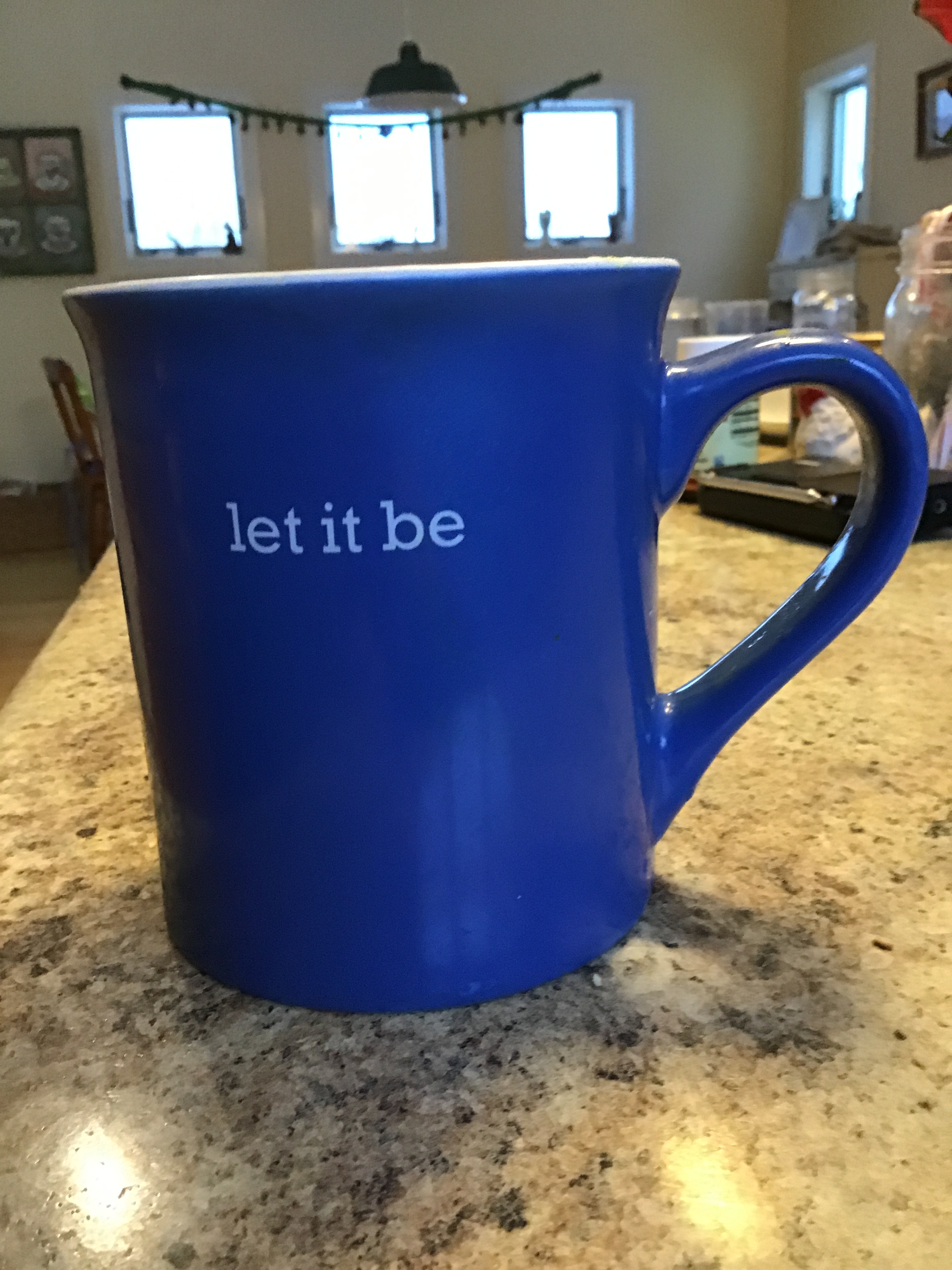
So, although I often drink my tea and coffee from an oversized mug printed with “Let It Be” (an impulse buy from the T.J. Maxx checkout line years ago), I feel a little guilty about it. This mug, I think, does not adequately express my ideology. I’m tempted to add an asterisk with “some exceptions apply.”

But this year, I gained a new outlook on “Let It Be.”

This Advent season, I’m working my way through a new-to-me devotional: the excellent God With Us, edited by Greg Pennoyer and Gregory White. In his reflection for the first Thursday of Advent, Richard John Neuhaus writes: 

To be anxious is to be human. The question is what we do with our anxieties. The decision is between hanging on to them or handing them over. After listening to the angel, Mary handed over herself, including her anxieties. ‘Behold, I am the handmaid of the Lord; let it be to me according to your word.’ That is Mary’s great fiat – ‘Let it be.’ It is not fatalism, but faith. Fatalism is resigning ourselves to the inevitable; faith is entrusting ourselves to the One who is eternally trustworthy[.] (Bold print mine.)

I let out an audible gasp after reading that paragraph. In all the times I’d read Luke 1:38 – Mary’s response to the angel’s announcement that she’s going to become Jesus’s mother – somehow I had never noticed that she actually utters the words: “Let it be.”

But as Neuhaus points out, Mary’s “Let it be” is hardly passive. Like so much else in the Bible, it’s an almost paradoxical both/and statement: Mary is submissive, but it’s an active submission. She’s agreeing to become pregnant with, give birth to, and parent God’s son, none of which is passive (as any mother will tell you.) And, as an unwed mother in 1st century Palestine, Mary’s agreement includes the real possibility of death by stoning. When Mary says, “Let it be,” what she’s really saying is, “I’m not sure I understand this crazy, scary plan, but I’m all in: Use me.”

Suddenly, my view of The Beatles’ song — and my coffee mug – was transformed. 

“The Beatles are brilliant!” I thought (stating the obvious, but with new zeal.) “Amazing! They worked a Biblical reference into a pop song that everyone thinks is a call for Zenlike detachment but is really an anthem for active participation in plans that are bigger than us! From now on, I will drink from my mug with pride!”

I figured that I surely wasn’t the only one to discern the layers of meaning behind “Let It Be,” so I decided to confirm my theory with a little internet research. 

And it turned out that I was wrong.

In interview after interview, Paul McCartney, who wrote “Let It Be,” recounts the story behind the song: At a time when he was troubled by many things (and doing too many drugs), he had a dream in which his mother, who’d died when he was an adolescent – and whose name was Mary – stood before him and said, “Let it be.”

So, my deep theological insight was deflated shortly after its revelation. 

Except that Paul McCartney has also been quick to add that, although “Let It Be” was inspired by his dream about his mother, he wants people to feel free to interpret it however they want. That seems wise to me; the longer I’m alive, the more the world appears to be made of layers of meaning. Things are not always as they seem, or as they are intended. 

A pop song may have spiritual undertones that were never meant to be there.

That life event that seems like a terrifying mistake may really be one small part of a massively awesome plan. 

A pregnant teenager may turn out to be among the most brave and holy people in history.

A light shines in the darkness, and depending upon your Bible translation, the darkness either can’t understand it or can’t overcome it — which may mean the same thing after all. 

And a baby born in a barn may grow up to save the world. 

An invitation to mourn…and hope

On Monday, November 25, 1963, all federal agencies and departments in the United States were closed. For four days, all of the commercial television networks suspended their regular programming for the first time in television history. Many schools, offices, stores, entertainment venues, and factories closed down, and those that remained open held a minute of silence. The reason? Our entire country was observing a national day of mourning proclaimed by President Johnson, following the assassination of President John F. Kennedy.

In the United States, official days of mourning are proclaimed by a sitting president in order to allow the country to grieve deaths caused by tragedy, or the deaths of former presidents. Since 1963, there have been six days of mourning for deceased presidents, although none has equaled the scale of President Kennedy’s tribute; typically, presidents are honored by flying flags at half-mast and closing federal offices. Since Kennedy’s killing, only five national days of mourning have commemorated something other than a presidential death: the assassination of Dr. Martin Luther King, Jr. (1968), the shootdown of Korean Air Lines Flight 007 (1983), the USS Stark incident (1987), the Oklahoma City bombing (1995), and the September 11 attacks (in 2001, although technically this was a “National Day of Prayer and Remembrance,” which has continued annually.) The total deaths across those five events: 3,471.

National days of mourning are not unique to the United States; almost every other country in the world holds them for similar reasons, and they may last multiple days or even months. To mourn is to express deep sorrow over a loss; when nations experience the collective loss of a leader, or of multiple lives due to a tragedy, it seems fitting – necessary, even – to set aside a time to weep. 

Which is why I hope that, at some point, we will have a national day of mourning to allow ourselves to grieve for those who have died from the Covid-19 pandemic in the United States – a number that, as I write this, stands at nearly 300,000 people. (To put this number in perspective, it’s roughly equivalent to losing every single person in the entire city of Greensboro, North Carolina– or Pittsburg, or St. Louis.)

Click here to continue reading this week’s “Faith in Vermont” column in The Addison Independent.

Letter from Maine: Fog and Face Masks

IMG_20200711_133943

Much to my surprise, I am writing this column from the front porch of our rental house in Ogunquit, Maine. It is the tenth summer that I have spent a week at this beach with my husband, our growing brood of children, and my parents. This year, as the COVID-19 pandemic shut down and cancelled everything else in our lives, I assumed that we wouldn’t be able to make our annual pilgrimage to the shore. But then, at the eleventh hour, COVID-19 cases in Maine and Vermont dropped low enough that both states declared reciprocal travel was allowed, with no quarantine necessary. So, here we are.

Click here to continue reading this week’s “Faith in Vermont” column in The Addison Independent. 

God on a Respirator: A Reflection for Good Friday

7216086536_ede2e5eabb_b

I began writing a reflection for Lent back in early March. Then the world got turned inside-out as the COVID-19 pandemic spread around the globe, filling intensive care units, distancing us from each other by six feet or more, wiping our calendars clean, and confining us to screens within our homes.

When I went back to take a look at my pre-COVID-19 reflection, I found that I could no longer relate to what I’d written; my words belonged to a former life.

I am going to begin with two assumptions:

1) That Jesus Christ is “God the Son,” and

2) That what we are commemorating during Good Friday and Easter is Jesus’s death by crucifixion, followed by his resurrection from the dead three days later.

I recognize that not all of my readers will share those assumptions, but I am not going to spend time arguing them here. (If you’re interested in excellent, logical arguments in this arena, I’d refer you to C.S. Lewis’s Mere Christianity, and Rebecca McLaughlin’s Confronting Christianity: 12 Hard Questions for the World’s Largest Religion.)

So.

COVID-19 is a virus that attacks the lungs. It destroys lung cells as it starts to replicate, which triggers the immune system to step in. But the immune response may also destroy lung tissue and cause inflammation, which can lead to pneumonia. As the air sacs in the lungs become inflamed and fill with fluid, it becomes more difficult for the lungs to get oxygen into the bloodstream. People who die from COVID-19 are usually dying from multiple organ failure and septic shock due to lack of oxygen.

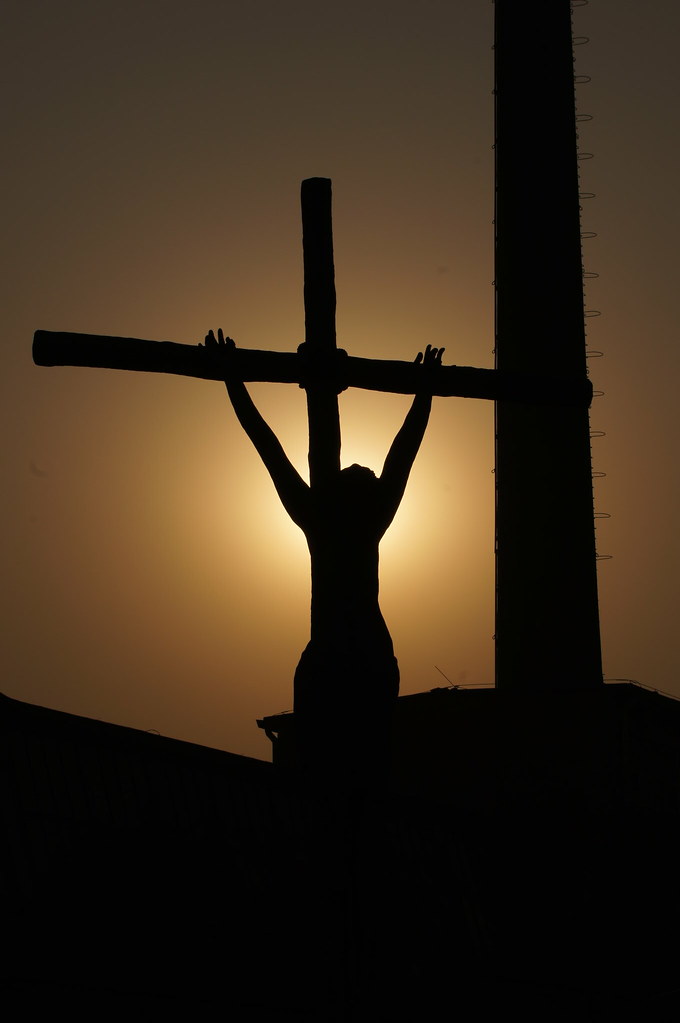
Crucifixion, which was developed by the Persians around 300-400 BC, was perfected by the Romans and used as a punishment for the worst offenders. It’s death by slow torture: Hands and feet were nailed or tied to a cross, and as the arms and legs gave way over time the victim would bear his entire weight on his chest. This put the victim into a state of perpetual inhalation; death resulted from suffocation or organ failure due to the resultant lack of oxygen.

In other words: Both COVID-19 and crucifixion involve death by asphyxiation.

I have been reflecting upon this over the past week. What it means, if you accept my opening assumptions, is this:

God has experienced firsthand what it feels like to die from COVID-19. 

God has felt the crush of chest pressure, God has gasped for breath, God’s oxygen saturation has plummeted, God’s heart has raced and then stopped all together.

I’m just going to leave it at that. I’m not going to interpret it or tell you how it should make you feel.

You may find it comforting that God in human form underwent the worst that the world can throw at us, and therefore understands what we are experiencing right now.

You may find hope that, in rising from the dead, God demonstrated that death does not have the final say and promises an ultimate resurrection of all things.

You may feel infuriated. “I don’t want your sympathy, God,” you may be thinking. “If you know how bad things are here, why don’t you FIX them already?”

All of those seem like valid responses, good places to start. Let’s approach Good Friday with whatever we’re feeling, be it awe or anger, and let God take it from there. The most important thing, it seems to me, is that we feel something.

How to Thrive

1600px-seed_germination

I have never been a big New Year’s person. As an introvert, I’d rather be curled up at home in pajamas with a book than at a late-night party. The transition from one calendar year to the next doesn’t excite me much, and resolutions have always struck me as futile attempts to delude ourselves that a new year will bring automatic personal renewal.

But this year, as 2019 becomes 2020, I’m doing something I’ve never done before: I’m choosing a word to focus on for the new year. The word is THRIVE.

My word for the new year is a rebellion against the diagnosis handed down to our infant son, but it’s also a resolution for our entire family.

Click here to continue reading this week’s “Faith in Vermont” column in The Addison Independent.