The Mystery Behind the Winchester Mystery House

Our family recently enjoyed an epic trip to California – a trip that lasted two weeks and spanned 6,500 miles as we traveled from Vermont to Montreal, Canada, flew to San Francisco, drove to Los Angeles, and returned to Vermont again by way of Montreal. We slept in five different locations and reconnected with numerous dear friends and family members. 

The three days that we spent in the San Francisco Bay Area marked our first return to the region since 2016. The Bay Area is where my husband, Erick, grew up and lived until his college graduation; we’d lived there for half of our first decade of marriage and it’s where our first three children were born. We barely scratched the surface of our family history during this visit, but we did take our children to the Winchester Mystery House. 

Erick and I had visited the Winchester Mystery House once, before we had children. It was shortly after we’d moved to Berkeley, something to do on a free Saturday when we were still exploring the new landscape we now inhabited. Come to think of it, we probably even slept late and then read the newspaper over brunch; we may even have watched an entire movie the night before! 

The details of that first visit were fuzzy in my mind, but I still remembered the bizarre story behind the Winchester Mystery House. Here is the story as I relayed it to my children: 

Sarah Winchester, who had married into the family that owned the Winchester Repeating Arms Company, moved to San Jose, California in the 1880s after the deaths of her husband and infant daughter. She was consumed with guilt over the people who’d been killed by Winchester rifles, and was told by a medium that she had to continually build a house for their ghosts; if construction ever stopped, she would have bad luck – or die (or perhaps both.) So, she bought an old farmhouse and began a 38-year construction project that ballooned the house to 500 rooms, complete with bizarre features like doors to nowhere, curving staircases with tiny steps, trapdoors, and walled-off windows. The building was, of course, never finished. 

Click here to continue reading this week’s “Faith in Vermont” column in The Addison Independent.

Beautiful Things: The Eclipse

Since this is a semimonthly column, I’m in the awkward position of writing about the total solar eclipse two weeks after it happened. This may be far too late, given the pace at which we’re accustomed to receiving our news these days. On the other hand, given the quantity of news we’re accustomed to receiving these days, it may be excellent timing: It comes after the glut of eclipse images, stories, and reflections have faded. (Although, if you’re anything like our family, you still have eclipse glasses lurking in corners of your house and some eclipse cookies going stale on top of the refrigerator.)

Remember the total solar eclipse on April 8? How could I not make that event the final installment of my miniseries on the beautiful things of Addison County? 

The eclipse took me by surprise on many fronts. It was a highly anticipated event that I didn’t anticipate, a big deal that I ignored – but it became a big deal despite my inattentiveness. I was vaguely aware of its approach about six months in advance, when some friends who live in Brooklyn told us that they were traveling to Texas in order to place themselves in the path of totality. That seemed like a lot of effort. 

When my 13-year-old daughter, who gets wild-eyed with excitement about things like meteor showers and eclipses, started enthusing about the impending eclipse, I responded with caution: I honestly had no idea when, where, or at what time this eclipse might be happening. I didn’t want her to get her hopes up and be disappointed. I nodded and murmured some vaguely interested words. Did I do any research on the subject? I did not.

And so it was that I failed to realize what hundreds of thousands of people had apparently realized years earlier: That our section of Vermont would lie right in the path of totality on the afternoon of April 8. 

Click here to continue reading this week’s “Faith in Vermont” column in The Addison Independent.

Looking for the Light

At the close of my last column, in September 2023, I announced that I’d be taking a brief sabbatical and expressed my hope that I’d return to writing early in 2024. Well, here I am!

In that column, I explained my need for a fall sabbatical: Of our five children, three were entering new schools.  We’d have one child up in Burlington (one hour to the north), two in Ripton (30 minutes to the southeast), one in preschool (a blessed 10 minutes away), and one child still being homeschooled. There were assorted fall sports, music lessons, and a driver’s ed class. We’d gained a puppy over the summer. And my husband was returning to teaching after a year’s sabbatical.

Those are just the facts. 

Here is what the facts don’t tell you:

The facts don’t tell you that, between 2016 and 2019, I homeschooled all my children. One of them told me that they consider those years “The Golden Days” – and they were. We read wonderful literature, wrote, and learned together in the mornings. The afternoons stretched long; I remember them as seen through the window above our kitchen sink: my four oldest children dressed in various costumes, romping in the amber light with the boy next door or assorted friends – there was always a spare child or two around in those days. 

The facts don’t tell you what our particular experience of COVID was like, with a baby still recovering from a stint in the ICU for respiratory distress, and isolation from our beloved friends and homeschool community. How our eldest child turned 13 alone in her bedroom, celebrating with the faces of friends arrayed on a laptop screen, and how she spent much of the next year behind her closed door. 

Click here to continue reading this week’s “Faith in Vermont” column in The Addison Independent.

A Mother’s Day Reflection on “The Giving Tree”

“You know that book, The Giving Tree?” my daughter asked the other day. We were on our way home from her two-day class camping trip  – a 9th grade tradition at her school. 

“Yes….” I replied, warily. I do know The Giving Tree, Shel Silverstein’s bestselling 1964 picture book about a boy and the tree who loves him. We’d been given the book early on in our life as a young family, but I’d gradually become so disturbed at the type of relationship The Giving Tree modeled for my children that I’d expelled it from our bookshelves. 

“Lil read it to us on the trip,” my daughter continued, “and I was crying so hard. It’s so sad; it’s like a metaphor for everything.” 

“What touched you most about the book?” I asked.

“Well, at the end, the boy and the tree both have nothing left to give, but they’re just together….”

“That’s true,” I acknowledged. “What do you think that’s a metaphor for?”

“A lot of things. Parenthood.”

Parenthood?!?” I yelped. “Do you plan to strip me of everything and then sit on my dead body?” 

“Well you wrote once about how you should die slowly for the people you love!” she countered. 

Not for the first time, I had mixed feelings about intelligent children who read my columns.

Click here to continue reading this week’s “Faith in Vermont” column in The Addison Independent.

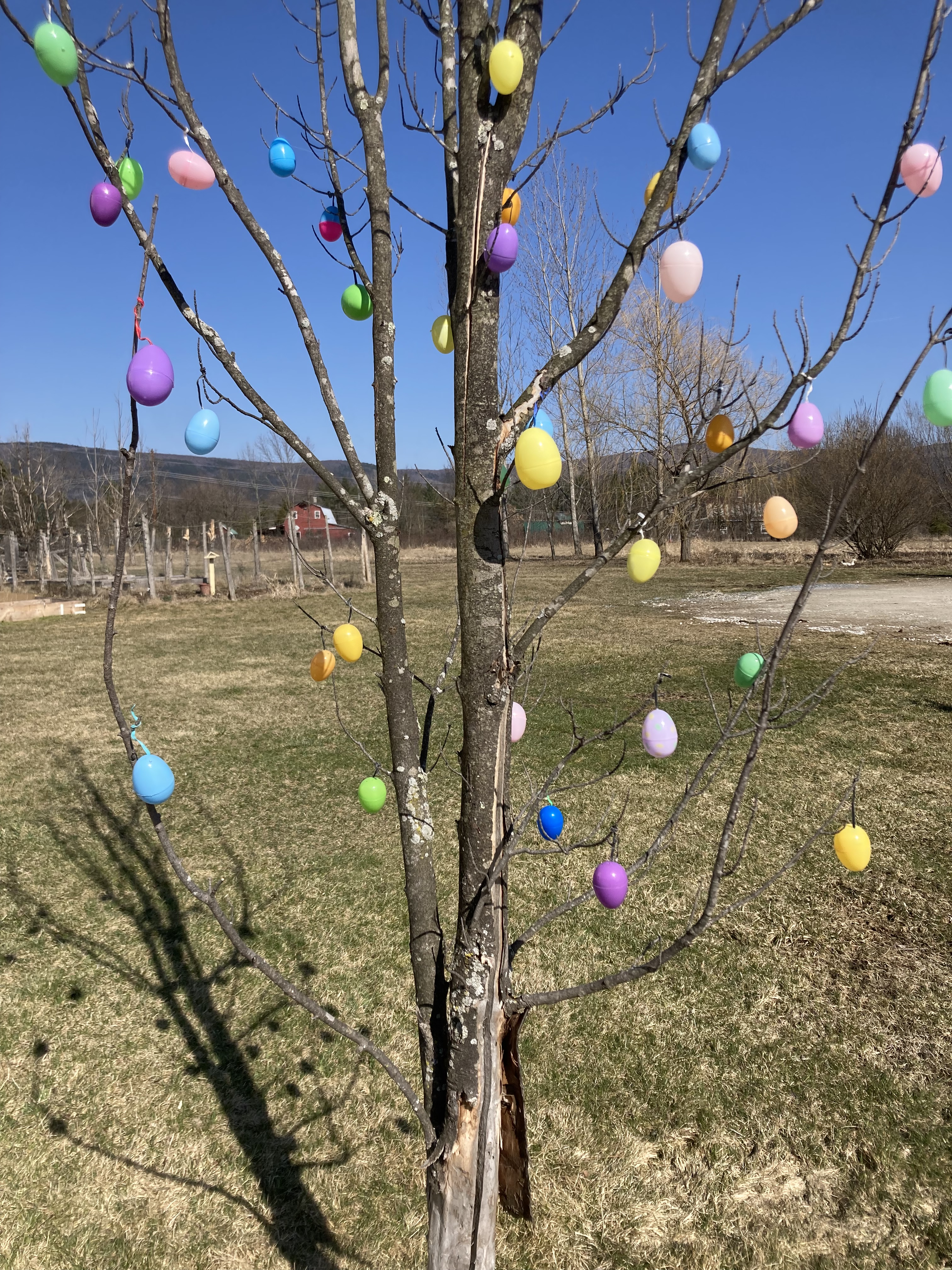
On Dyeing Eggs…Again

Having now parented five children over the course of 15 years (and counting), I can attest that parenting is seldom repetitive. Each child is different, every stage and season brings new challenges (or, as parenting blogs often frame them, “exciting new opportunities for growth!”) Even predictable developmental milestones seem novel, because I honestly can’t remember when my older children hit those same milestones. (This is embarrassingly clear when our fifth child has pediatric appointments and the doctors ask, “When did his big sisters start walking/talking/eating solids?” I hem and haw over vague time ranges, all the while thinking, Do I LOOK like I have time to keep track of all that?!?)

But there is one area in which repetition is apparently required: holiday celebrations.

When I was a younger, more energetic mother, I had an idealistic vision of creating our own particular family traditions around holidays. We would do special things year after year that would define our family culture! These things would channel our creativity! They would bring us closer as a family! They would be the very things our children would remember nostalgically when they were grown!

Click here to continue reading this week’s “Faith in Vermont” column in The Addison Independent.

Reflections on the New Year’s Fireworks

For a moment, it looks as if the weather might reshape another holiday celebration.

Like many others across the United States, our family’s Christmas was altered by the collision of a bomb cyclone and polar vortex, which brought gale-force winds and frigid temperatures to our corner of the world and knocked out our power for nearly two days. Thankfully, my parents, who live across town, never lost power. As the sun set on our cold, dark house on Christmas Eve, we packed up all our children, food, and gifts and unleashed Christmas on the grandparents. Sadly, our church never regained power in time for either the Christmas Eve or Christmas Day services; my children felt this loss more keenly than I expected, but we all adjusted. God knows we’ve all gotten used to adjusting since this decade began. 

So when it begins raining as dark falls on New Year’s Eve and my already-exhausted children seem increasingly unenthusiastic about carrying on our tradition of attending Middlebury’s annual fireworks display, I prepare to adjust our plans yet again. 

As it turns out, the rain slows to a manageable drizzle and we’re able to muster enough momentum to load everyone into the minivan and be driven very slowly by our 15-year-old (who just got her learner’s permit) to the elementary school. 

This is where the peculiar magic of small-town fireworks begins. 

Click here to continue reading this week’s “Faith in Vermont” column in The Addison Independent.

Favorite Books of 2022

This year I’m continuing my annual tradition of taking stock of the books I’ve read over the past year and sharing my favorites.

2022 was an interesting year for me — in many ways, but certainly in terms of reading. This past year I read far fewer books than I had in recent years. Part of this can be attributed to life opening up again after the pandemic lockdowns of 2020-21; I was out and about more, as opposed to sitting at home with my books. This was also a year when my daily schedule shifted at the expense of my reading time: I used to read for about an hour after all the kids were in bed, but now with teenagers who stay up late doing homework and who don’t seem to want to spill their innermost feelings unless it’s after 10 PM, I no longer have as much quiet, kid-free time to read. Finally, this fall I began reading Jonathan Strange and Mr. Norrell, Susanna Clarke’s sweeping novel about two magicians in 19th century England. It’s an amazing work of detailed world-creation, but it’s also 1000 pages long. I have yet to finish it (or it might be on this list), and it’s monopolized one-quarter of my reading year!

So, that’s why I have fewer books to recommend this year, but every book on this list is a gem.

Favorite Fiction

To Kill a Mockingbird by Harper Lee

This was the very first book I read in 2022. The last time I read it was in middle school; now that my two middle schoolers were reading it, I decided to re-read it. It was even better than I remembered. If, like me, you haven’t read To Kill a Mockingbird since your own school days, it certainly deserves a re-read. When I was thirteen, I most closely identified with the narrator, Scout; this time around, I found that I related more to her father, the amazing Atticus Finch, who has become one of my parenting heroes.

Sea of Tranquility by Emily St. John Mandel

If you have seen me at all this year, I have probably recommended this book to you — effusively. I even wrote a column about some of its themes. I have since read every other book Emily St. John Mandel has written, and while I like them all, this one remains my definite favorite. It’s a beautifully crafted story that weaves through time and space (literally), but is at its heart a story about love, the beauty of daily life, and our interconnectedness. Please do yourself a favor and read it.

Peace Like a River by Leif Enger

Like To Kill a Mockingbird, this book is told from the viewpoint of a child and features an incredible father. Set primarily in the bleak winter landscape of the northern Midwest, it follows the Land family as they search for their outlaw older brother. The glue that holds the family — and the narrative — together is a father’s fierce love, and it may just convince you that miracles are possible.

Favorite Non-Fiction

These Precious Days by Ann Patchett

I have never disliked anything Ann Patchett has written, but this collection of essays is my new favorite. I read the title essay during the dog days of COVID, when it first appeared in Harper’s, and it’s a breathtaking — and heartbreaking — story of how circumstances bring us into each other’s lives. But all the essays in this book are excellent, circling themes of family, friendship, love, loss, and literature.

The Color of Water: A Black Man’s Tribute to His White Mother by James McBride

This was another re-read for me; I first read McBride’s memoir of his remarkable mother a couple decades ago, but decided to revisit it after reading his novel, Deacon King Kong, last year. The Color of Water tells the story of Ruth McBride Jordan, social worker, church founder, daughter of an abusive Orthodox rabbi, twice-widowed mother of twelve black children — a resilient warrior of a woman. Looking back over many of my favorite books from this year, it’s clear that I was seeking examples of excellent parents; Ruth certainly belongs in the line-up.

Favorite Book on Christian/Spiritual Topics

Aggressively Happy: A Realist’s Guide to Believing in the Goodness of Life by Joy Marie Clarkson

I feel like I need to apologize for this book’s title whenever I recommend it. “It’s really NOT annoyingly positive,” I say. “It’s about how to find joy without denying how difficult things are.” Clarkson is still a young woman — an excellent writer with a clear-eyed gaze at life. I read the entire introduction to my family over dinner one night, then passed the book on to my eldest daughter because I wish I’d read it much earlier in life.

Favorite Children’s Books

The Tale of Despereaux by Kate DiCamillo

I consider Kate DiCamillo a literary giant, and believe that her books should be read by everyone of all ages — but The Tale of Despereaux sat unread on our shelf for years because my children assumed they’d outgrown books with rodent protagonists. We were all pleasantly surprised when we finally read it this December. As with all DiCamillo books, it is beautiful, funny, true, and moving, with a particularly poignant focus on forgiveness.

A Wish in the Dark by Christina Soontornvat

The best explanation I’ve read of this book is that it’s Les Miserables set in a Thai-inspired fantasy world. It prompted some excellent discussions in our family around issues of justice and right vs. wrong.

Favorite Poetry Books

Devotions: The Selected Poems of Mary Oliver

Poetry has come to have an increasingly large part in our family’s life, and we are always able to find something breathtaking in this extensive collection of Mary Oliver’s poetry.

Everything Comes Next: Collected and New Poems by Naomi Shihab Nye

My 11-year-old poet picked up this book of Naomi Shihab Nye’s poems for young readers on a Barnes & Noble trip, and she hasn’t put it down since. (Her favorite is “Window.”)

BONUS: Favorite Show Based on a Book!

Is anybody else out there watching The Mysterious Benedict Society on Disney+? We read the book series by Trenton Lee Stewart, but the series — now in its second season — may actually be better than the books, thanks to clever writing, an outstanding ensemble of young actors, and the brilliant Tony Hale as Nicholas Benedict. One of the very few shows that every single member of our family looks forward to watching.

Wishing you a wonderful year of reading in 2023. I’ll be joining you — as soon as I finish Jonathan Strange and Mr. Norrell!

Throwback Thursday: A Still Small Christmas

baby-jesus-sleeping

As we head into Christmas, I am always thrown back to Christmas 2019-2020, which was one of the most difficult Christmas seasons our family ever experienced. It was also one of the most real and meaningful. 

I know that many of you are walking through difficult seasons now. In fact, this year there have been two deaths in my own immediate family over the past two weeks: my grandmother and my aunt. So often in life, our mourning and our rejoicing are commingled. 

So I’m reposting this piece, which I wrote next to my infant son’s hospital bed, to remind us all that hard things are not inconsistent with Christmas; that our holidays don’t have to big big and shiny and perfect, but can sometimes look like still, small moments of awareness.

***

I hesitate to assume that there’s such a thing as a “typical” Christmas, but if it exists then I feel quite confident in stating that this has been a very atypical Christmas for our family.

As some of you may know, I have spent the past five days in the pediatric inpatient ward of the University of Vermont Medical Center with our 7-week-old son. This was completely unexpected and sudden. Our entire family – including all four daughters – had driven happily up to Burlington for some scheduled testing for the baby. We’d planned to have lunch and look at holiday decorations after what we assumed would be an hour-long appointment. But, to quote Joan Didion, “Life changes in the instant. The ordinary instant.” And in that instant, we were being told that the doctor was concerned about our baby’s growth trajectory and wanted to admit him to the hospital for “failure to thrive.”

So, without any preparation or planning, without a toothbrush for me or extra clothes for the baby, and with a long list of pre-Christmas plans and to-dos that was going to require sudden and extreme revision, I found myself ushered into a pediatric hospital room. I found myself discussing who-takes-the-girls-where-and-when logistics with my husband (whose birthday was the following day.) I found myself groping through my own dashed expectations as I tried to explain to four teary girls what I knew of the immediate plan, and how little idea I had of anything beyond the next couple of hours.

This is not a medical drama, so I will very quickly set your mind at rest about our son: He is fine. He was tiny at birth and has always been a robust spitter-upper. His pediatrician has been monitoring his weight since birth, and everyone was pleased with his steady gains until his spitting up increased dramatically after a routine outpatient hernia repair surgery. His weight gain never stopped or reversed, but it slowed. After a couple of days of testing at the hospital to rule out Big Scary Things, he was diagnosed with severe reflux, which we will manage at home until he outgrows it eventually.

But I didn’t know the end of the story as I sat in our hospital room that first night, trying in vain to sleep in a pull-out chair while my freaked-out baby fussed beside me and nurses came and went all night long. The next days would be the darkest of the year; this made a certain narrative sense to me. What I couldn’t quite manage was to find the sense in our situation – I couldn’t figure out where God was in the whole thing.

Even though you know better, it’s so easy to fall into thinking that life should reward the good and punish the bad. We are adopting our son, not to earn brownie points with any person or deity, but because we love children (this one in particular; he’s our son) and we wanted to provide a good home for a child who needed one. Since his birth, our sweet boy has not had an easy road: Each of his seven weeks of life has brought some new health wrinkle – none deeply serious, all treatable, but most of them involving a degree of disruption and discomfort for him and for the rest of our family. All of this is outweighed by the extravagant amount of love the little guy has brought into our lives. Still, the temptation every time we hit the next hurdle is to say, “Really, God? This kiddo has been through so much; can’t he just get a break? We’ve all been through so much; would it have killed you to make this just a little less hard?”

On that first night in the hospital, I looked out the window at a narrow strip of dark winter sky barely visible between the buildings opposite our room, and my heart screamed, “Where ARE you, God?”

A passage of the Bible that I’ve always loved for the beauty of its language is 1 Kings 19:11-12. The backstory is that the prophet Elijah has been doing everything right, risking his life by warning the Israelites and the corrupt King Ahab and Queen Jezebel to turn back to God. In response, Ahab and Jezebel kill all the other prophets and threaten to do the same to Elijah. Elijah escapes into the wilderness, where he is on the run for forty days and nights until he reaches a cave on Mt. Horeb.

11 Then He [God] said, “Go out, and stand on the mountain before the Lord.” And behold, the Lord passed by, and a great and strong wind tore into the mountains and broke the rocks in pieces before the Lord, but the Lord was not in the wind; and after the wind an earthquake, but the Lord was not in the earthquake; 12 and after the earthquake a fire, but the Lord was not in the fire; and after the fire a still small voice. [New King James Version]

When Elijah hears that still small voice, he knows it’s God, and God gives Elijah instructions about what to do next.

It took me three days in the hospital to realize that the answer to my cry, “Where ARE you, God?” was: Right here. It took that long because God’s voice didn’t boom down from heaven, there were no chariots of fire, comets, flashy miracles, or apparitions. But there was a still small voice – a series of them, in fact.

God was not in the wind, the earthquake, or the fire:

God was in the nurse who, while tenderly giving my son a bath, told me how she’d switched from geriatrics to pediatrics seven years earlier, when she learned she couldn’t have children.

God was in the young man from Patient Transport who, while wheeling my son down to a swallow study, told me how he drives his mother an hour to her haircut appointments in our town. (“She used to go with my grandma, but after my grandma died, I started taking her.”)

God was in the doctor from radiology who, observing me walk the halls for an hour as the barium solution moved through my son’s digestive tract, ushered me into the staff break room. “There’s a nice, big window,” he explained.

God was in the gentle hands and kind words of the countless doctors, nurses, and staff throughout our stay who counseled us and brought bottles, warm blankets, white noise machines, and mobiles to make my son more comfortable.

God was in the faces of the hospital patients – the really ill ones who passed us on gurneys in radiation, the other children on the pediatric floor – and their caregivers.

God was in my parents, who took our daughters at no notice and provided them with love, security, and fun.

God was in my husband, who couldn’t have cared less that his birthday had been overshadowed, and who drove an hour up to and back from the hospital numerous times to bring me clothes, toiletries, and Chipotle dinners.

God was in my daughters, whose primary concern was never their own plans, but the fact that they were separated from their baby brother.

God was in the stunning sunrise in the strip of sky between buildings on the morning of the darkest day of the year – a reminder that there is always light in the darkness.

And God was in our baby, because this experience taught us that he needs us, and we need him.

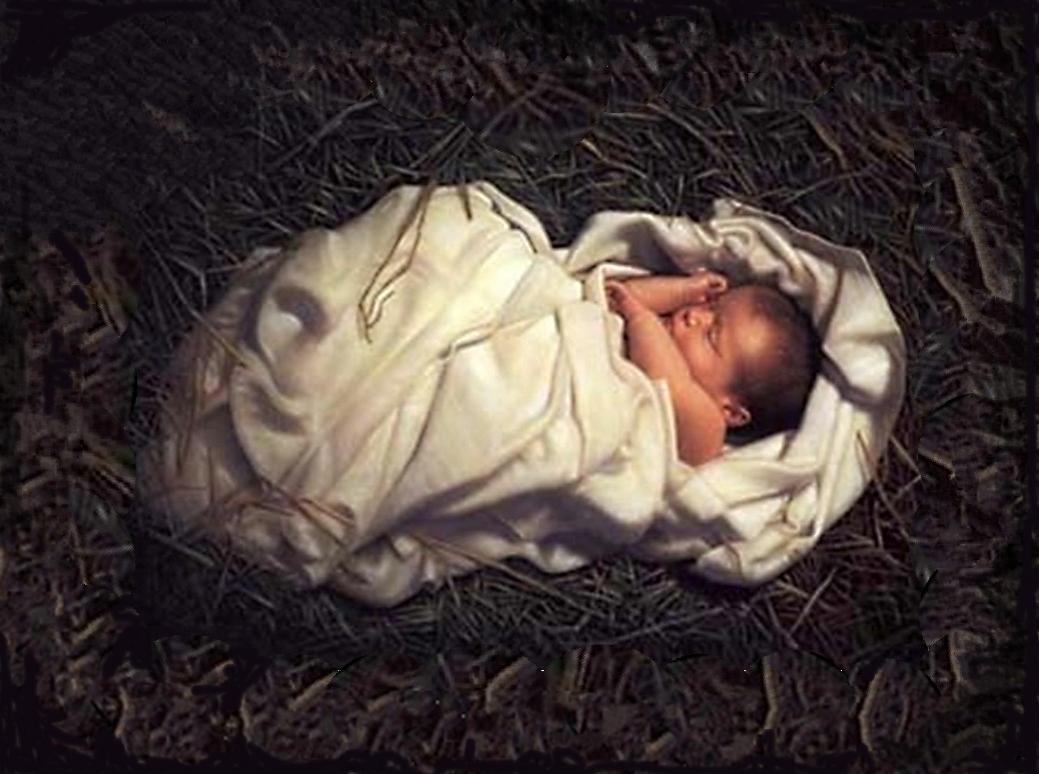
Since this all happened days before Christmas, I was thinking of another baby, too: A New Testament baby who was the embodiment of the “still small voice” in 1 Kings. Isn’t that just like God? He doesn’t show up like you’d expect, in the earthquake, wind, or fire, or with the rich, powerful, or lovely; He shows up in the hospital corridors, amid those who suffer and those who serve. He shows up as a helpless newborn baby, born in a barn on the back edge of an empire. There may have been choirs of angels in the sky, but God lay in the straw crying for milk.

On this most atypical of Christmases, I learned to stop scanning the skies for those angel choirs, and to listen instead for the still, small voice in the dark.

A Nearsighted Holiday

As I am writing this there are nine days left until Christmas, and we still don’t have a Christmas tree.

Bear in mind that we live next door to a Christmas tree farm. Not only that, but for the past month our two oldest children have been working at said Christmas tree farm. So we don’t really have any excuse: This December hasn’t been more busy or stressful than any other December; there just hasn’t been a good time for our entire family (because, yes, it requires the entire family) to walk next door and pick out a tree. Sometimes the nearest things are the hardest to do. 

Sometimes the nearest things are also the hardest to see. 

My annual vision checkup always falls between Thanksgiving and Christmas. This year, my optometrist gave me a Sophie’s Choice: My distance vision had worsened to the point that I was going to have to sacrifice clarity at close range in order to see far off. 

And so I have become a wearer of reading glasses. 

Click here to continue reading this week’s “Faith in Vermont” column in The Addison Independent.

Holiday Film Review: Disenchanted

Over the Thanksgiving holiday, our entire family sat down to watch the new Disney film, Disenchanted. In a rare occurrence, all our children were excited to view the long-awaited sequel to 2007’s Enchanted. The original film, which we’ve seen multiple times, follows Giselle – a stereotypical Disney princess in search of “true love’s kiss” – as she’s transported in modern-day New York City. The film is a smart satire of the more absurd elements of traditional Disney films (including singing rats and pigeons), but of course Giselle’s dewy-eyed goodness wins over the cynical Manhattanites in the end. 

The two films bookend my parenting years: I first watched Enchanted with a visiting college friend while my newborn firstborn slept upstairs; the release of Disenchanted corresponded with that first child’s 15th birthday. 

Disenchanted reunites the stars from the original movie, including Amy Adams as Giselle, Patrick Dempsey as her husband, Robert, and Idina Menzel and James Marsden as the King and Queen of Andalasia (Giselle’s native fairytale kingdom.) Fifteen years later, these actors are all decidedly middle aged. The sequel addresses the question: What comes after “happily ever after?” When it begins, Giselle and Robert are still living in an increasingly cramped Manhattan apartment with their daughter Morgan (a young girl in the original film, she’s now a sarcastic teenager) and their baby daughter, Sofia. In a rather predictable middle-aged move, they decide to relocate to the suburbs, where Giselle is sure that they can make a fresh start. Disney-fied chaos ensues, including talking animals, large musical numbers, and the eventual triumph of goodness and love over evil. 

The movie has received a tepid response from critics. It wasn’t even released in theaters, but was streamed directly to Disney+, which says something. My own children were lukewarm-to-negative in their reviews. A friend who watched Disenchanted with her family said her response was, “What am I watching?” 

That’s all valid if you’re watching Disenchanted purely as a film. But I thought it was brilliant, because about partway through I realized that it wasn’t just a film. That’s when I leaned over and whispered to my husband, “This is the perfect metaphor for perimenopause!”

Click here to continue reading this week’s “Faith in Vermont” column in The Addison Independent.