Dead Mom Walking

This is my birth story: The story of how I became a mother for the first time. I wrote it five years ago, in honor of International Women’s Day, and it appeared in the On the Willows blog. 

I am posting it again because the other day this article appeared on my NPR news feed, featuring a mother who had the exact same conditions that I did, but whose birth story didn’t end as happily. When I first wrote this story, I was focusing on child and maternal healthcare elsewhere in the world, in less developed countries, but this NPR story happened RIGHT HERE, in my own country. 

Today is Mother’s Day, and for the past couple of days I’ve been walking around thinking about mothers who won’t have the chance to be celebrated today, because their birth stories ended badly. I dedicate this to them, with the prayer that we will advocate for quality maternal and child healthcare throughout the world AND right where we live. Every mother should have the chance to celebrate Mother’s Day. 

Me, about two weeks before Fiona’s birth.

It’s a miracle that I’m sitting here, typing this right now, because I should be dead.

That’s not an exaggeration; I’m not trying on a dramatic opening line for effect. I should be dead, and in any other time or place, I would be.

I’ve never written about the circumstances of our first daughter’s birth before, because my husband Erick was the one writing all the updates during and after, so here goes:

I had a fairly easy, uneventful first pregnancy. No morning sickness, no notable symptoms of any kind aside from an insatiable craving for movie theater popcorn. When they took the 20-week ultrasound, the doctors noticed that our baby was a little on the small side, but nobody worried much about it. “You’re a small person,” they said, by way of explanation.

Then my doctor went to Korea for six weeks. The two substitute doctors I saw in the interim noted that the baby was still measuring small, “But you’re a small person,” they kept saying. Other than smallness, both the baby and I seemed healthy.

When my regular doctor came back and the baby was still lagging behind in size, he was nervous. This doctor, who saw me through three pregnancies, is long on brains and short on bedside manner — which was fine by me. Imagine a very, very pessimistic, Korean Mr. Miyagi, and you’ve captured him. (His introduction to genetic testing was: “Sometimes, baby is born with no brain.”). He sent me to a specialist in high-risk pregnancies for another ultrasound, and he prescribed a weekly non-stress test (where you sit for an hour while a nurse monitors the baby’s heart rate — then it was boring, now I’d call it a vacation). The baby continued to measure small, but everything else was a-okay. I tried to eat more and move less.

Skip ahead to Saturday, November 17, 2007 — two weeks before my due date. I noticed my heart racing a little bit that morning, and my ankles and feet were suddenly very swollen, but I didn’t think much of it; both seemed within the realm of normal third trimester symptoms.

The next morning, which was to be the day of my baby shower, I woke up with what I thought was heartburn. Again, a normal pregnancy discomfort. Skipped church, did some work on the couch, sent Erick out for Tums and 7-Up. A few hours later, when the heartburn seemed to be getting worse, Erick suggested I call the advice nurse. I did so, reluctantly: I have this fear of annoying nurses with silly concerns, which comes from decades of people-pleasing. But I figured that maybe she could hook me up with some prescription-strength Tums. “You’re pregnant with chest pain,” the nurse told me bluntly. “You need to go to the ER.”

We obediently went to the ER (me looking at my watch in annoyance to see how much time was left until my baby shower). When the intake nurse took my blood pressure, it was much higher than usual — much higher than it had been at my checkup three days earlier. I noted this, but he told me that increased blood pressure was normal in late pregnancy. The EKG was normal. I was sent to the outpatient clinic.

It was at this point that my “heartburn” became excruciating. The people in the waiting room thought I was in labor, and, having been through three subsequent labors, I can tell you that the pain was right up there. I remember very little from this point on, just that they took my blood pressure again and it was even higher than before. Suddenly, a nurse was running with me in a wheelchair over to Labor & Delivery, cursing the people at the ER who hadn’t thought to send me directly there in the first place.

The Labor & Delivery nurses hooked me up and started running tests. These nurses were amazing; I remember asking them two things: “Can you please make the pain go away?” and “Do you think I can make my baby shower? It starts in 30 minutes.” They made the pain go away, but one of the kind nurses said, “Honey, I think you’re going to miss your baby shower.”

It turns out I had sudden, severe preeclampsia. Preeclampsia is pregnancy-induced high blood pressure. In my case, preeclampsia was combined with a condition called HELLP Syndrome, which is an acronym for Hemolysis (the breakdown of red blood cells), Elevated Liver enzymes, and Low Platelets. Possible outcomes of this combo include hemorrhage, liver and kidney failure (my “heartburn” was, in fact, my liver swelling), pulmonary edema, stoke…and death. The only cure is to deliver the baby immediately. Fiona was delivered via emergency c-section. At 37.5 weeks, she was full term, but she weighed in at 3 lbs. 11 oz.  She spent one night in the Neonatal Intensive Care Unit for observation, and was released the next day, completely healthy.
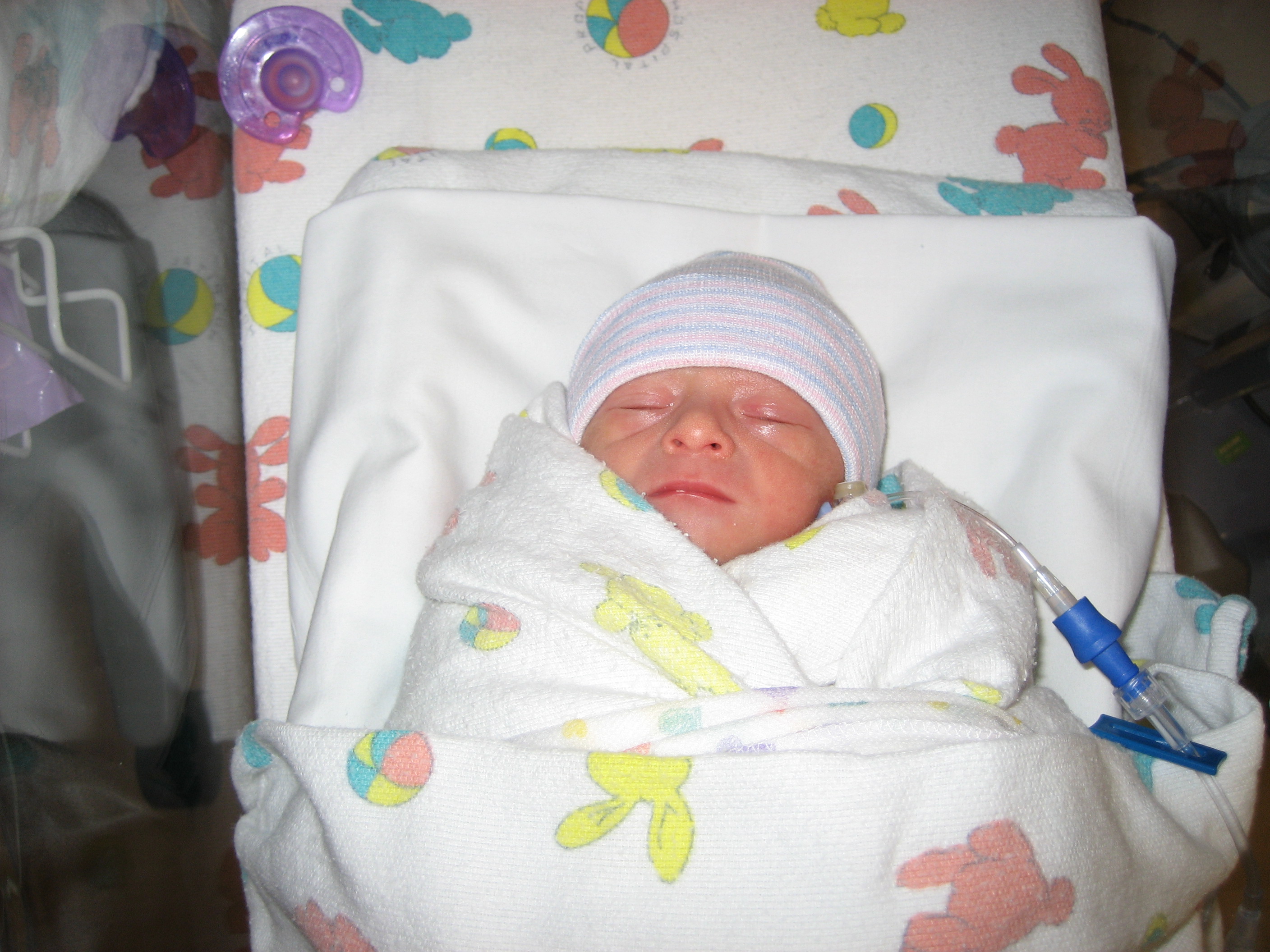
The first picture ever taken of Fiona.

Because I was recovering from a rather traumatic birth, and because I suddenly had a 3 lb. 11 oz. baby to care for, I didn’t initially spend a lot of time reflecting upon what had just happened. And I still don’t, since that baby was followed very quickly by three others. But here’s what I know now:

The causes of preeclampsia and HELLP Syndrome are unknown. Researchers currently suspect insufficient blood flow to the uterus, immune system problems, or poor diet as possible causes. My case was a little strange, both because of its sudden and severe onset, and also because I had only one of the usual risk factors for preeclampsia: that this was my first pregnancy. Nobody has ever been able to explain Fiona’s tiny size, other than that it must have had something to do with the preeclampsia. (And our other three daughters weren’t exactly linebackers when they were born).

According to the Preeclampsia Foundation, preeclampsia affects at least 5-8% of all pregnancies, and HELLP Syndrome accompanies 15-20% of cases of severe preeclampsia. While preeclampsia rarely causes maternal death in the developed world these days, it is a leading cause of worldwide maternal and infant deaths. Conservative estimates are that preeclampsia is responsible for 76,000 maternal and 500,000 infant deaths worldwide per year.

It’s not just the numbers that get me. Since Fiona’s birth, I’ve read several accounts of preeclamptic women in third world countries who died (along with their unborn children) while waiting for medical care outside of health centers. I’ve even read of a woman who died from preeclampsia in this country during the last century. So, every once in a while, I will stop and think, “If I’d been born in just about any other time or place, I would be dead right now. And so would Fiona.”
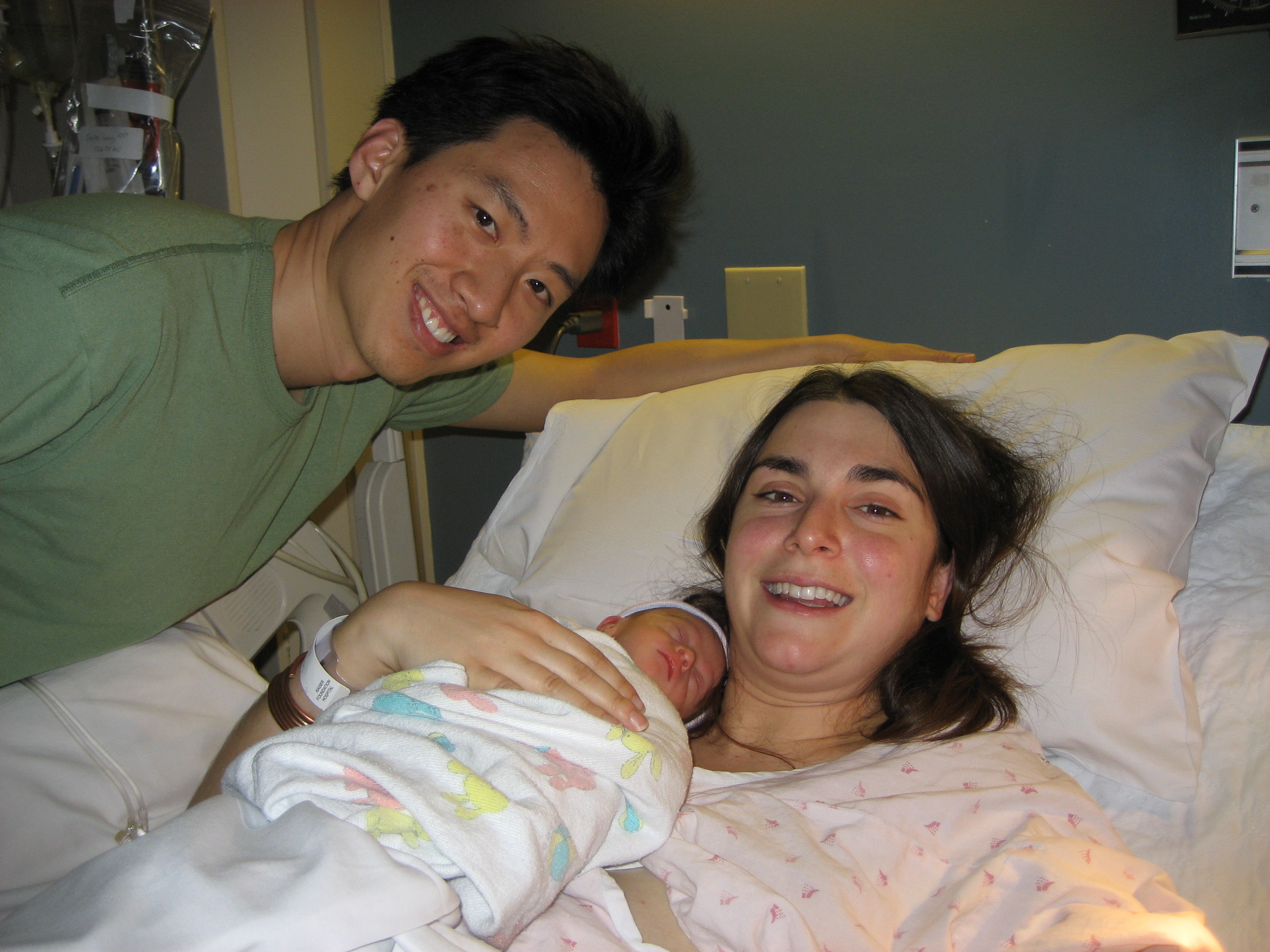
Erick and me with Fiona, the day after her birth. You’ll notice I don’t look so great, because I wasn’t.

I’m writing this on March 8, International Women’s Day. (It’s a shame I didn’t write it in time to actually post on International Women’s Day, but that’s how life is these days). Thinking about International Women’s Day got me reflecting on Fiona’s birth, because even though this is a personal story, the conclusions I draw from it are quite global:

1. I am so stinking grateful for health care. Sure, the hospital made a few snafus in my case (they should’ve sent me to Labor & Delivery right away, for instance), but Fiona and I were able to get quick and appropriate medical attention to save our lives. The nurses and doctors who cared for us were competent and compassionate, and during most of the experience I had confidence that everything would turn out okay. It did; I came out on the other side, and followed up with three completely normal and healthy pregnancies, labors, and deliveries. So I think of myself as a “Dead Mom Walking.” Then I look around and realize that I know a whole lot of Dead Moms Walking: women who, like me, would be dead had they not received appropriate medical care during their pregnancies and deliveries. I bet you know a bunch of Dead Moms Walking — you may even be a Dead Mom Walking. Childbirth is, and always has been, a very risky proposition; it’s a luxury that, in this time and place, most of us go into it covered by the assurance that everything will likely be well.

2. I think it’s absolutely unacceptable that so many women in the world don’t have access to the health care that I do. Why are so many women and babies still dying from a condition that my baby and I lived through? A condition that can be cured by a timely c-section? Why are some of these women dying on the sidewalk outside of health care centers? I can imagine why; if I’d had to walk to the hospital, or if we’d had to take time to figure out how to pay for my care, or if the hospital didn’t have the capacity to do c-sections, it would have been too late. I believe this reality fits squarely into the definition of “injustice.”

There are a few excellent initiatives and organizations involved in preeclampsia research, and working to address the imbalances in maternal health care, like the aforementioned Preeclampsia Foundation, The United Nations Foundation, and the Million Moms Challenge. I wish there were more. I would love to see those 5- and 6-digit death figures diminish to near zero: more Dead Moms Walking, less dead moms. If I were First Lady, or Miss America, or Angelina Jolie, this would be “my issue.” And I guess, even though I’m just me, it still is my issue.

Fiona today.

Two for One!

Despite what feels like far too long a stretch of grey skies and rain, spring is truly springing in the Green Mountains, with all sorts of green and flowery friends reemerging every day. So I guess it’s appropriate that this has been a productive week for writing: I have not one, but TWO new posts up over the past two days.

Here’s my latest installment of “Our Favorite Things” on the Minibury website, which focuses on tips for gardening with children.

And here’s today’s “Faith in Vermont” column for The Addison Independent, in which I describe three recent experiences in community.

Agway Adventures

I am sitting in Carol’s Hungry Mind Café to write this column, as I do nearly every Saturday afternoon. Usually I crave this time, when my husband takes our daughters so that I can have a handful of silent and solitary hours – usually my only silent and solitary hours of the week – in order to “work.” (“Work” is in quotations, because being alone to write feels more like play to me.)

But today I had to force myself to come here. Today it was only the threat of a looming deadline that compelled me to drive over to Carol’s. The light rain helped, too. Still, I couldn’t resist stopping in at Agway before landing at Carol’s.

It was my third visit to Agway this week.

Right now, I am not craving silent time to write so much as I am craving time to start seeds, dig and weed, compost and mulch, reseed the lawn, and help my husband finish off the poultry fencing. I want dirt under my fingers more than computer keys.

I’m distracted because it’s spring, of course. Really and truly spring – I think. In Vermont, April is still on the risky side of spring: We are still balancing along the wire of the average last frost, still unsure that Mother Nature won’t throw us one final snowstorm for good measure. But my online forecast shows evening temperatures above freezing for the next ten days, so I’ve taken the plunge and put my spring planting schedule into play.

Spring planting means plenty of visits to Agway, our closest lawn, garden, farm, and pet supply store. And because the only time I’m guaranteed freedom from my children is Saturday afternoon, I usually visit Agway with at least some of my daughters.

Click here to read my latest “Faith in Vermont” column in The Addison Independent. 

When You Feel Like Your Family is Killing You: Thoughts On Washing Feet (and a Little Bit of Politics)

Have you ever felt like your family was killing you?

I don’t mean killing with intent, of course; I’m talking about a slow and steady nibbling away at your emotional, physical, and spiritual health. The sense that your blood is flowing directly into their veins, and your breath is being sucked up by their lungs. The fear that it might really happen: You may not be able to take one more step, answer one more question, or get out of bed tomorrow morning. The joy-sucking realization that you’re giving and giving, they’re taking and taking, and the equation will probably never be balanced.

I have felt this way. My neck and shoulders become cement and I feel like I’m carrying three times my body weight — the combined total weight of my people. My people, who want me to answer “How long does it take to get to the Moon?”, slice them an apple for snack, listen to their latest piano piece, and admire their newest Lego creation — all at the same time. My people, who throw themselves down screaming in front of a whole schoolyard full of people when I won’t carry them to the car — because I’m already loaded down by three backpacks. And that was just yesterday.

The endless dishes, crusty countertops, overflowing baskets of laundry, popcorn and Cheerios crunching underfoot: These things seem to sit on my chest and crush my breath.

Many’s the time I’ve longed for a diagnosis — not a terribly bad one, of course, but one in which the doctor says, “I’m sorry, the only cure is for you to spend a week in bed, in total silence.”

The last time I felt sure my family would kill me was two days ago, in the pre-dawn hours between Maundy Thursday and Good Friday. Earlier in the day, when I wasn’t homeschooling two daughters, shuttling everyone else back and forth from activities, or hosting two little friends who were over to play, I was hustling to get five apple trees and two blueberry bushes — which had arrived the day before and needed to be planted within 48 hours — into the ground.

When I collapsed into bed that night, I was looking at about six hours of sleep before I had to wake up and do it all over again.

At about 12:30 AM, the screaming started.

One of our daughters was scared. So scared that she woke up two of her sisters, who had to be soothed down. So scared that she couldn’t sleep.

At 1:30 AM, after three trips up and down the stairs, doing all that I could to comfort and reassure (prayers, back rubs, silent meditation, etc.), I dragged my pillow and an extra quilt upstairs and made a “bed” by pulling two beanbags together.

My neck and shoulders had become cement, and I settled in for a long, sleepless night on the floor. My daughter continued to cry on and off, and I cried, too.

They are killing me, I thought. This is SO UNFAIR. 

It wasn’t until the next day that I realized the parallels between my night on the floor and this Easter holiday that we’re celebrating.

(I’m going to write a little bit about Jesus now. If you don’t celebrate Easter, or don’t believe in Jesus’s spiritual legacy, please don’t stop reading; This is a story to which I think anybody can relate.)

***

In the hours between Maundy Thursday and Good Friday, the Bible tells us, Jesus also spent a sleepless night. Jesus also cried. He was stretched out on the hard ground of the garden of Gesthemane. He’d just celebrated the Last Supper with his disciples, and he knew he’d been betrayed by Judas – one of that chosen family of disciples – to Jerusalem’s religious leaders. He knew that those leaders were coming at any moment to arrest him and lead him off to death.

The differences between Jesus and me are clear. Jesus never said, “This is SO UNFAIR!” He was distressed. He asked if God could take away what was coming. But, unlike me, Jesus didn’t whine.

Also, unlike me, Jesus actually was about to die.

***

After this realization hit me, I recalled the conversation I’d had with my daughters the night before.

We were reading about the Last Supper in the Gospel of John. We read about how, before Jesus celebrated the Passover meal with his disciples, he took off his robe, put on an apron, and washed their feet. Their filthy, smelly, walking-on-dirt-and-dung-strewn-1st century roads feet. He told them to be servants like him; to wash each other’s feet and love each other.

Next, Jesus predicted that one of the disciples would betray him. When asked who would do such a thing, Jesus dipped a piece of bread in wine and handed it to Judas Iscariot. Judas promptly left to collect on the 30 pieces of silver he’d get in exchange for Jesus’s life.

“Wait,” one of my daughters interrupted, “So, was Judas there for the foot washing part, too?”

In all my years of reading about the Last Supper, I’m embarrassed to say, this thought had never occurred to me.

“I guess he was,” I answered. “The Bible says Jesus was gathered with all his disciples. Judas was a disciple, so he must’ve been there the whole time.”

And it felt like a punch right to my gut: Jesus washed the filthy, smelly feet of the man he KNEW was going to cause his death.

***

As I staggered around, exhausted, that morning after my sleepless night, I thought about how Jesus, knowing he was actually going to die, washed the feet of his murderer and spent a sleepless night of agony without whining.

I am far from being Jesus, but maybe I could try to cultivate those same attitudes with respect to my family.

Maybe, just maybe, we could all try to cultivate those same attitudes with respect to each other.

***

It’s not just our families that cause us sleepless nights: Especially now, at this particular moment in history, it’s almost impossible to keep from worrying over the state of our nation and our world. Terrorism and genocide headline international news. Political parties — and their supporters — refuse to listen, talk, or work together. Emotions are high in my own little town over a controversial speaker who was recently invited to speak at Middlebury College.

These things can slowly nibble away at our emotional, physical, and spiritual health.

Everywhere you look, we are divided: nation against nation, race against race, gender against gender, party against party, humans against world. The list goes on, until all the “against’s” crack open and release a flood of vitriolic social media posts, strident position statements, nonsensical legislation, and anxiety-provoking newscasts.

I have been divided against myself as well. Shortly after the U. S. Presidential election, I read something online — I can’t remember who wrote it — the gist of which was: “Now, more than ever, we need writers to give voice to what’s going on.”

I’m a writer, I thought, so I guess I should write about what’s going on. Otherwise I might be complicit; I might become part of the problem.

I wrote a couple of posts about the state of our nation. People who agreed with me were complimentary, and those who didn’t agree either don’t read or stayed gracefully silent.

But I never felt quite right about these posts. So, for the past few months, I’ve stuck to my usual subject matter: Vermont, my children, birds and trees and weather, quaint happenings in our small town. All the while, I’ve felt terribly guilty that I wasn’t addressing Bigger Things.

As I thought about sleepless nights, Jesus, foot washing, and family, I realized the source of my angst: By adding my political opinions to the mix, I feared becoming part of the problem. By choosing sides publicly, I would be complicit in deepening the already deep divides between us. Because at the bottom, the problem isn’t Trump, or ISIS, or Charles Murray: The problem is that we are all picking our sides, digging in our heels, writing our posts and statements against each other.

This is not to say that we shouldn’t care about injustice, or that we shouldn’t speak or act against assaults to human rights. This is to say that we need to choose our issues and how we address them with care.

And it may be that the most important things we do to fight injustice are not done publicly, or on social media. Things like washing feet.

Jesus showed love to Judas, who was about to kill him, by washing his feet. I don’t want to cheapen this act with an overused word  like “love” or “grace;” but perhaps if we applied a little more of  “whatever it takes to wash the feet of your killer” to our lives, our politics, our world, we might see radical change.

“But, Faith,” you say, “Jesus did that, and he was killed anyway.”

Yes, he was. And — regardless of whether you subscribe to the resurrection or the religion that arose after his death — I think most would agree that the world was radically changed.

***

So, for now, I will continue to write about things that are true and beautiful: Vermont, my children, birds and trees and weather, quaint happenings in our small town. And I will continue trying to do “whatever it takes to wash the feet of your killer” when I feel like my family — both the family in my house and my family in the world — is killing me. Given the choice, I’d rather live out what I’m for, rather than write about what I’m against.

Happy Easter.

Backyard Birds and Growing Up


I have become a person who watches birds.

For as long I’ve known him – my entire life – my father has been a birdwatcher. Growing up, we always had bird feeders in the yard and birdhouses (which he built himself) on our trees. He could usually, immediately, name any bird that happened by; if he couldn’t he’d pull down our 1965 copy of A Guide to Field Identification: Birds of North America. When he passed that book on to our family this past year, I found that he’d taken notes in felt-tip pen of precisely where and when he’d seen each bird.

I never paid much attention to this peculiar birdwatching habit: I didn’t see the point. Birds were always just part of the scenery, hanging around in the background. They were nice, but far less important than studying, socializing, or going to the mall. Why should I bother to learn their names?

My dismissive attitude towards birds and birdwatching continued for nearly 20 years. I lived in cities for most of that time, where everything was too loud and too busy to even notice birds. Birdwatching, when I thought of it at all, seemed like a hobby for “old people:” people who had time on their hands, pricey binoculars around their necks, floppy-brimmed hats on their heads, and chunky hiking boots on their feet.

Change began gradually, after our family moved to Vermont. I can pinpoint the moment my interest in birds shifted: I was walking the dog, and I heard a mockingbird call. I didn’t know it was a mockingbird at the time, but I recognized the sad, haunting call as something that I’d heard often during the long, lazy afternoons of my childhood. When I got home, I looked it up. Now I knew one bird.

Click here to continue reading this week’s “Faith in Vermont” column in The Addison Independent. 

On the Ice

img_8954

Just like that, winter is over.

At least, that’s what it feels like today, as I look out at snowless fields under a sunny blue sky. The temperatures over the past week have been unseasonably warm for February in Vermont, culminating in a high of 66 degrees at our house. Our entire family spent the morning outside: the children romping in t-shirts, the adults starting some early yard work. As if to confirm the change of seasons, two honking V’s of Canada geese flew north overhead.

In all likelihood, winter is not over yet. My online forecast for the coming week predicts temperatures that are half of what we’ve experienced today. Like a cruel barn cat, the Vermont weather will toy with us for a while; it’s quite common to have decent snowstorms here in March, April – even as late as May.

But it feels as if a corner has been turned: If winter isn’t over, we’re heading into its downslope. As I look back upon the winter of 2016-17, it’s certainly not the snow I will remember; the Champlain Valley received very little snow, which came in a few dumps with long, bare breaks in between.

For me, this winter was about ice.

Click here to continue reading this week’s “Faith in Vermont” column in The Addison Independent. 

New Minibury Column: Our Favorite Things

header

Several months ago, a fellow mother and the founder of local family website Minibury asked if I’d be able to provide some content for the site. This opportunity rolled together many of my favorite things: supporting other moms, supporting good community-building ideas, and writing. Today, my first post in the “Our Favorite Things” series is up on the Minibury website. Click here to check it out!

The concept behind “Our Favorite Things” is simple: Each month, I’ll share with your families one of our family’s favorite things. The goal is to highlight things that are simple, inexpensive (or free!), local, and that promote creativity.

Today’s topic: Popsicle sticks!

[For those who, like me, have tired brains and heavy hearts from following recent political developments in our country (and I suspect that’s everyone), a post about popsicle sticks may seem either a welcome diversion, or akin to fiddling while the Titanic sinks. Here is what I tell myself: No matter what may be happening at the moment, we still need to parent our children. In fact, parenting our children is one of the absolute best things we can do at times like this. So, here’s to popsicle sticks!]

The Cow on the Wall

img_8666

The cow was hanging on the wall, opposite the checkout counter at the Sweet Charity resale shop in Vergennes, and I fell in love with it immediately.

That I was in Sweet Charity, without children, on a Saturday afternoon, was due to a series of anomalous events. My husband was in Chicago for work, so a generous friend had taken pity on me and invited all four of my children over to her house to play for a couple of hours.

Faced with two precious hours of free time after two days of single parenting, I did what any woman would do: I went shopping for home furnishings with my mother, of course.

Click here to continue reading my latest “Faith in Vermont” column in The Addison Independent. 

The Day After

I am not marching today, the day after Donald J. Trump’s inauguration as 45th President of the United States. I feel far more conflicted about this than I expected. Today, my fellow women in all 50 states and on all 7 continents (yes, even Antarctica!) are marching in opposition to Trump’s stances on various issues. Among these women are dozens whom I’m privileged to call friends. My hearts are with them.

Marching — an action I’m not naturally quick to jump on — proved to be too logistically complicated on this particular weekend. Instead, I am protesting by writing. My two oldest daughters are protesting by going to see Hidden Figures (a film about three female African-American mathematicians who worked behind the scenes of NASA’s early space missions) with our Victoria. My two youngest daughters are protesting by assembling furniture with my husband. This morning, we all protested by driving up the mountain for some cross-country skiing.

Barack Obama began his first term in office when my firstborn was one year old. She rode on her father’s shoulders as we joined a jubilant crowd to watch the inauguration on a big screen in U.C. Berkeley’s Sproul Plaza. We felt so fortunate that our children would be born into this historic era of hope and promise.

The hope and promise of that day eight years ago didn’t last, of course. And here we are.

I have now lived through 11 Presidential inaugurations. But never in my life have I felt the type of crushing sadness that I felt yesterday.

In trying to figure out exactly why I felt the way I did — why this inauguration felt so different from all others to me and many of my friends — here is what I came up with:

For me, this is not, first and foremost, about political parties, or even policies. I’ve seen Presidents from both parties come and go. Some have espoused views and policies that I agreed with, and some have not. There have been times in the past when I’ve been disappointed — distressed, even — over the person taking office. But I’ve always had faith in democracy and the political process. I’ve been able to take the view that “You win some, you lose some.” And while we’ve had some very flawed leaders on both sides of the aisle, for the most part I’ve had confidence that our government was trying to be on the right side of history, to do what would best promote freedom and justice in the United States and the world, even when those efforts proved sloppy or misguided.

No, my sorrow yesterday was not sour grapes; it was not whining because my side lost.

Nor were my feelings, at root, targeted anger towards Trump’s policies. Yes, he made campaign promises that, if he’s able to deliver on them, are incredibly alarming; policies that, if implemented, I believe will harm people I love, their children, and our nation as a whole. If some of these things come to pass, then you likely will see me marching. But the fact is that, as of yesterday, Trump hadn’t been in office. He’d made some troubling promises and nominated some troubling people, but he hadn’t really done anything yet. So I cling to a small strand of hope that what’s said on the campaign trail and what’s actually possible to accomplish are two very different things. I’m willing to wait and see what unfolds, instead of wasting my energy on “what-ifs.”

When I questioned my own sadness, I remembered a discussion that I’d had with my eldest daughter right after the November election.

She’d started saying, repeatedly, that she was “scared about the wall.” She meant, of course, Trump’s promise that he would build a wall along our country’s southern border with Mexico — and make Mexico pay for it.

Just where my daughter heard about “the wall,” I’m not sure. Certainly not from my husband or me: My daughters are so prone to fear and drama that I try to shield them from the darker facts of life, for better or worse. And honestly, for much of the election cycle my husband and I (foolishly) thought that a Trump Presidency was a logical impossibility, so we didn’t bother discussing anything he said in front of the children.

But wherever she heard about it, the fact remained that my daughter was scared about this idea of a wall. Finally, I asked her why: Just what was it that she was afraid of?

“I guess because it means that we’re just not that nice,” she said.

And that right there — my daughter giving voice to her realization that this election revealed that “we’re just not that nice” — that is why my heart broke a little yesterday.

We have just installed as the highest leader in our land a man whose entire career has been built unabashedly upon greed, self-promotion, and the objectification of women. A man who tweets out knee-jerk, angry, demeaning, juvenile insults at anybody who questions him. A man who has used the most offensive language possible to talk about women — and bragged about acting on that language. A man who, throughout his campaign and even in his inaugural address, has fed off of anger and fear — which, as any young Star Wars fan can tell you, basically means that you’re going over to the Dark Side.

There is a darkness around our new President. I cannot trust him to be responsible with his words or his actions, and thus I would not trust him — our country’s leader — in a room with my children. (And note that I’ve not even touched upon the possible dark deals with Russia and issues of business ethics.)

Have we had morally questionable leaders in the past? Absolutely. But in the past, they’ve always tried to hide their misdeeds behind polite rhetoric. And, when discovered, they usually apologized and paid the price in terms of loss of public confidence and votes. What’s different about this situation is that we knew all of these things about Trump before the election, and we elected him anyway.

I recognize that there may be value in ripping the band-aid off of the polite rhetoric that we’ve come to expect from our politicians. I recognize that the anger and fear that Trump tapped into have been simmering for a long time among certain citizens of this country, and that the needs of these citizens deserve to be heard and addressed. And yet, it feels as if we’ve sold our souls in a misguided attempt to save our country.

“We’re just not that nice,” my daughter said. “Nice” can be an insipid term, difficult to define. But when I think of my country, I think of a place that’s always tried (in halting, imperfect fashion) to enfranchise as many people as possible, to welcome refugees, and to fight for justice worldwide. “America First” may appeal to our patriotism, but it’s essentially a defensive posture, a circling of the wagons that leaves a lot of people out in the cold.

This is probably idealistic; the reality may well be that the United States isn’t “nice,” and hasn’t been for a long time. What breaks my heart, though, is that now my daughters know it.

Like any mother, I try to shield my daughters from the darkness. I attempt to preserve their innocence for as long as possible. I teach them that love wins, and that bullies and cheaters lose in the end: I teach them to be “nice.” So yesterday I mourned that, in order to continue to instill these ideals in my daughters, I now have to shield them from their President.

For the past two days, my eldest daughter has worn her Star Wars “Resistance” pin, which she promises she’ll wear daily for the next four years. We discussed what “resistance” really means, for our family. The answer, of course, is that to resist the slide into being “not that nice,” we will have to be nice.

So we resist by hugging loved ones, by having friends over to play, by going to church, by playing “Ode to Joy” on the piano, by finally getting our compost bin built. We resist by sharing meals, volunteering, donating what we have, reading March and listening to Hamilton. By promoting what is loving and beautiful and true. Until grander actions become clear, this is how we resist: Small things with great love.