The Problem With Ping

Sometimes, when reading stories to my children that were read to me as a child, I discover how truly dark and twisted children’s literature can be. Or perhaps it’s really how innocent I was as a child, and how my memory has failed me. Two sides of the same coin, in any case.

That’s how I stumbled upon the problem with Ping.

Ping, of course, is the title character in the classic 1933 children’s book The Story About Ping, by Marjorie Flack and Kurt Wiese. I remembered this book fondly as a story about a naughty little yellow duck who doesn’t want to get spanked. The other week, Fiona was, as she put it, “really into Ping,” so I had occasion to read her The Story About Ping five times in one sitting. When you read a book repeatedly like that, you start to notice things.

Ping is a young Chinese duck who lives with his large duck family on “a boat with two wise eyes on the Yangtze river.” The tension in the story is that, at the end of every day, the boatmaster calls the ducks back to the boat from the riverbank, and the last duck to cross over the gangplank always gets a spank on the back with a stick. Ping really, really does NOT want to get a spank on his back. But one day, when he’s upside down in the river catching a fish, Ping doesn’t hear the boatmaster call. When he resurfaces, it’s clear that he’ll be the last duck across the plank. Rather than suffer a spanking, Ping hides along the riverbank.

It was Fiona who pointed out a major issue with the book’s exposition: “Why does the last duck always get a spanking?” she asked. I explained that this was the boatmaster’s way of getting all the ducks to hurry up. NObody wants to stand around waiting for a bunch of ducks to straggle up a gangplank, right?

But I couldn’t deny the fundamental injustice of the boatmaster’s system. Because, of course, when you have a group of ducks waddling up a narrow gangplank, somebody’s always going to be the last duck. That’s just common sense. And it doesn’t necessarily mean that the last duck is a slacker. Take Ping, for instance: he wasn’t doing anything wrong, he was just unlucky enough to miss the boatmaster’s first call. I’m sure he would’ve busted his tail once he realized that it was time to go home, if he wasn’t so afraid of that spanking.

I started to wonder if maybe Ping was really a fable about capitalism, or unions — something like that. I don’t know; there’s only one economist in this family, and it ain’t me, babe.

In any event, once Ping runs away, the story unfolds in a familiar “journey-and-return” sequence. Ping spends a lonely night on the riverbank, and then travels down the river to find his family. Along the way, he has some sobering experiences: Ping sees a fisherman who uses captive birds to fish by fastening metal rings around their necks so that they’re dependent on the small pieces of fish he rewards them with, and then Ping is captured by a boat family who would’ve cooked him for dinner, if not for the mercy of their young son. At the end of this adventurous day, Ping hears the boatmaster’s call and sees the boat with two wise eyes — his home! Although he’s clearly going to be the last across the plank again, this time Ping presses on and submits to the spanking, before snuggling up with his family.

The moral of the story, as I always understood it: there are rules to being part of a family, and sometimes you have to accept discipline in order to live in love and safety.

Except that by about the third reading, I started to wonder: Just how safe WAS Ping’s life with his family? What was REALLY going on in that boat with two wise eyes? I can’t be sure, of course, but somehow I doubt that the boatmaster was raising all those ducks as pets, or simply for their eggs. I married into a Chinese-American family, and I know what happens to ducks. My guess is that Ping and his whole family were going to be Peking-ed before too long.

I sat for a while, letting this bother me. What gives, Kurt and Marjorie? You put Ping through a brush with death and force him to submit to unjust punishment, only to have him end up hanging, roasted, in the window of some restaurant?!?

But then, I realized that it was possible to consider another moral for this story, one that made a lot more sense to me.

We all know that life is unjust: there will always be a last duck over the gangplank who gets unfairly spanked. We also know that we’re all headed for death, eventually. In the meantime? You might as well snuggle up with the ones you love. Go home.

Being Mean

Photo by Fiona

As our girls are getting older, their anger is getting more personal.

Back when they were toddlers, they’d howl and scream and throw themselves on the ground when they were upset about something — like all toddlers. But their howls and screams weren’t personal: they were cries of fury directed at the universe, existential angst. WHY can’t I have what I want RIGHT NOW?!? Even when I was the cause of that angst, I wasn’t the target of their anger. Their tantrums launched them into another realm, and even their garbled yells rarely, if ever, included my name.

That’s all changed in the past six months. Now, when I say “no,” or look askance, or fail to use the nicest possible tone, my oldest daughters are quick to make it personal: “You’re being mean. We’re getting a new mommy!”

(Note on the idea of “getting a new mommy,” which seems particularly cruel: this idea did not originate with my girls. Maybe, just maybe, it’s something that I suggested once in an effort to lighten up a heated exchange….but the girls latched on to the concept).

I suppose another way of saying this is that, as my girls grow up, they’re learning how to hit where it hurts. I’m so proud.

Not for the faint of heart, this parenting gig. It’s incredible how quickly children turn from innocent, adorable, dependent infants, into such willful, flawed little people. NOBODY warned me that adolescence begins during preschool, but it does. Oh yes, it does, complete with the pouting, eye rolling, and shouting “FINE!” while stomping upstairs.

For a while, I responded to the “You’re being mean!” complaint by trying to reason with the girls. “I’m not being mean,” I’d say calmly. (The calm is important; I’ve learned that if my anger rises to meet theirs, things will only escalate and I’ll feel terrible afterwards. This way I can say, “Well, at least I remained calm.”) Then I’d point to the evidence; almost every single time I was accused of being mean, I was, in fact, engaged in activities that would suggest just the opposite. Like driving the girls to get ice cream. Preparing dinner for the entire family. Getting everybody dressed to go out.

But of course there’s no convincing a preschooler that you’re not being mean. We’re not talking about logical people here. It doesn’t matter that I’m doing non-mean things for the greater good; if they’re not getting what they want, when they want it, I’m mean. I could be discovering the cure for cancer with one hand, but if the other hand isn’t putting exactly the right ponytail into my daughter’s hair, I’m “not nice.”

Finally, one day when daughter #1 pulled out the “You’re being mean” card, I responded, “You know what? That’s okay. It’s not my job to be nice.”

That surprised us both for a minute. After all, I’ve spent my whole life trying to be nice; my attempts to be nice, to make everybody like me, have defined my character for most of my life — and have been at the root of some of my very worst choices.

But after I said it, I realized that I was right: being nice is NOT part of my job as a mother.

It’s my job to LOVE my children. But “love” and “nice” are not synonyms.

Here’s what I think love looks like: keeping my children alive (to the extent that I can control), nurturing their bodies and minds and spirits, encouraging them to become the best versions of themselves, and giving them the tools to grow into independent adults. Nothing in there about “nice.” On the contrary, the items on that list will probably require a whole lot of behavior that, at the time, looks “mean” to my kids.

What a concept. This is something that does NOT come naturally to me. But I’ve kept repeating, “It’s not my job to be nice,” as a reminder to myself and to my girls of what love really looks like.

One more thing: The other night, as I was putting them to bed after a day filled with “mean” accusations from my girls, Fiona asked what I planned to do for the rest of the evening.

“Oh,” I said, “I think I’m going to read this great new book I just got. It’s called 101 Ways to be Mean to Your Kids.

MOMMY,” she said, and in the dark I could hear her eyes rolling.

But I think she got it. It’s not my job to be nice, but it is my job to help us all keep a sense of humor about life. I see it as a favor to that new Mommy they’ve ordered, whenever she arrives.

That Crazy Tree

I’ve been reading The Artist’s Way this past month. This is the sort of book, marketed as “A Course in Discovering and Recovering Your Creative Self,” that I’d usually avoid. Really, who has the time? Its author, Julia Cameron, claims to have helped countless “blocked artists” discover “a spiritual path to higher creativity.” I bought this book back when I was a legitimate artist, having just completed a photography degree in New York City — but apparently it didn’t work for me back then, because I made it to the third chapter and then quit photography.

I’m not sure why I decided to pick up this book again, since I wouldn’t describe myself as an “artist” — unless by “artist” you mean “someone who started writing a blog about her kids and then got tired of writing about her kids.” Nor would I describe myself as “blocked,” although I’m sure there are some who WISH I’d develop a little writer’s block.

I guess I just hate to have a book in my house that’s partially read. And it’s turned out to be pretty good. My FAVORITE part is when Cameron recommends taking yourself out on a weekly “artist date,” where you go off alone to do something fun and restorative. That seems like a good idea for anybody, artist or no. So, the “artist date” was on my mind when Erick took out all three girls on a recent Saturday morning. I figured I’d give it a try; beats cleaning the house.

I decided to take a hike. I love walking, and looking, and thinking. When the girls are around, I may be able to walk short distances, but I have to watch THEM instead of the scenery, and there’s always too much chatter for me to hear myself think. A nice, quiet hike seemed just the thing for my first artist date.

The problem is, hiking by myself makes me a little nervous; I’m still too much of a city girl. I worry about things like getting killed. And where we live, the options for hiking tend towards two opposing but potentially dangerous scenarios: rugged wilderness trails, or the narrow shoulders of winding roads along which cars drive waaaay too quickly.

But there is one exception: the TAM. TAM stands for “Trail Around Middlebury,” and is a 16-mile loop around Middlebury through conserved land owned by the Middlebury Area Land Trust. I opted to walk a small section of the trail that starts at the Middlebury College golf course and ends close to town. The assurance that retirees with golf clubs would be within shouting distance was enough to make me feel passably secure.

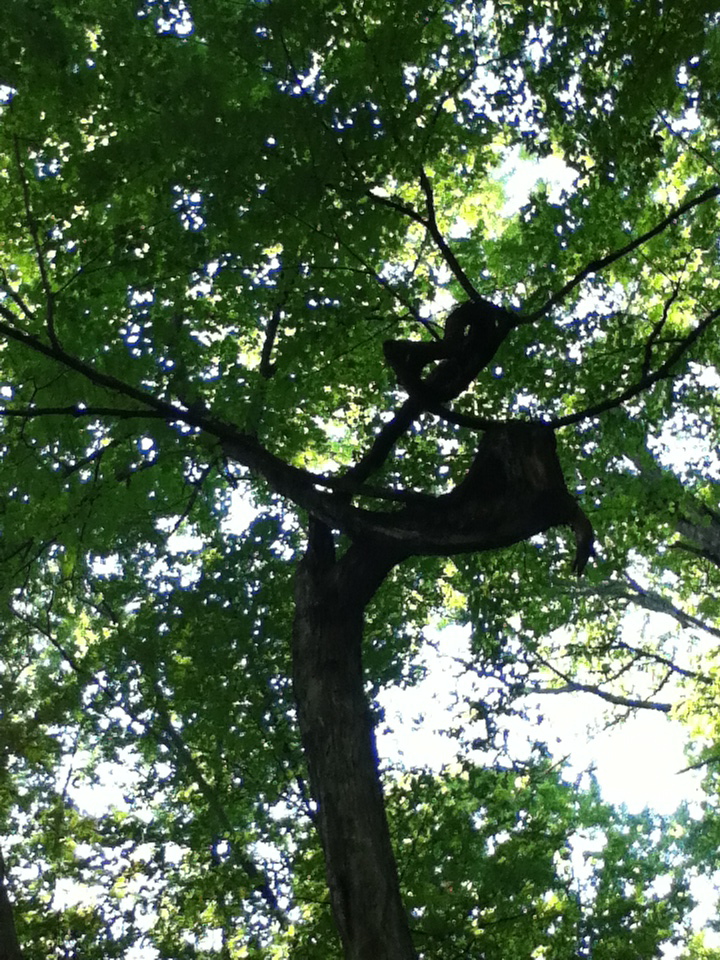
It was a beautiful, sunny late summer day. The section of trail that I walked is mostly wooded, with a few open fields between the trees. It felt secluded and quiet — I passed no more than five other people along the way. Then, in one dappled green stretch of woods, I looked up and spotted this tree:

I know the photo isn’t great — I snapped it with my iPod — but LOOK at that crazy tree! I can’t see the leaves well enough to tell what kind of tree it is, but I think it’s an oak. Oak trees — the ones in my yard, at least — usually grow up straight and strong and tall. Certainly all the trees around this one were growing straight, or else I wouldn’t have noticed it. Something happened to this tree, something was strange enough about its environment that its trunk veered off in one direction, and then abruptly changed course and doubled back upon itself. From the looks of it, this may have happened several times.

And yet, the tree survived. It’s healthy, thriving there in the woods. And isn’t it beautiful? Much more interesting than all the straight arrow trees around it.

There are a couple of points in life — usually around age 18 and 21 — when people make Big Decisions. Decisions about school, work, life partners. We tend to invest these decisions with a sense of great importance; we worry that we’ll make the wrong choice, and then we worry that we did make the wrong choice. By “we,” of course, I mean “me.” I went to college with no idea where to focus my attention, then bopped along through a series of decisions: graduate degree in education, teaching job, graduate degree in studio art, photography freelancer, nonprofit manager, mother. I love what I’m doing right now the best, but whatever you call this life I’ve cobbled together, you can’t call it “employment.” And that’s what tends to matter on paper and at cocktail parties.

When I saw that crazy tree, though, it reminded me of my life — and not just my life, but the lives of so many people I know and love.

So, I decided that when my girls reach the age of Big Decision Making, I’m going to show them the picture of this crazy tree — or take them to see it in person. And I’ll say something like this:

You’re worried about making the wrong choices, and your choices DO matter, but you don’t need to worry so much. Check out this crazy tree. This tree didn’t worry, it just grew towards where the most light was at each stage of its life. It’s okay if you change your mind later, or if you look back and feel like you were all over the place. As long as you’re growing towards the light at each stage of your life, you’ll be okay. And when you stand back to look, it’ll be beautiful.

College Town

‘Does it hurt?’ asked the Rabbit.

‘Sometimes,’ said the Skin Horse, for he was always truthful. ‘When you are Real you don’t mind being hurt.’

-from The Velveteen Rabbit

What happens when you end up living in a college town that’s almost a carbon copy of the town where you spent your own undergraduate years?

I went to Williams College, a small liberal arts school of about 2,000 students in Massachusetts’ Berkshire Mountains. I now live near where my husband teaches: Middlebury College, a small liberals arts school of about 2,000 students in Vermont’s Green Mountains. When he was interviewing for his job, Erick knew that I had some concerns about the deja vu aspect of this move, so he specifically asked his future colleagues how Middlebury differed from Williams. “Oh,” they scoffed, “Williams is out in the middle of nowhere. It’s tiny. Middlebury is much more of a town.”

I found — and still find — this comparison hilarious. It’s like arguing the relative difference between a flea and a gnat. In fact, as of the 2000 census Middlebury’s population was 8,183; Williamstown’s was 8,424. (And please note that those numbers include the  2,000 undergrads who descend on each town for nine months of the year). Both towns are centered around a single main street. It may be true that Middlebury’s main street is slightly longer, with slightly more offerings that Williamstown’s. But I’m living in essentially the same town where I went to college.

So far, it’s been interesting how little I’m aware of living in a college town. Sure, my husband goes off to work at the college every morning. Sure, I’ll occasionally notice students walking around downtown. Roads and restaurants are busier during special weekends when the students’ families come to town. Many of our friends work for the college in some capacity — but by no means all of them. There’s an unofficial “college pew” at our church where all the students sit together. Our daughters take swim lessons taught by members of the college swim team at the college pool. We’ve even had students from Erick’s senior seminar over to our house.

That sounds like a lot of interaction with the college, but it’s such a vastly different experience from when I actually attended college that I seldom feel any deja vu. As a mother of three, more than a decade out of college myself, I’m in a different world. We’re a 15-minute drive away from campus, and — what with the three young kids — we don’t attend many campus events. Shockingly, the undergraduate population tends not to breakfast at 7 AM, hang out in the children’s room of the public library, frequent the local playgrounds, or eat dinner at 5:30 PM. So we don’t see much of them.

When I do see groups of undergrads going about their college lives, they seem very young, and very loud. Their confidence and energy make me a little nervous. They appear to float on their own potential; most of them haven’t yet felt life’s hard blows that cultivate humility and empathy.

I look and them and think, NOT FOR ANYTHING WOULD I WANT TO BE BACK WHERE YOU ARE.

College was not a particularly happy time for me. As I understand it, many people look back on college as the best years of their lives: years when they forged lasting friendships, joyfully experimented in both the academic and personal arenas, and emerged after four years having found themselves.

For me, college was when I lost myself.

This may come as a shock to some people who knew me during college — perhaps even to most people who knew me then. I put up a very good front, as I’ve done for most of my life, because that’s what good girls do.

When I arrived at Williams, many of my peers seemed to already know who they were and where they were headed. They’d survived the proving ground of high school, and now they were ready to soar off on their talent. Sure, some edges needed to be smoothed, but at a basic level they were who they would be. Maybe it only seemed that way, but over a decade later these college friends and acquaintances still appear to be fundamentally who they were back then.

I was not that undergrad. I came to college looking like I had it all together, having spent the first 18 years of my life being perfect: working hard, getting good grades, going to church, and trying to make everybody happy. High school wasn’t much of a proving ground for me; I more or less breezed through it with a group of like-minded peers.

Problem is, trying to be perfect and make everybody happy for 18 years doesn’t leave much room for becoming a real person. I was 18 years old and I didn’t have a single opinion of my own. Going to church didn’t help me with identity formation, frankly, because if you’re perfect then you completely miss the point of grace. How can you receive forgiveness and love despite your failings if you’ve never actually failed?

No, when I arrived at college, I was more like the description of a crab cake I once saw on a menu: “Just enough binding to hold it together.”

If this were a novel or a movie, what would happen to a protagonist like that? Clearly, they’d have to fail. Something would have to rip apart the binding of their fragile self so that the pieces could be put back together more securely. It’s an old story. It’s The Velveteen Rabbit: the toy bunny needs to be discarded on the trash heap with a broken heart in order to become Real.

And, thankfully, that did happen to me: I made mistakes. The specifics aren’t important. These weren’t major crimes against humanity; they were the kind of mistakes that happen when you wander through four years of college without knowing who you are. But they were major to me, because I wasn’t supposed to make mistakes. And it wasn’t pretty; the ripping apart of my binding that began in college resulted in a three-year post-college morass of depression and anorexia, during which time I distanced myself from friends and family. It wasn’t until I found grace and Erick — almost simultaneously — that my pieces started to come together again.

I missed my college reunion this year (because our California family was visiting) and I’m very sorry that I did. None of this was college’s fault; I still have fun memories, and I made some friends whom I hope to know forever (and whom I wish I saw more often!). I wanted to be at that reunion, because I think that most people who knew me in college didn’t really know me. I’d like to have a chance to get re-introduced.

So, these are the thoughts that enter my mind when I come into contact with undergrads these days. I’m glad for those moments, for living in a town that allows me periodic flashbacks to the lost-est time of my life. I wonder how many of these students — underneath their pulled-together, confident exteriors — are just as much of a mess as I was back then. (For that matter, I wonder how many of my own college peers were just as much of a mess as I was back then? Probably a fair amount).

NOT FOR ANYTHING WOULD I WANT TO BE BACK WHERE YOU ARE, I’d like to tell these undergrads, BUT NOT FOR ANYTHING WOULD I HAVE SKIPPED IT.

Here’s what I would have skipped: My panic and shame at having my perfect front deconstructed. It was that panic and shame that I took out on my body, my family, my friends. And for that, I’ll always be deeply sorry.

So if I were to give advice to any undergrad who, like me, arrives at college as a hollow shell of “perfection,” it would be this: DO NOT PANIC when you discover that you’re not perfect after all. Welcome it as the thing that will make you who you are, as radiation therapy for your soul. But don’t wallow. Show yourself some grace. Gently pick up your pieces and start looking for the tools to put yourself back together again.

In a recent segment on the NPR program This American Life called “The Ghost of Bobby Dunbar,” a woman from a family that had suffered tragedy, deceit, and mistaken identity concluded, “If you hate that it happened, then you hate that you are.”

If you hate that it happened, then you hate that YOU ARE.

You should never, EVER, hate that you are.

Living Without Blinds

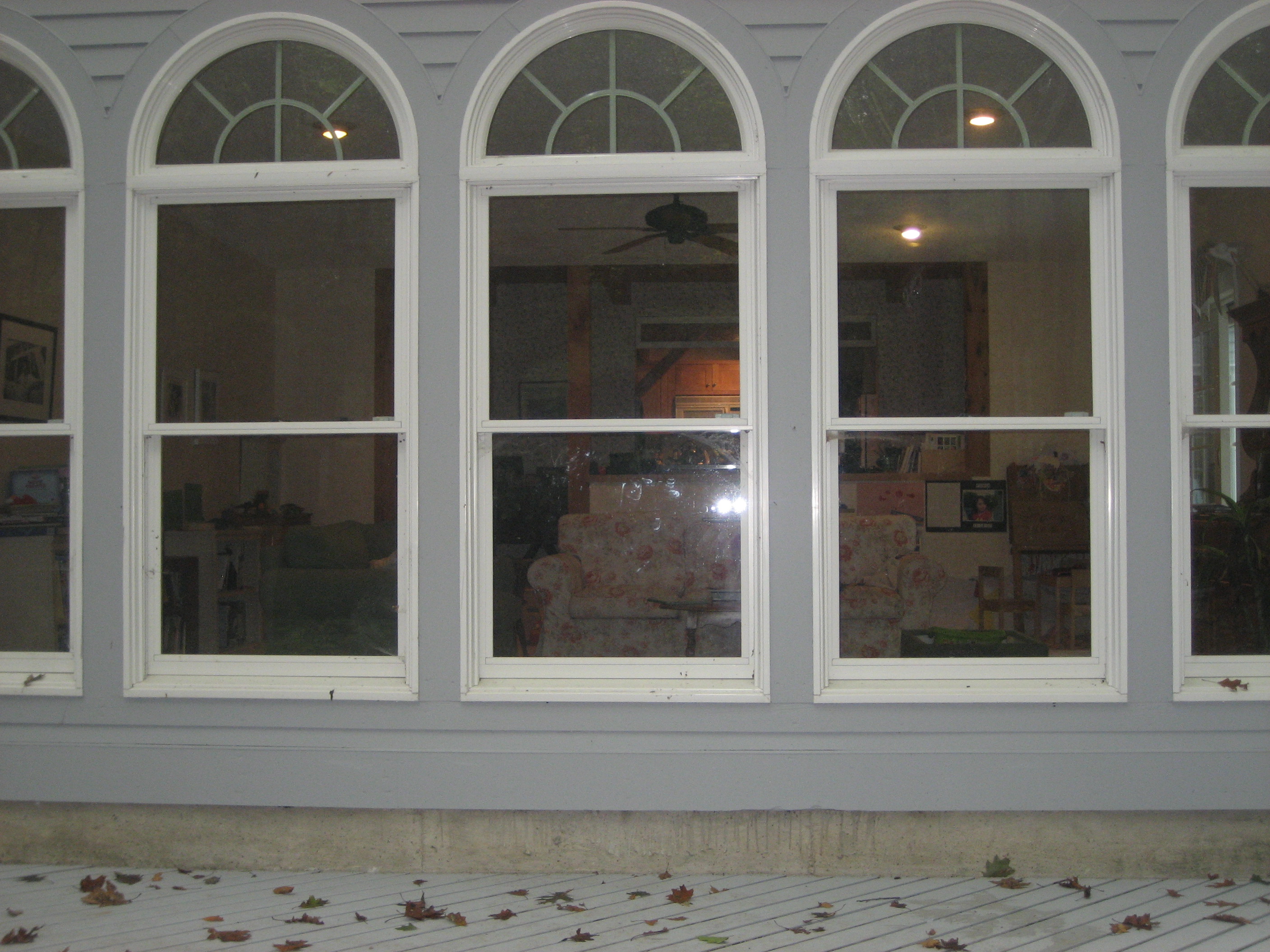
Because we live in the woods, our yard is very beautiful and our house – particularly during those times of year when all the leaves are on the trees – can get very dark. Probably for both of those reasons, our house was constructed with many windows. We have eight windows on the first floor alone, plus an entire wall of floor-to-ceiling windows in the Sun Room and five sets of sliding glass doors.

When we moved in, every single one of these windows was covered by blinds.

There were heavy wooden horizontal blinds hung above each window, and vertical blinds to cover the sliding glass doors. It was kind of the previous owners to leave us their window treatments, which were in good shape and had probably been installed with much effort and expense.

One of the first things I did after we moved in was to remove all the blinds from the first-floor windows.

Okay, I didn’t remove the blinds; at the time, I was busy unpacking, painting, nursing a three-month-old, and supervising two rambunctious toddlers. But when my parents, who were helping us move in, asked what I wanted to do about the window treatments, I said, “Take them all down!”

A friend recently lent me a wonderful book of essays by Shauna Niequist called cold tangerines. In an essay titled “basement,” Niequist makes the case that our homes are like mirrors for our selves: the rooms we love the most often contain qualities of who we’d like to be; the rooms we hate the most reflect facets of who we fear we are.

Yes, this is going to be a metaphor for my life. Because it’s like my house knew, even before I did, the kind of life I wanted to lead.

I’ve realized over the course of this year that I want to live a life that’s open, unobstructed: a life without blinds. I’ve spent so much of my life with the blinds drawn, trying to hide parts of myself from the outside world, trying to protect myself. But you know what? It’s a lot of work having to continually raise, lower, and clean those blinds. And they get in the way of my view; it’s hard to see clearly through my blinds to other people, to the beautiful world outside.

Writing has been a major — if not the major — step towards taking down the blinds of my life. This past winter, I started writing (and publishing) more of what I was really thinking and feeling. I admitted that I wasn’t perfect, with perfect kids and a perfect house. I wrote honestly about my faith for the first time ever — something I’d always been terrified to do for fear that people would assume I was going to start judging them or trying to convert them. These were all big steps for me.

I’ve been amazed by the grace with which people have responded. My favorite thing about writing — and life — is that it allows for so many “You, too? Me, too!” moments. Because trying to write as my honest self is very, very scary. It’s scary for the same reasons that some of my family members were horrified that I had no blinds on my first-floor windows: “But people can look right in and see you!” gasped one relative.

Of course, it’s much easier to live without blinds on your house than to live without blinds on your life. My response to “But people can see you!” is: What people? We no longer live in Manhattan or Berkeley; for much of the year, we can barely see our neighbors’ houses through the trees. Somebody would have to go to an awful lot of trouble to look through our windows. And even if they did, So what? They’d see a family, going about our normal, loud, crazy, loving business. We’re not cooking meth in the kitchen or torturing chipmunks in the living room.

It’s much harder to apply that logic to my life.

I’m writing this as a prelude of sorts: within the next couple of days, I’m going to publish one of the most personal things that I’ve ever written.

I’ve written about what happens when you end up living in a college town that’s almost an exact replica of the town where you yourself attended college: the thoughts, memories, and emotions that get dredged up. To leave out this aspect of our move to Vermont would be a major omission.

Don’t get too excited or worried: this is a big deal for me, but that’s because I’ve been living with the blinds drawn for so long. There are no bodies in our basement, no fourth Gong child stashed in our attic, no secret bank account in the Caribbean.

I’m going to publish this piece, and then I’ll probably go back to writing about our mice and bugs and wacky daughters. This blog is about our life, and our life these days is mostly about mice and bugs and wacky daughters. I’ve no interest in starting down a path of gratuitously emotional soul-baring.

You see, as much as I want to live an open life, it’s important to set appropriate limits. I removed all the blinds from our first-floor windows, but I left up all the blinds on our second-floor windows. Not because that’s where we cook the meth or torture chipmunks, but because there are things we do on the second floor — where most of our bedrooms and bathrooms are — that are and never will be anybody else’s business.

So there you have it: my philosophy of life, writing, and home decorating all wrapped up in one little metaphor. It’s a little scary, a little less safe, this life without blinds. But the views are amazing and there’s a lot less upkeep required.

Requiescat in Pace, Pulli*

*Latin for “Rest in Peace, Chickens.” Yep, I took a little Latin in college.

I’m gonna keep this brief, because if you know me well or keep up with me on Facebook, it’s old news. But I figure it’s a narrative thread that I need to tie up, so here goes:

We no longer have any chickens.

You may recall that, a couple of weeks ago, Brinkley killed one of our chickens, bringing the total down to three. Earlier this week, two neighborhood dogs finished the job.

It was a grey Monday morning, and it’d been raining for three days. As usual, I’d fed the chickens and let them out of their coop at around 6:30 AM, but what with the rain and the recent Brinkley attack, they were inclined to stay up in their roosting area.

At around 9 AM, as I came downstairs from wrestling the girls into a relative state of cleanliness and dressed-ness, I looked out the kitchen window and froze: there were two chocolate labs, dogs that I’d seen running through our yard from time to time, INSIDE the chicken fence with mouths full of feathers. Chicken corpses littered the ground at their feet. I knew right then that they were all dead.

I pulled on my boots and raced out the door to yell at the dogs and get them out of the coop. The girls followed me outside. “HEY! Get outta there!” I shouted. The dogs looked at me calmly and ambled away. I suggested that the girls stay inside, because the scene looked pretty gory, but they insisted on coming with me.

It was a mess. The dogs had bashed their way through the wire fence, and then ripped a wall out of the chicken coop in order to pull the chickens down from their roost. Body parts and pieces of wood were everywhere. I checked around to see if there were any survivors, because it was hard to count the total kill based on the partial bodies strewn around. No survivors.

“Gross,” Fiona said. “That’s even grosser than the dead chipmunk.” (A small specimen of roadkill that represented her grossest dead animal — until now).

I don’t know what made me think it, but I decided to call our next-door neighbor, Brinkley’s owner. I figured she’d know who owned the dogs, and she might also appreciate knowing that she wouldn’t have to worry about Brinkley killing our chickens anymore. This was one of the best calls I’ve ever made. Not only did she know the dogs’ owner (turns out these dogs have a reputation for breaking out of their electric fence and roaming the neighborhood, and were even on the Forest Service’s “warning” list for chasing deer), but she offered to call the owner for me.

Then she asked, “Have you cleaned it up yet?” I told her I hadn’t.

“I’m coming over right now to take care of it for you. You shouldn’t have to clean that up with little ones in the house,” she said. And no matter how much I protested, she insisted.

A few hours later, the dogs’ owner called and was as sweet and apologetic as could be. But, what can you do?

Aside from the four dead chickens, the worst thing about this is the sense of waste. It took a LOT of time, effort, and expense to raise these chickens over the past five months. They would’ve started laying eggs next month, and we never even saw that pay-off.

But the way I see it, the good things outweigh the bad. Here they are:

1. I learned that I have the absolute best neighbor in the world. I would give our next-door neighbors my kidney, my right arm, even one of our girls (hmmm….) for the asking. At the very least, I hope I have a chance to clean up some dead animals for them in the future.

2. I got to have some good conversations with our girls about death and nature throughout the day — about dogs being dogs, chickens being chickens, and death being part of life.

3. I have one less thing to take care of. It’s funny that I’d just written about adding things to my life, and my mom’s concern that I was taking on too much. Apparently the universe agreed with my mom. (Don’t you hate it when that happens?) The way I see it, these chickens were taken out of our lives at the perfect time, making way for the new puppy that’s set to arrive later next week. And I can’t say that I’m sorry not to have to feed the chickens on those cold, dark winter mornings when I’ll already be taking the dog out to relieve herself.

We learned a lot. We had fun with those chickens. We’re not the only people we know who’ve lost an entire flock to predators. And if we get more chickens next spring, we’re also getting an electric chicken fence.