No Sudden Moves

One of the lifeboats from the Titanic.           National Archives photo.

Originally published in April 2012. I had to chuckle when re-reading this piece, because clearly it’s fortunate I didn’t end up making any sudden moves career-wise. An appropriate re-title might be: “No Sudden Moves, And Remember the Birth Control.”

I just read a fascinating article about the sinking of the Titanic, which addresses the question: Why didn’t the passengers panic while the Titanic was going down? Apparently, this is of great interest to economists (economists are strange), because they believe that people usually act out of their own self-interest. Three years after the Titanic sunk, the Lusitania, another luxury ship with a similar number of passengers, also sank. But the passengers on the Lusitania panicked, whereas while the Titanic went down, the band famously began playing music, doomed men strolled around smoking cigars, and order prevailed. What made the difference?

The answer to this question is proposed by an economist (so you can take it with a shaker full of salt); he theorizes that the Titanic passengers didn’t panic because the boat took longer to sink. The Titanic took about 2.5 hours to go down, whereas the Lusitania sank in under 20 minutes. David Savage, the economist who proposed this theory, says, “If you’ve got an event that lasts two and a half hours, social order will take over and everybody will behave in a social manner. If you’re going down in under 17 minutes, basically it’s instinctual.”

In other words, it takes time for our best instincts to win out.

This article fascinated me because it seems to support something I’ve been telling myself repeatedly over the past couple of months: “No sudden moves.”

I track time by the photos that show up in the “Last 12 Months” category in my iPhoto program, so I can tell you that exactly one year ago, we had just bought our house in Vermont, Erick was graduating from his PhD program at Berkeley, Georgia was getting baptized, and our California house was slowly filling with moving boxes. Around the same time, Erick and I decided that since he finally had a full-time job, and since our family was going through so many major transitions, I should take a year to focus solely on the home front. A year without thinking about any work outside the home. A year in which my job was to help a husband and three young children adjust to our new life. It turned out to be a great decision, I’m thankful that I had the luxury to even consider it, and it’s been a special year for our family.

But that year is almost up.

Which means that I’m thinking about thinking about what my next move, if any, should be. And that’s why I keep telling myself, “No sudden moves.”

This doesn’t come naturally to me. In fact, the reason I’m telling myself to slow down is because I’ve done the opposite for most of my life. I’ve never been someone with what you might call a “life plan.” I went to college with no firm idea of what I wanted to major in or what I wanted to be. Post-college, if I liked something, I decided that’s what I should do. If I got accepted for a job or graduate school, I jumped. When we reached a stage at which it seemed like we should be thinking about kids, we tried to have kids (and, fortunately for us, everything happened pretty quickly). I bopped through about a decade of post-college life in this completely unintentional, take-whatever-comes-my-way fashion. Even moving to Vermont, though practical and wonderful, followed this pattern: Erick was offered a job in February, we had a baby in March, bought a house in April, and by June we were here.

I can’t say that I entirely regret my lack of a coherent path; all of that strikes me as what you should be able to do in your 20s, and each experience was important in its way. But now I want to do things differently. Thoughtfully. Slowly. No knee-jerk reactions, no taking a job just because it’s there. No sudden moves.


In other words, I’m trying to behave more like a passenger on the Titanic. Because I think that David Savage is probably right; given more time, it’s our better instincts that tend to prevail.

I’m actually trying to behave this way throughout my life, because I don’t think this rule applies only to sinking ships or career decisions. Give anything a little more time — be it parenting, relationships, or major purchases — and I’m less likely to act out of instinctual panic, more likely to make wise choices. Sometimes this means closing my eyes, biting my tongue, and taking several deep breaths before dealing with a kicking, screaming child, but it usually leads to a better outcome.

Of course, taking too much time can also be counter-productive, the equivalent of “rearranging the deck chairs on the Titanic.” Whether or not there’s an open spot on the lifeboat, at some point you have to get off of the sinking ship. So, I’m aware of the need for balance; no sudden moves, but no spinning my wheels for years waiting for some unattainable “perfect thing.” (And, by the way, I’m also aware that EVERYTHING I’m writing about here is a luxury: being able to find jobs after college, being able to take a year at home, being able to take time making decisions. If I were a single mother or if Erick lost his job or if I’d graduated college a decade later, I might suddenly find myself on the Lusitania, even if I wanted to have a Titanic mindset.)

Here’s one more fascinating fact I learned from the article: regardless of the passengers’ behavior, the Titanic and the Lusitania each had roughly the same number of survivors. Which means that whether they behaved calmly or panicked, the same percentage of people made it off each boat.

That could be a discouraging fact: whether you calmly light up a cigar while allowing women and children to board the lifeboats first, or whether you crawl over fellow passengers in order to make it to safety, your chances of survival are the same. If you’ll allow me to extend the ship metaphor a little further, I suppose what it comes down to is this: we all know that the ship sinks in the end, but none of us really know how long that’s going to take. So, how to behave in the time we’ve got?

I say: take a stroll, light up a cigar, listen to the music, let other people go first.

No Sudden Moves.

How I Learned to Stop Worrying and Be Patriotic

3623725380_8bf6186171

I’m part of Generation X. I don’t do patriotic, or nostalgic. I grew up in the era of MTV, “Greed is good,” and the Internet explosion. My generation had it easy, so we’re often (rightly) considered selfish, cynical, and apathetic. For most of my life, the U.S. government has done embarrassing things in public, which tends to discourage a sense of national pride. What was there to be proud of?

To find out, continue reading my latest “Faith in Vermont” column in The Addison Indpendent.

Uphill and Down

Looking down into Smuggler’s Notch from the Long Trail North.

Originally published in July 2012.

Erick and I have always loved hiking, and we used to hike fairly often…pre-kids. The last substantial hike we took was when we left 6-month-old Fiona with her grandparents and took off on a day hike in California’s Pt. Reyes State Park. If you do the math, that was FOUR YEARS AGO.

Unless you’re a masochist, hiking any further than 1/2 mile with children under the age of 5 is just not very fun. Somebody — usually the oldest, heaviest child, NOT the baby who’s already strapped to your back — is always whining to be carried, somebody always has to pee and then misses and gets soaked, somebody always needs a drink or a snack. Our two older girls are reaching ages at which we can see the glimmer of pleasant future hikes together, but for now we still have to catch them both on a good day.

So, when Erick’s parents were visiting this June, we jumped at the chance to leave the girls with them for a night, and headed off for a hike in Smugglers’ Notch State Park in Stowe, VT. Smugglers’ Notch got its name back in 1807, when President Jefferson banned trade with Great Britain and Canada. This was rough on northern Vermonters, who relied on trade with Montreal. So, during the trade embargo and later during Prohibition, goods were smuggled to and from Canada through this narrow pass in the Green Mountains.

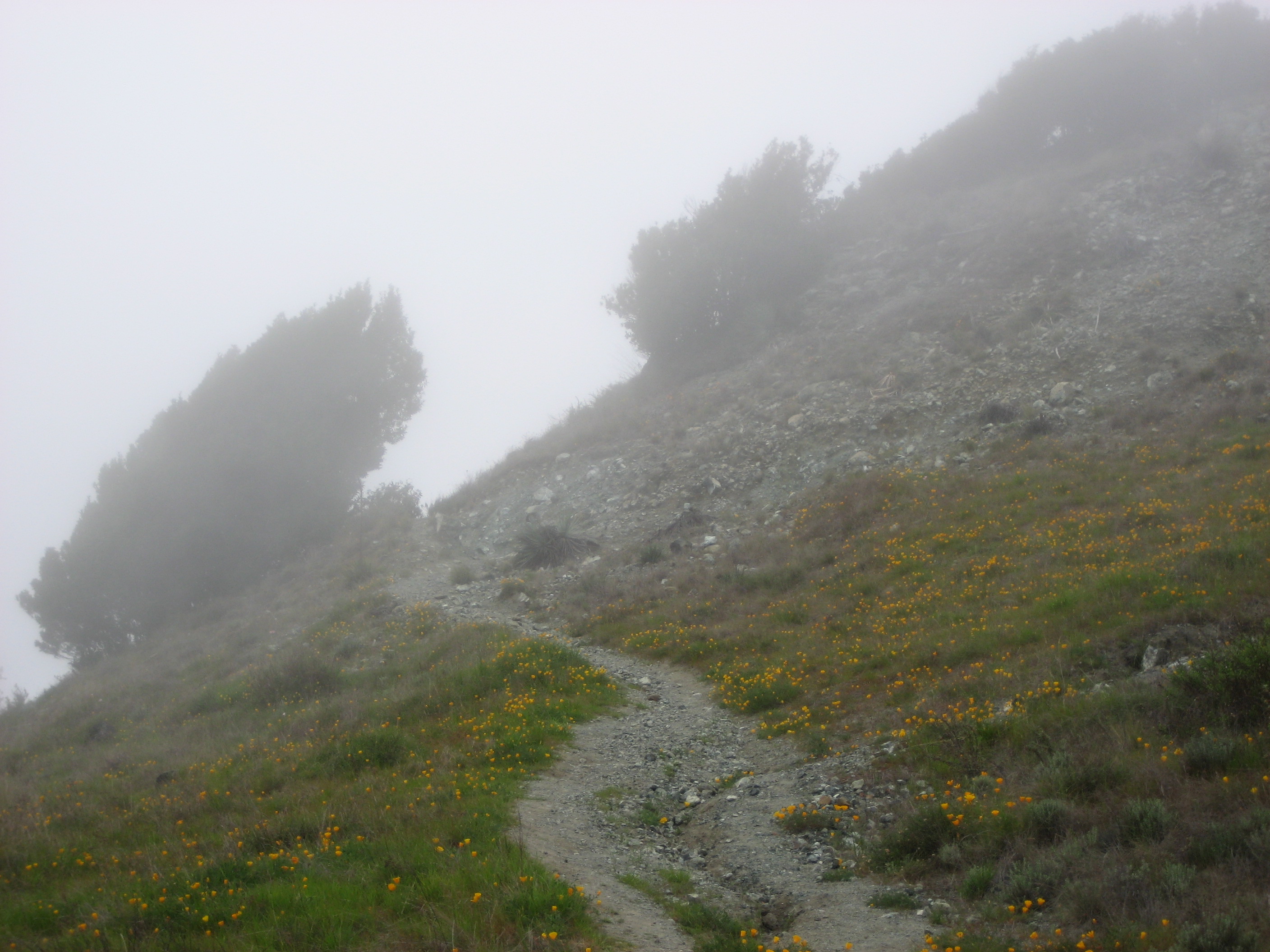
And let me tell you: those smugglers had a tough job — I seriously doubt that much of the liquor made it through the Notch untouched. Erick and I opted for the Long Trail North to Sterling Pond, a 6.6-mile round trip hike with an 1,800-foot elevation change. The trail was rated “difficult,” which was no overstatement: it was steep, and rocky, and muddy in many places. But it afforded some stunning panoramic views of Mt. Mansfield (Vermont’s highest peak) to the west and Spruce Peak to the east. We ate our picnic lunch of bread, cheese, and salami overlooking pristine Sterling Pond. Best of all, the hike gave us FIVE HOURS of peace and quiet; Erick and I aren’t big talkers on our hikes, and on this hike we were so winded most of the time that talking wouldn’t have been an attractive option in any event.

A portion of the trail: believe me, this looks much easier than it was.

During those five hours of quiet,  I thought about a question that my sister-in-law had asked me a week earlier, a question that had been weighing on my mind because I wasn’t satisfied with my initial answer. And on that hike, I arrived at a much better response.

The question was this: “So, it gets easier, huh?”

By “it,” she meant parenthood.

My sister-in-law, who is an amazing mother to the most adorable two-year-old nephew on the planet, was not the first person to ask me this. I’ve been asked versions of this question for most of my parenting career by mothers who are just a step behind me, and I’ve asked the same question of mothers who are a step ahead of me. With three children under the age of five, I’d hardly seem like an expert. But when my sister-in-law posed her question, I got it: I no longer have a newborn, and I’m right on the cusp of having multiple children in school. With kids in my house who can feed themselves, dress themselves, forgo diapers, and verbalize their needs without screaming (often), I’ve reached the next level: the level that comes after the brain-fogged survival of the newborn years.

So when my sister-in-law asked if parenthood gets easier, my first response was: “Yes,” because you should always give people hope.

But you should also be honest, so I added: “Well, it gets different.” That’s what mothers of older children are always telling me, and from my limited experience I know that it’s true. Then I floundered around that statement for awhile without accurately conveying what I think it means. Our hike helped show me what it means, so here goes:

I think the first couple years of parenting, especially the first couple years of parenting your first child, are like the initial ascent on a mountain hike. They’re HARD: the terrain is unfamiliar, you’re using muscles that you probably haven’t used in a while, you’re weighed down by a ton of gear in your pack (say, for instance, three bottles of water, a two-pound bag of trail mix, and a rain parka), you have to keep your eyes down on the ground because if you look ahead you’ll get discouraged, and sometimes the only thing to do is just to crawl on all fours.

I’ve done a fair number of these mountain hikes, and each time I make the same mistake, even though I know better; while I’m scaling that trail, I think to myself, “This’ll be MUCH easier on the way back down.”

Of course, it’s NOT AT ALL easier on the way back down, it’s just…different. Your pack is probably a little lighter, because hopefully you’ve drunk some of your water and eaten some trail mix. And the going may be a bit faster, but descending that slope is hard on the knees and toes, the tree roots that supported your feet on the way up now want to trip you, and sometimes the only thing to do is to scootch down on your bottom.

It’s kind of like the parenting that follows those first years: you’re done with diapers and middle-of-the-night feedings, sure. But instead you get to see your children’s hearts broken by friends, you start to see all of the neuroses and flaws that you know will plague them for life, you have to deal with their various anxieties in areas that you never expected. You’re up in the middle of the night again, but this time you’re wondering whether your child will ever have friends, and whether those friends will be good friends or will introduce your kid to crack cocaine and reality TV, and whether your child is just going through normal development or whether you need to call in a child psychiatrist stat.

It gets different, not easier.

But the things that keep me going during a hike are pretty much the same things that keep me going in parenthood. Sometimes the trees open up on a vista — mountains, sky, valley — that truly takes your breath away, a view you wouldn’t have experienced without that climb. Sometimes there are simple, quiet, delicious lunches by the pond. And sometimes you meet people like the couple we passed on the trail: not a day under 70, coming back down as we were going up, and chipper as could be. After we saw them, there was no way we were complaining for the rest of the hike.

A view of Mt. Mansfield from the trail.

And on the way back down, I found it easier to drop my worries about whether it was going to rain or how much longer it would be to our destination, and instead I just felt thankful. Thankful for the smallest things: the breeze, that cloud that provided a minute of shade, my hardworking legs — especially my knees, my awesome moisture-wicking hiking socks, the evergreen branches that some kind hiker had laid across the muddiest patches.

After all, you don’t want to get back to the parking lot and realize that you spent the entire hike wondering when it was going to get easier.

Sterling Pond.

The Second Day

Originally published in September 2012. (Side note: Campbell’s “Second Day” ended up lasting the entire year. “I hate school! I’m not going!” she’d announce with a big grin EVERY MORNING she had preschool. Then she’d skip happily through the school doors without a backwards glance. This may be a kid who’s whole life is one big Second Day!)

Fiona and Campbell started preschool at the end of August. For Fiona, this was a return to the same preschool, same classroom, and same teacher as last year. Her fellow students, however, were almost entirely new to her. (Because of Fiona’s November birthday, she was placed in the four-year-old class last year; because the cut-off date for kindergarten is September 1, Fiona and a few other classmates will spend another year in the four-year-old class, while most of their peers from last year move on to kindergarten).  For Campbell, starting out in the three-year-old class next door to Fiona, the whole experience was new.

Both of them were hugely excited for the first day of school — but not as excited as I was!

There’s a lot of build-up before the first day of school each year: anticipation, nervousness, new clothes and shoes and supplies. Even I felt a little nervous, although my main priority was just getting the kids out of the house. I hoped and prayed that Fiona would make friends and be happy with her new peer group. I hoped and prayed that Campbell would respect her teachers and be kind to the other students and avoid inappropriately using the word “poo-poo” — at least for the first day.

But, having done the first-day-of-school thing last year, I also knew this: It’s not the first day of school that’s the issue; it’s the SECOND day.

See, the first day, everything is fresh and exciting. There may be jitters, there may be wrenching goodbyes — but in my experience, adrenaline mostly carries everyone through. I’ve been the mom patting myself on the back after the first day of school, proudly relieved that my child had NO PROBLEM saying goodbye.

And then the second day hit.

By the second day, the kids have wised up. It’s not fresh and exciting anymore; instead, they can see past the new clothes and school supplies to the rules, expectations, and social minefield that they’re going to have to navigate EVERY SINGLE DAY. You mean I have to KEEP GOING?!? their eyes seem to say.

I was thinking about this as school began, and I realized that much of what makes life hard has to do with The Second Day. It’s not always literally the second 24-hour day, but it’s the state of mind we face when the newness has worn off. Think about it: You get married, and at first you’re swept along through the wedding and honeymoon, but pretty soon comes that Second Day, when you stare at your partner across the table and think, You mean I have to KEEP GOING?!?

Or, say, you have a baby, and you’re all jazzed up because you survived labor and now you have this cute little munchkin and you’re getting all sorts of attention and your house is stuffed with nifty new baby supplies…but then you come home from the hospital and have to face the Second Day, when nobody cares anymore that you have a new baby (except your parents — they’ll always care), and all your clothes are covered with bodily fluids and that munchkin is STILL waking up every two hours and you think, You mean I have to KEEP GOING?!?

OR maybe you do something really great in your profession/vocation/calling/art: you win an award, or obtain a degree, or invent something new, or create a painting/performance/book/film/play/blog post that people really like. Congratulations! You feel like your existence is finally validated…for about 24 hours. Because then comes that Second Day, when you have to sit at your desk or computer or easel again, and you think, You mean I have to KEEP GOING?!?

OR EVEN, let’s say you move to a small town in Vermont, and everything is new and wonderful. You love your new house, your new friends, the new landscape — your entire new lifestyle. But then the second year rolls around, and suddenly nothing’s quite so new anymore. You’ve seen all these seasons before, done just about everything there is to do at least once. And one dark and freezing winter morning, when you’re heading outside to feed those damn chickens AGAIN, you think, You mean I have to KEEP GOING?!?

Hey, it could definitely happen.

That Second Day is no joke. Based on the examples above, I’d venture that it’s the root cause of many cases of divorce, postpartum depression, and personal and professional burnout. I myself have experienced it plenty. In fact, I abandoned my first profession — teaching — because after four years I just couldn’t face a lifetime of Second Days in the classroom.

I have no tips for avoiding the Second Day phenomenon. It’s an inescapable part of life. Nothing stays new forever; if every day were a FIRST day, life would eventually become hyperactive and exhausting. All I have is this insight: the Second Day is difficult and depressing, but if you persevere through it, that’s when things start to take root and get really interesting. Marriage and parenting will always be HARD WORK — filled with multiple Second Days — but when I think back to my husband on our wedding day, or my kids when they were first born, I realize that I love them now with much more richness and complexity. I wouldn’t go back to that first day for anything.

I suppose the best way to handle Second Days is to anticipate them. I know now that I need to be just as prepared — if not more — to help my kids navigate that second day of school. I need to linger with a few extra hugs and kisses at the door, maybe even slip a little love note or special chocolate treat into their lunch bags. I need to offer encouragement that the most worthwhile thing in life — deep and genuine LOVE: for others, for what you do, for where you live — requires pushing past that Second Day. Perhaps we should all treat ourselves accordingly when we face life’s Second Days. Especially the extra chocolate treat.

So, now I’ve thought this through, and I feel more equipped to tackle those Second Days. But you know what?

I still have to get up tomorrow morning and feed those damn chickens.

Dare to Date

IMG_1824

The best parenting advice I’ve ever received came when our oldest daughter was one year old, and I was pregnant with our second. My husband had arranged for his parents to watch our daughter for TWO NIGHTS so that we could take a brief getaway.

I was a little freaked out.

Click here to continue reading about dating post-kids over at On the Willows.

Born in Vermont

IMG_2314

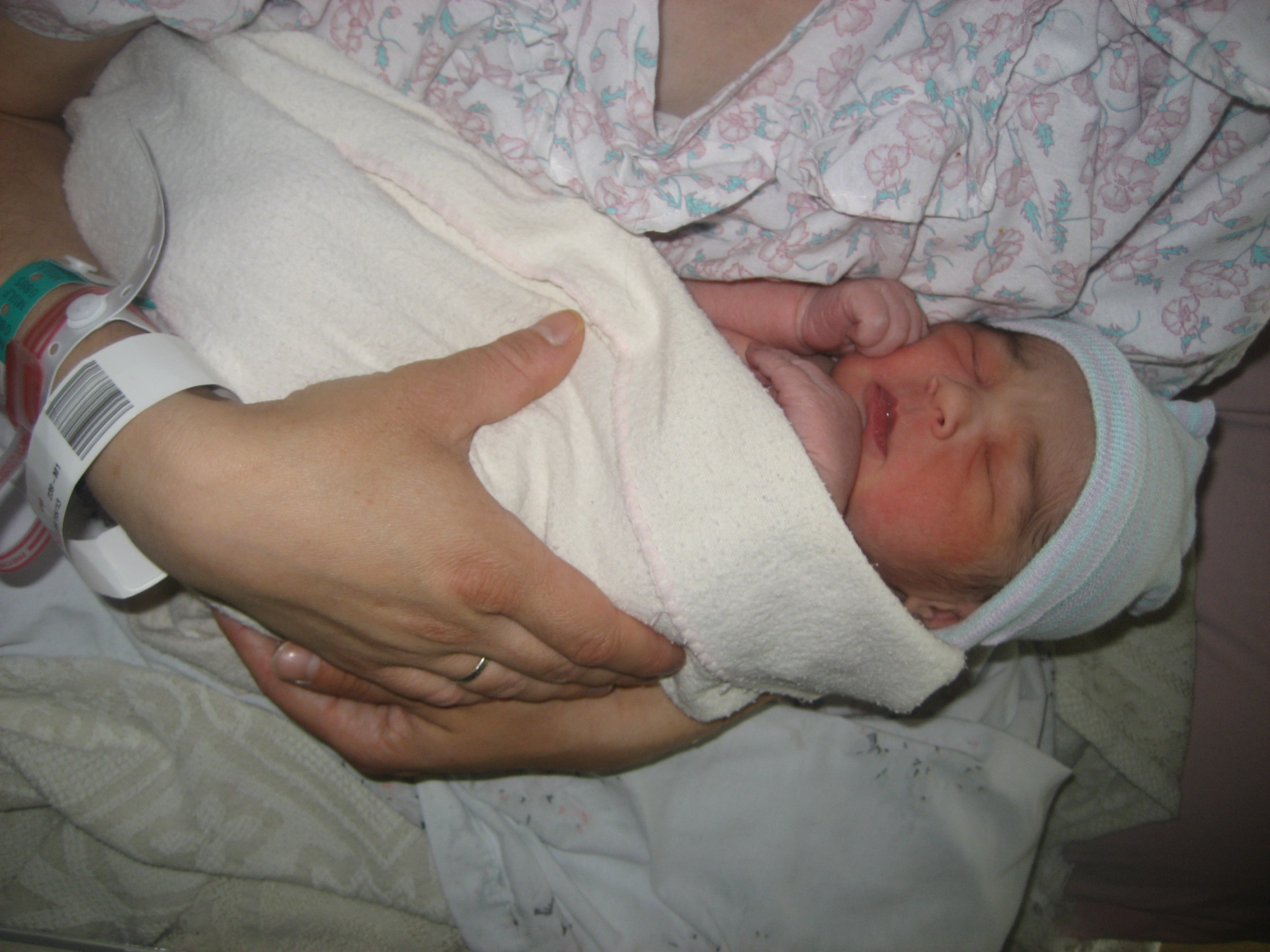
This Father’s Day, the Gong family did our part to increase Vermont’s native population: at 3:30 AM, our fourth daughter, Abigail Esther, was born at Porter Hospital’s Birthing Center in Middlebury.

Click here to continue reading my latest “Faith in Vermont” column in The Addison Independent, about our experience giving birth in a small-town hospital.

How to Talk to a Mom

Originally published May 2012. Unfortunately, given recent events, this is going to be true of my conversation for many years to come.

Since becoming a mom, I have become a terrible conversationalist.

As with anything I write here, I can only speak for myself. So this may be particular to a mother of three young children who is a recovering social perfectionist, doesn’t work outside the home, and has moved cross-country within the past year. I’m also not sure that I was a master of sparkling conversation before having children. I can’t remember those days very well; if I had to guess, I’d say I was only average with the chit-chat back then.

Which is much, much better than what I am now.

If you attempt a conversation with me these days, you will find me in one of two modes, neither of them eloquent. Whichever mode I’m in depends entirely upon external circumstances: whether or not my kids are with me.

Scenario #1: The Kids Are With Me.

I will be able to have, at most, two minute blocks of uninterrupted conversation with you. I will probably never make eye contact; instead, I’ll be scanning the room continuously to make sure I keep tabs on all three children. My side of the conversation will go something like this: “Uh-huh… yeah…. Excuse me just a minute. Campbell, SHARE!… Sorry, where were we?… Oh, right….Excuse me. Fiona, I’m talking with a grown-up. Just a minute, please…. So, wait, you were saying…? Oh, yup….Sorry, hang on. Oh, Georgia, what’s wrong?”

And so on. The conversation will end in one of two ways: either I’ll become engrossed in our conversation and establish eye contact for four seconds, in which case I will inevitably lose one of the kids (Campbell) and have to excuse myself to search frantically for her, OR one of the kids will have a complete melt-down (this is more likely the closer it gets to mealtime) and I’ll have to make a quick exit with a screaming child. I will smile apologetically and say, “I’ll catch up with you later.” (“Later,” I believe, is code for “in about five years”).

Scenario #2: The Kids are NOT With Me

This is a very rare occurrence. These days, this scenario applies mostly to occasional Moms’ Nights Out, or to doctor appointments. You’d think that being free of the kids, free of distractions, would liberate me to spread my wings and emerge as a conversational butterfly. Not the case, unfortunately for you.

First of all, I’m used to conversations that have to be crammed into two-minute time slots. It’s like eating: I usually bolt down my food as quickly as possible in order to deal with the numerous crises that happen every meal with three children, but if I’m eating without my children, I still bolt down my food in a matter of seconds. It’s become a habit. The same habit applies to conversation: I’m used to rushing in order to get the most conversational bang for the time I have, so even without children around I talk waaay too fast. And I start to feel panicked if the conversation extends beyond two minutes.

Also, you may be the first adult, aside from my husband, whom I’ve spoken with in over a week. (Not counting harried two-minute exchanges with other moms or brief pleasantries with check-out clerks). If we’re standing face-to-face and I’m looking you in the eyes and none of my kids are on the premises, this is an Event. And I have so much to say; all of the me that I can’t share with my kids will come gushing out like a horrible case of verbal Montezuma’s revenge. I can’t help it. I suspect that this is why so many moms have blogs: so they’ll have an outlet for those spillover thoughts and will talk less in social situations. It kind of works.

Finally, I’m really tired. I can’t claim that mind-numbing exhaustion that you have with a newborn; I’m fortunate that all three of our kids now sleep through the night. But I’m still really, really tired. Which just exacerbates the speedy talking, the verbal runs, and possibly some bizarre comments or tripping over words, because I’m lacking my full filtering capacities.

So, How to Talk to a Mom?

First, even if all of the above scares your pants off, you definitely should talk to moms. Because it’s a nice thing to do. Moms are usually starved for conversation with other grown-ups. Look at it as your act of charity for the week. But here are a few tips to get you through it:

1. Be patient, merciful, and understanding. Remember that you’re talking with someone who’s used to having to rush through all interactions, who may not have had a sustained social conversation with another adult in quite some time, and who is probably exhausted. If the mom rattles on or overshares, give her the benefit of the doubt.

2. Don’t feel like you have to ask about the kids. If you ask me about my kids, I’m going to have to tell you about my kids. And that might become a conversational snowball, rolling downhill out of my control. I can tell you a lot about my kids, but while I’m doing it I’ll be feeling horrible remembering how much I used to hate having to listen to other people talk about their kids (before I had kids, of course). So, I promise that I won’t be offended if you don’t ask about my kids. And I’ll be delighted if you treat me like any other normal person who thinks about things other than her kids. Because I do. Ask what I’ve read lately, ask about current events, ask about my vacation plans, whatever.

3. Talk about yourself. These days, if you ask me about what I’ve read lately, current events, or my vacation plans, I may have nothing much to say. In this case, I suggest that you talk about yourself. Usually, talking too much about oneself is frowned upon in social situations, but talking with a mom is an exception.  I say: Please feel free to rattle on about yourself. Give me the whole monologue — you’ll be doing me a favor. In talking about yourself, you’re taking the pressure off of me. I won’t worry about talking too long or too fast or too much about my kids if I can’t get a word in, and I’ll feel like I’m doing a swell job holding up my end of the conversation by just smiling, nodding, and asking the occasional question. I may be fascinated by what you’re saying, or I may zone out and plan what I’ll make for dinner the next week, but either thing is a gift to me.

Okay, then. I’ll catch up with you later!

Abigail Esther

IMG_2282

Almost everyone who follows this blog has likely heard the news by now, but it seems appropriate to make a brief announcement here, with a few more details:

We are thrilled to announce that FINALLY, 10 days overdue, our beautiful new daughter/sister decided to make her appearance! 
 
Abigail Esther Gong
6 lbs, 14 oz
21 inches long
Born 3:27 AM on June 16 (Father’s Day!)
A word about her names:
Abigail was chosen by Erick, and appropriately means “the father’s joy.” It’s also a family name, appearing in both my maternal grandmother and grandfather’s lineage. And finally, Abigail is a strong Biblical female character who appears in 1 Samuel 25. She’s described as “beautiful and intelligent,” and she overrides her loutish husband’s rudeness by showing hospitality to David (whom she later marries after her husband is struck dead).
We’re going to try to stick with “Abigail” and avoid “Abby,” but really, what can you do?
Esther was chosen by our other daughters — because, frankly, we were all out of female middle names. They like the Biblical character of Queen Esther, who stopped a planned genocide of the Jews by bravely speaking up.
We already know that she has a mind of her own and doesn’t mind making people wait; now with the names of two powerful and brave women, it should be interesting to see how our fourth daughter turns out!
We’re all back at home and doing well. Fiona won’t let anybody else hold Abigail if she’s around. Campbell’s stated goal is “to teach Abigail about horses” (Today’s lesson: “NEVER walk BEHIND a horse, Abigail!”). Georgia is giving Abigail lots of sweet head-kisses, and then trying to poke her eyes out. Gracie went through an initial freak-out because she couldn’t understand why a little person was stuck to me, but she quickly figured out that Abigail was one of her people. Now, whenever Abigail so much as peeps, Gracie runs over and licks her head.
This little baby is already showing an amazing tolerance for noise and chaos, which will serve her well.
As for Erick, poor Erick: he’s drawing up plans for a sound-proof bunker!
We’ve felt so loved and supported by family and friends during Abigail’s arrival. Thank you!
IMG_2291

Thoughts After A Fight

Originally published in May 2012, this was a really important post to me. It was the first time — although not the last — that I admitted publicly that I struggle with faith, that God and I don’t always seem to see eye-to-eye on how life should be. The process of writing through that grief helped me to resolve it.

****

NOTE: I’m kind of terrified to publish this. It wasn’t written for public consumption; I wrote it for myself last week, as a way of processing a tragic fight that I’d been witnessing. It’s also, because of its frank discussion of faith, something I’d usually submit over at On The Willows. But it just feels right to publish it here. For some reason I’ve heard from numerous people over the past weeks who are also struggling with loss. Just about everybody who reads this blog knows me, and many probably know the family in question (whose names and identifying details I’ve removed in order to respect their privacy during this horrible time). I’m putting this out there and trusting that whoever needs to will read it, and that maybe it will help a little. (Lighter fare coming soon).

Some weeks, faith feels like the middle miles of a marathon, or the transition stage of childbirth, or 4:30 PM everyday in our house: when you say to yourself, “I just don’t think I’m going to make it.” This has been one of those weeks.

A beautiful baby’s fight ended this morning. We met her parents several years ago at our church in California. Around the same time we moved to Vermont, they moved overseas to work as missionaries — missionaries with a deep respect for their host culture, who wanted to know their community and be helpful in meaningful ways. Her mama started work as an English teacher at a local school, and her papa was researching various business ventures. Shortly after they moved, they sent out an email announcing the happy news that they were expecting their first child. And shortly after that, the trouble started: about halfway through the pregnancy, her mama started leaking amniotic fluid. She was put on bed rest and received various treatments, but things didn’t improve. Miraculously, despite low fluid levels, the baby continued to thrive. And then, about a week ago, their baby girl was delivered two months early. She was born with a systemic infection that affected her vital organs, and a lung condition that prevented oxygen from being absorbed into her bloodstream. This sweet newborn was put on a ventilator in intensive care, where she fought for her life. Hundreds of people all over the world were praying for her by this point. Her life ended today, at 9 days old.

Her parents’ faith, as expressed in their email updates, appears to be Teflon-strong. But then, they’ve been in the middle of a fight. I know from experience that, faith-wise, it’s often harder to watch a fight from the sidelines than to be one of the participants — at least while the fight’s going on. When you’re dodging blows and trying to land punches, you don’t have time to think about whether it’s fair.

Here’s what I think, though (not that anybody’s asking): What’s up with THIS, God?!? Here’s a faithful couple that’s just trying to do everything you told them to do — to love and serve others — and what did it get them? Stranded in a faraway country with a high risk pregnancy and a premature baby, THAT’S what it got them. This was your chance to pull out all the stops, move some mountains. Miracle Time! WHERE WERE YOU?!?

This type of situation is where my faith starts to fray. And I know I’m not alone. Of course, there’s lots of suffering in the world, and all of it is tragic. But when it’s a baby or young child who is sick, suffering, dying — someone who’s barely had the chance to live — what’s the point? I can’t think of anything more unjust. As a mother, I can barely process these stories, because they’re the worst of my worst-case scenarios. Then I look at my three healthy daughters, and it’s an embarrassment of riches. It’s. Just. Not. Fair.

Frankly, God doesn’t give me a whole lot of help here. One example of many, which we tend to gloss over in the joy of Christmas, is that a direct consequence of Jesus’s birth was the Slaughter of the Innocents: King Herod ordering that all babies under age two be killed. What’s up with THAT, God?!?

I have no good answers. I have nothing helpful to say to our friends, these mourning parents, other than: “I’m so sorry. We’re still praying for you.”

But it’s not all radio silence from God, either. Because, the same week that this baby girl was born, I happened to be reading Annie Dillard’s essay, “Teaching a Stone to Talk,” in which she writes:

It is difficult to undo our own damage, and to recall to our presence that which we have asked to leave….What have we been doing all these centuries but trying to call God back to the mountain, or, failing that, raise a peep out of anything that isn’t us?…At a certain point you say to the woods, to the sea, to the mountains, the world, Now I am ready. Now I will stop and be wholly attentive. You empty yourself and wait, listening. After a time you hear it: there is nothing there….There is a vibrancy to the silence, a suppression, as if someone were gagging the world.

Oddly, reading this passage started to reweave my fraying faith. Annie Dillard reminded me that when we wait for answers that don’t come, it’s not because that’s just how things are; it’s because things are wrong. People end up in trouble far from home, babies get sick and die, and nature itself is gagging.

Wait a minute, you may be thinking, that’s the GOOD news? Well, yes. That things are horribly wrong at this moment in history doesn’t disprove the existence of God, or his ultimate goodness. Because the wrong-ness of a baby having to fight for life, and of nature’s silence as recorded by Annie Dillard, IS answered, almost directly, by Isaiah 55:8-13 (This is for my mom: See, Mom, I’m listening!) I’m going to quote the entire passage, because it’s good stuff:

“For my thoughts are not your thoughts, neither are your ways my ways,” declares the Lord. “As the heavens are higher than the earth, so are my ways higher than your ways and my thoughts than your thoughts. As the rain and the snow come down from heaven and do not return to it without watering the earth and making it bud and flourish, so that it yields seed for the sower and bread for the eater, so is my word that goes out from my mouth: It will not return to me empty, but will accomplish what I desire and achieve the purpose for which I sent it. You will go out in joy and be led forth in peace; the mountains and hills will burst into song before you, and all the trees of the field will clap their hands. Instead of the thornbush will grow the pine tree, and instead of briers the myrtle will grow. This will be for the Lord’s renown, for an everlasting sign, which will not be destroyed.”

I’ve mentioned before that Erick and I help our daughters — and ourselves — grapple with the unanswerable questions of sadness and fear by paraphrasing from The Return of the King: One day everything sad will come untrue. Praying for this baby, and then reading Annie Dillard and Isaiah, I realized that I often dwell in the everything sad, but I have so little vision for the will come untrue. Isaiah 55 helped me color in that vision a bit. Mountains and hills bursting into song? Trees clapping their hands? I tend to read that as poetic hyperbole, but what if it’s literal? I can hardly imagine singing mountains or clapping trees that don’t look like some corny CGI effect, and every day I see mountains and trees when I look out my window. What if that’s what actually happens when nature regains its voice?

And if mountains are singing and trees are clapping, what might this baby girl be doing on that day? You will go out in joy and be led forth in peace.

I usually forget to remember that when we pray, we’re praying for eternity. Not just for what will happen tomorrow, or next week, or next year. Our prayers stretch out of time through forever. My thoughts are not your thoughts, neither are your ways my ways. God has all the time in the world to make wrong things right, sad things untrue. And when that’s what we’re praying for, I have to believe that the answer will always, eventually, be YES.

I took all the photos in this post during a 2007 trip down the California coast (I was pregnant with Fiona but didn’t know it yet). They seemed strangely to fit.

Panic at the A & W

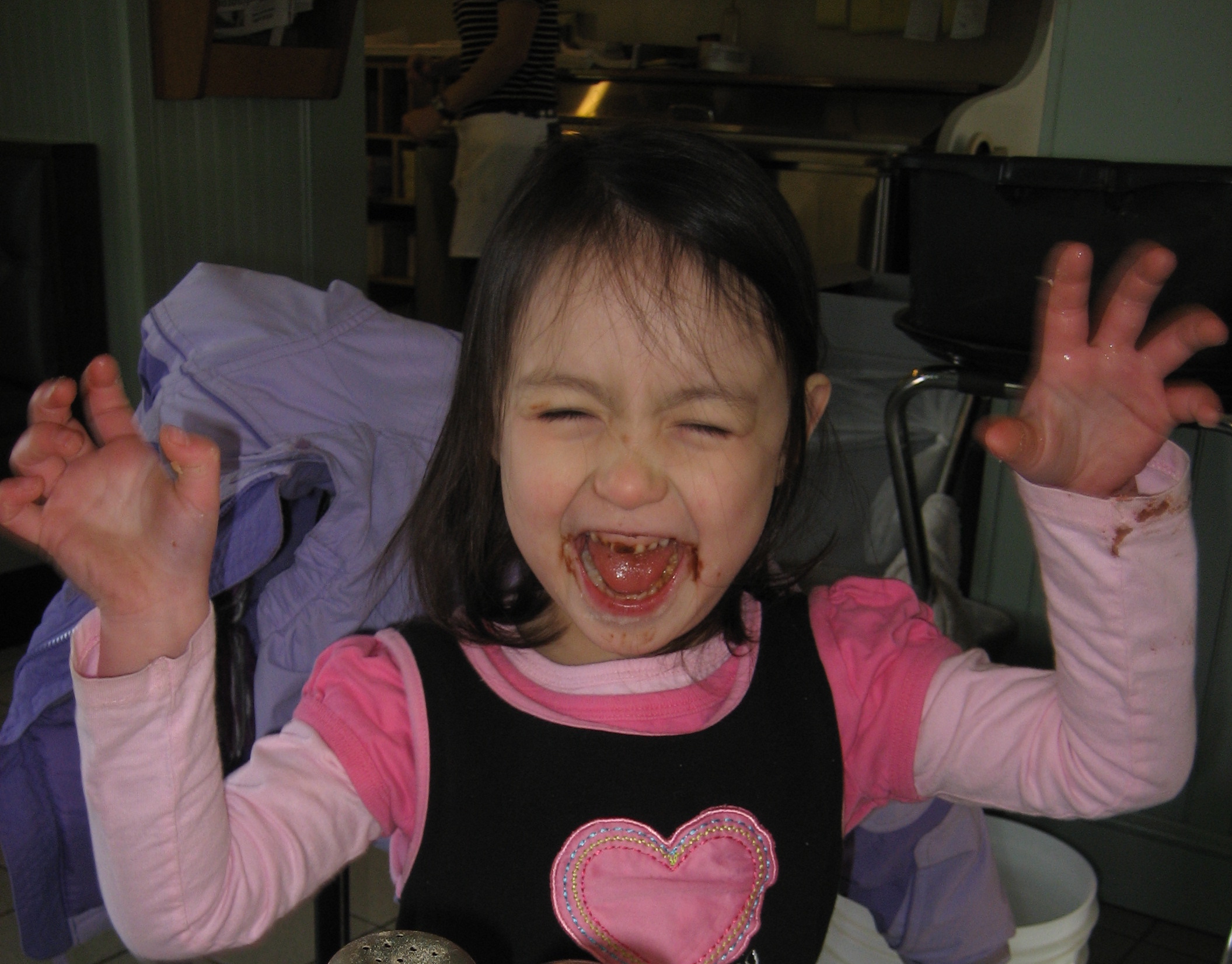
Fiona’s impression of “panic” — with a mouthful of chocolate doughnut.

This is one of my all-time favorite posts — and one of my all-time favorite memories from our first year in Vermont. (For the record, Fiona hasn’t done anything like this in a long, long time). Originally published April 2012.

Hello, my name is Faith, and I’m a perfectionist.

Actually, I’m a recovering perfectionist. I expect to be in recovery for the rest of my life.

This is not intended as a cute, “Boo hoo, I’m soooo perfect!” quasi-lament. On the contrary, I consider perfectionism to be equally as addictive as controlled substances, and potentially as damaging.

It sounds so positive, so socially acceptable: PERFECTIONISM. Like you’re packaging an admirable quality as an -ism so that it doesn’t come across as bragging. Saying “I’m such a perfectionist” is in the same league as, “Gosh, I wish I could put on weight!” or “Really, celebrity isn’t all it’s cracked up to be.”

But don’t be fooled: if you truly desire perfection, you have put yourself in an untenable position. NOTHING in life is perfect — or if it is, it doesn’t stay that way for long. So, by proclaiming yourself a perfectionist, you are placing yourself in opposition to the universe. And if that isn’t a recipe for bitterness, disappointment, and strained relationships, I don’t know what is.

Just as there are a variety of substances available for addiction, there are a variety of outlets for perfectionism. You may be a perfectionist when it comes to your work, your food and coffee (that was a big one when we lived in the Bay Area), your appearance. I am a (recovering) social perfectionist, which means that I care too much about what other people think of me in social situations.  I believe this is the perfectionism equivalent of crack cocaine: you can’t win.

One thing that my perfectionism sometimes leads me into is a little game I call “Script the Social Interaction.” In this game, before I head into a social situation, I script it out in my head beforehand. I think about how I want to come across, and I plan what I’ll say to the various people who will be there. Then, during the social interaction, I will actually give myself direction (“Nod less, smile more. NO, don’t talk about your kids!”). And of course, afterwards the critics weigh in (“Idiot! NEVER ask an economist about their research!!”). It’s like having the entire motion picture industry inside my head: crowded and exhausting.

(And please tell me that some of you do this, too. Even if you’re telling me very slowly and hoping that I don’t notice you dialing 911 behind your back).

ANYWAY, my point is that sometimes I do this, but I’m trying to stop as part of my perfectionism recovery. Because if you can’t be real and open with people, it’s impossible to have genuine relationships. If I’m only concerned with maintaining a perfect front during social interactions, what’s the fun in being my friend? I’ll bring nothing interesting to the relationship, and will only make you feel bad that you’re not as perfect as I appear to be. If, on the other hand, I’m able to relax and be myself and share imperfections like (theoretically): “Sometimes I yell at my kids and feel like a horrible mom,” or “Sometimes when my husband is talking about his day, I’m really wondering whether he’ll make us popcorn after dinner,” — well, you still may not want to be my friend, but at least you won’t feel inadequate by comparison.

And you know what’s really helping me get over this perfectionism? KIDS.

One of the greatest things about children is that they force you to be real. I can script out social interactions all I want, but it’s hard to maintain a slick front when a little person is pulling at my sleeve yelling, “Mommy, I need to pee! RIGHT NOW!”

I’ve found that the power of kids to cut through my social perfectionism is exponentially stronger in a small town. Since we moved to Vermont, we see the same people EVERYWHERE we go: the park, the library, the playgroup, the pizza place. So when Campbell pitches a massive tantrum at the library (not that this happened just last week or anything), we likely know every single witness. Not only that, but we’ll see them all again the next day, and the day after that, until forever. The lovely thing about this is that when this tantrum happened (okay, it was last week), I had several moms offering to help push our stroller out. The drawback is that I worry that I’ll always be known around here as “That poor gal from California who’s in over her head with those three crazy kids!”

The Middlebury A&W                                     Photo credit

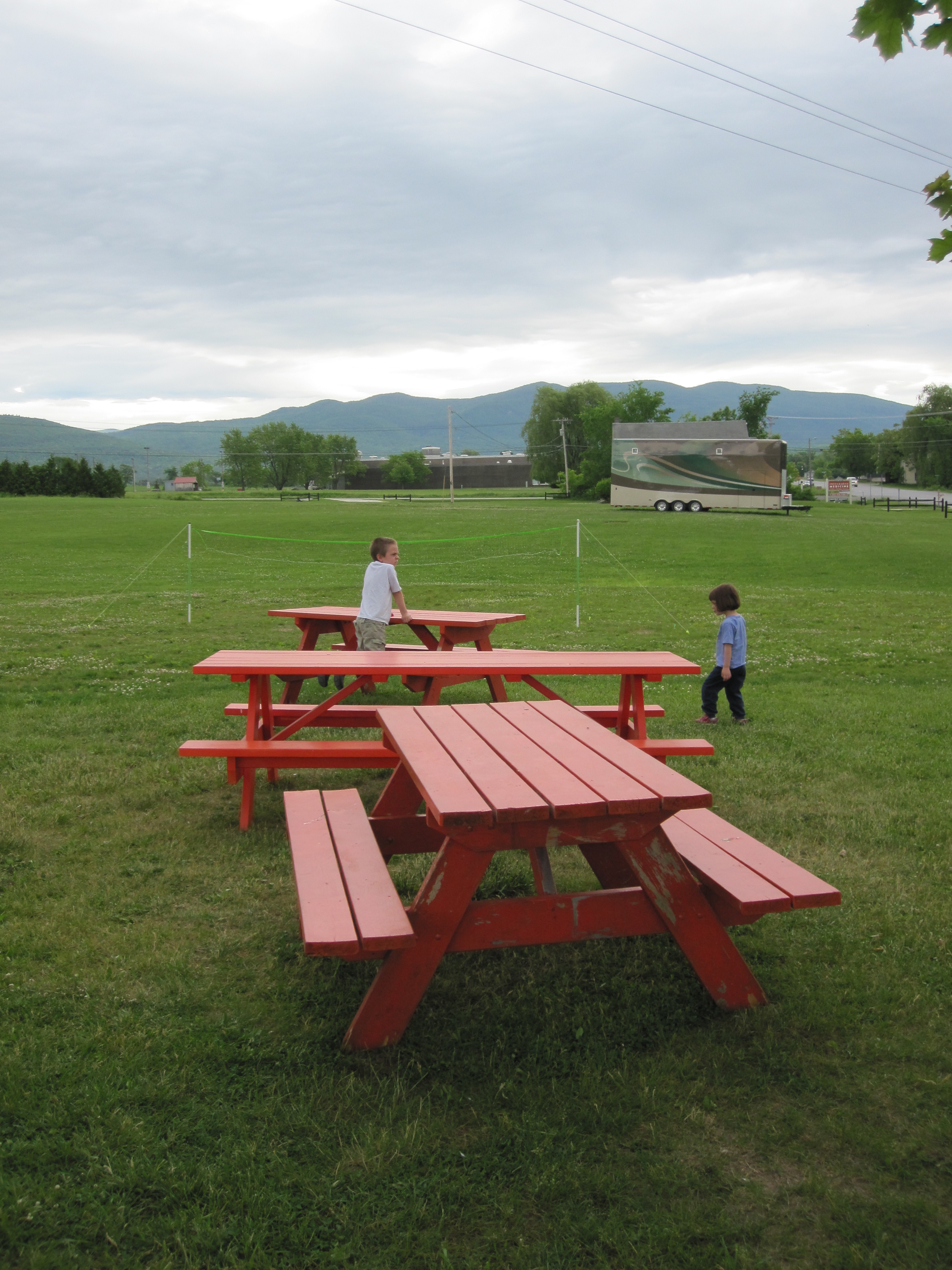
A perfect example of this happened last summer at the A & W.  This is a classic drive-in restaurant with simple, greasy food. It’s only open during the warm weather months. (The A & W is Campbell’s favorite place; she calls it “The ABC,” and all summer long, whenever we’d drive past it, she’d scream: “Look! The ABC!!”) You can either eat right in your car, or at picnic tables in a large grassy field next to the parking lot. The Gong Girls prefer the picnic tables, because there’s a big bucket of plastic outdoor toys (balls, bats, frisbees, etc) nearby. The Gong adults prefer the picnic tables, too, because WHY would we be having 3 kids eat in our car if we could have them running around in a grassy field instead?!?

The A & W picnic tables.             Photo credit

One evening in late summer, we met the girls’ friend Ruth and her parents for dinner there. It was a magical summer night: golden sunset, pleasant adult conversation, the girls running through the grass pretending they were being chased by aliens. It was when all three girls were happily dancing on top of an unused picnic table that we heard it: “Mommy, Mommy, I’m POOPING!” Turns out Fiona had been having so much fun that she’d neglected to tell us she had to use the bathroom. So there she was: holding up her dress, laying one right on top of the picnic table in full view of Rte. 7 and the other A & W diners. (This was one of those moments when my entire parenting life flashed before my eyes. I wasn’t sure whether to laugh or be horrified, so I sort of did both).

This being a small town, the A & W diners were: us, Ruth’s parents, and another family that we know from church. So the good news was that everybody there knew us…aaaand the bad news was that everybody there knew us.

So, if you’re ever in Middlebury and you’re not sure where to find us, just ask anybody for “That mom whose kid pooped on top of the picnic table at the A & W” and they’ll point you the right way.

And yes, we will be telling this story at Fiona’s wedding.