A Few Thoughts on Love
IMG_3672

It being Valentine’s Day, I thought I might write a little something about love. So a few nights ago at dinner, I asked my family how they’d define love. I was hoping for some cute little sound bites.

Of course, my children can tell when I’m sniffing around for quotable material, so they clammed up immediately. “Uh, I dunno,” they said. “Love is when you like somebody a lot.”

So, sorry folks; you don’t get to read a lighthearted piece about love. Because my children were right to resist my efforts to boil love down to a cute quote. In the same way, we should probably resist the Valentine’s Day Marketing Department’s efforts to boil love down to cards and candy and flowers. Throughout the course of this past decade, which has encompassed 10/11 of my marriage and all of my childbearing years, I have learned repeatedly that LOVE IS NOT CUTE; LOVE IS TERRIFYING.

Listen: I’m an enormous fan of love. I happen to believe that love is the purpose of our lives, the most important thing we can do with our time on this planet.

But we’ve been sold a lie about love. For my first two decades of life, I longed for love in any form: romantic love, friendship love, spiritual love, the love between parents and children. I longed for love because it would make me feel good. Everything I’d heard and seen indicated that love would validate me, would be an assurance that I was okay, would make me feel happy.

Partly, I blame fairy tales for my misconception of love, especially the Disney-fied versions. One of my daughters recently noted, “None of the princes in fairy tales has a name. Are they all just called Prince Charming?” Good point. We make a big to-do about the portrayal of females in fairy tales, but if I were the mother of boys I’d be pretty steamed at the absence of male role models. Love in fairy tales is only about the female protagonist; her nameless love object only exists to free her in some way.

Likewise, my initial impression of love was primarily about ME: how I felt (mostly, I was supposed to feel good). It took almost another two decades to discover that that was the opposite of love. In fact, love is not really about me at all; it’s primarily about the other person, the loved one. Which means that mostly, I won’t feel “good” when I’m being loving. Mostly, love will feel like work, like a fight, like “a cold and a broken ‘Hallelujah.'” (Leonard Cohen told the truth about love).

Perhaps the purest incarnation of love is dying for somebody else. Stepping in front of an oncoming car so that your child won’t be hit. Sydney Carton going to the guillotine in place of Charles Darnay at the end of A Tale of Two Cities. Jesus on the cross on behalf of all humankind.

I used to imagine these scenarios as a way of testing my love. Would I take a bullet for a friend? Put my children onto the lifeboat and go down with the ship? Push my husband out of the way of the runaway train?

Then I realized that love asks us to die a little bit for our loved ones every day. Sure, occasionally love demands a big dramatic gesture, but mostly it involves doing things that you don’t really want to do.

For instance, I never, ever want to wake up in the morning while it’s still dark in order to change diapers, fix meals, and mediate disputes, but every morning that I force myself up out of bed, I’m dying a little for my children. Erick and I would both probably rather read or watch T.V. once the kids are in bed and the house is quiet at last, but every evening that we force ourselves to sit and discuss our days and ourselves and our relationship, we’re dying a little for our marriage. And I’m usually scared to fix a meal for somebody else (Will they like my cooking?), or pick up the phone to call a friend (Will I be interesting enough?), or host a party (The house is a mess and I’m so tired….), but whenever I force myself to do these things, I’m dying a little for my friends.

Love is a gradual process of killing yourself for others.

(To be clear, I’m not talking about a martyr complex: If you’re sacrificing yourself to manipulate others into gratitude or repayment, it negates love because you’re really just making things all about yourself. I’m also not suggesting that love requires giving up your identity. If you have no sense of self, no boundaries, then it’s impossible to love others without fizzling out. A healthy sense of self is not the same as selfishness).

Oh my gosh, it’s so hard, isn’t it? Especially when your child accuses you of being mean when you’ve just spent all day ministering at her sickbed. Or when you feel like your spouse just doesn’t get you. Or when your friends seem to keep taking and taking.

We’re not big on hard these days; our culture is all about making things easy for ourselves. We can do so many things with the touch of a few buttons: cook a meal, buy stuff, pay our bills. Love is one of the few things that remains hard.

So why bother?

I’d submit that the most worthwhile things in life are hard — the things that we have to work or fight for. But what about when love doesn’t feel worthwhile, when your efforts are repaid with eye rolls or indifference or divorce papers?

That’s where faith comes in. Faith is love’s water; it’s necessary in order for love to survive. We put love out into the world like a seed that we may never see germinate. Or like making a fire in the woodstove; I pile the wood on top of the glowing embers, but then I have to sit and wait a while until the wood heats up enough and suddenly bursts into flame. We love even though we may never see a payoff; we love because we have faith that it’s the right thing to do, that somewhere down the line it’ll make a difference in a life — or in the world.

We’re all gradually dying anyway. We’re slowly killing ourselves simply by living another day. The question is: what are we dying for? Are we spending our lives serving self, work, pleasure… or love? I’ve tried serving all of those things. And love is a slow dying to ourselves, but it’s the only thing I know of that doesn’t kill my soul.

One Flu Over the Cuckoo’s Nest

IMG_3613

The challenge of writing a bi-weekly column as a mother of four young children is this: Most writing benefits from the writer leaving the house. Seeing the greater world. Having new experiences. While I do occasionally manage to leave the house, it takes 30-minutes to get out the door, and then my attention isn’t so much on the greater world as on the wriggling little people in my care.

Last month, my usual challenge was made even more challenging when our entire family fell sick over the course of a ten-day period. So, because I’ve left the house even less than usual in the past two weeks, I’m going to write about what I know: illness.

Click here to continue reading my “Faith in Vermont” column for The Addison Independent. I promise it’s not depressing….

From the Annals of Bad Motherhood….

It's not easy being the fourth. (Photo of Abigail by Campbell, because nobody else bothers to take pictures of the baby).
It’s not easy being the fourth. (Photo of Abigail by Campbell, because nobody else bothers to take pictures of the baby).

I’ve written before about my propensity for dropping my babies. You’d think that by the fourth time around, things would be different. You might expect that I’d have learned something from my first three babies, or at least exhausted all possible disastrous scenarios.

Poor Abigail. Parental experience aside, I really think that the fourth child has it the worst in terms of personal safety: the house is now designed to accommodate big kids, and nobody has time to look out for the baby. In her seven months of life, Abigail’s sister has pulled her off the sofa — by her feet. She’s been improperly snapped into her high chair (I thought it was good enough to get one leg buckled in, but I didn’t count on her wriggling that leg free and sliding under the tray onto the kitchen floor). I’ve even repeated the manicure massacre that I first tried on Georgia, in which I sliced off the tip of her finger while trimming her nails.

But today, my friends, I’ve really outdone myself. Today, I brought innocent bystanders down with me.

In retrospect, it was a poor choice to push Abigail in the stroller while running errands in town with my three youngest girls. The stroller in question is one of those “Snap & Go” types: a frame with wheels into which you insert the infant carseat. This stroller has been through three babies already; it’s rusty, the fabric basket is torn, and I fully expect a wheel to pop off any day now. But it only has to last a few more months.

This rickety stroller was my choice for Abigail’s transportation the day after a decent snowstorm. Although our town has been shoveled and plowed, mounds of snow are heaped along the sidewalks, and deep puddles of slush precede every crosswalk. So every few feet the stroller would get stuck and  I’d have to puuuuuuush it through the slushy snow.

But I decided to soldier on with the stroller; with two bags and two additional children in tow, it was my best option. Of course I didn’t fasten the belt that’s supposed to secure the carseat to the stroller frame; I haven’t done that in four years — who has time? Also, Abigail wasn’t buckled into her carseat, because she’d been fussy in Ben Franklin’s and I’d had to take her out and carry her. But since we weren’t driving and she can’t exactly get up and walk out of her carseat, I figured it was fine to just lay her back in.

The girls and I crossed Main Street, which took about ten minutes. Then, at the curb by Two Brothers Tavern, I hit a slush trap. The stroller was stuck, and it wouldn’t budge. I was going to have to lift it over the curb and onto the sidewalk.

At that moment, my good Samaritans appeared. This happens a lot when you have young kids in our nice little town, especially when you look as frazzled as I do — someone’s always offering to help me out. In this case it was a young couple — a childless young couple, as I later deduced.

“Do you need some help?” asked the husband.

“Oh, thanks, I think I’m okay,” I grunted, as I wrestled with the stroller and my two older daughters ran on ahead.

He wasn’t buying my independent act, so he circled to the back of the stroller. “Well, okay, maybe if you can lift that side,” I said gratefully.

At which point, he lifted not the stroller, but the carseat that was sitting atop the stroller. And remember how I didn’t have that carseat belted on? So, he lifted the back end of the carseat out of the stroller frame, which flipped the carseat right over.

And remember how Abigail wasn’t buckled into that carseat? So, when the carseat flipped over, Abigail flipped out and landed on her stomach in a puddle of slush.

The husband stared at me and said, “Holy s*#%t! There was a baby in that stroller?!?” Apparently, when he saw my other daughters run ahead (good thing they did, so that I didn’t have to define “s*#%t” for them later) he assumed that I was a normal person with two children, using my empty stroller to carry things.

The great thing is that, when I picked up Abigail (unhurt, just a little soggy), she was totally unfazed. She even smiled at the man who’d just flipped her out of her carseat. Her entire demeanor said: Yup, I’m a fourth child and I have no concept that my life is supposed to be safe and easy. That’s my girl.

The couple didn’t notice how fine she was; they just started apologizing profusely. They even offered to give me their names — I suppose in case I wanted to sue for damages. In retrospect, I probably should have jumped on the opportunity and asked for a scholarship fund. But I took the high road.

“It’s okay, it’s really okay,” I reassured them. “She’s a fourth child. This sort of thing happens to her every day. If anything, it’s my fault; I knew there was a baby in the stroller. Excuse me, I probably should catch up to my other children now.” (At this point, Campbell and Georgia were small dots in the distance; Abigail’s near-death experiences don’t phase them, either).

As I trudged away, I’m sure that the nice young couple stared after me with horror. Perhaps they still felt guilty, or perhaps they were starting to wonder whether they should call social services. In any case, I figure that’s one couple that’s going to wait a while before having kids.

The Worm and Me

Happy February! I’m back.

In a manner of speaking.

I’m back, but a little broken.

“Humbled,” might be a more accurate word.

“Still exhausted,” would also be true.

If you regularly read this blog, then you know that in early January I announced that I would extend the “Pickle-cation” I began over the holidays in order to do some restorative reflecting and writing. I had high hopes that this month-long break would provide me with tons of new material, a fresh outlook, inspiration by the truckload.

This is not a triumphal re-entry.

I can’t remember a more difficult month — personally or for our whole family — than this January. Like anybody, I have bad days; days when I feel like I’m clawing my way up the walls of a deep, dark pit, trying desperately to find some joy. The entire month of January was like that for me.

There weren’t any big tragedies, just a steady stream of days that became progressively more difficult. There was the freezing Arctic air — colder than usual, even for Vermont — which kept us housebound and cancelled school and skiing and, one particularly busy morning, froze both garage doors shut. Then Erick went to Africa for two weeks. Four days after he left, the girls started getting sick. By the time he returned, every girl had been sick at least once with either a stomach bug, a fever bug, or a confirmed case of the flu. The Gong supervirus also took down three grandparents (who’d come in shifts to help while Erick was away), and me. Three days after his homecoming, Erick was also sick.

Did I mention that, during this time, our bathroom was being renovated? Also, Georgia was getting potty-trained for good, which meant a lot of bodily fluids always needed wiping up at exactly the worst possible moment.

So, on January 31 — the last day of my “break” — I sat at my computer, exhausted and with nothing to show for my month of bloglessness except a hacking cough, and I felt very, very sorry for myself.

Self-pity brings out my worst self. It’s probably one of the most dangerous emotions, because it promotes selfishness and gives birth to resentment and anger. Poor me, I thought, this was supposed to be my month of rest, but I’m more exhausted than when it started. It was supposed to be my month to concentrate on writing, and I had less time than ever to write. I spent all my time taking care of other people, and NOBODY took care of ME!

See? Dangerous. Before too long, that kind of thinking would have me angry at my husband, resentful of my kids, and ungrateful for all the help I do receive.

Self-pity is like living by the banks of a poisoned river, but choosing to use the water for drinking and cooking and washing because, hey, it’s right there. Then, one day, someone passes by and says, “You know, there’s a lake filled with beautiful, clean, clear water right over that mountain!”  But instead of making the effort to get to that clean water, you say, “Naw, I’m good. I’ll just keep poisoning myself with this water right here.” The worst emotions are always the easiest. They’re also the ones that slowly poison our souls. But getting out of them, finding our way back to joy, to gratitude, to selfless love — that’s HARD WORK. It’s like scaling a mountain — or clawing out of a dark pit.

How could I claw my way out of this self-pity?

It just so happened that when half of our girls were sick and sacked-out on the couch, their grandfather had shown them the VeggieTales version of Jonah on his iPad. Which reminded me that the story of Jonah gives an honest (and hilarious) portrayal of self-pity.

Even if you didn’t do time in Sunday School, you probably know the first half of Jonah: God tells Jonah to take a message to the evil city of Nineveh, Jonah says, “No way!” and sails in the opposite direction, terrible storm rocks the boat, Jonah realizes it’s his fault and demands to be tossed overboard, fish swallows Jonah (thus saving his life), Jonah feels grateful, fish spits out Jonah.

But that’s only the first half. In the 3rd and 4th chapters of Jonah, Jonah finally does go to Nineveh to deliver God’s message. The message is: “God’s going to destroy this city in 40 days.” But instead of getting mad at Jonah and killing him (which is presumably what Jonah feared at the outset), the Ninevites repent. Once they’ve repented, God changes his mind and doesn’t destroy the city.

And Jonah is LIVID. “Awwww, God, I knew you’d do this!” he yells. “That’s why I didn’t want to come here; you sent me to condemn this horrible city, but I knew you’d take pity on them in the end! I’m so mad I could DIE!” Jonah sits down on the ground and pouts. Like some kids I know. Like myself.

A plant growing over Jonah gives him shade, and he feels a little better. But then a worm eats the plant so that it withers and dies. “I’m so angry I wish I were dead!” Jonah whines again.

I understand exactly how Jonah is feeling here: Not only has he just had a harrowing near-death nautical adventure, NOW God’s used Jonah against his will as a tool to save the wickedest city of his time, and on top of that he can’t even pout in peace because a worm just killed his nice shade plant. Sheesh.

It’s classic self-pity.

And here’s what God says to Jonah: “You have been concerned about this plant, though you did not tend it or make it grow. It sprang up overnight and died overnight. And should I not have concern for the great city of Nineveh, in which there are more than a hundred and twenty thousand people who cannot tell their right hand from their left — and also many animals?”

Boom. That’s it; that’s the end of the book of Jonah. God’s great like that: “–and also many animals.” Full stop. No further advice or explanation.

But God’s saying: Get over yourself, Jonah. You’re so worried about your little shade plant, but I’m worried about an entire city of lost people (and also many animals). And that may just be the best advice for overcoming self-pity: Get over yourself. Raise your head and look around at all the people who need your help.

I thought this would be my month to get into myself; to spend time hanging out in my head, putting my thoughts into words and putting the words into print. But God had other plans. Instead, this was my month to get over myself. There were people who needed my help. (And also one animal). My people are more important than my words. That’s a blessing, not a pity.

It’s good to be back.

Burrs Make For A Sticky Weekend

Georgia's post-burr look.
Georgia’s post-burr look.

The second weekend of January — after a December ice storm, several snows, and freezing temperatures had covered the ground with a thick layer of solid ice — the temperature shot up into the 40s and 50s. That mild weekend, our family traded the Brrrrr of winter for another kind of burr.

Click here to continue reading about our various burr run-ins at The Addison Independent.

Post-Holiday Lessons from Christmas Cards and Fudge.

IMG_3921
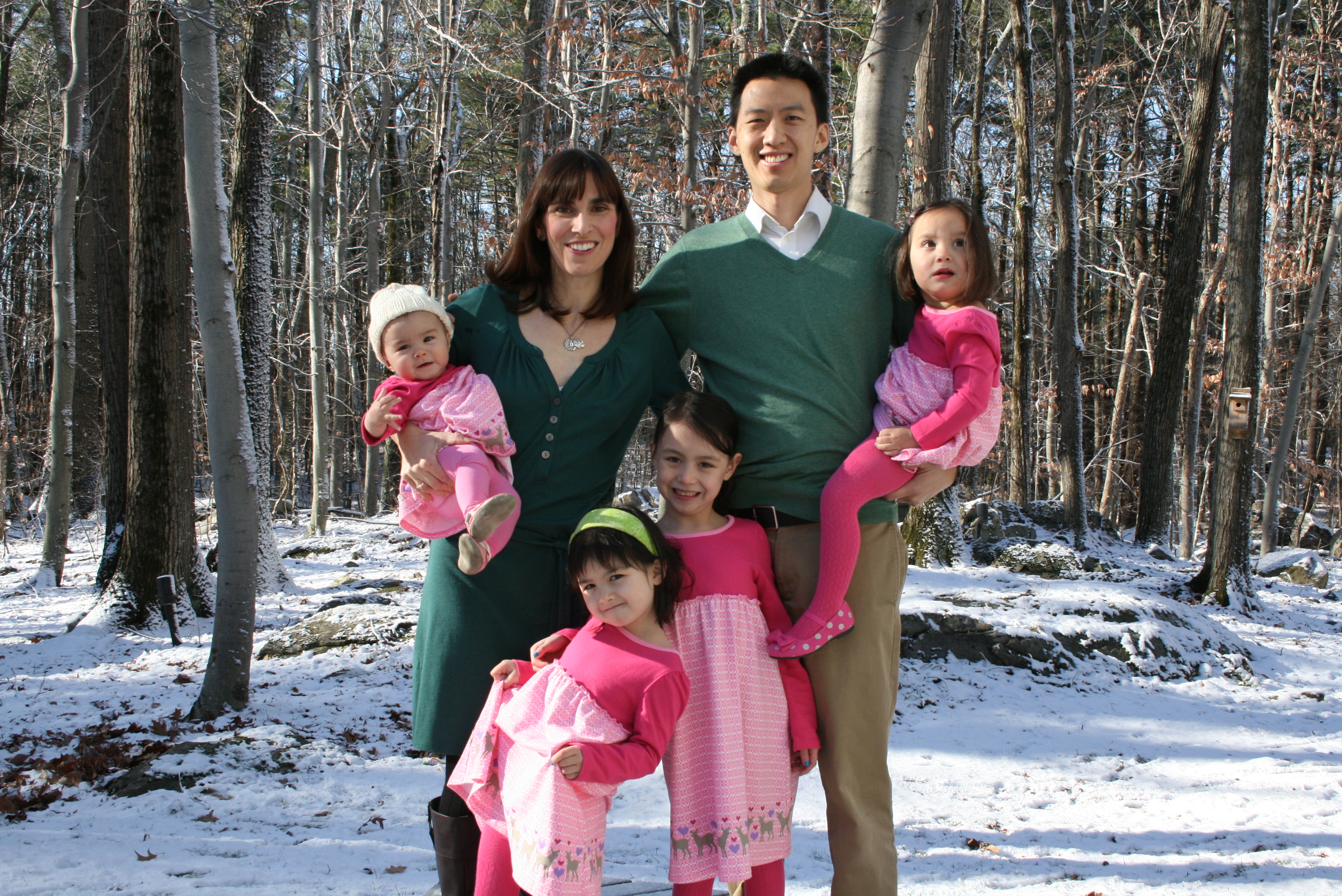
This year’s Christmas card photo

Every year, I feel conflicted about Christmas cards. They’re impersonal; many on our Christmas card list hear from us once a year, and at best we send them a form letter. Christmas cards can seem braggy; we showcase our best photo and write a rosy update — no mention of the potty accidents or the fights or the dusty corners. Christmas cards have absolutely nothing to do with the real Christmas, and they’re a lot of work and expense at a time of year that’s already stressful and expensive.

Click here to continue reading — and for a recipe for my Nana’s famous fudge — over at On the Willows.


How to Enjoy Freezing Temperatures…With Kids

IMG_3466

[Abridged version: Stay indoors. Drink Scotch.]

Last week’s sub-zero temperatures across much of the continental United States were Big News. We all heard the reports and saw the pictures of children blowing bubbles that froze solid, polar bears sheltering inside their zoo houses, planes grounded due to freezing fuel, lighthouses covered in buttercream-thick ice, schools closed because of cold.

As most Vermonters are aware, however, last week was a fairly unremarkable week in our own state, as winter temperatures go; the temperature hovered between the single digits and teens, with one bizarre rainy thaw into the 30s.

Vermont’s own sub-zero temperatures came the week before the rest of the country: the first week of the New Year. The National Weather Service recorded negative temperatures in Middlebury every day between January 2 and 5; on January 3, the high was -3. I witnessed a -17 reading on our outdoor thermometer; one afternoon as I prepared to meet the school bus, I found myself thinking, “Oh, good, it’s warmed up to -5; otherwise, it’d be really cold out there!”

Click here to continue reading my latest “Faith in Vermont” column for The Addison Independent.

A Break From My Break

IMG_3580

In early December, I announced that I would take a “Pickle-cation” from writing for this blog. The break was to extend through the holidays, and I envisioned it as a time to “write…reflect…and to enjoy the holidays with my family” without the pressure of writing weekly posts for The Pickle Patch.

Well, folks, this is me checking in from my self-imposed exile to give you the update: there has been NO writing, and NO reflecting, but an overabundance of “enjoying the holidays with my family.” In other words: Holidays: 1, Faith: 0.

Please don’t misunderstand: I love the holidays, and I love my family. The Gongs had a wonderful Christmas season. There was skiing and sledding and skating and hikes in the woods. There were grandparents. There were holiday parties and sleepovers with friends. There were “Mommy dates” with my oldest, who’s usually at school all day. There was baking and crafting. There were many candles lit and books read. There was the joyful hysteria of Christmas morning. There was the Christmas pageant in which Campbell performed a moving interpretation of an attention-seeking cow with poor impulse control.

It was lovely.

But every holiday or vacation time, there are moms who post something like this on Facebook: “So glad for the school break! It’s wonderful to have all the kids at home.”

And every holiday or vacation time, I’m reminded that I am not yet that mom. Maybe I never will be; maybe that kind of selfless desire for togetherness requires a special kind of temperament — or medication. I prefer to think that it requires time; that, when the girls are older and school holidays don’t just mean that I have double the number of voices calling, “Mommy! Mooooommmmmy!” every two minutes, perhaps I really will welcome extended times of togetherness.

For now, though, holidays mostly feel draining and confusing. I know that holidays can feel that way for everyone; there are errands to run, events to attend, and the expectation that every single second should somehow be “special” and “memorable.” In my case, I also forgot one crucial thing: at this point in my life, “writing and reflecting” and “enjoying the holidays with my family” are not compatible.

You see, during our regularly-scheduled life, I’m able to write and reflect due to the presence of certain structures that are built into the day to keep the kids away from me: school, naptime, and bedtime. I also wake up an hour earlier than any of our kids so that I can get dressed, wash my face, and start the day in peace. But during vacations and holidays, all of that goes out the window.

It starts first thing each day with this dilemma: Do I keep to my regular, pre-dawn wake-up time, or do I sleep in? Every morning, I decide to sleep in. It’s vacation, after all, there’s no need to rush the kids off to their schools, and I need the rest. And every morning, when the girls come racing down the hall (much earlier than is warranted by their way-too-late holiday bedtimes) screaming, “I have to go potty!” or “She hit me!” and I’m stuck wiping bottoms and resolving disputes without having had the chance to get dressed and centered, I think, This is horrible. I NEED to get up earlier tomorrow. The next day, it’s the same scene all over again.

Each day of holiday vacation is a nonstop marathon of togetherness, without the separation imposed by school and universal naptimes. About midway through the vacation, Erick can see that I’m starting to fray, so he’ll say something like, “How about I take the girls to see the train display, so that you can have a break?” And almost without fail, I’ll respond, “You’re going to see the train display? But I want to come, too!” The next day, I’ll feel overwhelmed and put-upon, with thoughts like, “Why is Joan of Arc considered a martyr? I could teach her a thing or two about martyrdom — she didn’t even have kids!!!” But then, when Erick says, “Hey, how about I take the girls out for breakfast tomorrow?” I’ll say, “Can I come, too?”

I think I read somewhere that the definition of insanity is repeatedly doing the same things, but expecting different results. You can draw your own conclusions, but when I examine my own behavior during the holidays, I do not look sane.

I’m coming to see that the problem isn’t with what I’m doing; the problem is my expectations. It’s okay — healthy, even — to sleep later and adopt a more relaxed schedule during the holidays. It’s more than okay to sacrifice alone time — even if that’s time normally spent doing things that feed your soul, like reflecting and writing — in favor of time spent with family. In general, I think it’s important to be selfish about things that feed your soul, but it just may be that Christmas week isn’t one of those times.

This reminds me of this year’s Apple holiday commercial, which went viral because it touched so many people. You know: the one with the awkward teenage kid who won’t put down his iPhone throughout the family holidays, and then on Christmas morning he plays the holiday video he’s been recording all along, and everyone weeps as if to say, “It’s okay that you’ve spent the entire holiday tethered to your smartphone, since you were using it to create this digital memory!”

I HATE that commercial.

I get that it’s supposed to be about understanding, and how the person on the sidelines might not be as tuned out as they seem. But the first time Erick and I saw it, we looked at each other and burst out laughing, because it was such a naked attempt to justify our culture’s electronics addiction.

Here’s the thing: all the time, but especially during vacations and holidays, YOUR FAMILY WANTS YOU. Who cares if you’ve spent a week making a digital video, if it sidelined you from participating fully in your life? Let’s face it: in a decade, that footage will probably be unwatchable, anyway, because Apple will have developed some new video technology. Likewise, my daughters could care less if I’m carving out daily writing time during the holidays, even if I’m writing beautiful and thought-provoking pieces about the holidays; they do care that I’m available to play and bake and read and participate fully in our family’s holiday.

So, I’ve learned something: next year I will again take a Pickle-cation, but I will NOT expect to get any writing done until after the New Year. Which is to say: I now need a break from my break, and so I will be extending my Pickle-cation through January to do the writing and reflecting that didn’t happen in December. See you in February!

Resolution: Take Kids Cross-Country Skiing

IMG_3857

I no longer remember who gave us the advice, but when our family first moved to Vermont some wise soul told my husband and me: “The winters are long and cold. The best way to survive them is to find an outdoor activity that you enjoy.”

For the first couple of years, we stumbled around trying to settle on the optimal winter recreation. Snowshoeing was pleasant and could be done in the woods right behind our house, but it required substantial snow and willing children – both of which were lacking during the past two years. Sledding was fun for the kids but not for the parents; on our end, it mostly involved lugging 80 pounds of little girls uphill. Ice skating was lovely in concept, but since my husband claims he can’t skate due to “flat feet,” it required me to navigate inconvenient rink times for the pleasure of skating around picking up fallen children who flopped around on the ice like eels out of water.

This year, however, our family has a newfound sense of clarity: we cross-country ski.

Click here to continue reading my latest “Faith in Vermont” column in The Addison Independent.

What Shall I Give Her?: Thoughts on GoldieBlox, William’s Doll, and the Confusing World of “Girly” Toys (Part 2 of 2)

IMG_3457
Who’re you calling “girly?”

INTRODUCTION: In the first part of this piece, which appeared yesterday, I related how I’d been bombarded by the viral video commercial for GoldieBlox — construction kits that are being marketed specifically to girls in order “to get girls building” — while considering Christmas gifts for my own four daughters. After an initial rush of enthusiasm from consumers, GoldieBlox experienced some backlash for peddling pastel toys while simultaneously claiming that they wanted to “disrupt the pink aisle.” All of which raised interesting questions that get at the heart of our culture’s confusion about what it means to be a female: Are traditionally “girly” toys and games (dolls, tea sets, princess play) inferior to traditionally masculine toys and games? In order to encourage girls to engage in more “masculine” play, do we need to make separate-but-equal toys (i.e. traditional boy toys in pastel hues)? And if we answer “yes” to the two previous questions, aren’t we being demeaning to girls? So where does that leave us?

I’ll attempt to tackle some of these issues based on my own experience.

Click here to read Part 2 of this post over at On the Willows.