Lessons from the Garden

IMG_5496

The older I get, the more I love gardening.

I have commented previously in this column about my ambivalence towards gardening — the result of a childhood spent watching my parents slave away each weekend in their garden — and the unfavorable gardening conditions in my own rock-infested, tree-shaded yard. One could quite rightly characterize my current relationship with my garden as “rocky.”

But perhaps in the same way that women are said to always come to resemble their mothers, I find that my gardening behavior is increasingly coming to resemble that of my parents. I attribute most of this change to age; while young gardeners do exist, I consider them a special breed, prodigies, the Mozarts of the soil. For the rest of us, it takes age to teach us the particular blend of passion and patience required for gardening.

Click here to continue reading my latest “Faith in Vermont” column in the Addison Independent. 

Lust for Land

My desire for land started gradually, until suddenly it had gripped me like the unbearable compulsion some pregnant women feel to eat dirt. It was a primal urge. I felt it in my mouth, back near my molars. I felt it in my hands, which wanted to clutch.

To clarify: I never felt the need to eat dirt during my pregnancies. My strongest craving occurred during my third pregnancy: It was 9 o’clock at night, and I had to have walnut shrimp (an Americanized dish served at most Chinese restaurants: batter-fried shrimp and walnuts slathered in a creamy sweet sauce.)

“I would crawl over broken glass for walnut shrimp,” I moaned to my husband, who tracked down the only place where it could be obtained so late at night: the Panda Express at the Oakland Airport.

My craving for land was like that.

It began rationally enough, almost as an intellectual exercise. I was researching Vermont dairy farming for a book I’m working on, and I kept reading heartbreaking stories about the demise of small family farms: farmers who could no longer afford to keep farming, children who didn’t want to continue farming, land that was worth more to sell off or develop than to keep.

In the five years since our family moved to Vermont, I have come to love this place passionately. I want to raise my children here, and when they grow up I hope that some of them will choose to stay, because I certainly plan to grow old in Vermont. So the fact that part of what makes Vermont Vermont was at risk — small farms, undeveloped land, local agriculture — hit me right in the heart.

What could I do?

I’m married to an economist, so I’m somewhat of a realist when it comes to the ability of government programs or agricultural subsidies to effect change. But what I could do was some version of Voltaire’s exhortation at the end of Candide: “We must cultivate our own garden.” What I could do was to get a plot of land in Vermont, care for it, and not develop it.

Once I had this idea, it was difficult to shake. It also seemed do-able. Vermont is the second least populous state in the nation (after Wyoming); due to an abundance of supply and lack of demand, it is possible to buy a house with multiple acres of land in Vermont for a relatively reasonable price.

The more I thought about it, the better it seemed. Our current house is a perfectly lovely 25-year-old cape set on one wooded and rocky acre along a paved road in a neighborhood where the houses are close enough together that we can see four other homes from our windows (when the leaves are off of the trees.) After five years in Vermont, this seems suburban and wimpy.

I craved a hundred-year-old farmhouse down a dirt road on multiple open acres with outbuildings. Such a setting would allow me to garden without my spade hitting solid rock 1/2 inch into the ground. It would allow me to plant vegetables and fruit trees and flowers that need at least partial sunlight in order to thrive. It would allow my children to range freely, without my having to worry about cars on the paved road out front. It would allow us to try raising chickens for a second time. (Our first flock of hens was massacred by neighborhood dogs; I know that massacres are a rite of passage for chicken owners, but these dogs had broken easily into our coop because we couldn’t sink fence posts securely enough into the rocky ground.) It would allow for the future possibility of larger animals: a few sheep, a couple of pigs, perhaps even a horse one day if our daughters continue to love riding.

This would be a lot of work, but it would be my work. Writing is a stationary and solitary profession. The idea of caring for some livestock and land in between hours of sitting at my computer was appealing: I could be a female version of E.B. White or Wendell Berry. And yes, we have four children: four children who, in another year, will all be in school at least part of the week. Four children who could help with chores, fondly recall their childhood on the family farm, get married on the land where they were raised.

It made so much sense to me, on both an idealogical and a practical level.

Notice that all of the pronouns thus far have been in the first person singular. And I am no longer a first person singular: I am part of a marriage, a family of six. In order to make this dream a reality, I would have to convince my un-dreamy, un-handy, and un-willing-to-take-financial-risks husband — and, to a lesser degree, my children — that it was a good idea.

So I put some logical limits on my dream. My children are incredibly happy in our town school, and nobody wants my husband to have a longer commute, so this land would have to be located in our current town. It should have 3 or more acres, and preferably some usable outbuildings. Odds are that the house wouldn’t be a new construction, but it couldn’t be a dump, either. And, of course, there were financial limits.

I kept my eyes open as I shuttled our children around town, and narrowed my focus to three or four properties that would be appealing if they ever went on the market. I settled down to wait; we weren’t going anywhere, so I was in a great position to be patient and watchful.

Then one of those properties went on the market.

It was an 1890’s farmhouse with 5 outbuildings, set on 16 gorgeous acres of mostly-cleared land with stunning views of the Green Mountains. It was actually closer to town — to the schools, my husband’s office, and my parents’ house — than our current home.

Of course, the timing was terrible: Our entire family is relocating to California for the first five months of 2016 for my husband’s sabbatical.

Also, it was outside our price range.

I went to look at it anyway, first with my parents and all my children in tow, then with my husband. The house needed a complete interior lead paint abatement and re-painting, a new perimeter drain, possible asbestos tile removal, and there were five rooms that appeared to have gone untouched — used only for storage — for 40-some years.  Still, the potential was there if we were willing to work towards it; I could see the beautiful house it would become over time.

So I held onto hope, because that’s what you do when you have a dream, right? I held onto hope for 25 days, up until that house sold. And then I mourned it hard.

It has occurred to me that this desire for land is my version of a midlife crisis; that, at almost 40 years of age, I’m hoping to rediscover my purpose and youth in a plot of land rather than a sports car or a tattoo or an affair. And it occurs to me that there are two ways of responding to a midlife crisis: either you come around to peacefully accepting that all the paths that once seemed open to you have narrowed down to the path that you’re on — or else you get bitter. Maybe I need to accept that my life — our life — is not going to end on a multi-acre small-scale farm. As I’m constantly reminding my daughters (and quoting Mick Jagger): “You can’t always get what you want.”

But maybe, maybe, this isn’t so much a midlife crisis as it is a natural desire: the desire to find a little corner of creation and sink roots down deep, to have the ability to raise your own food, to preserve some of the world’s beauty and pass it on to your children.

My husband and I had dinner with a couple who’ve lived in Vermont far longer than us, who have first-hand experience with farming. We discussed my dream of land. “Feel free to talk me out of it,” I quipped.

They didn’t. “There’s nothing wrong with wanting to own a piece of Vermont,” said the husband. “Go down the rabbit hole.”

His wife’s response was more serious. “This is what we were made for,” she said. “We were created to be stewards of the land. And if that’s what God is prompting you to do, then maybe you should listen to it.”

Maybe I should; maybe I will. In the meantime, there’s a book of Wendell Berry essays beside my bed, a brand-new membership card to our local food co-op (finally!) in my wallet, and our weekly CSA starts up next month. I guess that’ll do.


American Girl Dolls and the Decline of Civilization

IMG_5419

Grandparents get to do whatever they want — that’s my philosophy.

It wasn’t always; like most first-time parents, I tended to be overly controlling when it came to toys, food, and naps. But my children are blessed with four grandparents who love them and respect reasonable boundaries, and I realized that, after the arduous task of raising my husband and me, these grandparents are entitled to spoil their grandchildren. So these days, my default response to grandparent inquiries is: “Sure!”

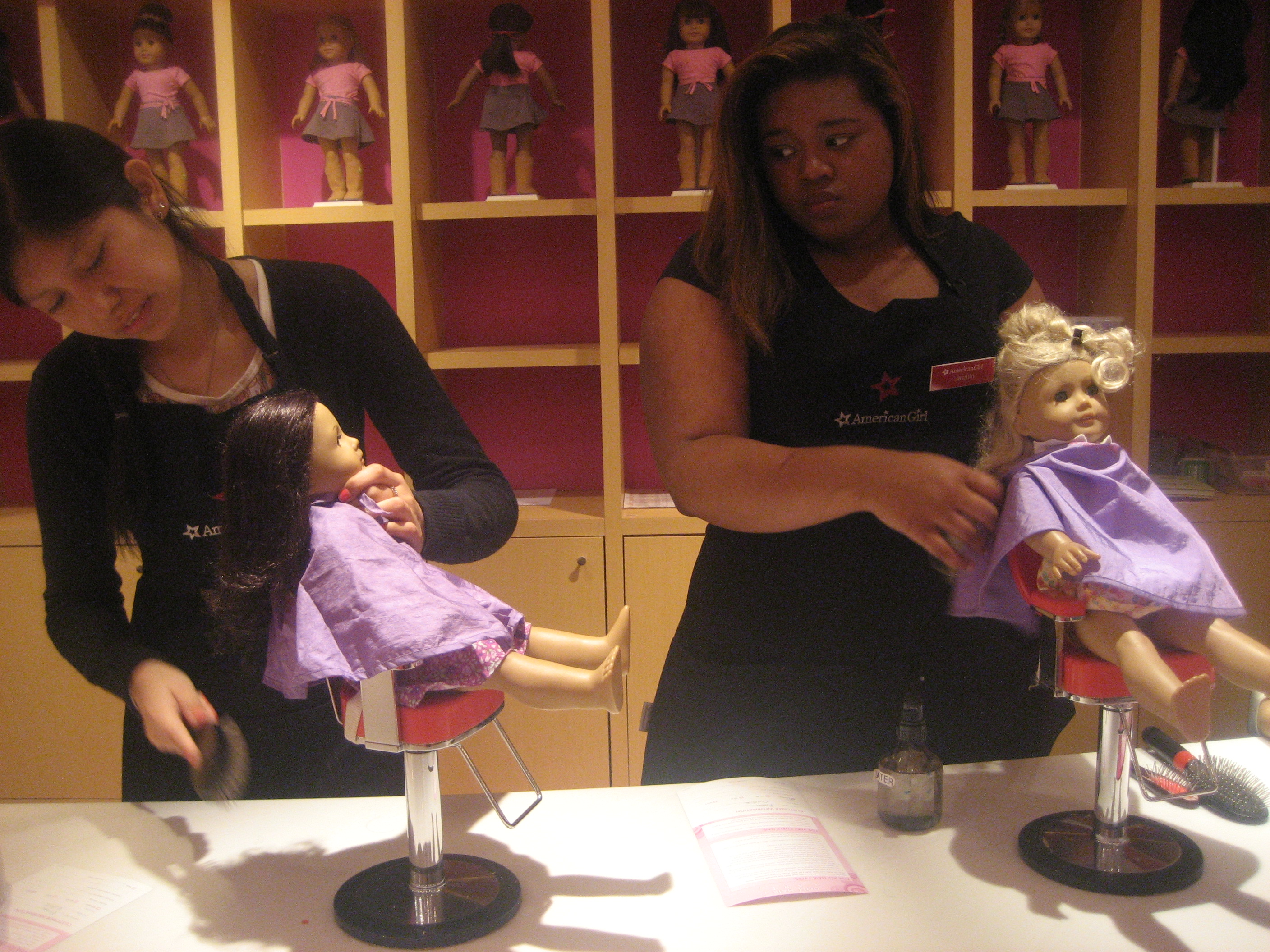
And that’s how we wound up getting my daughters’ dolls’ hair styled at the American Girl store in Tysons Corner, Virginia. (“You’re doing what?” my husband asked, incredulous, before we left. “Grandparents get to do whatever they want,” I shrugged.)

Click here to continue reading this week’s “Faith in Vermont (travel edition)” column in The Addison Independent.

Following Through

IMG_5401

As of today, I have finished the “birth books” of my two oldest daughters.

Their prenatal ultrasound pictures are tucked inside the front covers; photographs from their early years, baptismal certificates, birthday invitations, and Christmas cards are affixed where appropriate. Most of the lines are filled with writing — not all, as I will never be able to answer the question about the fashion trends when they were born– but enough to look like I put some effort into the thing.

The birth book seemed like such a nice thing when I was pregnant with our first baby. It even seemed essential, in the same way it seemed essential that our nursery have a “theme,” with linens matching the lamp matching the wall art. (Ours was “Safari.”) Who wouldn’t want to record their child’s earliest moments for posterity? Hadn’t my own mother kept a detailed birth book for me?

So I bought one: a thin, hard-bound book with Winnie-the-Pooh on the cover. Inside were pages dedicated to the family tree, the pregnancy and birth details, celebrations, and major developmental milestones.

It was only once I began keeping a birth book for my first — and then second — child, that I realized its reassuringly thin spine and apparent simplicity were clever disguises for something more sinister. To begin with, this was not a “birth” book: each book is designed to cover the first five years of your child’s life, up through kindergarten. There were pages to accommodate multiple baby showers (I missed my first baby shower because I was giving birth, and never had a traditional shower again.) There were questions about current events during your baby’s birth year. There were lines for recording information about every single visit to the doctor or dentist. There were guilt-inducing blank boxes in which I was instructed to paste before-and-after photos of my child’s first haircut.

In short, these birth books were designed for first-time parents. And now I had to do four of them.

By the time I got to my third and fourth children, the format of the birth books I ordered had changed slightly: Now, the books expected you to record your baby’s height, weight, and developmental milestones during each month of their first year of life.

These birth books are exercises in following through.

I responded with denial. All four birth books sat on a shelf beside my computer, and I reassured myself that I’d work on them when I had “free time.” This meant that, every couple of months, I’d enter a guilty panic when I realized I’d gotten behind and couldn’t remember when my third child began walking, or how my fourth child slept at five months. The younger half of my children are going to have hard evidence that I loved them less than their older siblings.

But this morning I recalled that both my first and second child have turned five, which means that I no longer had to keep up their birth books! Freedom! I spent a few minutes tying up loose ends, and then stashed the books in each daughter’s memory box in the closet.

Two down, two to go.

***

If pressed, I would say that one reason we’ve yet to wipe out poverty, war, injustice, and climate change is due to lack of follow-through. The problems are daunting, and we are all, to various degrees, lazy, selfish, exhausted, busy, and scared.

I’m no different: In addition to the baby books, the list of things I’ve left hanging includes planting a raised-bed vegetable garden, baking fresh bread weekly, going through the boxes of pictures that we shoved in a closet 5 years ago, and a pile of mending.

I am particularly bad at following through with people. During my sophomore year of college, I was asked to mentor a young woman about five years older than myself. She was the daughter of a family in town, and I gathered that she’d been a bit wild until she’d suffered a traumatic brain injury in a car accident. Now, her parents wanted her to have a friend who’d be a good influence.

I can’t recall how I became that friend; I think it was arranged through the church I attended at the time. I knew that I was in over my head almost immediately, but I persevered through a series of awkward conversations over coffee. Looking back, it seems ludicrous to charge a  19-year-old who’s just left a sheltered home with mentoring a 24-year-old who’s lived hard. I don’t remember the last time we talked. I certainly never followed through after I graduated, and have no idea what became of her.

That young woman was the first in a series of people whom I’ve failed similarly. I’ve neglected to follow through on relationships from Africa to California and in between.

The church we attend now isn’t one of those churches where people dress nicely and have all their stuff together. Every Sunday, our pews hold people who struggle openly with addiction and mental illness. (I like to imagine that Jesus would be more comfortable there than in a suburban mega-church.)

But every Sunday some of those struggling people are missing. Sometimes they’re gone for weeks or months; sometimes they disappear completely. I know this is common, but I always feel badly, like maybe if I’d been more friendly, or done something to help, they’d still be there.

I’m not proud of my lack of follow-through, and I’m trying to do better. I’m trying to reach out to people when I think of them and to do kind things when they occur to me, instead of hiding behind the “I have four young children” excuse.

Because the truth is that something is always better than nothing. And finished is always better than left hanging. Like with those baby books: Sometimes you just have to fill in what you can and call it done, even if you leave a few blank lines. There will always be blank lines. Maybe they weren’t yours to fill in, anyway.


Some Gifts of Spring

IMG_5340

We are starting to move outward now. The turning point came a few days before Easter, when I looked outside one morning and saw that there was more bare ground than snow visible through the window.

Later that morning, I took my two youngest daughters and several friends to the playground in East Middlebury for the first time in about six months. The playground was hopping with caregivers and their young charges. As is always the case on those first warm days of spring, I saw people whom I hadn’t laid eyes on since the fall, people I’d nearly forgotten during our long hibernation.

We ate both snack and lunch outside that day. Then, while my daughters napped, I pulled the gardening book down from its shelf with some trepidation. Much to my relief, it told me that since I live in a cold climate, I can safely leave most of the gardening work until May. I left the book on the kitchen counter to refer to in another month, when the ground is thawed and dry and the chance of snow is almost zero.

As if to justify my leisure, the temperature dropped 30 degrees and it snowed the next day, and the day after that.

Click here to continue reading my latest “Faith in Vermont” column for The Addison Independent.

My New Collection

IMG_5387

Almost every Thursday afternoon when school lets out, my daughters and I drive to the Sarah Partridge Library in East Middlebury.  From 4:00-5:00 PM on Thursdays, Mona Rogers, the Sarah Partridge Librarian, has a “Craft Circle” for children. The original vision for this craft hour was that Mrs. Rogers would teach all of us to knit. This idea was abandoned when it became clear that most of my daughters are still too young to knit — and since my daughters make up 98% of the children who attend craft hour, they direct the agenda. In the end, Mrs. Rogers taught me to knit, which I continue to do during craft hour: I knit while standing, with frequent breaks in order to referee sibling squabbles or pull my youngest child off the bookshelves.

Between the knitting and the child-wrangling, it’s rare that I have time to look at books. But the other week, thanks to a big bowl of microwave popcorn that was occupying all of my children, I was able to peruse the used books for sale.

This isn’t a normal activity for me, children aside. I’m not especially anxious to add to our already-overflowing home bookshelves, and when I’m at the library I figure that the point is: free books! But since my children were munching their popcorn next to the shelves of used books, I could browse and still keep an eye on them.

Used book sales are about hope. There’s a reason why most of these books have been exiled from the library shelves or donated by their prior owners. There’s usually a large selection of boilerplate mysteries, spy thrillers, and romance novels. I’ve decided that cookbooks are the bread machines of books: people think they’ll use them, but instead they just take up space in the kitchen. And travel books are quickly out-of-date, plus fairly useless once you’ve actually visited the place.

But every once in a while, there’s a used book gem to be found. That day, I found it.

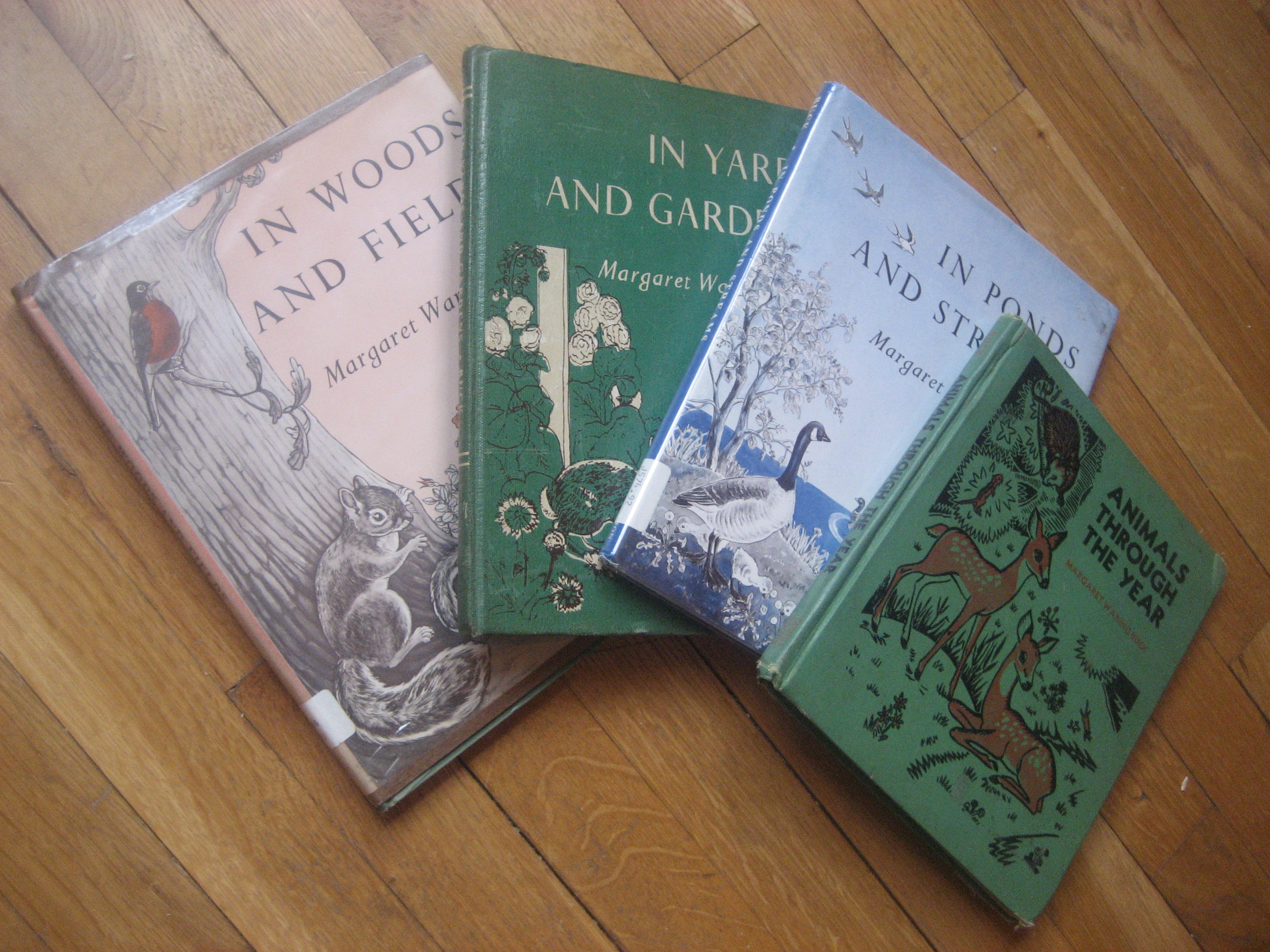
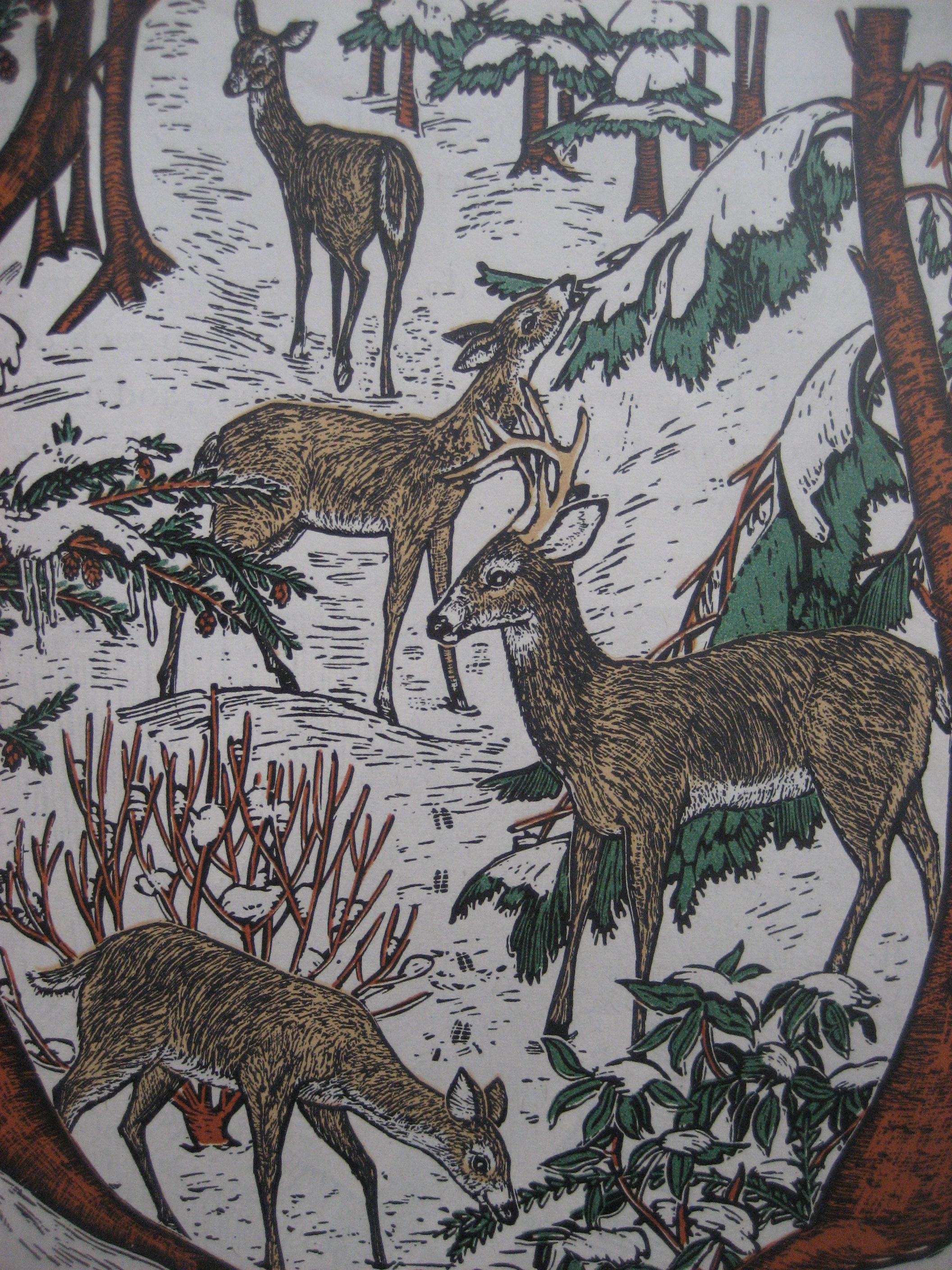
I can’t remember what prompted me to pick up the slim, green hardcover. It was clearly very old. The book’s title and author were stamped into the front cover — Animals Through the Year by Margaret Waring Buck — along with a beautiful print depicting two young deer, a possum, a chipmunk, and a mouse in the wild. It was clearly a children’s book — and we have so many children’s books at home that I wasn’t looking for one more.

Opening the book, I saw that it was a discard from the Sarah Partridge Library (back when it was the Community House Library). The book was first published in 1941, although this was a 1949 edition, and it had been checked out last on August 30, 1993.

When I fanned through the pages, I knew that I had to buy Animals Through the Year. It’s organized by season, and each page describes a certain animal (20 in all) and how it spends that season. The descriptions are clear and fascinating, written for young children without oversimplifying or pandering.

What really sold me, though, were the illustrations: On every page is a gorgeous block print of the animal described. Some are in color, but most are black-and-white.

Animals Through the Year cost me $1 — more than the usual 10 cents, because it was “antique.” I showed it to my daughters once we returned home, and they all huddled together on the couch, looking at the pictures while my 7-year-old daughter read out loud.  Later that night, she asked if she could take the new book to bed with her. Since then, one daughter or another has picked it up from its home on the table beside our living room “comfy chair” to look at the pictures or learn more about what our animal neighbors are doing this time of year.

Meanwhile, I have become obsessed with Margaret Waring Buck. There’s not much to be found about her, but her papers now reside in Archives & Special Collections at the University of Connecticut’s Thomas J. Dodd Research Center. The brief biography on the Dodd Center website informed me that Margaret Waring Buck was born in New York City in 1905, and died in Mystic, Connecticut in 1997. She was an illustrator, naturalist, and physiognomist. Animals Through the Year was her first book, and she wrote and illustrated ten more between 1947 and 1979. All were nature books for children, with the exception of The Face — What it Means: The Merton Method of Character Analysis,  which was based upon her studies with Dr. Holmes W. Merton on the “science” of Face Reading.

All her books are out of print now, but that hasn’t stopped me. Thanks to the magic of online shopping, I’ve been able to obtain used copies — all library discards — of In Woods and Fields, In Yards and Gardens, and In Ponds and Streams for under $10. Like Animals Through the Year, these books are filled with plainspoken information and gorgeous illustrations (ink drawings instead of block prints). Along the Seashore and How they Grow are on my wish list, because I don’t want to be greedy and buy up  Waring Buck’s entire oeuvre in one swoop; it’s important to have something to look forward to.

The obvious question is: WHY? Why have I suddenly become a fan and collector of the works of a little-known author and illustrator of children’s nature books? I am not the collecting type — haven’t collected a thing since my childhood doll and thimble collections.

I’ve thought about this, and I believe the answer is: It’s April, and there’s still snow on the ground. For over four months, the only nature we’ve seen outside has been limited to the occasional squirrel or crow. I am ready for the plants and animals to return; I am craving wildlife.

And when wildlife returns, I will pull down one of our books by Margaret Waring Buck, find the relevant page, gather my girls around me, and read. Because, 74 years later, the first words of Animals Through the Year are still true: “Many baby animals first see this beautiful world in the spring months of March, April, and May.”


Saying No to Lucky

IMG_5374

It’s important to learn how to say “No.”

I know, I know, you think, rolling your eyes. C’mon, tell me something new.

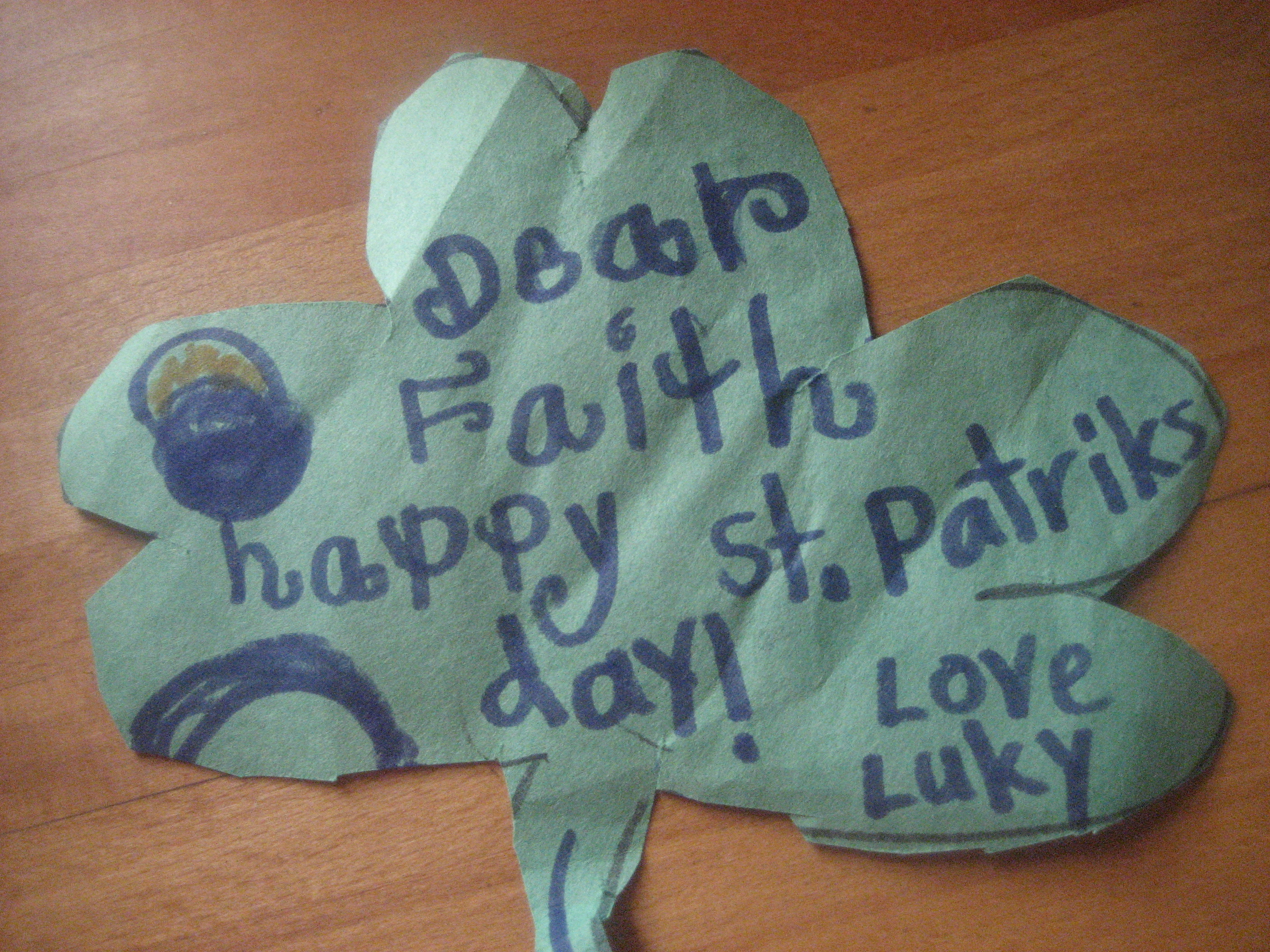
Here’s my best shot at something new: I’d wager that not many people have been taught to say “No” by Lucky the Leprechaun.

Click here to continue reading my latest “Faith in Vermont” column in The Addison Independent.

A Tale of Two Women

So there was this woman, and she was pretty comfortable. After a decade of moving every few years, she’d been settled in a nice small town for nearly five years. Healthy kids, good marriage. She was mostly “at home” with the kids, but had carved out a little sideline writing for a few blogs and her local newspaper. Life was crazy, sure: She had four young children. But she felt like she’d finally nailed the rest-work balance. Three kids were in school now. She had her village firmly in place: school, church, friends, and her parents, who lived 15 minutes away.

And she was about to lose it all, because the following year, her husband was going on sabbatical. Sabbatical: from the Greek word “sabatikos,” meaning “of the Sabbath” – the day of rest. For her husband, sabbatical was a year of rest from his job as a college professor. For her, it felt like the opposite of rest.

Click here to continue reading this post over at On the Willows.  


On Summer Activities, Economic Development, and Overthinking

IMG_5314

Because I have children who still live at home, and because the work I do does not (yet) contribute to our household expenses, the standard description for me is: “stay-at-home mom.”

I find this description inaccurate at best. I may be a mother who often stays at home, but the truth is that I spend an awful lot of time trying to get my children out of the house.

As much as I love my children, I never cry on the first day of school. In fact, the happiest moment of my day is usually when the mudroom door closes behind my husband and three-quarters of my daughters at 7:45 every weekday morning, and I put our fourth daughter down for her morning nap. The house is quiet, and for one blissful hour I am free to do whatever I want – even if that just means folding laundry (as it often does.)

I cry on weekends. I cry on snow days. And as summer vacation approaches, I feel panic setting in.

Summer vacation is approaching.

Click here to continue reading my latest “Faith in Vermont” column in The Addison Independent.

Paw Prints


IMG_5311

This morning we took what was almost certainly our last cross-country ski of the season. The ground is still covered with snow, but there’s an icy crust on top. The temperature at 8:30 AM was around 13 degrees, so nothing was melting, but there were other signs of the end: the sun was bright, the trees were bare, cracks had appeared in the ice beside the trail to reveal a brook’s rushing water. And there were animal tracks, too, weaving on and off of the trail at various points. If I were a tracker I could identify them for you; all I can say is that there were some medium-sized paws and some smaller paws.

***

We were listening to NPR on the radio yesterday, my two youngest daughters and me. That’s not something I do very often: listen to the news with my children in the car. But I was just happy that they weren’t demanding a Disney princess CD, or — worse — music on the radio. They were tired, half dozing. It had been a busy morning: a preschool visit, a trip to the consignment shop to drop off old baby clothes, a stop at the library for books.

I was tired, too.

The NPR announcer was reporting breaking news about the attack by gunmen on a museum in Tunis, Tunisia, in which 23 people were killed.

“Did you hear that, Mommy?” my 4-year-old piped up from the backseat. “They said people were killed.”

This is my fairy-girl, my unicorn-believer, my sprite who has her head so deep in the clouds that it’s less than 50-50 she’ll hear me when I speak directly to her.

“Yes, honey, I heard that. It’s very sad.”

“But, why were people killed? I know sometimes deer get killed, and foxes,” she mused, half to herself.

“Well, sweetie, sometimes there’s fighting. People fight each other, and sometimes people get killed.”

“So it was an accident then,” she concluded.

“Well…no. Sometimes, in some places, there are wars. People fight each other for land, or for power.”

We were almost home, so I tried to wrap things up. “This happened in Africa,” I added.

She took the bait. “Oh, so it was a really long way away.”

And just like that, the topic switched to airplane travel.

***

On the evening of that same day, I saw two deer. I was driving home from my book group meeting. The deer — two large does, from what I could tell– had just crossed the road and were heading into the trees on the opposite side.

Minutes later, an owl swooped down so low in front of my car that I thought it might hit the roof.

The wildlife sure are on the move tonight, I thought to myself. I figured it must have something to do with the coming of spring.

Whatever the season, we don’t see many deer around here. Since moving to Vermont, I’ve seen far fewer deer than in Berkeley, California, where deer would sometimes strut right down the paved streets of our suburban neighborhood and graze brazenly in garden courtyards.

In Vermont, the deer still have plenty of natural habitat in which to range, so they usually avoid developed areas.

The white-tailed deer that live in Vermont travel in social units, and they tend to move in predictable patterns. Each social unit has a summer range and a winter range of roughly 300-500 acres each.

It appears that there’s a winter deer yard back behind our house. Whenever we take a family snowshoe trek into our backyard woods, we find deer tracks and droppings along the same rocky ridge every winter. It’s like a deer highway.

This clearly wasn’t a secret, because up in the trees above the deer highway are the remains of several old hunting stands. You can’t hunt in those woods anymore, though; it’s too close to the houses.

***

My 4-year-old knocked on our bedroom door at 2:30 AM, holding her pillow and a blankie.

“I’m so, so scared,” she said.

We’re trying to stamp out this kind of behavior, but she started crying genuine tears, so I let her snuggle in with us.

The next day, she told me that she’d had very good dreams: dreams about mermaids.

***

I listened to NPR again this morning while driving down the mountain after our cross-country ski. The announcer was giving another update on the Tunisia attack. The only other person in the car was the baby, although at 20 months old she’s not much of a baby anymore.

I was alone on the road, passing through the Middlebury Gap. To my right was the Middlebury River, to my left was Green Mountain National Forest, and before me I could see the Champlain Valley through a break in the trees.

I thought how, just a relatively short time ago — 150 years? A century? — you wouldn’t know all this world news. If you lived in central Vermont, you’d probably have no idea what was happening in Tunisia.

And, it seemed to me, that wouldn’t necessarily be such a bad thing. I’m probably oversimplifying, but if your news were limited to a more local range, you’d have a clearer sense of what was expected of you, of how you could make the world a bit better: raise your family with love, tend your land with care, be kind to your neighbors.

They say that knowledge is power, and I do believe them. But I can’t help feeling that the wider the scope of my news, the less I know what’s expected of me.

The little I can do to make the world a bit better seems like one tiny paw print on a mountain covered with snow.