The Annunciation by way of Abbey Road
When I was young, I listened to The Beatles. I believe this began after Ms. Dutton, my long-haired, swishy-skirted, dulcimer-playing elementary school music teacher, taught my class to sing “Penny Lane.” (If memory serves, she also taught us “Eleanor Rigby,” which seems like a bizarre choice for a group of 10-year-olds but may explain why for years I couldn’t see anyone eating alone in a restaurant without bursting into tears. All the lonely people.)

In any event, when I told my parents that I liked this British pop group from their own youth, they encouraged my interest. We had a record player (which was retro even back then – we did have cassette tapes, and some CDs.) I spent my junior high and high school years sitting at our kitchen table doing my homework while The Complete Beatles or Sgt. Pepper’s Lonely Hearts Club Band spun on the turntable. In this I was an outlier among my peers, most of whom were listening to late 80s and early 90s pop music: Whitney Houston, Mariah Carey, Bryan Adams. I think I got the better end of the bargain. 

A Beatles song that never failed to inspire me was “Let It Be.” For an overly anxious teenager who believed perfection was the end goal, the song’s reassuring message seemed to be: Just relax; everything will be okay.

Over time, though, I soured a bit on “Let It Be.” The more life experiences I accumulated, the song’s message sounded less inspiring and closer to a potentially dangerous apathy. Even worse was that this seemed to be couched in quasi-religious terms: I assumed that “Mother Mary” was meant to be Mary, Mother of Jesus, crooning soothingly that, “There will be an answer…. Let it be.”

As I understand my Christian faith, we’re not supposed to fret about everyday issues like food and clothes (Matthew 6:34: “Do not worry about tomorrow, for tomorrow will worry about itself.”) We’re not supposed to be ruled by fear; “Do not be afraid” is one of the most repeated statements in the Bible. On the other hand, we’re definitely not encouraged to take a kicked-back, chilled-out, hands-off attitude to life’s problems. A short list of areas which we are not supposed to just “let be” includes: loving our neighbors, loving our enemies, raising children, caring for widows and orphans and immigrants, visiting prisoners, studying scripture, praying, trying to follow Jesus’s example. 

Speaking of Jesus, this Christmas holiday that we’re approaching celebrates how God put on human flesh (the literal meaning of “incarnate”) and entered our planet as a baby in order to begin a huge salvation plan that’s still ongoing. In three decades on Earth, Jesus taught crowds, healed the sick, fed the hungry, scolded the self-righteous, and even flipped some tables in the temple. The God I follow does not “let it be.”

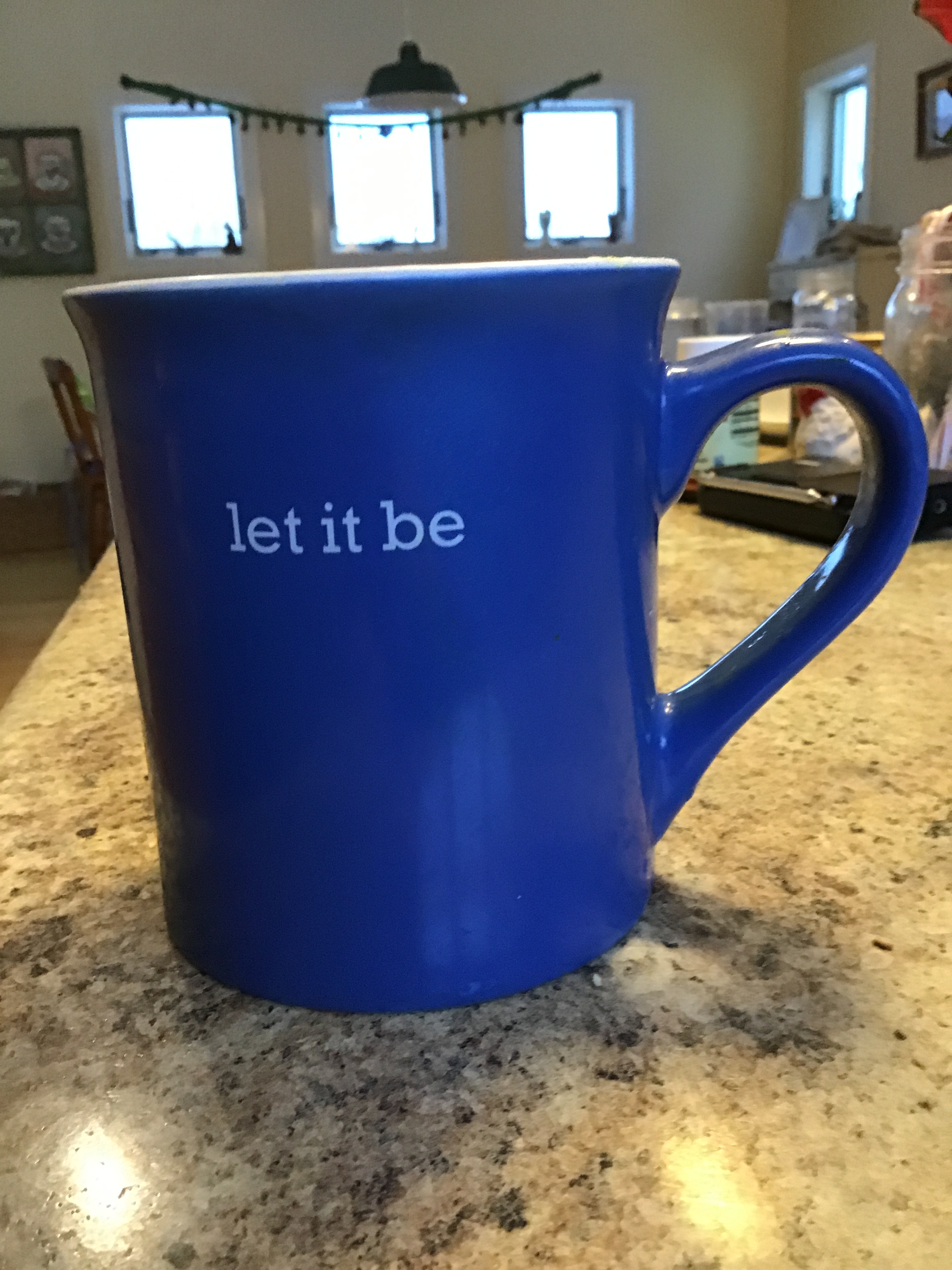
So, although I often drink my tea and coffee from an oversized mug printed with “Let It Be” (an impulse buy from the T.J. Maxx checkout line years ago), I feel a little guilty about it. This mug, I think, does not adequately express my ideology. I’m tempted to add an asterisk with “some exceptions apply.”

But this year, I gained a new outlook on “Let It Be.”

This Advent season, I’m working my way through a new-to-me devotional: the excellent God With Us, edited by Greg Pennoyer and Gregory White. In his reflection for the first Thursday of Advent, Richard John Neuhaus writes: 

To be anxious is to be human. The question is what we do with our anxieties. The decision is between hanging on to them or handing them over. After listening to the angel, Mary handed over herself, including her anxieties. ‘Behold, I am the handmaid of the Lord; let it be to me according to your word.’ That is Mary’s great fiat – ‘Let it be.’ It is not fatalism, but faith. Fatalism is resigning ourselves to the inevitable; faith is entrusting ourselves to the One who is eternally trustworthy[.] (Bold print mine.)

I let out an audible gasp after reading that paragraph. In all the times I’d read Luke 1:38 – Mary’s response to the angel’s announcement that she’s going to become Jesus’s mother – somehow I had never noticed that she actually utters the words: “Let it be.”

But as Neuhaus points out, Mary’s “Let it be” is hardly passive. Like so much else in the Bible, it’s an almost paradoxical both/and statement: Mary is submissive, but it’s an active submission. She’s agreeing to become pregnant with, give birth to, and parent God’s son, none of which is passive (as any mother will tell you.) And, as an unwed mother in 1st century Palestine, Mary’s agreement includes the real possibility of death by stoning. When Mary says, “Let it be,” what she’s really saying is, “I’m not sure I understand this crazy, scary plan, but I’m all in: Use me.”

Suddenly, my view of The Beatles’ song — and my coffee mug – was transformed. 

“The Beatles are brilliant!” I thought (stating the obvious, but with new zeal.) “Amazing! They worked a Biblical reference into a pop song that everyone thinks is a call for Zenlike detachment but is really an anthem for active participation in plans that are bigger than us! From now on, I will drink from my mug with pride!”

I figured that I surely wasn’t the only one to discern the layers of meaning behind “Let It Be,” so I decided to confirm my theory with a little internet research. 

And it turned out that I was wrong.

In interview after interview, Paul McCartney, who wrote “Let It Be,” recounts the story behind the song: At a time when he was troubled by many things (and doing too many drugs), he had a dream in which his mother, who’d died when he was an adolescent – and whose name was Mary – stood before him and said, “Let it be.”

So, my deep theological insight was deflated shortly after its revelation. 

Except that Paul McCartney has also been quick to add that, although “Let It Be” was inspired by his dream about his mother, he wants people to feel free to interpret it however they want. That seems wise to me; the longer I’m alive, the more the world appears to be made of layers of meaning. Things are not always as they seem, or as they are intended. 

A pop song may have spiritual undertones that were never meant to be there.

That life event that seems like a terrifying mistake may really be one small part of a massively awesome plan. 

A pregnant teenager may turn out to be among the most brave and holy people in history.

A light shines in the darkness, and depending upon your Bible translation, the darkness either can’t understand it or can’t overcome it — which may mean the same thing after all. 

And a baby born in a barn may grow up to save the world. 

An invitation to mourn…and hope

On Monday, November 25, 1963, all federal agencies and departments in the United States were closed. For four days, all of the commercial television networks suspended their regular programming for the first time in television history. Many schools, offices, stores, entertainment venues, and factories closed down, and those that remained open held a minute of silence. The reason? Our entire country was observing a national day of mourning proclaimed by President Johnson, following the assassination of President John F. Kennedy.

In the United States, official days of mourning are proclaimed by a sitting president in order to allow the country to grieve deaths caused by tragedy, or the deaths of former presidents. Since 1963, there have been six days of mourning for deceased presidents, although none has equaled the scale of President Kennedy’s tribute; typically, presidents are honored by flying flags at half-mast and closing federal offices. Since Kennedy’s killing, only five national days of mourning have commemorated something other than a presidential death: the assassination of Dr. Martin Luther King, Jr. (1968), the shootdown of Korean Air Lines Flight 007 (1983), the USS Stark incident (1987), the Oklahoma City bombing (1995), and the September 11 attacks (in 2001, although technically this was a “National Day of Prayer and Remembrance,” which has continued annually.) The total deaths across those five events: 3,471.

National days of mourning are not unique to the United States; almost every other country in the world holds them for similar reasons, and they may last multiple days or even months. To mourn is to express deep sorrow over a loss; when nations experience the collective loss of a leader, or of multiple lives due to a tragedy, it seems fitting – necessary, even – to set aside a time to weep. 

Which is why I hope that, at some point, we will have a national day of mourning to allow ourselves to grieve for those who have died from the Covid-19 pandemic in the United States – a number that, as I write this, stands at nearly 300,000 people. (To put this number in perspective, it’s roughly equivalent to losing every single person in the entire city of Greensboro, North Carolina– or Pittsburg, or St. Louis.)

Click here to continue reading this week’s “Faith in Vermont” column in The Addison Independent.

On Thin Ice

This Thanksgiving, I wondered whether Californians discuss their lawns the way that Vermonters discuss their heat.

When our family had recently moved to Vermont, my husband and I noticed that a certain topic never failed to arouse interest and strong opinions during gatherings with Vermonters. (This was back in the days when there were gatherings.) This topic was: How do you heat your house? 

It’s not surprising that Vermonters are fascinated by heating methods, given that some form of manmade warmth is required for comfort over half the year in Vermont. Options include fuel oil, gas, heat pumps, and wood. Discussions about heating with wood could monopolize an entire dinner party (back when there were dinner parties), with topics like: What type of woodstove do you use? Where do you get your wood? How do you stack your wood?

The topic of heating never came up in California, where we lived before moving to Vermont and where half of our extended family still lives. 

The subject of lawns arose during a virtual Thanksgiving visit over Zoom with our beloved California family members. Like many Californians, our relatives live in suburban neighborhoods in which homeowners’ associations have certain requirements about how one’s house and lawn should look. The challenge is that California has been in a drought for years, which makes it difficult to maintain a pristine green carpet in the front yard. Options include using copious amounts of water, making use of native plants, or ripping up the lawn entirely and replacing it with fake grass. (I’m not kidding about that last one.) 

Any other year, my husband and I would find it difficult to relate to a discussion of lawns. On our property, we don’t have a lawn so much as we have a yard. For much of spring and summer the yard looks green enough — except for the dead brown patches and clusters of yellow dandelions. During the growing season, my husband keeps the yard mowed, although you’ll get a better idea of what this involves when I say that he uses a brush mower to do so. And our yard resembles a relief map more than a carpet, as it’s worked over daily by chickens scratching with their feet, ducks digging with their bills, and children excavating with their shovels. 

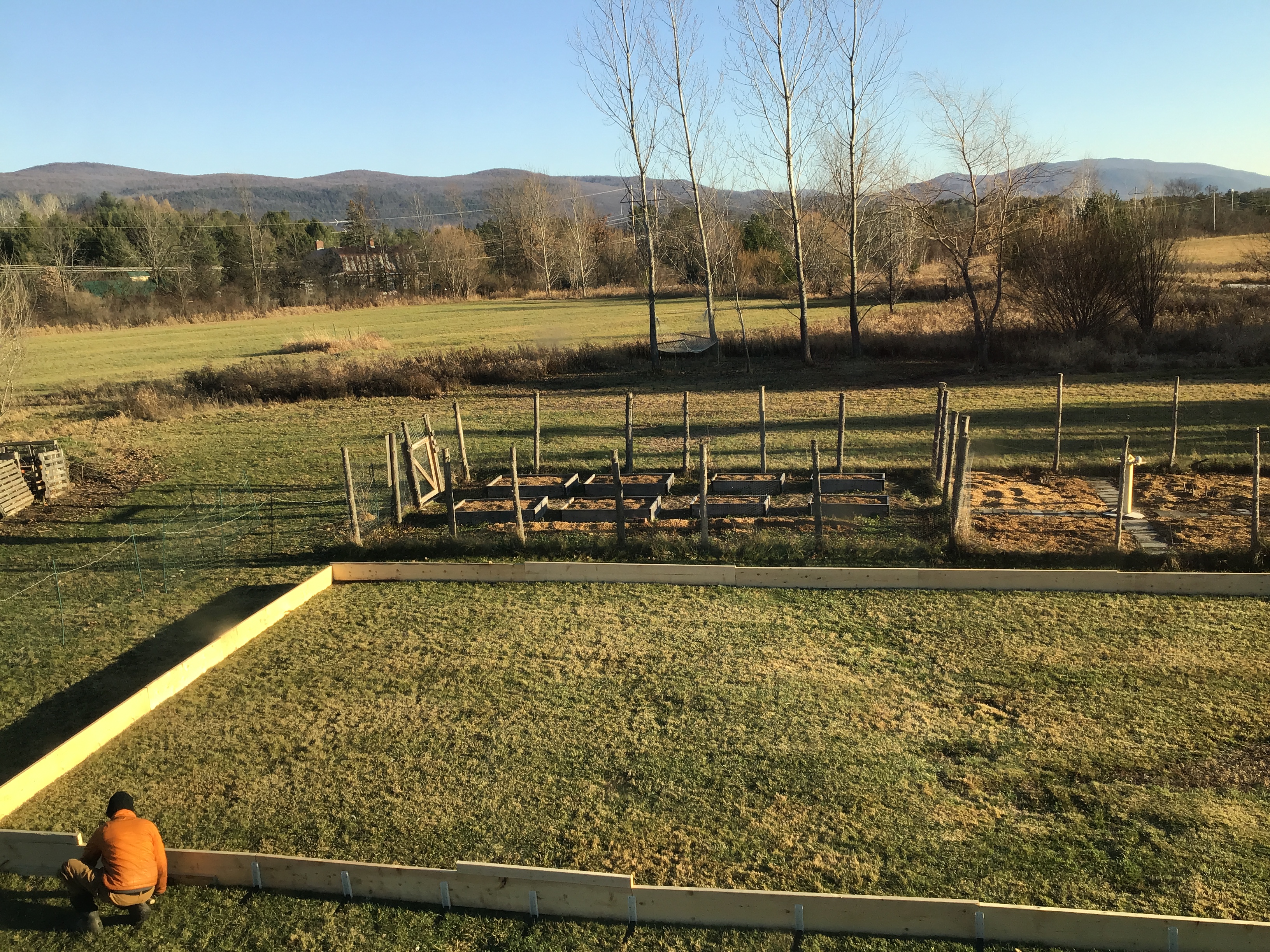
But this year my husband has spent the past few weeks on his hands and knees, studying every dip and rise of our yard, so he has something to say about lawns. The reason for this sudden interest? My husband is building an ice rink.

Click here to continue reading this week’s “Faith in Vermont” column in The Addison Independent.

Stone Soup

When I began writing this column in 2012, my vision was that it would be a space to record the observations and anecdotes of my young family as we explored our new home state of Vermont. I never expected to still be writing eight years later; given that timespan, it’s hardly surprising that the column’s focus has shifted as my family became less young and Vermont became less new. Somehow, though, I never seemed to lack enough material to generate a new biweekly column. 

Until now.

It’s stating the obvious to say that the restrictions made necessary by the COVID-19 pandemic have been challenging in many ways, for all of humanity. In my own case, it’s difficult to write a column of observations and anecdotes when my world is now limited mostly to my own house, yard, driveway, and immediate family. (Granted, my immediate family is quite pleased when I include them in columns, but I’ve become more concerned with protecting my children’s privacy.) Still, when COVID struck, I determined to make this column a place where people could find beauty and respite from the stresses of life, the ugliness of the news and social media. Nobody needs more hopelessness these days; it felt like one tiny thing I could do to write a few words that might give hope.

But I’ve rarely struggled to find hope as I have this week. This week, as the unseasonably warm weather we’d enjoyed in Vermont gave way at last to a more typical chill, grey November. This week, as COVID cases surged around the world and in Vermont, prompting Governor Phil Scott to issue a mandate prohibiting all multi-family gatherings, whether inside or out. This week, as there is still seemingly no end in sight to the tensions swirling around the 2020 Presidential election, let alone the brokenness it revealed in our nation. This week, as I carry the weight and sorrow of many friends and family members who have recently received bad news or are awaiting diagnoses. 

This week, I was not sure I could write a column worthy of putting out into the world. 

And then a friend’s eight-year-old son reminded me about Stone Soup. 

Click here to continue reading this week’s “Faith in Vermont” column in The Addison Independent.

An Election Day Reflection in Praise of Tongue-Biting

I am acutely aware that this column will be published the day before Election Day. There are intense emotions swirling around November 3, 2020: an election that falls during a year of pandemic, wildfires, protests over systemic racism, and a country bitterly divided along partisan lines. Reflecting on the United States in 1967, Joan Didion wrote, “The center was not holding.” Reflecting on the United States in 2020, I ask, “Is there a center anymore, and can anybody find it?!?”

After the 2016 election, I wrote my opinion about the state of the nation. At the time, I felt an obligation – as someone who works with words – to make a statement, to add my response. If you’ve consumed any news or been on social media lately, it’s clear that now almost everybody feels this obligation. 

But I no longer do, so today I am writing about the often-underrated value of silence. 

By silence, I mean: no words, either spoken or written.

Wordlessness might seem like an odd thing for me to embrace. I am a writer. I live in a house that is full of noise and lively discussion all the time. We are a family that reads, and reads out loud, then reads some more, because individuals and cultures are formed by story. I believe wholeheartedly in the value of teaching my children written and spoken expression. If you give me money, I will buy books (or, occasionally, bookshelves.) I inhale and exhale words. 

But there can be too much of a good thing: too much chocolate, too much exercise, too much vacation. And at this point in time, there are too many words.

Click here to continue reading this week’s “Faith in Vermont” column in The Addison Independent.

A Geese-Eye View

My daughters began digging the hole on the first weekend of October. 

The large window over our kitchen sink is my window on the world – or the world of our backyard, at least. It was from this vantage point that I spotted three of my daughters hard at work with shovels on a Friday afternoon, clustered around a growing pile of dirt right in the middle of the yard.

“What are you doing?” I called out the back door.

“We’re digging a hole!” they shouted back.

“Couldn’t you have picked a less central place to dig it?” I asked.

“Daddy said it was okay!”

And that was that.

Click here to continue reading this week’s “Faith in Vermont” column in The Addison Independent.

summer of the wasps

Summer is now firmly behind us. It’s the time of year when I like to snuggle up in my fall uniform (jeans and a flannel shirt) with a cup of tea (I’m weaning myself from coffee after finally admitting that it affects my digestion — because why wouldn’t you give up coffee when you’re parenting a tween, a newly crawling baby, and three children in between? But that’s a subject for another column….) As the golden light of a crisp afternoon filters through the Vermont foliage, I’m contemplating the summer that just passed.

Our family’s summer was marked by the COVID-19 pandemic, political turmoil, gratitude for our newly installed heat pumps, afternoons spent in our inflatable pool, and the animated series Avatar: The Last Airbender (referred to in our house as “the show that saved summer.”) But the thing that most defined our Summer 2020 was: wasps.

Click here to continue reading this week’s “Faith in Vermont” column in The Addison Independent.

A tale of two roosters

Fall has arrived suddenly and dramatically in Vermont, with plunging temperatures and nighttime frosts. This shouldn’t have surprised, me, as this has hardly been a year of subtlety; nothing seems to have happened “just a little” in 2020. 

But whether we tumble into it headlong or ease into it gradually, fall is always a season of change. This change is evident in the weather and the leaves, but also in our lifestyles. Children are heading back to school, which this year is a bigger change than usual for most families as they adjust to remote learning or virtual/in-person hybrid arrangements. In my family, fall marks the start of field hockey season – the one athletic activity that has ever gripped my bookish, artsy brood – so four afternoons a week I am shuttling (masked) girls to practices with the town’s youth program or at the middle school. And fall means that our local apple orchard is open again, which adds a weekly errand to pick up fresh apples, cider, and cider doughnuts. 

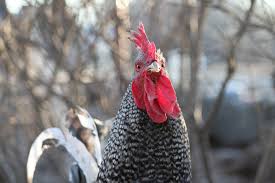
There’s another change at my house this fall: We’ve got a new rooster. 

Cluck — er, CLICK — here to continue reading the latest “Faith in Vermont” in this week’s Addison Independent.

Like Little Children

I have a confession to make: With five children in our family, I can no longer remember important individual milestones. Were you to ask me at what ages each of my children walked, talked, cut their first tooth, I couldn’t say. I could give you a range, which would be, “Somewhere between the ages of birth and two.” 

I love my children deeply for the individuals that they are; ask me today about their personalities and tastes, and I’ll tell you in detail. But past details have all receded into the fog of thirteen years of sleep deprivation. I cannot recall my fourth child’s first word, what everyone wore for Halloween two years ago, and I have difficulty remembering everyone’s current shoe size. 

I mention this to give you a sense of how significant it is that, over the past month, three of my daughters said things that I felt compelled to record in my journal so that I wouldn’t forget. 

Click here to continue reading this week’s “Faith in Vermont” column in The Addison Independent.

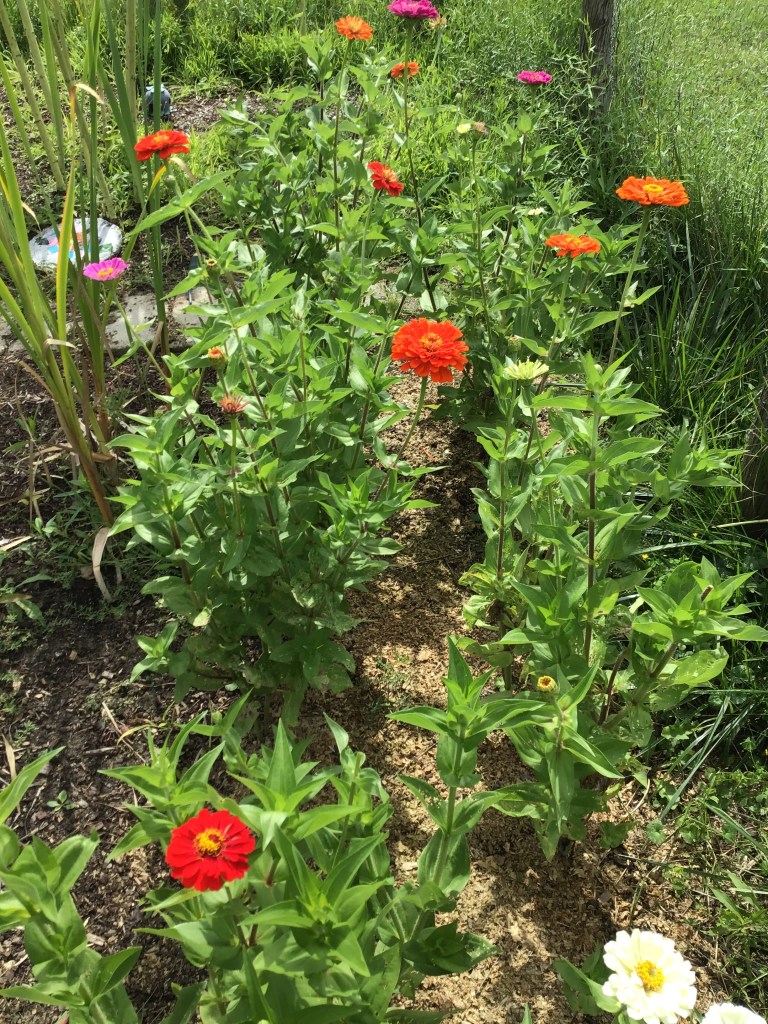
Mushrooms, Zinnias, and Changing Minds

The baby is beginning to have strong opinions. 

At the moment, his preferences manifest themselves most in the matter of food. For the first four months of his life, for a variety of health reasons, he subsisted upon a pre-digested infant formula called Nutramigen. If the words “pre-digested” make you shudder, let me assure you that this concoction smells like something you’d find in the dark recesses of a dairy barn.

But the baby didn’t complain. He gulped down the formula happily at every meal. His sisters held their noses and carried him at arm’s length, but he didn’t care that he smelled like he’d just crawled out from under a log. 

Then we started “solid foods,” which are really liquefied versions of actual foods like sweet potatoes, pears, and green beans. As far as the baby was concerned, these were all excellent additions to the Nutramigen. Beyond eating applesauce and carrots with a bit more gusto than asparagus, he didn’t show much preference between foods; it was all good.

Until he discovered watermelon. 

Click here to continue reading this week’s “Faith in Vermont” column in The Addison Independent.